

Building the Field of Health Policy and Systems Research: Framing the Questions
Open accessThe DOI matches its Crossref record; 26 of the 26 references it cites were found in a registry or an index.
Abstract
The Policy Forum allows health policy makers around the world to discuss challenges and
Overview
The claims and statistics of this paper haven’t been checked yet.
Free: it reads the open-access text and checks the first 5 claims that cite a source we can check. Create a free account to check every claim.
Integrity signals
Registry
Cites
Statistics
Figures
Verification
Claims the paper makes
The claims and statistics of this paper haven’t been checked yet.
Free: it reads the open-access text and checks the first 5 claims that cite a source we can check. Create a free account to check every claim.
Claims other papers make about this one
Each is checked against this paper’s own text: does it say what the citing paper says it does?
The source backs part of the claim, not all of it — or backs it for a different population, condition or comparison.
In the citing paper
“The formal establishment of a Mental Health Desk facilitated coordination across fragmented administrative units and enhanced the visibility of mental health within routine planning processes, consistent with governance theories emphasizing institutional legitimacy and bureaucratic alignment (Sheikh et al. 2011).”
From Government-led scale-up of task-shifted mental health services in Lagos State, Nigeria: a mixed-methods descriptive-explanatory case study (2026) · cites this paper as Sheikh et al. 2011
Experimental — accuracy not yet measuredThe source backs part of the claim, not all of it — or backs it for a different population, condition or comparison.
In the citing paper
“Disentangling the relative contributions of project facilitation, senior political commitment, and ambient health sector dynamics remains inherently difficult in embedded implementation research, where the programme and the system it seeks to change are not cleanly separable (Sheikh et al. 2011).”
From Government-led scale-up of task-shifted mental health services in Lagos State, Nigeria: a mixed-methods descriptive-explanatory case study (2026) · cites this paper as Sheikh et al. 2011
Experimental — accuracy not yet measuredThe source backs part of the claim, not all of it — or backs it for a different population, condition or comparison.
In the citing paper
“Variability in execution, continued dependence on individual champions, procurement delays, and fiscal uncertainty underscore the uneven nature of embedding, consistent with observations from other LMIC health system strengthening efforts (Sheikh et al. 2011).”
From Government-led scale-up of task-shifted mental health services in Lagos State, Nigeria: a mixed-methods descriptive-explanatory case study (2026) · cites this paper as Sheikh et al. 2011
Experimental — accuracy not yet measured
Self-check
Percentages, sums and reported differences re-computed from the paper’s own numbers.
The self-check needs the paper’s full text.
Citations
Cites
Reforming the health sector in developing countries: the central role of policy analysis
WALT, G., & GILSON, L. (1994) · Health Policy and Planning · doi:10.1093/heapol/9.4.353 · Cited by 1,439 · cited 1×
“Increasingly, however, it has been understood to encompass, importantly, the processes of decision-making at all levels of the health system and the wider influences that underpin the prioritisation of policy issues, the formulation of policy, the processes of bringing them alive in practice, and their evaluation [3].”
BackgroundSelf-citationTrust and the development of health care as a social institution
Gilson, L. (2003) · Social Science & Medicine · doi:10.1016/s0277-9536(02)00142-9 · Cited by 1,193
Self-citationSystems thinking for health systems strengthening.
de Savigny, D., & Adam, T. (2009) · Cited by 1,074
Limits to Medicine: Medical Nemesis: The Expropriation of Health
Illich, I. (1976) · Equinox Publishing eBooks · doi:10.1558/isbn.9780714521206 · Cited by 820
Health literacy: addressing the health and education divide
Kickbusch, I. S. (2001) · Health Promotion International · doi:10.1093/heapro/16.3.289 · Cited by 750
Sundquist, J. L. (1973) · Political Science Quarterly · doi:10.2307/2148170 · Cited by 472
(1981) · Cited by 378
Accounting for EBM: Notions of evidence in medicine
Lambert, H. (2006) · Social Science & Medicine · doi:10.1016/j.socscimed.2005.11.023 · Cited by 320
Building the Field of Health Policy and Systems Research: Social Science Matters
Gilson, L., Hanson, K., Sheikh, K., Agyepong, I. A., Ssengooba, F., & Bennett, S. (2011) · PLoS Medicine · doi:10.1371/journal.pmed.1001079 · Cited by 319
Self-citationLimits to medicine. Medical nemesis: the expropriation of health
Smith, R. (2003) · Journal of Epidemiology and Community Health · doi:10.1136/jech.57.12.928 · Cited by 280
Cited by
Items 101–200 of 484
Postings and transfers in the Ghanaian health system: a study of health workforce governance
Kwamie, A., Asiamah, M., Schaaf, M., & Agyepong, I. A. (2017) · International Journal for Equity in Health · doi:10.1186/s12939-017-0583-1 · Cited by 44
“the ideas and interests, norms and values, power and relations) [38] which oil the ongoing negotiations of postings and transfers.”
BackgroundSelf-citationNandi, S., & Schneider, H. M. (2020) · Health Research Policy and Systems · doi:10.1186/s12961-020-00555-3 · Cited by 46
Greenley, R., Bell, S., Rigby, S., Legood, R., Kirkby, V., & McKee, M. (2023) · Frontiers in Public Health · doi:10.3389/fpubh.2023.1144674 · Cited by 45
“To facilitate the use of our findings to inform policy, we structure the different issues into the level of the health system at which they arise and can best be addressed (19) including the health system level (macro level), the screening program level (meso level) and the individual/community level (micro level).”
MethodExamining health sector stakeholder perceptions on the efficiency of county health systems in Kenya
Nyawira, L., Mbau, R., Jemutai, J., Musiega, A., Hanson, K., Molyneux, S. C., Normand, C. E. M., Tsofa, B., Maina, I., Mulwa, A., et al. (2021) · PLOS Global Public Health · doi:10.1371/journal.pgph.0000077 · Cited by 40
Self-citationBuilding institutions for health and health systems in contexts of rapid change
Bloom, G., & Wolcott, S. J. (2012) · Social Science & Medicine · doi:10.1016/j.socscimed.2012.12.014 · Cited by 46
Rover, M. R. M., Faraco, E. B., Vargas-Peláez, C. M., Colussi, C. F., Storpirtis, S., Farías, M. R., & Leite, S. N. (2021) · Ciência & Saúde Coletiva · doi:10.1590/1413-812320212611.27402020 · Cited by 50
Abrahams, N., Gilson, L., Levitt, N. S., & Dave, J. A. (2019) · BMC Endocrine Disorders · doi:10.1186/s12902-019-0465-1 · Cited by 37
Self-citationCorbaz-Kurth, S., Juvet, T. M., Benzakour, L., Cereghetti, S., Fournier, C.-A., Moullec, G., Nguyen, A., Suard, J.-C., Vieux, L., Wozniak, H., et al. (2022) · Safety Science · doi:10.1016/j.ssci.2022.105879 · Cited by 39
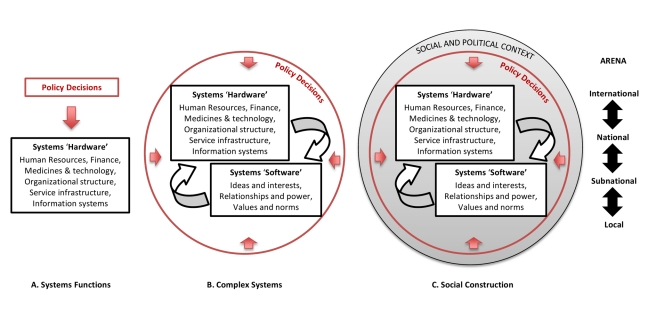
“Hardware includes the system’s physical and organisational infrastructure, products, resources, services and finances (Sheikh et al., 2011).”
BackgroundColombini, M., Mayhew, S., García‐Moreno, C., d’Oliveira, A. F. P. L., Feder, G. S., & Bacchus, L. (2022) · BMC Health Services Research · doi:10.1186/s12913-022-08826-1 · Cited by 36
“These are as important as the more tangible resources commonly measured such as organisational policy, legal and material resources and structures such as infrastructure, supplies, management information systems, and financing [55].”
BackgroundMathole, T., Lembani, M., Jackson, D. J., Zarowsky, C., Bijlmakers, L. A., & Sanders, D. M. (2018) · Health Policy and Planning · doi:10.1093/heapol/czx174 · Cited by 42
“Leadership in health care settings involves decision-making for complex systems comprising both the hardware (human resources, finances, medicines and technology, organizational structures, service infrastructure and information systems) and the software aspects (ideas, interests, interrelationships, trust, power, val…”
BackgroundKielmann, K., Hutchinson, E., & MacGregor, H. (2022) · Social Science & Medicine · doi:10.1016/j.socscimed.2022.114838 · Cited by 36
Peterson, H. B., Haidar, J., Merialdi, M., Say, L., Gülmezoglu, A. M., Fajans, P., Mbizvo, M. T., Ghaffar, A., Tran, N. T., de Bernis, L., et al. (2012) · Obstetrics and Gynecology · doi:10.1097/aog.0b013e3182632cc1 · Cited by 36
Okello, G. R., Molyneux, S. C., Zakayo, S. M., Gerrets, R. P., & Jones, C. H. D. (2019) · Malaria Journal · doi:10.1186/s12936-019-3061-y · Cited by 36
George, A. S., LeFevre, A. E., Jacobs, T., Kinney, M. V., Buse, K., Chopra, M., Daelmans, B. M. E. G., Haakenstad, A., Huicho, L., Khosla, R., et al. (2019) · BMJ Global Health · doi:10.1136/bmjgh-2018-001316 · Cited by 35
“We use digital health to illustrate health systems dynamics relevant to governance at micro (individual level), maternal and perinatal death surveillance and response (MPDSR) to highlight facility-level meso (organisational level) dynamics, and multisectoral action for adolescent health for macro (structural level) dy…”
MethodSajjad, S. R., & Qureshi, M. O. (2018) · International Journal of Healthcare Management · doi:10.1080/20479700.2018.1433459 · Cited by 46
The ethics of health systems research in low- and middle-income countries: A call to action
Hyder, A. A., Pratt, B., Ali, J., KASS, N. E., & Sewankambo, N. K. (2014) · Global Public Health · doi:10.1080/17441692.2014.931998 · Cited by 36
“…Francis Thus far, the geographical focus of HSR has primarily been LMICs, though it can and has been performed in high-income countries (Gilson, 2012; Sheikh et al., 2011).2 Renewed attention to health systems in LMICs appears to have emerged strongly between 2000 and 2005, with influential…”
BackgroundMethodConsumers' Perspectives on National Health Insurance in South Africa: Using a Mobile Health Approach
Weimann, E., & Stuttaford, M. C. (2014) · JMIR mhealth and uhealth · doi:10.2196/mhealth.3533 · Cited by 37
“This is because the building blocks provide an outline for the “hardware” but not for the “software” required to apply ideas and interests, relationships and power, norms [47], values, and human rights to the strengthening process [48].”
Molyneux, S. C., Tsofa, B., Barasa, E., Nyikuri, M., Waweru, E., Goodman, C. A., & Gilson, L. (2016) · Developing World Bioethics · doi:10.1111/dewb.12130 · Cited by 33
Self-citationElmusharaf, K., Byrne, E., Manandhar, M., Hemmings, J., & O’Donovan, D. T. (2016) · Qualitative Health Research · doi:10.1177/1049732316673975 · Cited by 43
“The PEER approach was chosen to address the scarcity of bottom-up, health system research approaches in such settings (Sheikh et al., 2011).”
Announcing the Lancet Global Health Commission on medical oxygen security
Kitutu, F. E., Rahman, A. E., Graham, H., King, C., Arifeen, S. E., Ssengooba, F., Greenslade, L., & Mullan, Z. (2022) · The Lancet Global Health · doi:10.1016/s2214-109x(22)00407-7 · Cited by 31
Self-citationHealth systems guidance appraisal—a critical interpretive synthesis
on behalf of the AGREE-HS Team, Ako-Arrey, D. E., Brouwers, M. C., Lavis, J. N., & Giacomini, M. K. (2015) · Implementation Science · doi:10.1186/s13012-016-0373-y · Cited by 35
“[92] Building the field of health policy and systems research: framing the questions Public Health Foundation of India / India This paper discusses the state-of-the-art in Health Policy and Systems Research (HPSR), addresses the current challenges and opportunities for the field, and lays out what is needed to build c…”
BackgroundSriram, V. M., Baru, R. V., & Bennett, S. (2018) · Health Policy and Planning · doi:10.1093/heapol/czy055 · Cited by 33
Self-citationThe role of leadership in people-centred health systems: a sub-national study in The Gambia
Chigudu, S., Jasseh, M., D’Alessandro, U., Corrah, T., Demba, A., & Balen, J. (2014) · Health Policy and Planning · doi:10.1093/heapol/czu078 · Cited by 37
“The post-millennial era ushered in an unprecedented level of attention to the role of health systems in improving global health (Sheikh et al. 2011).”
BackgroundUzochukwu, B. S. C., Mbachu, C. O., Onwujekwe, O. E., Okwuosa, C., Etiaba, E., Nyström, M. E., & Gilson, L. (2016) · Health Research Policy and Systems · doi:10.1186/s12961-016-0083-6 · Cited by 34
“acity development interventions that are tailored to the needs of different entrants in HPSR+A and address the disciplinary diversity need to be developed while still maintaining the scientific foundations of HPSR+A [9, 13].”
BackgroundInfluentialSelf-citationTadesse, A. W., Gurmu, K. K., Kebede, S. T., & Habtemariam, M. K. (2021) · Globalization and Health · doi:10.1186/s12992-021-00702-7 · Cited by 34
“These values and principles have played a significant role in the creation of synergies between the three global health agenda [2, 18].”
BackgroundCometto, G., Samuel, A., Geta, A., Kifle, M., Tunçalp, Ö., Syed, S. B., Kleine-Bingham, M., Nyoni, J., & Ajuebor, O. (2022) · BMJ Global Health · doi:10.1136/bmjgh-2021-008007 · Cited by 31
“36 An integrated approach at these three levels can help mitigate the drivers of mistreatment, improve the CRC policy environment and community awareness on rights.”
BackgroundMichael Lipsky, Street-Level Bureaucracy: Dilemmas of the Individual in Public Service
Gilson, L. L. (2016) · Oxford University Press eBooks · doi:10.1093/oxfordhb/9780199646135.013.19 · Cited by 49
Self-citationImplementation research in LMICs—evolution through innovation
Sheikh, K., Hargreaves, J., Khan, M. S., & Mounier‐Jack, S. (2020) · Health Policy and Planning · doi:10.1093/heapol/czaa118 · Cited by 30
“Key questions range from the normative and evaluative to explanatory and even exploratory in nature (Sheikh et al., 2011).”
BackgroundSelf-citationNasir, N., Molyneux, S. C., Were, F., Aderoba, A. K., & Fuller, S. (2023) · BMJ Global Health · doi:10.1136/bmjgh-2023-012308 · Cited by 34
Srinivas, P. N., Seshadri, T., Velho, N., Babu, G. R., Madegowda, C., Basappa, Y. C., Narasimhamurti, N. S., Majgi, S. M., Madhusudan, M. D., & Marchal, B. (2019) · Wellcome Open Research · doi:10.12688/wellcomeopenres.15549.1 · Cited by 30
The potential of digital molecular diagnostics for infectious diseases in sub-Saharan Africa
The Digital Diagnostics for Africa Network (2022) · PLOS Digital Health · doi:10.1371/journal.pdig.0000064 · Cited by 35
Ahmad, R., Zhu, N., Lebcir, R., & Atun, R. A. (2019) · BMJ Global Health · doi:10.1136/bmjgh-2018-001242 · Cited by 32
“The application of new research methodologies drawing on diverse disciplinary perspectives as demonstrated here has the potential for operational, implementation and health systems research relevant for decision-making at the national and international levels.(38)”
MethodErasmus, E., Gilson, L., Govender, V., & Nkosi, M. (2017) · International Journal for Equity in Health · doi:10.1186/s12939-017-0659-y · Cited by 37
“Against the background of these current global debates, this paper addresses a common question asked by health policymakers, managers and researchers: why are policies often implemented in ways that diverge from policy objectives and intended changes? [4, 5, 9, 10, 11].”
BackgroundSelf-citationRover, M. R. M., Vargas-Peláez, C. M., Farías, M. R., & Leite, S. N. (2016) · Physis Revista de Saúde Coletiva · doi:10.1590/s0103-73312016000200017 · Cited by 27
Managing health care in the digital world: A comparative analysis
Cucciniello, M., Lapsley, I., & Nasi, G. (2016) · Health Services Management Research · doi:10.1177/0951484816674032 · Cited by 38
“While the effects of technological innovation on organizational performance have been studied in many sectors of the economy, there is a shortage of evidence as to the impacts of EMRs in the healthcare sector.(8,9) Recent analyses of existing research in this area conclude that human and organizational factors are as…”
BackgroundWhat constitutes responsiveness of physicians: A qualitative study in rural Bangladesh
Joarder, T., George, A. S., Ahmed, S. M., Rashid, S. F., & Sarker, M. (2017) · PLoS ONE · doi:10.1371/journal.pone.0189962 · Cited by 27
D’Ambruoso, L., van der Merwe, M., Wariri, O., Byass, P., Goosen, G., Kahn, K., Masinga, S., Mokoena, V., Spies, B., Tollman, S. M., et al. (2019) · Health Policy and Planning · doi:10.1093/heapol/czz047 · Cited by 33
“HPSR is an interdisciplinary and problem-oriented, prioritizing research conducted with and for policy stakeholders negotiating solutions to health systems issues and establishing a nexus between providers and socially excluded groups (Gilson et al., 2011; Sheikh et al., 2011; Gilson, 2012).”
Systems approaches to public service delivery: methods and frameworks
Mansoor, Z., & Williams, M. J. (2023) · Journal of Public Policy · doi:10.1017/s0143814x23000405 · Cited by 30
“Second, some systems researchers emphasize that service delivery is not only complicated (in the sense of involving many moving parts) but also complex (in the sense of possessing dynamics that are non-linear and/or fundamentally unpredictable) (Sheikh et al. 2011; Snyder 2013).”
InfluentialErasmus, E., Lehmann, U., Agyepong, I. A., Alwar, J., de Savigny, D., Kamuzora, P., Mirzoev, T. N., Nxumalo, N., Tomson, G. B., Uzochukwu, B. S. C., et al. (2016) · Health Research Policy and Systems · doi:10.1186/s12961-016-0097-0 · Cited by 26
“The last 5–10 years have seen significant international momentum build around the field of health policy and systems research and analysis (HPSR + A) [1, 2], including greater consensus on definition and boundaries, the formation of Health Systems Global and three global symposia for sharing experiences in the field.”
BackgroundSelf-citationDarmstadt, G. L., Weng, Y., Pepper, K. T., Ward, V. C., Mehta, K. M., Borkum, E., Bentley, J., Raheel, H., Rangarajan, A., Bhattacharya, D., et al. (2020) · Journal of Global Health · doi:10.7189/jogh.10.0201002 · Cited by 27
van Niekerk, L., Bautista-Gómez, M. M., Msiska, B. K., Mier-Alpaño, J. D., Ongkeko, A. M., & Manderson, L. H. (2023) · BMC Public Health · doi:10.1186/s12889-022-14451-8 · Cited by 26
“Background In recent times the conceptualization of health systems has evolved, from initially being regarded through a narrow, reductionist lens as comprised of ‘system hardware’ components, to include a greater awareness of and sensitivity to the role of human choice, ingenuity and ‘system software’ such as relation…”
BackgroundHealth system governance assessment in protracted crisis settings: Northwest Syria
Alaref, M., Al-Abdulla, O., Alzoubi, Z., Alkhalil, M., & Ekzayez, A. (2023) · Health Research Policy and Systems · doi:10.1186/s12961-023-01042-1 · Cited by 26
“Software refers to the quantifiable components of health systems, such as the goals and interests, values and norms, relations between the different actors, and power [38].”
BackgroundHuman resources for health: a framework synthesis to put health workers at the centre of healthcare
Nwankwo, O., Auer, C., Oyo-Ita, A. E., Eyers, J. E., Wyss, K., Fink, G., & Bosch‐Capblanch, X. (2024) · BMJ Global Health · doi:10.1136/bmjgh-2023-014556 · Cited by 32
“39 42 This concept acknowledges that the behaviours and decisions of people are underpinned by their ‘worlds’ or lived realities, 39 43 which can be appreciated and realigned in favour of broader health system goals.”
Ward, C., Phiri, E., Goodman, C. A., Mipando, A. L. N., Malata, M. P., Manda, W. C., Mwapasa, V., & Powell‐Jackson, T. (2024) · Health Policy and Planning · doi:10.1093/heapol/czae112 · Cited by 30
Schneider, H. M., van der Merwe, M., Marutla, B., Cupido, J., & Kauchali, S. (2019) · Health Policy and Planning · doi:10.1093/heapol/czz060 · Cited by 24
“Successful strategies operate at two levels: the formal and informal; the official and unofficial; system hardware and software (Sheikh et al., 2011).”
BackgroundJesus, T. S., Hoenig, H., & Landry, M. D. (2020) · International Journal of Environmental Research and Public Health · doi:10.3390/ijerph17030965 · Cited by 25
Onwujekwe, O. E., Mbachu, C. O., Etiaba, E., Ezumah, N., Ezenwaka, U., Arize, I., Okeke, C. C., Nwankwor, C. A., & Uzochukwu, B. S. C. (2020) · Implementation Science · doi:10.1186/s13012-020-00987-z · Cited by 24
Alhassan, Y. N., Twimukye, A., Malaba, T. R., Orrell, C., Myer, L., Waitt, C. J., Lamorde, M., Kambugu, A., Reynolds, H. E., Khoo, S., et al. (2020) · BMC Health Services Research · doi:10.1186/s12913-020-05580-0 · Cited by 24
“by the transition to focus our investigation [17, 18].”
BackgroundOliwa, J. N., Nzinga, J., Masini, E., van Hensbroek, M. B., Jones, C. O. H., English, M., & Hoog, A. H. V. (2020) · Implementation Science · doi:10.1186/s13012-020-01061-4 · Cited by 27
Kielmann, K., Dickson-Hall, L., Jassat, W., Roux, S. L., Moshabela, M., Cox, H. S., Grant, A. D., Loveday, M., Hill, J., Nicol, M. P., et al. (2021) · Health Policy and Planning · doi:10.1093/heapol/czaa147 · Cited by 26
“Our aim is to highlight the neglected role of actors’ behaviours and interactions—often referred to as ‘software’ (Sheikh et al., 2011)—in assessments of health systems ‘readiness’.”
BackgroundButler, N., Johnson, G. A., Chiweza, A. L., Aung, K. M., Quinley, J., Rogers, K., & Bedford, J. (2020) · BMC Health Services Research · doi:10.1186/s12913-020-05394-0 · Cited by 24
Holtrop, J. S., Potworowski, G. A., Green, L. A., & Fetters, M. D. (2016) · Journal of Mixed Methods Research · doi:10.1177/1558689816668689 · Cited by 26
Anthropologies of Global Maternal and Reproductive Health: From Policy Spaces to Sites of Practice
Wallace, L. J., MacDonald, M. E., & Storeng, K. T. (2022) · Global maternal and child health · doi:10.1007/978-3-030-84514-8 · Cited by 27
Loohuis, K. M. O., de Kok, B. C., Bruner, W. S., Jonker, A., Salia, E. L., Tunçalp, Ö., Portela, A. G., Mehrtash, H., Grobbee, D. E., Srofeneyoh, E., et al. (2023) · PLOS Global Public Health · doi:10.1371/journal.pgph.0002449 · Cited by 33
English, M., Gathara, D., Nzinga, J., Kumar, P. A., Were, F., Warfa, O., Tallam-Kimaiyo, E., Nandili, M., Obengo, A., Abuya, N., et al. (2020) · BMJ Global Health · doi:10.1136/bmjgh-2019-001937 · Cited by 25
‘Population self-reliance in health’ and COVID-19: The need for a 4th tier in the health system
Mathpati, M. M., Payyappallimana, U., Shankar, D., & Porter, J. (2020) · Journal of Ayurveda and Integrative Medicine · doi:10.1016/j.jaim.2020.09.003 · Cited by 26
What is context in knowledge translation? Results of a systematic scoping review
Schmitt, T., Czabanowska, K., & Schröder‐Bäck, P. (2024) · Health Research Policy and Systems · doi:10.1186/s12961-024-01143-5 · Cited by 24
Ackatia-Armah, N. M., Addy, N. A., Ghosh, S. A., & Dubé, L. (2016) · Social Science & Medicine · doi:10.1016/j.socscimed.2016.03.038 · Cited by 26
“To develop strategies for preventive health that potentially strengthen health systems, researchers in public health and human behavior have noted the need for a deeper understanding of the relationships and interactions between nurses and the communities they serve (Gilson, 2003; Sheikh et al., 2011).”
BackgroundPosting and transfer: key to fostering trust in government health services
Sheikh, K., Freedman, L. P., Ghaffar, A., Marchal, B., El‐Jardali, F., McCaffery, J., de Sardan, J. O., Poz, M. R. D., Flores, W., Garimella, S., et al. (2015) · Human Resources for Health · doi:10.1186/s12960-015-0080-9 · Cited by 22
Self-citationNachtnebel, M., O'Mahony, A., Pillai, N., & Hort, K. (2015) · Social Science & Medicine · doi:10.1016/j.socscimed.2015.05.021 · Cited by 21
Singh, N., Blanchard, A. K., Blencowe, H. K., Koon, A. D., Boerma, T., Sharma, S., & Campbell, O. M. R. (2021) · Health Policy and Planning · doi:10.1093/heapol/czab148 · Cited by 26
“There has also been more emphasis on the socio-political contexts and particularly social construction of policy-making and health systems’ software and hardware, which influence each other within socio-political spheres (van Olmen et al., 2012; Sheikh et al., 2011).”
BackgroundInfluentialNambiar, D., & Sheikh, K. (2016) · Health Systems & Reform · doi:10.1080/23288604.2016.1148802 · Cited by 23
Self-citationTowards an Explanation of the Social Value of Health Systems: An Interpretive Synthesis
Whyle, E. B., & Olivier, J. (2020) · International Journal of Health Policy and Management · doi:10.34172/ijhpm.2020.159 · Cited by 22
Topp, S. M., & Chipukuma, J. M. (2016) · BMJ Global Health · doi:10.1136/bmjgh-2016-000179 · Cited by 21
“Handling editor Valery Ridde.”
Mureithi, L., Burnett, J. M., Bertscher, A., & English, R. (2018) · International Journal for Equity in Health · doi:10.1186/s12939-018-0830-0 · Cited by 19
Orgill, M., Marchal, B., Shung-King, M., Sikuza, L., & Gilson, L. (2021) · BMC Public Health · doi:10.1186/s12889-021-10546-w · Cited by 22
Self-citationAccess to medicines in Latin America and the Caribbean (LAC): a scoping study
Emmerick, I. C. M., Oliveira, M. A., Luiza, V. L., Azeredo, T. B., & Bigdeli, M. (2013) · BMJ Open · doi:10.1136/bmjopen-2012-002224 · Cited by 21
“27 28 The proportion of studies using mixed-methods may demonstrate the complexity of ATM issues, within the broader HPSR fi eld, referred by Gilson et al 27 and Sheikh et al 28 who demand for interdisciplinary developments and a wide spectrum of methodologies.”
BackgroundBradley, H., Lehmann, U., & Butler, N. (2015) · Human Resources for Health · doi:10.1186/s12960-015-0081-8 · Cited by 23
“Mintzberg similarly identified cognitive competencies as essential for leaders and managers, and this aligns with recent healthsystem-strengthening initiatives highlighting the building of systems “software”, in addition to “hardware”, as critical for organizational performance [43].”
BackgroundTopp, S. M., Chetty-Makkan, C. M., Smith, H., Chimoyi, L., Hoffmann, C. J., Fielding, K., Reid, S. E., Olivier, A. J., Hausler, H., Herce, M. E., et al. (2019) · Global Health Science and Practice · doi:10.9745/ghsp-d-19-00051 · Cited by 20
“Health system software comprises the interests, values, relationships, and practicebased norms of the human stakeholders whose decisions and actions bring the health system to life.(15) Critically, in health system analyses, recognition of the values, beliefs, and relationships of service users (clients and/or patient…”
BackgroundMethodEl‐Jardali, F., Saleh, S. S., Khodor, R., Rub, R. A. A., Arfa, C., Romdhane, H. B., & Hamadeh, R. R. (2015) · Health Research Policy and Systems · doi:10.1186/s12961-015-0032-9 · Cited by 18
“In that same year, the ministerial meetings in Mexico City announced the importance of research for improved health and related systems [2].”
BackgroundKarim, A., Muñoz, D. C., Mäusezahl, D., & de Savigny, D. (2020) · Global Health Action · doi:10.1080/16549716.2020.1794106 · Cited by 19
“The Hardware-Software Framework developed by Sheikh et al. (2011) posits that it is not just the ‘Hardware’ of a system – i.e. its structure, financing schemes, commodities, human resources, service delivery mechanisms, among other tangible factors- but its interplay with the system’s ‘Software’-…”
BackgroundMyburgh, H., Reynolds, L., Hoddinott, G., van Aswegen, D., Grobbelaar, N., Gunst, C., Jennings, K., Kruger, J., Louis, F., Mubekapi-Musadaidzwa, C., et al. (2020) · Health Policy and Planning · doi:10.1093/heapol/czaa094 · Cited by 19
“As such, in our framework, we distinguish between health systems infrastructure or ‘hardware’ and the relational aspects of health systems or its ‘software’ (Sheikh et al., 2011), to allow for the fact that many studies of health systems do not effectively account for the relational.”
BackgroundMethodMacDonald, M. (2022) · Global maternal and child health · doi:10.1007/978-3-030-84514-8_6 · Cited by 23
“Critical global health scholarship shares much in common with the health policy and systems research (HPSR) agenda defined by Sheikh and colleagues (Sheikh et al., 2011) in terms of its attention to wider influences and micro processes that shape the multiple levels of policy decisions and practices and sees them as n…”
BackgroundHow to work with intangible software in public health systems: some experiences from India
Ramani, S., Parashar, R., Roy, N., Kullu, A., Gaitonde, R., Ananthakrishnan, R., Arora, S., Mishra, S., Pitre, A., Saluja, D., et al. (2022) · Health Research Policy and Systems · doi:10.1186/s12961-022-00848-9 · Cited by 18
“Others have contended that health policies and programmes must acknowledge and work with intan-gibles within more widely scoped system-strengthening efforts [4, 12, 13].”
BackgroundInfluentialApplying a Global Justice Lens to Health Systems Research Ethics: An Initial Exploration
Pratt, B., & Hyder, A. A. (2015) · Kennedy Institute of Ethics journal · doi:10.1353/ken.2015.0005 · Cited by 18
Collaborative Commissioning: regional funding models to support value‐based care in New South Wales
Koff, E., Pearce, S., & Peiris, D. (2021) · The Medical Journal of Australia · doi:10.5694/mja2.51243 · Cited by 23
Improving facility-based care: eliciting tacit knowledge to advance intervention design
English, M., Nzinga, J., Oliwa, J. N., Maina, M., Oluoch, D., Barasa, E., Irimu, G., Muinga, N., Vincent, C. A., & McKnight, J. (2022) · BMJ Global Health · doi:10.1136/bmjgh-2022-009410 · Cited by 19
Decoster, K., Appelmans, A., & Hill, P. (2012) · Cited by 28
Topp, S. M., Black, J., Morrow, M., Chipukuma, J. M., & Damme, W. V. (2015) · BMC Health Services Research · doi:10.1186/s12913-015-0703-9 · Cited by 20
“[37] suggesting that health system performance is a product of interactions between”
BackgroundPhillips, J. F., Sheff, M. C., & Boyer, C. (2015) · Global Health Science and Practice · doi:10.9745/ghsp-d-15-00034 · Cited by 20
“Evidence based on complex systems interventions that cut across domains of the WHO building blocks and test the impact of health systems strengthening on health, survival, or fertility is rarer still.(4,90) Examples of exceptions to this generalization are health systems development trials that have been conducted in…”
BackgroundHealth policy and systems research training: global status and recommendations for action
Tancred, T., Schleiff, M., Peters, D. H., & Balabanova, D. (2016) · Bulletin of the World Health Organization · doi:10.2471/blt.15.162818 · Cited by 17
Lembani, M., Teddy, G., Molosiwa, D., & Hwabamungu, B. (2016) · Health Research Policy and Systems · doi:10.1186/s12961-016-0159-3 · Cited by 17
“ing, especially in low- and middle-income countries (LMICs) [1].”
BackgroundConducting health policy analysis in primary care research: turning clinical ideas into action
Engelman, A., Case, B., Meeks, L. M., & Fetters, M. D. (2019) · Family Medicine and Community Health · doi:10.1136/fmch-2018-000076 · Cited by 20
“projecting outcomes, (6) confronting trade-offs, (7)”
McNab, S., Scudder, E., Syed, U., & Freedman, L. P. (2022) · Globalization and Health · doi:10.1186/s12992-022-00830-8 · Cited by 17
“Implementation challenges that remain The implementation challenges that will have to be addressed in earnest can be categorized into two groups: the hardware and the software [49].”
BackgroundHealth policy research: successes and challenges
Lemer, C., Cheung, R., Viner, R., & Wolfe, I. (2014) · Archives of Disease in Childhood · doi:10.1136/archdischild-2014-306042 · Cited by 16
Jessani, N., Lewy, D., Kiracho, E. E., & Bennett, S. (2014) · Health Research Policy and Systems · doi:10.1186/1478-4505-12-21 · Cited by 16
“While such problems have been recognized previously [4,32], and were accordingly addressed in the original tool, the explanations and examples of HSR provided were not sufficient, resulting in a need to organize additional activities for faculty sensitization to HSR.”
BackgroundSelf-citationTowards a theoretical model on medicines as a health need
Vargas-Peláez, C. M., Soares, L., Rover, M. R. M., Blatt, C. R., Mantel-Teeuwisse, A. K., Rossi, F., Vélez, L. G. R., Latorre, M. C., López, J. J., Bürgin, M. T., et al. (2017) · Social Science & Medicine · doi:10.1016/j.socscimed.2017.02.015 · Cited by 20
“The national level includes as potentially modulating factors the constitutional de fi nition of right to health, the health system model and its components ( software and hardware , according to Sheikh et al. (2011)) and the national pharmaceutical industry.”
InfluentialWhat makes health systems resilient? A qualitative analysis of the perspectives of Swiss NGOs
Grimm, P. Y., & Wyss, K. (2022) · Globalization and Health · doi:10.1186/s12992-022-00848-y · Cited by 15
“Finally, the strongest determinant for resilience identified by the NGOs were health system hardware and software that require long term investments [21].”
BackgroundPower Dynamics Among Health Professionals in Nigeria: A Case Study of the Global Fund Policy Process
Lassa, S., Saddiq, M., Owen, J., Burton, C. D., & Balen, J. (2022) · International Journal of Health Policy and Management · doi:10.34172/ijhpm.2022.6097 · Cited by 18
Strengthening human resources for health systems resilience to care for mothers and children
Lehmann, U. (2015) · BMC Health Services Research · doi:10.1186/1472-6963-15-s1-s6 · Cited by 16
“It also requires attention to health systems ‘software’: attitudes (values, beliefs, motivation of health workers as well as community members), and relationships (between health workers and between health workers and communities) [4].”
BackgroundCrane, O., Balen, J., Devkota, B., Ghimire, S., & Rushton, S. (2017) · Health Policy and Planning · doi:10.1093/heapol/czx115 · Cited by 19
“2013) and, more generally, in health systems strengthening and promoting resilience (Sheikh et al. 2011).”
BackgroundHutchinson, E., Mundua, S., Ochero, L., Mbonye, A. K., & Clarke, S. E. (2021) · Social Science & Medicine · doi:10.1016/j.socscimed.2021.113941 · Cited by 15
Hirose, A., Hall, S., Memon, Z., & Hussein, J. (2015) · Health Research Policy and Systems · doi:10.1186/s12961-015-0034-7 · Cited by 18
“[21] argue that ‘software’, such as values, norms, and power, that “guide actions and underpin the relationships amongst system actors and elements are also critical to overall health system performance”.”
BackgroundSocial sciences: vital to improving our understanding of health equity, policy and systems
Daniels, K., Hanefeld, J., & Marchal, B. (2017) · International Journal for Equity in Health · doi:10.1186/s12939-017-0546-6 · Cited by 19
“Social science approaches are firmly embedded in the field of health policy and systems research (HSPR), where they not only shape our methods of enquiry, but provide key critical theory through which we are better able to understand the people and the processes shaping health systems [4].”
BackgroundStudents as policymakers and policy advocates: Role-playing evidence-based health policies
Al-Mubarak, S. (2022) · Simulation & Gaming · doi:10.1177/10468781221143052 · Cited by 16
“As part of the health policy and systems research filed, health policy includes concepts such as policy process, policy analysis, policy issues and their influences and the application of relevant knowledge within the healthcare context (Sheikh et al., 2011).”
BackgroundGlobal financing for health policy and systems research: a review of funding opportunities
Kentikelenis, A., Ghaffar, A., McKee, M., Zennaro, L. D., & Stückler, D. (2022) · Health Policy and Planning · doi:10.1093/heapol/czac109 · Cited by 18
“In recent years, both scholars and policymakers have increasingly recognized the need to increase investment in ‘health policy and systems research’ (HPSR) (Sheikh et al., 2011; Shroff et al., 2017; Bennett et al., 2018; Dugle et al., 2020).”
BackgroundAgwu, P., Onwujekwe, O. E., Obi, U. S., McKee, M., Odii, A., Orjiakor, C. T., Hutchinson, E., & Balabanova, D. (2023) · The International Journal of Health Planning and Management · doi:10.1002/hpm.3736 · Cited by 14
Measuring management practices in India's district public health bureaucracy
Powell‐Jackson, T., Purohit, B., Saxena, D. B., Golechha, M., Fabbri, C., Ganguly, P. S., & Hanson, K. (2018) · Social Science & Medicine · doi:10.1016/j.socscimed.2018.10.031 · Cited by 15
Self-citationStrategic planning in LAMIC mental health research: A Ghana case study
Anum, A., Washington‐Nortey, M., & Dzokoto, V. A. A. (2020) · International Journal of Mental Health · doi:10.1080/00207411.2020.1719621 · Cited by 13
The Missed Opportunity of Patient-Centered Medical Homes to Thrive in an Asian Context
Surendran, S., Foo, C. D., Tam, C. H., Ho, E. Q. Y., Matchar, D. B., Car, J., & Koh, G. C. (2021) · International Journal of Environmental Research and Public Health · doi:10.3390/ijerph18041817 · Cited by 14
“These factors, generally called contextual policy factors occur in a broader context and are but not limited to historical and political backgrounds, relationships and collaborations between various stakeholders, and value [10,11].”
Background
Metadata
- Authors
- Sheikh, K., Gilson, L., Agyepong, I. A., Hanson, K., Ssengooba, F., & Bennett, S.
- Affiliations
- Public Health Foundation of India (IN)
- University of Cape Town (ZA)
- London School of Hygiene & Tropical Medicine (GB)
- Makerere University (UG)
- Johns Hopkins University (US)
- Corresponding author
- Sheikh, Kabir
- Venue
- PLoS Medicine
- Publisher
- Public Library of Science (PLoS)
- Published
- 2011-08-16
- Volume
- 8
- Issue
- 8
- Pages
- e1001073
- ISSN
- 1549-1277 (ISSN-L)
- 1549-1676
- PMC
- PMC3156683
- OpenAlex
- W2082481117
- Cited by
- 443
- References
- 26
- Citations by year
- 2026: 35 · 2025: 36 · 2024: 30 · 2023: 31 · 2022: 38 · 2021: 44 · 2020: 52 · 2019: 26 · 2018: 23 · 2017: 27 · 2016: 25 · 2015: 27 · 2014: 22 · 2013: 11 · 2012: 13
- FWCI
- 29.09
- Type
- journal article
- Language
- en
- Open access
- gold
- doi.org
- Locations
- PLoS Medicine (publishedVersion, cc-by)
- Europe PMC (PubMed Central) (publishedVersion, cc-by)
- PubMed Central (publishedVersion, cc-by)
- PubMed (publishedVersion)
- LSHTM Research Online (London School of Hygiene and Tropical Medicine) (acceptedVersion)
- DOAJ (DOAJ: Directory of Open Access Journals) (submittedVersion, cc-by-sa)
- Figshare (submittedVersion, cc-by)
- Open University of Cape Town (University of Cape Town) (submittedVersion, cc-by)
- OpenDocs (Institute of Development Studies) (submittedVersion, cc-by)
- Topics
- Health Sciences › Medicine › Public Health, Environmental and Occupational Health › Healthcare Systems and Practices
- Health Sciences › Health Professions › General Health Professions › Health Policy Implementation Science
- Health Sciences › Medicine › Public Health, Environmental and Occupational Health › Healthcare Systems and Reforms
- Keywords
- health policy research, health systems research, research agenda, research questions, health policy development
- MeSH terms
- Delivery of Health Care, Developing Countries, Health Policy, Health Services Research, Humans, National Health Programs, Surveys and Questionnaires
About these checks
Registry, retraction, Cites and statistics results are computed, not judged, with one exception: a printed reference that no index lists is read once by a model before it counts as a citation error. Claims are extracted by a model and kept only when their quote appears verbatim in the text; each cited source is then checked, with a model’s help, for whether it says what the claim relies on. Those verdicts can be wrong — read the claim’s quote and the cited source before relying on one.
Statistics and arithmetic are recomputed, not judged.
Confidence bands are shown only for fields calibrated on our annotated test set. None is calibrated yet, so no band is shown.
What counts as a claim ›How we measure confidence ›How we check this ›
Are you an author, or do you see a problem with this page? Request a review
Data sources
Bibliographic data: Semantic Scholar, OpenAlex, Crossref.
Contains information from the Semantic Scholar Academic Graph Datasets, made available under the ODC Attribution License (ODC-BY 1.0).
Semantic Scholar’s data is described in: Kinney, R., et al. (2023). The Semantic Scholar Open Data Platform. arXiv:2301.10140.
