

Improved Response to Disasters and Outbreaks by Tracking Population Movements with Mobile Phone Network Data: A Post-Earthquake Geospatial Study in Haiti
Open accessThe DOI matches its Crossref record; 19 of the 20 references it cites were found in a registry or an index.
Abstract
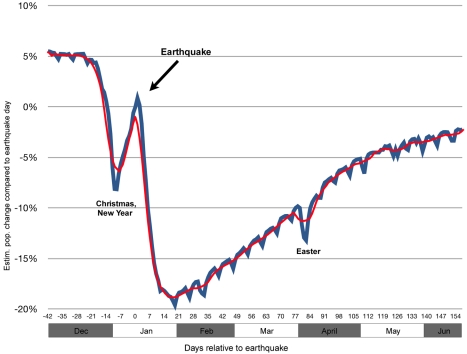
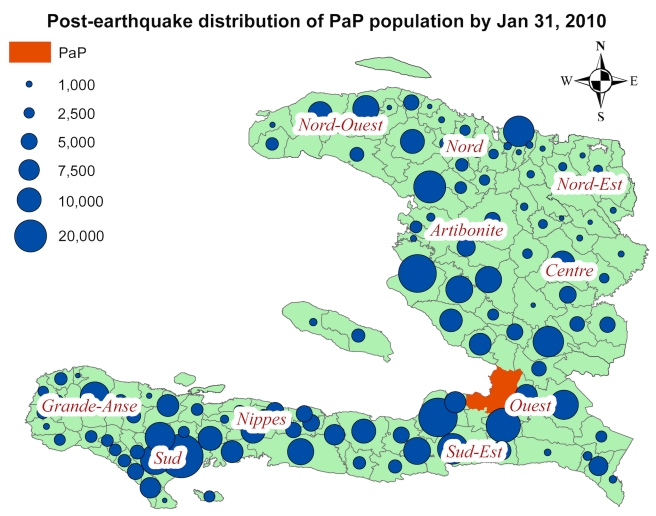
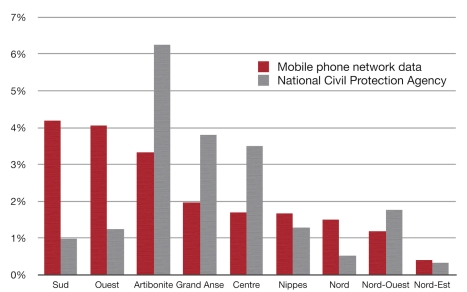
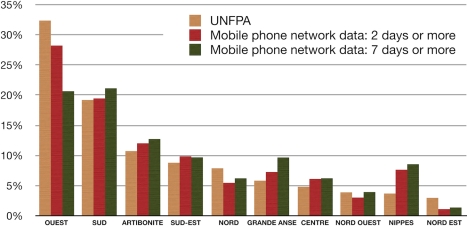
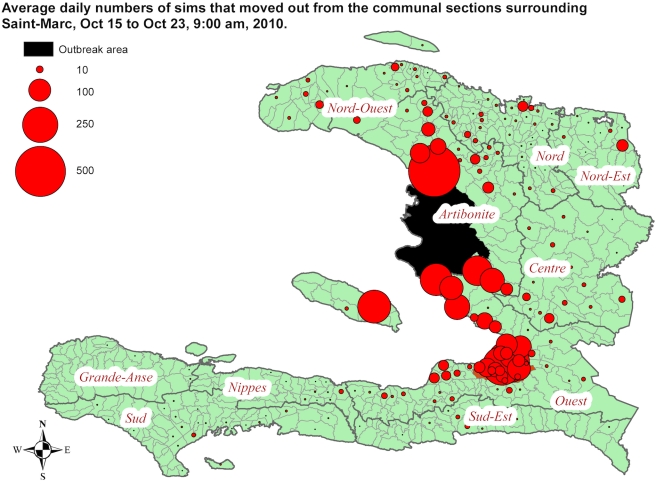
BACKGROUND: Population movements following disasters can cause important increases in morbidity and mortality. Without knowledge of the locations of affected people, relief assistance is compromised. No rapid and accurate method exists to track population movements after disasters. We used position data of subscriber identity module (SIM) cards from the largest mobile phone company in Haiti (Digicel) to estimate the magnitude and trends of population movements following the Haiti 2010 earthquake and cholera outbreak. METHODS AND FINDINGS: Geographic positions of SIM cards were determined by the location of the mobile phone tower through which each SIM card connects when calling. We followed daily positions of SIM cards 42 days before the earthquake and 158 days after. To exclude inactivated SIM cards, we included only the 1.9 million SIM cards that made at least one call both pre-earthquake and during the last month of study. In Port-au-Prince there were 3.2 persons per included SIM card. We used this ratio to extrapolate from the number of moving SIM cards to the number of moving persons. Cholera outbreak analyses covered 8 days and tracked 138,560 SIM cards. An estimated 630,000 persons (197,484 Digicel SIM cards), present in Port-au-Prince on the day of the earthquake, had left 19 days post-earthquake. Estimated net outflow of people (outflow minus inflow) corresponded to 20% of the Port-au-Prince pre-earthquake population. Geographic distribution of population movements from Port-au-Prince corresponded well with results from a large retrospective, population-based UN survey. To demonstrate feasibility of rapid estimates and to identify areas at potentially increased risk of outbreaks, we produced reports on SIM card movements from a cholera outbreak area at its immediate onset and within 12 hours of receiving data. CONCLUSIONS: Results suggest that estimates of population movements during disasters and outbreaks can be delivered rapidly and with potentially high validity in areas with high mobile phone use.
Overview
The claims and statistics of this paper haven’t been checked yet.
Free: it reads the open-access text and checks the first 5 claims that cite a source we can check. Create a free account to check every claim.
Integrity signals
Registry
Cites
Statistics
Figures
Verification
Claims the paper makes
The claims and statistics of this paper haven’t been checked yet.
Free: it reads the open-access text and checks the first 5 claims that cite a source we can check. Create a free account to check every claim.
Claims other papers make about this one
Each is checked against this paper’s own text: does it say what the citing paper says it does?
The cited source says what the claim attributes to it.
In the citing paper
“Reports have described mobile technology use during natural disasters, including the earthquakes in China in 2008 and Haiti in 2010 [38,39].”
Self-check
Percentages, sums and reported differences re-computed from the paper’s own numbers.
The self-check needs the paper’s full text.
Citations
Cites
Understanding individual human mobility patterns
González, M. C., Hidalgo, C. A., & Barabási, A.-L. (2008) · Nature · doi:10.1038/nature06958 · Cited by 6,059 · cited 1×
“. However, in addition to enabling communication, mobile phone networks routinely register data that can be used to track the location of all active mobile phones. This data source has been used to analyse mobility patterns under stable societal conditions”
MethodMultiscale mobility networks and the spatial spreading of infectious diseases
Balcan, D., Colizza, V., Gonçalves, B., Hu, H., Ramasco, J. J., & Vespignani, A. (2009) · Proceedings of the National Academy of Sciences · doi:10.1073/pnas.0906910106 · Cited by 1,380 · cited 1×
“Human mobility is extremely important for the spread of communicable diseases [28,29], and early containment of epidemic outbreaks is often a key factor in preventing spread [30].”
BackgroundZook, M., Graham, M., Shelton, T., & Gorman, S. (2010) · World Medical & Health Policy · doi:10.2202/1948-4682.1069 · Cited by 768 · cited 2×
“Network data can provide even richer information when combined with information on the ground and potentially also with data from mobile phone surveys [13].”
BackgroundSocial and environmental risk factors in the emergence of infectious diseases
Weiss, R. A., & McMichael, A. J. (2004) · Nature Medicine · doi:10.1038/nm1150 · Cited by 704 · cited 1×
“Human mobility is extremely important for the spread of communicable diseases [28,29], and early containment of epidemic outbreaks is often a key factor in preventing spread [30].”
BackgroundMeasuring the information society
(1989) · Choice Reviews Online · doi:10.5860/choice.26-3322 · Cited by 610
Large-Scale Spatial-Transmission Models of Infectious Disease
Riley, S. (2007) · Science · doi:10.1126/science.1134695 · Cited by 603 · cited 1×
“Human mobility is extremely important for the spread of communicable diseases [28,29], and early containment of epidemic outbreaks is often a key factor in preventing spread [30].”
BackgroundTHE PUBLIC HEALTH ASPECTS OF COMPLEX EMERGENCIES AND REFUGEE SITUATIONS
Toole, M., & Waldman, R. (1997) · Annual Review of Public Health · doi:10.1146/annurev.publhealth.18.1.283 · Cited by 381 · cited 1×
“Rapid, uncontrolled population movements often lead to important increases in morbidity and mortality [2,3].”
BackgroundLessons learned from complex emergencies over past decade
Salama, P., Spiegel, P., Talley, L., & Waldman, R. (2004) · The Lancet · doi:10.1016/s0140-6736(04)17405-9 · Cited by 346 · cited 1×
“Rapid, uncontrolled population movements often lead to important increases in morbidity and mortality [2,3].”
BackgroundPublic health impact of Rwandan refugee crisis: what happened in Goma, Zaire, in July, 1994?
Goma Epidemiology Group (1995) · The Lancet · doi:10.1016/s0140-6736(95)90338-0 · Cited by 330
Evaluating passive mobile positioning data for tourism surveys: An Estonian case study
Ahas, R., Aasa, A., Roose, A., Mark, Ü., & Silm, S. (2008) · Tourism Management · doi:10.1016/j.tourman.2007.05.014 · Cited by 319 · cited 2×
“This data source has been used to analyse mobility patterns under stable societal conditions [14–16], but not during major societal disruptions such as a natural disaster or a large infectious disease outbreak under unstable conditions.”
BackgroundMethod
Research works printed but not linked: 2
- 1998, The demography of forced migration: summary of a workshop
- 2010, World Telecommunication/ICT Development Report 2010. Monitoring the WSIS targets. A mid-term review
Cited by
Items 201–300 of 633
Intelligent System for Urban Emergency Management during Large-Scale Disaster
Song, X., Zhang, Q., Sekimoto, Y., & Shibasaki, R. (2014) · Proceedings of the AAAI Conference on Artificial Intelligence · doi:10.1609/aaai.v28i1.8758 · Cited by 26
Agile Application of Digital Health Interventions during the COVID-19 Refugee Response
Narla, N. P., Sürmeli, A., & Kivlehan, S. M. (2020) · Annals of Global Health · doi:10.5334/aogh.2995 · Cited by 30
Reporting under extreme conditions: journalists' experience of disaster coverage
Englund, L., Johannesson, K. B., & Arnberg, F. K. (2023) · Frontiers in Communication · doi:10.3389/fcomm.2023.1060169 · Cited by 33
“inhabitants of Port-au-Prince left the city following the earthquake (Bengtsson et al., 2011; Hsu and Schuller, 2020).”
BackgroundHartzler, A. L., & Wetter, T. C. (2014) · Yearbook of Medical Informatics · doi:10.15265/iy-2014-0022 · Cited by 26
“Big data analytics [32, 13] offer opportunities to investigate mHealth at large scale.”
BackgroundInfluentialThere’s an App for That: Mobile Applications for Urban Planning
Evans-cowley, J. S. (2012) · International Journal of E-Planning Research · doi:10.4018/ijepr.2012040105 · Cited by 31
Mobile phone data in studying urban rhythms: Towards an analytical framework
Švéda, M., Madajová, M. S., Barlík, P., Križan, F., & Šuška, P. (2020) · Moravian Geographical Reports · doi:10.2478/mgr-2020-0018 · Cited by 24
“…chronopolis, Bratislava, Slovakia Article history: Received 10 April, Accepted 5 October 2020, Published 31 December 2020 crisis management (Bengtsson et al., 2011), the monitoring of foreign tourist visits (Ahas et al., 2008; Šveda et al., 2019), or the spread of epidemics (Weselowski et…”
BackgroundTracking the Evolution of Infrastructure Systems and Mass Responses Using Publically Available Data
Guan, X., Chen, C., & Work, D. B. (2016) · PLoS ONE · doi:10.1371/journal.pone.0167267 · Cited by 27
Multi-Modal Description of Public Safety Events Using Surveillance and Social Media
Xu, Z., Mei, L., Lv, Z., Hu, C., Luo, X., Zhang, H., & Liu, Y. (2017) · IEEE Transactions on Big Data · doi:10.1109/tbdata.2017.2656918 · Cited by 22
“[14] followed daily positions of SIM cards of the Haiti earthquake.”
BackgroundUnderstanding data sources to measure patient retention in HIV care in sub-Saharan Africa
Clouse, K., Phillips, T. K., & Myer, L. (2017) · International Health · doi:10.1093/inthealth/ihx024 · Cited by 26
Mobile Phone Data as Source to Discover Spatial Activity and Motion Patterns
Loibl, W., & Peters-Anders, J. (2012) · Cited by 21
Rapid Multi-Dimensional Impact Assessment of Floods
Pastor-Escuredo, D., Torres, Y., Martínez-Torres, M., & Zufiria, P. J. (2020) · Sustainability · doi:10.3390/su12104246 · Cited by 28
“…of mobile phone data has allowed the quantification of behaviors and patterns caused by disasters by characterizing hotspots of mobility and social network behavior spatially and temporally [7,8], although these studies are mainly focused on small temporal intervals due to the availability of data.”
BackgroundZaragozí, B., Trilles, S., & Gutiérrez, A. (2021) · ISPRS International Journal of Geo-Information · doi:10.3390/ijgi10020098 · Cited by 21
“It should be noted that, apart from tourism studies, some attempts have been made to use PMD to investigate other geographical issues, such as generational differences in spatial mobility [15], internal migration [16], estimation of literacy rates [17], measuring ethnic segregation [18,19], mapping changes in residenc…”
BackgroundAssessing Bias in Smartphone Mobility Estimates in Low Income Countries
Milusheva, S., Björkegren, D., & Viotti, L. (2021) · ACM SIGCAS Conference on Computing and Sustainable Societies (COMPASS) · doi:10.1145/3460112.3471968 · Cited by 24
Andrienko, G., Gkoulalas-Divanis, A., Gruteser, M., Kopp, C., Liebig, T., & Rechert, K. (2013) · ACM SIGMOBILE Mobile Computing and Communications Review · doi:10.1145/2505395.2505398 · Cited by 21
Disaster preparedness in a complex urban system: the case of Kathmandu Valley, Nepal
Carpenter, S. H., & Grünewald, F. (2015) · Disasters · doi:10.1111/disa.12164 · Cited by 31
Investigation of Traffic and Evacuation Aspects at Kumamoto Earthquake and the Future Issues
Kawasaki, Y., Kuwahara, M., Hara, Y., Mitani, T., Takenouchi, A., Iryo, T., & Urata, J. (2017) · Journal of Disaster Research · doi:10.20965/jdr.2017.p0272 · Cited by 21
Wang, Q., & Taylor, J. E. (2014) · Procedia Economics and Finance · doi:10.1016/s2212-5671(14)00910-1 · Cited by 28
Xia, C., & Yeh, A. G. O. (2022) · Travel Behaviour and Society · doi:10.1016/j.tbs.2022.01.008 · Cited by 19
Modeling the Temporal Nature of Human Behavior for Demographics Prediction
Felbo, B., Sundsøy, P., Pentland, A., Lehmann, S., & de Montjoye, Y.-A. (2017) · Lecture notes in computer science · doi:10.1007/978-3-319-71273-4_12 · Cited by 32
“For instance, mobile phone metadata have been used to plan disaster response and inform public health policy [2,24].”
Prieto, J. T., Jara, J., Alvis-Estrada, J. P., Furlán, L., Murray, C. T., García, J., Benghozi, P., & Kaydos‐Daniels, S. C. (2017) · JMIR Public Health and Surveillance · doi:10.2196/publichealth.8610 · Cited by 22
“It may also contribute to improved response to disease outbreaks by providing near real-time syndromic data and rapidly detecting localized and unusual incidence of specific symptoms [35-37].”
Cross-Sectoral Big Data: The Application of an Ethics Framework for Big Data in Health and Research
Laurie, G. T. (2019) · Asian Bioethics Review · doi:10.1007/s41649-019-00093-3 · Cited by 22
“This realtime data was used to target relief programmes where they were most needed (Bengtsson et al. 2011).”
Behaviour Analysis Using Tweet Data and geo-tag Data in a Natural Disaster
Hara, Y. (2015) · Transportation research procedia · doi:10.1016/j.trpro.2015.12.033 · Cited by 20
Torrens, P. M. (2016) · Computation · doi:10.3390/computation4030037 · Cited by 27
Bharti, N., & Tatem, A. J. (2018) · Scientific Data · doi:10.1038/sdata.2018.256 · Cited by 23
Winders, W. T., Garbern, S. C., Bills, C. B., Relan, P., Schultz, M. L., Trehan, I., Kivlehan, S. M., Becker, T. K., & McQuillan, R. (2021) · Journal of Global Health · doi:10.7189/jogh.11.04023 · Cited by 28
Spatial interpolation of mobile positioning data for population statistics
Aasa, A., Kamenjuk, P., Saluveer, E., Šimbera, J., & Raun, J. (2021) · Journal of Location Based Services · doi:10.1080/17489725.2021.1917710 · Cited by 19
Fantazzini, D., Pushchelenko, J., Mironenkov, A., & Kurbatskii, A. N. (2021) · Forecasting · doi:10.3390/forecast3040048 · Cited by 22
Clouse, K., Noholoza, S., Madwayi, S., Mrubata, M., Camlin, C. S., Myer, L., & Phillips, T. K. (2023) · JMIR mhealth and uhealth · doi:10.2196/44945 · Cited by 19
“Previous studies demonstrated the utility of aggregated cellular phone data in showing population mobility [21-24].”
Gaspar, R., Yan, Z., & Domingos, S. (2019) · Technological Forecasting and Social Change · doi:10.1016/j.techfore.2019.04.029 · Cited by 21
Digital Humanitarianism: Collective Intelligence Emerging
Editors, T. P. M. (2012) · PLoS Medicine · doi:10.1371/journal.pmed.1001278 · Cited by 19
Letta, M., Montalbano, P., & Paolantonio, A. (2023) · Journal of Economic Surveys · doi:10.1111/joes.12584 · Cited by 24
Towards connecting people, locations and real-world events in a cellular network
Trestian, R., Shah, P., Nguyen, H. X., Vien, Q., Gemikonakli, O., & Barn, B. S. (2016) · Telematics and Informatics · doi:10.1016/j.tele.2016.05.006 · Cited by 18
Conclusion: What Do We Know About Group Privacy?
Taylor, L., van der Sloot, B., & Floridi, L. (2016) · Springer eBooks · doi:10.1007/978-3-319-46608-8_12 · Cited by 26
Mapping changes of residence with passive mobile positioning data: the case of Estonia
Kamenjuk, P., Aasa, A., & Sellin, J. (2017) · International Journal of Geographical Information Science · doi:10.1080/13658816.2017.1295308 · Cited by 20
A review of human mobility: Linking data, models, and real-world applications
Du, Y., Aoki, T., & Fujiwara, N. (2025) · Journal of Computational Social Science · doi:10.1007/s42001-025-00414-7 · Cited by 35
Simulation: The past 10 years and the next 10 years
Cheng, R. C. H., Macal, C. M., Nelson, B. L., Rabe, M., Currie, C. S. M., Fowler, J., & Lee, L. H. (2016) · Winter Simulation Conference · doi:10.1109/wsc.2016.7822260 · Cited by 23
Analysing the impact of electrification on rural attractiveness in Senegal with mobile phone data
Salat, H., Schläpfer, M., Smoreda, Z., & Rubrichi, S. (2021) · Royal Society Open Science · doi:10.1098/rsos.201898 · Cited by 23
Human mobility models reveal the underlying mechanism of seasonal movements across China
Song, B., Yan, X.-Y., Tan, S., Sai, B., Lai, S., Yu, H., Ou, C., & Lu, X. B. (2021) · International Journal of Modern Physics C · doi:10.1142/s0129183122500541 · Cited by 18
Self-citationMinora, U., Bosco, C., Iacus, S. M., Grubanov-Bošković, S., Sermi, F., & Spyratos, S. (2022) · EPJ Data Science · doi:10.1140/epjds/s13688-022-00370-6 · Cited by 17
“5 million people displaced in Ukraine as a direct result of the war, according to the Protection Cluster([2]), a joint study”
BackgroundInfluentialAutomatic identification of relevant places from cellular network data
Mamei, M., Colonna, M., & Galassi, M. (2016) · Pervasive and Mobile Computing · doi:10.1016/j.pmcj.2016.01.009 · Cited by 17
Anyidoho, P. K., Ju, X., Davidson, R. A., & Nozick, L. K. (2023) · Computational Urban Science · doi:10.1007/s43762-023-00102-0 · Cited by 16
“CDRs have been used to examine population movements after the Haiti (2010), New Zealand (2011), and Nepal (2015) earthquakes (Bengtsson et al., 2011; Wilson et al., 2016).”
MethodRecovery of HIV service provision post-earthquake
Walldorf, J. A., Joseph, P., Valles, J. S., Sabatier, J. F., Marston, B. J., Jean-Charles, K., Louissant, E., & Tappero, J. W. (2012) · AIDS · doi:10.1097/qad.0b013e328352d032 · Cited by 16
“Service provision in January and May 2010, reported as percentage of baseline, was 43 and 78.7% (VCT), 50.8 and 88.7% (HIV testing at ANC), 46 and 81% (PMTCT), and 41 and 82.7% (ART enrollment), respectively.”
BackgroundInfluentialZhang, G., Rui, X., Poslad, S., Song, X., Fan, Y., & Ma, Z. (2019) · Sensors · doi:10.3390/s19092156 · Cited by 16
Public perceptions and attitudes to biological risks: Saudi Arabia and regional perspectives
Alshehri, S. A., Rezgui, Y., & Li, H. (2016) · Disasters · doi:10.1111/disa.12179 · Cited by 19
Changing travel patterns in China during the early stages of the COVID-19 pandemicPreprint
Gibbs, H. P., Liu, Y., Pearson, C. A. B., Jarvis, C. I., Grundy, C., Quilty, B. J., Diamond, C., LSHTM CMMID COVID-19 working group, & Eggo, R. M. (2020) · medRxiv · doi:10.1101/2020.05.14.20101824 · Cited by 16
What we do know (and could know) about estimating population sizes of internally displaced people
Ratnayake, R., Abdelmagid, N., & Dooley, C. (2022) · Journal of Migration and Health · doi:10.1016/j.jmh.2022.100120 · Cited by 15
“Since its validation during the 2010 earthquake in Haiti (Bengtsson et al., 2011), it has been utilized to estimate IDP populations and IDP flows between locations in crises where data sharing agree-”
Revealing an Inherently Limiting Factor in Human Mobility Prediction
Amichi, L., Viana, A. C., Crovella, M. E., & Loureiro, A. A. F. (2022) · IEEE Transactions on Emerging Topics in Computing · doi:10.1109/tetc.2022.3229088 · Cited by 19
“, the COVID-19 pandemics) [1], disaster response, and traffic management [2], [3].”
Rogers, G., Koper, P., Ruktanonchai, C., Ruktanonchai, N., Utazi, C. E., Woods, D. R., Cunningham, A., Tatem, A. J., Steele, J. E., Lai, S., et al. (2023) · Remote Sensing · doi:10.3390/rs15174252 · Cited by 17
Švéda, M., Hurbánek, P., Madajová, M. S., Rosina, K., Förstl, F., Záboj, P., & Výbošťok, J. (2024) · Computers Environment and Urban Systems · doi:10.1016/j.compenvurbsys.2024.102106 · Cited by 15
Deriving human activity from geo-located data by ontological and statistical reasoning
Dashdorj, Z., Sobolevsky, S. L., Lee, S., & Ratti, C. (2017) · Knowledge-Based Systems · doi:10.1016/j.knosys.2017.11.038 · Cited by 15
“Indeed, experiments in large-scale social dynamics have been conducted in the areas of public safety and emergency management [4, 36, 43], health and disease management [21, 66], social and economic development [1, 18, 22], transport/infrastructure [5, 32], urban planning [3, 9, 24, 27, 33, 38, 44] and international d…”
BackgroundFusion of Terrain Information and Mobile Phone Location Data for Flood Area Detection in Rural Areas
Yabe, T., Tsubouchi, K., & Sekimoto, Y. (2018) · IEEE International Conference on Big Data (BigData) · doi:10.1109/bigdata.2018.8622156 · Cited by 15
“details to understand information diffusion during various disasters [22].”
BackgroundMobile Phone-Based Population Flow Data for the COVID-19 Outbreak in Mainland China
Lu, X. B., Tan, J., Cao, Z., Xiong, Y., Qin, S., Wang, T., Liu, C., Huang, S., Zhang, W., Marczak, L. B., et al. (2021) · Health Data Science · doi:10.34133/2021/9796431 · Cited by 16
“On the other hand, largescale movement data has been extracted from transportation systems [11], mobile devices [16, 17], and geo-tagged online posts [18, 19].”
BackgroundSelf-citationSenaratna, N., Baudoin, M.-A., Oluoko-Odingo, A. A., Ajuang, L., Wepukhulu, D. W., & Mwadali, A. S. (2014) · Springer eBooks · doi:10.1007/978-94-017-8598-3_19 · Cited by 15
Mobile Phones in Data Collection: A Systematic Review
Şahin, F., & Yan, Z. (2013) · International Journal of Cyber Behavior Psychology and Learning · doi:10.4018/ijcbpl.2013070106 · Cited by 18
Taibah, H., & Arlikatti, S. (2015) · International Journal of Mass Emergencies & Disasters · doi:10.1177/028072701503300203 · Cited by 15
Benton, B., Handuleh, J. I. M., Harris, K., Maruthappu, M., Patel, P., Godman, B., & Finlayson, A. E. T. (2014) · Medicine Conflict & Survival · doi:10.1080/13623699.2014.874185 · Cited by 17
“In addition, population displacement following disasters can severely complicate care provision, further adding to the burden of disease (Bengtsson et al. 2011).”
BackgroundInfluentialMigration Multiple? Big Data, Knowledge Practices and the Governability of Migration
Stielike, L. (2021) · Springer eBooks · doi:10.1007/978-3-030-81226-3_5 · Cited by 14
Disparities in mobile phone ownership reflect inequities in access to healthcare
Blake, A., Hazel, A., Jakurama, J., Matundu, J., & Bharti, N. (2023) · PLOS Digital Health · doi:10.1371/journal.pdig.0000270 · Cited by 20
Strategic Deployment of AI and Drones Enhancing Disaster Management in Natural Disasters
Singh, R., Manoharan, G., & Singh, S. (2024) · Advances in computational intelligence and robotics book series · doi:10.4018/979-8-3693-3896-4.ch009 · Cited by 15
Rajarethinam, J., Ong, J., Lim, S.-H., Tay, Y.-H., Bounliphone, W., Chong, C., Yap, G., & Ng, L. C. (2019) · International Journal of Environmental Research and Public Health · doi:10.3390/ijerph16050808 · Cited by 15
“In addition, another study on the same epidemic also showed that it was feasible to monitor real-time population movements using mobile phone data during infectious disease outbreaks, thus allowing for better preparedness in controlling outbreaks [15].”
BackgroundAn entropy-based approach to the study of human mobility and behavior in private homes
Wang, Y., Yalçin, A., & VandeWeerd, C. L. (2020) · PLoS ONE · doi:10.1371/journal.pone.0243503 · Cited by 18
“Understanding human mobility benefits applications including but not limited to urban planning [11,12], epidemic models [13,14], and disaster response [15,16].”
BackgroundLeveraging Mobile Phone Data for Migration Flows
Luca, M., Barlacchi, G., Oliver, N., & Lepri, B. (2022) · British Academy eBooks · doi:10.5871/bacad/9780197267103.003.0004 · Cited by 22
Dai, K., Cheng, C., Shen, S., Su, K., Zheng, X., & Zhang, T. (2021) · International Journal of Disaster Risk Reduction · doi:10.1016/j.ijdrr.2021.102736 · Cited by 14
Emotional and Physical Child Abuse in The Context of Natural Disasters: A Focus on Haiti
Subedi, S., Bartels, S. A., & Davison, C. (2019) · Disaster Medicine and Public Health Preparedness · doi:10.1017/dmp.2019.16 · Cited by 16
RescueMe: Smartphone-Based Self Rescue System for Disaster Rescue
Pu, C., & Zhou, X. (2019) · IEEE Annual Computing and Communication Workshop and Conference (CCWC) · doi:10.1109/ccwc.2019.8666565 · Cited by 14
“For example, after the Haiti earthquake in 2010, there were approximately 2.8 million active mobile subscribers out of 10 million inhabitants contributing data for tracking the movement of population in the affected region [5].”
BackgroundInfluentialCerna-Turoff, I., Kane, J. C., Devries, K. M., Mercy, J. A., Massetti, G. M., & Baiocchi, M. (2020) · Child Abuse & Neglect · doi:10.1016/j.chiabu.2020.104393 · Cited by 17
Mass Tracking in Cellular Networks for the COVID-19 Pandemic Monitoring
Khatib, E. J., Roselló, M. J. P., Páez, J. M., Giralt, V., & Barco, R. (2021) · Sensors · doi:10.3390/s21103424 · Cited by 16
“For instance, in [46], mobile phone data are used to estimate the mobility of users after the 2010 earthquake in Haiti, concluding that it would help to better coordinate the relief efforts.”
BackgroundUsing big data for evaluating development outcomes: A systematic map
Rathinam, F., Khatua, S., Siddiqui, Z., Malik, M., Duggal, P., Watson, S., & Vollenweider, X. (2021) · Campbell Systematic Reviews · doi:10.1002/cl2.1149 · Cited by 22
Cumbane, S. P., & Gidófalvi, G. (2021) · ISPRS International Journal of Geo-Information · doi:10.3390/ijgi10060421 · Cited by 12
“[23] used position data of Subscriber Identity Module (SIM) cards from the largest mobile phone company in Haiti (Digicel) to estimate the magnitude and trends of population movements following the Haiti 2010 earthquake and cholera outbreak.”
MethodIs the Phone Mightier than the Virus? Cell Phone Access and Epidemic Containment Efforts
Gonzalez, R. M., & Maffioli, E. M. (2020) · Journal of Development Economics · doi:10.1016/j.jdeveco.2023.103228 · Cited by 14
Population displacement after earthquakes: benchmarking predictions based on housing damage
Paul, N., Galasso, C., Silva, V., & Baker, J. W. (2024) · Seismica · doi:10.26443/seismica.v3i2.1374 · Cited by 12
“Some example studies using CDRs to track population displacement after disasters include Bengtsson et al. (2011), Lu et al. (2012), and Wilson et al. (2016).”
BackgroundPlace-Based Attributes Predict Community Membership in a Mobile Phone Communication Network
Caughlin, T. T., Ruktanonchai, N., Acevedo, M. A., Lopiano, K. K., Prosper, O., Eagle, N., & Tatem, A. J. (2013) · PLoS ONE · doi:10.1371/journal.pone.0056057 · Cited by 13
“For example, mobile phone communication data could be used in epidemiology to model human movement between patches with high and low disease transmission risk [18–19].”
BackgroundWilson, S., & Dunne, D. W. (2012) · Current Opinion in HIV and AIDS · doi:10.1097/coh.0b013e328351b9fb · Cited by 13
COVID-19 early-alert signals using human behavior alternative data
Bari, A., Khubchandani, A., Wang, J., Heymann, M., & Coffee, M. P. (2021) · Social Network Analysis and Mining · doi:10.1007/s13278-021-00723-5 · Cited by 13
A Survey of Application and Key Techniques for Mobile Crowdsensing
Wang, H. (2022) · Wireless Communications and Mobile Computing · doi:10.1155/2022/3693537 · Cited by 12
“(4) After receiving the sensing data delivered by the sensing task participants, the service platform aggregates and processes the sensing data and provides it to the sensing task requester [27, 28]”
BackgroundScalable Mining of Common Routes in Mobile Communication Network Traffic Data
Görnerup, O. (2012) · Lecture notes in computer science · doi:10.1007/978-3-642-31205-2_7 · Cited by 12
“This data has for instance been used to statistically characterise human mobility [13, 24, 25], in crisis management [5], for traffic modeling [20], for detecting anomalous events [2, 9], to identify common locations [14, 17], for mobility prediction [6, 26], and to determine low-level properties, such as if a termina…”
MethodPuttkammer, N. H., Zeliadt, S. B., Balan, J. G., Baseman, J. G., Destiné, R., Domerçant, J. W., Duvilaire, J. M., Raphael, N. A., Sherr, K., Yuhas, K., et al. (2014) · Global Health Action · doi:10.3402/gha.v7.24572 · Cited by 12
“Approximately 10,000 people from Port-au-Prince relocated to the commune of Jérémie within 3 weeks after the earthquake (3), swelling the population within the commune by about 8% (12).”
BackgroundSmallman-Raynor, M. R., Cliff, A. D., & Barford, A. (2015) · Annals of the Association of American Geographers · doi:10.1080/00045608.2015.1050755 · Cited by 12
“Finally, the ongoing population displacement and associated interdepartmental movements since the earthquake have maintained the nationwide spread of the disease (Bengtsson et al. 2011; Chery, Dodard, and Fournier 2012).”
BackgroundLocating disaster communication in changing communicative ecologies across the Pacific
Noske-Turner, J., Tacchi, J., Horst, H. A., & Papoutsaki, E. (2014) · Journal of Telecommunications and the Digital Economy · doi:10.7790/ajtde.v2n4.66 · Cited by 13
“…holding potential for circulating and crowdsourcing information (Heinzelman & Waters 2010 [13] ; Roche et al 2013 [14] ), providing status reports (Bengtsson et al 2011 [15] ), moving money (Mas & Moraczynski 2009 [16] ) and documenting and ?witnessing? violence through videos and cameraphones…”
BackgroundFusing Non-Authoritative Data to Improve Situational Awareness in Emergencies
Oxendine, C., Schnebele, E., Cervone, G., & Waters, N. M. (2014) · doi:10.13140/2.1.4980.5443 · Cited by 12
Osoba, O., & Davis, P. K. (2019) · Wiley eBooks · doi:10.1002/9781119485001.ch19 · Cited by 15
Small area population denominators for improved disease surveillance and response
Tatem, A. J. (2022) · Epidemics · doi:10.1016/j.epidem.2022.100641 · Cited by 11
“…induced by migration and displacement have been shown to be reliably captured by models driven by mobile phone record data (Lai et al., 2019; Bengtsson et al., 2011), and approaches for incorporating such flow data into small area population estimation models continue to be explored (Dooley…”
Predictability of human mobility during the COVID-19 pandemic in the United States
Hajlasz, M., & Pei, S. (2024) · PNAS Nexus · doi:10.1093/pnasnexus/pgae308 · Cited by 12
“For instance, Lu et al. (60, 61) analyzed the predictability of population displacement after the 2010 Haiti earthquake.”
BackgroundZhou, S., Zhou, S., Liu, L., Zhang, M., Kang, M., Xiao, J., & Song, T. (2019) · International Journal of Environmental Research and Public Health · doi:10.3390/ijerph16245013 · Cited by 15
“However, most studies about human mobility and DF are conducted at a large-scale (national scale or cross-city scale) [24,25,35,36].”
BackgroundAmi, J., Ishii, K., Sekimoto, Y., Masui, H., Ohmukai, I., Yamamoto, Y., & Okumura, T. (2021) · IEEE Access · doi:10.1109/access.2021.3087478 · Cited by 12
“This field was pio-neered by an attempt to model the spread of infection during the cholera outbreak in Haiti in late 2010 [10]–[13].”
BackgroundPrivacy, Security, and Liberty: ICT in Crises
Büscher, M., Perng, S.-Y., & Liegl, M. (2014) · International Journal of Information Systems for Crisis Response and Management · doi:10.4018/ijiscram.2014100106 · Cited by 16
Characterizing ethnic interactions from human communication patterns in Ivory Coast
Morales, A. J., Creixell, W., Borondo, J., Losada, J. C., & Benito, R. M. (2015) · Networks and Heterogeneous Media · doi:10.3934/nhm.2015.10.87 · Cited by 11
Cumulative Participant Selection with Switch Costs in Large-Scale Mobile Crowd Sensing
Li, H., Li, T., Li, F., Wu, Y., & Wang, Y. (2018) · International Conference on Computer Communications and Networks (ICCCN) · doi:10.1109/icccn.2018.8487375 · Cited by 11
“Therefore, MCS has been used in many applications such as human behavior mining [3], [4], environment monitoring [5]–[7], traffic planning [8]–[10] and public safety monitoring [11].”
MethodAutomated Assessment of Building Damage from Seismic Events Using Smartphones
Na, Y., El‐Tawil, S., Ibrahim, A., & Eltawil, A. M. (2020) · Journal of Structural Engineering · doi:10.1061/(asce)st.1943-541x.0002618 · Cited by 11
Zhang, Z., Yin, D., Virrantaus, K., Ye, X., & Wang, S. (2021) · Computational Urban Science · doi:10.1007/s43762-021-00006-x · Cited by 12
A Framework for Official Temporary Population Statistics
Charles‐Edwards, E., Bell, M., Panczak, R., & Corcoran, J. (2020) · Journal of Official Statistics · doi:10.2478/jos-2020-0001 · Cited by 11
Nizam, A., Sivakumar, P., & Rajan, S. I. (2022) · Journal of South Asian Development · doi:10.1177/09731741221122000 · Cited by 10
“…people, starting with the earthquake and cholera outbreak in Haiti, the H1N1 outbreak in Mexico, the Ebola outbreak in West Africa, Dengue in Pakistan and the Cyclone Mahasen in Bangladesh (Bengtsson et al., 2011, 2015; Frias-Martinez et al., 2011; Lu et al., 2016; Wesolowski et al., 2014, 2015).”
BackgroundWang, S., Zhang, M., Hu, T., Fu, X., Gao, Z., Halloran, B., & Liu, Y. (2021) · Sustainability · doi:10.3390/su13105372 · Cited by 17
Tournier, A. J., & de Montjoye, Y.-A. (2022) · Science Advances · doi:10.1126/sciadv.abl6464 · Cited by 19
“They are also used by governments to monitor employment ( 6 ), quickly respond to natural disasters ( 7 ), and recently to respond to the coronavirus disease 2019 (COVID-19) pandemic ( 8 ).”
BackgroundConnecting Sectors and Systems for Health Results
Pierre-Louis, A. M., El-Saharty, S., Stanciole, A. E., Jonas, O., Pascual, F. B., Oelrichs, R. B., Lorenzo, M. M., Villafana, T. L., Fernando Lavadenz, M., & Rock, M. (2012) · World Bank, Washington, DC eBooks · doi:10.1596/26806 · Cited by 11
New media methods for syndromic surveillance and disease modelling.
Walker, J. G. (2013) · CABI Reviews · doi:10.1079/pavsnnr20138031 · Cited by 10
“Following the 2010 earthquake in Haiti, population movements were tracked by using anonymous location data based on mobile phone connections to network towers [53].”
MethodMulti-expertise Aware Participant Selection in Mobile Crowd Sensing via Online Learning
Li, H., Li, T., Li, F., Yang, S., & Wang, Y. (2018) · IEEE International Conference on Mobile Ad-Hoc and Sensor Systems (MASS) · doi:10.1109/mass.2018.00067 · Cited by 10
“Several MCS applications have been used in real world such as dynamic behavior mining [3], [4], environmental monitoring [5]–[7], traffic planning [8]–[11] and public safety monitoring [12].”
MethodInference of node attributes from social network assortativity
Mulders, D., de Bodt, C., Bjelland, J., Pentland, A., Verleysen, M., & de Montjoye, Y.-A. (2019) · Neural Computing and Applications · doi:10.1007/s00521-018-03967-z · Cited by 13
“Different researches exploit mobile phone data for healthcare, epidemics containment, determination of socioeconomic status or marketing study purposes [4, 6, 28, 39, 45].”
BackgroundDynamic Resource Allocation During Natural Disasters Using Multi-agent Environment
Vereshchaka, A., & Dong, W. (2019) · Lecture Notes in Computer Science · doi:10.1007/978-3-030-21741-9_13 · Cited by 10
Ngom, R. V., Chouto, S., Doua, S. A., Garabed, R. B., Pagnah, A. Z., & Gonné, B. (2019) · International Journal of Health Geographics · doi:10.1186/s12942-019-0186-8 · Cited by 10
Metadata
- Authors
- Bengtsson, L., Lu, X., Thorson, A., Garfield, R., & von Schreeb, J.
- Affiliations
- Karolinska Institutet (SE)
- Stockholm University (SE)
- Columbia University (US)
- Corresponding author
- Bengtsson, Linus
- Venue
- PLoS Medicine
- Publisher
- Public Library of Science (PLoS)
- Published
- 2011-08-30
- Volume
- 8
- Issue
- 8
- Pages
- e1001083
- ISSN
- 1549-1277 (ISSN-L)
- 1549-1676
- PMC
- PMC3168873
- OpenAlex
- W2057301737
- Cited by
- 634
- References
- 20
- Citations by year
- 2026: 14 · 2025: 17 · 2024: 24 · 2023: 37 · 2022: 38 · 2021: 91 · 2020: 66 · 2019: 46 · 2018: 52 · 2017: 40 · 2016: 53 · 2015: 57 · 2014: 40 · 2013: 33 · 2012: 21
- FWCI
- 91.53
- Type
- journal article
- Language
- en
- Open access
- gold
- doi.org
- Locations
- PLoS Medicine (publishedVersion, cc-by)
- Europe PMC (PubMed Central) (publishedVersion, cc-by)
- PubMed Central (publishedVersion, cc-by)
- PubMed (publishedVersion)
- DOAJ (DOAJ: Directory of Open Access Journals) (submittedVersion, cc-by-sa)
- Figshare (submittedVersion, cc-by)
- Funders
- Socialstyrelsen
- Topics
- Social Sciences › Transportation › Human Mobility and Location-Based Analysis
- Social Sciences › Geography, Planning and Development › Earthquake and Disaster Impact Studies
- Health Sciences › Health Professions › Emergency Medical Services › Disaster Response and Management
- Keywords
- 2010 Haiti earthquake, cholera outbreak, disaster response, humanitarian aid, Port-au-Prince, outbreak risk assessment, spatial epidemiology
- MeSH terms
- Cholera, Demography, Disasters, Disease Outbreaks, Geography, Haiti, Humans, International Cooperation, Locomotion, Relief Work, Cell Phone, Earthquakes
About these checks
Registry, retraction, Cites and statistics results are computed, not judged, with one exception: a printed reference that no index lists is read once by a model before it counts as a citation error. Claims are extracted by a model and kept only when their quote appears verbatim in the text; each cited source is then checked, with a model’s help, for whether it says what the claim relies on. Those verdicts can be wrong — read the claim’s quote and the cited source before relying on one.
Statistics and arithmetic are recomputed, not judged.
Confidence bands are shown only for fields calibrated on our annotated test set. None is calibrated yet, so no band is shown.
What counts as a claim ›How we measure confidence ›How we check this ›
Are you an author, or do you see a problem with this page? Request a review
Data sources
Bibliographic data: Semantic Scholar, OpenAlex, Crossref.
Contains information from the Semantic Scholar Academic Graph Datasets, made available under the ODC Attribution License (ODC-BY 1.0).
Semantic Scholar’s data is described in: Kinney, R., et al. (2023). The Semantic Scholar Open Data Platform. arXiv:2301.10140.
