

Improved Response to Disasters and Outbreaks by Tracking Population Movements with Mobile Phone Network Data: A Post-Earthquake Geospatial Study in Haiti
Open accessThe DOI matches its Crossref record; 19 of the 20 references it cites were found in a registry or an index.
Abstract
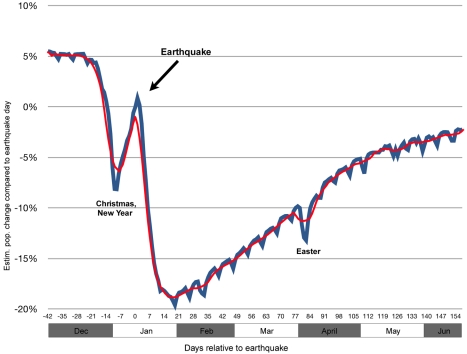
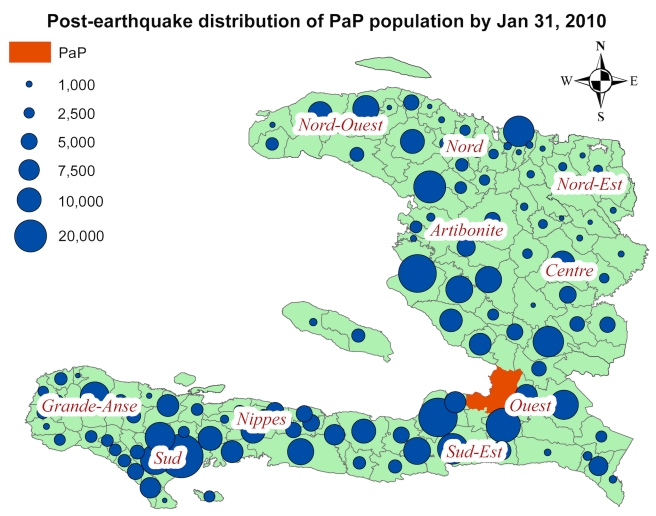
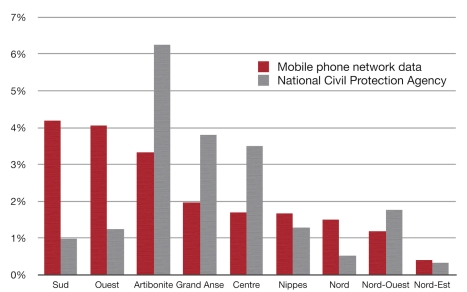
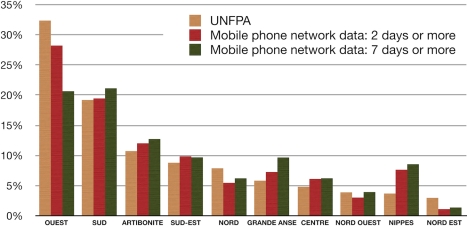
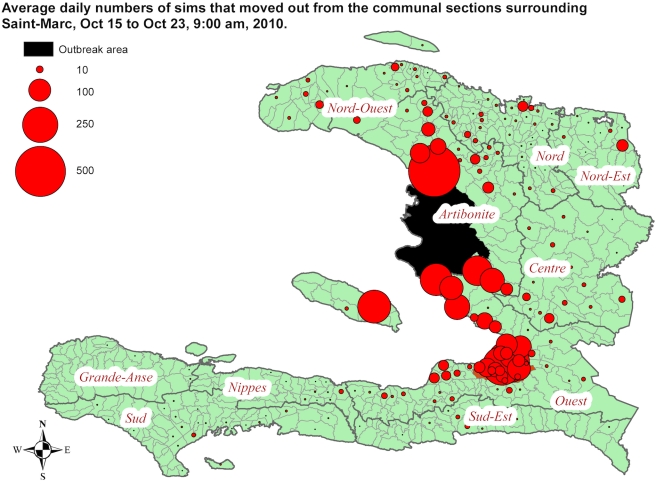
BACKGROUND: Population movements following disasters can cause important increases in morbidity and mortality. Without knowledge of the locations of affected people, relief assistance is compromised. No rapid and accurate method exists to track population movements after disasters. We used position data of subscriber identity module (SIM) cards from the largest mobile phone company in Haiti (Digicel) to estimate the magnitude and trends of population movements following the Haiti 2010 earthquake and cholera outbreak. METHODS AND FINDINGS: Geographic positions of SIM cards were determined by the location of the mobile phone tower through which each SIM card connects when calling. We followed daily positions of SIM cards 42 days before the earthquake and 158 days after. To exclude inactivated SIM cards, we included only the 1.9 million SIM cards that made at least one call both pre-earthquake and during the last month of study. In Port-au-Prince there were 3.2 persons per included SIM card. We used this ratio to extrapolate from the number of moving SIM cards to the number of moving persons. Cholera outbreak analyses covered 8 days and tracked 138,560 SIM cards. An estimated 630,000 persons (197,484 Digicel SIM cards), present in Port-au-Prince on the day of the earthquake, had left 19 days post-earthquake. Estimated net outflow of people (outflow minus inflow) corresponded to 20% of the Port-au-Prince pre-earthquake population. Geographic distribution of population movements from Port-au-Prince corresponded well with results from a large retrospective, population-based UN survey. To demonstrate feasibility of rapid estimates and to identify areas at potentially increased risk of outbreaks, we produced reports on SIM card movements from a cholera outbreak area at its immediate onset and within 12 hours of receiving data. CONCLUSIONS: Results suggest that estimates of population movements during disasters and outbreaks can be delivered rapidly and with potentially high validity in areas with high mobile phone use.
Overview
The claims and statistics of this paper haven’t been checked yet.
Free: it reads the open-access text and checks the first 5 claims that cite a source we can check. Create a free account to check every claim.
Integrity signals
Registry
Cites
Statistics
Figures
Verification
Claims the paper makes
The claims and statistics of this paper haven’t been checked yet.
Free: it reads the open-access text and checks the first 5 claims that cite a source we can check. Create a free account to check every claim.
Claims other papers make about this one
Each is checked against this paper’s own text: does it say what the citing paper says it does?
The cited source says what the claim attributes to it.
In the citing paper
“Reports have described mobile technology use during natural disasters, including the earthquakes in China in 2008 and Haiti in 2010 [38,39].”
Self-check
Percentages, sums and reported differences re-computed from the paper’s own numbers.
The self-check needs the paper’s full text.
Citations
Cites
Understanding individual human mobility patterns
González, M. C., Hidalgo, C. A., & Barabási, A.-L. (2008) · Nature · doi:10.1038/nature06958 · Cited by 6,059 · cited 1×
“. However, in addition to enabling communication, mobile phone networks routinely register data that can be used to track the location of all active mobile phones. This data source has been used to analyse mobility patterns under stable societal conditions”
MethodMultiscale mobility networks and the spatial spreading of infectious diseases
Balcan, D., Colizza, V., Gonçalves, B., Hu, H., Ramasco, J. J., & Vespignani, A. (2009) · Proceedings of the National Academy of Sciences · doi:10.1073/pnas.0906910106 · Cited by 1,380 · cited 1×
“Human mobility is extremely important for the spread of communicable diseases [28,29], and early containment of epidemic outbreaks is often a key factor in preventing spread [30].”
BackgroundZook, M., Graham, M., Shelton, T., & Gorman, S. (2010) · World Medical & Health Policy · doi:10.2202/1948-4682.1069 · Cited by 768 · cited 2×
“Network data can provide even richer information when combined with information on the ground and potentially also with data from mobile phone surveys [13].”
BackgroundSocial and environmental risk factors in the emergence of infectious diseases
Weiss, R. A., & McMichael, A. J. (2004) · Nature Medicine · doi:10.1038/nm1150 · Cited by 704 · cited 1×
“Human mobility is extremely important for the spread of communicable diseases [28,29], and early containment of epidemic outbreaks is often a key factor in preventing spread [30].”
BackgroundMeasuring the information society
(1989) · Choice Reviews Online · doi:10.5860/choice.26-3322 · Cited by 610
Large-Scale Spatial-Transmission Models of Infectious Disease
Riley, S. (2007) · Science · doi:10.1126/science.1134695 · Cited by 603 · cited 1×
“Human mobility is extremely important for the spread of communicable diseases [28,29], and early containment of epidemic outbreaks is often a key factor in preventing spread [30].”
BackgroundTHE PUBLIC HEALTH ASPECTS OF COMPLEX EMERGENCIES AND REFUGEE SITUATIONS
Toole, M., & Waldman, R. (1997) · Annual Review of Public Health · doi:10.1146/annurev.publhealth.18.1.283 · Cited by 381 · cited 1×
“Rapid, uncontrolled population movements often lead to important increases in morbidity and mortality [2,3].”
BackgroundLessons learned from complex emergencies over past decade
Salama, P., Spiegel, P., Talley, L., & Waldman, R. (2004) · The Lancet · doi:10.1016/s0140-6736(04)17405-9 · Cited by 346 · cited 1×
“Rapid, uncontrolled population movements often lead to important increases in morbidity and mortality [2,3].”
BackgroundPublic health impact of Rwandan refugee crisis: what happened in Goma, Zaire, in July, 1994?
Goma Epidemiology Group (1995) · The Lancet · doi:10.1016/s0140-6736(95)90338-0 · Cited by 330
Evaluating passive mobile positioning data for tourism surveys: An Estonian case study
Ahas, R., Aasa, A., Roose, A., Mark, Ü., & Silm, S. (2008) · Tourism Management · doi:10.1016/j.tourman.2007.05.014 · Cited by 319 · cited 2×
“This data source has been used to analyse mobility patterns under stable societal conditions [14–16], but not during major societal disruptions such as a natural disaster or a large infectious disease outbreak under unstable conditions.”
BackgroundMethod
Research works printed but not linked: 2
- 1998, The demography of forced migration: summary of a workshop
- 2010, World Telecommunication/ICT Development Report 2010. Monitoring the WSIS targets. A mid-term review
Cited by
Items 501–600 of 633
Model for Pollutant and Disease Monitoring
Rinaldi, G., & Rinaldi, S. (2017) · Springer eBooks · doi:10.1007/978-3-319-62731-1_27 · Cited by 1
The Impacts of Natural Disasters on Population Outflow: Focusing on the Flood
Lee, E., Yeol, K. H., & Song, J. (2018) · Korean Society of Hazard Mitigation · doi:10.9798/kosham.2018.18.7.137 · Cited by 2
“또한 재해로 인한 직간접 피해를 모두 고려한 연구의 경우(Bengtsson et al., 2011; Gray and Valerie, 2012), 재해의 피해뿐만 아니라 재해로 인한 전염병, 작물의 실패 등이 재해의 직접적 피해와 더불어 인구 이주에 영향을 미칠 수 있다는 결과를 보였다.”
Kawasaki, Y., Umeda, S., & Kuwahara, M. (2021) · Journal of JSCE · doi:10.2208/journalofjsce.9.1_8 · Cited by 1
Landau, S. M. (2020) · New Security Paradigms Workshop · doi:10.1145/3442167.3442171 · Cited by 8
“By tracking the movement of SIM cards after the 2010 Haitian earthquake, researchers produced estimates that matched the Haitian National Civil Protection Agency’s, which had tracked the refugees’ movement based on counting ship and bus movements—and was slower and far more labor intensive [19].”
Improving Public Transportation Safety in COVID-19 Era Through Crowdsourcing Technique
Pan, Q., Jin, Z., & Tao, T. (2021) · Human dynamics in smart cities · doi:10.1007/978-3-030-72808-3_17 · Cited by 1
МЕТОДОЛОГИЧЕСКИЕ ПРОБЛЕМЫ КОЛИЧЕСТВЕННЫХ ОЦЕНОК И ПРОГНОЗОВ КЛИМАТИЧЕСКОЙ МИГРАЦИИ
Михайловна, М. Е. (2021) · Bulletin of the South-Russian state technical University (NPI) Series Socio-economic Sciences · doi:10.17213/2075-2067-2021-5-128-141 · Cited by 1
Case-Control and Cohort Designs
Kazdin, A. E. (2021) · Cambridge University Press eBooks · doi:10.1017/9781108993647.008 · Cited by 2
Null Hypothesis Significance Testing
Kazdin, A. E. (2021) · Cambridge University Press eBooks · doi:10.1017/9781108993647.014 · Cited by 1
Developments in Implicit Measurements
Ziepert, B., de Vries, P. W., Ufkes, E. G., Toet, A., Anne-Marie, B., Barski, J. J., Spink, A., Riedel, G., & Roy, R. N. (2022) · Frontiers research topics · doi:10.3389/978-2-88974-342-1 · Cited by 1
Nara, A., Yang, X. “., Machiani, S. G., & Tsou, M. (2021) · Human dynamics in smart cities · doi:10.1007/978-3-030-83010-6_6 · Cited by 1
Raharja, S., & Sugawara, T. (2022) · IIAI International Congress on Advanced Applied Informatics (IIAI-AAI) · doi:10.1109/iiaiaai55812.2022.00079 · Cited by 1
“It is also possible to track movement of people, for example using mobile phone signals [2] or mobile phone signal base stations [5].”
BackgroundComparison of User Presence Information from Mobile Phone and Sensor Data
Rabenjamina, S., Stanica, R., Iova, O., & Rivano, H. (2022) · ACM International Conference on Modeling, Analysis and Simulation of Wireless and Mobile Systems (MSWiM) · doi:10.1145/3551659.3559054 · Cited by 2
“At a country level, mobile phone data was used to estimate the destination distribution of people who left the affected area in the months following the 2010 Haiti earthquake, showing a good matching with a large survey conducted by the United Nations [7].”
BackgroundMethodExploring Health and Wellbeing in a Low-to-Middle Income Country: A Case Study of Kenya
Onyango, E. O. (2019) · UWSpace (University of Waterloo) · Cited by 2
Gender-specific behavior change following terror attacksPreprint
Juul, J. L., Alessandretti, L., Dammeyer, J., Zettler, I., Lehmann, S., & Mathiesen, J. (2020) · arXiv (Cornell University) · doi:10.48550/arxiv.2004.02957 · Cited by 1
“[16] Linus Bengtsson, Xin Lu, Anna Thorson, Richard Garfield, and Johan Von Schreeb.”
BackgroundThe impact of electrification on rural attractiveness in SenegalPreprint
Salat, H., Schläpfer, M., Smoreda, Z., & Rubrichi, S. (2020) · arXiv (Cornell University) · doi:10.48550/arxiv.2005.12464 · Cited by 1
“Areas of application include public health to minimise the spread of infectious diseases [18], national statistics to help mapping populations [19] and associated socio-economic indicators [15], the estimation of transportation and electricity demands [20, 21, 22] or the monitoring of population displacement after dis…”
BackgroundMartín, Y., Li, Z., & Ge, Y. (2020) · arXiv (Cornell University) · doi:10.48550/arxiv.2011.13482 · Cited by 1
“Earthquake and the subsequent cholera outbreak, Bengtsson et al. (2011) tracked 138,560 SIM cards to produce detailed reports of the population movements associated with the disaster.”
Ahmad, K. (2018) · Cambridge University Press eBooks · doi:10.1017/9781108575720.002 · Cited by 1
Joseph, G., Milusheva, S., Sturrock, H. J. W., Kashangura, F. M., Ayling, S. C. E., & Hoo, Y. R. (2023) · World Bank, Washington, DC eBooks · doi:10.1596/1813-9450-10327 · Cited by 1
Addressing the reactiveness problem in sensor networks using rich task representation
Borowiecki, K. (2011) · ORCA Online Research @Cardiff (Cardiff University)
Chandy, R. K., & Ramdas, K. (2013) · London Business School Review · doi:10.1111/j.1467-8616.2013.00917.x
Van-Ess, S. E., Nonvignon, J., Dwomoh, D., Calopietro, M., van der Hoek, W., Konradsen, F., & Aikins, M. (2015) · International journal of scientific and technology research · Cited by 2
Disaster Preparedness and Response Innovations: Implications for Urbanization and Health
Janneck, L. M., & Biddinger, P. D. (2015) · Springer eBooks · doi:10.1007/978-1-4899-7597-3_6
e-Science for Digital Development: ICT4ICT4D
Hilbert, M. (2015) · eScholarship (California Digital Library) · Cited by 2
Cellular Location Determination - Reliability and Trustworthiness of GSM Location Data.
Zahoransky, R. M., Rechert, K., Meier, K., Wehrle, D., & von Suchodoletz, D. (2012)
Verifying Big Data with Artificial Intelligence
Meier, P. P. (2015) · Routledge eBooks · doi:10.1201/b18023-12
Baines, L. S., Jindal, R. M., & Kathan, M. (2015) · Anglia Ruskin Research Online (Anglia Ruskin University)
Zeinalzadeh, A., Alizadeh, B. M., Raeisi, P., Babaie, J., Firooznia, R., Ghozikali, M. G., Majd, S. R., Nouri, M., & Khamnian, Z. (2017) · Türkiye Halk Sağlığı Dergisi · doi:10.20518/tjph.326814
Development and Implementation of the DHAPP Military eHealth Information Network System
Kratz, M., Thomas, A., Hora, R. A., Vera, D. M., Lutz, M., & Johnson, M. D. (2017) · Current HIV Research · doi:10.2174/1570162x15666170517093714
BMSCE, Unnikrishnan, A., Narayan, A., & Guruprasad, H. (2017) · International Journal of Computer Trends and Technology · doi:10.14445/22312803/ijctt-v46p108
“Bengtsson et al [24] discuss their work in creating a model that can extract location information of large population using the information gained from the SIM (subscriber Identity Module) cards wherein each SIM card’s location is tracked using CDR that pinpoint the nearest cell phone tower.”
MethodWhat Can Disaster Epidemiology Contribute to Building Resilient Communities?
Horney, J. A. (2017) · Elsevier eBooks · doi:10.1016/b978-0-12-809318-4.00024-1
Dimensions of Mobile Phone Behaviors in Environmental Communication
Wang, Y. X. (2015) · IGI Global eBooks · doi:10.4018/978-1-4666-8239-9.ch020
A Proposed Framework for Crowd-Sourced Social Network Data Collected over Bluetooth
Benavides, J. (2014) · Mspace (University of Manitoba)
Event Detection on Call Detail Records
Hajdú-Szücs, K., & Kiss, A. (2018) · International Conference on Applied Informatics (ICAI) · doi:10.14794/icai.10.2017.121
Application of Big Data in Digital Epidemiology
Naaz, S., & Siddiqui, F. (2018) · Advances in healthcare information systems and administration book series · doi:10.4018/978-1-5225-7071-4.ch013
Smartphone-Based Self Rescue System for Disaster Rescue
Zhou, X. (2018)
Epidemiology, prevention and control of Legionnaires' disease in Europe.
Beauté, J. (2019) · Figshare
Automated Post-Earthquake Building Damage Assessment Using Smart Devices
Na, Y. (2019) · Deep Blue (University of Michigan)
Nelson, E. (2015) · Elsevier eBooks · doi:10.1016/b978-0-323-28665-7.00040-6
Mobile Disaster Communication in Wireless Network Communication
Vennisa, V., & prabhu, D. R. (2020) · JOURNAL OF SCIENCE COMPUTING AND ENGINEERING RESEARCH · doi:10.46379/jscer.2020.010202
Cerna-Turoff, I. (2020) · LSHTM Research Online (London School of Hygiene and Tropical Medicine) · doi:10.17037/pubs.04658954 · Cited by 1
Strategies for containing an emerging COVID-19 pandemic in a population: an epidemiological survey
Melo, M. S. D. S., Borges, L. P., de Souza, D. R. V., Martins, A. F., Borges, P. C., Neto, J. M. D. R., Serafini, M. R., Dósea, M., & de Oliveira, M. G. B. (2020) · Trends in Research · doi:10.15761/tr.1000173 · Cited by 1
“1000173 Volume 3: 4-7 after the 2010 earthquake in Haiti, humanitarian organizations started to incorporate many new technologies into their field operations, including drone imagery and SMS messaging to guide responses to disease outbreaks, wars and disasters [33].”
BackgroundDevelopment of a communication system for humanitarian emergencies
Cabezuelo, A. S. (2021) · The Journal of Engineering and Exact Sciences · doi:10.18540/jcecvl7iss2pp12209-01-12e
Rapid Damage Estimation with Iterative Improvements for Relief Resource Planning Post-DisastersPreprint
Garg, R., Zhang, Y., Golden, L. L., & Brockett, P. L. (2018) · SSRN Electronic Journal · doi:10.2139/ssrn.3254748
Machado, D., & Mendes, L. S. (2020) · SSRN Electronic Journal · doi:10.2139/ssrn.3751990
Sustaining Planetary Health in the Anthropocene
Haines, A., & Frumkin, H. (2021) · Cambridge University Press eBooks · doi:10.1017/9781108698054.012
Application of Disaster Management Information for the COVID-19 Pandemic
Li, W.-S., Huang, M., Su, W.-R., Lee, Y., Liu, Y., Chen, K.-H., & Chang, C.-L. (2021) · IFIP advances in information and communication technology · doi:10.1007/978-3-030-81469-4_5
Social physicsPreprint
Jusup, M., Holme, P., Kanazawa, K., Takayasu, M., Romić, I., Wang, Z., Geček, S., Lipić, T., Boris Podobnik, A., Wang, L., et al. (2021) · arXiv (Cornell University)
Bernal, E. V., Saucedo, O., & Tien, J. H. (2021) · arXiv (Cornell University) · doi:10.48550/arxiv.2111.00119
“There is an abundance of empirical data on mobility and connectivity between locations [7, 31, 55, 56], and these data are being increasingly incorporated into mathematical and computational models of vector-borne disease dynamics [26, 41].”
BackgroundA Ten Year Retrospective Study of Pediatric Pneumonia Cases in Haiti
Savic, T. (2015) · OpenCommons - UConn (University of Connecticut) · Cited by 1
Kazdin, A. E. (2021) · Cambridge University Press eBooks · doi:10.1017/9781108993647.001
Construct and Data-Evaluation Validity
Kazdin, A. E. (2021) · Cambridge University Press eBooks · doi:10.1017/9781108993647.004
Single-Case Experimental Research Designs
Kazdin, A. E. (2021) · Cambridge University Press eBooks · doi:10.1017/9781108993647.009
Kazdin, A. E. (2021) · Cambridge University Press eBooks · doi:10.1017/9781108993647.007
Cautions, Negative Effects, and Replication
Kazdin, A. E. (2021) · Cambridge University Press eBooks · doi:10.1017/9781108993647.016
Selecting Measures for Research
Kazdin, A. E. (2021) · Cambridge University Press eBooks · doi:10.1017/9781108993647.011
Kazdin, A. E. (2021) · Cambridge University Press eBooks · doi:10.1017/9781108993647.021
Kazdin, A. E. (2021) · Cambridge University Press eBooks · doi:10.1017/9781108993647.013
Kazdin, A. E. (2021) · Cambridge University Press eBooks · doi:10.1017/9781108993647.022
Ideas that Begin the Research Process
Kazdin, A. E. (2021) · Cambridge University Press eBooks · doi:10.1017/9781108993647.005
Kazdin, A. E. (2021) · Cambridge University Press eBooks · doi:10.1017/9781108993647.020
Kazdin, A. E. (2021) · Cambridge University Press eBooks · doi:10.1017/9781108993647.025
Presenting and Analyzing the Data
Kazdin, A. E. (2021) · Cambridge University Press eBooks · doi:10.1017/9781108993647.015
Kazdin, A. E. (2021) · Cambridge University Press eBooks · doi:10.1017/9781108993647.024
Kazdin, A. E. (2021) · Cambridge University Press eBooks · doi:10.1017/9781108993647.018
Kazdin, A. E. (2021) · Cambridge University Press eBooks · doi:10.1017/9781108993647.002
Assessment: Types of Measures and Their Use
Kazdin, A. E. (2021) · Cambridge University Press eBooks · doi:10.1017/9781108993647.012
Experimental Research Using Group Designs
Kazdin, A. E. (2021) · Cambridge University Press eBooks · doi:10.1017/9781108993647.006
Ethical Issues and Guidelines for Research
Kazdin, A. E. (2021) · Cambridge University Press eBooks · doi:10.1017/9781108993647.017
Communication of Research Findings
Kazdin, A. E. (2021) · Cambridge University Press eBooks · doi:10.1017/9781108993647.019
Information and Communication Technology, Peacebuilding, and Conflict
Stones, E. (2022) · Elsevier eBooks · doi:10.1016/b978-0-12-820195-4.00267-3
Pastor-Escuredo, D. (2020) · Revista Diecisiete Investigación Interdisciplinar para los Objetivos de Desarrollo Sostenible · doi:10.36852/2695-4427_2020_03.07 · Cited by 1
RescueMe: A Smart Phone Self-help Application
(2022) · Journal of Research in Science and Engineering · doi:10.53469/jrse.2022.04(03).05
Innovative human mobility data for fast crisis responsePreprint
Minora, U., Bosco, C., Iacus, S. M., Grubanov-Bošković, S., Sermi, F., & Spyratos, S. (2022) · Research Square · doi:10.21203/rs.3.rs-1550901/v1
Donar, G. B. (2020) · Türkiye Halk Sağlığı Dergisi · doi:10.20518/tjph.656035 · Cited by 1
(2012) · Salud Pública de México · doi:10.1590/s0036-36342012000400015
Creative reuses of data for greater value
Bank, W. (2021) · World Bank, Washington, DC eBooks · doi:10.1596/978-1-4648-1600-0_ch4
Trestian, R., Zaman, F., & Muntean, G. (2015) · Advances in knowledge acquisition, transfer, and management book series/Advances in knowledge acquisition, transfer and management book series · doi:10.4018/978-1-4666-8833-9.ch001
Privacy, Security, and Liberty: ICT in Crises
Büscher, M., Perng, S.-Y., & Liegl, M. (2019) · IGI Global eBooks · doi:10.4018/978-1-5225-8897-9.ch013 · Cited by 1
Trestian, R., Zaman, F., & Muntean, G. (2016) · IGI Global eBooks · doi:10.4018/978-1-4666-9845-1.ch003
Young, A. Y., Zahuranec, A. J., Winowatan, M. W., & Verhulst, S. (2020) · doi:10.15868/socialsector.40381
Ahmad, K. (2018) · Cambridge University Press eBooks · doi:10.1017/9781108575720.001
Licence Agreement for the Use of a Social Media Monitor in Disaster Management
Ahmad, K. (2018) · Cambridge University Press eBooks · doi:10.1017/9781108575720.008 · Cited by 1
Ahmad, K. (2018) · Cambridge University Press eBooks · doi:10.1017/9781108575720.009
de Stefani, P. (2018) · Cambridge University Press eBooks · doi:10.1017/9781108575720.006
Ahmad, K. (2018) · Cambridge University Press eBooks · doi:10.1017/9781108575720.010
Social Computing Systems and Ethical Considerations
Ahmad, K., Finan, S., Kelly, S., Zhang, X., Hayes, P., Hogan, L., & Jackson, D. (2018) · Cambridge University Press eBooks · doi:10.1017/9781108575720.003
Zbucki, Ł. (2022) · Miscellanea Geographica · doi:10.2478/mgrsd-2022-0016 · Cited by 2
Towards Early Public Health Emergency Anticipating with Emerging Non-health Data Per se
Semassel, I. E., & Yahia, S. B. (2023) · Lecture notes in networks and systems · doi:10.1007/978-3-031-25344-7_49
Evaluation of Emerging Data to Inform Disaster Response
Naganathan, S. (2023) · Elsevier eBooks · doi:10.1016/b978-0-323-80932-0.00022-7
Chapter 3. “The Tremors Felt Round the World”: Haiti’s Earthquake as Global Imagined Community
Schuller, M. (2016) · Berghahn Books · doi:10.1515/9781789204773-004
Conclusion: Legally Using Social Computing Streams and Privacy Protection
Corbet, R., & Maguire, C. (2018) · Cambridge University Press eBooks · doi:10.1017/9781108575720.007
Oriola, T. A. (2018) · Cambridge University Press eBooks · doi:10.1017/9781108575720.004
Metadata
- Authors
- Bengtsson, L., Lu, X., Thorson, A., Garfield, R., & von Schreeb, J.
- Affiliations
- Karolinska Institutet (SE)
- Stockholm University (SE)
- Columbia University (US)
- Corresponding author
- Bengtsson, Linus
- Venue
- PLoS Medicine
- Publisher
- Public Library of Science (PLoS)
- Published
- 2011-08-30
- Volume
- 8
- Issue
- 8
- Pages
- e1001083
- ISSN
- 1549-1277 (ISSN-L)
- 1549-1676
- PMC
- PMC3168873
- OpenAlex
- W2057301737
- Cited by
- 634
- References
- 20
- Citations by year
- 2026: 14 · 2025: 17 · 2024: 24 · 2023: 37 · 2022: 38 · 2021: 91 · 2020: 66 · 2019: 46 · 2018: 52 · 2017: 40 · 2016: 53 · 2015: 57 · 2014: 40 · 2013: 33 · 2012: 21
- FWCI
- 91.53
- Type
- journal article
- Language
- en
- Open access
- gold
- doi.org
- Locations
- PLoS Medicine (publishedVersion, cc-by)
- Europe PMC (PubMed Central) (publishedVersion, cc-by)
- PubMed Central (publishedVersion, cc-by)
- PubMed (publishedVersion)
- DOAJ (DOAJ: Directory of Open Access Journals) (submittedVersion, cc-by-sa)
- Figshare (submittedVersion, cc-by)
- Funders
- Socialstyrelsen
- Topics
- Social Sciences › Transportation › Human Mobility and Location-Based Analysis
- Social Sciences › Geography, Planning and Development › Earthquake and Disaster Impact Studies
- Health Sciences › Health Professions › Emergency Medical Services › Disaster Response and Management
- Keywords
- 2010 Haiti earthquake, cholera outbreak, disaster response, humanitarian aid, Port-au-Prince, outbreak risk assessment, spatial epidemiology
- MeSH terms
- Cholera, Demography, Disasters, Disease Outbreaks, Geography, Haiti, Humans, International Cooperation, Locomotion, Relief Work, Cell Phone, Earthquakes
About these checks
Registry, retraction, Cites and statistics results are computed, not judged, with one exception: a printed reference that no index lists is read once by a model before it counts as a citation error. Claims are extracted by a model and kept only when their quote appears verbatim in the text; each cited source is then checked, with a model’s help, for whether it says what the claim relies on. Those verdicts can be wrong — read the claim’s quote and the cited source before relying on one.
Statistics and arithmetic are recomputed, not judged.
Confidence bands are shown only for fields calibrated on our annotated test set. None is calibrated yet, so no band is shown.
What counts as a claim ›How we measure confidence ›How we check this ›
Are you an author, or do you see a problem with this page? Request a review
Data sources
Bibliographic data: Semantic Scholar, OpenAlex, Crossref.
Contains information from the Semantic Scholar Academic Graph Datasets, made available under the ODC Attribution License (ODC-BY 1.0).
Semantic Scholar’s data is described in: Kinney, R., et al. (2023). The Semantic Scholar Open Data Platform. arXiv:2301.10140.
