

A multicomponent secondary school health promotion intervention and adolescent health: An extension of the SEHER cluster randomised controlled trial in Bihar, India
Open accessThe DOI matches its Crossref record; 22 of the 22 references it cites were found in a registry or an index.
Abstract
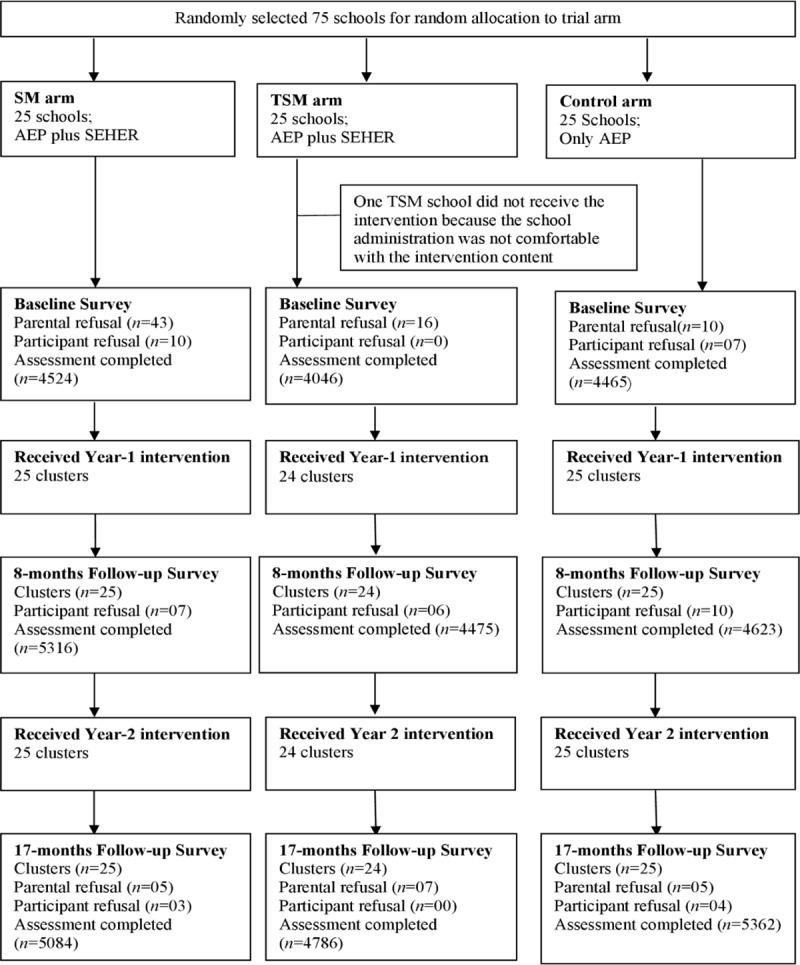
BACKGROUND: Strengthening Evidence base on scHool-based intErventions for pRomoting adolescent health (SEHER) is a multicomponent, whole-school health promotion intervention delivered by a lay counsellor or a teacher in government-run secondary schools in Bihar, India. The objective of this study is to examine the effects of the intervention after two years of follow-up and to evaluate the consistency of the findings observed over time. METHODS AND FINDINGS: We conducted a cluster randomised trial in which 75 schools were randomised (1:1:1) to receive the SEHER intervention delivered by a lay counsellor (SEHER Mitra [SM]) or a teacher (Teacher as SEHER Mitra [TSM]), respectively, alongside a standardised, classroom-based life skills Adolescence Education Program (AEP), compared to AEP alone (control group). The trial design was a repeat cross-sectional study. Students enrolled in grade 9 (aged 13-15 years) in the 2015-2016 academic year were exposed to the intervention for two years and the outcome assessment was conducted at three time points─at baseline in June 2015; 8-months follow-up in March 2016, when the students were still in grade 9; and endpoint at 17-months follow-up in December 2016 (when the students were in grade 10), the results of which are presented in this paper. The primary outcome, school climate, was measured with the Beyond Blue School Climate Questionnaire (BBSCQ). Intervention effects were estimated using mixed-effects linear or logistic regression, including a random effect to adjust for within-school clustering, minimisation variables, baseline cluster-level score of the outcome, and sociodemographic characteristics. In total, 15,232 students participated in the 17-month survey. Compared with the control group, the participants in the SM intervention group reported improvements in school climate (adjusted mean difference [aMD] = 7.33; 95% CI: 6.60-8.06; p < 0.001) and most secondary outcomes (depression: aMD = -4.64; 95% CI: -5.83-3.45; p < 0.001; attitude towards gender equity: aMD = 1.02; 95% CI: 0.65-1.40; p < 0.001; frequency of bullying: aMD = -2.77; 95% CI: -3.40 to -2.14; p < 0.001; violence victimisation: odds ratio [OR] = 0.08; 95% CI: 0.04-0.14; p < 0.001; and violence perpetration: OR = 0.16; 95% CI: 0.09-0.29; p < 0.001). There was no evidence of an intervention effect in the TSM group compared with control group. The effects of the lay counsellor-delivered intervention were larger for most outcomes at 17-months follow-up compared with those at 8 months: school climate (effect size [ES; 95% CI] = 2.23 [1.97-2.50] versus 1.88 [1.44-2.32], p < 0.001); depression (ES [95% CI] = -1.19 [-1.56 to -0.82] versus -0.27 [-0.44 to -0.11], p < 0.001); attitude towards gender equity (ES [95% CI] = 0.53 [0.27-0.79] versus 0.23 [0.10-0.36], p < 0.001); bullying (ES [95% CI] = -2.22 [-2.84 to -1.60] versus -0.47 [-0.61 to -0.33], p < 0.001); violence victimisation (OR [95% CI] = 0.08 [0.04-0.14] versus 0.62 [0.46-0.84], p < 0.001); and violence perpetration (OR [95% CI] = 0.16 [0.09-0.29] versus 0.68 [0.48-0.96], p < 0.001), suggesting incremental benefits with an extended intervention. A limitation of the study is that 27% of baseline participants did not complete the 17-month outcome assessment. CONCLUSIONS: The trial showed that the second-year outcomes were similar to the first-year outcomes, with no effect of the teacher-led intervention and larger benefits on school climate and adolescent health accruing from extending lay counsellor-delivered intervention. TRIAL REGISTRATION: ClinicalTrials.gov NCT02907125.
Overview
The claims and statistics of this paper haven’t been checked yet.
Free: it reads the open-access text and checks the first 5 claims that cite a source we can check. Create a free account to check every claim.
Integrity signals
Registry
Cites
Statistics
Figures
Verification
Claims the paper makes
The claims and statistics of this paper haven’t been checked yet.
Free: it reads the open-access text and checks the first 5 claims that cite a source we can check. Create a free account to check every claim.
Claims other papers make about this one
Each is checked against this paper’s own text: does it say what the citing paper says it does?
In the citing paper
“Multi-component public health and youth engagement strategies impacting the overall school climate (rather than individual behaviour change) may improve depressive symptoms (along with physical health outcomes) 171,172”
From Preventive psychiatry: a blueprint for improving the mental health of young people (2021) · cites this paper as [172]
Self-check
Percentages, sums and reported differences re-computed from the paper’s own numbers.
The self-check needs the paper’s full text.
Citations
Cites
Our future: a Lancet commission on adolescent health and wellbeing
Patton, G. C., Sawyer, S. M., Santelli, J. S., Ross, D. A., Afifi, R., Allen, N. B., Arora, M., Azzopardi, P., Baldwin, W., Bonell, C., et al. (2016) · The Lancet · doi:10.1016/s0140-6736(16)00579-1 · Cited by 3,785
Self-citationMinimization: A new method of assigning patients to treatment and control groups
Taves, D. R. (1974) · Clinical Pharmacology & Therapeutics · doi:10.1002/cpt1974155443 · Cited by 891
Hayes, R. J., & Moulton, L. H. (2009) · Chapman & Hall/CRC eBooks · doi:10.1201/9781584888178 · Cited by 887 · cited 1×
“All adjusted models included a random effect to adjust for within-school clustering, stratification variables (school type, school size, and school nature), baseline cluster-level score of the outcome, and a priori fixed effects to account for age, gender, marital status, and parents’ education and occupation [25].”
MethodLangford, R., Bonell, C. P., Jones, H. E., Pouliou, T., Murphy, S. M., Waters, E., Komro, K. A., Gibbs, L. F., Magnus, D., & Campbell, R. (2014) · Cochrane Database of Systematic Reviews · doi:10.1002/14651858.cd008958.pub2 · Cited by 768
The method of minimization for allocation to clinical trials
Scott, N. W., McPherson, G. C., Ramsay, C. R., & Campbell, M. K. (2002) · Controlled Clinical Trials · doi:10.1016/s0197-2456(02)00242-8 · Cited by 651
Pulerwitz, J., & Barker, G. (2008) · Men and Masculinities · doi:10.1177/1097184x06298778 · Cited by 526
Systematic review of school-based prevention and early intervention programs for depression
Calear, A. L., & Christensen, H. (2010) · Journal of Adolescence · doi:10.1016/j.adolescence.2009.07.004 · Cited by 365 · cited 1×
“These findings seem aligned with the evidence from a systematic review of 42 randomised controlled trials of 28 school-based individual interventions for depression, which observed that effects were larger when the intervention was delivered by mental health professionals or graduate students as compared to teacher-le…”
ResultExamining the Effectiveness of School-Bullying Intervention Programs Globally: a Meta-analysis
Gaffney, H., Farrington, D. P., & Ttofi, M. M. (2019) · International Journal of Bullying Prevention · doi:10.1007/s42380-019-0007-4 · Cited by 309 · cited 1×
“In a meta-analysis of 100 independent evaluations of anti-bullying programmes, three of the four programmes adopted a ‘whole-school’ approach; however, the whole-school approach was not always the most effective [30].”
BackgroundShackleton, N., Jamal, F., Viner, R. M., Dickson, K., Patton, G., & Bonell, C. (2016) · Journal of Adolescent Health · doi:10.1016/j.jadohealth.2015.12.017 · Cited by 221 · cited 2×
“The SM and TSM selection, training, and supervision are detailed elsewhere [9].”
BackgroundSelf-citationShinde, S., Weiss, H. A., Varghese, B., Khandeparkar, P., Pereira, B., Sharma, A., Gupta, R., Ross, D. A., Patton, G., & Patel, V. (2018) · The Lancet · doi:10.1016/s0140-6736(18)31615-5 · Cited by 219 · cited 5×
“We have previously published the trial results comparing the effects of the two delivery approaches (SM and TSM) with the control (the classroom Adolescence Education Program [AEP], which teaches life skills) among a cohort of grade 9 students, evaluated at the end of the grade 9 academic year [11].”
BackgroundMethodSelf-citation
Research works printed but not linked: 4
- Government of India. District Census 2011. Census Organization of India, New Delhi, India; 2011.
- Global Accelerated Action for the Health of Adolescents (AA-HA!): guidance to support country implementation. Summary. Geneva: World Health Organization; 2017.
- World Health Organisation. The health promoting school-a framework for action in the WHO Western Pacific Region. Manila: Regional Office for the Western Pacific; 1995.
- Adelman HS and Taylor L. Mental health in schools: Engaging learners, prevention problems, and improving schools. Thousand Oaks, CA: Corwin Press; 2010.
Cited by
Time for united action on depression: a Lancet–World Psychiatric Association Commission
Herrman, H., Patel, V., Kieling, C., Berk, M., Buchweitz, C., Cuijpers, P., Furukawa, T. A., Kessler, R. C., Kohrt, B. A., Maj, M., et al. (2022) · The Lancet · doi:10.1016/s0140-6736(21)02141-3 · Cited by 1,104
Self-citationThapar, A., Eyre, O., Patel, V., & Brent, D. (2022) · The Lancet · doi:10.1016/s0140-6736(22)01012-1 · Cited by 869
“…Evidence base on scHool-based intErventions for pRomoting adolescent health), a school based intervention with universal, group and targeted strategies; a trial in rural India demonstrated large reductions in depressive symptoms where the intervention was delivered by lay counsellors 108,109 .”
Self-citationPreventive psychiatry: a blueprint for improving the mental health of young people
Fusar‐Poli, P., Correll, C. U., Arango, C., Berk, M., Patel, V., & Ioannidis, J. P. A. (2021) · World Psychiatry · doi:10.1002/wps.20869 · Cited by 497
Self-citationKnipe, D., Padmanathan, P., Newton-Howes, G., Chan, L. F., & Kapur, N. (2022) · The Lancet · doi:10.1016/s0140-6736(22)00173-8 · Cited by 331
Adverse childhood experiences and lifelong health
Bhutta, Z. A., Bhavnani, S., Betancourt, T. S., Tomlinson, M., & Patel, V. (2023) · Nature Medicine · doi:10.1038/s41591-023-02426-0 · Cited by 182
Self-citationWasserman, D., Carli, V., Iosue, M., Javed, A., & Herrman, H. (2021) · Asia-Pacific Psychiatry · doi:10.1111/appy.12452 · Cited by 158
“It found large and incremental effects with time in reducing bullying and depression symptom severity (Shinde et al., 2020).”
BackgroundO’Connor, R. C., Worthman, C. M., Abanga, M. A., Athanassopoulou, N., Boyce, N., Chan, L. F., Christensen, H. M., Das‐Munshi, J., Downs, J. L., Koenen, K. C., et al. (2023) · The Lancet Psychiatry · doi:10.1016/s2215-0366(23)00058-5 · Cited by 153
“109 Indeed, a multi-component school-based health promotion intervention in India to promote adolescent health has also shown promise, 110 highlighting an important role for early intervention.”
BackgroundSingla, D. R., Shinde, S., Patton, G. C., & Patel, V. (2020) · Journal of Adolescent Health · doi:10.1016/j.jadohealth.2020.09.030 · Cited by 125
Self-citationWalsh, E. H., McMahon, J., & Herring, M. P. (2022) · Journal of Child Psychology and Psychiatry · doi:10.1111/jcpp.13598 · Cited by 80
“The lower-bound 95%CIs of the teacher-led trial by Shinde et al. (2020) were higher than the SA pooled effect upper-bound 95%CI, indicating that this trial is not part of the ‘population’ effect (Harrer, Cuijpers, Furukawa, & Ebert, 2019).”
InfluentialMental Health Interventions among Adolescents in India: A Scoping Review
Mehra, D., Lakiang, T., Kathuria, N., Kumar, M., Mehra, S., & Sharma, S. (2022) · Healthcare · doi:10.3390/healthcare10020337 · Cited by 114
Ceccarelli, C., Prina, E., Muneghina, O., Jordans, M. J. D., Barker, E. D., Miller, K. E., Singh, R. K., Acartürk, C., Sorsdhal, K., Cuijpers, P. J., et al. (2022) · Epidemiology and Psychiatric Sciences · doi:10.1017/s2045796022000580 · Cited by 70
Global pandemic perspectives: public health, mental health, and lessons for the future
Moeti, M. R., Gao, G. F., & Herrman, H. (2022) · The Lancet · doi:10.1016/s0140-6736(22)01328-9 · Cited by 77
Yosep, I., Hikmat, R., & Mardhiyah, A. (2023) · International Journal of Environmental Research and Public Health · doi:10.3390/ijerph20021577 · Cited by 99
“Multicomponent secondary school health promotion intervention was carried out for 4 weeks [30].”
BackgroundInfluentialLekamge, R. B., Jain, R., Sheen, J., Solanki, P., Zhou, Y., Romero, L., Barry, M. M., Chen, L., Karim, M. N., & Ilić, D. (2025) · Journal of Youth and Adolescence · doi:10.1007/s10964-025-02135-6 · Cited by 91
Walsh, E. H., Herring, M. P., & McMahon, J. (2023) · Prevention Science · doi:10.1007/s11121-022-01449-2 · Cited by 50
Filia, K., Eastwood, O., Herniman, S. E., & Badcock, P. B. (2021) · Translational Psychiatry · doi:10.1038/s41398-021-01406-7 · Cited by 61
Shenderovich, Y., Boyes, M. E., Esposti, M. D., Casale, M., Toska, E., Roberts, K. J. S., & Cluver, L. D. (2021) · BMC Public Health · doi:10.1186/s12889-020-10147-z · Cited by 50
School educational models and child mental health among K-12 students: a scoping review
Yu, T., Xu, J., Jiang, Y., Hua, H., Zhou, Y., & Guo, X. (2022) · Child and Adolescent Psychiatry and Mental Health · doi:10.1186/s13034-022-00469-8 · Cited by 60
Nagamitsu, S., Kanie, A., Sakashita, K., Sakuta, R., Okada, A., Matsuura, K., Ito, M., Katayanagi, A., Katayama, T., Otani, R., et al. (2022) · JMIR mhealth and uhealth · doi:10.2196/34154 · Cited by 51
Cruz, C. M., Lamb, M. M., Giri, P., Vanderburg, J. L., Ferrarone, P., Bhattarai, S., Giardina, A. A., Hampanda, K., Gaynes, B. N., & Matergia, M. (2021) · International Journal of Mental Health Systems · doi:10.1186/s13033-021-00453-3 · Cited by 37
School Mental Health Program in India—Issues and Possible Practical Solutions
Raman, V., & Thomas, S. (2023) · Indian Journal of Psychological Medicine · doi:10.1177/02537176231165033 · Cited by 46
A Systematic Review of Bullying and Victimization Among Adolescents in India
Thakkar, N., van Geel, M., & Vedder, P. H. (2020) · International Journal of Bullying Prevention · doi:10.1007/s42380-020-00081-4 · Cited by 40
“Only two of the 37 included studies were experimental studies with pre- and post-test intervention designs (Sharma et al. 2020; Shinde et al. 2018, 2020), which also underlines the urgent need to conduct fundamental indigenous research on the topic of bullying behaviors so that future research…”
BackgroundHugh‐Jones, S., Naidu, J., Al‐Janabi, H., Bhola, P., Cooke, P. A., Fazel, M. S., Hudson, K., Khandeparkar, P., Mirzoev, T. N., Venkataraman, S., et al. (2022) · BMJ Open · doi:10.1136/bmjopen-2021-054897 · Cited by 35
Self-citationHarte, P., & Barry, M. M. (2024) · Cambridge Prisms Global Mental Health · doi:10.1017/gmh.2024.48 · Cited by 45
“This is best demonstrated by comparing the positive, sustained effects of the multi-component SEHER when implemented by lay counsellors (SM) with the null effects when implemented by class teachers (TSM), who reported inadequate support and time for delivery (Shinde et al., 2018, 2020).”
BackgroundDavies, C. A., Cordier, R., Graham, P., Littlefair, D., Speyer, R., & Melo, D. (2025) · Education Sciences · doi:10.3390/educsci15050582 · Cited by 50
Purgato, M., Prina, E., Ceccarelli, C., Cadorin, C., Abdulmalik, J. O., Amaddeo, F., Arcari, L., Churchill, R., Jordans, M. J., Lund, C., et al. (2023) · Cochrane Database of Systematic Reviews · doi:10.1002/14651858.cd014722.pub2 · Cited by 27
Debate: Where to next for universal school‐based mental health interventions?
Birrell, L., Grummitt, L. R., Smout, S., Maulik, P. K., Teesson, M., & Newton, N. C. (2025) · Child and Adolescent Mental Health · doi:10.1111/camh.12749 · Cited by 33
Bullying among children and adolescents in the SAARC countries: A scoping review
Srinivasan, S. P., Arumugam, C., Rangeela, E., Raghavan, V., & Ramachandran, P. (2022) · Heliyon · doi:10.1016/j.heliyon.2022.e09781 · Cited by 26
Hunt, X., Shakespeare, T., Vilyte, G., Meléndez‐Torres, G. J., Henry, J., Bradshaw, M., Naidoo, S., Mbuyamba, R., Aljassem, S., Suubi, E., et al. (2023) · International Journal of Environmental Research and Public Health · doi:10.3390/ijerph20031895 · Cited by 32
“Life skills programmes delivered in schools as part of the curriculum were shown to be effective for promoting social inclusion in two studies [48,54].”
BackgroundMahajan, A., Negi, P. C., Gandhi, S., Sharma, D. D., & Grover, N. (2021) · The Indian Journal of Pediatrics · doi:10.1007/s12098-021-03786-6 · Cited by 18
“A study in Bihar reported substantial beneficial effects on school climate and health-related outcomes when delivered by lay counselors, but no effects when delivered by teachers [28, 29].”
BackgroundResultFoulkes, L., Holst, C. G., & Andrews, J. L. (2025) · Current Opinion in Psychology · doi:10.1016/j.copsyc.2025.102196 · Cited by 23
Ponsford, R., Meléndez‐Torres, G. J., Miners, A. H., Falconer, J., & Bonell, C. P. (2024) · Public Health Research · doi:10.3310/dwtr3299 · Cited by 27
Bechange, S., Gillani, M., Jolley, E., Iqbal, R., Ahmed, L., Bilal, M., Khan, I. K., Yasmin, S., & Schmidt, E. (2021) · BMC Public Health · doi:10.1186/s12889-021-10404-9 · Cited by 22
“In many countries, tasks such as screening for malnutrition, immunizations and deworming have been successfully performed by trained teachers in the school setting [20, 21].”
BackgroundMental health in adolescence: the role of schools-based social emotional teaching
Kuyken, W., Blakemore, S., Byford, S., Dalgleish, T., Ford, T. J., Hinze, V., Mansfield, K. L., Montero‐Marín, J., Ukoumunne, O. C., & Viner, R. (2023) · Journal of Mental Health · doi:10.1080/09638237.2023.2210668 · Cited by 23
“Instead, specialist mental health practitioners could to work alongside school teachers (e.g., Shinde et al., 2020), and include a whole school approach that includes supporting teachers’ mental health MYRIAD and numerous other studies have shown that such programs can enhance teachers’ mental…”
Prabhu, S. G., Mallikarjun, P. K., Palmer, A., Nag, R., Khadeparkar, P., Arelingaiah, M., Lakshman, K. A., Podiya, J. K., Navaneetham, J., & Hugh‐Jones, S. (2024) · Journal of Mental Health · doi:10.1080/09638237.2024.2426994 · Cited by 29
“Despite some disquiet about schools as places for public mental health work (e.g. Eisenbach & Frydman, 2023; Shinde et al., 2020), evidence suggests that teachers world-wide are generally open to improving their MHL so that they can deliver responsible and effective front-line responses to young…”
Prokop‐Dorner, A., Piłat, A., Ślusarczyk, M., Świątkiewicz‐Mośny, M., Ożegalska-Łukasik, N., Potysz-Rzyman, A., Zarychta, M., Juszczyk, A., Kondyjowska, D., Magiera, A., et al. (2024) · PLoS ONE · doi:10.1371/journal.pone.0307094 · Cited by 22
“…73, 82, 124, 127, 128, 136], contraceptive methods [62, 94, 120, 124], menstruation [14], gender roles [32, 108, 119, 132], healthy relationships [32, 55, 119], sexually transmitted disease [82, 86, 118, 119], and AIDS and HIV prevention [21, 55, 56, 59, 73, 82, 86, 116, 118, 119, 124, 133, 136].”
BackgroundMoore, G. F. (2025) · Journal of Child Psychology and Psychiatry · doi:10.1111/jcpp.70061 · Cited by 22
Lemberger-Truelove, M. E., Li, D., Kim, H., Hill, D. D., Dickson, R., & Kang, Z. (2026) · Adolescents · doi:10.3390/adolescents6010006 · Cited by 17
Pilot Study on the Effects of the Teaching Interpersonal Skills Program for Teens Program (PEHIA)
Pintado, I. S., Llamazares, M. D. C. E., & Sánchez-Mateos, J. D. (2022) · Frontiers in Psychology · doi:10.3389/fpsyg.2022.764926 · Cited by 14
“…et al., 2002), without which there is an increased risk of behavioral problems in interpersonal relationships, difficulties in psychological well-being, academic performance and a greater likelihood of disruptive behaviors (Carmona and López, 2015; Armada Crespo et al., 2020; Shinde et al., 2020).”
BackgroundMeléndez‐Torres, G. J., Ponsford, R., Falconer, J., & Bonell, C. P. (2023) · Public Health · doi:10.1016/j.puhe.2023.06.021 · Cited by 20
“This analysis drew on 71 effect sizes from 11 studies 35 e 38,44,46,49 e 56 and included a substantial amount of heterogeneity with an I 2 of 80.8% (see Supplementary File 1).”
MethodInfluentialAkran Zorbalığını Önlemede Okul Tabanlı Müdahale Programları: Sistematik Derleme
Toraman, A. U., Dağhan, Ş., & Ökkeş, K. I. S. A. (2021) · Humanistic Perspective · doi:10.47793/hp.936791 · Cited by 14
Empowering Adolescents to Transform Schools: Lessons from a Behavioral Targeting
Alan, Ş., & Kubilay, E. (2025) · American Economic Review · doi:10.1257/aer.20240374 · Cited by 19
Coetzee, B., & Loades, M. E. (2024) · Child and Adolescent Mental Health · doi:10.1111/camh.12752 · Cited by 9
“For example, the Strengthening Evidence Base on School-Based Interventions for Promoting Adolescent Health (SEHER) program in India (Shinde et al., 2018, 2020), which Birrell et al. (2025) point out in their piece, utilised trained lay counsellors and teachers to deliver school-based mental health support, and showed…”
Lekamge, R. B., Jain, R., Sheen, J., Solanki, P., Zhou, Y., Romero, L., Barry, M. M., Chen, L., Karim, M. N., & Ilić, D. (2025) · Campbell Systematic Reviews · doi:10.1002/cl2.70024 · Cited by 15
“…by students in the baseline survey) and the nature of bullying in schools, as well as establishing consistent approaches to bullying prevention and effective disciplinary practices among staff for managing bullying incidents (Cross et al. 2018; Shinde et al. 2020; Hunt 2007; Stevens et al. 2000).”
InfluentialSeervi, A., & Sharma, I. (2025) · Indian Journal of Psychiatry · doi:10.4103/indianjpsychiatry_537_25 · Cited by 7
“[22,23] These recommendations align with international postvention frameworks and evidence-based school guidelines that emphasize coordinated crisis response, ongoing student and staff support, and systematic monitoring.”
Yamaguchi, S., DeVylder, J., Yamasaki, S., Ando, S., Miyashita, M., Hosozawa, M., Baba, K., Niimura, J., Nakajima, N., Usami, S., et al. (2024) · Psychological Medicine · doi:10.1017/s0033291724003192 · Cited by 6
Birrell, L., Grummitt, L. R., Christensen, H. M., & Teesson, M. (2025) · Research Directions Depression · doi:10.1017/dep.2025.1 · Cited by 6
“Effects were sustained at 2 years, but only when the intervention was delivered by a lay counsellor (compared to a teacher or control) (Shinde et al., 2020).”
Reininghaus, U., Rauschenberg, C., Schick, A., & Hartmann, J. (2023) · Bundesgesundheitsblatt - Gesundheitsforschung - Gesundheitsschutz · doi:10.1007/s00103-023-03673-9 · Cited by 6
Alekhya, G., Chinnadurai, A., Dora, S., Patro, S. K., Sahu, D. P., & Mourougan, M. (2025) · Reproductive Health · doi:10.1186/s12978-025-02098-8 · Cited by 4
“This finding was similar to a cluster randomized trial in Bihar where teachers felt overworked and unable to meet requirement of program [43].”
Mapping the literature on school bullying in India: A scoping review
Suresh, S., & Vijaya, R. (2024) · Aggression and Violent Behavior · doi:10.1016/j.avb.2024.101978 · Cited by 7
Neelakantan, L., Logan, N., Raniti, M. B., Morgan, A. J., Lim, M. H., & Reavley, N. J. (2025) · Mental Health & Prevention · doi:10.1016/j.mhp.2025.200465 · Cited by 5
Yosep, I., Hikmat, R., Mardhiyah, A., & Purnama, H. (2025) · BMC Nursing · doi:10.1186/s12912-025-03991-0 · Cited by 3
“Because of its repetitive nature, bullying tends to have long-term detrimental effects, not only for the victim but also for the perpetrator and bystanders [3].”
Lewer, D., Gilbody, S. M., Lewis, G., Pryce, J., Santorelli, G., Wadman, R., Watmuff, A., & Wright, J. (2024) · Social Psychiatry and Psychiatric Epidemiology · doi:10.1007/s00127-023-02608-8 · Cited by 8
Manjari, A. S., & Sudhesh, N. T. (2024) · Journal of Child and Adolescent Psychiatric Nursing · doi:10.1111/jcap.70003 · Cited by 5
Novel skills-based training for healthy lifestyle adoption in India
Thatshanamoorthy, N., Vasudevan, J., Ilango, M., Ramanathan, M., & Sundararajan, T. (2026) · Health Education Journal · doi:10.1177/00178969261419244 · Cited by 2
“Our study bridges this gap by demonstrating that skills-based interventions can effectively target multiple health behaviours simultaneously (Shinde et al., 2020).”
Aggression, Suicide, and Self-Harm in Children and Adolescents
Chhabria, A., & Khar, P. B. (2023) · Journal of Indian Association for Child and Adolescent Mental Health · doi:10.1177/09731342231190715 · Cited by 6
Role of Gratitude in Positive Adolescent Development
Khanna, P., Singh, K. K., & Dua, S. (2022) · Springer eBooks · doi:10.1007/978-981-16-9881-1_19 · Cited by 4
Saúde no ambiente escolar: uma revisão integrativa da literatura
Silveira, L. D. S., Vargas, D. D. S., Jacobi, L. F., & Schetinger, M. R. C. (2023) · Revista Foco · doi:10.54751/revistafoco.v16n6-094 · Cited by 2
Bantwal, P., Kulkarni, M. M., Kamath, V. G., Jay, R., Jois, G. S., Nivetha, S., Shankar, M., Bajwa, D. S., Bhagawath, R., & Naik, A. K. (2024) · Child & Youth Care Forum · doi:10.1007/s10566-024-09830-8 · Cited by 8
“However, our review found a study where long-term follow-up of teacher led intervention had adverse effects, demonstrating increased odds for tobacco use (Shinde et al., 2018, 2020).”
Sawyer, S. M., Raniti, M. B., & Borschmann, R. (2025) · BJPsych Open · doi:10.1192/bjo.2025.10058 · Cited by 1
Giri, P., Dukpa, C., Vanderburg, J. L., Bhattarai, S., Thapa, A., Rauniyar, A. K., Hampanda, K., Gaynes, B. N., Lamb, M. M., Lama, R., et al. (2025) · Australasian Psychiatry · doi:10.1177/10398562251381451 · Cited by 1
Shenderovich, Y., Martin, M., Lachman, J. M., Mgunga, S., Ndyetabura, E., & Wamoyi, J. (2025) · Prevention Science · doi:10.1007/s11121-025-01852-5 · Cited by 3
“…may vary across locations and timing, thereby necessitating different intervention modifications, particularly due to COVID, while facilitator background may influence modifications because of previous training or ongoing work with the same communities in a different role (Shinde et al., 2020).”
Zhong, Y., Zhang, Z.-W., Ding, J.-H., Sun, Y., Zheng, Y., Yu, Y.-F., Guan, Z.-C., Su, S.-Z., Wu, T., Gong, Y.-M., et al. (2026) · Molecular Psychiatry · doi:10.1038/s41380-026-03605-4 · Cited by 3
Podiya, J. K., Navaneetham, J., Bhola, P., Arelingaiah, M., Prabhu, S. G., Nag, R., Lakshman, K. A., & Hugh‐Jones, S. (2025) · International Journal of Bullying Prevention · doi:10.1007/s42380-025-00308-2 · Cited by 3
“School is a significant place to promote health awareness and healthy behavior among adolescents in India (Shinde et al. 2020).”
Cruz, C. M., Lamb, M. M., Giri, P., Vanderburg, J. L., Ferrarone, P., Bhattarai, S., Giardina, A. A., Hampanda, K., Gaynes, B. N., & Matergia, M. (2020) · doi:10.21203/rs.3.rs-98098/v1 · Cited by 2
Izutsu, T., Tsutsumi, A., Moodie, R., Saxena, S., & Herrman, H. (2024) · Elsevier eBooks · doi:10.1016/b978-0-323-99967-0.00177-0 · Cited by 1
Irarrázaval, M. (2022) · Depression and personality · doi:10.1007/978-3-031-13029-8_2
Hot Topics in Public Mental Health
Bhui, K. S., Mooney, R., Butcher, I., & Hugh‐Jones, S. (2023) · World Social Psychiatry · doi:10.4103/wsp.wsp_29_23
Harte, P., & Barry, M. M. (2024) · Cambridge Prisms Global Mental Health · doi:10.1017/gmh.2024.48.pr3
Harte, P., & Barry, M. M. (2024) · Cambridge Prisms Global Mental Health · doi:10.1017/gmh.2024.48.pr2
Harte, P., & Barry, M. M. (2024) · Cambridge Prisms Global Mental Health · doi:10.1017/gmh.2024.48.pr5
Harte, P. (2024) · Cambridge Prisms Global Mental Health · doi:10.1017/gmh.2024.48.pr4
Harte, P., & Barry, M. M. (2024) · Cambridge Prisms Global Mental Health · doi:10.1017/gmh.2024.48.pr6
Harte, P. (2023) · Cambridge Prisms Global Mental Health · doi:10.1017/gmh.2024.48.pr1
Mental Health Issues Among Adolescents: Challenges and Management
Kumar, S., Kumar, K., Avti, P., & Anand, A. (2024) · Current Psychiatry Research and Reviews · doi:10.2174/0126660822308733240820065218 · Cited by 1
Wadman, R., Taylor, O., Hudson, K., Lewer, D., Hewitt, C. E., Pickavance, J., Pryce, J., Wright, J., & Gilbody, S. M. (2024) · NIHR Open Research · doi:10.3310/nihropenres.13678.1
Revisão integrativa de intervenções com foco no clima escolar
da Silva, A. C. P., Fernandes, G., Braga, J. P. G., Danzmann, P. S., Durgante, H. B., & Patias, N. D. (2025) · Psico-USF · doi:10.1590/1413-8271202530e281015
An integrated TISM and MICMAC approach to adolescent perceptions of sexual education in India
Joshi, R. M., & Gupta, D. (2025) · International Journal of Adolescence and Youth · doi:10.1080/02673843.2025.2544943 · Cited by 1
Hugh‐Jones, S., Prabhu, S. G., Arelingaiah, M., Podiya, J. K., Lakshman, K., Nag, R., Warriner, L., Palmer, A., Hudson, K., Fazel, M. S., et al. (2025) · Frontiers in Public Health · doi:10.3389/fpubh.2025.1670439 · Cited by 6
Self-citationBROWN, R. M. A., Lennon, J., Donaldson, C., Anthony, R., Rowe, A., & Moore, G. (2025) · Wellbeing Space and Society · doi:10.1016/j.wss.2025.100333
“There is some evidence to suggest that whole school interventions, which by definition address multiple aspects of the school environment, can be effective in reducing bullying (Bonell et al. 2018; Shinde et al. 2020) and it reasonable to theorise that this would, in turn, improve perceived EMWB .”
Cruz, C. M., Lamb, M. M., Giri, P., Vanderburg, J. L., Ferrarone, P., Bhattarai, S., Giardina, A. A., Hampanda, K., Gaynes, B. N., & Matergia, M. (2021) · Figshare · doi:10.6084/m9.figshare.14516701
Bechange, S., Gillani, M., Jolley, E., Iqbal, R., Ahmed, L., Bilal, M., Khan, I. K., Yasmin, S., & Schmidt, E. (2021) · Figshare · doi:10.6084/m9.figshare.14053477
Bechange, S., Gillani, M., Jolley, E., Iqbal, R., Ahmed, L., Bilal, M., Khan, I. K., Yasmin, S., & Schmidt, E. (2021) · Figshare · doi:10.6084/m9.figshare.14053471
Cruz, C. M., Lamb, M. M., Giri, P., Vanderburg, J. L., Ferrarone, P., Bhattarai, S., Giardina, A. A., Hampanda, K., Gaynes, B. N., & Matergia, M. (2021) · Figshare · doi:10.6084/m9.figshare.14516704
Cruz, C. M., Lamb, M. M., Giri, P., Vanderburg, J. L., Ferrarone, P., Bhattarai, S., Giardina, A. A., Hampanda, K., Gaynes, B. N., & Matergia, M. (2021) · Figshare · doi:10.6084/m9.figshare.14516707
Bechange, S., Gillani, M., Jolley, E., Iqbal, R., Ahmed, L., Bilal, M., Khan, I. K., Yasmin, S., & Schmidt, E. (2021) · Figshare · doi:10.6084/m9.figshare.14053474
Yu, T., Xu, J., Jiang, Y., Hua, H., Zhou, Y., & Guo, X. (2022) · Figshare · doi:10.6084/m9.figshare.19669961
Shenderovich, Y., Boyes, M. E., Esposti, M. D., Casale, M., Toska, E., Roberts, K. J. S., & Cluver, L. D. (2021) · Figshare · doi:10.6084/m9.figshare.13619824
School-Based Intervention Programs in Preventing Peer Bullying: A Systematic Review
Toraman, A. U., Dağhan, Ş., & Ökkeş, K. I. S. A. (2021) · Humanistic Perspective
Dabrowski, A., Mackley, G., Fernando, C., Rahim, H. A., & Siena, J. A. (2026) · Frontiers in Education · doi:10.3389/feduc.2026.1812649
Preventive strategies for mental disorders in children and adolescents
Golovina, A. G., & Shmakova, O. P. (2026) · S S Korsakov Journal of Neurology and Psychiatry · doi:10.17116/jnevro202612609264
Inclusive Teaching: Spotting Social Isolation in the Classroom
Alan, Ş., Carlana, M., & Leone, M. (2026) · American Economic Journal Economic Policy · doi:10.1257/pol.20250089 · Cited by 2
Metadata
- Authors
- Shinde, S., Weiss, H. A., Khandeparkar, P., Pereira, B., Sharma, A., Gupta, R., Ross, D. A., Patton, G., & Patel, V.
- Affiliations
- Population Council (IN)
- London School of Hygiene & Tropical Medicine (GB)
- Sangath (IN)
- The University of Melbourne (AU)
- Harvard University (US)
- Corresponding author
- Patel, Vikram
- ORCID
- Venue
- PLOS Medicine
- Publisher
- Public Library of Science (PLoS)
- Published
- 2020-02-11
- Volume
- 17
- Issue
- 2
- Pages
- e1003021
- ISSN
- 1549-1277 (ISSN-L)
- 1549-1676
- PMC
- PMC7012396
- OpenAlex
- W3006607866
- Cited by
- 93
- References
- 22
- Citations by year
- 2026: 6 · 2025: 20 · 2024: 19 · 2023: 13 · 2022: 16 · 2021: 16 · 2020: 3
- FWCI
- 17.10
- Type
- journal article
- Language
- en
- Open access
- gold
- doi.org
- Licence
- Locations
- PLoS Medicine (publishedVersion, cc-by)
- PubMed Central (publishedVersion, cc-by)
- PubMed (publishedVersion)
- LSHTM Research Online (London School of Hygiene and Tropical Medicine) (acceptedVersion)
- Minerva Access (University of Melbourne) (submittedVersion, cc-by)
- RePEc: Research Papers in Economics (submittedVersion)
- DOAJ (DOAJ: Directory of Open Access Journals) (submittedVersion, cc-by-sa)
- Figshare (submittedVersion, cc-by)
- Funders
- John D. and Catherine T. MacArthur Foundation
- United Nations Population Fund India
- Topics
- Health Sciences › Medicine › Public Health, Environmental and Occupational Health › School Health and Nursing Education
- Health Sciences › Medicine › Public Health, Environmental and Occupational Health › Adolescent Health and Behaviors
- Health Sciences › Medicine › Public Health, Environmental and Occupational Health › Adolescent Sexual and Reproductive Health
- Keywords
- school health promotion, adolescent health, teacher-delivered intervention, school climate, depression, life skills education, adolescent sexual and reproductive health, Bihar, high school students, long-term follow-up
- MeSH terms
- Adolescent Health, Adolescent, Attitude, Depression, Female, Humans, India, Male, School Health Services, Social Environment, Violence, Crime Victims, Bullying, Sexism
About these checks
Registry, retraction, Cites and statistics results are computed, not judged, with one exception: a printed reference that no index lists is read once by a model before it counts as a citation error. Claims are extracted by a model and kept only when their quote appears verbatim in the text; each cited source is then checked, with a model’s help, for whether it says what the claim relies on. Those verdicts can be wrong — read the claim’s quote and the cited source before relying on one.
Statistics and arithmetic are recomputed, not judged.
Confidence bands are shown only for fields calibrated on our annotated test set. None is calibrated yet, so no band is shown.
What counts as a claim ›How we measure confidence ›How we check this ›
Are you an author, or do you see a problem with this page? Request a review
Data sources
Bibliographic data: Semantic Scholar, OpenAlex, Crossref.
Contains information from the Semantic Scholar Academic Graph Datasets, made available under the ODC Attribution License (ODC-BY 1.0).
Semantic Scholar’s data is described in: Kinney, R., et al. (2023). The Semantic Scholar Open Data Platform. arXiv:2301.10140.
