

Drug-induced orthostatic hypotension: A systematic review and meta-analysis of randomised controlled trials
Open accessThe DOI matches its Crossref record; 35 of the 35 references it cites were found in a registry or an index.
Abstract
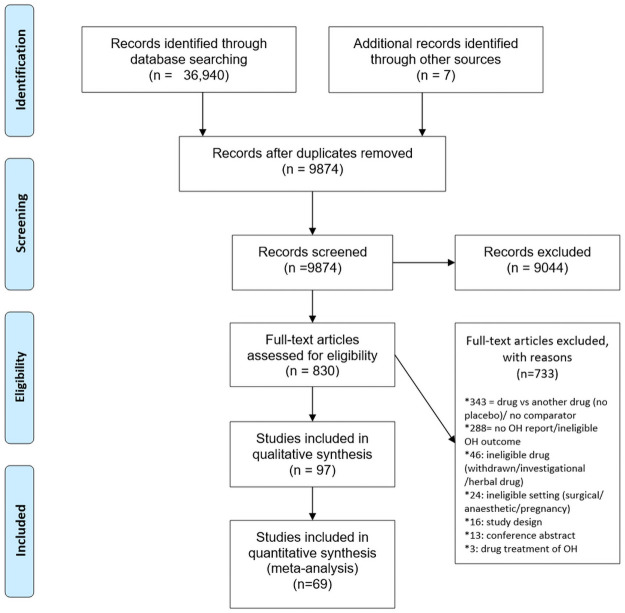
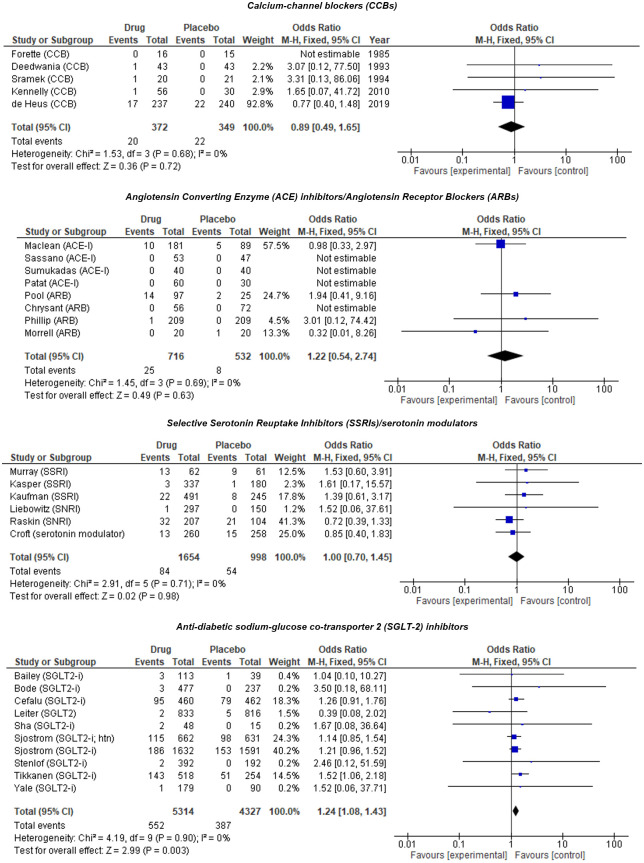
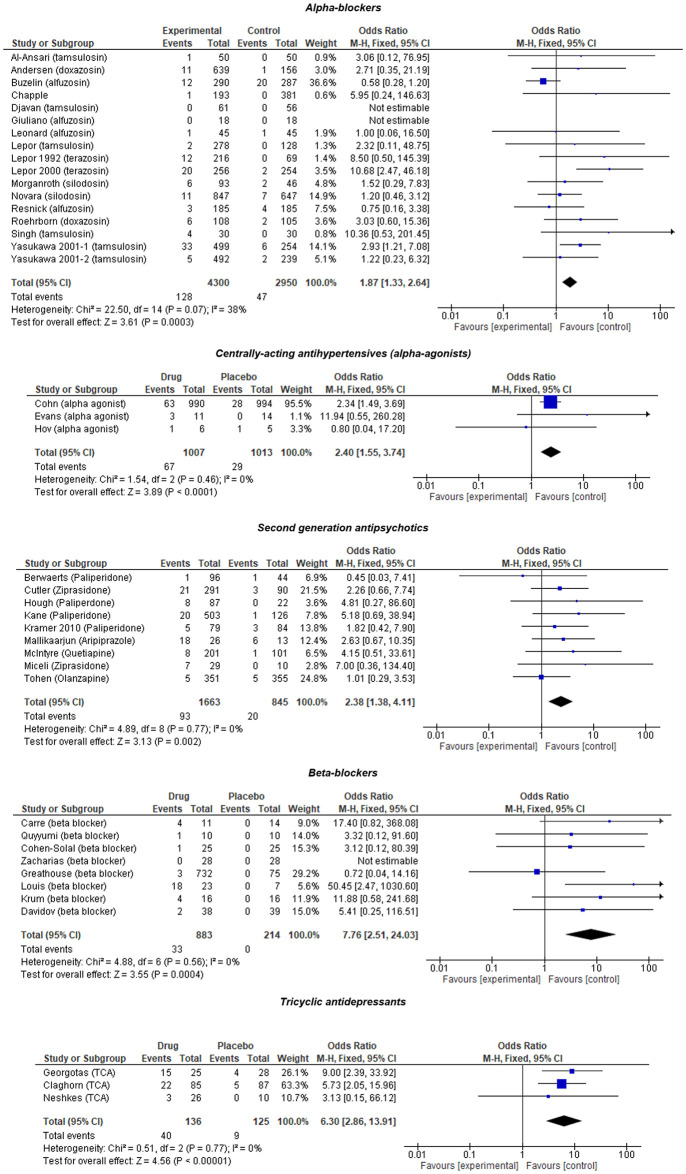
Background: Drug-induced orthostatic hypotension (OH) is common, and its resulting cerebral hypoperfusion is linked to adverse outcomes including falls, strokes, cognitive impairment, and increased mortality. The extent to which specific medications are associated with OH remains unclear. Methods and findings: We conducted a systematic review and meta-analysis to evaluate the extent to which specific drug groups are associated with OH. EMBASE, MEDLINE, and Web of Science databases were searched from inception through 23 November 2020. Placebo-controlled randomised controlled trials (RCTs) on any drug reporting on OH as an adverse effect in adults (≥18 years) were eligible. Three authors extracted data on the drug, OH, dose, participant characteristics, and study setting. The revised Cochrane risk-of-bias tool for randomised trials (RoB 2) was used to appraise evidence. Summary odds ratios (ORs) were estimated for OH using fixed effects Mantel–Haenszel statistics. We conducted subgroup analysis on validity of OH measurement, drug dose, risk of bias, age, and comorbidity. The Grading of Recommendations Assessment, Development, and Evaluation (GRADE) tool was used to summarise the certainty of evidence. Of 36,940 citations, 69 eligible RCTs were included in the meta-analysis comprising 27,079 participants. Compared with placebo, beta-blockers and tricyclic antidepressants were associated with increased odds of OH (OR 7.76 [95% CI 2.51, 24.03]; OR 6.30 [95% CI 2.86, 13.91]). Alpha-blockers, antipsychotics, and SGLT-2 inhibitors were associated with up to 2-fold increased odds of OH, compared to placebo. There was no statistically significant difference in odds of OH with vasodilators (CCBs, ACE inhibitors/ARBs, SSRIs), compared to placebo. Limitations of this study are as follows: data limited to placebo-controlled studies, (excluding head-to-head trials), many RCTs excluded older participants; therefore results may be amplified in older patients in the clinical setting. The study protocol is publicly available on PROSPERO (CRD42020168697). Conclusions: Medications prescribed for common conditions (including depression, diabetes, and lower urinary tract symptoms) were associated with significantly increased odds of OH. Drugs causing sympathetic inhibition were associated with significantly increased odds of OH, while most vasodilators were associated with small nonsignificant differences in odds of OH, compared to placebo. Drugs targeting multiple parts of the orthostatic blood pressure (BP) reflex pathway (e.g. sympathetic inhibition, vasodilation, cardio-inhibitory effects) may carry cumulative risk, suggesting that individuals with polypharmacy could benefit from postural BP monitoring.
Overview
The claims and statistics of this paper haven’t been checked yet.
Free: it reads the open-access text and checks the first 5 claims that cite a source we can check. Create a free account to check every claim.
Integrity signals
Registry
Cites
Statistics
Figures
Verification
Claims the paper makes
The claims and statistics of this paper haven’t been checked yet.
Free: it reads the open-access text and checks the first 5 claims that cite a source we can check. Create a free account to check every claim.
Claims other papers make about this one
Each is checked against this paper’s own text: does it say what the citing paper says it does?
The source backs part of the claim, not all of it — or backs it for a different population, condition or comparison.
In the citing paper
“Some drugs can impair exercise engagement and adaptation, necessitating adjustments in exercise prescriptions, behavioral support, and monitoring.”
From Global consensus on optimal exercise recommendations for enhancing healthy longevity in older adults (ICFSR) (2025) · cites this paper as [570]
Experimental — accuracy not yet measuredThe check wasn’t confident either way, so it gives no verdict — never disputed.
In the citing paper
“For example, psychotropics that cause sedation, fatigue, cognitive deficits, mobility impairment, depression, and anorexia may be replaced by aerobic or PRT [[569], [570], [571], [572]].”
From Global consensus on optimal exercise recommendations for enhancing healthy longevity in older adults (ICFSR) (2025) · cites this paper as [570]
Experimental — accuracy not yet measuredIn the citing paper
“For example, psychotropics that cause sedation, fatigue, cognitive deficits, mobility impairment, depression, and anorexia may be replaced by aerobic or PRT [[569], [570], [571], [572]].”
From Global consensus on optimal exercise recommendations for enhancing healthy longevity in older adults (ICFSR) (2025) · cites this paper as [570]
Self-check
Percentages, sums and reported differences re-computed from the paper’s own numbers.
The self-check needs the paper’s full text.
Citations
Cites
RoB 2: a revised tool for assessing risk of bias in randomised trials
Sterne, J. A. C., Savović, J., Page, M. J., Elbers, R. G., Blencowe, N. S., Boutron, I., Cates, C. J., Cheng, H.-Y., Corbett, M. S., Eldridge, S. M., et al. (2019) · BMJ · doi:10.1136/bmj.l4898 · Cited by 34,787
Cochrane Handbook for Systematic Reviews of Interventions: Cochrane Book Series
(2008) · doi:10.1002/9780470712184 · Cited by 25,048
GRADE: an emerging consensus on rating quality of evidence and strength of recommendations
Guyatt, G. H., Oxman, A. D., Vist, G. E., Kunz, R., Falck-Ytter, Y., Alonso-Coello, P., & Schünemann, H. J. (2008) · BMJ · doi:10.1136/bmj.39489.470347.ad · Cited by 23,305 · cited 1×
“The Grading of Recommendations Assessment, Development, and Evaluation (GRADE) tool [22] was used to summarise the certainty of evidence.”
MethodCochrane Handbook for Systematic Reviews of Interventions
Higgins, J. P. T., Green, S., & Ben Van Den, A. (2020) · International Coaching Psychology Review · doi:10.53841/bpsicpr.2020.15.2.123 · Cited by 5,670
McGuinness, L. A., & Higgins, J. P. T. (2021) · Research Synthesis Methods · doi:10.1002/jrsm.1411 · Cited by 5,579 · cited 1×
“Using the revised Cochrane risk-of-bias tool for randomised trials (RoB 2) [18,19], CB assessed all articles for risk of bias, and 3 reviewers (DN, HH, and SM) independently assessed 10% of articles.”
MethodFreeman, R., Wieling, W., Axelrod, F. B., Benditt, D. G., Benarroch, E., Biaggioni, I., Cheshire, W. P., Chelimsky, T., Cortelli, P., Gibbons, C. H., et al. (2011) · Clinical Autonomic Research · doi:10.1007/s10286-011-0119-5 · Cited by 1,697 · cited 1×
“Orthostatic hypotension (OH), defined as a reduction in systolic blood pressure (BP) of�20 mm Hg or diastolic BP of�10 mm Hg within 3 minutes of assuming an erect posture [1], is estimated to affect 30% to 70% of older adults [2] and is commonly associated with use of medications [3].”
BackgroundFreeman, R., Wieling, W., Axelrod, F. B., Benditt, D. G., Benarroch, E., Biaggioni, I., Cheshire, W. P., Chelimsky, T., Cortelli, P., Gibbons, C. H., et al. (2011) · Autonomic Neuroscience · doi:10.1016/j.autneu.2011.02.004 · Cited by 1,243
Essentials of Medical Pharmacology
Tripathi, K. (2008) · Jaypee Brothers Medical Publishers (P) Ltd. eBooks · doi:10.5005/jp/books/10282 · Cited by 1,032
Essentials of Medical Pharmacology
Tripathi, K. (1994) · Indian Journal of Pharmacology · doi:10.4103/ijpha_1994262_166 · Cited by 886
Scheen, A. J. (2015) · Drugs · doi:10.1007/s40265-014-0337-y · Cited by 554
Research works printed but not linked: 2
- OpenPrescribing.net. EBM DataLab. University of Oxford; 2017 [cited 2021 Sept 15].
- National Institute for Health and Care Excellence. Depression in adults: recognition and management [NICE CG90]. 2009 [cited 2021 Sept 15]. https://www.nice.org.uk/guidance/cg90. 31990491
Cited by
Items 101–116 of 116
Gilyarevskiy, S. R., Shchedrina, A. Y., Golshmid, M. V., Вячеславовна, Л. А., Eruslanova, K. A., Rybaulina, А. Y., & Alibekova, L. Y. (2026) · Russian Journal of Geriatric Medicine · doi:10.37586/2686-8636-1-2026-94-106
Điều trị dược lý cho bệnh tăng huyết áp ở người lớn tuổi
1, N. Đ. H., 2, H. A. T., 2, H. V. M., Huế, 1. B. V. T. Ư., & Huế, 2. T. Đ. H. Y. D. (2025) · Tạp chí Tim Mạch Học Việt Nam · doi:10.58354/jvc.119.2025.1023
Castrillejo, M. J., Velasco, A., Mielgo‐Ayuso, J., Pérez, J., Garrosa, M., Rodríguez-Arias, C. A., & Fernández‐Lázaro, D. (2026) · Pharmaceuticals · doi:10.3390/ph19040645
“This receptor-centric framework, however, provides an incomplete pharmacodynamic account of autonomic liability [7–9], and the perceived burden of these effects independently reduces patient quality of life [5].”
Adeniyi, M. J., & Awosika, A. (2026) · World Journal of Methodology · doi:10.5662/wjm.v16.i2.115219
Rajesh, S., Lee, G. R., Gao, K. J., Verma, A., & Juraschek, S. P. (2026) · Current Hypertension Reports · doi:10.1007/s11906-026-01368-5 · Cited by 1
Jia, J., Zeng, J., Gong, Y., Zhou, H., Zeng, X., & Zou, J. (2026) · Journal of Parkinson s Disease · doi:10.1177/1877718x261457798
The bidirectional mechanistic links between Alzheimer’s disease and cardiovascular disease
You, J., & Yang, J. (2026) · Neurological Sciences · doi:10.1007/s10072-026-09151-9
“When non-pharmacological interventions prove ineffective in managing severe BPSD in AD patients, atypical antipsychotic drugs such as risperidone, quetiapine, and olanzapine [133] are often prescribed for short-term use to ensure patient safety and relieve caregiver burden.”
Beyond classic: initial and delayed orthostatic hypotension in the elderly
Oh, J. (2026) · Journal of Geriatric Neurology · doi:10.53991/jgn.2026.00234
Severe orthostatic hypotension after left atrial appendage occlusion
Kopreski, C., Puckett, E. H., Sotolongo-Fernandez, A. J., & Nilsson, K. R. (2026) · HeartRhythm Case Reports · doi:10.1016/j.hrcr.2026.06.009
“–26 He also had diabetic peripheral neuropathy, which is associated with diabetic autonomic neuropathy.”
Ferri, C., Mazza, A., Manfellotto, D., Dentali, F., Pignone, A. M., D’Avino, M., Buso, R., Valerio, A., Muiesan, M. L., Desideri, G., et al. (2026) · High Blood Pressure & Cardiovascular Prevention · doi:10.1007/s40292-026-00808-2
Hsu, W.-Y., Tsai, L.-Y., Lai, C.-Y., Chen, J.-P., Kao, C., Chen, Y.-J., Chen, I., & Chen, Y. (2026) · Lupus Science & Medicine · doi:10.1136/lupus-2026-002188
“…exert sedative and ataxic effects through voltage-gated calcium channel blockade 24 ; tricyclic antidepressants impair cognition and promote orthostatic hypotension through anticho-linergic mechanisms 25 ; and SNRIs may contribute to fall risk through serotonin-mediated haemodynamic instability.”
InfluentialMa, H., Zheng, Z., Chen, C., Xu, M., Zhu, Q., & He, S. (2026) · Frontiers in Aging Neuroscience · doi:10.3389/fnagi.2026.1894279
“…defined that the drug-attributable fraction could not be estimated (Nimmons et al., 2022); the evidence for non-parkinsonian agents is stronger, with the highest odds for beta-blockers and tricyclic antide-pressants (Bhanu et al., 2021), which is why those classes are reported separately.”
Degen, M., Kopp‐Schneider, A., Vlaški, T., Carlsson, S., Hallermann, P., Jewlanowa, L., Barinoff, J., Goede, V., Lüders, C., Kiefer, T., et al. (2026) · Journal of Internal Medicine · doi:10.1111/joim.70161
Kabaklić, A., & Spirkoska, A. (2026) · Medicina · doi:10.3390/medicina62101886
“No significant association was identified for calcium-channel blockers or angiotensin-converting enzyme (ACE) inhibitors/angiotensin receptor blockers (ARBs) versus placebo [20].”
Liu, E. Y., Lee, G., Khan, M. M., Petriceks, A. H., Col, H., Zhang, M., Ngo, L. H., Lipsitz, L. A., & Juraschek, S. P. (2026) · American Journal of Hypertension · doi:10.1093/ajh/hpag119
HIPOTENSÃO ORTOSTÁTICA EM IDOSOS HIPERTENSOS: HIPERTENSÃO SUPINA, QUEDAS E REVISÃO DO TRATAMENTO
Oliveira, S. H. D., Leal, C. E. G., Souza, G. T., Gomes, I. C. A., Panisi, M. E. L., & Faria, P. C. C. (2026) · Derecho y cambio social. · doi:10.54899/dcs.v23i100.021
Metadata
- Authors
- Bhanu, C., Nimmons, D., Petersen, I., Orlu, M., Davis, D., Hussain, H., Magammanage, S., & Walters, K.
- Affiliations
- University College London (GB)
- UCL School of Pharmacy (GB)
- MRC Unit for Lifelong Health and Ageing (GB)
- Corresponding author
- Bhanu, Cini
- Venue
- PLOS Medicine
- Publisher
- Public Library of Science (PLoS)
- Published
- 2021-11-09
- Volume
- 18
- Issue
- 11
- Pages
- e1003821
- ISSN
- 1549-1277 (ISSN-L)
- 1549-1676
- PMC
- PMC8577726
- OpenAlex
- W3212865282
- Cited by
- 116
- References
- 35
- Citations by year
- 2026: 28 · 2025: 31 · 2024: 27 · 2023: 21 · 2022: 9
- FWCI
- 3.43
- Type
- journal article
- Language
- en
- Open access
- gold
- doi.org
- Licence
- Locations
- PLoS Medicine (publishedVersion, cc-by)
- Europe PMC (PubMed Central) (publishedVersion, other-oa)
- PubMed Central (publishedVersion, cc-by)
- PubMed (publishedVersion)
- RePEc: Research Papers in Economics (submittedVersion)
- DOAJ (DOAJ: Directory of Open Access Journals) (submittedVersion, cc-by-sa)
- UCL Discovery (University College London) (submittedVersion)
- Funders
- Dunhill Medical Trust (RTF1906\131)
- Topics
- Health Sciences › Medicine › Cardiology and Cardiovascular Medicine › Cardiovascular Syncope and Autonomic Disorders
- Health Sciences › Medicine › Geriatrics and Gerontology › Pharmaceutical Practices and Patient Outcomes
- Health Sciences › Health Professions › Physical Therapy, Sports Therapy and Rehabilitation › Balance, Gait, and Falls Prevention
- Keywords
- orthostatic hypotension, beta-blockers, tricyclic antidepressants, alpha-blockers, antipsychotic drugs, SGLT2 inhibitors, cerebral hypoperfusion, falls, adverse drug reactions, drug dosing, older adults, cardiovascular drugs, antihypertensive drugs, diabetes mellitus
- MeSH terms
- Angiotensin-Converting Enzyme Inhibitors, Antidepressive Agents, Humans, Hypotension, Orthostatic, Placebos, Antipsychotic Agents, Vasodilator Agents, Randomized Controlled Trials as Topic, Angiotensin Receptor Antagonists
About these checks
Registry, retraction, Cites and statistics results are computed, not judged, with one exception: a printed reference that no index lists is read once by a model before it counts as a citation error. Claims are extracted by a model and kept only when their quote appears verbatim in the text; each cited source is then checked, with a model’s help, for whether it says what the claim relies on. Those verdicts can be wrong — read the claim’s quote and the cited source before relying on one.
Statistics and arithmetic are recomputed, not judged.
Confidence bands are shown only for fields calibrated on our annotated test set. None is calibrated yet, so no band is shown.
What counts as a claim ›How we measure confidence ›How we check this ›
Are you an author, or do you see a problem with this page? Request a review
Data sources
Bibliographic data: Semantic Scholar, OpenAlex, Crossref.
Contains information from the Semantic Scholar Academic Graph Datasets, made available under the ODC Attribution License (ODC-BY 1.0).
Semantic Scholar’s data is described in: Kinney, R., et al. (2023). The Semantic Scholar Open Data Platform. arXiv:2301.10140.
