

The DOI matches its Crossref record; 62 of the 62 references it cites were found in a registry or an index; none of the 61 sources its claims cite is checked for support yet.
Opioid agonist treatment and risk of death or rehospitalization following injection drug use–associated bacterial and fungal infections: A cohort study in New South Wales, Australia
Open accessAbstract
Background: Injecting-related bacterial and fungal infections are associated with significant morbidity and mortality among people who inject drugs (PWID), and they are increasing in incidence. Following hospitalization with an injecting-related infection, use of opioid agonist treatment (OAT; methadone or buprenorphine) may be associated with reduced risk of death or rehospitalization with an injecting-related infection. Methods and findings: Data came from the Opioid Agonist Treatment Safety (OATS) study, an administrative linkage cohort including all people in New South Wales, Australia, who accessed OAT between July 1, 2001 and June 28, 2018. Included participants survived a hospitalization with injecting-related infections (i.e., skin and soft-tissue infection, sepsis/bacteremia, endocarditis, osteomyelitis, septic arthritis, or epidural/brain abscess). Outcomes were all-cause death and rehospitalization for injecting-related infections. OAT exposure was classified as time varying by days on or off treatment, following hospital discharge. We used separate Cox proportional hazards models to assess associations between each outcome and OAT exposure. The study included 8,943 participants (mean age 39 years, standard deviation [SD] 11 years; 34% women). The most common infections during participants’ index hospitalizations were skin and soft tissue (7,021; 79%), sepsis/bacteremia (1,207; 14%), and endocarditis (431; 5%). During median 6.56 years follow-up, 1,481 (17%) participants died; use of OAT was associated with lower hazard of death (adjusted hazard ratio [aHR] 0.63, 95% confidence interval [CI] 0.57 to 0.70). During median 3.41 years follow-up, 3,653 (41%) were rehospitalized for injecting-related infections; use of OAT was associated with lower hazard of these rehospitalizations (aHR 0.89, 95% CI 0.84 to 0.96). Study limitations include the use of routinely collected administrative data, which lacks information on other risk factors for injecting-related infections including injecting practices, injection stimulant use, housing status, and access to harm reduction services (e.g., needle exchange and supervised injecting sites); we also lacked information on OAT medication dosages. Conclusions: Following hospitalizations with injection drug use–associated bacterial and fungal infections, use of OAT is associated with lower risks of death and recurrent injecting-related infections among people with opioid use disorder.
Overview
AI snapshot
Written from the paper’s full text.
TL;DR
In a New South Wales cohort of 8,943 people with opioid use disorder discharged after an injecting-related bacterial or fungal infection, time-varying opioid agonist treatment (OAT) exposure was associated with lower all-cause mortality and lower rehospitalization for injecting-related infection. The mortality association was stronger than the rehospitalization association and attenuated over follow-up.
Key findings
- Among 8,943 participants, 1,481 (17%) died over median 6.56 years; OAT exposure was associated with lower hazard of death (adjusted hazard ratio [aHR] 0.63, 95% CI 0.57–0.70).
- 3,653 (41%) were rehospitalized for an injecting-related infection over median 3.41 years; OAT exposure was associated with lower hazard of rehospitalization (aHR 0.89, 95% CI 0.84–0.96).
- Period-specific aHRs for mortality were 0.47 (0.40–0.55) within the first year, 0.66 (0.54–0.81) in years 2–3, and 0.76 (0.58–0.98) in years 4–6; for rehospitalization they were 0.83 (0.77–0.91), 0.87 (0.76–0.99), and 1.10 (0.91–1.33), respectively.
- At index discharge, 4,292 (48%) had an active OAT prescription; among the 4,651 without one, 706 (15%) initiated OAT within 12 weeks.
Methods
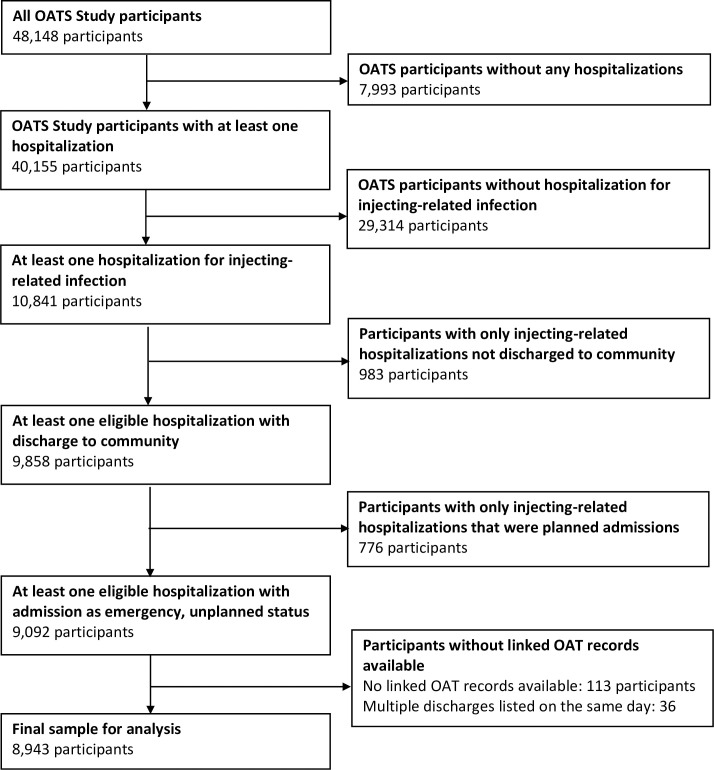
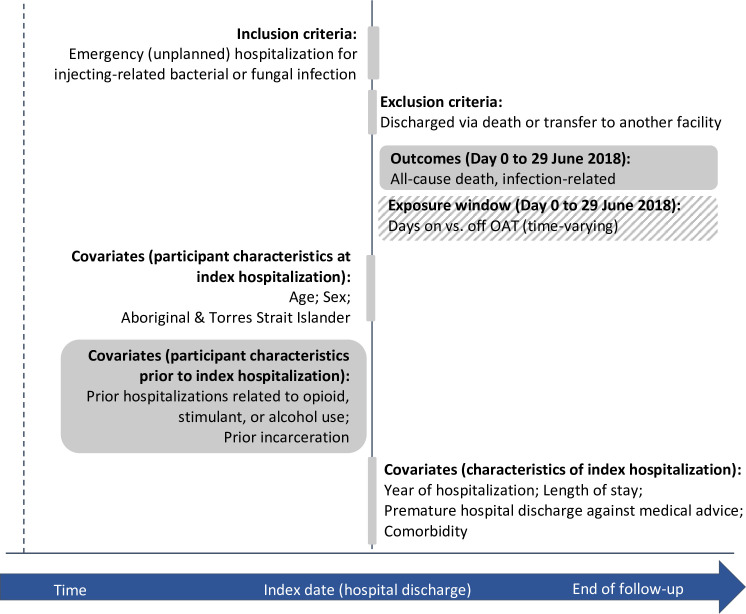
- Retrospective cohort using the Opioid Agonist Treatment Safety (OATS) administrative linkage study, including all people in New South Wales, Australia who accessed OAT between July 1, 2001 and June 28, 2018; included participants who survived an emergency hospitalization with an injecting-related infection and were discharged alive to the community (n = 8,943).
- OAT exposure was time-varying by days on or off treatment; outcomes were all-cause death and rehospitalization with an injecting-related infection. Analyses used incidence rates, extended Kaplan–Meier curves, and Cox proportional hazards models adjusted for covariates.
- Sensitivity analyses varied the post-OAT exposure window (2, 6, or 10 days after an OAT episode) and restricted the mortality sample to hospitalizations occurring after the first OAT record (n = 7,641).
Limitations
- Stated: routinely collected administrative data lacked information on injecting practices, injection stimulant use, housing status, access to harm reduction services (e.g., needle exchange and supervised injecting sites), and OAT medication dosages; OATS includes only people who accessed OAT, though this was estimated to cover >75% of people with opioid use disorder in NSW; social covariates were time-fixed; only methadone and buprenorphine were available in NSW during the study period.
- Stated/evident: observational design leaves potential residual confounding; the authors note the exposure definition may misclassify outcomes occurring after leaving treatment and bias estimates conservatively, and rehospitalizations may include both new infections and failed treatment of the initial infection.
Model-written summary. Check it against the paper before relying on it.
Integrity signals
Registry
Cites
Statistics
Figures
Verification
Claims the paper makes
33 Own result · 24 Check pending · 11 Own method · 6 Own interpretation · 2 No full text of the sources · 1 Sources not found · 1 No basis given
A result the paper reports from its own data — it cites no other source for it, so there is none to check. The quote shows it is in the paper.
In the paper
“Half of the sample were not prescribed OAT at the time of discharge from their initial infection-related hospitalization, and only 15% of these participants initiated OAT in the 3 months following.”
§ Opioid agonist treatment and risk of death or rehospitalization following injection drug use–associated bacterial and fungal infections: A cohort study in New South Wales, Australia > Discussion
plain- Asserted: passes — The authors put it forward as true.
- Checkable: passes — It can be checked against evidence.
- Load-bearing: passes — The paper’s conclusions depend on it.
- Based: passes — The paper gives a reason why it holds.
A result the paper reports from its own data — it cites no other source for it, so there is none to check. The quote shows it is in the paper.
In the paper
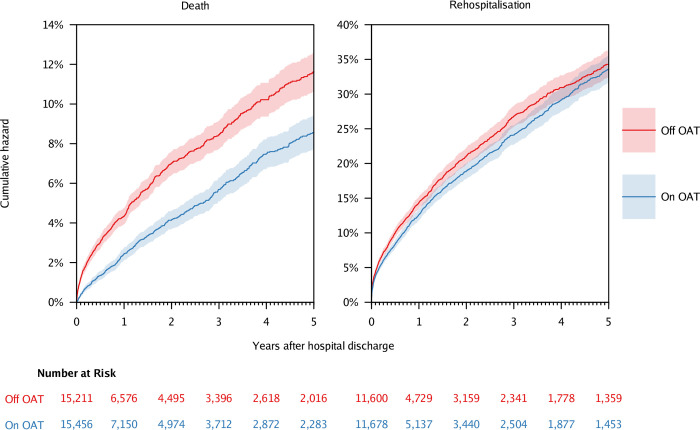
“In the adjusted model, OAT was associated with lower hazard of all-cause death (adjusted hazard ratio [aHR] 0.63, 95% CI 0.57 to 0.70).”
- Also stated in: § Methods and findings · plain
“During median 6.56 years follow-up, 1,481 (17%) participants died; use of OAT was associated with lower hazard of death (adjusted hazard ratio [aHR] 0.63, 95% confidence interval [CI] 0.57 to 0.70).”
§ Opioid agonist treatment and risk of death or rehospitalization following injection drug use–associated bacterial and fungal infections: A cohort study in New South Wales, Australia > Results > Main results
plaincorrelationaln = 8,943- Asserted: passes — The authors put it forward as true.
- Checkable: passes — It can be checked against evidence.
- Load-bearing: passes — The paper’s conclusions depend on it.
- Based: passes — The paper gives a reason why it holds.
- Rests on an assumption: Opioid agonist treatment exposure defined by dates with an active opioid agonist treatment prescription accurately reflects actual opioid agonist treatment use.
- Also stated in: § Methods and findings · plain
A result the paper reports from its own data — it cites no other source for it, so there is none to check. The quote shows it is in the paper.
In the paper
“Half of the sample were not prescribed OAT at the time of discharge from their initial infection-related hospitalization, and only 15% of these participants initiated OAT in the 3 months following.”
§ Opioid agonist treatment and risk of death or rehospitalization following injection drug use–associated bacterial and fungal infections: A cohort study in New South Wales, Australia > Discussion
plain- Asserted: passes — The authors put it forward as true.
- Checkable: passes — It can be checked against evidence.
- Load-bearing: passes — The paper’s conclusions depend on it.
- Based: passes — The paper gives a reason why it holds.
A result the paper reports from its own data — it cites no other source for it, so there is none to check. The quote shows it is in the paper.
In the paper
“Just under half of participants (4,292; 48%) were receiving OAT at the time of discharge from their index hospitalization for injecting-related infections.”
§ Opioid agonist treatment and risk of death or rehospitalization following injection drug use–associated bacterial and fungal infections: A cohort study in New South Wales, Australia > Results > Participants
plain- Asserted: passes — The authors put it forward as true.
- Checkable: passes — It can be checked against evidence.
- Load-bearing: unclear — It is unclear whether the paper’s conclusions depend on it.
- Based: passes — The paper gives a reason why it holds.
A result the paper reports from its own data — it cites no other source for it, so there is none to check. The quote shows it is in the paper.
In the paper
“Rates of death and rehospitalization remained high for this young cohort of patients, even among those exposed to OAT.”
- Also stated in: § Discussion · plain
“Risks of death and rehospitalization remain high among people with opioid use disorder even when engaged in OAT.”
§ Opioid agonist treatment and risk of death or rehospitalization following injection drug use–associated bacterial and fungal infections: A cohort study in New South Wales, Australia > Discussion
plain- Asserted: passes — The authors put it forward as true.
- Checkable: passes — It can be checked against evidence.
- Load-bearing: passes — The paper’s conclusions depend on it.
- Based: passes — The paper gives a reason why it holds.
- Also stated in: § Discussion · plain
A result the paper reports from its own data — it cites no other source for it, so there is none to check. The quote shows it is in the paper.
In the paper
“Out of 8,943 participants, 1,481 (17%) died during follow-up.”
- Also stated in: § Methods and findings · plain
“During median 6.56 years follow-up, 1,481 (17%) participants died; use of OAT was associated with lower hazard of death (adjusted hazard ratio [aHR] 0.63, 95% confidence interval [CI] 0.57 to 0.70).”
§ Opioid agonist treatment and risk of death or rehospitalization following injection drug use–associated bacterial and fungal infections: A cohort study in New South Wales, Australia > Results > Main results
plainn = 8,943- Asserted: passes — The authors put it forward as true.
- Checkable: passes — It can be checked against evidence.
- Load-bearing: unclear — It is unclear whether the paper’s conclusions depend on it.
- Based: passes — The paper gives a reason why it holds.
- Also stated in: § Methods and findings · plain
A result the paper reports from its own data — it cites no other source for it, so there is none to check. The quote shows it is in the paper.
In the paper
“In the fully adjusted model in this smaller sample, OAT was also associated with lower hazard of all-cause death (aHR 0.56, 95% CI 0.51 to 0.62).”
§ Opioid agonist treatment and risk of death or rehospitalization following injection drug use–associated bacterial and fungal infections: A cohort study in New South Wales, Australia > Results > Other analyses
plaincorrelationaln = 7,641- Asserted: passes — The authors put it forward as true.
- Checkable: passes — It can be checked against evidence.
- Load-bearing: unclear — It is unclear whether the paper’s conclusions depend on it.
- Based: passes — The paper gives a reason why it holds.
A result the paper reports from its own data — it cites no other source for it, so there is none to check. The quote shows it is in the paper.
In the paper
“Changing our exposure definition to incorporate the 2 days following the end of the OAT episode (reduced from 6 days in the main analysis) demonstrated similar results for the association between OAT with all-cause mortality (aHR 0.51, 95% CI 0.46 to 0.57) and with rehospitalization (aHR 0.88, 95% CI 0.83 to 0.95).”
§ Opioid agonist treatment and risk of death or rehospitalization following injection drug use–associated bacterial and fungal infections: A cohort study in New South Wales, Australia > Results > Other analyses
boostedcorrelational- Asserted: passes — The authors put it forward as true.
- Checkable: passes — It can be checked against evidence.
- Load-bearing: unclear — It is unclear whether the paper’s conclusions depend on it.
- Based: passes — The paper gives a reason why it holds.
A result the paper reports from its own data — it cites no other source for it, so there is none to check. The quote shows it is in the paper.
In the paper
“We identified 8,943 participants with at least 1 hospitalization for injecting-related bacterial or fungal infections.”
§ Opioid agonist treatment and risk of death or rehospitalization following injection drug use–associated bacterial and fungal infections: A cohort study in New South Wales, Australia > Results > Participants
plainn = 8,943- Asserted: passes — The authors put it forward as true.
- Checkable: passes — It can be checked against evidence.
- Load-bearing: passes — The paper’s conclusions depend on it.
- Based: passes — The paper gives a reason why it holds.
A result the paper reports from its own data — it cites no other source for it, so there is none to check. The quote shows it is in the paper.
In the paper
“Extending the exposure period to incorporate 10 days following the end of the OAT episode also demonstrated similar results for mortality (aHR 0.72, 95% CI 0.65 to 0.80) and for rehospitalization (0.89, 95% CI 0.84 to 0.95).”
§ Opioid agonist treatment and risk of death or rehospitalization following injection drug use–associated bacterial and fungal infections: A cohort study in New South Wales, Australia > Results > Other analyses
boostedcorrelational- Asserted: passes — The authors put it forward as true.
- Checkable: passes — It can be checked against evidence.
- Load-bearing: unclear — It is unclear whether the paper’s conclusions depend on it.
- Based: passes — The paper gives a reason why it holds.
- It may state two separate claims as one. 27
- Probably not a substantial claim. 23
A result the paper reports from its own data — it cites no other source for it, so there is none to check. The quote shows it is in the paper.
In the paper
“Of 4,651 (52%) participants without an active OAT prescription at the time of their index hospitalization, most did not access OAT soon after discharge. For example, 199 (4%) participants initiated OAT within 1 week of hospital discharge, 410 (9%) participants initiated OAT within 4 weeks, and 706 (15%) within 12 weeks.”
§ Opioid agonist treatment and risk of death or rehospitalization following injection drug use–associated bacterial and fungal infections: A cohort study in New South Wales, Australia > Results > Participants
plain- Asserted: passes — The authors put it forward as true.
- Checkable: passes — It can be checked against evidence.
- Load-bearing: unclear — It is unclear whether the paper’s conclusions depend on it.
- Based: passes — The paper gives a reason why it holds.
It may state two separate claims as one.
A result the paper reports from its own data — it cites no other source for it, so there is none to check. The quote shows it is in the paper.
In the paper
“The distribution of infection type for these rehospitalizations was similar to the distribution during the index hospitalization. This included 2,718 (78%) hospitalizations with skin and soft-tissue infections, 556 (15%) with sepsis, 255 (7%) with endocarditis, 254 (7%) with osteomyelitis, 144 (4%) with septic arthritis, and 53 (1%) with central nervous system infections.”
§ Opioid agonist treatment and risk of death or rehospitalization following injection drug use–associated bacterial and fungal infections: A cohort study in New South Wales, Australia > Results > Main results
plainn = 8,943- Asserted: passes — The authors put it forward as true.
- Checkable: passes — It can be checked against evidence.
- Load-bearing: unclear — It is unclear whether the paper’s conclusions depend on it.
- Based: passes — The paper gives a reason why it holds.
It may state two separate claims as one.
A result the paper reports from its own data — it cites no other source for it, so there is none to check. The quote shows it is in the paper.
In the paper
“In total, participants were followed for 65,240 person-years (median 6.56 years of follow-up per person), including 34,146 (52%) person-years exposed to OAT and 31,094 (48%) person-years unexposed.”
§ Opioid agonist treatment and risk of death or rehospitalization following injection drug use–associated bacterial and fungal infections: A cohort study in New South Wales, Australia > Results > Main results
plainn = 8,943- Asserted: passes — The authors put it forward as true.
- Checkable: passes — It can be checked against evidence.
- Load-bearing: passes — The paper’s conclusions depend on it.
- Based: passes — The paper gives a reason why it holds.
It may state two separate claims as one.
A result the paper reports from its own data — it cites no other source for it, so there is none to check. The quote shows it is in the paper.
In the paper
“Of all participants, 2,174 (24%) remained exposed to OAT throughout the entire follow-up period, and 1,341 (15%) remained unexposed throughout.”
§ Opioid agonist treatment and risk of death or rehospitalization following injection drug use–associated bacterial and fungal infections: A cohort study in New South Wales, Australia > Results > Main results
plainn = 8,943- Asserted: passes — The authors put it forward as true.
- Checkable: passes — It can be checked against evidence.
- Load-bearing: unclear — It is unclear whether the paper’s conclusions depend on it.
- Based: passes — The paper gives a reason why it holds.
It may state two separate claims as one.
A result the paper reports from its own data — it cites no other source for it, so there is none to check. The quote shows it is in the paper.
In the paper
“Incidence rates for rehospitalization with injecting-related infection were 7.92 (95% CI 7.66 to 8.29) per 100 person-years exposed to OAT, and 8.45 (8.06 to 8.84) per 100 person-years unexposed to OAT.”
§ Opioid agonist treatment and risk of death or rehospitalization following injection drug use–associated bacterial and fungal infections: A cohort study in New South Wales, Australia > Results > Main results
plainn = 8,943- Asserted: passes — The authors put it forward as true.
- Checkable: passes — It can be checked against evidence.
- Load-bearing: passes — The paper’s conclusions depend on it.
- Based: passes — The paper gives a reason why it holds.
It may state two separate claims as one.
A result the paper reports from its own data — it cites no other source for it, so there is none to check. The quote shows it is in the paper.
In the paper
“Participants were followed for 44,690 person-years (median 3.41 years per participant), which included 22,987 (51%) person-years exposed to OAT and 21,703 (49%) person-years unexposed.”
§ Opioid agonist treatment and risk of death or rehospitalization following injection drug use–associated bacterial and fungal infections: A cohort study in New South Wales, Australia > Results > Main results
plainn = 44,690- Asserted: passes — The authors put it forward as true.
- Checkable: passes — It can be checked against evidence.
- Load-bearing: passes — The paper’s conclusions depend on it.
- Based: passes — The paper gives a reason why it holds.
It may state two separate claims as one.
A result the paper reports from its own data — it cites no other source for it, so there is none to check. The quote shows it is in the paper.
In the paper
“Cumulative hazard for death in OAT treatment versus nontreatment periods was 0.3% versus 1.2% at 30 days, 0.8% versus 2.1% at 90 days, and 2.4% versus 4.3% at 365 days.”
§ Opioid agonist treatment and risk of death or rehospitalization following injection drug use–associated bacterial and fungal infections: A cohort study in New South Wales, Australia > Results > Main results
plainn = 8,943- Asserted: passes — The authors put it forward as true.
- Checkable: passes — It can be checked against evidence.
- Load-bearing: passes — The paper’s conclusions depend on it.
- Based: passes — The paper gives a reason why it holds.
It may state two separate claims as one.
A result the paper reports from its own data — it cites no other source for it, so there is none to check. The quote shows it is in the paper.
In the paper
“Of all 8,943 participants, 2,693 (30%) remained exposed to OAT throughout the entire follow-up period, and 2,157 (24%) remained unexposed throughout.”
§ Opioid agonist treatment and risk of death or rehospitalization following injection drug use–associated bacterial and fungal infections: A cohort study in New South Wales, Australia > Results > Main results
plainn = 8,943- Asserted: passes — The authors put it forward as true.
- Checkable: passes — It can be checked against evidence.
- Load-bearing: unclear — It is unclear whether the paper’s conclusions depend on it.
- Based: passes — The paper gives a reason why it holds.
It may state two separate claims as one.
A result the paper reports from its own data — it cites no other source for it, so there is none to check. The quote shows it is in the paper.
In the paper
“14% of participants experienced a premature discharge “against medical advice.””
§ Opioid agonist treatment and risk of death or rehospitalization following injection drug use–associated bacterial and fungal infections: A cohort study in New South Wales, Australia > Results > Participants
plainn = 8,943- Asserted: passes — The authors put it forward as true.
- Checkable: passes — It can be checked against evidence.
- Load-bearing: fails — The paper’s conclusions may not depend on it.
- Based: passes — The paper gives a reason why it holds.
Probably not a substantial claim. The paper’s conclusions may not depend on it.
A result the paper reports from its own data — it cites no other source for it, so there is none to check. The quote shows it is in the paper.
In the paper
“Of the rehospitalizations, 1,820 (50%) occurred during an OAT exposure period, and 1,833 (50%) occurred while unexposed to OAT.”
§ Opioid agonist treatment and risk of death or rehospitalization following injection drug use–associated bacterial and fungal infections: A cohort study in New South Wales, Australia > Results > Main results
plainn = 8,943- Asserted: passes — The authors put it forward as true.
- Checkable: passes — It can be checked against evidence.
- Load-bearing: unclear — It is unclear whether the paper’s conclusions depend on it.
- Based: passes — The paper gives a reason why it holds.
It may state two separate claims as one.
A result the paper reports from its own data — it cites no other source for it, so there is none to check. The quote shows it is in the paper.
In the paper
“Mortality rates were 1.88 deaths (95% CI 1.17 to 2.03) per 100 person-years exposed to OAT and 2.69 (2.51 to 2.88) per 100 person-years unexposed to OAT.”
§ Opioid agonist treatment and risk of death or rehospitalization following injection drug use–associated bacterial and fungal infections: A cohort study in New South Wales, Australia > Results > Main results
plainn = 8,943- Asserted: passes — The authors put it forward as true.
- Checkable: passes — It can be checked against evidence.
- Load-bearing: passes — The paper’s conclusions depend on it.
- Based: passes — The paper gives a reason why it holds.
It may state two separate claims as one.
A result the paper reports from its own data — it cites no other source for it, so there is none to check. The quote shows it is in the paper.
In the paper
“Length of stay had a right-skewed distribution, with median 4 days, 75th percentile 8 days, and 99th percentile 65 days.”
§ Opioid agonist treatment and risk of death or rehospitalization following injection drug use–associated bacterial and fungal infections: A cohort study in New South Wales, Australia > Results > Participants
plainn = 8,943- Asserted: passes — The authors put it forward as true.
- Checkable: passes — It can be checked against evidence.
- Load-bearing: fails — The paper’s conclusions may not depend on it.
- Based: passes — The paper gives a reason why it holds.
Probably not a substantial claim. The paper’s conclusions may not depend on it.
A result the paper reports from its own data — it cites no other source for it, so there is none to check. The quote shows it is in the paper.
In the paper
“Participants were mostly men (66.0%), and median age at study entry was 38 years.”
§ Opioid agonist treatment and risk of death or rehospitalization following injection drug use–associated bacterial and fungal infections: A cohort study in New South Wales, Australia > Results > Participants
plainn = 8,943- Asserted: passes — The authors put it forward as true.
- Checkable: passes — It can be checked against evidence.
- Load-bearing: fails — The paper’s conclusions may not depend on it.
- Based: passes — The paper gives a reason why it holds.
Probably not a substantial claim. The paper’s conclusions may not depend on it. It may state two separate claims as one.
A result the paper reports from its own data — it cites no other source for it, so there is none to check. The quote shows it is in the paper.
In the paper
“Skin and soft tissue infections were present during most hospitalizations (see Table 1)”
§ Opioid agonist treatment and risk of death or rehospitalization following injection drug use–associated bacterial and fungal infections: A cohort study in New South Wales, Australia > Results > Participants
plain- Asserted: passes — The authors put it forward as true.
- Checkable: passes — It can be checked against evidence.
- Load-bearing: fails — The paper’s conclusions may not depend on it.
- Based: passes — The paper gives a reason why it holds.
Probably not a substantial claim. The paper’s conclusions may not depend on it.
A result the paper reports from its own data — it cites no other source for it, so there is none to check. The quote shows it is in the paper.
In the paper
“Of the deaths, 643 (43%) occurred during an OAT exposure period, and 838 (57%) occurred while unexposed to OAT.”
§ Opioid agonist treatment and risk of death or rehospitalization following injection drug use–associated bacterial and fungal infections: A cohort study in New South Wales, Australia > Results > Main results
plainn = 8,943- Asserted: passes — The authors put it forward as true.
- Checkable: passes — It can be checked against evidence.
- Load-bearing: unclear — It is unclear whether the paper’s conclusions depend on it.
- Based: passes — The paper gives a reason why it holds.
It may state two separate claims as one.
A result the paper reports from its own data — it cites no other source for it, so there is none to check. The quote shows it is in the paper.
In the paper
“Cumulative hazard for rehospitalization in OAT treatment versus nontreatment periods was 3.7% versus 4.3% at 30 days, 6.0% versus 7.1% at 90 days, and 12.7% versus 14.4% at 365 days.”
§ Opioid agonist treatment and risk of death or rehospitalization following injection drug use–associated bacterial and fungal infections: A cohort study in New South Wales, Australia > Results > Main results
plain- Asserted: passes — The authors put it forward as true.
- Checkable: passes — It can be checked against evidence.
- Load-bearing: passes — The paper’s conclusions depend on it.
- Based: passes — The paper gives a reason why it holds.
It may state two separate claims as one.
In the paper
“One study identified a reduced risk of death after hospitalizations with injecting-related endocarditis, but did not assess rehospitalizations [40].”
§ Opioid agonist treatment and risk of death or rehospitalization following injection drug use–associated bacterial and fungal infections: A cohort study in New South Wales, Australia > Introduction
What the sources say
- Check pendingcites [40] SD Kimmel, 2020, Association of Treatment With Medications for Opioid Use Disorder With Mortality After Hospitalization for Injection Drug Use–Associated Infective Endocarditis, JAMA Netw Open source
plaindirect- Asserted: passes — The authors put it forward as true.
- Checkable: passes — It can be checked against evidence.
- Load-bearing: passes — The paper’s conclusions depend on it.
- Based: passes — The paper gives a reason why it holds.
It may state two separate claims as one.
In the paper
“OAT limits opioid withdrawal symptoms, reduces reliance on illicit drug markets, and empowers PWID to inject less frequently or in a safer way [25,26].”
§ Opioid agonist treatment and risk of death or rehospitalization following injection drug use–associated bacterial and fungal infections: A cohort study in New South Wales, Australia > Introduction
What the sources say
- Not checked — no full text of the sourcecites [25] RE Harris, 2018, Experiences with skin and soft tissue infections among people who inject drugs in Philadelphia: A qualitative study., Drug Alcohol Depend source
- Check pendingcites [26] D. Frank, 2018, “I was not sick and I didn’t need to recover”: Methadone Maintenance Treatment (MMT) as a refuge from criminalization, Subst Use Misuse. source
plaindirect- Asserted: passes — The authors put it forward as true.
- Checkable: passes — It can be checked against evidence.
- Load-bearing: passes — The paper’s conclusions depend on it.
- Based: passes — The paper gives a reason why it holds.
It may state two separate claims as one.
In the paper
“Reflecting suboptimal access, use of OAT (or of naltrexone, an opioid antagonist medication used for opioid use disorder treatment in the US) was reported as 24% within 3 months following hospital discharge in the first study [40]”
§ Opioid agonist treatment and risk of death or rehospitalization following injection drug use–associated bacterial and fungal infections: A cohort study in New South Wales, Australia > Introduction
What the sources say
- Check pendingcites [40] SD Kimmel, 2020, Association of Treatment With Medications for Opioid Use Disorder With Mortality After Hospitalization for Injection Drug Use–Associated Infective Endocarditis, JAMA Netw Open source
plain- Asserted: passes — The authors put it forward as true.
- Checkable: passes — It can be checked against evidence.
- Load-bearing: fails — The paper’s conclusions may not depend on it.
- Based: passes — The paper gives a reason why it holds.
Probably not a substantial claim. The paper’s conclusions may not depend on it.
In the paper
“Suboptimal access to OAT may reflect system-level issues that separate addiction care from specialized, acute medical care for infections [1,22,29,30].”
§ Opioid agonist treatment and risk of death or rehospitalization following injection drug use–associated bacterial and fungal infections: A cohort study in New South Wales, Australia > Introduction
What the sources say
- Check pendingcites [1] TD Brothers, 2021, Social and structural determinants of injecting-related bacterial and fungal infections among people who inject drugs: protocol for a mixed studies systematic review, BMJ Open source
- Check pendingcites [22] M. Harris, 2020, Normalised pain and severe health care delay among people who inject drugs in London: Adapting cultural safety principles to promote care., Soc Sci Med source
- Check pendingcites [29] TD Brothers, 2022, Unequal access to opioid agonist treatment and sterile injecting equipment among hospitalized patients with injection drug use-associated infective endocarditis, PLoS ONE source
- Not checked — no full text of the sourcecites [30] TD Brothers, 2018, Multidisciplinary infective endocarditis care teams should address substance use disorders and harm reduction services, Open Heart
hedgedconditional- Asserted: passes — The authors put it forward as true.
- Checkable: fails — It may be too vague to check against evidence.
- Load-bearing: fails — The paper’s conclusions may not depend on it.
- Based: passes — The paper gives a reason why it holds.
Probably not a substantial claim. It may be too vague to check against evidence. The paper’s conclusions may not depend on it.
In the paper
“Injection drug use–associated bacterial and fungal infections (e.g., skin and soft-tissue infections, endocarditis, osteomyelitis, septic arthritis, and epidural abscess) are associated with significant morbidity and mortality among people who inject drugs (PWID) and are costly for healthcare systems [1–6].”
§ Opioid agonist treatment and risk of death or rehospitalization following injection drug use–associated bacterial and fungal infections: A cohort study in New South Wales, Australia > Introduction
What the sources say
- Check pendingcites [1] TD Brothers, 2021, Social and structural determinants of injecting-related bacterial and fungal infections among people who inject drugs: protocol for a mixed studies systematic review, BMJ Open source
- Check pendingcites [2] T Gomes, 2021, Trends in Hospitalizations for Serious Infections Among People With Opioid Use Disorder in Ontario, Canada, J Addict Med. source
- Check pendingcites [3] DP Serota, 2021, Evaluating Differences in Opioid and Stimulant Use-associated Infectious Disease Hospitalizations in Florida, 2016–2017, Clin Infect Dis source
- Check pendingcites [4] JA Meisner, 2020, Changes in Infective Endocarditis Admissions in Pennsylvania During the Opioid Epidemic, Clin Infect Dis source
- Check pendingcites [5] D Lewer, 2020, Frequency of healthcare utilisation by adults who use illicit drugs: a systematic review and meta-analysis, Addiction source
- Check pendingcites [6] JH Kim, 2020, Disparities in United States hospitalizations for serious infections in patients with and without opioid use disorder: A nationwide observational study, PLoS Med source
plaincorrelational- Asserted: passes — The authors put it forward as true.
- Checkable: passes — It can be checked against evidence.
- Load-bearing: passes — The paper’s conclusions depend on it.
- Based: passes — The paper gives a reason why it holds.
Probably not a substantial claim. It may state two separate claims as one.
In the paper
“A third identified a reduced risk of rehospitalization for skin and soft-tissue infections at 1 year [41].”
§ Opioid agonist treatment and risk of death or rehospitalization following injection drug use–associated bacterial and fungal infections: A cohort study in New South Wales, Australia > Introduction
What the sources say
- Check pendingcites [41] JA Barocas, 2020, Impact of medications for opioid use disorder among persons hospitalized for drug use-associated skin and soft tissue infections, Drug Alcohol Depend source
plaindirect- Asserted: passes — The authors put it forward as true.
- Checkable: passes — It can be checked against evidence.
- Load-bearing: fails — The paper’s conclusions may not depend on it.
- Based: passes — The paper gives a reason why it holds.
Probably not a substantial claim. The paper’s conclusions may not depend on it.
In the paper
“This may be in part because of social and structural factors (e.g., criminalization, discrimination, lack of access to housing, harm reduction services, and supervised injection sites) that constrain the ability of PWID to inject more safely [1,21] and that push PWID away from healthcare [22].”
§ Opioid agonist treatment and risk of death or rehospitalization following injection drug use–associated bacterial and fungal infections: A cohort study in New South Wales, Australia > Introduction
What the sources say
- Check pendingcites [1] TD Brothers, 2021, Social and structural determinants of injecting-related bacterial and fungal infections among people who inject drugs: protocol for a mixed studies systematic review, BMJ Open source
- Check pendingcites [21] R Robertson, 2021, Injecting drug use, the skin and vasculature, Addiction source
- Check pendingcites [22] M. Harris, 2020, Normalised pain and severe health care delay among people who inject drugs in London: Adapting cultural safety principles to promote care., Soc Sci Med source
hedgeddirect- Asserted: passes — The authors put it forward as true.
- Checkable: passes — It can be checked against evidence.
- Load-bearing: unclear — It is unclear whether the paper’s conclusions depend on it.
- Based: passes — The paper gives a reason why it holds.
It may state two separate claims as one.
In the paper
“For people with opioid use disorder, OAT is associated with many benefits including reduced risks of death and of viral infections including human immunodeficiency virus (HIV) and hepatitis C virus [23,24].”
§ Opioid agonist treatment and risk of death or rehospitalization following injection drug use–associated bacterial and fungal infections: A cohort study in New South Wales, Australia > Introduction
What the sources say
- Check pendingcites [23] J Stone, 2022, Modelling the intervention effect of opioid agonist treatment on multiple mortality outcomes in people who inject drugs: a three-setting analysis, Lancet Psychiatry source
- Check pendingcites [24] GJ MacArthur, 2012, Opiate substitution treatment and HIV transmission in people who inject drugs: systematic review and meta-analysis, BMJ source
plaincorrelational- Asserted: passes — The authors put it forward as true.
- Checkable: passes — It can be checked against evidence.
- Load-bearing: passes — The paper’s conclusions depend on it.
- Based: passes — The paper gives a reason why it holds.
It may state two separate claims as one.
In the paper
“The latter 2 studies also only included information on buprenorphine use, as they did not have access to insurance claims or prescribing records for methadone.”
§ Opioid agonist treatment and risk of death or rehospitalization following injection drug use–associated bacterial and fungal infections: A cohort study in New South Wales, Australia > Introduction
What the sources say
- Check pendingcites [39] JA Barocas, 2021, Outcomes Associated With Medications for Opioid Use Disorder Among Persons Hospitalized for Infective Endocarditis, Clin Infect Dis source
- Check pendingcites [41] JA Barocas, 2020, Impact of medications for opioid use disorder among persons hospitalized for drug use-associated skin and soft tissue infections, Drug Alcohol Depend source
plaindirect- Asserted: passes — The authors put it forward as true.
- Checkable: passes — It can be checked against evidence.
- Load-bearing: fails — The paper’s conclusions may not depend on it.
- Based: passes — The paper gives a reason why it holds.
Probably not a substantial claim. The paper’s conclusions may not depend on it.
In the paper
“The incidence of hospitalization for injecting-related infections is increasing in many parts of the world, including Australia [7], Canada [2,8,9], South Africa [10], the United Kingdom [11], the United States of America [12–16], and India [17].”
§ Opioid agonist treatment and risk of death or rehospitalization following injection drug use–associated bacterial and fungal infections: A cohort study in New South Wales, Australia > Introduction
What the sources say
- Not checked — no full text of the sourcecites [7] A Wright, 2018, The Current Epidemiology of Injecting Drug Use-Associated Infective Endocarditis in Victoria, Australia in the Midst of Increasing Crystal Methamphetamine Use, Heart Lung Circ source
- Check pendingcites [2] T Gomes, 2021, Trends in Hospitalizations for Serious Infections Among People With Opioid Use Disorder in Ontario, Canada, J Addict Med. source
- Check pendingcites [8] K Mosseler, 2020, Epidemiology, microbiology, and clinical outcomes among patients with intravenous drug use-associated infective endocarditis in New Brunswick, CJC Open source
- Check pendingcites [9] KA Morin, 2020, A retrospective cohort study evaluating correlates of deep tissue infections among patients enrolled in opioid agonist treatment using administrative data in Ontario, Canada, PLoS ONE source
- Check pendingcites [10] R Meel, 2018, Striking increase in the incidence of infective endocarditis associated with recreational drug abuse in urban South Africa, S Afr Med J source
plain- Asserted: passes — The authors put it forward as true.
- Checkable: passes — It can be checked against evidence.
- Load-bearing: fails — The paper’s conclusions may not depend on it.
- Based: passes — The paper gives a reason why it holds.
Probably not a substantial claim. The paper’s conclusions may not depend on it.
In the paper
“Prevention efforts to date have focused on individual-level behavior change interventions to promote more sterile drug preparation and safer drug injecting techniques. Unfortunately, these have shown mixed results [18–20] and have had limited impact on a population level [1].”
§ Opioid agonist treatment and risk of death or rehospitalization following injection drug use–associated bacterial and fungal infections: A cohort study in New South Wales, Australia > Introduction
What the sources say
- Check pendingcites [18] KT Phillips, 2021, A randomized controlled trial of a brief behavioral intervention to reduce skin and soft tissue infections among people who inject drugs, Drug Alcohol Depend source
- Not checked — no full text of the sourcecites [19] MD Stein, 2021, Skin-cleaning among hospitalized people who inject drugs: a randomized controlled trial, Addiction. source
- Not checked — no full text of the sourcecites [20] P Roux, 2021, Implementation and evaluation of an educational intervention for safer injection in people who inject drugs in Europe: a multi-country mixed-methods study, Int J Drug Policy source
- Check pendingcites [1] TD Brothers, 2021, Social and structural determinants of injecting-related bacterial and fungal infections among people who inject drugs: protocol for a mixed studies systematic review, BMJ Open source
plain- Asserted: passes — The authors put it forward as true.
- Checkable: passes — It can be checked against evidence.
- Load-bearing: passes — The paper’s conclusions depend on it.
- Based: passes — The paper gives a reason why it holds.
It may state two separate claims as one.
In the paper
“A second study identified no significant effect (with wide CIs) on risk of rehospitalization after endocarditis and did not assess mortality [39].”
§ Opioid agonist treatment and risk of death or rehospitalization following injection drug use–associated bacterial and fungal infections: A cohort study in New South Wales, Australia > Introduction
What the sources say
- Check pendingcites [39] JA Barocas, 2021, Outcomes Associated With Medications for Opioid Use Disorder Among Persons Hospitalized for Infective Endocarditis, Clin Infect Dis source
plain- Asserted: passes — The authors put it forward as true.
- Checkable: passes — It can be checked against evidence.
- Load-bearing: passes — The paper’s conclusions depend on it.
- Based: passes — The paper gives a reason why it holds.
It may state two separate claims as one.
In the paper
“and as 6% within 30 days following discharge in the second and third studies [39,41].”
§ Opioid agonist treatment and risk of death or rehospitalization following injection drug use–associated bacterial and fungal infections: A cohort study in New South Wales, Australia > Introduction
What the sources say
- Check pendingcites [39] JA Barocas, 2021, Outcomes Associated With Medications for Opioid Use Disorder Among Persons Hospitalized for Infective Endocarditis, Clin Infect Dis source
- Check pendingcites [41] JA Barocas, 2020, Impact of medications for opioid use disorder among persons hospitalized for drug use-associated skin and soft tissue infections, Drug Alcohol Depend source
plain- Asserted: passes — The authors put it forward as true.
- Checkable: passes — It can be checked against evidence.
- Load-bearing: fails — The paper’s conclusions may not depend on it.
- Based: passes — The paper gives a reason why it holds.
Probably not a substantial claim. The paper’s conclusions may not depend on it.
In the paper
“This manuscript follows the REporting of studies Conducted using Observational Routinely collected health Data statement for PharmacoEpidemiology (RECORD-PE) guidelines [44] (see S1 RECORD-PE checklist).”
§ Opioid agonist treatment and risk of death or rehospitalization following injection drug use–associated bacterial and fungal infections: A cohort study in New South Wales, Australia > Methods
What the sources say
- Check pendingcites [44] SM Langan, 2018, The reporting of studies conducted using observational routinely collected health data statement for pharmacoepidemiology (RECORD-PE)., BMJ source
plain- Asserted: passes — The authors put it forward as true.
- Checkable: passes — It can be checked against evidence.
- Load-bearing: fails — The paper’s conclusions may not depend on it.
- Based: passes — The paper gives a reason why it holds.
Probably not a substantial claim. The paper’s conclusions may not depend on it.
In the paper
“OAT exposure was treated as time varying, by day of receipt. This means that each participant’s follow-up time was divided into exposed (on OAT) and unexposed (off OAT) episodes (ie, medication status was not necessarily constant through follow-up) [46].”
§ Opioid agonist treatment and risk of death or rehospitalization following injection drug use–associated bacterial and fungal infections: A cohort study in New South Wales, Australia > Methods > Measures
What the sources say
- Not matchedcites [46] T Therneau, 2013
Couldn’t be matched to a paper in Crossref, so it can’t be checked.
plain- Asserted: passes — The authors put it forward as true.
- Checkable: passes — It can be checked against evidence.
- Load-bearing: passes — The paper’s conclusions depend on it.
- Based: passes — The paper gives a reason why it holds.
Probably not a substantial claim.
- Rests on an assumption: Opioid agonist treatment exposure defined by dates with an active opioid agonist treatment prescription accurately reflects actual opioid agonist treatment use.
- Not matched
What the paper did — it cites no source for this, so there is none to check. The quote shows it is in the paper.
In the paper
“First, the OATS study cohort does not include all people who inject opioids in NSW; only those who have accessed OAT at least once during the study period are eligible for linkage and inclusion.”
§ Opioid agonist treatment and risk of death or rehospitalization following injection drug use–associated bacterial and fungal infections: A cohort study in New South Wales, Australia > Discussion
plain- Asserted: passes — The authors put it forward as true.
- Checkable: passes — It can be checked against evidence.
- Load-bearing: passes — The paper’s conclusions depend on it.
- Based: passes — The paper gives a reason why it holds.
It may state two separate claims as one.
What the paper did — it cites no source for this, so there is none to check. The quote shows it is in the paper.
In the paper
“This approach may introduce bias by allocating outcomes to the treatment period when they actually occurred after leaving treatment; this may overestimate rates of outcomes in-treatment (on OAT) and underestimate rates of outcomes out-of-treatment (off OAT), resulting in conservate estimates of potential benefit.”
§ Opioid agonist treatment and risk of death or rehospitalization following injection drug use–associated bacterial and fungal infections: A cohort study in New South Wales, Australia > Methods > Measures
hedgedconditional- Asserted: passes — The authors put it forward as true.
- Checkable: passes — It can be checked against evidence.
- Load-bearing: unclear — It is unclear whether the paper’s conclusions depend on it.
- Based: passes — The paper gives a reason why it holds.
It may state two separate claims as one.
A conclusion the paper draws from its own results — it cites no other source for it, so there is none to check. The quote shows it is in the paper.
In the paper
“Our findings of an association between OAT and lower risk of death among people with opioid use disorder are consistent with prior evidence.”
§ Opioid agonist treatment and risk of death or rehospitalization following injection drug use–associated bacterial and fungal infections: A cohort study in New South Wales, Australia > Discussion
plaincorrelational- Asserted: passes — The authors put it forward as true.
- Checkable: passes — It can be checked against evidence.
- Load-bearing: fails — The paper’s conclusions may not depend on it.
- Based: passes — The paper gives a reason why it holds.
Probably not a substantial claim. The paper’s conclusions may not depend on it.
In the paper
“The Opioid Agonist Treatment Safety (OATS) study is an administrative data linkage cohort study in New South Wales, Australia, which includes OAT permit records (with methadone or buprenorphine) for every person accessing OAT for opioid use disorder treatment in New South Wales from 2001 to 2018 [42,43].”
§ Opioid agonist treatment and risk of death or rehospitalization following injection drug use–associated bacterial and fungal infections: A cohort study in New South Wales, Australia > Introduction
What the sources say
- Check pendingcites [42] S Larney, 2018, Using routinely collected data to understand and predict adverse outcomes in opioid agonist treatment: Protocol for the Opioid Agonist Treatment Safety (OATS) Study., BMJ Open source
- Check pendingcites [43] S Larney, 2021, Data resource profile: The Opioid Agonist Treatment and Safety (OATS) Study, New South Wales, Australia Int J Epidemiol. source
plain- Asserted: passes — The authors put it forward as true.
- Checkable: passes — It can be checked against evidence.
- Load-bearing: passes — The paper’s conclusions depend on it.
- Based: passes — The paper gives a reason why it holds.
It may state two separate claims as one.
What the paper did — it cites no source for this, so there is none to check. The quote shows it is in the paper.
In the paper
“We then conducted a sensitivity analysis to address a potential source of “immortal time bias” in the mortality outcome survival analysis.”
§ Opioid agonist treatment and risk of death or rehospitalization following injection drug use–associated bacterial and fungal infections: A cohort study in New South Wales, Australia > Methods > Analysis
plain- Asserted: passes — The authors put it forward as true.
- Checkable: passes — It can be checked against evidence.
- Load-bearing: fails — The paper’s conclusions may not depend on it.
- Based: passes — The paper gives a reason why it holds.
Probably not a substantial claim. The paper’s conclusions may not depend on it.
What the paper did — it cites no source for this, so there is none to check. The quote shows it is in the paper.
In the paper
“The main analysis was prespecified before conducting the analyses, but the supplementary and sensitivity analyses were not prespecified.”
§ Opioid agonist treatment and risk of death or rehospitalization following injection drug use–associated bacterial and fungal infections: A cohort study in New South Wales, Australia > Methods
plain- Asserted: passes — The authors put it forward as true.
- Checkable: passes — It can be checked against evidence.
- Load-bearing: fails — The paper’s conclusions may not depend on it.
- Based: passes — The paper gives a reason why it holds.
Probably not a substantial claim. The paper’s conclusions may not depend on it. It may state two separate claims as one.
What the paper did — it cites no source for this, so there is none to check. The quote shows it is in the paper.
In the paper
“We then used Cox proportional hazards models to estimate the association between OAT and the study outcomes to generate hazard ratios, adjusting for all covariates.”
§ Opioid agonist treatment and risk of death or rehospitalization following injection drug use–associated bacterial and fungal infections: A cohort study in New South Wales, Australia > Methods > Analysis
plaincorrelational- Asserted: passes — The authors put it forward as true.
- Checkable: passes — It can be checked against evidence.
- Load-bearing: passes — The paper’s conclusions depend on it.
- Based: passes — The paper gives a reason why it holds.
Probably not a substantial claim.
What the paper did — it cites no source for this, so there is none to check. The quote shows it is in the paper.
In the paper
“Study limitations include the use of routinely collected administrative data, which lacks information on other risk factors for injecting-related infections including injecting practices, injection stimulant use, housing status, and access to harm reduction services (e.g., needle exchange and supervised injecting sites); we also lacked information on OAT medication dosages.”
§ Opioid agonist treatment and risk of death or rehospitalization following injection drug use–associated bacterial and fungal infections: A cohort study in New South Wales, Australia > Abstract > Methods and findings
plain- Asserted: passes — The authors put it forward as true.
- Checkable: passes — It can be checked against evidence.
- Load-bearing: unclear — It is unclear whether the paper’s conclusions depend on it.
- Based: passes — The paper gives a reason why it holds.
It may state two separate claims as one.
What the paper did — it cites no source for this, so there is none to check. The quote shows it is in the paper.
In the paper
“Third, we did not have reliable information on the dose received each day, so did not include OAT dosing information.”
§ Opioid agonist treatment and risk of death or rehospitalization following injection drug use–associated bacterial and fungal infections: A cohort study in New South Wales, Australia > Discussion
plain- Asserted: passes — The authors put it forward as true.
- Checkable: passes — It can be checked against evidence.
- Load-bearing: fails — The paper’s conclusions may not depend on it.
- Based: passes — The paper gives a reason why it holds.
Probably not a substantial claim. The paper’s conclusions may not depend on it. It may state two separate claims as one.
What the paper did — it cites no source for this, so there is none to check. The quote shows it is in the paper.
In the paper
“We excluded routine or planned admissions (e.g., for physical therapy or diagnostic procedures) because they are unlikely to represents episodes of acute illness attributable to injecting-related infections.”
§ Opioid agonist treatment and risk of death or rehospitalization following injection drug use–associated bacterial and fungal infections: A cohort study in New South Wales, Australia > Methods > Participants
hedged- Asserted: passes — The authors put it forward as true.
- Checkable: passes — It can be checked against evidence.
- Load-bearing: passes — The paper’s conclusions depend on it.
- Based: passes — The paper gives a reason why it holds.
Probably not a substantial claim.
What the paper did — it cites no source for this, so there is none to check. The quote shows it is in the paper.
In the paper
“We did not publish a protocol before conducting the analyses.”
§ Opioid agonist treatment and risk of death or rehospitalization following injection drug use–associated bacterial and fungal infections: A cohort study in New South Wales, Australia > Methods
plain- Asserted: passes — The authors put it forward as true.
- Checkable: passes — It can be checked against evidence.
- Load-bearing: fails — The paper’s conclusions may not depend on it.
- Based: passes — The paper gives a reason why it holds.
Probably not a substantial claim. The paper’s conclusions may not depend on it.
What the paper did — it cites no source for this, so there is none to check. The quote shows it is in the paper.
In the paper
“We did not feel this potential issue with immortal time bias would affect the rehospitalization outcome survival analysis because participants could have experienced a rehospitalization event at any time (in this case, the fact that they have a future OAT record does not necessarily mean they could not have been hospitalized before then).”
§ Opioid agonist treatment and risk of death or rehospitalization following injection drug use–associated bacterial and fungal infections: A cohort study in New South Wales, Australia > Methods > Analysis
hedged- Asserted: passes — The authors put it forward as true.
- Checkable: passes — It can be checked against evidence.
- Load-bearing: passes — The paper’s conclusions depend on it.
- Based: passes — The paper gives a reason why it holds.
Probably not a substantial claim.
The paper states this without a source or data behind it here, so there is nothing to check it against. The quote shows it is in the paper.
In the paper
“While OAT is known to be beneficial for other injecting-related health outcomes, there has been relatively little research on OAT and risk for injecting-related infections.”
§ Opioid agonist treatment and risk of death or rehospitalization following injection drug use–associated bacterial and fungal infections: A cohort study in New South Wales, Australia > Introduction
plain- Asserted: passes — The authors put it forward as true.
- Checkable: passes — It can be checked against evidence.
- Load-bearing: passes — The paper’s conclusions depend on it.
- Based: fails — The paper may give no reason why it holds.
Probably not a substantial claim. The paper may give no reason why it holds.
What the paper did — it cites no source for this, so there is none to check. The quote shows it is in the paper.
In the paper
“We conducted several post hoc sensitivity analyses to test the robustness of our main analysis.”
§ Opioid agonist treatment and risk of death or rehospitalization following injection drug use–associated bacterial and fungal infections: A cohort study in New South Wales, Australia > Methods > Analysis
plain- Asserted: passes — The authors put it forward as true.
- Checkable: passes — It can be checked against evidence.
- Load-bearing: fails — The paper’s conclusions may not depend on it.
- Based: passes — The paper gives a reason why it holds.
Probably not a substantial claim. The paper’s conclusions may not depend on it.
In the paper
“This was so that the timing of potential exposure and potential outcome were aligned, to avoid problems with “immortal time bias” when participants would be unable to experience either the exposure (OAT outside of acute care hospitals) or the outcomes (rehospitalization or death) [45].”
§ Opioid agonist treatment and risk of death or rehospitalization following injection drug use–associated bacterial and fungal infections: A cohort study in New South Wales, Australia > Methods > Participants
What the sources say
- Not checked — no full text of the sourcecites [45] S. Suissa, 2008, Immortal Time Bias in Pharmacoepidemiology, Am J Epidemiol source
plain- Asserted: passes — The authors put it forward as true.
- Checkable: passes — It can be checked against evidence.
- Load-bearing: passes — The paper’s conclusions depend on it.
- Based: passes — The paper gives a reason why it holds.
It may state two separate claims as one.
The paper relies on this without support.
Opioid agonist treatment exposure defined by dates with an active opioid agonist treatment prescription accurately reflects actual opioid agonist treatment use.
“The primary exposure was use of OAT, defined by dates with an active OAT prescription.”
The paper relies on this without support.
Oral methadone and sublingual buprenorphine were the only OAT medications used in New South Wales during the study period.
“Fourth, oral methadone and sublingual buprenorphine were the only OAT medications used in NSW during the study period, so we were unable to estimate the effects of other treatment and harm reduction modalities including slow-release oral morphine, injectable OAT (with diamorphine or hydromorphone), or the emerging practice prescribing a “safe supply” of pharmaceutical opioids to substitute for ill”
Self-check
Percentages, sums and reported differences re-computed from the paper’s own numbers.
Rated minor: it would not touch a result — a value no result rests on, a p-value that stays on the same side of the significance level, or a conflict that is clerical, resolved elsewhere in the paper, or outside its own findings.
In the paper
“Out of 8,943 participants, 3,653 (41%) were rehospitalized with an injecting-related bacterial or fungal infection. The distribution of infection type for these rehospitalizations was similar to the distribution during the index hospitalization. This included 2,718 (78%) hospitalizations with skin and soft-tissue infections”
§ Opioid agonist treatment and risk of death or rehospitalization following injection drug use–associated bacterial and fungal infections: A cohort study in New South Wales, Australia > Results > Main results
Reported 78 · recomputed 74.404599
Rated minor: it would not touch a result — a value no result rests on, a p-value that stays on the same side of the significance level, or a conflict that is clerical, resolved elsewhere in the paper, or outside its own findings.
In the paper
“| Year of hospitalization | 2001 to 2006 | 2,772 (30%) |”
§ Opioid agonist treatment and risk of death or rehospitalization following injection drug use–associated bacterial and fungal infections: A cohort study in New South Wales, Australia > Results > Participants
Reported 30 · recomputed 30.99631
Citations
Cites
Immortal Time Bias in Pharmacoepidemiology
Suissa, S. (2008) · American Journal of Epidemiology · doi:10.1093/aje/kwm324 · Cited by 1,708
Santo, T., Clark, B., Hickman, M., Grebely, J., Campbell, G., Sordo, L., Chen, A., Tran, L. T., Bharat, C., Padmanathan, P., et al. (2021) · JAMA Psychiatry · doi:10.1001/jamapsychiatry.2021.0976 · Cited by 607
Self-citationLangan, S. M., Schmidt, S. A., Wing, K., Ehrenstein, V., Nicholls, S. G., Filion, K. B., Klungel, O., Petersen, I., Sorensen, H. T., Dixon, W. G., et al. (2018) · BMJ · doi:10.1136/bmj.k3532 · Cited by 550
Immortal Time Bias in Observational Studies
Yadav, K., & Lewis, R. J. (2021) · JAMA · doi:10.1001/jama.2020.9151 · Cited by 468
MacArthur, G. J., Minozzi, S., Martin, N., Vickerman, P., Deren, S., Bruneau, J., Degenhardt, L., & Hickman, M. (2012) · BMJ · doi:10.1136/bmj.e5945 · Cited by 410
Self-citationRonan, M. V., & Herzig, S. J. (2016) · Health Affairs · doi:10.1377/hlthaff.2015.1424 · Cited by 410
Increasing Infectious Endocarditis Admissions Among Young People Who Inject Drugs
Wurcel, A. G., Anderson, J. E., Chui, K. K. H., Skinner, S. C., Knox, T. A., Snydman, D. R., & Stopka, T. J. (2016) · Open Forum Infectious Diseases · doi:10.1093/ofid/ofw157 · Cited by 383
Degenhardt, L. J., Randall, D., Hall, W., Law, M. G., Butler, T. G., & Burns, L. (2009) · Drug and Alcohol Dependence · doi:10.1016/j.drugalcdep.2009.05.021 · Cited by 337
Self-citationRosenthal, E. S., Karchmer, A. W., Theisen-Toupal, J., Castillo, R. A., & Rowley, C. F. (2016) · The American Journal of Medicine · doi:10.1016/j.amjmed.2015.09.024 · Cited by 248
Degenhardt, L. J., Larney, S., Kimber, J., Gisev, N., Farrell, M., Dobbins, T., Weatherburn, D., Gibson, A., Mattick, R. P., Butler, T. G., et al. (2014) · Addiction · doi:10.1111/add.12536 · Cited by 223
Self-citation
Cited by
Sorted by citations
Infective endocarditis: it takes a team
LAU, L. S. W., Baddour, L. M., Fernández‐Hidalgo, N., Brothers, T. D., Kong, W. K. F., Borger, M. A., Duval, X., Tribouilloy, C. M., Obadia, J., Golian, M., et al. (2025) · European Heart Journal · doi:10.1093/eurheartj/ehaf219 · Cited by 47
Self-citationMedication for Opioid Use Disorder After Serious Injection-Related Infections in Massachusetts
Kimmel, S. D., Walley, A. Y., White, L. F., Yan, S., Grella, C. E., Majeski, A., Stein, M. D., Bettano, A. L., Bernson, D., Drainoni, M., et al. (2024) · JAMA Network Open · doi:10.1001/jamanetworkopen.2024.21740 · Cited by 16
Current trends and challenges in infective endocarditis
Patel, S. K., Hassan, S. M. A., Côté, M., Leis, B. T., & Yanagawa, B. (2024) · Current Opinion in Cardiology · doi:10.1097/hco.0000000000001192 · Cited by 15
Epidemiology of acute infections in people who inject drugs in Australia
Attwood, L. O., O’Keefe, D., Higgs, P., Vujovic, O., Doyle, J., & Stewardson, A. J. (2023) · Drug and Alcohol Review · doi:10.1111/dar.13772 · Cited by 12
Goodman‐Meza, D., Goto, M., Salimian, A., SHOPTAW, S. J., Bui, A. A. T., Gordon, A. J., & Goetz, M. B. (2024) · Open Forum Infectious Diseases · doi:10.1093/ofid/ofae030 · Cited by 11
Metadata
- Authors
- Brothers, T. D., Lewer, D., Jones, N., Colledge-Frisby, S., Farrell, M., Hickman, M., Webster, D., Hayward, A., & Degenhardt, L.
- Affiliations
- Dalhousie University (CA)
- UNSW Sydney (AU)
- University of Bristol (GB)
- University College London (GB)
- Corresponding author
- Brothers, Thomas D.
- ORCID
- Venue
- PLOS Medicine
- Publisher
- Public Library of Science (PLoS)
- Published
- 2022-07-19
- Volume
- 19
- Issue
- 7
- Pages
- e1004049
- ISSN
- 1549-1277 (ISSN-L)
- 1549-1676
- PMC
- PMC9295981
- OpenAlex
- W4285798360
- Semantic Scholar
- 0c80718ff37a57b5625879dcf2d810cb024fd1f2
- Cited by
- 25
- References
- 62
- Citations by year
- 2026: 4 · 2025: 8 · 2024: 7 · 2023: 6
- FWCI
- 3.64
- Type
- journal article
- Language
- en
- Open access
- gold
- doi.org
- Licence
- Locations
- PLoS Medicine (publishedVersion, cc-by)
- PubMed (publishedVersion)
- PubMed Central (publishedVersion, cc-by)
- UNSWorks (University of New South Wales, Sydney, Australia) (submittedVersion, cc-by-nc-nd)
- DOAJ (DOAJ: Directory of Open Access Journals) (submittedVersion, cc-by-sa)
- UCL Discovery (University College London) (submittedVersion)
- Funders
- Dalhousie University Internal Medicine Research Foundation (Fellowship)
- Faculty of Medicine, Dalhousie University (Killam Postgraduate Scholarship, Ross Stewart Smith Memorial Fellowship in Medical Research, Clinician Investigator Program Graduate Stipend)
- Canadian Institutes of Health Research (CIHR-FRN 171259)
- National Institute on Drug Abuse (R25DA033211, R25DA013582, R01DA044740)
- National Institute for Health Research (DRF-2018–11-ST2-016)
- University of New South Wales (Scientia PhD Scholarship)
- National Health and Medical Research Council (PhD Scholarship, 1135991)
- Australian Government Department of Health (Drug and Alcohol Program)
- Topics
- Health Sciences › Medicine › Epidemiology › HIV, Drug Use, Sexual Risk
- Health Sciences › Medicine › Public Health, Environmental and Occupational Health › Opioid Use Disorder Treatment
- Health Sciences › Medicine › Epidemiology › Substance Abuse Treatment and Outcomes
- Keywords
- opioid substitution therapy, people who inject drugs, bacterial infection, fungal infection, methadone, buprenorphine, all-cause mortality, hospital readmission, skin and soft tissue infections, sepsis, endocarditis, harm reduction, New South Wales, opioid use disorder
- MeSH terms
- Adult, Analgesics, Opioid, Australia, Endocarditis, Female, Humans, Male, Mycoses, New South Wales, Cohort Studies, Substance Abuse, Intravenous, Bacteremia, Sepsis, Opiate Substitution Treatment
About these checks
Registry, retraction, Cites and statistics results are computed, not judged, with one exception: a printed reference that no index lists is read once by a model before it counts as a citation error. Claims are extracted by a model and kept only when their quote appears verbatim in the text; each cited source is then checked, with a model’s help, for whether it says what the claim relies on. Those verdicts can be wrong — read the claim’s quote and the cited source before relying on one.
A language model drew the claims from the paper on 2026-11-11, under version 3 of the claim definition (model deepseek-v4.1-flash, prompt extract-v3).
A second model labelled each claim on 2026-11-11 (model jev-1.13-20260917, definition revision gold-guideline-v0.2).
Statistics and arithmetic are recomputed, not judged.
Confidence bands are shown only for fields calibrated on our annotated test set. None is calibrated yet, so no band is shown.
What counts as a claim ›How we measure confidence ›How we check this ›
Are you an author, or do you see a problem with this page? Request a review
