

Decoding the similarities and differences among mycobacterial species
Open accessThe DOI matches its Crossref record; 63 of the 63 references it cites were found in a registry or an index.
Abstract
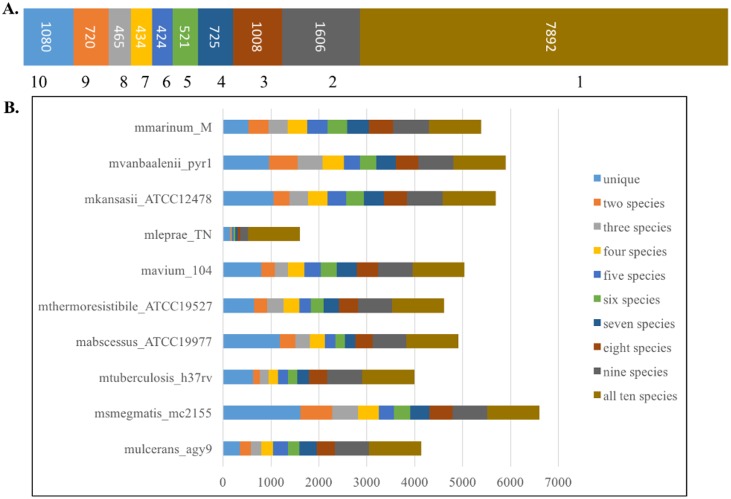
Mycobacteriaceae comprises pathogenic species such as Mycobacterium tuberculosis, M. leprae and M. abscessus, as well as non-pathogenic species, for example, M. smegmatis and M. thermoresistibile. Genome comparison and annotation studies provide insights into genome evolutionary relatedness, identify unique and pathogenicity-related genes in each species, and explore new targets that could be used for developing new diagnostics and therapeutics. Here, we present a comparative analysis of ten-mycobacterial genomes with the objective of identifying similarities and differences between pathogenic and non-pathogenic species. We identified 1080 core orthologous clusters that were enriched in proteins involved in amino acid and purine/pyrimidine biosynthetic pathways, DNA-related processes (replication, transcription, recombination and repair), RNA-methylation and modification, and cell-wall polysaccharide biosynthetic pathways. For their pathogenicity and survival in the host cell, pathogenic species have gained specific sets of genes involved in repair and protection of their genomic DNA. M. leprae is of special interest owing to its smallest genome (1600 genes and ~1300 psuedogenes), yet poor genome annotation. More than 75% of the pseudogenes were found to have a functional ortholog in the other mycobacterial genomes and belong to protein families such as transferases, oxidoreductases and hydrolases.
Overview
The claims and statistics of this paper haven’t been checked yet.
Free: it reads the open-access text and checks the first 5 claims that cite a source we can check. Create a free account to check every claim.
Integrity signals
Registry
Cites
Statistics
Figures



Verification
Claims the paper makes
The claims and statistics of this paper haven’t been checked yet.
Free: it reads the open-access text and checks the first 5 claims that cite a source we can check. Create a free account to check every claim.
Claims other papers make about this one
Each is checked against this paper’s own text: does it say what the citing paper says it does?
The source backs part of the claim, not all of it — or backs it for a different population, condition or comparison.
In the citing paper
“By contrast, M. smegmatis encodes thousands of conserved mycobacterial gene orthologs and has the same cell architecture and physiology.”
From Mycobacterium smegmatis: The Vanguard of Mycobacterial Research (2023) · cites this paper as [33]
Experimental — accuracy not yet measuredThe cited source says what the claim attributes to it.
In the citing paper
“The average protein identities between protein orthologs in M. smegmatis and their pathogenic cousins are >70% in most cases (33).”
From Mycobacterium smegmatis: The Vanguard of Mycobacterial Research (2023) · cites this paper as [33]
Self-check
Percentages, sums and reported differences re-computed from the paper’s own numbers.
The self-check needs the paper’s full text.
Citations
Cites
Deciphering the biology of Mycobacterium tuberculosis from the complete genome sequence
Cole, S. T., Brosch, R., Parkhill, J., Garnier, T., Churcher, C., Harris, D., Gordon, S. V., Eiglmeier, K., Gas, S., Barry, C. E., et al. (1998) · Nature · doi:10.1038/31159 · Cited by 7,847
UniProt: the Universal Protein knowledgebase
Apweiler, R. (2004) · Nucleic Acids Research · doi:10.1093/nar/gkh131 · Cited by 7,498
Accelerated Profile HMM Searches
Eddy, S. R. (2011) · PLoS Computational Biology · doi:10.1371/journal.pcbi.1002195 · Cited by 6,975
The Pfam protein families database: towards a more sustainable future
Finn, R. D., Coggill, P., Eberhardt, R. Y., Eddy, S. R., Mistry, J., Mitchell, A. L., Potter, S. C., Punta, M., Qureshi, M., Sangrador-Vegas, A., et al. (2016) · Nucleic Acids Research · doi:10.1093/nar/gkv1344 · Cited by 5,975
UniProt: the universal protein knowledgebase
The UniProt Consortium (2017) · Nucleic Acids Research · doi:10.1093/nar/gkw1099 · Cited by 4,436
Massive gene decay in the leprosy bacillus.
Cole, S. T., Eiglmeier, K., Parkhill, J., James, K. D., Thomson, N. R., Wheeler, P. R., Honoré, N., Garnier, T., Churcher, C., Harris, D., et al. (2001) · Nature · doi:10.1038/35059006 · Cited by 1,777
Improved method for predicting linear B-cell epitopes.
Larsen, J., Lund, O., & Nielsen, M. (2006) · Immunome Research · doi:10.1186/1745-7580-2-2 · Cited by 1,413
PATRIC, the bacterial bioinformatics database and analysis resource
Wattam, A. R., Abraham, D., Dalay, O., Disz, T. L., Driscoll, T., Gabbard, J. L., Gillespie, J. J., Gough, R., Hix, D., Kenyon, R., et al. (2014) · Nucleic Acids Research · doi:10.1093/nar/gkt1099 · Cited by 1,243
Proteinortho: Detection of (Co-)orthologs in large-scale analysis
Lechner, M., Findeiß, S., Steiner, L., Marz, M., Stadler, P. F., & Prohaska, S. J. (2011) · BMC Bioinformatics · doi:10.1186/1471-2105-12-124 · Cited by 1,221
Persister cells and tolerance to antimicrobials
Keren, I., Kaldalu, N., Spoering, A., Wang, Y., & Lewis, K. (2004) · FEMS Microbiology Letters · doi:10.1016/s0378-1097(03)00856-5 · Cited by 1,098
Research works printed but not linked: 1
- WHO | Weekly Epidemiological Record, 2 September 2016, vol. 91, 35 (pp. 405–420). WHO. World Health Organization; 2016;
Cited by
Mycobacterium smegmatis: The Vanguard of Mycobacterial Research
Sparks, I. L., Derbyshire, K. M., Jacobs, W. R., & Morita, Y. S. (2023) · Journal of Bacteriology · doi:10.1128/jb.00337-22 · Cited by 149
Drug Resistance in Nontuberculous Mycobacteria: Mechanisms and Models
Saxena, S., Spaink, H. P., & Forn‐Cuní, G. (2021) · Biology · doi:10.3390/biology10020096 · Cited by 182
“smegmatis is used for laboratory testing and modeling of NTM disease pathogenesis due to its rapid growth rate and ease of handling [138].”
MethodThe Many Lives of Nontuberculous Mycobacteria
Claeys, T. A., & Robinson, R. (2018) · Journal of Bacteriology · doi:10.1128/jb.00739-17 · Cited by 106
“Even though NTM species may share a similar number of genes, the presence of species-specific genes appears to be very high and diverse (40).”
BackgroundInfluentialBasha, R. Y., Sampath Kumar, T. S., & Doble, M. (2019) · Carbohydrate Polymers · doi:10.1016/j.carbpol.2019.04.056 · Cited by 84
Geographically dispersed zoonotic tuberculosis in pre-contact South American human populations
Vågene, Å. J., Honap, T. P., Harkins, K. M., Rosenberg, M. S., Giffin, K. L., Cárdenas-Arroyo, F., Leguizamón, L. P., Arnett, J., Buikstra, J. E., Herbig, A., et al. (2022) · Nature Communications · doi:10.1038/s41467-022-28562-8 · Cited by 66
“The enrichment of non-MTBC mycobacterial DNA during capture points to the well-known genetic similarity between environmental mycobacteria and MTBC strains 71 .”
Mycobacterium tuberculosis Metabolism
Mashabela, G. T., de Wet, T. J., & Warner, D. F. (2019) · Microbiology Spectrum · doi:10.1128/microbiolspec.gpp3-0067-2019 · Cited by 71
Structural Implications of Mutations Conferring Rifampin Resistance in Mycobacterium leprae
Vedithi, S. C., Malhotra, S., Das, M., Daniel, S., Kishore, N., George, A., Arumugam, S., Rajan, L., Ebenezer, M., Ascher, D. B., et al. (2018) · Scientific Reports · doi:10.1038/s41598-018-23423-1 · Cited by 49
Self-citationMycobacterial genomics and structural bioinformatics: opportunities and challenges in drug discovery
Waman, V., Vedithi, S. C., Thomas, S. E., Bannerman, B. P., Munir, A., Skwark, M. J., Malhotra, S., & Blundell, T. L. (2019) · Emerging Microbes & Infections · doi:10.1080/22221751.2018.1561158 · Cited by 46
“Malhotra et al. [44] describe a 90% overlap of known and proposed drug targets against all mycobacterial species.”
Self-citationAnand, P., & Akhter, Y. (2022) · International Journal of Biological Macromolecules · doi:10.1016/j.ijbiomac.2022.05.124 · Cited by 44
QcrB in Mycobacterium tuberculosis: The new drug target of antitubercular agents
Bahuguna, A., Rawat, S., & Rawat, D. S. (2021) · Medicinal Research Reviews · doi:10.1002/med.21779 · Cited by 39
“tuberculosis as both share 70% similarity between the orthologous cluster of genomes.(30) Recently, respiratory supercomplex (complex III–IV) ofM.”
BackgroundSimcox, B. S., Tomlinson, B. R., Shaw, L. N., & Rohde, K. H. (2023) · Frontiers in Cellular and Infection Microbiology · doi:10.3389/fcimb.2023.1144210 · Cited by 26
“Given the diversity of conditions encountered by Mab as an environmental, opportunistic pathogen, and larger genome (compared to Mtb) comprised of ~800 species-specific genes, the potential for unique gene sets in Mab TCS regulons is high (Malhotra et al., 2017; Wee et al., 2017).”
BackgroundStrategies for drug target identification in Mycobacterium leprae
Acebrón-García-de-Eulate, M., Blundell, T. L., & Vedithi, S. C. (2021) · Drug Discovery Today · doi:10.1016/j.drudis.2021.03.026 · Cited by 23
Self-citationMaeda, T., Kawada, M., Sakata, N., Kotani, H., & Furusawa, C. (2021) · Scientific Reports · doi:10.1038/s41598-021-94645-z · Cited by 21
Xie, W., Wang, L., Luo, D., Soni, V., Rosenn, E. H., & Wang, Z. (2023) · Vaccines · doi:10.3390/vaccines11081302 · Cited by 20
Grey, A., Cadelis, M. M., Diao, Y., Park, D., Lumley, T., Weir, B. S., Copp, B. R., & Wiles, S. (2021) · Frontiers in Microbiology · doi:10.3389/fmicb.2021.739995 · Cited by 17
Wei, A. C., Lee, B. M., Jackson, C. J., Wang, Y., Franzblau, S. G., Francisco, A. F., Kelly, J. M., Bernhardt, P. V., Tan, L., West, N. P., et al. (2022) · Journal of Medicinal Chemistry · doi:10.1021/acs.jmedchem.2c00972 · Cited by 14
Nayak, T., Kakkar, A., Singh, R. K., Jaiswal, L. K., Singh, A. K., Temple, L. M., & Gupta, A. (2023) · Frontiers in Cellular and Infection Microbiology · doi:10.3389/fcimb.2023.1173894 · Cited by 14
“smegmatis were shown to have an average identity of over 70% (Malhotra et al., 2017).”
In-vitro Anti-Tuberculosis, Anti-Efflux Pumps and Anti-Biofilm Effects of Crinum Asiaticum Bulbs
Ofori, M., Danquah, C. A., Ativui, S., Doe, P., & Asamoah, W. A. (2021) · Biomedical & Pharmacology Journal · doi:10.13005/bpj/2289 · Cited by 13
Gupta, R., & Rohde, K. H. (2022) · Tuberculosis · doi:10.1016/j.tube.2022.102292 · Cited by 14
Nyinoh, I. W., & McFadden, J. (2018) · Drug Development Research · doi:10.1002/ddr.21497 · Cited by 14
Management of nontuberculous mycobacteria in lung transplant cases: an international Delphi study
Asif, H., Rahaghi, F., Ohsumi, A., Philley, J. V., Emtiazjoo, A. M., Hirama, T., Baker, A. W., Shu, C., Silveira, F. P., Poulin, V., et al. (2023) · ERJ Open Research · doi:10.1183/23120541.00377-2022 · Cited by 11
Compartmentalized cell envelope biosynthesis in Mycobacterium tuberculosis
Puffal, J., Sparks, I. L., Brenner, J. R., Li, X., Leszyk, J., Hayashi, J. M., Shaffer, S. A., & Morita, Y. S. (2025) · mBio · doi:10.1128/mbio.02680-25 · Cited by 12
Yadav, R., Rajput, V., Gohil, K. N., Khairnar, K., & Dharne, M. S. (2020) · Ecotoxicology and Environmental Safety · doi:10.1016/j.ecoenv.2020.110938 · Cited by 10
Shu, Q., Liu, S., Alonzi, T., LaCourse, S. M., Singh, D. K., Bao, D., Wamalwa, D. C., Jiang, L., Lyon, C. J., John-Stewart, G. C., et al. (2022) · Theranostics · doi:10.7150/thno.70373 · Cited by 10
“Such diagnostic proteins should ideally be expressed throughout infection and play essential roles in replication or virulence [1], but these properties can also limit their utility as specific biomarkers since proteins that play central roles in pathogen function tend to be highly conserved among related species [2],…”
Swain, A., Gnanasekar, P., Prava, J., Rajeev, A. C., Kesarwani, P., Lahiri, C., & Pan, A. (2020) · Microbial Drug Resistance · doi:10.1089/mdr.2020.0161 · Cited by 8
“30 In the present study, we exploit the comparative genomics approach to gradually shortlist a set of broad-spectrum targets in a wide range of NTM.”
van Wijk, R. C., van der Sar, A. M., Krekels, E. H. J., Verboom, T., Spaink, H. P., Simonsson, U. S. H., & van der Graaf, P. H. (2020) · Clinical and Translational Science · doi:10.1111/cts.12793 · Cited by 6
“marinum share a genetic program for (intracellular) growth(4) and genetic functions required for dormant infections are found in both genomes.(22) To quantify the growth rate for the M.”
Identification of genes associated with persistence in Mycobacterium smegmatis
Joshi, H., Kandari, D., Maitra, S. S., Bhatnagar, R., & Banerjee, N. (2024) · Frontiers in Microbiology · doi:10.3389/fmicb.2024.1302883 · Cited by 6
“The fast-growing, non-pathogenic Mycobacterium smegmatis , which shares 70% homology with the pathogenic M. tuberculosis , is often used as a model to study persistence genes (Malhotra et al., 2017; Ranjitha et al., 2020).”
Boussamba-Digombou, K. J., Sandasi, M., Kamatou, G., van Vuuren, S. F., Sawicki, R., Fakhar, Z., & Viljoen, A. M. (2022) · Antibiotics · doi:10.3390/antibiotics11070948 · Cited by 8
“These strains belong to the Mycobacteriaceae family, known for a rapid growth rate with the ability to adapt to different environmental niches [65].”
BackgroundMycobacterium marinum Immune Evasion in Zebrafish
Kumar, P., Cameron, D. J., Saviola, B., & Venketaraman, V. (2025) · Pathogens · doi:10.3390/pathogens14090908 · Cited by 6
“M. marinum possesses a 6.6 Mbp genome with 5424 coding regions, 10 prophages, and a mercury resistance plasmid [21,40,41].”
InfluentialEmerging Concepts in Bacterial Taxonomy
Rai, A., Indu, Smita, N., Gupta, D., Gaurav, K., Dhanesh, K., Suresh, G., Sasikala, C., & Ramana, C. V. (2019) · Springer eBooks · doi:10.1007/978-981-13-8315-1_1 · Cited by 5
Cornejo‐Granados, F., Kohl, T. A., Sotomayor, F. V., Andres, S., Hernández‐Pando, R., Hurtado-Ramírez, J. M., Utpatel, C., Niemann, S., Maurer, F. P., & Ochoa‐Leyva, A. (2021) · BMC Genomics · doi:10.1186/s12864-021-07670-7 · Cited by 5
“In contrast, rapidly growing NTM such as MAB are considered to represent a more ancient evolutionary state, with larger genomes than those of MTB [23, 24].”
BackgroundWimalasena, S. H. M. P., Seo, S. Y., Lee, H. G., Jung, Y., Do, Y. J., Cho, A., Choe, C., Yoo, A. S., Kang, S.-J., Lee, J. H., et al. (2025) · Journal of Veterinary Science · doi:10.4142/jvs.24201 · Cited by 4
Vedithi, S. C., Malhotra, S., Acebrón-García-de-Eulate, M., Matusevicius, M., Torres, P. H. M., & Blundell, T. L. (2021) · Frontiers in Molecular Biosciences · doi:10.3389/fmolb.2021.663301 · Cited by 5
Self-citationShitikov, E. A., Malakhova, M. V., Kuznetsova, S., Bespiatykh, D., Gorodnichev, R. B., Kiselev, S., Kornienko, M. A., Klimina, K. M., Strokach, A. A., German, A., et al. (2025) · Frontiers in Microbiology · doi:10.3389/fmicb.2025.1713073 · Cited by 3
Animal models of Mycobacterium abscessus pulmonary infection phenotypes: What are we modeling?
Sui, X., & Oehlers, S. H. (2025) · PLoS Pathogens · doi:10.1371/journal.ppat.1013414 · Cited by 3
“The genus level similarities between M. abscessus and M. tuberculosis span genomic similarity demonstrated by both genetic measures such as sequence similarity and essential gene analyses, and pathogenic manifestations such as chronic pulmonary infection and residency within macrophages [1,2].”
Srivastava, V., Navabharath, M., Khan, M., Samal, M., Parveen, R., Singh, S. V., & Ahmad, S. (2024) · Journal of Ethnopharmacology · doi:10.1016/j.jep.2024.118482 · Cited by 4
Zheng, Y., Lin, C., Sun, X., Li, L., Jiang, Y., Li, W., Zhou, S., Kuang, W., Pan, L., & Shao, Q. (2025) · Industrial Crops and Products · doi:10.1016/j.indcrop.2025.121726 · Cited by 2
Neutrophils from Protection to Pathogenesis in Tuberculosis
Beig, H., & Singh, A. (2025) · ACS Infectious Diseases · doi:10.1021/acsinfecdis.5c00096 · Cited by 3
Mycobacterium tuberculosis Metabolism
Mashabela, G. T., de Wet, T. J., & Warner, D. F. (2019) · ASM Press eBooks · doi:10.1128/9781683670131.ch67 · Cited by 3
Mwangi, L. W., Matofari, J. W., Bebe, B. O., Njeru, M. J., & Nduko, J. M. (2025) · Current Microbiology · doi:10.1007/s00284-025-04244-8 · Cited by 1
“…variation in virulence factor numbers, such as Mycolicibacterium pulveris (JEL_161 with 75) vs Mycobacterium colombiense (JAEL_158) with 361 in PATRIC_VF suggests potential differences in pathogenicity among Mycobacterium species, particularly in relation to diseases like tuberculosis [55, 57].”
Protein Architecture and Composition in Mycobacterium tuberculosis
Farnia, P., Velayati, A. A., Ghanavi, J., & Farnia, P. (2025) · Advances in experimental medicine and biology · doi:10.1007/978-3-031-96883-9_3 · Cited by 2
Zaychikova, M. V., Avdeev, V. V., Kuznetsova, S., Malakhova, M. V., & Shitikov, E. A. (2026) · Russian Journal of Infection and Immunity · doi:10.15789/2220-7619-bda-18100 · Cited by 2
Kotimoole, C. N., Ramya, V., Kaur, P., Reiling, N., Shandil, R. K., Narayanan, S., Flo, T. H., & Prasad, T. S. K. (2024) · Journal of Proteome Research · doi:10.1021/acs.jproteome.3c00850 · Cited by 1
PE/PPE Proteome and ESX-5 Substrate Spectrum in Mycobacterium marinum
Yan, L., Lai, H. Y., Leung, T. C. N., Cheng, H. F., Chen, X., Tsui, S. K., Ngai, S. M., & Au, S. W. N. (2024) · International Journal of Molecular Sciences · doi:10.3390/ijms25179550 · Cited by 2
“This species is widely used as a surrogate for Mtb because of the similarity in genome composition, host–pathogen interactions, and pathogenesis [19,20,35–37].”
MethodIvanchenko, D., & Hrytsenko, L. (2020) · Regulatory Mechanisms in Biosystems · doi:10.15421/022019 · Cited by 1
Asif, H., & Mirsaeidi, M. S. (2020) · Elsevier eBooks · doi:10.1016/b978-0-08-102723-3.00065-2 · Cited by 1
Chong, S. S. M. (2020) · DR-NTU (Nanyang Technological University) · doi:10.32657/10356/143914
Quiñones-García, S., Gilman, R. H., Sheen, P., & Zimic, M. (2021) · bioRxiv (Cold Spring Harbor Laboratory) · doi:10.1101/2021.10.29.466536 · Cited by 4
Arif, S., Shafiq, A., Javed, R., Hasan, A., Hussain, A., Alonazi, W. B., Ibrahim, M. K., & Shen, J. F. (2024) · Research Square · doi:10.21203/rs.3.rs-4661466/v1
Zhang, K., Du, Z., Wang, Z., Chen, Y., Zhang, L., Chen, X., & Guo, A. (2025) · World Journal of Microbiology and Biotechnology · doi:10.1007/s11274-025-04343-5
“Additionally, the average protein identity between orthologous genes across different species exceeds 70% (Malhotra et al. 2017).”
Cornejo‐Granados, F., Kohl, T. A., Sotomayor, F. V., Andres, S., Hernández-Pando, R., Hurtado-Ramirez, J. M., Utpatel, C., Niemann, S., Maurer, F. P., & Ochoa‐Leyva, A. (2021) · Figshare · doi:10.6084/m9.figshare.14676706
Cornejo‐Granados, F., Kohl, T. A., Sotomayor, F. V., Andres, S., Hernández-Pando, R., Hurtado-Ramirez, J. M., Utpatel, C., Niemann, S., Maurer, F. P., & Ochoa‐Leyva, A. (2021) · Figshare · doi:10.6084/m9.figshare.14676718
Cornejo‐Granados, F., Kohl, T. A., Sotomayor, F. V., Andres, S., Hernández-Pando, R., Hurtado-Ramirez, J. M., Utpatel, C., Niemann, S., Maurer, F. P., & Ochoa‐Leyva, A. (2021) · Figshare · doi:10.6084/m9.figshare.14676703
Cornejo‐Granados, F., Kohl, T. A., Sotomayor, F. V., Andres, S., Hernández-Pando, R., Hurtado-Ramirez, J. M., Utpatel, C., Niemann, S., Maurer, F. P., & Ochoa‐Leyva, A. (2021) · Figshare · doi:10.6084/m9.figshare.14676715
Cornejo‐Granados, F., Kohl, T. A., Sotomayor, F. V., Andres, S., Hernández-Pando, R., Hurtado-Ramirez, J. M., Utpatel, C., Niemann, S., Maurer, F. P., & Ochoa‐Leyva, A. (2021) · Figshare · doi:10.6084/m9.figshare.14676709
Cornejo‐Granados, F., Kohl, T. A., Sotomayor, F. V., Andres, S., Hernández-Pando, R., Hurtado-Ramirez, J. M., Utpatel, C., Niemann, S., Maurer, F. P., & Ochoa‐Leyva, A. (2021) · Figshare · doi:10.6084/m9.figshare.14676721
Cornejo‐Granados, F., Kohl, T. A., Sotomayor, F. V., Andres, S., Hernández-Pando, R., Hurtado-Ramirez, J. M., Utpatel, C., Niemann, S., Maurer, F. P., & Ochoa‐Leyva, A. (2021) · Figshare · doi:10.6084/m9.figshare.14676712
Cornejo‐Granados, F., Kohl, T. A., Sotomayor, F. V., Andres, S., Hernández-Pando, R., Hurtado-Ramirez, J. M., Utpatel, C., Niemann, S., Maurer, F. P., & Ochoa‐Leyva, A. (2021) · Figshare · doi:10.6084/m9.figshare.14676724
Wang, S., Zhang, L., Wu, R., Wang, H., Sun, M., Zhang, Y., Xing, J., Fang, R., Li, X., Wang, Y. F., et al. (2026) · ACS Omega · doi:10.1021/acsomega.5c10658
Gautreau, G. (2020) · theses.fr (ABES) · doi:10.70675/d5c3a7fezdc60z410fza79cz2ed2c937aa11 · Cited by 3
Apport de la génomique comparative dans l’étude des infections à mycobactéries
Lecorché, E. (2020) · theses.fr (ABES) · doi:10.70675/9e5db5c1z3e9az44fazb638z2555db09bc5d
The Antimycobacterial Activity, Toxicity and Chemical Composition of South African Propolis
Mzimba, N. F., Ncube, E. N., Salifu, E. Y., Viljoen, A. M., Gordhan, B. G., Kana, B. D., & van Vuuren, S. F. (2026) · Chemistry & Biodiversity · doi:10.1002/cbdv.71577
Metadata
- Authors
- Malhotra, S., Vedithi, S. C., & Blundell, T. L.
- Affiliations
- University of Cambridge (GB)
- Corresponding author
- Malhotra, Sony
- Blundell, Tom L.
- Venue
- PLOS Neglected Tropical Diseases
- Publisher
- Public Library of Science (PLoS)
- Published
- 2017-08-30
- Volume
- 11
- Issue
- 8
- Pages
- e0005883
- ISSN
- 1935-2727 (ISSN-L)
- 1935-2735
- PMC
- PMC5595346
- OpenAlex
- W2751144760
- Cited by
- 63
- References
- 63
- Citations by year
- 2026: 3 · 2025: 10 · 2024: 5 · 2023: 6 · 2022: 6 · 2021: 17 · 2020: 8 · 2019: 5 · 2018: 3
- FWCI
- 3.42
- Type
- journal article
- Language
- en
- Update notices
- new_version (2017-09-12)
- Open access
- gold
- doi.org
- Licence
- Locations
- PLoS neglected tropical diseases (publishedVersion, cc-by)
- PubMed Central (publishedVersion, cc-by)
- PubMed (publishedVersion)
- DOAJ (DOAJ: Directory of Open Access Journals) (submittedVersion, cc-by-sa)
- Figshare (submittedVersion, cc-by)
- Apollo (University of Cambridge) (submittedVersion, cc-by)
- Apollo (cc-by)
- Funders
- Medical Research Council (RG78439)
- Cystic Fibrosis Foundation Therapeutics (US) (RG70975)
- Wellcome Trust (GB) (200814/Z/16/Z)
- American leprosy Mission (RG88726)
- Topics
- Health Sciences › Medicine › Epidemiology › Mycobacterium research and diagnosis
- Health Sciences › Medicine › Infectious Diseases › Tuberculosis Research and Epidemiology
- Life Sciences › Biochemistry, Genetics and Molecular Biology › Molecular Biology › Genomics and Phylogenetic Studies
- Keywords
- Mycobacteriaceae, comparative genomics, pathogenicity, Mycobacterium tuberculosis, Mycobacterium leprae, Mycobacterium abscessus, Mycobacterium smegmatis, Mycobacterium thermoresistibile, pseudogenes, DNA repair genes, amino acid biosynthesis, purine and pyrimidine biosynthesis, cell wall polysaccharide biosynthesis, RNA methylation, genome evolution
- MeSH terms
- Bacterial Proteins, Mycobacteriaceae, Genome, Bacterial, Virulence Factors
About these checks
Registry, retraction, Cites and statistics results are computed, not judged, with one exception: a printed reference that no index lists is read once by a model before it counts as a citation error. Claims are extracted by a model and kept only when their quote appears verbatim in the text; each cited source is then checked, with a model’s help, for whether it says what the claim relies on. Those verdicts can be wrong — read the claim’s quote and the cited source before relying on one.
Statistics and arithmetic are recomputed, not judged.
Confidence bands are shown only for fields calibrated on our annotated test set. None is calibrated yet, so no band is shown.
What counts as a claim ›How we measure confidence ›How we check this ›
Are you an author, or do you see a problem with this page? Request a review
Data sources
Bibliographic data: Semantic Scholar, OpenAlex, Crossref.
Contains information from the Semantic Scholar Academic Graph Datasets, made available under the ODC Attribution License (ODC-BY 1.0).
Semantic Scholar’s data is described in: Kinney, R., et al. (2023). The Semantic Scholar Open Data Platform. arXiv:2301.10140.
