

The DOI matches its Crossref record; 18 of the 18 references it cites were found in a registry or an index.
A thermostable messenger RNA based vaccine against rabies
Open accessAbstract
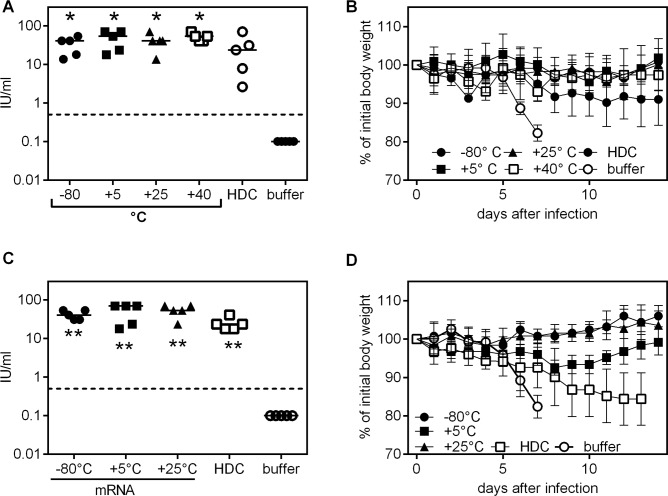
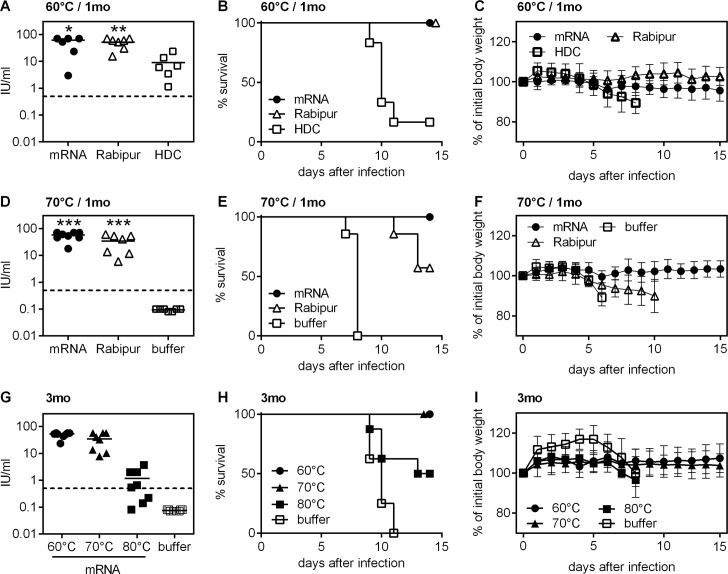
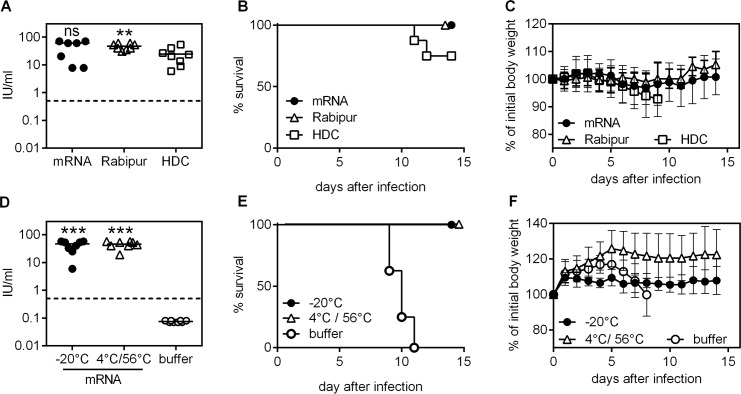
Although effective rabies virus vaccines have been existing for decades, each year, rabies virus infections still cause around 50.000 fatalities worldwide.Most of these cases occur in developing countries, where these vaccines are not available.The reasons for this are the prohibitive high costs of cell culture or egg grown rabies virus vaccines and the lack of a functional cold chain in many regions in which rabies virus is endemic.Here, we describe the excellent temperature resistance of a non-replicating mRNA based rabies virus vaccine encoding the rabies virus glycoprotein (RABV-G).Prolonged storage of the vaccine from -80˚C to up to +70˚C for several months did not impact the protective capacity of the mRNA vaccine.Efficacy after storage was demonstrated by the induction of rabies specific virus neutralizing antibodies and protection in mice against lethal rabies infection.Moreover, storing the vaccine at oscillating temperatures between +4˚and +56˚C for 20 cycles in order to simulate interruptions of the cold chain during vaccine transport, did not affect the vaccine's immunogenicity and protective characteristics, indicating that maintenance of a cold chain is not essential for this vaccine. Author summaryConventional prophylactic vaccines require transport and storage under controlled temperatures in an unbroken cold chain.Therefore, distribution of many vaccines is restricted to areas where the cold chain can be maintained which excludes especially rural areas in many countries from continues vaccine supply.Unfortunately, some diseases that can be prevented by vaccination, like the rabies virus infection, are still endemic in such areas.Therefore, logistic reasons often prevent delivery of life saving vaccines to areas in which they are most needed.Here, we describe an mRNA vaccine encoding the rabies virus glycoprotein (RABV-G) that remains protective in a mouse challenge model upon storage at highly variable temperatures.These results suggest that such a vaccine allows storage outside the cold chain and can therefore reach all areas of the world where rabies
Overview
The claims and statistics of this paper haven’t been checked yet.
Run the check — free, no account needed. It reads the open-access text and checks the sources it cites.
Integrity signals
Registry
Cites
Statistics
Figures
Verification
Claims the paper makes
The claims and statistics of this paper haven’t been checked yet.
Run the check — free, no account needed. It reads the open-access text and checks the sources it cites.
Claims other papers make about this one
Each is checked against this paper’s own text: does it say what the citing paper says it does?
The source backs part of the claim, not all of it — or backs it for a different population, condition or comparison.
In the citing paper
“Both CVnCoV and CV2CoV are based on RNActive technology4–7 and consist of non-chemically modified sequence-engineered mRNA without pseudouridine6–12.”
From Optimization of non-coding regions for a non-modified mRNA COVID-19 vaccine (2022) · cites this paper as [9]
Experimental — accuracy not yet measuredIn the citing paper
“A more recent storage approach involves employing freeze-drying to mRNA vaccine conservation, which was shown to effectively reduce storage requirements, being thus considered a promising technique to improve mRNA vaccine stability.472,473”
From Advances in COVID-19 mRNA vaccine development (2022) · cites this paper as [472]
In the citing paper
“In preclinical studies, CureVac demonstrated that its sequence-optimized RABV-G vaccine against rabies could withstand exposure to temperatures ranging from −80 °C to +70 °C for several months243.”
From mRNA vaccines for infectious diseases: principles, delivery and clinical translation (2021) · cites this paper as [243]
Self-check
Percentages, sums and reported differences re-computed from the paper’s own numbers.
The self-check needs the paper’s full text.
Citations
Cites
Alberer, M., Gnad-Vogt, U., Hong, H. S., Mehr, K. T., Backert, L., Finak, G., Gottardo, R., Bica, M. A., Garofano, A., Koch, S. D., et al. (2017) · The Lancet · doi:10.1016/s0140-6736(17)31665-3 · Cited by 530
Petsch, B., Schnee, M., Vogel, A. B., Lange, E., Hoffmann, B., Voss, D., Schlake, T., Thess, A., Kallen, K.-J., Stitz, L., et al. (2012) · Nature Biotechnology · doi:10.1038/nbt.2436 · Cited by 464
Self-citationCliquet, F., Aubert, M., & Sagné, L. (1998) · Journal of Immunological Methods · doi:10.1016/s0022-1759(97)00212-3 · Cited by 432
Fotin-Mleczek, M., Duchardt, K. M., Lorenz, C., Pfeiffer, R., Ojkić-Zrna, S., Probst, J., & Kallen, K.-J. (2011) · Journal of Immunotherapy · doi:10.1097/cji.0b013e3181f7dbe8 · Cited by 335
Freezing temperatures in the vaccine cold chain: A systematic literature review
Matthias, D. M., Robertson, J., Garrison, M. M., Newland, S., & Nelson, C. (2007) · Vaccine · doi:10.1016/j.vaccine.2007.02.052 · Cited by 304
Opportunities and challenges of developing thermostable vaccines
Chen, D., & Kristensen, D. D. (2009) · Expert Review of Vaccines · doi:10.1586/erv.09.20 · Cited by 227
Schnee, M., Vogel, A. B., Voss, D., Petsch, B., Baumhof, P., Kramps, T., & Stitz, L. (2016) · PLOS Neglected Tropical Diseases · doi:10.1371/journal.pntd.0004746 · Cited by 212
Self-citationNucleic acid vaccines: prospects for non-viral delivery of mRNA vaccines
Deering, R. P., Kommareddy, S., Ulmer, J. B., Brito, L. A., & Geall, A. J. (2014) · Expert Opinion on Drug Delivery · doi:10.1517/17425247.2014.901308 · Cited by 180
Vaccination with Messenger RNA (mRNA)
Pascolo, S. (2008) · Handbook of Experimental Pharmacology · doi:10.1007/978-3-540-72167-3_11 · Cited by 126
Long-term storage of DNA-free RNA for use in vaccine studies
Jones, K. L., Drane, D., & Gowans, E. J. (2007) · BioTechniques · doi:10.2144/000112593 · Cited by 115
A vaccine cold chain freezing study in PNG highlights technology needs for hot climate countries
Wirkas, T., Toikilik, S., Miller, N., Morgan, C., & Clements, C. J. (2007) · Vaccine · doi:10.1016/j.vaccine.2006.08.028 · Cited by 82
Vaccine stabilization: Research, commercialization, and potential impact
Kristensen, D. D., Chen, D., & Cummings, R. (2011) · Vaccine · doi:10.1016/j.vaccine.2011.05.070 · Cited by 81
Characterization of the freeze sensitivity of a hepatitis B vaccine
Chen, D., Tyagi, A., Carpenter, J. P., Perkins, S., Sylvester, D., Guy, M., Kristensen, D. D., & Braun, L. J. (2009) · Human Vaccines · doi:10.4161/hv.5.1.6494 · Cited by 71
Thermotolerance of an inactivated rabies vaccine for dogs
Lankester, F. J., Wouters, P. A. W. M., Czupryna, A., Palmer, G. H., Mzimbiri, I., Cleaveland, S., Francis, M. J., Sutton, D. J., & Sonnemans, D. (2016) · Vaccine · doi:10.1016/j.vaccine.2016.10.015 · Cited by 46
Saxena, S., Sonwane, A., Dahiya, S. S., Patel, C. L., Saini, M., Rai, A., & Gupta, P. K. (2008) · Veterinary Microbiology · doi:10.1016/j.vetmic.2008.10.030 · Cited by 37
Rabies vaccine preserved by vaporization is thermostable and immunogenic
Smith, T. G., Siirin, M., Wu, X., Hanlon, C. A., & Bronshtein, V. (2015) · Vaccine · doi:10.1016/j.vaccine.2015.03.025 · Cited by 25
Sudarshan, M. K., Mahendra, B. J., Madhusudana, S. N., Narayana, D. H. A., Sanjay, T. V., Gangaboraiah, & Anandagiri, M. S. (2005) · Human Vaccines · doi:10.4161/hv.1.5.2110 · Cited by 17
Hoerr, I. (2000) · doi:10.1002/1521-4141(200001)30:1
Research works printed but not linked: 1
- Montagnon B, Fanget B (1996) Purified Vero cell vaccine for humans, WHO Laboratory techniques in rabies 4th edition, chapter 26. 4.
Cited by
Sorted by citations
mRNA-lipid nanoparticle COVID-19 vaccines: structure and stability
Schoenmaker, L., Witzigmann, D., Kulkarni, J. A., Verbeke, R., Kersten, G., Jiskoot, W., & Crommelin, D. J. A. (2021) · International Journal of Pharmaceutics · doi:10.1016/j.ijpharm.2021.120586 · Cited by 1,566
mRNA vaccines for infectious diseases: principles, delivery and clinical translation
Chaudhary, N., Weissman, D., & Whitehead, K. A. (2021) · Nature Reviews Drug Discovery · doi:10.1038/s41573-021-00283-5 · Cited by 1,555
A thermostable mRNA vaccine against COVID-19
Zhang, N.-N., Li, X.-F., Deng, Y.-Q., Zhao, H., Huang, Y.-J., Yang, G., Huang, W.-J., Gao, P., Zhou, C., Zhang, R.-R., et al. (2020) · Cell · doi:10.1016/j.cell.2020.07.024 · Cited by 671
Advances in mRNA Vaccines for Infectious Diseases
Zhang, C., Maruggi, G., Shan, H., & Li, J. (2019) · Frontiers in Immunology · doi:10.3389/fimmu.2019.00594 · Cited by 696
Advances in COVID-19 mRNA vaccine development
Fang, E., Liu, X., Li, M., Zhang, Z., Song, L., Zhu, B., Wu, X., Liu, J., Zhao, D., & Li, Y. (2022) · Signal Transduction and Targeted Therapy · doi:10.1038/s41392-022-00950-y · Cited by 601
Metadata
- Authors
- Stitz, L., Vogel, A., Schnee, M., Voss, D., Rauch, S., Mutzke, T., Ketterer, T., Kramps, T., & Petsch, B.
- Affiliations
- Friedrich-Loeffler-Institut (DE)
- CureVac (Germany) (DE)
- Corresponding author
- Petsch, Benjamin
- Venue
- PLOS Neglected Tropical Diseases
- Publisher
- Public Library of Science (PLoS)
- Published
- 2017-12-07
- Volume
- 11
- Issue
- 12
- Pages
- e0006108
- ISSN
- 1935-2727 (ISSN-L)
- 1935-2735
- PMC
- PMC5737050
- OpenAlex
- W2772901255
- Cited by
- 117
- References
- 18
- Citations by year
- 2026: 5 · 2025: 9 · 2024: 12 · 2023: 19 · 2022: 26 · 2021: 22 · 2020: 14 · 2019: 5 · 2018: 4
- FWCI
- 3.42
- Type
- journal article
- Language
- en
- Update notices
- new_version (2017-12-19)
- Open access
- gold
- doi.org
- Licence
- Locations
- PLoS neglected tropical diseases (publishedVersion, cc-by)
- PubMed Central (publishedVersion, cc-by)
- PubMed (publishedVersion)
- OpenAgrar (submittedVersion, cc-by)
- DOAJ (DOAJ: Directory of Open Access Journals) (submittedVersion, cc-by-sa)
- Funders
- Bundesministerium für Bildung und Forschung (02PK2178)
- Topics
- Life Sciences › Immunology and Microbiology › Virology › Rabies epidemiology and control
- Life Sciences › Biochemistry, Genetics and Molecular Biology › Molecular Biology › RNA Interference and Gene Delivery
- Health Sciences › Medicine › Epidemiology › Virology and Viral Diseases
- Keywords
- rabies virus, mRNA vaccines, rabies virus glycoprotein, thermostable vaccine, cold chain, vaccine storage, vaccine transport, virus-neutralizing antibodies, non-replicating vaccine, rabies prevention
- MeSH terms
- Immunogenicity, Vaccine, Animals, Antibodies, Viral, Antigens, Viral, Glycoproteins, Rabies, Rabies Vaccines, Rabies virus, RNA, Messenger, Temperature, Vaccines, Synthetic, Viral Envelope Proteins, Mice, Antibodies, Neutralizing, Vaccine Potency
About these checks
Registry, retraction, Cites and statistics results are computed, not judged, with one exception: a printed reference that no index lists is read once by a model before it counts as a citation error. Claims are extracted by a model and kept only when their quote appears verbatim in the text; each cited source is then checked, with a model’s help, for whether it says what the claim relies on. Those verdicts can be wrong — read the claim’s quote and the cited source before relying on one.
Statistics and arithmetic are recomputed, not judged.
Confidence bands are shown only for fields calibrated on our annotated test set. None is calibrated yet, so no band is shown.
What counts as a claim ›How we measure confidence ›How we check this ›
Are you an author, or do you see a problem with this page? Request a review
