

The DOI matches its Crossref record; 60 of the 62 references it cites were found in a registry or an index.
Sex-Related Differences in Gene Expression in Human Skeletal Muscle
Open accessAbstract
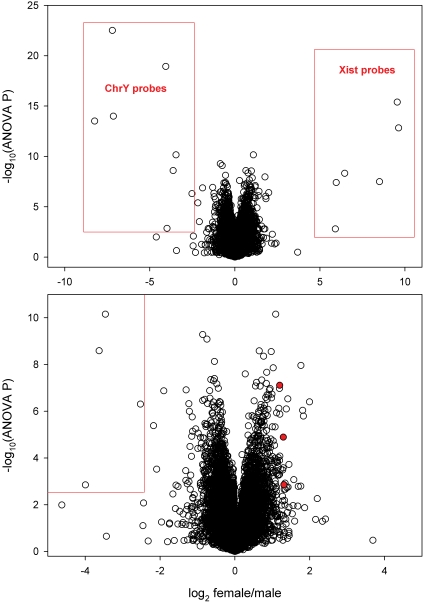
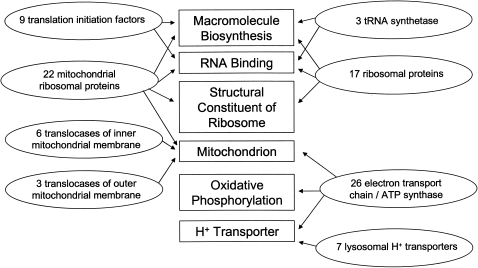
There is sexual dimorphism of skeletal muscle, the most obvious feature being the larger muscle mass of men. The molecular basis for this difference has not been clearly defined. To identify genes that might contribute to the relatively greater muscularity of men, we compared skeletal muscle gene expression profiles of 15 normal men and 15 normal women by using comprehensive oligonucleotide microarrays. Although there were sex-related differences in expression of several hundred genes, very few of the differentially expressed genes have functions that are obvious candidates for explaining the larger muscle mass of men. The men tended to have higher expression of genes encoding mitochondrial proteins, ribosomal proteins, and a few translation initiation factors. The women had >2-fold greater expression than the men (P<0.0001) of two genes that encode proteins in growth factor pathways known to be important in regulating muscle mass: growth factor receptor-bound 10 (GRB10) and activin A receptor IIB (ACVR2B). GRB10 encodes a protein that inhibits insulin-like growth factor-1 (IGF-1) signaling. ACVR2B encodes a myostatin receptor. Quantitative RT-PCR confirmed higher expression of GRB10 and ACVR2B genes in these women. In an independent microarray study of 10 men and 9 women with facioscapulohumeral dystrophy, women had higher expression of GRB10 (2.7-fold, P<0.001) and ACVR2B (1.7-fold, P<0.03). If these sex-related differences in mRNA expression lead to reduced IGF-1 activity and increased myostatin activity, they could contribute to the sex difference in muscle size.
Overview
The claims and statistics of this paper haven’t been checked yet.
Run the check — free, no account needed. It reads the open-access text and checks the sources it cites.
Integrity signals
Registry
Cites
Statistics
Figures
Verification
Claims the paper makes
The claims and statistics of this paper haven’t been checked yet.
Run the check — free, no account needed. It reads the open-access text and checks the sources it cites.
Claims other papers make about this one
Each is checked against this paper’s own text: does it say what the citing paper says it does?
In the citing paper
“Previous studies have identified over 3,000 genes that are differentially expressed in male and female skeletal muscle.”
From Sex-Based Differences in Skeletal Muscle Kinetics and Fiber-Type Composition (2015) · cites this paper as [96]
In the citing paper
“Analysis of mRNA from both male and female vastus lateralis biopsies by microarray shows (when normalized to α-actinin) that the female muscle has 35% more MyHC-I/β, 30% less MyHC-IIa, and 15% less MyHC-IIx mRNA than the corresponding male muscle (96).”
From Sex-Based Differences in Skeletal Muscle Kinetics and Fiber-Type Composition (2015) · cites this paper as [96]
In the citing paper
“In this study, the authors focus on two particular genes that are upregulated in women compared with men and that are known to code for proteins that are in signaling pathways of growth factors known to regulate muscle mass: growth factor receptor-bound protein 10 (GRB10) and activin receptor type-2A (ACVR2A).”
From Sex-Based Differences in Skeletal Muscle Kinetics and Fiber-Type Composition (2015) · cites this paper as [96]
In the citing paper
“The identification of over 3,000 genes differentially regulated in male and female muscle highlights the complex differences that occur in skeletal muscle from both sexes (96).”
From Sex-Based Differences in Skeletal Muscle Kinetics and Fiber-Type Composition (2015) · cites this paper as [96]
Self-check
Percentages, sums and reported differences re-computed from the paper’s own numbers.
The self-check needs the paper’s full text.
Citations
Cites
Subramanian, A., Tamayo, P., Mootha, V. K., Mukherjee, S., Ebert, B. L., Gillette, M. A., Paulovich, A., Pomeroy, S. L., Golub, T. R., Lander, E. S., et al. (2005) · Proceedings of the National Academy of Sciences · doi:10.1073/pnas.0506580102 · Cited by 53,625
In silico prediction of protein-protein interactions in human macrophages
Souiai, O., Guerfali, F. Z., Miled, S. B., Brun, C., & Benkahla, A. (2014) · BMC Research Notes · doi:10.1186/1756-0500-7-157 · Cited by 10,785
Exploration, normalization, and summaries of high density oligonucleotide array probe level data
Irizarry, R. A. (2003) · Biostatistics · doi:10.1093/biostatistics/4.2.249 · Cited by 10,603 · cited 5×
“This method was chosen after comparing it the standard Affymetrix method, a modified version of the Affymetrix comparison analysis algorithm that was used for our analyses of age-related differences [53], and RMA [54], because it had the best performance in accounting for non-specific hybridization (expression scores…”
InfluentialSignificance analysis of microarrays applied to the ionizing radiation response
Tusher, V. G., Tibshirani, R., & Chu, G. (2001) · Proceedings of the National Academy of Sciences · doi:10.1073/pnas.091062498 · Cited by 10,568
Regulation of skeletal muscle mass in mice by a new TGF-p superfamily member
McPherron, A. C., Lawler, A. M., & Lee, S.-J. (1997) · Nature · doi:10.1038/387083a0 · Cited by 4,013 · cited 1×
“Myostatin has a major role in determining muscle size. Constitutive myostatin knockout in mice leads to a hypermuscular phenotype caused by an increased number of fibers and fiber enlargement”
BackgroundSandri, M., Sandri, C., Gilbert, A., Skurk, C., Calabria, E., Picard, A., Walsh, K., Schiaffino, S., Lecker, S. H., & Goldberg, A. L. (2004) · Cell · doi:10.1016/s0092-8674(04)00400-3 · Cited by 3,012 · cited 1×
“In its active non-phosphorylated state, this transcription factor stimulates expression of the ubiquitin ligase atrogin-1 (also known as MAFbx or F-box protein 32) [47].”
Identifying biological themes within lists of genes with EASE
Hosack, D. A., Dennis, G., Sherman, B. T., Lane, H. C., & Lempicki, R. A. (2003) · Genome biology · doi:10.1186/gb-2003-4-10-r70 · Cited by 1,961 · cited 4×
“The EASE program (Version 2.0) was provided by the National Institutes of Health [27].”
InfluentialMultiple types of skeletal muscle atrophy involve a common program of changes in gene expression
Lecker, S. H., Jagoe, R. T., Gilbert, A., Gomes, M., Baracos, V., Bailey, J., Price, S. R., Mitch, W. E., & Goldberg, A. L. (2004) · The FASEB Journal · doi:10.1096/fj.03-0610com · Cited by 1,539 · cited 1×
“Atrogin-1 is upregulated under conditions associated with muscle atrophy [48].”
Myostatin Mutation Associated with Gross Muscle Hypertrophy in a Child
Schuelke, M., Wagner, K. R., Stolz, L. E., Hübner, C., Riebel, T., Kömen, W., Braun, T., Tobin, J. F., & Lee, S.-J. (2004) · New England Journal of Medicine · doi:10.1056/nejmoa040933 · Cited by 1,399
Skeletal muscle hypertrophy and atrophy signaling pathways
Glass, D. J. (2005) · The International Journal of Biochemistry & Cell Biology · doi:10.1016/j.biocel.2005.04.018 · Cited by 1,106 · cited 1×
“It is well accepted that IGF-1 has an anabolic effect on muscle [28].”
Cited by
Sorted by citations
Fiber Types in Mammalian Skeletal Muscles
Schiaffino, S., & Reggiani, C. (2011) · Physiological Reviews · doi:10.1152/physrev.00031.2010 · Cited by 3,022
“Thus, in men, the levels of MyHC-slow transcripts are lower than in women and the levels of MyHC-2A and -2X transcripts are higher (855).”
BackgroundSex differences in human fatigability: mechanisms and insight to physiological responses
Hunter, S. K. (2014) · Acta Physiologica · doi:10.1111/apha.12234 · Cited by 595
Sex-Based Differences in Skeletal Muscle Kinetics and Fiber-Type Composition
Haizlip, K. M., Harrison, B. C., & Leinwand, L. A. (2015) · Physiology · doi:10.1152/physiol.00024.2014 · Cited by 521
“Analysis of mRNA from both male and female vastus lateralis biopsies by microarray shows (when normalized to -actinin) that the female muscle has 35% more MyHC-I/ , 30% less MyHC-IIa, and 15% less MyHC-IIx mRNA than the corresponding male muscle (96).”
BackgroundInfluentialAnsdell, P., Thomas, K., Hicks, K. M., Hunter, S. K., Howatson, G., & Goodall, S. (2020) · Experimental Physiology · doi:10.1113/ep088548 · Cited by 403
“Sex differences in genetic expression and phenotype within skeletal muscle at rest are well established (Lindholm et al., 2014; Welle et al., 2008); however, whether sex mediates the phenotypic adaptation to endurance training is not clear.”
BackgroundThe role of sex in the genomics of human complex traits
Khramtsova, E. A., Davis, L. K., & Stranger, B. E. (2019) · Nature Reviews Genetics · doi:10.1038/s41576-018-0083-1 · Cited by 303
Metadata
- Authors
- Welle, S., Tawil, R., & Thornton, C. A.
- Affiliations
- University of Rochester Medicine (US)
- Corresponding author
- Welle, Stephen
- Venue
- PLoS ONE
- Publisher
- Public Library of Science (PLoS)
- Published
- 2008-01-02
- Volume
- 3
- Issue
- 1
- Pages
- e1385
- ISSN
- 1932-6203 (ISSN-L)
- PMC
- PMC2148100
- OpenAlex
- W2094746410
- Cited by
- 224
- References
- 62
- Citations by year
- 2026: 8 · 2025: 22 · 2024: 19 · 2023: 27 · 2022: 24 · 2021: 23 · 2020: 9 · 2019: 12 · 2018: 16 · 2017: 5 · 2016: 8 · 2015: 6 · 2014: 9 · 2013: 5 · 2012: 4
- FWCI
- 3.42
- Type
- journal article
- Language
- en
- Open access
- gold
- doi.org
- Locations
- PLoS ONE (publishedVersion, cc-by)
- Europe PMC (PubMed Central) (publishedVersion, cc-by)
- PubMed Central (publishedVersion, cc-by)
- PubMed (publishedVersion)
- DOAJ (DOAJ: Directory of Open Access Journals) (submittedVersion, cc-by-sa)
- Funders
- University of Rochester
- National Institutes of Health
- National Institute on Aging (AG18254, AG17891, P30AG018254, R01AG017891)
- National Institute of Arthritis and Musculoskeletal and Skin Diseases (AR/NS48143, K24AR048143)
- National Center for Research Resources (RR-00044, M01RR000044)
- Topics
- Life Sciences › Biochemistry, Genetics and Molecular Biology › Molecular Biology › Muscle Physiology and Disorders
- Life Sciences › Biochemistry, Genetics and Molecular Biology › Genetics › Genetics and Physical Performance
- Health Sciences › Nursing › Nutrition and Dietetics › Muscle metabolism and nutrition
- Keywords
- sex differences, skeletal muscle, gene expression, sexual dimorphism, muscle mass, Grb10, ACVR2B, IGF-1 signaling, facioscapulohumeral muscular dystrophy, mitochondrial proteins, ribosomal proteins, growth factor pathways
- MeSH terms
- Adult, Aged, Female, Gene Expression Regulation, Humans, Male, Middle Aged, Sex Factors, Muscle, Skeletal, Oligonucleotide Array Sequence Analysis
About these checks
Registry, retraction, Cites and statistics results are computed, not judged, with one exception: a printed reference that no index lists is read once by a model before it counts as a citation error. Claims are extracted by a model and kept only when their quote appears verbatim in the text; each cited source is then checked, with a model’s help, for whether it says what the claim relies on. Those verdicts can be wrong — read the claim’s quote and the cited source before relying on one.
Statistics and arithmetic are recomputed, not judged.
Confidence bands are shown only for fields calibrated on our annotated test set. None is calibrated yet, so no band is shown.
What counts as a claim ›How we measure confidence ›How we check this ›
Are you an author, or do you see a problem with this page? Request a review
