

Nucleoside Analogue Reverse Transcriptase Inhibitors Differentially Inhibit Human LINE-1 Retrotransposition
Open accessThe DOI matches its Crossref record; 41 of the 42 references it cites were found in a registry or an index.
Abstract
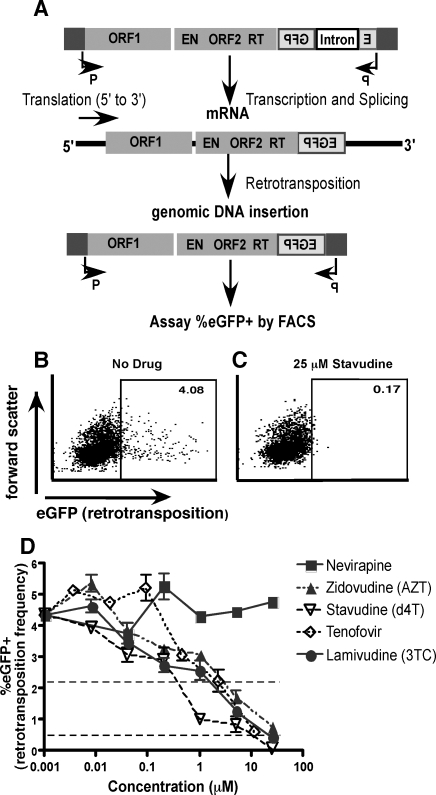
BACKGROUND: Intact LINE-1 elements are the only retrotransposons encoded by the human genome known to be capable of autonomous replication. Numerous cases of genetic disease have been traced to gene disruptions caused by LINE-1 retrotransposition events in germ-line cells. In addition, genomic instability resulting from LINE-1 retrotransposition in somatic cells has been proposed as a contributing factor to oncogenesis and to cancer progression. LINE-1 element activity may also play a role in normal physiology. METHODS AND PRINCIPAL FINDINGS: Using an in vitro LINE-1 retrotransposition reporter assay, we evaluated the abilities of several antiretroviral compounds to inhibit LINE-1 retrotransposition. The nucleoside analogue reverse transcriptase inhibitors (nRTIs): stavudine, zidovudine, tenofovir disoproxil fumarate, and lamivudine all inhibited LINE-1 retrotransposition with varying degrees of potencies, while the non-nucleoside HIV-1 reverse transcriptase inhibitor nevirapine showed no effect. CONCLUSIONS/SIGNIFICANCE: Our data demonstrates the ability for nRTIs to suppress LINE-1 retrotransposition. This is immediately applicable to studies aimed at examining potential roles for LINE-1 retrotransposition in physiological processes. In addition, our data raises novel safety considerations for nRTIs based on their potential to disrupt physiological processes involving LINE-1 retrotransposition.
Overview
The claims and statistics of this paper haven’t been checked yet.
Free: it reads the open-access text and checks the first 5 claims that cite a source we can check. Create a free account to check every claim.
Integrity signals
Registry
Cites
Statistics
Figures
Verification
Claims the paper makes
The claims and statistics of this paper haven’t been checked yet.
Free: it reads the open-access text and checks the first 5 claims that cite a source we can check. Create a free account to check every claim.
Claims other papers make about this one
Each is checked against this paper’s own text: does it say what the citing paper says it does?
In the citing paper
“One study demonstrated by using an in vitro LINE-1 retrotransposition assay that L1 retrotransposition could be suppressed by a number of different NRTIs with different degrees of potencies (Jones et al., 2008).”
From Cytoplasmic DNA: sources, sensing, and role in aging and disease (2021) · cites this paper as Jones et al., 2008
Self-check
Percentages, sums and reported differences re-computed from the paper’s own numbers.
The self-check needs the paper’s full text.
Citations
Cites
1 retracted
Roman-Gomez, J., Jimenez-Velasco, A., Agirre, X., Cervantes, F., Sanchez, J., Garate, L., Barrios, M., Castillejo, J. A., Navarro, G., Colomer, D., et al. (2005) · Oncogene · doi:10.1038/sj.onc.1208866 · Cited by 215
RetractedInitial sequencing and analysis of the human genome
International Human Genome Sequencing Consortium, Whitehead Institute for Biomedical Research, C. F. G. R., Lander, E. S., Linton, L. M., Birren, B., Nusbaum, C., Zody, M. C., Baldwin, J., Devon, K., Dewar, K., et al. (2001) · Nature · doi:10.1038/35057062 · Cited by 24,216 · cited 1×
“genome sequencing project was the observation that our genome is 42% comprised of retrotransposable element (RE) sequence [1].”
Mitsuya, H., Weinhold, K. J., Furman, P. A., St Clair, M. H., Lehrman, S. N., Gallo, R. C., Bolognesi, D., Barry, D. W., & Broder, S. (1985) · Proceedings of the National Academy of Sciences · doi:10.1073/pnas.82.20.7096 · Cited by 1,866
Human L1 retrotransposon encodes a conserved endonuclease required for retrotransposition
Feng, Q., Moran, J. V., Kazazian, H. H., & Boeke, J. D. (1996) · Cell · doi:10.1016/s0092-8674(00)81997-2 · Cited by 1,139
Hot L1s account for the bulk of retrotransposition in the human population
Brouha, B., Schustak, J., Badge, R. M., Lutz-Prigge, S., Farley, A. H., Moran, J. V., & Kazazian, H. H. (2003) · Proceedings of the National Academy of Sciences · doi:10.1073/pnas.0831042100 · Cited by 1,073 · cited 3×
“‘hot’ LINE-1 elements, and demonstrated that a high degree of similarity of a LINE-1 sequence to this consensus is predictive of high-level in vitro activity [3].”
BackgroundHigh frequency retrotransposition in cultured mammalian cells
Moran, J. V., Holmes, S. E., Naas, T. P., DeBerardinis, R. J., Boeke, J. D., & Kazazian, H. H. (1996) · Cell · doi:10.1016/s0092-8674(00)81998-4 · Cited by 1,022
Somatic mosaicism in neuronal precursor cells mediated by L1 retrotransposition
Muotri, A. R., Chu, V. T., Marchetto, M. C. N., Deng, W., Moran, J. V., & Gage, F. H. (2005) · Nature · doi:10.1038/nature03663 · Cited by 942 · cited 2×
“LINE-1 retrotransposition has been implicated in the generation of somatic mosaicism of neurons, and other cells over the course of development [25].”
BackgroundKazazian, H. H., Wong, C., Youssoufian, H., Scott, A. F., Phillips, D. G., & Antonarakis, S. E. (1988) · Nature · doi:10.1038/332164a0 · Cited by 929
Disruption of the APC gene by a retrotransposal insertion of L1 sequence in a colon cancer.
Miki, Y., Nishisho, I., Horii, A., Miyoshi, Y., Utsunomiya, J., Kinzler, K. W., Vogelstein, B., & Nakamura, Y. (1992) · PubMed · Cited by 564
Sequence patterns indicate an enzymatic involvement in integration of mammalian retroposons
Jurka, J. (1997) · Proceedings of the National Academy of Sciences · doi:10.1073/pnas.94.5.1872 · Cited by 556
Cited by
Retrotransposons Revisited: The Restraint and Rehabilitation of Parasites
Goodier, J. L., & Kazazian, H. H. (2008) · Cell · doi:10.1016/j.cell.2008.09.022 · Cited by 626
“Also, a recent study reported inhibition of L1 retrotransposition in cell culture by nucleoside analog reverse transcriptase inhibitors but not by nevirapine (Jones et al., 2008).”
A LINE1-Nucleolin Partnership Regulates Early Development and ESC Identity
Percharde, M., Lin, C.-J., Yin, Y., Guan, J., Peixoto, G. A., Bulut-Karslioglu, A., Biechele, S., Huang, B., Shen, X., & Ramalho-Santos, M. (2018) · Cell · doi:10.1016/j.cell.2018.05.043 · Cited by 555
“Inhibition of LINE1 retrotransposition using antiretroviral drugs (Jones et al., 2008) does not phenocopy LINE1 RNA KD, indicating that its role in ESCs is independent of retrotransposition (Figures S2G–S2I).”
InfluentialLINE1 Derepression in aged wild-type and SIRT6-deficient mice drives inflammation
Simon, M., Van Meter, M., Ablaeva, J., Ke, Z., Gonzalez, R. S., Taguchi, T., De Cecco, M., Leonova, K. I., Kogan, V., Helfand, S. L., et al. (2019) · Cell Metabolism · doi:10.1016/j.cmet.2019.02.014 · Cited by 498
“Several studies have reported that in addition to impeding the activity of viral polymerases, NRTIs such as 3TC and d4T, are also potent inhibitors of L1 RT (Dai et al., 2011; Jones et al., 2008).”
BackgroundThe quest to slow ageing through drug discovery
Partridge, L., Fuentealba, M., & Kennedy, B. K. (2020) · Nature Reviews Drug Discovery · doi:10.1038/s41573-020-0067-7 · Cited by 468
Thomas, C. A., Tejwani, L., Trujillo, C. A., Negraes, P. D., Herai, R. H., Mesci, P., Macia, A., Crow, Y. J., & Muotri, A. R. (2017) · Cell Stem Cell · doi:10.1016/j.stem.2017.07.009 · Cited by 330
“These inhibitors are well known anti-HIV-1 drugs that have been shown to inhibit both HIV and L1 reverse transcription (Jones et al., 2008).”
BackgroundCytoplasmic DNA: sources, sensing, and role in aging and disease
Miller, K. N., Victorelli, S. G., Salmonowicz, H., Dasgupta, N., Liu, T., Passos, J. F., & Adams, P. D. (2021) · Cell · doi:10.1016/j.cell.2021.09.034 · Cited by 288
Somatic expression of LINE-1 elements in human tissues
Belancio, V. P., Roy-Engel, A. M., Pochampally, R. R., & Deininger, P. (2010) · Nucleic Acids Research · doi:10.1093/nar/gkq132 · Cited by 238
“To determine that generation of these NeoR colonies depends on the functional L1 RT activity, we used a HIV RT inhibitor 20,30-didehydro-30-deoxy-thymidine, d4T or stavudine, which has been shown to inhibit L1 RT function in a competitive manner (33,40).”
MethodA role for retrotransposon LINE-1 in fetal oocyte attrition in mice
Malki, S., van der Heijden, G. W., O’Donnell, K. A., Martin, S. L., & Bortvin, A. (2014) · Developmental Cell · doi:10.1016/j.devcel.2014.04.027 · Cited by 215
Long Interspersed Element–1 (LINE-1): Passenger or Driver in Human Neoplasms?
Rodić, N., & Burns, K. H. (2013) · PLoS Genetics · doi:10.1371/journal.pgen.1003402 · Cited by 164
“Several nucleoside analogues have been shown in biochemical analyses to inhibit the RT activity of ORF2p and, in cell-culturebased retrotransposition assays, to reduce the number of L1 retrotransposition events [38,39].”
SIRT7 antagonizes human stem cell aging as a heterochromatin stabilizer
Bi, S., Liu, Z., Wu, Z., Wang, Z., Liu, X., Wang, S., Ren, J., Yao, Y., Zhang, W., Song, M., et al. (2020) · Protein & Cell · doi:10.1007/s13238-020-00728-4 · Cited by 157
Reprogramming somatic cells into iPS cells activates LINE-1 retroelement mobility
Wissing, S., Muñoz-Lopez, M., Macia, A., Yang, Z., Montano, M., Collins, W., Garcia-Perez, J. L., Moran, J. V., & Greene, W. C. (2012) · Human Molecular Genetics · doi:10.1093/hmg/ddr455 · Cited by 146
“Further, treatment with lamivudine (3TC, 100 mM), a reverse transcriptase inhibitor that potently suppresses L1 retrotransposition (56), reduced retrotransposition by 95% (Supplementary Material, Fig.”
BackgroundDai, L., Huang, Q., & Boeke, J. D. (2011) · BMC Biochemistry · doi:10.1186/1471-2091-12-18 · Cited by 131
HIV infection and HERV expression: a review
van der Kuyl, A. C. (2012) · Retrovirology · doi:10.1186/1742-4690-9-6 · Cited by 129
“Nevirapine was not active against LINE-1 retroposon-encoded RT, whereas several nucleoside analogue RT inhibitors did inhibit LINE-1 RT, albeit with varying degrees of efficacy [52].”
BackgroundGamdzyk, M., Doycheva, D. M., Araujo, C., Ocak, U., Luo, Y., Tang, J., & Zhang, J. H. (2020) · Molecular Neurobiology · doi:10.1007/s12035-020-01904-7 · Cited by 127
An autoimmune disease prevented by anti-retroviral drugs
Beck-Engeser, G. B., Eilat, D., & Wabl, M. (2011) · Retrovirology · doi:10.1186/1742-4690-8-91 · Cited by 117
“Because nucleoside reverse transcription inhibitors also inhibit human LINE-1 retrotransposition [18], we assumed that a Truvada/Viramune combination (both FDA-approved drugs) would inhibit both classes of retroelements–retroviruses and retrotransposons.”
Backgroundp53 directly represses human LINE1 transposons
Tiwari, B., Jones, A. E., Caillet, C. J., Das, S., Royer, S. K., & Abrams, J. M. (2020) · Genes & Development · doi:10.1101/gad.343186.120 · Cited by 111
“Since 3TC is a potent inhibitor of the L1 reverse transcriptase (Jones et al. 2008; Dai et al. 2011; Banuelos-Sanchez et al. 2019), these results indicate that L1s can drive inflammatory genes when p53 is abolished.”
BackgroundMethodBrégnard, C., Guerra, J., Déjardin, S., Passalacqua, F., Benkirane, M., & Laguette, N. (2016) · EBioMedicine · doi:10.1016/j.ebiom.2016.05.005 · Cited by 106
“To further strengthen this correlation, we determined the effect of the Tenofovir (TenoF) nucleoside analogue RT inhibitor, known to prevent LINE-1 retrotransposition (Jones et al., 2008), on IFN production in FA.”
Wissing, S., Montano, M., Garcia-Perez, J. L., Moran, J. V., & Greene, W. C. (2011) · Journal of Biological Chemistry · doi:10.1074/jbc.m111.251058 · Cited by 103
Silencing of LINE-1 retrotransposons is a selective dependency of myeloid leukemia
Gu, Z., Liu, Y., Zhang, Y., Cao, H., Lyu, J., Wang, X., Wylie, A., Newkirk, S. J., Jones, A. E., Lee, M., et al. (2021) · Nature Genetics · doi:10.1038/s41588-021-00829-8 · Cited by 115
Engrailed homeoprotein blocks degeneration in adult dopaminergic neurons through LINE‐1 repression
Blaudin de Thé, F., Rekaik, H., Peze‐Heidsieck, E., Massiani‐Beaudoin, O., Joshi, R. L., Fuchs, J., & Prochiantz, A. (2018) · The EMBO Journal · doi:10.15252/embj.201797374 · Cited by 94
“(2′,3′-didehydro-2′,3′-dideoxythymidine, d4T), a nucleoside analog and strong reverse transcriptase inhibitor (Jones et al. 2008).”
Onozawa, M., Zhang, Z., Kim, Y. J., Goldberg, L., Varga, T., Bergsagel, P. L., Kuehl, W. M., & Aplan, P. D. (2014) · Proceedings of the National Academy of Sciences · doi:10.1073/pnas.1321889111 · Cited by 88
“One was treated with AZT and 2′, 3′-dideoxyinosine (ddI), which have been shown to inhibit LINE-1 and other endogenous reverse-transcriptase enzymes (30, 31).”
The Specificity and Flexibility of L1 Reverse Transcription Priming at Imperfect T-Tracts
Monot, C., Kuciak, M., Viollet, S., Mir, A. A., Gabus, C., Darlix, J.-L., & Cristofari, G. (2013) · PLoS Genetics · doi:10.1371/journal.pgen.1003499 · Cited by 69
The RNA Polymerase Dictates ORF1 Requirement and Timing of LINE and SINE Retrotransposition
Kroutter, E. N., Belancio, V. P., Wagstaff, B. J., & Roy‐Engel, A. M. (2009) · PLoS Genetics · doi:10.1371/journal.pgen.1000458 · Cited by 87
“[48,49].”
LINE-1 Retrotransposable Element DNA Accumulates in HIV-1-Infected Cells
Jones, R. B., Song, H., Xu, Y., Garrison, K. E., Buzdin, A. A., Anwar, N., Hunter, D. V., Mujib, S., Mihajlovic, V., Martin, E., et al. (2013) · Journal of Virology · doi:10.1128/jvi.02257-13 · Cited by 66
“Supporting reverse transcription as the mode of origin of these L1 and Alu ssDNAs, it has recently been demonstrated that treating TREX1deficient mice with nucleoside analogue reverse transcriptase inhibitors, previously shown to suppress L1 retrotransposition (33), ameliorates myocarditis (34).”
BackgroundSelf-citationSources of Pathogenic Nucleic Acids in Systemic Lupus Erythematosus
Mustelin, T., Lood, C., & Giltiay, N. V. (2019) · Frontiers in Immunology · doi:10.3389/fimmu.2019.01028 · Cited by 78
“It has been demonstrated to have robust RT activity (121–123), which is key for retrotransposition (124) and which is sensitive to some clinically used RT inhibitors (125, 126).”
BackgroundAmbati, J., Magagnoli, J., Leung, H., Wang, S.-B., Andrews, C. A., Fu, D., Pandey, A., Sahu, S., Narendran, S., Hirahara, S., et al. (2020) · Nature Communications · doi:10.1038/s41467-020-18528-z · Cited by 66
The Reverse Transcription Inhibitor Abacavir Shows Anticancer Activity in Prostate Cancer Cell Lines
Carlini, F., Ridolfi, B., Molinari, A., Parisi, C., Bozzuto, G., Toccacieli, L., Formisano, G., Orsi, D. D., Paradisi, S., Grober, O. M. V., et al. (2010) · PLoS ONE · doi:10.1371/journal.pone.0014221 · Cited by 73
“[23] demonstrated with an in vitro LINE-1 retrotransposition assay that NRTIs have the ability to suppress LINE-1 retrotransposition, indicating the susceptibility of LINE-1 RT to this class of drugs.”
BackgroundDeath by transposition – the enemy within?
Sedivy, J. M., Kreiling, J. A., Neretti, N., Cecco, M. D., Criscione, S. W., Hofmann, J. W., Zhao, X., Ito, T., & Peterson, A. L. (2013) · BioEssays · doi:10.1002/bies.201300097 · Cited by 60
Hecht, M., Erber, S., Harrer, T., Klinker, H., Roth, T., Parsch, H., Fiebig, N., Fietkau, R., & Distel, L. V. (2015) · PLOS ONE · doi:10.1371/journal.pone.0130277 · Cited by 60
Maximizing the ovarian reserve in mice by evading LINE-1 genotoxicity
Tharp, M. E., Malki, S., & Bortvin, A. L. (2020) · Nature Communications · doi:10.1038/s41467-019-14055-8 · Cited by 61
L1 retrotransposition alters the hippocampal genomic landscape enabling memory formation
Bachiller, S., Martín, Y. D. P., & Carrión, Á. M. (2016) · Brain Behavior and Immunity · doi:10.1016/j.bbi.2016.12.018 · Cited by 63
Mustelin, T., & Ukadike, K. C. (2020) · Frontiers in Immunology · doi:10.3389/fimmu.2020.593891 · Cited by 60
LINE‐1 retrotransposon copies are amplified during murine early embryo development
Vitullo, P., Sciamanna, I., Baiocchi, M., Vallebona, P. S., & Spadafora, C. (2011) · Molecular Reproduction and Development · doi:10.1002/mrd.22003 · Cited by 60
“…RT in vitro, which resulted in developmental arrest (Pittoggi et al., 2003), subsequent studies have demonstrated a higher effectiveness of nucleoside inhibitors on both reverse transcription by the mammalian RT enzymes and on LINE-1 retrotransposition events (Jones et al., 2008; Dai et al., 2011).”
BackgroundPatnala, R., Lee, S. C., Dahlstrom, J. E., Ohms, S., Chen, L., Dheen, S. T., & Rangasamy, D. (2013) · Breast Cancer Research and Treatment · doi:10.1007/s10549-013-2812-7 · Cited by 59
“Recent studies show that efavirenz has a higher affinity to L1-encoded RT than nevirapine [21, 22] and is a more effective inhibitor of RT activity.”
Background(2022) · Nucleic Acids Research · doi:10.1093/nar/gkac146 · Cited by 44
“In parallel, treatment with the reverse-transcriptase inhibitor lamivudine, which has been reported to inhibit the synthesis of LINE1 cDNA (49,112), effectively attenuated the LINE1 retrotransposition (Figure 5F and G), interferon response and SASP (Figure 5H) caused by BMAL1 deficiency.”
BackgroundIFN-Aging: Coupling Aging With Interferon Response
Cao, W. (2022) · Frontiers in Aging · doi:10.3389/fragi.2022.870489 · Cited by 53
“Nucleoside reverse-transcriptase inhibitors (NRTi) are a class of FDA-approved drugs that suppress TE by interfering with the reverse transcription step of retroelement replication (Jones et al., 2008; Dai et al., 2011).”
BackgroundBanuelos‐Sanchez, G., Sánchez, L., Benitez‐Guijarro, M., Sanchez-Carnerero, V., Salvador‐Palomeque, C., Tristán-Ramos, P., Benkaddour-Boumzaouad, M., Morell, S., García-Puche, J. L., Heras, S. R., et al. (2019) · Cell chemical biology · doi:10.1016/j.chembiol.2019.04.010 · Cited by 50
Evolutionary Conservation of the Functional Modularity of Primate and Murine LINE-1 Elements
Wagstaff, B. J., Barnerβoi, M., & Roy‐Engel, A. M. (2011) · PLoS ONE · doi:10.1371/journal.pone.0019672 · Cited by 48
“transcription is critical, as mutations [16] and the addition of reverse transcriptase inhibitors suppress retrotransposition [28,29].”
BackgroundOocyte Quality Control: Causes, Mechanisms, and Consequences
Hunter, N. (2017) · Cold Spring Harbor Symposia on Quantitative Biology · doi:10.1101/sqb.2017.82.035394 · Cited by 46
“…correlate with oocyte survival; (iii) expression of an L1 transgene enhances EOA; and (iv) the nucleoside analog azidothymidine AZT, which presumptively inhibits of L1ORF2 reverse transcriptase activity (Jones et al. 2008; Dai et al. 2011), prevents EOA at normal times (between embryonic day E13.”
BackgroundLack of Trex1 Causes Systemic Autoimmunity despite the Presence of Antiretroviral Drugs
Achleitner, M., Kleefisch, M., Hennig, A., Peschke, K., Polikarpova, A., Oertel, R., Gabriel, B., Schulze, L., Lindeman, D., Gerbaulet, A., et al. (2017) · The Journal of Immunology · doi:10.4049/jimmunol.1700714 · Cited by 50
Bravo, J. I., Nozownik, S., Danthi, P. S., & Benayoun, B. A. (2020) · Development · doi:10.1242/dev.175786 · Cited by 38
“D E V E LO P M E N T 2011; Jones et al., 2008) and ameliorate L1-driven IFN signaling and inflammation (De Cecco et al., 2019; Simon et al., 2019); however, some have highlighted the negative health effects NRTIs can pose and thus the need to find alternative, L1-specific reverse transcriptase or…”
BackgroundAwakening the dark side: retrotransposon activation in neurodegenerative disorders
Ochoa Thomas, E., Zuniga, G., Sun, W., & Frost, B. (2020) · Current Opinion in Neurobiology · doi:10.1016/j.conb.2020.01.012 · Cited by 35
Retrotransposition of Long Interspersed Element 1 Induced by Methamphetamine or Cocaine
Okudaira, N., Ishizaka, Y., & Nishio, H. (2014) · Journal of Biological Chemistry · doi:10.1074/jbc.m114.559419 · Cited by 32
“Previous studies reported a suppressive effect of d4T on L1-RTP (53, 54).”
BackgroundLou, C., Goodier, J. L., & Qiang, R. (2020) · Reproductive Biology and Endocrinology · doi:10.1186/s12958-020-0564-x · Cited by 36
Iijima, K., Okudaira, N., Tamura, M., Doi, A., Saito, Y. M., Shimura, M., Goto, M., Matsunaga, A., Kawamura, Y. I., Otsubo, T., et al. (2013) · Retrovirology · doi:10.1186/1742-4690-10-83 · Cited by 27
“inhibitors of reverse transcriptase (RTIs) [39,40].”
p53 in the game of transposons
Wylie, A., Jones, A. E., & Abrams, J. M. (2016) · BioEssays · doi:10.1002/bies.201600115 · Cited by 29
The Interplay Among HIV, LINE-1, and the Interferon Signaling System
Zhao, X., Zhao, Y., Du, J., Gao, P., & Zhao, K. (2021) · Frontiers in Immunology · doi:10.3389/fimmu.2021.732775 · Cited by 36
“The replication of LINE-1 starts with the transcription of LINE-1 RNA and is followed by the synthesis of the LINE-1 proteins ORF1p and ORF2p.”
BackgroundInfluentialLi, M., Zhao, J., Tang, Q., Zhang, Q., Wang, Y., Zhang, J., Hao, Y., Bai, X., & Lu, Z. (2021) · Journal of Cellular and Molecular Medicine · doi:10.1111/jcmm.16811 · Cited by 24
Tanaka, A., Nakatani, Y., Hamada, N., Jinno‐Oue, A., Shimizu, N., Wada, S., Funayama, T., Mori, T., Islam, S., Hoque, S. A., et al. (2012) · Mutagenesis · doi:10.1093/mutage/ges025 · Cited by 24
LINEs of evidence: noncanonical DNA replication as an epigenetic determinant
Belan, E. (2013) · Biology Direct · doi:10.1186/1745-6150-8-22 · Cited by 18
“when tested on an FL-L1 element [39] at much lower con-”
MethodSbardella, G., Mai, A., Bartolini, S., Castellano, S., Cirilli, R., Rotili, D., Milite, C., Santoriello, M., Orlando, S., Sciamanna, I., et al. (2011) · Journal of Medicinal Chemistry · doi:10.1021/jm200734j · Cited by 22
Ukadike, K. C., Najjar, R., Ni, K., Laine, A., Wang, X., Bays, A. M., Taylor, M. S., LaCava, J., & Mustelin, T. (2023) · Mobile DNA · doi:10.1186/s13100-023-00293-7 · Cited by 19
“Inclusion of the two RTIs, emtricitabine and tenofovir alafenamide, both of which have been shown to inhibit the activity of ORF2p [50, 51], reduced the expression of these IFNinducible genes.”
Backgroundp53-mediated regulation of LINE1 retrotransposon-derived R-loops
Paul, P., Kumar, A., De, A. K., Parida, A. S., Bhadke, G., Khatua, S., Pattanayak, F., & Tiwari, B. (2025) · Journal of Biological Chemistry · doi:10.1016/j.jbc.2025.108200 · Cited by 22
Egan, J. B., Barrett, M. T., Champion, M. D., Middha, S., Lenkiewicz, E., Evers, L., Francis, P., Schmidt, J. E., Shi, C.-X., Wier, S. V., et al. (2014) · PLoS ONE · doi:10.1371/journal.pone.0087113 · Cited by 17
“Recent studies of a number of murine and human cancer cell lines have established the efficacy of both Non-Nucleoside and Nucleoside Reverse Transcription Inhibitors (NRTIs) in suppressing L1 retrotransposition, inducing significant cell growth and differentiation phenotypes [65,66].”
BackgroundWard, J. R., Khan, A., Torres, S., Crawford, B., Nock, S. L., Frisbie, T. J., Moran, J. V., & Longworth, M. S. (2022) · Nucleic Acids Research · doi:10.1093/nar/gkac802 · Cited by 23
“L1 retrotransposition requires L1 ORF2p reverse transcriptase activity (35,70) and the treatment of transfected cells with Nucleoside Reverse Transcriptase Inhibitors (NRTIs) severely inhibits the retrotransposition of engineered L1s in cultured cells (68,71,72).”
BackgroundLINE-1 RNA triggers matrix formation in bone cells via a PKR-mediated inflammatory response
Mangiavacchi, A., Morelli, G., Reppe, S., Saera-Vila, A., Liu, P., Eggerschwiler, B., Zhang, H., Bensaddek, D., Casanova, E. A., Medina‐Gómez, C., et al. (2024) · The EMBO Journal · doi:10.1038/s44318-024-00143-z · Cited by 18
“S6) (Jones et al, 2008; Lama et al, 2019).”
Ketola, K., Kaljunen, H., Taavitsainen, S., Kaarijärvi, R., Järvelä, E., Rodríguez–Martín, B., Haase, K., Woodcock, D. J., Tubío, J. M. C., Wedge, D. C., et al. (2021) · Cancer Research · doi:10.1158/0008-5472.can-21-0371 · Cited by 18
“Antiretroviral drug AZT reverses treatment-induced L1 activity in prostate cancer cells As an antiretroviral compound, nucleoside analogue reverse transcriptase inhibitor (nRTI) AZT has previously been reported to suppress L1 retrotransposition in HeLa cells (26).”
TDP-43 Epigenetic Facets and Their Neurodegenerative Implications
Gimenez, J., Spalloni, A., Cappelli, S., Ciaiola, F., Orlando, V., Buratti, E., & Longone, P. (2023) · International Journal of Molecular Sciences · doi:10.3390/ijms241813807 · Cited by 16
Feng, S., Marhon, S. A., Sokolowski, D., D’Costa, A., Soares, F., Mehdipour, P., Ishak, C. A., Yau, H. L., Ettayebi, I., Patel, P. S., et al. (2024) · Nature Communications · doi:10.1038/s41467-024-53515-8 · Cited by 16
“We next examined whether increased levels of ssDNA arise due to L1-mediated reverse transcription through employing reverse-transcriptase (RT) inhibitors known to inhibit L1 reverse transcription 57,58 .”
D’Ordine, A. M., Jogl, G., & Sedivy, J. M. (2024) · Nature Communications · doi:10.1038/s41467-024-48066-x · Cited by 15
“A similar approachwasusedtodiscoverthatsomeHIVRTinhibitors,suchasthe widely-used drug Lamivudine (also known as 3TC), have ef fi cacy againsttheL1RTduetosimilaritiesinsequenceandenzymaticactivity, and can therefore be repurposed for L1 inhibition 34,35 .”
RNA transcripts serve as a template for double-strand break repair in human cells
Jalan, M., Brambati, A., Shah, H., McDermott, N., Patel, J., Zhu, Y., Doymaz, A., Wu, J., Anderson, K. S., Gazzo, A. M., et al. (2025) · Nature Communications · doi:10.1038/s41467-025-59510-x · Cited by 16
“2b) 39 , which showed a three-fold reduction in integration following drug treatment (Supplementary Fig.”
Talotta, R., Atzeni, F., & Laska, M. J. (2020) · Autoimmunity · doi:10.1080/08916934.2020.1755962 · Cited by 13
Wang, F., Chamani, I. J., Luo, D., Chan, K., Navarro, P. A., & Keefe, D. L. (2021) · Journal of Assisted Reproduction and Genetics · doi:10.1007/s10815-021-02331-w · Cited by 13
“NRTIs also inhibit LINE-1 reverse transcriptase activity [35, 36].”
BackgroundThe Regulation and Immune Signature of Retrotransposons in Cancer
Alkailani, M. I., & Gibbings, D. (2023) · Cancers · doi:10.3390/cancers15174340 · Cited by 10
HCV Activates Somatic L1 Retrotransposition—A Potential Hepatocarcinogenesis Pathway
Sudhindar, P. D., Wainwright, D., Saha, S. K., Howarth, R., McCain, M. V., Bury, Y. A., Saha, S. S., McPherson, S., Reeves, H. L., Patel, A. H., et al. (2021) · Cancers · doi:10.3390/cancers13205079 · Cited by 8
“In addition, L1 retrotransposition can be inhibited by means of anti-retroviral drugs [48,49].”
BackgroundSpecific suppression of long terminal repeat retrotransposon mobilization in plants
Brestovitsky, A., Iwasaki, M., Cho, J., Adulyanukosol, N., Paszkowski, J., & Catoni, M. (2022) · PLANT PHYSIOLOGY · doi:10.1093/plphys/kiac605 · Cited by 9
“Yet, the possible effect of RT inhibitors on TE mobilization is poorly investigated even in animal models (Jones et al., 2008; Banuelos-Sanchez et al., 2019), and in plants, Tenofovir was previously tested only as a potential antiviral agent against pathogenic virus infections (Špak et al., 2011).”
BackgroundSchlafen-5 inhibits LINE-1 retrotransposition
Ding, J., Wang, S., Liu, Q., Duan, Y., Cheng, T., Ye, Z., Cui, Z., Zhang, A., Liu, Q., Zhang, Z., et al. (2023) · iScience · doi:10.1016/j.isci.2023.107968 · Cited by 8
TREX1 Deficiency Induces ER Stress-Mediated Neuronal Cell Death by Disrupting Ca2+ Homeostasis
Halder, D., Jeon, S.-J., Yoon, J., Lee, J.-J., Jun, S. Y., Choi, M.-H., Jeong, B., Sung, D. H., Lee, D. Y., Kim, B. J., et al. (2022) · Molecular Neurobiology · doi:10.1007/s12035-021-02631-3 · Cited by 8
Contribution of Retrotransposable Elements to Aging
Kreiling, J. A., Jones, B. C., Wood, J. G., Cecco, M. D., Criscione, S. W., Neretti, N., Helfand, S. L., & Sedivy, J. M. (2017) · Springer eBooks · doi:10.1007/978-3-319-48344-3_13 · Cited by 7
Dormant viral pathways underlie space-induced neural senescencePreprint
Martins, A. M. A., Nakashima, H., Macia, Á., Umeyama, T., Miyashita, S., Nascimento, L. L., Coelho, L. B. V., Mesci, P., Viirre, E., Suarez, N., et al. (2025) · bioRxiv (Cold Spring Harbor Laboratory) · doi:10.1101/2025.11.02.686043 · Cited by 6
Ahuja, A., Journo, G., Eitan, R., Rubin, E., & Shamay, M. (2020) · Oncogene · doi:10.1038/s41388-020-01549-9 · Cited by 4
Crawford, B. I., Talley, M. J., Russman, J., Riddle, J., Torres, S., Williams, T., & Longworth, M. S. (2024) · Nature Communications · doi:10.1038/s41467-024-47042-9 · Cited by 6
“…increased cell death in these NSPCs. Interestingly, increased levels of retrotransposition and increased cell death are rescued when condensin-insuf fi cient larvae are allowed to develop on food containing nucleoside reverse transcriptase inhibitors (NRTIs) which inhibit RTE activity 36,37 .”
Anderson, P. L., Pang, A. P. S., Coyle, R. P., Schlachetzki, J. C. M., Molina, A. J. A., Bushman, L. R., Aguado, J., Hill, R. B., Liu, A., Brooks, K. M., et al. (2026) · medRxiv · doi:10.64898/2026.03.23.26349105 · Cited by 5
“Early mechanistic work showed that multiple NRTIs including 3TC (lamivudine), tenofovir disoproxil fumarate (TDF), stavudine, and zidovudine can directly suppress human LINE-1 retrotransposition in cell-based reporter systems 18 .”
Wang, M., Zhang, M., Chen, J., Wang, Y., Zhang, J., Dai, Y., Zhao, C., Gan, Y., Liu, L., & Li, Z. (2026) · Cellular Signalling · doi:10.1016/j.cellsig.2025.112351 · Cited by 3
Activity of Retrotransposons in Stem Cells and Differentiated Cells
Macia, Á., Tejwani, L., Mesci, P., Muotri, A. R., & Garcia-Perez, J. L. (2017) · Springer eBooks · doi:10.1007/978-3-319-48344-3_6 · Cited by 3
Kou, Y., Wang, S., Ma, Y., Zhang, N., Zhang, Z., Liu, Q., Mao, Y., Zhou, R., Yi, D., Ma, L., et al. (2022) · Frontiers in Pharmacology · doi:10.3389/fphar.2022.881938 · Cited by 3
“It was previously reported that IFN-α and several nucleoside analogs such as d4T, AZT and 3 TC all can suppress LINE-1 retrotransposition through different mechanisms (Jones et al., 2008; De Cecco et al., 2019).”
BackgroundZhang, F., Li, M., Pan, F., Lei, W., Xi, Y., Ling, L., Myatt, L., Sun, K., & Wang, W. (2025) · Advanced Science · doi:10.1002/advs.202414682 · Cited by 3
Potential to use of viral reverse transcriptase inhibitors in oncology
Vlasova, O. A., Antonova, I., Magomedova, K., Usolkina, M. A., Игоревич, К. К., Belitsky, G. A., Valiev, T. T., & Геннадиевна, Я. М. (2024) · Advances in molecular oncology · doi:10.17650/2313-805x-2024-11-2-8-28 · Cited by 2
Mechanisms of Disease: The Damaged Genome in HCC
Hoare, M. (2018) · Springer eBooks · doi:10.1007/978-3-319-92216-4_4 · Cited by 1
Potential Contribution of Retrotransposons to Learning and Memory
Glanzman, D. L. (2024) · Springer eBooks · doi:10.1007/978-3-031-59286-7_12 · Cited by 2
de Pinho, C. S. N., Pinto, J. P., Martins, P. L. B., Fiorenza, N. G., Clemente, D. C. D. S., Castro, H. I. R., Viana, M. D. S., Teles, C. B. M., Rebouças, M. D. O., Silva, M. F. S., et al. (2025) · Schizophrenia Bulletin · doi:10.1093/schbul/sbaf209 · Cited by 2
LINE-1 Activation in Endocrine-Related Cancers: Molecular Mechanisms and Translational Implications
Pessoa, B. S., D’Alessandre, N. D. R., Guardia, G. D. A., Marques, J. M., Gruetzmacher, C., Craveiro, F. L., Asprino, P. F., Galante, P. A. F., & Batista, R. L. (2026) · Molecular Cancer Research · doi:10.1158/1541-7786.mcr-25-0682 · Cited by 1
Abuhassan, Q., Saeed, T. N., Al-Hussainy, A. F., Roopashree, R., Mishra, S., Nanda, A., Mukherjee, G., Rizaev, J., Taher, S. G., Alwan, M., et al. (2026) · Journal of Molecular Neuroscience · doi:10.1007/s12031-026-02532-x · Cited by 1
“• NRTIs : Reverse Transcriptase inhibitors (e.g., Lamivudine) (Jones et al. 2008).”
InfluentialTenofovir, Interferon Pathways, and Mucosal Immunity: Implications for People Living With HIV
Hladik, F., Hughes, S. M., Levy, C., Creighton, R. L., Mackelprang, R. D., & Gornalusse, G. G. (2026) · American Journal of Reproductive Immunology · doi:10.1111/aji.70255 · Cited by 1
Endogenous retrotransposons cause catastrophic deoxyribonucleic acid damage in human trophoblasts
Mauro, M., Wei, S., Breborowicz, A., Li, X., Bognanni, C., Fuller, Z. L., Philipp, T., McDonald, T. L., Lattin, M. T., & Williams, Z. (2023) · F&S Science · doi:10.1016/j.xfss.2023.05.005 · Cited by 1
Retrotransposons in embryogenesis and neurodevelopment
Talley, M. J., & Longworth, M. S. (2024) · Biochemical Society Transactions · doi:10.1042/bst20230757 · Cited by 3
Evading non-essential fetal oocyte attrition maximizes the ovarian reservePreprint
Tharp, M. E., Malki, S., & Bortvin, A. L. (2019) · bioRxiv (Cold Spring Harbor Laboratory) · doi:10.1101/656645 · Cited by 1
Inhibition of retrotransposition improves health and extends lifespan of SIRT6 knockout micePreprint
Simon, M., Meter, M. V., Ablaeva, J., Ke, Z., González, R. S., Taguchi, T., Cecco, M. D., Leonova, K. I., Kogan, V., Helfand, S. L., et al. (2018) · bioRxiv (Cold Spring Harbor Laboratory) · doi:10.1101/460808 · Cited by 3
“Several studies have reported that in addition to impeding the activity of viral polymerases, NRTIs such as lamivudine and stavudine, are also potent inhibitors of L1 RT (Dai et al., 2011; Jones et al., 2008; Xie et al., 2011).”
BackgroundMangiavacchi, A., Reppe, S., Morelli, G., D’Onghia, M., Gautvik, K. M., & Orlando, V. (2025) · bioRxiv (Cold Spring Harbor Laboratory) · doi:10.64898/2025.12.27.696700 · Cited by 1
“…to also target endogenous reverse transcriptases (RT), particularly those derived from LINE-1 (long interspersed nuclear element-1) and ERV-K (human endogenous retrovirus K) retrotransposons, two major contributors to endogenous reverse transcription activity in mammalian cells 16 17 18 19 20 21 .”
LINE-1 Retrotransposable Elem ent DNA Accumulates in HIV-1-
Jones, R. B., Song, H., Xu, Y., Garrison, K. E., Buzdin, A. A., Anwar, N. M., Hunter, D. V., Mujib, S., Mihajlovic, V., Martin, E. S., et al. (2013)
Self-citationImproved ThwaRTing of Genome Symbionts
Goodier, J. L. (2019) · Cell chemical biology · doi:10.1016/j.chembiol.2019.07.014
Stribinskis, V., & Ramos, K. S. (2010) · Elsevier eBooks · doi:10.1016/b978-0-08-046884-6.00222-0
Rougeulle, C. (2018) · Faculty Opinions – Post-Publication Peer Review of the Biomedical Literature · doi:10.3410/f.733482986.793549108
Benacom, D., Chataing, C., Ribot, J., Quéguiner, I., Prochiantz, A., & Nardo, A. A. D. (2023) · bioRxiv (Cold Spring Harbor Laboratory) · doi:10.1101/2023.09.11.557035
Crawford, B. I., Talley, M. J., Russman, J., Riddle, J., Torres, S., Williams, T., & Longworth, M. S. (2024) · bioRxiv (Cold Spring Harbor Laboratory) · doi:10.1101/2024.01.22.576652
p53 mediated regulation of LINE1 retrotransposition derived R-loopsPreprint
Paul, P., Kumar, A., De, A. K., Parida, A. S., Bhadke, G., Khatua, S., Pattanayak, F., & Tiwari, B. (2024) · bioRxiv (Cold Spring Harbor Laboratory) · doi:10.1101/2024.04.12.589154
Tomasović, A. (2025) · Medical Hypotheses · doi:10.1016/j.mehy.2025.111667
The Role of Non-LTR Retrotransposons in Sterile Inflammation: Mechanisms and Therapeutic Potential
Yang, H., Chen, X., Saksida, T., Vidaković, M., Chen, S., Savković, V., Chen, M., Wang, S. N., & Zhao, Z. (2026) · Biomedicines · doi:10.3390/biomedicines14020272
“Breakthrough progress has been made in developing candidate drugs that target LINE-1 reverse transcriptase [80].”
SIRT1 Silences L1 Retrotransposons by Stabilizing Heterochromatin‐Modifying Complexes
Wang, X., Li, T., Tang, H., Liu, M. X., Peng, Q., Huang, X., Mao, Z., Jiang, Y., & Geng, A. (2026) · Aging Cell · doi:10.1111/acel.70689 · Cited by 1
“Several studies have reported that nucleoside reverse transcriptase inhibitors (NRTIs) such as 3TC are potent inhibitors of L1 (Simon et al. 2019; Jones et al. 2008).”
Metadata
- Authors
- Jones, R. B., Garrison, K. E., Wong, J. C., Duan, E. H., Nixon, D. F., & Ostrowski, M. A.
- Affiliations
- University of Toronto (CA)
- University of California, San Francisco (US)
- St. Michael's Hospital (CA)
- Corresponding author
- Jones, R. Brad
- Venue
- PLoS ONE
- Publisher
- Public Library of Science (PLoS)
- Published
- 2008-02-06
- Volume
- 3
- Issue
- 2
- Pages
- e1547
- ISSN
- 1932-6203 (ISSN-L)
- PMC
- PMC2212136
- OpenAlex
- W2002118607
- Cited by
- 99
- References
- 42
- Citations by year
- 2026: 7 · 2025: 7 · 2024: 9 · 2023: 6 · 2022: 6 · 2021: 7 · 2020: 12 · 2019: 5 · 2018: 5 · 2017: 5 · 2016: 3 · 2015: 1 · 2014: 4 · 2013: 8 · 2012: 2
- FWCI
- 4.85
- Type
- journal article
- Language
- en
- Open access
- gold
- doi.org
- Locations
- PLoS ONE (publishedVersion, cc-by)
- PubMed Central (publishedVersion, cc-by)
- PubMed (publishedVersion)
- DOAJ (DOAJ: Directory of Open Access Journals) (submittedVersion, cc-by-sa)
- Funders
- Pfizer
- Ontario Innovation Trust
- Canadian Foundation for AIDS Research
- Ontario HIV Treatment Network
- National Institutes of Health
- University of California, San Francisco
- Canadian Institutes of Health Research
- National Institute of Allergy and Infectious Diseases
- Topics
- Life Sciences › Biochemistry, Genetics and Molecular Biology › Genetics › Chromosomal and Genetic Variations
- Health Sciences › Medicine › Infectious Diseases › HIV/AIDS drug development and treatment
- Life Sciences › Biochemistry, Genetics and Molecular Biology › Genetics › Virus-based gene therapy research
- Keywords
- LINE-1 retrotransposition, retrotransposons, antiretroviral drugs, stavudine, zidovudine, tenofovir disoproxil fumarate, lamivudine, nevirapine, drug safety, genomic instability, carcinogenesis
- MeSH terms
- Drug Evaluation, Humans, Nucleosides, Genome, Human, Retroelements, Reverse Transcriptase Inhibitors, Long Interspersed Nucleotide Elements, Drug-Related Side Effects and Adverse Reactions
About these checks
Registry, retraction, Cites and statistics results are computed, not judged, with one exception: a printed reference that no index lists is read once by a model before it counts as a citation error. Claims are extracted by a model and kept only when their quote appears verbatim in the text; each cited source is then checked, with a model’s help, for whether it says what the claim relies on. Those verdicts can be wrong — read the claim’s quote and the cited source before relying on one.
Statistics and arithmetic are recomputed, not judged.
Confidence bands are shown only for fields calibrated on our annotated test set. None is calibrated yet, so no band is shown.
What counts as a claim ›How we measure confidence ›How we check this ›
Are you an author, or do you see a problem with this page? Request a review
Data sources
Bibliographic data: Semantic Scholar, OpenAlex, Crossref.
Contains information from the Semantic Scholar Academic Graph Datasets, made available under the ODC Attribution License (ODC-BY 1.0).
Semantic Scholar’s data is described in: Kinney, R., et al. (2023). The Semantic Scholar Open Data Platform. arXiv:2301.10140.
