

The DOI matches its Crossref record; 18 of the 18 references it cites were found in a registry or an index.
Enhanced Caenorhabditis elegans Locomotion in a Structured Microfluidic Environment
Open accessAbstract
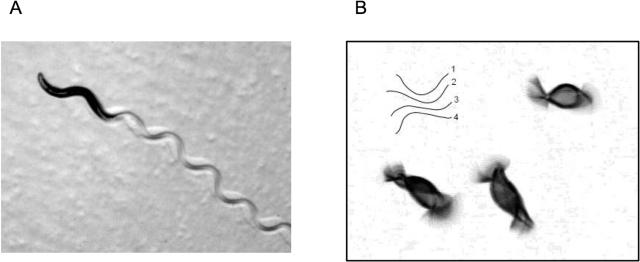
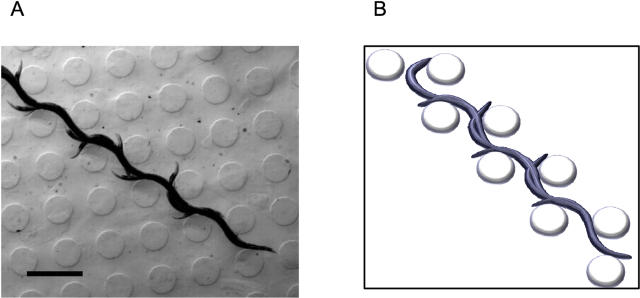
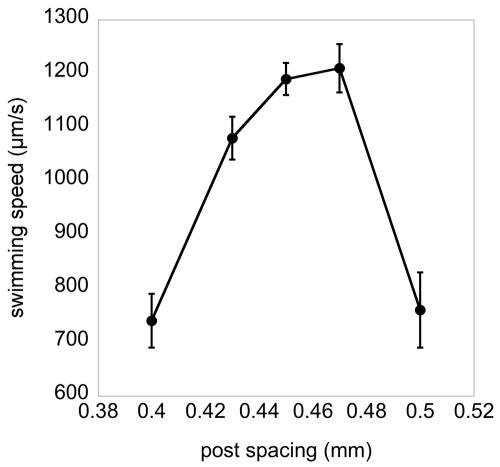
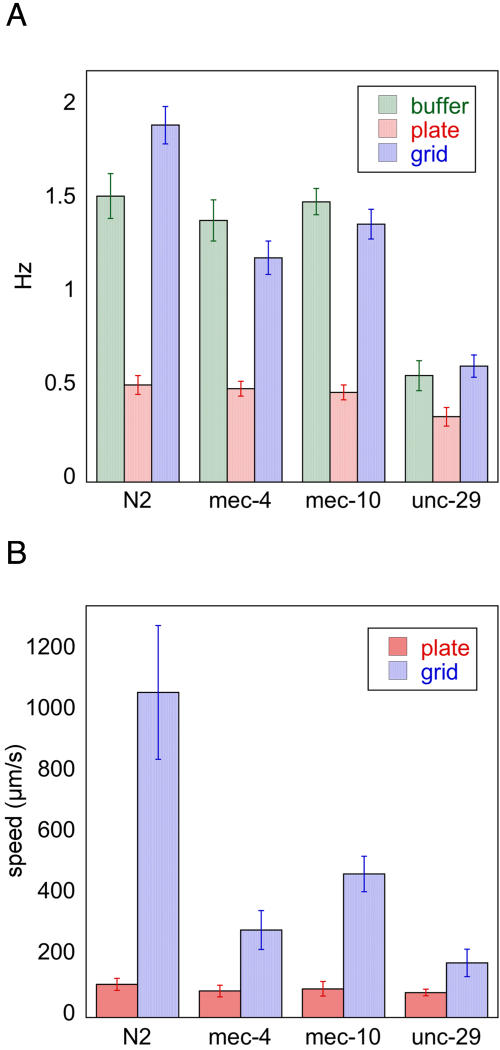
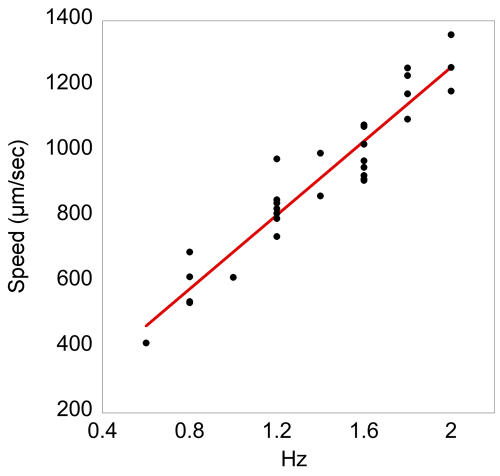
BACKGROUND: Behavioral studies of Caenorhabditis elegans traditionally are done on the smooth surface of agar plates, but the natural habitat of C. elegans and other nematodes is the soil, a complex and structured environment. In order to investigate how worms move in such environments, we have developed a technique to study C. elegans locomotion in microstructures fabricated from agar. METHODOLOGY/PRINCIPAL FINDINGS: When placed in open, liquid-filled, microfluidic chambers containing a square array of posts, we discovered that worms are capable of a novel mode of locomotion, which combines the fast gait of swimming with the more efficient movements of crawling. When the wavelength of the worms matched the periodicity of the post array, the microstructure directed the swimming and increased the speed of C. elegans ten-fold. We found that mutants defective in mechanosensation (mec-4, mec-10) or mutants with abnormal waveforms (unc-29) did not perform this enhanced locomotion and moved much more slowly than wild-type worms in the microstructure. CONCLUSION/SIGNIFICANCE: These results show that the microstructure can be used as a behavioral screen for mechanosensory and uncoordinated mutants. It is likely that worms use mechanosensation in the movement and navigation through heterogeneous environments.
Overview
The claims and statistics of this paper haven’t been checked yet.
Run the check — free, no account needed. It reads the open-access text and checks the sources it cites.
Integrity signals
Registry
Cites
Statistics
Figures
Verification
Claims the paper makes
The claims and statistics of this paper haven’t been checked yet.
Run the check — free, no account needed. It reads the open-access text and checks the sources it cites.
Claims other papers make about this one
Each is checked against this paper’s own text: does it say what the citing paper says it does?
The cited source says what the claim attributes to it.
In the citing paper
“In particular, arrays of microfluidic posts (“artificial dirt”) have recently been developed specifically for this purpose (Lockery et al., 2008; Park et al., 2008).”
From Gait Modulation in C. elegans: An Integrated Neuromechanical Model (2012) · cites this paper as Park et al., 2008
The cited source says what the claim attributes to it.
In the citing paper
“We find that the model copes well with these environments, producing remarkably realistic locomotion when compared to the reported behavior (Lockery et al., 2008; Park et al., 2008).”
From Gait Modulation in C. elegans: An Integrated Neuromechanical Model (2012) · cites this paper as Park et al., 2008
The cited source says what the claim attributes to it.
In the citing paper
“Specifically, as in the experiments, the model yields crawling behavior in the hexagonal post configuration (Movies S3–S5 in Supplementary Material; Lockery et al., 2008) and swimming like motion in the cubic configuration (Movie S6 in Supplementary Material; Park et al., 2008).”
From Gait Modulation in C. elegans: An Integrated Neuromechanical Model (2012) · cites this paper as Park et al., 2008
Self-check
Percentages, sums and reported differences re-computed from the paper’s own numbers.
The self-check needs the paper’s full text.
Citations
Cites
THE GENETICS OF CAENORHABDITIS ELEGANS
Brenner, S. (1974) · Genetics · doi:10.1093/genetics/77.1.71 · Cited by 15,220
Stiernagle, T. (2006) · WormBook · doi:10.1895/wormbook.1.101.1 · Cited by 2,972 · cited 1×
“. Worms were synchronized using the standard hypochlorite procedure”
MethodThe neural circuit for touch sensitivity in Caenorhabditis elegans
Chalfie, M., Sulston, J., White, J., Southgate, E., Thomson, J., & Brenner, S. (1985) · The Journal of Neuroscience · doi:10.1523/jneurosci.05-04-00956.1985 · Cited by 1,093 · cited 1×
“elegans behavior, including the studies of chemotaxis, thermotaxis, and mechanosensation [1,3].”
BackgroundSawin, E. R., Ranganathan, R., & Horvitz, H. R. (2000) · Neuron · doi:10.1016/s0896-6273(00)81199-x · Cited by 1,076 · cited 1×
“Worms have an exquisite sense of touch, and it has even been shown that worms can ‘‘feel’’ when they are in a lawn of bacteria [15].”
BackgroundPathogenic bacteria induce aversive olfactory learning in Caenorhabditis elegans
Zhang, Y., Lu, H., & Bargmann, C. I. (2005) · Nature · doi:10.1038/nature04216 · Cited by 819 · cited 1×
“Previously, microstructures made from PDMS have been used to develop a behavioral assay to screen for oxygen sensing mutants [6] and for olfaction [14].”
MethodOxygen sensation and social feeding mediated by a C. elegans guanylate cyclase homologue
Gray, J. M., Karow, D. S., Lu, H., Chang, A. J., Chang, J. S., Ellis, R. E., Marletta, M. A., & Bargmann, C. I. (2004) · Nature · doi:10.1038/nature02714 · Cited by 591 · cited 3×
“Previous studies have used microfabricated chambers [6], mazes [7], and arrays of posts [8], to explore worm behavior in more structured and challenging environments.”
BackgroundMethodDriscoll, M., & Chalfie, M. (1991) · Nature · doi:10.1038/349588a0 · Cited by 552 · cited 1×
“Physiologically MEC-4 and MEC-10 are core subunits of the same mechanosensitive channel [11,12], and so have a similar mechanosensory defect and produce similar behavior in the microstruture.”
BackgroundEscherichia coli swim on the right-hand side
DiLuzio, W. R., Turner, L., Mayer, M., Garstecki, P., Weibel, D. B., Berg, H. C., & Whitesides, G. M. (2005) · Nature · doi:10.1038/nature03660 · Cited by 528 · cited 1×
“The understanding of the self-powered motion of organisms through microfabricated structures is the first step towards their use in scientific and in bioengineering applications”
BackgroundC. elegans : a practical approach
Hope, I. D. (1999) · Cited by 445
Gene interactions affecting mechanosensory transduction in Caenorhabditis elegans
Huang, M., & Chalfie, M. (1994) · Nature · doi:10.1038/367467a0 · Cited by 393 · cited 1×
“Physiologically MEC-4 and MEC-10 are core subunits of the same mechanosensitive channel [11,12], and so have a similar mechanosensory defect and produce similar behavior in the microstruture.”
BackgroundGray, J., & Lissmann, H. W. (1964) · Journal of Experimental Biology · doi:10.1242/jeb.41.1.135 · Cited by 230
Influence of topology on bacterial social interaction
Park, S., Wolanin, P. M., Yuzbashyan, E. A., Lin, H., Darnton, N. C., Stock, J. B., Silberzan, P., & Austin, R. H. (2003) · Proceedings of the National Academy of Sciences · doi:10.1073/pnas.1935975100 · Cited by 194 · cited 2×
“The procedure used to fabricate the SU-8 molds has been previously described [9].”
MethodSelf-citationComponents and patterns in the behaviour of the nematode Caenorhabditis elegans
Croll, N. A. (1975) · Journal of Zoology · doi:10.1111/j.1469-7998.1975.tb03191.x · Cited by 184
Artificial Dirt: Microfluidic Substrates for Nematode Neurobiology and Behavior
Lockery, S. R., Lawton, K. J., Doll, J. C., Faumont, S., Coulthard, S. M., Thiele, T. R., Chronis, N., McCormick, K. E., Goodman, M. B., & Pruitt, B. L. (2007) · Journal of Neurophysiology · doi:10.1152/jn.91327.2007 · Cited by 177 · cited 2×
“Our system is similar in design to another post array structure recently used to study worm behavior [8] but presumably their hexagonal-post array does not support the enhanced locomotion we see in our square-post arrays.”
BackgroundResultTransducing Touch in Caenorhabditis elegans
Goodman, M. B., & Schwarz, E. M. (2003) · Annual Review of Physiology · doi:10.1146/annurev.physiol.65.092101.142659 · Cited by 163 · cited 1×
“The nematode Caenorhabditis elegans, is a model organism used in a wide range of behavioral studies—from sensory transduction [1] to learning and memory [2].”
BackgroundSIGNAL TRANSDUCTION IN THE CAENORHABDITIS ELEGANS NERVOUS SYSTEM
Bargmann, C. I., & Kaplan, J. M. (1998) · Annual Review of Neuroscience · doi:10.1146/annurev.neuro.21.1.279 · Cited by 143 · cited 2×
“elegans behavior, including the studies of chemotaxis, thermotaxis, and mechanosensation [1,3].”
BackgroundMaze exploration and learning in C. elegans
Qin, J., & Wheeler, A. R. (2006) · Lab on a Chip · doi:10.1039/b613414a · Cited by 139 · cited 2×
“Previous studies have used microfabricated chambers [6], mazes [7], and arrays of posts [8], to explore worm behavior in more structured and challenging environments.”
BackgroundAn imaging system for standardized quantitative analysis of C. elegans behavior
Feng, Z., Cronin, C. J., Wittig, J. H., Sternberg, P. W., & Schafer, W. R. (2004) · BMC Bioinformatics · doi:10.1186/1471-2105-5-115 · Cited by 124 · cited 1×
“We tested unc-29 worms which perform slightly abnormal sinusoidal movements [10]—the animals generate a larger amplitude at their heads compared to their tails.”
Background
Cited by
Sorted by citations
Sterling, P., & Laughlin, S. (2015) · doi:10.7551/mitpress/9780262028707.001.0001 · Cited by 482
C. elegans in high-throughput drug discovery
O’Reilly, L. P., Luke, C. J., Perlmutter, D. H., Silverman, G. A., & Pak, S. C. (2013) · Advanced Drug Delivery Reviews · doi:10.1016/j.addr.2013.12.001 · Cited by 274
Albrecht, D. R., & Bargmann, C. I. (2011) · Nature Methods · doi:10.1038/nmeth.1630 · Cited by 245
“…for neuronal imaging, high-throughput phenotypic screens, and laser axotomy (reviewed in 11,12 ), C. elegans could be completely immobilized, spatially restricted while permitting body posture movements 13 , or allowed to navigate through undulating channels 14 or structured environments 14,15 .”
Nictation, a dispersal behavior of the nematode Caenorhabditis elegans, is regulated by IL2 neurons
Lee, H., Choi, M. K., Lee, D., Kim, H. S., Hwang, H., Kim, H., Park, S., Paik, Y., & Lee, J. (2011) · Nature Neuroscience · doi:10.1038/nn.2975 · Cited by 184
“To overcome this drawback, we developed another assay that uses polydimethylsiloxane (PDMS)-based microfluidic structures that provide the necessary architecture for nictating dauer”
MethodSelf-citationGait Modulation in C. elegans: An Integrated Neuromechanical Model
Boyle, J. H., Berri, S., & Cohen, N. (2012) · Frontiers in Computational Neuroscience · doi:10.3389/fncom.2012.00010 · Cited by 148
“We recreated model microfluidic chambers with the same quasi-2D hexagonal arrays as in Lockery et al. (2008) and cubic arrays as in Park et al. (2008) and used these to perform simulations of our integrated model.”
BackgroundMethodInfluential
Metadata
- Authors
- Park, S., Hwang, H., Nam, S.-W., Martinez, F., Austin, R. H., & Ryu, W. S.
- Affiliations
- Ewha Womans University (KR)
- Princeton University (US)
- Corresponding author
- Ryu, William S.
- Venue
- PLoS ONE
- Publisher
- Public Library of Science (PLoS)
- Published
- 2008-06-25
- Volume
- 3
- Issue
- 6
- Pages
- e2550
- ISSN
- 1932-6203 (ISSN-L)
- PMC
- PMC2430527
- OpenAlex
- W1980172171
- Cited by
- 157
- References
- 18
- Citations by year
- 2026: 6 · 2025: 6 · 2024: 6 · 2023: 10 · 2022: 10 · 2021: 8 · 2020: 8 · 2019: 4 · 2018: 7 · 2017: 7 · 2016: 9 · 2015: 12 · 2014: 8 · 2013: 13 · 2012: 15
- FWCI
- 3.94
- Type
- journal article
- Language
- en
- Open access
- gold
- doi.org
- Locations
- PLoS ONE (publishedVersion, cc-by)
- PubMed Central (publishedVersion, cc-by)
- PubMed (publishedVersion)
- DOAJ (DOAJ: Directory of Open Access Journals) (submittedVersion, cc-by-sa)
- Funders
- Korea Science and Engineering Foundation
- Topics
- Life Sciences › Biochemistry, Genetics and Molecular Biology › Cell Biology › Cellular Mechanics and Interactions
- Life Sciences › Neuroscience › Cellular and Molecular Neuroscience › Neurobiology and Insect Physiology Research
- Physical Sciences › Physics and Astronomy › Condensed Matter Physics › Micro and Nano Robotics
- Keywords
- Caenorhabditis elegans, locomotion, swimming, crawling, mechanosensing, mec-4, mec-10, soil environment
- MeSH terms
- Animals, Locomotion, Caenorhabditis elegans, Microfluidics
About these checks
Registry, retraction, Cites and statistics results are computed, not judged, with one exception: a printed reference that no index lists is read once by a model before it counts as a citation error. Claims are extracted by a model and kept only when their quote appears verbatim in the text; each cited source is then checked, with a model’s help, for whether it says what the claim relies on. Those verdicts can be wrong — read the claim’s quote and the cited source before relying on one.
Statistics and arithmetic are recomputed, not judged.
Confidence bands are shown only for fields calibrated on our annotated test set. None is calibrated yet, so no band is shown.
What counts as a claim ›How we measure confidence ›How we check this ›
Are you an author, or do you see a problem with this page? Request a review
