

The DOI matches its Crossref record; 51 of the 51 references it cites were found in a registry or an index.
Detection and Molecular Characterization of 9000-Year-Old Mycobacterium tuberculosis from a Neolithic Settlement in the Eastern Mediterranean
Open accessAbstract
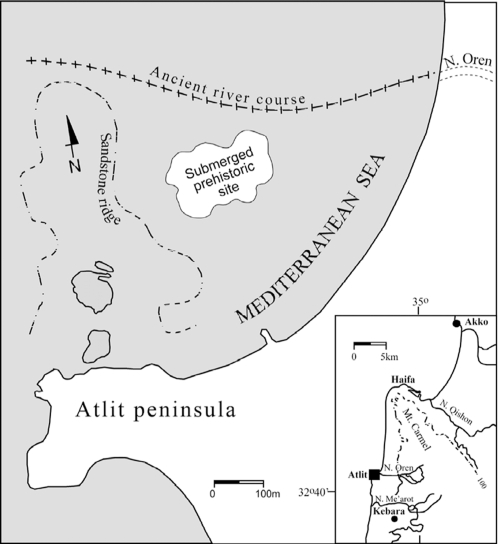
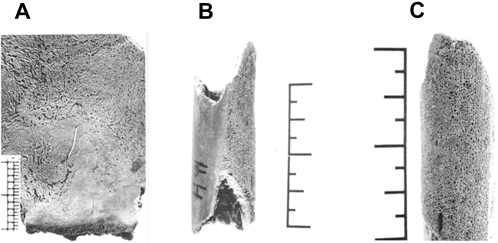
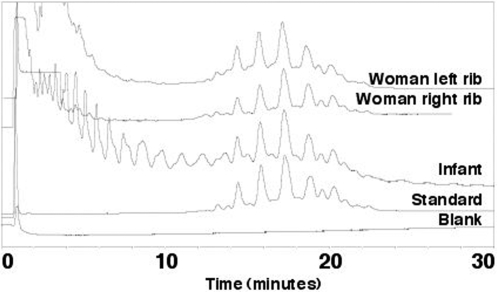
BACKGROUND: Mycobacterium tuberculosis is the principal etiologic agent of human tuberculosis. It has no environmental reservoir and is believed to have co-evolved with its host over millennia. This is supported by skeletal evidence of the disease in early humans, and inferred from M. tuberculosis genomic analysis. Direct examination of ancient human remains for M. tuberculosis biomarkers should aid our understanding of the nature of prehistoric tuberculosis and the host/pathogen relationship. METHODOLOGY/PRINCIPAL FINDINGS: We used conventional PCR to examine bone samples with typical tuberculosis lesions from a woman and infant, who were buried together in the now submerged site of Atlit-Yam in the Eastern Mediterranean, dating from 9,250-8,160 years ago. Rigorous precautions were taken to prevent contamination, and independent centers were used to confirm authenticity of findings. DNA from five M tuberculosis genetic loci was detected and had characteristics consistent with extant genetic lineages. High performance liquid chromatography was used as an independent method of verification and it directly detected mycolic acid lipid biomarkers, specific for the M. tuberculosis complex. CONCLUSIONS/SIGNIFICANCE: Human tuberculosis was confirmed by morphological and molecular methods in a population living in one of the first villages with evidence of agriculture and animal domestication. The widespread use of animals was not a source of infection but may have supported a denser human population that facilitated transmission of the tubercle bacillus. The similarity of the M. tuberculosis genetic signature with those of today gives support to the theory of a long-term co-existence of host and pathogen.
Overview
The claims and statistics of this paper haven’t been checked yet.
Run the check — free, no account needed. It reads the open-access text and checks the sources it cites.
Integrity signals
Registry
Cites
Statistics
Figures
Verification
Claims the paper makes
The claims and statistics of this paper haven’t been checked yet.
Run the check — free, no account needed. It reads the open-access text and checks the sources it cites.
Claims other papers make about this one
Each is checked against this paper’s own text: does it say what the citing paper says it does?
The source backs part of the claim, not all of it — or backs it for a different population, condition or comparison.
In the citing paper
“The identification of M. tuberculosis from an individual approximately 2,000 years ago is consistent with our current understanding of Mycobacterium infection and transmission between humans and in humans and domesticated animals [40].”
From Molecular Exploration of the First-Century Tomb of the Shroud in Akeldama, Jerusalem (2009) · cites this paper as [40]
Experimental — accuracy not yet measured
Self-check
Percentages, sums and reported differences re-computed from the paper’s own numbers.
The self-check needs the paper’s full text.
Citations
Cites
Kamerbeek, J., Schouls, L. M., Kolk, A. H. J., van Agterveld, M., van Soolingen, D., Kuijper, S., Bunschoten, A., Molhuizen, H. O. F., Shaw, R. J., Goyal, M., et al. (1997) · Journal of Clinical Microbiology · doi:10.1128/jcm.35.4.907-914.1997 · Cited by 2,871
Identification of Pathological Conditions in Human Skeletal Remains
Ortner, D. J. (2003) · Elsevier eBooks · doi:10.1016/b978-0-12-528628-2.x5037-6 · Cited by 2,526
A new evolutionary scenario for the Mycobacterium tuberculosis complex
Brosch, R., Gordon, S. V., Marmiesse, M., Brodin, P. M., Buchrieser, C., Eiglmeier, K., Garnier, T., Gutierrez, C., Hewinson, R. G., Kremer, K., et al. (2002) · Proceedings of the National Academy of Sciences · doi:10.1073/pnas.052548299 · Cited by 1,645
Paleopathology at the Origins of Agriculture.
Dennell, R., Cohen, M. N., & Armelagos, G. J. (1986) · Man · doi:10.2307/2803166 · Cited by 1,336
Identification of pathological conditions in human skeletal remains
Ortner, D. J., & Putschar, W. G. J. (1985) · Smithsonian contributions to anthropology · doi:10.5479/si.00810223.28.1 · Cited by 1,059
Sreevatsan, S., Pan, X., Stockbauer, K. E., Connell, N. D., Kreiswirth, B. N., Whittam, T. S., & Musser, J. M. (1997) · Proceedings of the National Academy of Sciences · doi:10.1073/pnas.94.18.9869 · Cited by 1,035
The epidemiology of Mycobacterium bovis infections in animals and man: A review
O'Reilly, L. M., & Daborn, C. J. (1995) · Tubercle and Lung Disease · doi:10.1016/0962-8479(95)90591-x · Cited by 835
Daniel, T. M. (2006) · Respiratory Medicine · doi:10.1016/j.rmed.2006.08.006 · Cited by 765
Eisenach, K. D., Donald Cave, M., Bates, J. H., & Crawford, J. T. (1990) · Journal of Infectious Diseases · doi:10.1093/infdis/161.5.977 · Cited by 748
Social and environmental risk factors in the emergence of infectious diseases
Weiss, R. A., & McMichael, A. J. (2004) · Nature Medicine · doi:10.1038/nm1150 · Cited by 714
Research works printed but not linked: 1
- DE Minnikin, 1987, Mass spectrometric analysis of multimethyl branched fatty acids and phthiocerols from clinically-significant mycobacteria., Proc Jap Soc Med Mass Spectrom, 12, 23
Cited by
Sorted by citations
Boivin, N. L., Zeder, M. A., Fuller, D. Q., Crowther, A., Larson, G., Erlandson, J. M., Denham, T., & Petraglia, M. D. (2016) · Proceedings of the National Academy of Sciences · doi:10.1073/pnas.1525200113 · Cited by 837
Ecology and evolution of Mycobacterium tuberculosis
Gagneux, S. (2018) · Nature Reviews Microbiology · doi:10.1038/nrmicro.2018.8 · Cited by 618
Extra Pulmonary Tuberculosis: An Overview
Cantres-Fonseca, O. J., Rodríguez-Cintrón, W., Olmo-Arroyo, F. D., & Baez-Corujo, S. (2019) · IntechOpen eBooks · doi:10.5772/intechopen.81322 · Cited by 517
Co‐evolution of M ycobacterium tuberculosis and H omo sapiens
Brites, D., & Gagneux, S. (2015) · Immunological Reviews · doi:10.1111/imr.12264 · Cited by 317
Archaeological and Anthropological Sciences
(2013) · Archaeological and Anthropological Sciences · doi:10.1007/12520.1866-9565 · Cited by 270
Metadata
- Authors
- Hershkovitz, I., Donoghue, H. D., Minnikin, D. E., Besra, G. S., Lee, O. Y.-C., Gernaey, A. M., Galili, E., Eshed, V., Greenblatt, C. L., Lemma, E., Bar-Gal, G. K., & Spigelman, M.
- Affiliations
- University College London (GB)
- University of Birmingham (GB)
- University of Salford (GB)
- Israel Antiquities Authority (IL)
- Tel Aviv University (IL)
- Hebrew University of Jerusalem (IL)
- Corresponding author
- Donoghue, Helen D.
- ORCID
- Venue
- PLoS ONE
- Publisher
- Public Library of Science (PLoS)
- Published
- 2008-10-15
- Volume
- 3
- Issue
- 10
- Pages
- e3426
- ISSN
- 1932-6203 (ISSN-L)
- PMC
- PMC2565837
- OpenAlex
- W2052515110
- Cited by
- 506
- References
- 51
- Citations by year
- 2026: 11 · 2025: 13 · 2024: 26 · 2023: 37 · 2022: 30 · 2021: 30 · 2020: 29 · 2019: 42 · 2018: 30 · 2017: 39 · 2016: 40 · 2015: 33 · 2014: 26 · 2013: 36 · 2012: 25
- FWCI
- 167.98
- Type
- journal article
- Language
- en
- Open access
- gold
- doi.org
- Locations
- PLoS ONE (publishedVersion, cc-by)
- Europe PMC (PubMed Central) (publishedVersion, cc-by)
- PubMed Central (publishedVersion, cc-by)
- PubMed (publishedVersion)
- DOAJ (DOAJ: Directory of Open Access Journals) (submittedVersion, cc-by-sa)
- UCL Discovery (University College London) (submittedVersion)
- Figshare (submittedVersion, cc-by)
- University of Birmingham Research Portal (University of Birmingham) (submittedVersion, other-oa)
- Funders
- Leverhulme Trust
- Deutsche Forschungsgemeinschaft
- Dan David Prize
- Topics
- Social Sciences › Arts and Humanities › Archeology (arts and humanities) › Paleopathology and ancient diseases
- Health Sciences › Medicine › Infectious Diseases › Tuberculosis Research and Epidemiology
- Social Sciences › Archeology › Archaeology and ancient environmental studies
- Keywords
- Mycobacterium tuberculosis, Neolithic, ancient DNA, host-pathogen coevolution, tuberculosis transmission, animal domestication, human remains, Eastern Mediterranean
- MeSH terms
- Adult, Bone and Bones, DNA, Bacterial, Female, Humans, Infant, Mycobacterium tuberculosis, Tuberculosis, Polymerase Chain Reaction, Mediterranean Region, History, Ancient
About these checks
Registry, retraction, Cites and statistics results are computed, not judged, with one exception: a printed reference that no index lists is read once by a model before it counts as a citation error. Claims are extracted by a model and kept only when their quote appears verbatim in the text; each cited source is then checked, with a model’s help, for whether it says what the claim relies on. Those verdicts can be wrong — read the claim’s quote and the cited source before relying on one.
Statistics and arithmetic are recomputed, not judged.
Confidence bands are shown only for fields calibrated on our annotated test set. None is calibrated yet, so no band is shown.
What counts as a claim ›How we measure confidence ›How we check this ›
Are you an author, or do you see a problem with this page? Request a review
