

Ancestry Analysis in the 11-M Madrid Bomb Attack Investigation
Open accessThe DOI matches its Crossref record; 37 of the 38 references it cites were found in a registry or an index.
Abstract
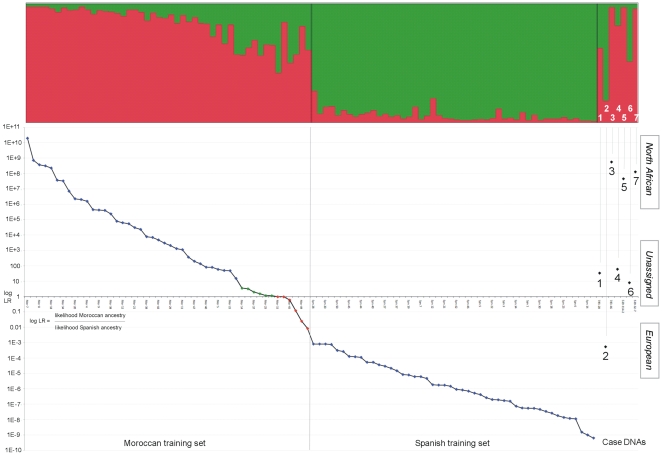
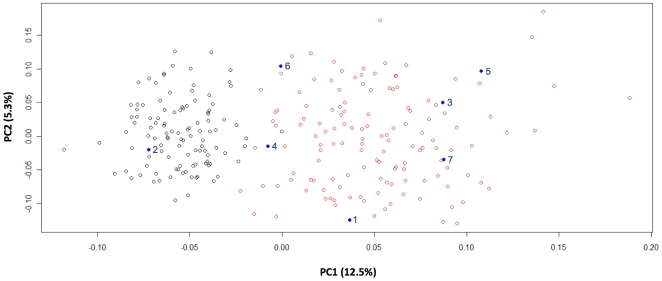
The 11-M Madrid commuter train bombings of 2004 constituted the second biggest terrorist attack to occur in Europe after Lockerbie, while the subsequent investigation became the most complex and wide-ranging forensic case in Spain. Standard short tandem repeat (STR) profiling of 600 exhibits left certain key incriminatory samples unmatched to any of the apprehended suspects. A judicial order to perform analyses of unmatched samples to differentiate European and North African ancestry became a critical part of the investigation and was instigated to help refine the search for further suspects. Although mitochondrial DNA (mtDNA) and Y-chromosome markers routinely demonstrate informative geographic differentiation, the populations compared in this analysis were known to show a proportion of shared mtDNA and Y haplotypes as a result of recent gene-flow across the western Mediterranean, while any two loci can be unrepresentative of the ancestry of an individual as a whole. We based our principal analysis on a validated 34plex autosomal ancestry-informative-marker single nucleotide polymorphism (AIM-SNP) assay to make an assignment of ancestry for DNA from seven unmatched case samples including a handprint from a bag containing undetonated explosives together with personal items recovered from various locations in Madrid associated with the suspects. To assess marker informativeness before genotyping, we predicted the probable classification success for the 34plex assay with standard error estimators for a naïve Bayesian classifier using Moroccan and Spanish training sets (each n = 48). Once misclassification error was found to be sufficiently low, genotyping yielded seven near-complete profiles (33 of 34 AIM-SNPs) that in four cases gave probabilities providing a clear assignment of ancestry. One of the suspects predicted to be North African by AIM-SNP analysis of DNA from a toothbrush was identified late in the investigation as Algerian in origin. The results achieved illustrate the benefit of adding specialized marker sets to provide enhanced scope and power to an already highly effective system of DNA analysis for forensic identification.
Overview
The claims and statistics of this paper haven’t been checked yet.
Free: it reads the open-access text and checks the first 5 claims that cite a source we can check. Create a free account to check every claim.
Integrity signals
Registry
Cites
Statistics
Figures
Verification
Claims the paper makes
The claims and statistics of this paper haven’t been checked yet.
Free: it reads the open-access text and checks the first 5 claims that cite a source we can check. Create a free account to check every claim.
Self-check
Percentages, sums and reported differences re-computed from the paper’s own numbers.
The self-check needs the paper’s full text.
Citations
Cites
Inference of Population Structure Using Multilocus Genotype Data
Pritchard, J. K., Stephens, M., & Donnelly, P. (2000) · Genetics · doi:10.1093/genetics/155.2.945 · Cited by 33,908
Reanalysis and revision of the Cambridge reference sequence for human mitochondrial DNA
Andrews, R. M., Kubacka, I., Chinnery, P. F., Lightowlers, R. N., Turnbull, D. M., & Howell, N. (1999) · Nature Genetics · doi:10.1038/13779 · Cited by 3,337 · cited 1×
“Nomenclature of mtDNA variants is based on the revised Cambridge reference sequence [24].”
MethodGenetic Structure of Human Populations
Rosenberg, N. A., Pritchard, J. K., Weber, J. L., Cann, H. M., Kidd, K. K., Zhivotovsky, L. A., & Feldman, M. W. (2002) · Science · doi:10.1126/science.1078311 · Cited by 2,222 · cited 1×
“We were initially cautious in recommending the use of 34 SNPs to differentiate such closely related population groups, particularly as the groups, while occupying different regions, can be realistically considered to be members of the same Eurasian metapopulation [32,34].”
MethodWorldwide Human Relationships Inferred from Genome-Wide Patterns of Variation
Li, J. Z., Absher, D. M., Tang, H., Southwick, A. M., Casto, A. M., Ramachandran, S., Cann, H. M., Barsh, G. S., Feldman, M., Cavalli-Sforza, L. L., et al. (2008) · Science · doi:10.1126/science.1153717 · Cited by 1,941
Identification of a variant associated with adult-type hypolactasia
Enattah, N. S., Sahi, T., Savilahti, E., Terwilliger, J. D., Peltonen, L., & Järvelä, I. (2002) · Nature Genetics · doi:10.1038/ng826 · Cited by 1,029 · cited 1×
“the LCT gene [28] that shows the highest levels of variability”
BackgroundInformativeness of Genetic Markers for Inference of Ancestry*
Rosenberg, N. A., Li, L. M., Ward, R., & Pritchard, J. K. (2003) · The American Journal of Human Genetics · doi:10.1086/380416 · Cited by 719 · cited 1×
“metric: In [26] for the Spanish and the CEPH-HGDP European populations compared to Moroccans and Mozabites.”
ResultCorrelation between Genetic and Geographic Structure in Europe
Lao, O., Lu, T. T., Nothnagel, M., Junge, O., Freitag-Wolf, S., Caliebe, A., Balascakova, M., Bertranpetit, J., Bindoff, L. A., Comas, D., et al. (2008) · Current Biology · doi:10.1016/j.cub.2008.07.049 · Cited by 503 · cited 1×
“within Europe of any genomic region studied to date [29].”
BackgroundThe Making of the African mtDNA Landscape
Salas, A., Richards, M., De la Fe, T., Lareu, M.-V., Sobrino, B., Sánchez-Diz, P., Macaulay, V., & Carracedo, Á. (2002) · The American Journal of Human Genetics · doi:10.1086/344348 · Cited by 493 · cited 4×
“However it should be noted that estimates of the extent to which population movements have contributed to patterns of variation in this region differ between markers and amongst studies [4–21].”
BackgroundResultInfluentialSelf-citationA High-Density Admixture Map for Disease Gene Discovery in African Americans
Smith, M. W., Patterson, N., Lautenberger, J. A., Truelove, A. L., McDonald, G. J., Waliszewska, A., Kessing, B. D., Malasky, M. J., Scafe, C., Le, E., et al. (2004) · The American Journal of Human Genetics · doi:10.1086/420856 · Cited by 459 · cited 10×
“The loci we opted to assess to differentiate Europeans from North Africans were: autosomal AIM-SNPs based on an established 34plex assay [1], mtDNA coding region SNPs and Ychromosome SNPs.”
MethodInfluentialSturm, R. A., Duffy, D. L., Zhao, Z. Z., Leite, F. P. N., Stark, M. S., Hayward, N. K., Martin, N. G., & Montgomery, G. W. (2008) · The American Journal of Human Genetics · doi:10.1016/j.ajhg.2007.11.005 · Cited by 378 · cited 1×
“Of particular interest here is the fact that a component marker of the 34plex AIM-SNP assay: rs12913832, was recently shown to be associated with blue eyes in homozygous G form, with the A allele associated with non-blue eyes [36,37].”
Background
Cited by
Next-Generation Sequencing Technology: Current Trends and Advancements
Satam, H., Joshi, K., Mangrolia, U., Waghoo, S., Zaidi, G., Rawool, S., Thakare, R. P., Banday, S., Mishra, A. K., Das, G., et al. (2023) · Biology · doi:10.3390/biology12070997 · Cited by 1,299
An overview of STRUCTURE: applications, parameter settings, and supporting software
Porras-Hurtado, L., Ruiz, Y., Santos, C., Phillips, C., Carracedo, Á., & Lareu, M. V. (2013) · Frontiers in Genetics · doi:10.3389/fgene.2013.00098 · Cited by 609
“M Madrid bomb attack investigations where results of a 34-SNP ancestry test were analysed with STRUCTURE to infer the probable ancestry of suspects (Phillips et al., 2009).”
MethodSelf-citationImproving human forensics through advances in genetics, genomics and molecular biology
Kayser, M., & de Knijff, P. (2011) · Nature Reviews Genetics · doi:10.1038/nrg2952 · Cited by 526
“Overall, we expect that there will be many forensic cases where DNA-based inference of biogeographic ancestry will be useful for guiding police investigations to find unknown persons or victims (for an example of one such case, see Ref”
BackgroundNext generation sequencing and its applications in forensic genetics
Børsting, C., & Morling, N. (2015) · Forensic Science International: Genetics · doi:10.1016/j.fsigen.2015.02.002 · Cited by 460
“The individual has two D8S1179 alleles nce of the two alleles was almost 1:1 (3995 reads of D8S1179[14]TCTA[14] versus e Server displays the repeat as TATC repeats whereas D8S1179 is defined as TCTA the HID-Ion AmpliSeqTM Ancestry Panel.”
BackgroundInfluentialGalanter, J. M., Fernandez-Lopez, J. C., Gignoux, C. R., Barnholtz-Sloan, J., Fernandez-Rozadilla, C., Via, M., Hidalgo-Miranda, A., Contreras, A. V., Figueroa, L. U., Raska, P., et al. (2012) · PLoS Genetics · doi:10.1371/journal.pgen.1002554 · Cited by 297
“For example, the forensic use of a panel of AIMs successfully identified the ancestral origin of seven unmatched samples implicated in the 11-M Madrid commuter train bombings of 2004 [5].”
BackgroundSelf-citation
Metadata
- Authors
- Phillips, C., Prieto, L., Fondevila, M., Salas, A., Gómez-Tato, A., Álvarez-Dios, J., Alonso, A., Blanco-Verea, A., Brión, M., Montesino, M., Carracedo, Á., & Lareu, M. V.
- Affiliations
- Universidade de Santiago de Compostela (ES)
- Instituto Nacional de Toxicología y Ciencias Forenses (ES)
- Corresponding author
- Phillips, Christopher
- Venue
- PLoS ONE
- Publisher
- Public Library of Science (PLoS)
- Published
- 2009-08-11
- Volume
- 4
- Issue
- 8
- Pages
- e6583
- ISSN
- 1932-6203 (ISSN-L)
- PMC
- PMC2719087
- OpenAlex
- W2045070968
- Cited by
- 149
- References
- 38
- Citations by year
- 2026: 3 · 2025: 9 · 2024: 18 · 2023: 5 · 2022: 7 · 2021: 11 · 2020: 7 · 2019: 10 · 2018: 8 · 2017: 7 · 2016: 10 · 2015: 11 · 2014: 8 · 2013: 11 · 2012: 5
- FWCI
- 4.68
- Type
- journal article
- Language
- en
- Open access
- gold
- doi.org
- Locations
- PLoS ONE (publishedVersion, cc-by)
- PubMed Central (publishedVersion, cc-by)
- PubMed (publishedVersion)
- LA Referencia (Red Federada de Repositorios Institucionales de Publicaciones Científicas) (submittedVersion, cc-by)
- DOAJ (DOAJ: Directory of Open Access Journals) (submittedVersion, cc-by-sa)
- Figshare (submittedVersion, cc-by)
- Hispana (submittedVersion, cc-by)
- Repositorio institucional da Universidade de Santiago de Compostela (University of Santiago de Compostela) (submittedVersion, other-oa)
- Funders
- European Commission
- Xunta de Galicia
- Topics
- Life Sciences › Biochemistry, Genetics and Molecular Biology › Genetics › Forensic and Genetic Research
- Life Sciences › Biochemistry, Genetics and Molecular Biology › Genetics › Genetic diversity and population structure
- Social Sciences › Anthropology › Race, Genetics, and Society
- Keywords
- forensic DNA analysis, ancestry informative markers, single nucleotide polymorphisms, North African ancestry, European ancestry, suspect identification, mitochondrial DNA, Y-chromosome markers, gene flow, Western Mediterranean, forensic identification
- MeSH terms
- Algeria, Bayes Theorem, DNA, Mitochondrial, Genotype, Probability, Spain, Tandem Repeat Sequences, Polymorphism, Single Nucleotide, Terrorism, Forensic Sciences
About these checks
Registry, retraction, Cites and statistics results are computed, not judged, with one exception: a printed reference that no index lists is read once by a model before it counts as a citation error. Claims are extracted by a model and kept only when their quote appears verbatim in the text; each cited source is then checked, with a model’s help, for whether it says what the claim relies on. Those verdicts can be wrong — read the claim’s quote and the cited source before relying on one.
Statistics and arithmetic are recomputed, not judged.
Confidence bands are shown only for fields calibrated on our annotated test set. None is calibrated yet, so no band is shown.
What counts as a claim ›How we measure confidence ›How we check this ›
Are you an author, or do you see a problem with this page? Request a review
Data sources
Bibliographic data: Semantic Scholar, OpenAlex, Crossref.
Contains information from the Semantic Scholar Academic Graph Datasets, made available under the ODC Attribution License (ODC-BY 1.0).
Semantic Scholar’s data is described in: Kinney, R., et al. (2023). The Semantic Scholar Open Data Platform. arXiv:2301.10140.
