

Quorum Sensing and Virulence of Pseudomonas aeruginosa during Lung Infection of Cystic Fibrosis Patients
Open accessThe DOI matches its Crossref record; 54 of the 54 references it cites were found in a registry or an index.
Abstract
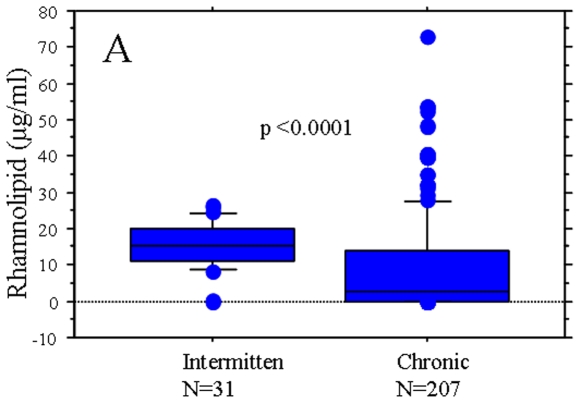
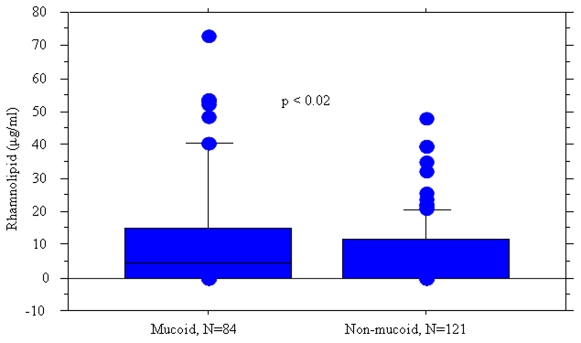
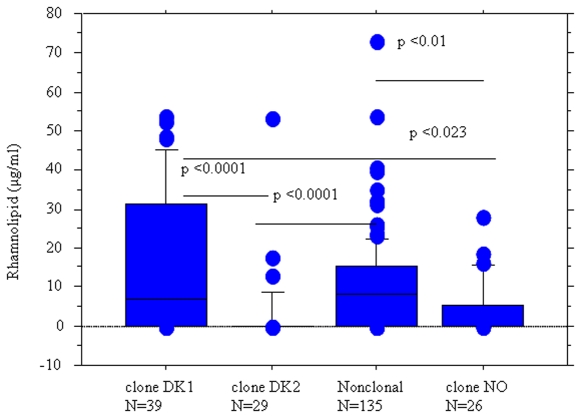
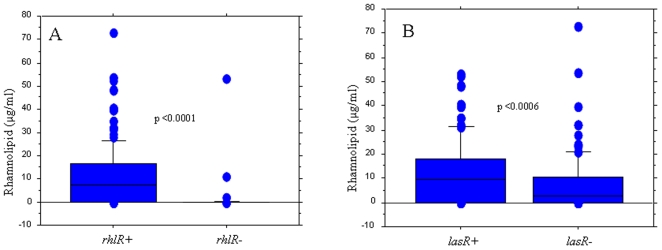
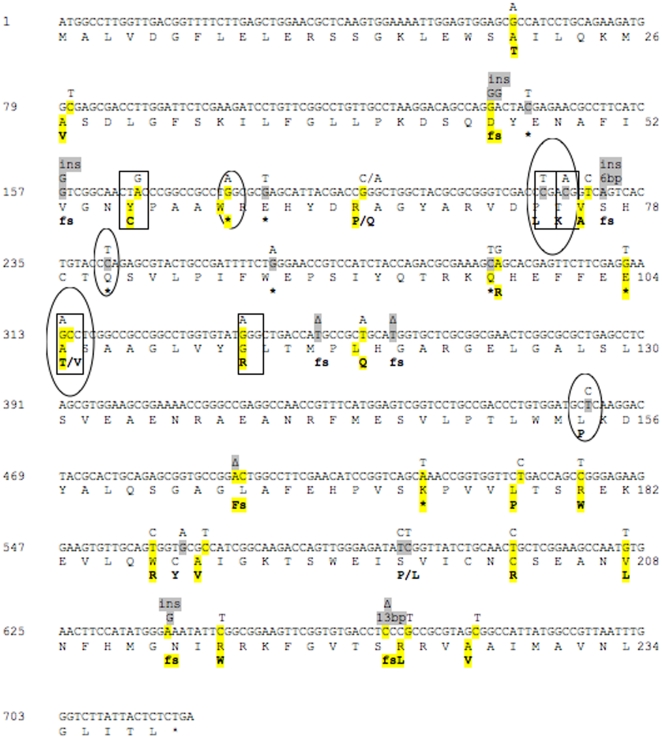
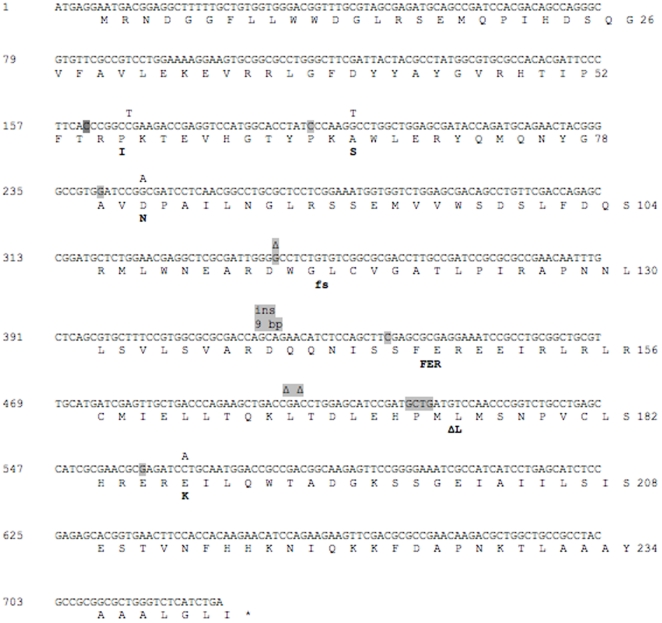
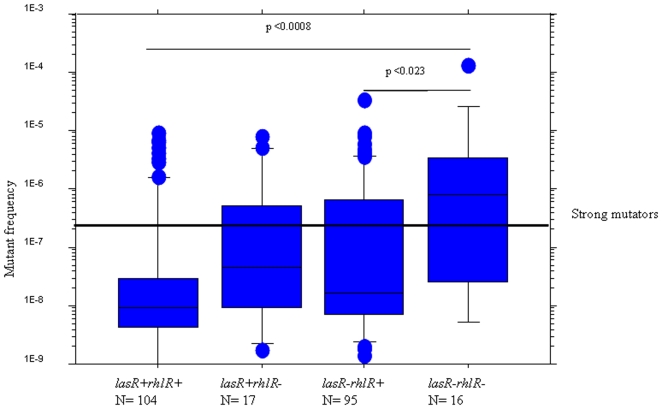
Pseudomonas aeruginosa is the predominant microorganism in chronic lung infection of cystic fibrosis patients. The chronic lung infection is preceded by intermittent colonization. When the chronic infection becomes established, it is well accepted that the isolated strains differ phenotypically from the intermittent strains. Dominating changes are the switch to mucoidity (alginate overproduction) and loss of epigenetic regulation of virulence such as the Quorum Sensing (QS). To elucidate the dynamics of P. aeruginosa QS systems during long term infection of the CF lung, we have investigated 238 isolates obtained from 152 CF patients at different stages of infection ranging from intermittent to late chronic. Isolates were characterized with regard to QS signal molecules, alginate, rhamnolipid and elastase production and mutant frequency. The genetic basis for change in QS regulation were investigated and identified by sequence analysis of lasR, rhlR, lasI and rhlI. The first QS system to be lost was the one encoded by las system 12 years (median value) after the onset of the lung infection with subsequent loss of the rhl encoded system after 17 years (median value) shown as deficiencies in production of the 3-oxo-C12-HSL and C4-HSL QS signal molecules respectively. The concomitant development of QS malfunction significantly correlated with the reduced production of rhamnolipids and elastase and with the occurrence of mutations in the regulatory genes lasR and rhlR. Accumulation of mutations in both lasR and rhlR correlated with development of hypermutability. Interestingly, a higher number of mucoid isolates were found to produce C4-HSL signal molecules and rhamnolipids compared to the non-mucoid isolates. As seen from the present data, we can conclude that P. aeruginosa and particularly the mucoid strains do not lose the QS regulation or the ability to produce rhamnolipids until the late stage of the chronic infection.
Overview
The claims and statistics of this paper haven’t been checked yet.
Free: it reads the open-access text and checks the first 5 claims that cite a source we can check. Create a free account to check every claim.
Integrity signals
Registry
Cites
Statistics
Figures
Verification
Claims the paper makes
The claims and statistics of this paper haven’t been checked yet.
Free: it reads the open-access text and checks the first 5 claims that cite a source we can check. Create a free account to check every claim.
Claims other papers make about this one
Each is checked against this paper’s own text: does it say what the citing paper says it does?
The source backs part of the claim, not all of it — or backs it for a different population, condition or comparison.
In the citing paper
“suggesting that these inhibitory molecules have a true role during pulmonary infections.”
From Aspergillus fumigatus and Aspergillosis in 2019 (2019) · cites this paper as [582]
Experimental — accuracy not yet measuredThe source backs part of the claim, not all of it — or backs it for a different population, condition or comparison.
In the citing paper
“Phenazines and rhamnolipids were detected in the sputum of cystic fibrosis patients at concentrations that impact the growth of A. fumigatus in vitro (572, 581, 582), suggesting that these inhibitory molecules have a true role during pulmonary infections.”
From Aspergillus fumigatus and Aspergillosis in 2019 (2019) · cites this paper as [582]
Experimental — accuracy not yet measuredIn the citing paper
“Phenazines and rhamnolipids were detected in the sputum of cystic fibrosis patients at concentrations that impact the growth of A. fumigatus in vitro (572, 581, 582), suggesting that these inhibitory molecules have a true role during pulmonary infections.”
From Aspergillus fumigatus and Aspergillosis in 2019 (2019) · cites this paper as [582]
Self-check
Percentages, sums and reported differences re-computed from the paper’s own numbers.
The self-check needs the paper’s full text.
Citations
Cites
Tenover, F. C., Arbeit, R. D., Goering, R. V., Mickelsen, P. A., Murray, B. E., Persing, D. H., & Swaminathan, B. (1995) · Journal of Clinical Microbiology · doi:10.1128/jcm.33.9.2233-2239.1995 · Cited by 8,204
Kovach, M. E., Elzer, P. H., Steven Hill, D., Robertson, G. T., Farris, M. A., Roop, R. M., & Peterson, K. M. (1995) · Gene · doi:10.1016/0378-1119(95)00584-1 · Cited by 3,350
Microbial pathogenesis in cystic fibrosis: mucoid Pseudomonas aeruginosa and Burkholderia cepacia
Govan, J. R. W., & Deretic, V. P. (1996) · Microbiological Reviews · doi:10.1128/mmbr.60.3.539-574.1996 · Cited by 1,812
High Frequency of Hypermutable Pseudomonas aeruginosa in Cystic Fibrosis Lung Infection
Oliver, A., Cantón, R., Campo, P., Baquero, F., & Blázquez, J. (2000) · Science · doi:10.1126/science.288.5469.1251 · Cited by 1,465
Genetic adaptation by Pseudomonas aeruginosa to the airways of cystic fibrosis patients
Smith, E. E., Buckley, D. G., Wu, Z., Saenphimmachak, C., Hoffman, L. R., D’Argenio, D. A., Miller, S. I., Ramsey, B. W., Speert, D. P., Moskowitz, S. M., et al. (2006) · Proceedings of the National Academy of Sciences · doi:10.1073/pnas.0602138103 · Cited by 1,319
Hentzer, M., Riedel, K., Rasmussen, T. B., Heydorn, A., Andersen, J. B., Parsek, M. R., Rice, S. A., Eberl, L., Molin, S., Høiby, N., et al. (2002) · Microbiology · doi:10.1099/00221287-148-1-87 · Cited by 1,050
Self-citationRegulation of las and rhl quorum sensing in Pseudomonas aeruginosa
Pesci, E. C., Pearson, J. P., Seed, P. C., & Iglewski, B. H. (1997) · Journal of Bacteriology · doi:10.1128/jb.179.10.3127-3132.1997 · Cited by 889
Cooperation and conflict in quorum-sensing bacterial populations
Diggle, S. P., Griffin, A. S., Campbell, G. S., & West, S. A. (2007) · Nature · doi:10.1038/nature06279 · Cited by 837
Pseudomonas aeruginosa biofilms in the respiratory tract of cystic fibrosis patients
Bjarnsholt, T., Jensen, P. Ø., Fiandaca, M. J., Pedersen, J., Hansen, C. R., Andersen, C. B., Pressler, T., Givskov, M., & Høiby, N. (2009) · Pediatric Pulmonology · doi:10.1002/ppul.21011 · Cited by 795
Self-citationCell-to-Cell Signaling and Pseudomonas aeruginosa Infections
Van Delden, C., & Iglewski, B. H. (1998) · Emerging Infectious Diseases · doi:10.3201/eid0404.980405 · Cited by 745
Cited by
Items 201–300 of 303
The P-Type ATPase PA1429 Regulates Quorum-Sensing Systems and Bacterial Virulence
Zhang, Y., Qin, J., Tan, B., Kong, W., Chen, G., Zhang, C., & Liang, H. (2017) · Frontiers in Microbiology · doi:10.3389/fmicb.2017.02449 · Cited by 7
Whole Genome Analysis of Ocular Pseudomonas aeruginosa Isolates Reveals Genetic Diversity
Miranda, S. W., André, C., Bispo, P. J. M., & Gilmore, M. S. (2025) · Investigative Ophthalmology & Visual Science · doi:10.1167/iovs.66.6.58 · Cited by 6
Jiang, B., Qiu, H., Lu, C., Lu, M., Li, Y., & Dai, W. (2024) · Nucleic Acids Research · doi:10.1093/nar/gkae187 · Cited by 6
Universal soldier: Pseudomonas aeruginosa — an opportunistic generalist
Gross, J., Passmore, I. J., Chung, J. C. S., Rzhepishevska, O. I., Ramstedt, M., & Welch, M. (2013) · Frontiers in Biology · doi:10.1007/s11515-013-1267-x · Cited by 6
Allelic polymorphism shapes community function in evolving Pseudomonas aeruginosa populationsPreprint
Azimi, S., Roberts, A. E. L., Peng, S., Weitz, J. S., McNally, A., Brown, S. P., & Diggle, S. P. (2019) · bioRxiv (Cold Spring Harbor Laboratory) · doi:10.1101/644724 · Cited by 6
RhlR-mediated cooperation in cystic fibrosis-adapted isolates of Pseudomonas aeruginosa
Cruz, R. L., Freeman, T. S., Asfahl, K. L., Smalley, N. E., & Dandekar, A. A. (2024) · Journal of Bacteriology · doi:10.1128/jb.00344-24 · Cited by 5
Infections à Pseudomonas aeruginosa
Mérens, A., Jault, P., Bargues, L., & Cavallo, J.-D. (2013) · EMC-Maladies infectieuses/Encyclopédie médico-chirurgicale. Maladies infectieuses · doi:10.1016/s1166-8598(12)56974-7 · Cited by 5
MOLECULAR REGULATION OF PSEUDOMONAS AERUGINOSA BIOFILMS
Manzenyuk, O. Y., Firstova, V. V., Mukhina, T. N., & Shemyakin, I. G. (2018) · Annals of the Russian academy of medical sciences · doi:10.15690/vramn1010 · Cited by 4
Microbial Infections and Virulence Factors
Bhattacharya, S., & Mukherjee, J. (2020) · Springer eBooks · doi:10.1007/978-981-15-1695-5_1 · Cited by 4
Microscopic methods in biofilm research
Dhayakaran, R., & Neethirajan, S. R. (2014) · Wageningen University & Research Publications · Cited by 4
Sakr, M. M., Ibrahim, N., Ali, S., Alzahaby, N., Omar, A. K. M., Khairy, W., Zohdy, B., Qassem, O. M., & Saleh, S. E. (2021) · Archives of Pharmaceutical Sciences Ain Shams University · doi:10.21608/aps.2021.76856.1062 · Cited by 4
Czárán, T., & Hoekstra, R. F. (2010) · Virulence · doi:10.4161/viru.1.5.12549 · Cited by 4
Quorum Sensing: Its Role in Rhamnolipid Production
Kumar, R., & Das, A. J. (2018) · Springer eBooks · doi:10.1007/978-981-13-1289-2_11 · Cited by 4
Gutiérrez‐Barranquero, J. A., Reen, F. J., McCarthy, R. R., Dobson, A. D. W., & O’Gara, F. (2015) · Applied Microbiology and Biotechnology · doi:10.1007/s00253-015-6465-9 · Cited by 4
A Review on Survival Strategies and Social Dynamics of Microbial Communities in Biofilm
Jafar, T., Saha, S. R., Alam, S., Saha, O., & Sultana, K. F. (2025) · Indian Journal of Microbiology · doi:10.1007/s12088-025-01501-z · Cited by 3
GENETIC AND MORPHOTYPIC HETEROGENEITY OF SWIMMING POOL BACTERIAL POPULATIONS
Magdanova, L. A., & Golyasnaya, N. V. (2011) · Ecological genetics · doi:10.17816/ecogen9224-33 · Cited by 3
Quorum Sensing in Bacterial Pathogenesis and Virulence
Parasuraman, P., Pattnaik, S., & Busi, S. (2018) · Springer eBooks · doi:10.1007/978-981-13-2429-1_8 · Cited by 3
Kristensen, R., Tolker‐Nielsen, T., & Jakobsen, T. H. (2022) · Springer series on biofilms · doi:10.1007/978-3-031-10992-8_7 · Cited by 3
Self-citationHathroubi, S. (2016) · Papyrus : Institutional Repository (Université de Montréal) · doi:10.71781/3638 · Cited by 3
MICROBIOLOGICAL ASSAYS FOR DIAGNOSIS OF LUNG DISEASE
Chernukha, M. Y., & Avetisyan, L. R. (2024) · doi:10.18093/987-5-6048754-9-0-2024-1-394-414 · Cited by 2
Saleh, N. M., Sudan, E. S. F., Mohamed, S., Elshahed, M. M. S., Hamouda, R. E., EL-Gendy, A. O., & Farag, A. A. (2025) · Current Microbiology · doi:10.1007/s00284-025-04167-4 · Cited by 2
Rosado-Rosa, J. M., Parmar, D. S., Shrout, J. D., & Sweedler, J. V. (2025) · Microbiology Spectrum · doi:10.1128/spectrum.01368-25 · Cited by 3
Chen, H., Liang, Y., Zhou, X., Cai, W., Qiu, H., Dandekar, A. A., & Dai, W. (2026) · mBio · doi:10.1128/mbio.00032-26 · Cited by 2
A Novel Screening System to Characterize and Engineer Quorum Quenching Lactonases
Sompiyachoke, K., Bravo, J., Sikdar, R., Abdullah, J., & Elias, M. H. (2025) · Biotechnology and Bioengineering · doi:10.1002/bit.28928 · Cited by 2
Pseudomonas aeruginosa rhamnolipids stabilize human rhinovirus 14 virions
Baty, J. J., Drozdick, A. K., & Pfeiffer, J. K. (2025) · Journal of Virology · doi:10.1128/jvi.00931-25 · Cited by 2
Chronic versus Acute Pseudomonas aeruginosa Infection States
Kazmierczak, B. I., & Murray, T. S. (2016) · ASM Press eBooks · doi:10.1128/9781555818524.ch2 · Cited by 2
Quorum sensing in Australian soft corals
Freckelton, M. L. (2015) · ResearchOnline at James Cook University (James Cook University) · doi:10.25903/t7g7-cf19 · Cited by 2
Zuttion, F. (2016) · theses.fr (ABES) · doi:10.70675/d83e36ebz86d7z4bb7z8cc1zb4041b9a7a7f · Cited by 2
Zhao, X., Zou, W., & 裴磊磊 (2026) · International Journal of Molecular Sciences · doi:10.3390/ijms27219439 · Cited by 1
Bader, R. A. (2015) · SOJ Immunology · doi:10.15226/soji/3/1/00121 · Cited by 1
Chemical Biology Strategies for Biofilm Control
Yang, L., & Givskov, M. (2015) · ASM Press eBooks · doi:10.1128/9781555817466.ch18 · Cited by 1
Self-citationThe infective pulmonary exacerbation in cystic fibrosis : an ecological perspective
Jones, A. (2013) · Spiral (Imperial College London) · doi:10.25560/19230 · Cited by 1
Raoof, W. M., & Tawfiq, A. L. S. M. (2023) · Tikrit Journal of Pure Science · doi:10.25130/tjps.v20i1.1133 · Cited by 1
Akram, T. (2018) · Pure and Applied Biology · doi:10.19045/bspab.2018.70033 · Cited by 1
Strategy of control for bacterial biofilm processes
Mayansky, A. N., & Chebotar, I. V. (2014) · Journal Infectology · doi:10.22625/2072-6732-2012-4-3-5-15 · Cited by 1
Jensen, P. Ø., Olsen, P., Dungu, A. M., Egelund, G. B., Jensen, A. V., Ravn, P., Lindegaard, B., Hertz, F. B., Bjarnsholt, T., Faurholt‐Jepsen, D., et al. (2024) · Apmis · doi:10.1111/apm.13381 · Cited by 1
Self-citationShetye, G. S. (2015) · Syracuse University Libraries (Syracuse University) · Cited by 1
Erriu, M. (2013) · PORTO@Iris · doi:10.6092/polito/porto/2507350 · Cited by 1
Cai, Z. (2017) · DR-NTU (Nanyang Technological University) · doi:10.32657/10356/69468 · Cited by 1
The Molecular Basis of a Nitric Oxide Responsive Quorum Sensing Circuit in Vibrio harveyi
Henares, B. M. (2012) · Academic Commons (Stony Brook University) · Cited by 1
Caçador, N. C. (2016) · Digital Library of Theses and Dissertations (Universidade de São Paulo) · doi:10.11606/t.60.2016.tde-05102016-143916 · Cited by 1
Sans-Serramitjana, E. (2017) · Dipòsit Digital de la Universitat de Barcelona (Universitat de Barcelona) · Cited by 1
The effects of large deletions on beta-lactam resistance in Pseudomonas aeruginosa
Dass, P. (2020) · Otago University Research Archive (University of Otago) · Cited by 1
Cruz, R. L. (2020) · ResearchWorks at the University of Washington (University of Washington) · Cited by 1
The Role of Ammonia Oxidising Bacteria in Mixed-Species Biofilm Formation and Chloramine Decay
Keshvardoust, P. (2016) · UNSWorks (University of New South Wales, Sydney, Australia) · doi:10.26190/unsworks/19666 · Cited by 1
A mucosal surface model of pseudomonas aeruginosa infections
Nelson, L. K. (2012) · Libraries and Cultural Resources (University of Calgary) · doi:10.11575/prism/4614 · Cited by 1
Nogueira, B. G. (2023) · Portuguese National Funding Agency for Science, Research and Technology (RCAAP Project by FCT) · Cited by 1
SCANO, A. (2019) · UNICA IRIS Institutional Research Information System (University of Cagliari) · Cited by 1
Power, D. (2025) · ePrints Soton (University of Southampton) · Cited by 1
Camus, L. (2020) · theses.fr (ABES) · doi:10.70675/ecddb701z1d6fz422fz86d0zc4e6a93d6a98 · Cited by 1
Knorr, E. G., Key, E. A., Schumacher, M. L., Kemper, L. M., Mallery, C. P., Singh, N., & Paczkowski, J. E. (2026) · bioRxiv (Cold Spring Harbor Laboratory) · doi:10.64898/2026.05.21.726854 · Cited by 1
Effect of Oxygen on the Competition between Pseudomonas aeruginosa and Staphylococcus aureus
Barrera, L., & Alexandra, M. (2014)
Controlling microbial multicellular behaviors with saccharide derivatives
Singh, N. (2015) · Syracuse University Libraries (Syracuse University)
Complex regulations of swarming and surfing motilities in pseudomonas aeruginosa
Yeung, A. T. Y. (2012) · cIRcle (University of British Columbia) · doi:10.14288/1.0073189
Fugère, A. (2014) · Knowledge UdeS (Institutional Deposit of the University of Sherbrooke)
Alhariri, M. (2013) · Lu Zone Ul (Laurentian University)
Microbial Treatment Strategies: An Integrative Approach
Brantner, J. S. (2015) · OhioLink ETD Center (Ohio Library and Information Network)
Sun, Z. (2013) · ScholarSpace (University of Hawaii at Manoa)
The evolution of virulence in the opportunistic pathogen Pseudomonas aeruginosa
Day, A. A. (2017) · Nottingham ePrints (University of Nottingham)
The Dynamical Modeling Studies of the Quorum Sensing Mechanism in Bacteria
张, 晓. (2018) · Biophysics · doi:10.12677/biphy.2018.62002
Yanardag, S. (2017) · Montana State University ScholarWorks (Montana State University)
Delshad, S. T. (2018) · Ghent University Academic Bibliography (Ghent University)
Using G-Functions to Investigate the Evolutionary Stability of Bacterial Quorum Sensing
Mund, A., Kuttler, C., & Pérez-Velázquez, J. (2019) · Mathematics · doi:10.3390/math7111112
PLEIOTROPIC PHENOTYPE OF PSEUDOMONAS AERUGINOSA MUTANTS DEFECTIVE IN GLUCOSE UPTAKE
Raneri, M. (2019) · Archivio Istituzionale della Ricerca (Universita Degli Studi Di Milano) · doi:10.13130/raneri-matteo_phd2019-02-11
The rice sheath rot pathogen Pseudomonas fuscovaginae; microbiome and cell-cell signalling studies
Musonerimana, S. (2020) · SDL
Tümmler, B. (2019) · Faculty Opinions – Post-Publication Peer Review of the Biomedical Literature · doi:10.3410/f.734414225.793563371
Roemer, T., & Balibar, C. J. (2014) · Faculty Opinions – Post-Publication Peer Review of the Biomedical Literature · doi:10.3410/f.718348565.793497912
Article Review: Production and Purification of Antibiotics from Environmental Microorganism
Hashim, S. T., Al-Taei, S. R. K., Saleh, T. H., & Al-Rubaii, B. A. L. (2024) · Stallion Journal for Multidisciplinary Associated Research Studies · doi:10.55544/sjmars.3.4.2
Biofilms and Methods of Their Reproduction in the Experiment
Даудова, А. Д., Demina, Y. Z., Rubalsky, O. V., & Yasenyavskaya, A. L. (2025) · Antibiot Khimioter = Antibiotics and Chemotherapy · doi:10.37489/0235-2990-2024-69-11-12-85-92
Identification of PilD mutants reveals the iterative social evolution in Pseudomonas aeruginosa
Qiu, H., Zhou, X., & Dai, W. (2025) · Applied and Environmental Microbiology · doi:10.1128/aem.00915-25
Harnessing Interspecies Antagonism to Enhance Antibiotic Efficacy
Radlinski, L. C. (2020) · Carolina Digital Repository (University of North Carolina at Chapel Hill) · doi:10.17615/efft-zk73
The genetics and phenotypes of Pseudomonas aeruginosa biofilm dispersal populations
Woo, J. K. K. (2011) · UNSWorks (University of New South Wales, Sydney, Australia) · doi:10.26190/unsworks/14970
Cheng, X., Lu, M., Qiu, H., Li, Y., Huang, L., & Dai, W. (2022) · Figshare · doi:10.6084/m9.figshare.19076406
Grassi, L. (2019) · Electronic Theses and Dissertations Repository (University of Pisa) · doi:10.13131/unipi/etd/03152019-105450
Effect of Oxygen on the Competition between Pseudomonas aeruginosa and Staphylococcus aureus
(2014) · Arizona State University Library Digital Repository (Arizona State University)
Cifani, N. (2013) · IRIS Research product catalog (Sapienza University of Rome)
Gonçalves, M. F. (2024) · Portuguese National Funding Agency for Science, Research and Technology (RCAAP Project by FCT)
Attività dei peptidi antimicrobici Bac7(1-35) e BMAP-27 nei confronti di microrganismi Gram-negativi
Milan, A. (2018) · ArTS Archivio della ricerca di Trieste (University of Trieste https://www.units.it/)
Quorum regulated resistance of E. coli against environmental bacteriophages
Khan, M. A. (2019) · BRAC University Institutional Repository (BRAC University)
Güncü, M. M. (2019) · Dspace Repository (Marmara Üniversitesi)
緑膿菌Quorum Sensing-Biofilm相互作用のin silico解析
Tsuyuzaki, K. (2015) · Institutional Repositories DataBase (IRDB) · doi:10.20604/00000104
Evolutionary ecology of social bacterial populations under antibiotic and bacteriophage pressure
Vasse, M. (2015) · theses.fr (ABES) · doi:10.70675/a109a51azf5c4z4292zad11z83413d0f2da9
Wauters, M., Bollé, L., Meester, G. D., den Bossche, S. V., Grassi, L. C., Haver, D. V., Dufour, S., Devos, S., Impens, F., Braeckel, E. V., et al. (2026) · Virulence · doi:10.1080/21505594.2026.2670050
Silva, C. I. A. (2026) · Investigo Institutional repository of UVigo (Universidade de Vigo)
Role of quorum sensing in the pathogenesis of ESKAPE pathogens
Kannappan, A., Priya, A., Nagaiah, H. P., Krishnan, S., Shi, C. Y., & MubarakAli, D. (2026) · Elsevier eBooks · doi:10.1016/b978-0-443-26726-0.00014-1
Patra, N., Gupta, A., & Bharatam, P. V. (2026) · Chemical Society Reviews · doi:10.1039/d5cs00605h
Palasca, O., Schwartz, C., Kristensen, R., Koshova, I., Murashevych, B. V., Thomsen, T., Hertz, F. B., Bjarnsholt, T., & Jakobsen, T. H. (2026) · New Microbes and New Infections · doi:10.1016/j.nmni.2026.101880
Self-citationระบบควอรัมเซนซิงการสื่อสารของแบคทีเรีย: กลไกการควบคุมการก่อโรคในเชื้อ Pseudomanas aeruginosa
เลิศวรปรีชา, ม., & สุวรรณมณี, ญ. (2014) · KKU Science Journal
Hadeel Ahmed Kenoosh, A. S. A. S. A. A., Azez, A. S. A. S. A., & Ali, L. H. (2024) · Journal of chemical health risks
Gaskins, S., Zhang, L., Kang, D., Xu, Q., & Kirienko, N. V. (2026) · Frontiers in Microbiology · doi:10.3389/fmicb.2026.1990701
Sowmiya, S. A., Selvam, S. K. A., Purushothaman, I., & Sangeetha, S. K. (2026) · Current Trends in Biotechnology and Pharmacy · doi:10.5530/ctbp.2026.4.41
Choi, H.-Y., Le, D. D., & Kim, W.-G. (2022) · doi:10.3389/fmicb.2022.913882.s001
Metadata
- Authors
- Bjarnsholt, T., Jensen, P. Ø., Jakobsen, T. H., Phipps, R., Nielsen, A. K., Rybtke, M. T., Tolker-Nielsen, T., Givskov, M., Høiby, N., Ciofu, O., & the Scandinavian Cystic Fibrosis Study Consortium
- Affiliations
- University of Copenhagen (DK)
- Rigshospitalet (DK)
- Technical University of Denmark (DK)
- Corresponding author
- Ciofu, Oana
- ORCID
- Venue
- PLoS ONE
- Publisher
- Public Library of Science (PLoS)
- Published
- 2010-04-12
- Volume
- 5
- Issue
- 4
- Pages
- e10115
- ISSN
- 1932-6203 (ISSN-L)
- PMC
- PMC2853559
- OpenAlex
- W2069962023
- Cited by
- 261
- References
- 54
- Citations by year
- 2026: 10 · 2025: 11 · 2024: 13 · 2023: 10 · 2022: 24 · 2021: 16 · 2020: 13 · 2019: 22 · 2018: 18 · 2017: 19 · 2016: 16 · 2015: 16 · 2014: 21 · 2013: 21 · 2012: 16
- FWCI
- 6.90
- Type
- journal article
- Language
- en
- Open access
- gold
- doi.org
- Locations
- PLoS ONE (publishedVersion, cc-by)
- PubMed Central (publishedVersion, cc-by)
- PubMed (publishedVersion)
- DOAJ (DOAJ: Directory of Open Access Journals) (submittedVersion, cc-by-sa)
- Research at the University of Copenhagen (University of Copenhagen) (submittedVersion)
- Technical University of Denmark, DTU Orbit (Technical University of Denmark, DTU) (submittedVersion, cc-by)
- Funders
- Lundbeckfonden
- H. Lundbeck A/S
- Strategic Research Council
- Topics
- Life Sciences › Biochemistry, Genetics and Molecular Biology › Molecular Biology › Bacterial biofilms and quorum sensing
- Health Sciences › Medicine › Pulmonary and Respiratory Medicine › Cystic Fibrosis Research Advances
- Life Sciences › Agricultural and Biological Sciences › Plant Science › Plant Pathogenic Bacteria Studies
- Keywords
- Pseudomonas aeruginosa, quorum sensing, cystic fibrosis, chronic lung infection, virulence, mucoidy, Las system, Rhl system, rhamnolipids, elastase, 3-oxo-C12-HSL, C4-HSL, hypermutability
- MeSH terms
- Cystic Fibrosis, Genes, Bacterial, Glycolipids, Humans, Lung Diseases, Pseudomonas aeruginosa, Pseudomonas Infections, Time Factors, Virulence, Quorum Sensing
About these checks
Registry, retraction, Cites and statistics results are computed, not judged, with one exception: a printed reference that no index lists is read once by a model before it counts as a citation error. Claims are extracted by a model and kept only when their quote appears verbatim in the text; each cited source is then checked, with a model’s help, for whether it says what the claim relies on. Those verdicts can be wrong — read the claim’s quote and the cited source before relying on one.
Statistics and arithmetic are recomputed, not judged.
Confidence bands are shown only for fields calibrated on our annotated test set. None is calibrated yet, so no band is shown.
What counts as a claim ›How we measure confidence ›How we check this ›
Are you an author, or do you see a problem with this page? Request a review
Data sources
Bibliographic data: Semantic Scholar, OpenAlex, Crossref.
Contains information from the Semantic Scholar Academic Graph Datasets, made available under the ODC Attribution License (ODC-BY 1.0).
Semantic Scholar’s data is described in: Kinney, R., et al. (2023). The Semantic Scholar Open Data Platform. arXiv:2301.10140.
