

The DOI matches its Crossref record; 52 of the 53 references it cites were found in a registry or an index.
Vitamin C: Intravenous Use by Complementary and Alternative Medicine Practitioners and Adverse Effects
Open accessAbstract
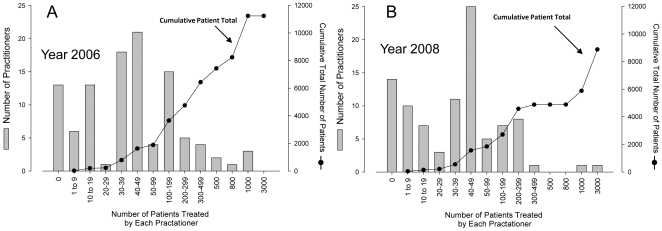
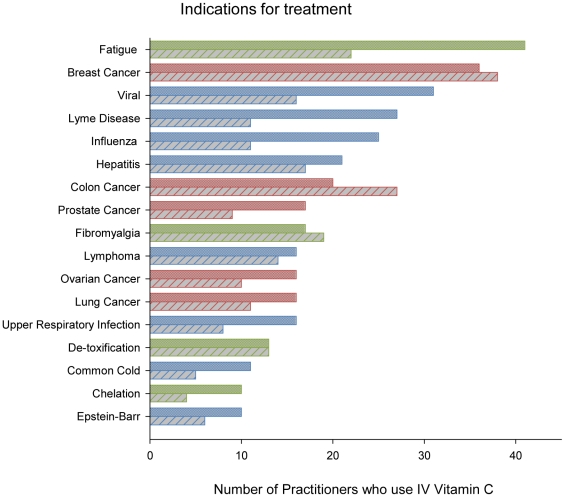
BACKGROUND: Anecdotal information and case reports suggest that intravenously administered vitamin C is used by Complementary and Alternate Medicine (CAM) practitioners. The scale of such use in the U.S. and associated side effects are unknown. METHODS AND FINDINGS: We surveyed attendees at annual CAM Conferences in 2006 and 2008, and determined sales of intravenous vitamin C by major U.S. manufacturers/distributors. We also queried practitioners for side effects, compiled published cases, and analyzed FDA's Adverse Events Database. Of 199 survey respondents (out of 550), 172 practitioners administered IV vitamin C to 11,233 patients in 2006 and 8876 patients in 2008. Average dose was 28 grams every 4 days, with 22 total treatments per patient. Estimated yearly doses used (as 25 g/50 ml vials) were 318,539 in 2006 and 354,647 in 2008. Manufacturers' yearly sales were 750,000 and 855,000 vials, respectively. Common reasons for treatment included infection, cancer, and fatigue. Of 9,328 patients for whom data is available, 101 had side effects, mostly minor, including lethargy/fatigue in 59 patients, change in mental status in 21 patients and vein irritation/phlebitis in 6 patients. Publications documented serious adverse events, including 2 deaths in patients known to be at risk for IV vitamin C. Due to confounding causes, the FDA Adverse Events Database was uninformative. Total numbers of patients treated in the US with high dose vitamin C cannot be accurately estimated from this study. CONCLUSIONS: High dose IV vitamin C is in unexpectedly wide use by CAM practitioners. Other than the known complications of IV vitamin C in those with renal impairment or glucose 6 phosphate dehydrogenase deficiency, high dose intravenous vitamin C appears to be remarkably safe. Physicians should inquire about IV vitamin C use in patients with cancer, chronic, untreatable, or intractable conditions and be observant of unexpected harm, drug interactions, or benefit.
Overview
The claims and statistics of this paper haven’t been checked yet.
Run the check — free, no account needed. It reads the open-access text and checks the sources it cites.
Integrity signals
Registry
Cites
Statistics
Figures
Verification
Claims the paper makes
The claims and statistics of this paper haven’t been checked yet.
Run the check — free, no account needed. It reads the open-access text and checks the sources it cites.
Claims other papers make about this one
Each is checked against this paper’s own text: does it say what the citing paper says it does?
The cited source says what the claim attributes to it.
In the citing paper
“Interestingly, even very high doses of i.v. vitamin C (ranging from 1 to 200 g and given repeatedly) are apparently well tolerated in most patients [206].”
From Vitamin C-Sources, Physiological Role, Kinetics, Deficiency, Use, Toxicity, and Determination (2021) · cites this paper as [206]
Self-check
Percentages, sums and reported differences re-computed from the paper’s own numbers.
The self-check needs the paper’s full text.
Citations
Cites
Complementary and alternative medicine use among adults: United States, 2002
Barnes, P. M., Powell‐Griner, E., McFann, K., & Nahin, R. L. (2004) · Seminars in Integrative Medicine · doi:10.1016/j.sigm.2004.07.003 · Cited by 2,183
Vitamin C pharmacokinetics in healthy volunteers: evidence for a recommended dietary allowance
Levine, M., Conry-Cantilena, C., Wang, Y., Welch, R. W., Washko, P. W., Dhariwal, K. R., Park, J. B., Lazarev, A., Graumlich, J. F., King, J., et al. (1996) · Proceedings of the National Academy of Sciences · doi:10.1073/pnas.93.8.3704 · Cited by 1,325
Self-citationChen, Q., Espey, M. G., Krishna, M. C., Mitchell, J. B., Corpe, C. P., Buettner, G. R., Shacter, E., & Levine, M. (2005) · Proceedings of the National Academy of Sciences · doi:10.1073/pnas.0506390102 · Cited by 1,075
Self-citationVitamin C pharmacokinetics: Implications for oral and intravenous use
Padayatty, S. J., Sun, H., Wang, Y., Riordan, H. D., Hewitt, S. M., Katz, A., Wesley, R. A., & Levine, M. (2004) · Annals of Internal Medicine · doi:10.7326/0003-4819-140-7-200404060-00010 · Cited by 992
Self-citationKennedy, C. O. (1971) · British Homeopathic journal · doi:10.1016/s0007-0785(71)80027-3 · Cited by 976
Chen, Q., Espey, M. G., Sun, A. Y., Pooput, C., Kirk, K. L., Krishna, M. C., Khosh, D. B., Drisko, J., & Levine, M. (2008) · Proceedings of the National Academy of Sciences · doi:10.1073/pnas.0804226105 · Cited by 854
Self-citationCameron, E., & Pauling, L. (1976) · Proceedings of the National Academy of Sciences · doi:10.1073/pnas.73.10.3685 · Cited by 710
Chen, Q., Espey, M. G., Sun, A. Y., Lee, J.-H., Krishna, M. C., Shacter, E., Choyke, P. L., Pooput, C., Kirk, K. L., Buettner, G. R., et al. (2007) · Proceedings of the National Academy of Sciences · doi:10.1073/pnas.0702854104 · Cited by 676
Self-citationMoertel, C. G., Fleming, T. R., Creagan, E. T., Rubin, J., O'Connell, M. J., & Ames, M. M. (1985) · New England Journal of Medicine · doi:10.1056/nejm198501173120301 · Cited by 637
Creagan, E. T., Moertel, C. G., O'Fallon, J. R., Schutt, A. J., O'Connell, M. J., Rubin, J., & Frytak, S. (1979) · New England Journal of Medicine · doi:10.1056/nejm197909273011303 · Cited by 584
Research works printed but not linked: 1
- HD Riordan, 1990, Case study: high-dose intravenous vitamin C in the treatment of a patient with adenocarcinoma of the kidney., J Orthomolecular Med, 5, 5
Cited by
Sorted by citations
Items 301–304 of 304
Carr, A. C., & Gupta, S. (2026) · Nutrition Research · doi:10.1016/j.nutres.2026.09.009
Der Tagesbedarf des Erwachsenen an Vitamin C [Adult requirements for vitamin C]
Scheunert, V. A. (1949) · Zenodo (CERN European Organization for Nuclear Research) · doi:10.5281/zenodo.10932392
High dose ascorbic acid in Nigerian asthmatics
Anah, C., Jarike, L., & Baig, H. (1980) · PubMed · doi:10.5281/zenodo.13912250
Overview of Vitamin C and Cancer
González, M. J., & Miranda-Massari, J. R. (2014) · Springer eBooks · doi:10.1007/978-1-4939-1890-4_1
Metadata
- Authors
- Padayatty, S. J., Sun, A. Y., Chen, Q., Espey, M. G., Drisko, J., & Levine, M.
- Affiliations
- National Institutes of Health (US)
- University of Kansas Medical Center (US)
- Corresponding author
- Levine, Mark
- Venue
- PLoS ONE
- Publisher
- Public Library of Science (PLoS)
- Published
- 2010-07-07
- Volume
- 5
- Issue
- 7
- Pages
- e11414
- ISSN
- 1932-6203 (ISSN-L)
- PMC
- PMC2898816
- OpenAlex
- W2108045872
- Cited by
- 304
- References
- 53
- Citations by year
- 2026: 8 · 2025: 9 · 2024: 17 · 2023: 15 · 2022: 25 · 2021: 25 · 2020: 27 · 2019: 15 · 2018: 23 · 2017: 13 · 2016: 21 · 2015: 20 · 2014: 24 · 2013: 29 · 2012: 16
- FWCI
- 49.62
- Type
- journal article
- Language
- en
- Open access
- gold
- doi.org
- Licence
- Locations
- PLoS ONE (publishedVersion, public-domain)
- PubMed Central (publishedVersion, public-domain)
- PubMed (publishedVersion)
- RePEc: Research Papers in Economics (submittedVersion)
- DOAJ (DOAJ: Directory of Open Access Journals) (submittedVersion, cc-by-sa)
- Figshare (submittedVersion, cc-by)
- Funders
- National Institutes of Health
- National Institute of Diabetes and Digestive and Kidney Diseases
- Topics
- Health Sciences › Medicine › Complementary and alternative medicine › Complementary and Alternative Medicine Studies
- Health Sciences › Nursing › Nutrition and Dietetics › Vitamin C and Antioxidants Research
- Health Sciences › Medicine › Public Health, Environmental and Occupational Health › Nutrition and Health Studies
- Keywords
- intravenous vitamin C, high-dose vitamin C, adverse effects, phlebitis, lethargy, cancer therapy, drug interactions, renal dysfunction, glucose-6-phosphate dehydrogenase deficiency
- MeSH terms
- Complementary Therapies, Ascorbic Acid, Data Collection, Humans, Injections, Intravenous, United States, United States Food and Drug Administration
About these checks
Registry, retraction, Cites and statistics results are computed, not judged, with one exception: a printed reference that no index lists is read once by a model before it counts as a citation error. Claims are extracted by a model and kept only when their quote appears verbatim in the text; each cited source is then checked, with a model’s help, for whether it says what the claim relies on. Those verdicts can be wrong — read the claim’s quote and the cited source before relying on one.
Statistics and arithmetic are recomputed, not judged.
Confidence bands are shown only for fields calibrated on our annotated test set. None is calibrated yet, so no band is shown.
What counts as a claim ›How we measure confidence ›How we check this ›
Are you an author, or do you see a problem with this page? Request a review
