

The DOI matches its Crossref record; 23 of the 23 references it cites were found in a registry or an index.
Real-Time Fluorescence Loop Mediated Isothermal Amplification for the Diagnosis of Malaria
Open accessAbstract
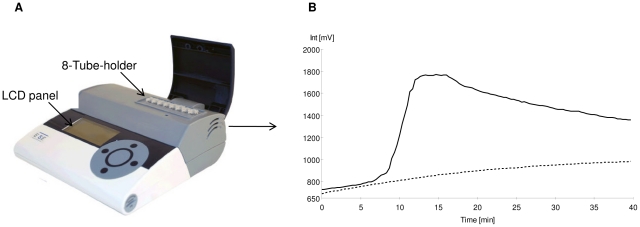
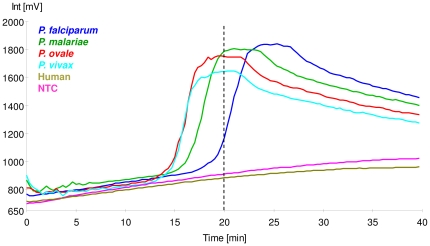
BACKGROUND: Molecular diagnostic methods can complement existing tools to improve the diagnosis of malaria. However, they require good laboratory infrastructure thereby restricting their use to reference laboratories and research studies. Therefore, adopting molecular tools for routine use in malaria endemic countries will require simpler molecular platforms. The recently developed loop-mediated isothermal amplification (LAMP) method is relatively simple and can be improved for better use in endemic countries. In this study, we attempted to improve this method for malaria diagnosis by using a simple and portable device capable of performing both the amplification and detection (by fluorescence) of LAMP in one platform. We refer to this as the RealAmp method. METHODOLOGY AND SIGNIFICANT FINDINGS: Published genus-specific primers were used to test the utility of this method. DNA derived from different species of malaria parasites was used for the initial characterization. Clinical samples of P. falciparum were used to determine the sensitivity and specificity of this system compared to microscopy and a nested PCR method. Additionally, directly boiled parasite preparations were compared with a conventional DNA isolation method. The RealAmp method was found to be simple and allowed real-time detection of DNA amplification. The time to amplification varied but was generally less than 60 minutes. All human-infecting Plasmodium species were detected. The sensitivity and specificity of RealAmp in detecting P. falciparum was 96.7% and 91.7% respectively, compared to microscopy and 98.9% and 100% respectively, compared to a standard nested PCR method. In addition, this method consistently detected P. falciparum from directly boiled blood samples. CONCLUSION: This RealAmp method has great potential as a field usable molecular tool for diagnosis of malaria. This tool can provide an alternative to conventional PCR based diagnostic methods for field use in clinical and operational programs.
Overview
The claims and statistics of this paper haven’t been checked yet.
Run the check — free, no account needed. It reads the open-access text and checks the sources it cites.
Integrity signals
Registry
Cites
Statistics
Figures
Verification
Claims the paper makes
The claims and statistics of this paper haven’t been checked yet.
Run the check — free, no account needed. It reads the open-access text and checks the sources it cites.
Claims other papers make about this one
Each is checked against this paper’s own text: does it say what the citing paper says it does?
In the citing paper
“Several studies that compared the LAMP method to microscopy, PCR and RDT, reported high sensitivity and specificity compared with microscopy or PCR in nonpregnant populations [34–37].”
From Diagnosing malaria in pregnancy: An update (2012) · cites this paper as [36]
Self-check
Percentages, sums and reported differences re-computed from the paper’s own numbers.
The self-check needs the paper’s full text.
Citations
Cites
Loop-mediated isothermal amplification of DNA
Notomi, T. (2000) · Nucleic Acids Research · doi:10.1093/nar/28.12.e63 · Cited by 8,805
Weltgesundheitsorganisation (2005) · Cited by 3,799
Accelerated reaction by loop-mediated isothermal amplification using loop primers
Nagamine, K., Hase, T., & Notomi, T. (2002) · Molecular and Cellular Probes · doi:10.1006/mcpr.2002.0415 · Cited by 2,075
Plasmodium knowlesi Malaria in Humans Is Widely Distributed and Potentially Life Threatening
Cox‐Singh, J., Davis, T. M. E., Lee, K.-S., Shamsul, S. S., Matusop, A., Ratnam, S., Rahman, H., Conway, D. J., & Singh, B. B. (2007) · Clinical Infectious Diseases · doi:10.1086/524888 · Cited by 884
Singh, B. B., Bobogare, A., Cox‐Singh, J., Snounou, G., Abdullah, M. S., & Rahman, H. (1999) · American Journal of Tropical Medicine and Hygiene · doi:10.4269/ajtmh.1999.60.687 · Cited by 593
Gamboa, D., Ho, M., Bendezú, J., Torres, K., Chiodini, P. L., Barnwell, J. W., Incardona, S., Perkins, M. D., Bell, D., McCarthy, J. S., et al. (2010) · PLoS ONE · doi:10.1371/journal.pone.0008091 · Cited by 547
Self-citationPoon, L. L., Wong, B. W., Ma, E. H., Chan, K. H., Chow, L. M., Abeyewickreme, W., Tangpukdee, N., Yuen, K. Y., Guan, Y., Looareesuwan, S., et al. (2006) · Clinical Chemistry · doi:10.1373/clinchem.2005.057901 · Cited by 476
Parida, M., Posadas-Herrera, G., Inoue, S., Hasebe, F., & Morita, K. (2004) · Journal of Clinical Microbiology · doi:10.1128/jcm.42.1.257-263.2004 · Cited by 439
Thai, H. T. C., Le, M. Q., Vuong, C. D., Parida, M., Minekawa, H., Notomi, T., Hasebe, F., & Morita, K. (2004) · Journal of Clinical Microbiology · doi:10.1128/jcm.42.5.1956-1961.2004 · Cited by 423
Han, E., Watanabe, R., Sattabongkot, J., Khuntirat, B., Sirichaisinthop, J., Iriko, H., Jin, L., Takeo, S., & Tsuboi, T. (2007) · Journal of Clinical Microbiology · doi:10.1128/jcm.02117-06 · Cited by 277
Cited by
Sorted by citations
Becherer, L., Borst, N., Bakheit, M. A., Frischmann, S., Zengerle, R., & von Stetten, F. (2020) · Analytical Methods · doi:10.1039/c9ay02246e · Cited by 432
Hofmann, N., Mwingira, F., Shekalaghe, S., Robinson, L. J., Mueller, I., & Felger, I. (2015) · PLOS Medicine · doi:10.1371/journal.pmed.1001788 · Cited by 413
Brief review of monitoring methods for loop-mediated isothermal amplification (LAMP)
Zhang, X., Lowe, S. B., & Gooding, J. J. (2014) · Biosensors and Bioelectronics · doi:10.1016/j.bios.2014.05.039 · Cited by 370
Hopkins, H., González, I. J., Polley, S. D., Angutoko, P., Ategeka, J., Asiimwe, C., Agaba, B. B., Kyabayinze, D. J., Sutherland, C. J., Perkins, M. D., et al. (2013) · The Journal of Infectious Diseases · doi:10.1093/infdis/jit184 · Cited by 288
Malaria rapid diagnostic tests in elimination settings—can they find the last parasite?
McMorrow, M., Aidoo, M., & Kachur, S. P. (2011) · Clinical Microbiology and Infection · doi:10.1111/j.1469-0691.2011.03639.x · Cited by 205
Self-citation
Metadata
- Authors
- Lucchi, N. W., Demas, A., Narayanan, J., Sumari, D., Kabanywanyi, A., Kachur, S. P., Barnwell, J. W., & Udhayakumar, V.
- Affiliations
- Centers for Disease Control and Prevention (US)
- Ifakara Health Institute (TZ)
- Corresponding author
- Lucchi, Naomi W.
- ORCID
- Venue
- PLoS ONE
- Publisher
- Public Library of Science (PLoS)
- Published
- 2010-10-29
- Volume
- 5
- Issue
- 10
- Pages
- e13733
- ISSN
- 1932-6203 (ISSN-L)
- PMC
- PMC2966401
- OpenAlex
- W1991198490
- Cited by
- 198
- References
- 23
- Citations by year
- 2026: 3 · 2025: 5 · 2024: 10 · 2023: 7 · 2022: 11 · 2021: 6 · 2020: 15 · 2019: 12 · 2018: 18 · 2017: 12 · 2016: 16 · 2015: 18 · 2014: 29 · 2013: 14 · 2012: 16
- FWCI
- 11.13
- Type
- journal article
- Language
- en
- Open access
- gold
- doi.org
- Licence
- Locations
- PLoS ONE (publishedVersion, public-domain)
- PubMed Central (publishedVersion, public-domain)
- PubMed (publishedVersion)
- DOAJ (DOAJ: Directory of Open Access Journals) (submittedVersion, cc-by-sa)
- Funders
- Association of Public Health Laboratories
- Centers for Disease Control and Prevention
- Topics
- Health Sciences › Medicine › Public Health, Environmental and Occupational Health › Malaria Research and Control
- Physical Sciences › Engineering › Biomedical Engineering › Biosensors and Analytical Detection
- Life Sciences › Biochemistry, Genetics and Molecular Biology › Molecular Biology › Molecular Biology Techniques and Applications
- Keywords
- malaria diagnosis, loop-mediated isothermal amplification, real-time fluorescence detection, portable diagnostic device, Plasmodium falciparum, Plasmodium species detection, sensitivity and specificity
- MeSH terms
- Animals, Fluorescence, Humans, Malaria, Plasmodium, Sensitivity and Specificity, DNA, Protozoan, Polymerase Chain Reaction, Molecular Diagnostic Techniques
About these checks
Registry, retraction, Cites and statistics results are computed, not judged, with one exception: a printed reference that no index lists is read once by a model before it counts as a citation error. Claims are extracted by a model and kept only when their quote appears verbatim in the text; each cited source is then checked, with a model’s help, for whether it says what the claim relies on. Those verdicts can be wrong — read the claim’s quote and the cited source before relying on one.
Statistics and arithmetic are recomputed, not judged.
Confidence bands are shown only for fields calibrated on our annotated test set. None is calibrated yet, so no band is shown.
What counts as a claim ›How we measure confidence ›How we check this ›
Are you an author, or do you see a problem with this page? Request a review
