

Anhydrobiosis-Associated Nuclear DNA Damage and Repair in the Sleeping Chironomid: Linkage with Radioresistance
Open accessThe DOI matches its Crossref record; 72 of the 73 references it cites were found in a registry or an index.
Abstract
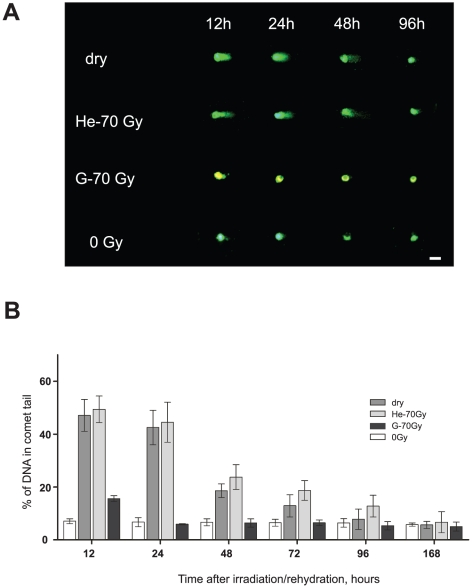
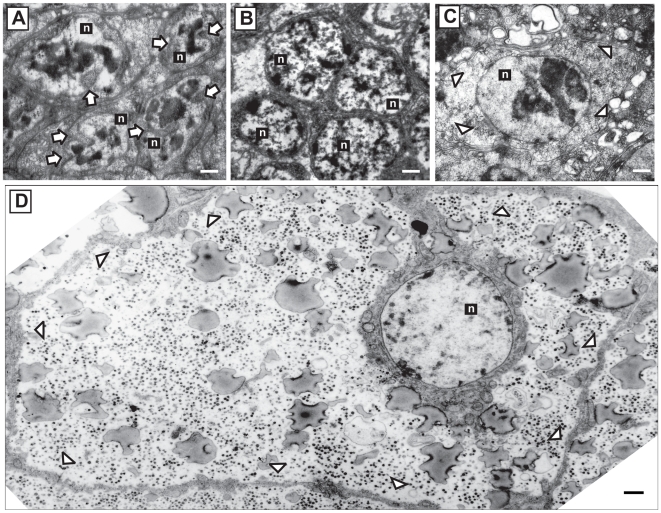
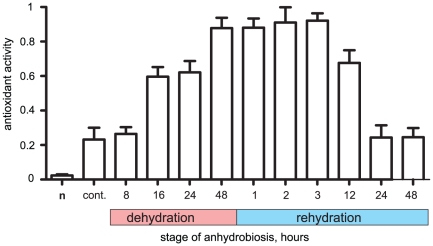
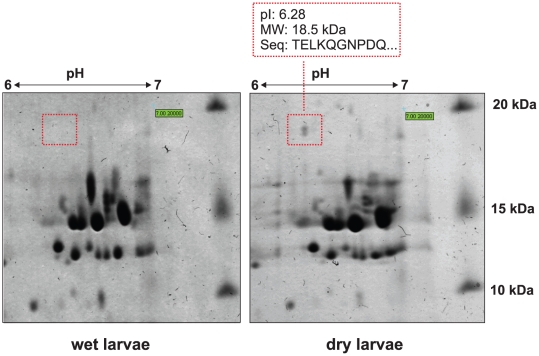
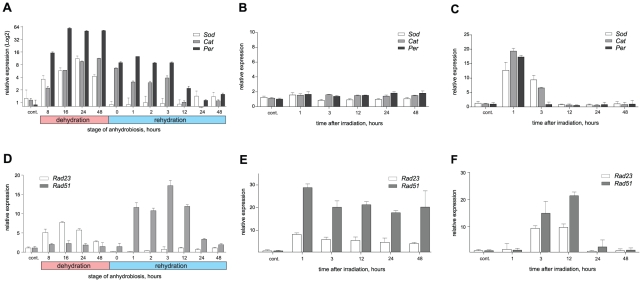
Anhydrobiotic chironomid larvae can withstand prolonged complete desiccation as well as other external stresses including ionizing radiation. To understand the cross-tolerance mechanism, we have analyzed the structural changes in the nuclear DNA using transmission electron microscopy and DNA comet assays in relation to anhydrobiosis and radiation. We found that dehydration causes alterations in chromatin structure and a severe fragmentation of nuclear DNA in the cells of the larvae despite successful anhydrobiosis. Furthermore, while the larvae had restored physiological activity within an hour following rehydration, nuclear DNA restoration typically took 72 to 96 h. The DNA fragmentation level and the recovery of DNA integrity in the rehydrated larvae after anhydrobiosis were similar to those of hydrated larvae irradiated with 70 Gy of high-linear energy transfer (LET) ions ((4)He). In contrast, low-LET radiation (gamma-rays) of the same dose caused less initial damage to the larvae, and DNA was completely repaired within within 24 h. The expression of genes encoding the DNA repair enzymes occurred upon entering anhydrobiosis and exposure to high- and low-LET radiations, indicative of DNA damage that includes double-strand breaks and their subsequent repair. The expression of antioxidant enzymes-coding genes was also elevated in the anhydrobiotic and the gamma-ray-irradiated larvae that probably functions to reduce the negative effect of reactive oxygen species upon exposure to these stresses. Indeed the mature antioxidant proteins accumulated in the dry larvae and the total activity of antioxidants increased by a 3-4 fold in association with anhydrobiosis. We conclude that one of the factors explaining the relationship between radioresistance and the ability to undergo anhydrobiosis in the sleeping chironomid could be an adaptation to desiccation-inflicted nuclear DNA damage. There were also similarities in the molecular response of the larvae to damage caused by desiccation and ionizing radiation.
Overview
The claims and statistics of this paper haven’t been checked yet.
Free: it reads the open-access text and checks the first 5 claims that cite a source we can check. Create a free account to check every claim.
Integrity signals
Registry
Cites
Statistics
Figures
Verification
Claims the paper makes
The claims and statistics of this paper haven’t been checked yet.
Free: it reads the open-access text and checks the first 5 claims that cite a source we can check. Create a free account to check every claim.
Self-check
Percentages, sums and reported differences re-computed from the paper’s own numbers.
The self-check needs the paper’s full text.
Citations
Cites
Antioxidants, Oxidative Damage and Oxygen Deprivation Stress: a Review
BLOKHINA, O. (2003) · Annals of Botany · doi:10.1093/aob/mcf118 · Cited by 4,002 · cited 15×
“In a series of irradiation studies [7,16,36], it has been demonstrated that dried larvae show higher tolerance to both high-LET (directly causing DNA breaks) and low-LET (causing increase of reactive oxygen species (ROS) in the irradiated tissues) irradiation, measured by short-term survival compared with physiologica…”
BackgroundInfluentialDeinococcus radiodurans — the consummate survivor
Cox, M. M., & Battista, J. R. (2005) · Nature Reviews Microbiology · doi:10.1038/nrmicro1264 · Cited by 741 · cited 1×
“Concerning this point, genetic adaptations to anhydrobiosis in the sleeping chironomid show some functional analogies with those of the radiotolerant bacteria Deinococcus radiodurans [23,60], in which both desiccation and irradiation cause severe DNA damage, followed by prolonged DNA recovery period associated with de…”
BackgroundMassive Horizontal Gene Transfer in Bdelloid Rotifers
Gladyshev, E. A., Meselson, M., & Arkhipova, I. R. (2008) · Science · doi:10.1126/science.1156407 · Cited by 499 · cited 1×
“In addition, recent studies have suggested that DNA breaks take place in other anhydrobionts such as bdelloid rotifers [30,65].”
BackgroundRad23 links DNA repair to the ubiquitin/proteasome pathway
Schauber, C., Chen, L., Tongaonkar, P., Vega, I., Lambertson, D., Potts, W., & Madura, K. (1998) · Nature · doi:10.1038/35661 · Cited by 457 · cited 1×
“DNA excision repair and different types of DNA damage recognition [40]; and Rad51 (HM062773), whose protein”
BackgroundProtein Oxidation Implicated as the Primary Determinant of Bacterial Radioresistance
Daly, M. J., Gaidamakova, E. K., Matrosova, V. Y., Vasilenko, A., Zhai, M., Leapman, R. D., Lai, B., Ravel, B., Li, S.-M. W., Kemner, K. M., et al. (2007) · PLoS Biology · doi:10.1371/journal.pbio.0050092 · Cited by 436 · cited 1×
“In addition, being anhydrobiotic confers cross-tolerance to various other extreme environmental stressors, including different types of radiation [7,8,9,10,11,12,13].”
BackgroundOxidative stress and its effects during dehydration
França, M. B., Panek, A. D., & Eleutherio, E. C. A. (2007) · Comparative Biochemistry and Physiology Part A: Molecular & Integrative Physiology · doi:10.1016/j.cbpa.2006.02.030 · Cited by 422 · cited 17×
“water loss on biomolecules upon post dry-state rehydration [3,6].”
BackgroundInfluentialTardigrades survive exposure to space in low Earth orbit
Jönsson, K. I., Rabbow, E., Schill, R. O., Harms-Ringdahl, M., & Rettberg, P. (2008) · Current Biology · doi:10.1016/j.cub.2008.06.048 · Cited by 415
Constraints of tolerance: why are desiccation-tolerant organisms so small or rare?
Alpert, P. (2006) · Journal of Experimental Biology · doi:10.1242/jeb.02179 · Cited by 344 · cited 3×
“The enhanced protection and repair of DNA might also be responsible for the cross-tolerance to ionizing radiation [2,7,10,13, 22,23].”
BackgroundLessons from nature: the role of sugars in anhydrobiosis
Crowe, L. M. (2002) · Comparative Biochemistry and Physiology Part A: Molecular & Integrative Physiology · doi:10.1016/s1095-6433(01)00503-7 · Cited by 329 · cited 1×
“hydrophilic proteins which prevent the biomolecules from irreversible aggregation [1,5,12,21,43].”
BackgroundRecombination at Double-Strand Breaks and DNA Ends
Cromie, G. A., Connelly, J. C., & Leach, D. R. F. (2001) · Molecular Cell · doi:10.1016/s1097-2765(01)00419-1 · Cited by 325
Cited by
Hashimoto, T., Horikawa, D. D., Saito, Y., Kuwahara, H., Kozuka-Hata, H., Shin-I, T., Minakuchi, Y., Ohishi, K., Motoyama, A., Aizu, T., et al. (2016) · Nature Communications · doi:10.1038/ncomms12808 · Cited by 394
Gusev, O., Suetsugu, Y., Cornette, R., Kawashima, T., Logacheva, M. D., Kondrashov, A. S., Penin, A. A., Hatanaka, R., Kikuta, S., Shimura, S., et al. (2014) · Nature Communications · doi:10.1038/ncomms5784 · Cited by 151
Self-citationThe induction of anhydrobiosis in the sleeping chironomid: Current status of our knowledge
Cornette, R., & Kikawada, T. (2011) · IUBMB Life · doi:10.1002/iub.463 · Cited by 127
“catalase and several superoxide dismutase genes were identified, and their expression was upregulated during the desiccation process (19, 21) (Fig.”
BackgroundSelf-citationComparative genomics of bdelloid rotifers: Insights from desiccating and nondesiccating species
Nowell, R. W., Almeida, P., Wilson, C. G., Smith, T., Fontaneto, D., Crisp, A., Micklem, G., Tunnacliffe, A., Boschetti, C., & Barraclough, T. G. (2018) · PLoS Biology · doi:10.1371/journal.pbio.2004830 · Cited by 118
Ecological and Societal Services of Aquatic Diptera
Adler, P. H., & Courtney, G. W. (2019) · Insects · doi:10.3390/insects10030070 · Cited by 118
“These larvae experience severe DNA damage but have an efficient repair mechanism [137].”
Background
Metadata
- Authors
- Gusev, O., Nakahara, Y., Vanyagina, V., Malutina, L., Cornette, R., Sakashita, T., Hamada, N., Kikawada, T., Kobayashi, Y., & Okuda, T.
- Affiliations
- Kazan Federal University (RU)
- Institute of Agrobiological Sciences (JP)
- Japan Atomic Energy Agency (JP)
- Central Research Institute of Electric Power Industry (JP)
- Corresponding author
- Okuda, Takashi
- ORCID
- Venue
- PLoS ONE
- Publisher
- Public Library of Science (PLoS)
- Published
- 2010-11-16
- Volume
- 5
- Issue
- 11
- Pages
- e14008
- ISSN
- 1932-6203 (ISSN-L)
- PMC
- PMC2982815
- OpenAlex
- W2068642632
- Cited by
- 87
- References
- 73
- Citations by year
- 2026: 5 · 2025: 6 · 2024: 8 · 2023: 6 · 2022: 5 · 2021: 4 · 2020: 6 · 2019: 3 · 2018: 8 · 2017: 6 · 2016: 6 · 2015: 6 · 2014: 5 · 2013: 7 · 2012: 5
- FWCI
- 4.42
- Type
- journal article
- Language
- en
- Open access
- gold
- doi.org
- Locations
- PLoS ONE (publishedVersion, cc-by)
- PubMed Central (publishedVersion, cc-by)
- PubMed (publishedVersion)
- DOAJ (DOAJ: Directory of Open Access Journals) (submittedVersion, cc-by-sa)
- zvestiya of the National Academy of Sciences of Belarus (National Academy of Sciences of Belarus) (submittedVersion)
- Funders
- Japan Society for the Promotion of Science (21688004)
- Topics
- Life Sciences › Agricultural and Biological Sciences › Ecology, Evolution, Behavior and Systematics › Tardigrade Biology and Ecology
- Health Sciences › Medicine › Radiology, Nuclear Medicine and Imaging › Effects of Radiation Exposure
- Physical Sciences › Environmental Science › Ecology › Physiological and biochemical adaptations
- Keywords
- anhydrobiosis, nuclear DNA damage, DNA repair, radioresistance (biology), chironomid larvae, desiccation stress, ionizing radiation, gamma radiation, chromatin structure, DNA fragmentation, DNA double-strand breaks, antioxidant enzymes, reactive oxygen species, cross-tolerance, rehydration
- MeSH terms
- Animals, Catalase, Cell Nucleus, Chironomidae, Dehydration, DNA Damage, DNA Repair, Glutathione Peroxidase, Larva, Molecular Sequence Data, Radiation Tolerance, Superoxide Dismutase, Electrophoresis, Gel, Two-Dimensional, Sequence Analysis, DNA, DNA, Complementary, Reverse Transcriptase Polymerase Chain Reaction, Comet Assay, Microscopy, Electron, Transmission, DNA Fragmentation
About these checks
Registry, retraction, Cites and statistics results are computed, not judged, with one exception: a printed reference that no index lists is read once by a model before it counts as a citation error. Claims are extracted by a model and kept only when their quote appears verbatim in the text; each cited source is then checked, with a model’s help, for whether it says what the claim relies on. Those verdicts can be wrong — read the claim’s quote and the cited source before relying on one.
Statistics and arithmetic are recomputed, not judged.
Confidence bands are shown only for fields calibrated on our annotated test set. None is calibrated yet, so no band is shown.
What counts as a claim ›How we measure confidence ›How we check this ›
Are you an author, or do you see a problem with this page? Request a review
How to cite
Cite CoChat for the checks on this page, and the paper for its own findings.
- This page
- CoChat. (2026). Citation check: Anhydrobiosis-Associated Nuclear DNA Damage and Repair in the Sleeping Chironomid: Linkage with Radioresistance. https://app.cochat.ai/papers/10.1371/journal.pone.0014008
- The paper
- Gusev, O., Nakahara, Y., Vanyagina, V., Malutina, L., Cornette, R., Sakashita, T., Hamada, N., Kikawada, T., Kobayashi, Y., & Okuda, T. (2010). Anhydrobiosis-Associated Nuclear DNA Damage and Repair in the Sleeping Chironomid: Linkage with Radioresistance. PLoS ONE. https://doi.org/10.1371/journal.pone.0014008
Data sources
Bibliographic data: Semantic Scholar, OpenAlex, Crossref.
Contains information from the Semantic Scholar Academic Graph Datasets, made available under the ODC Attribution License (ODC-BY 1.0).
Semantic Scholar’s data is described in: Kinney, R., et al. (2023). The Semantic Scholar Open Data Platform. arXiv:2301.10140.
