

The DOI matches its Crossref record; 22 of the 22 references it cites were found in a registry or an index.
Epigenetic Predictor of Age
Open accessAbstract
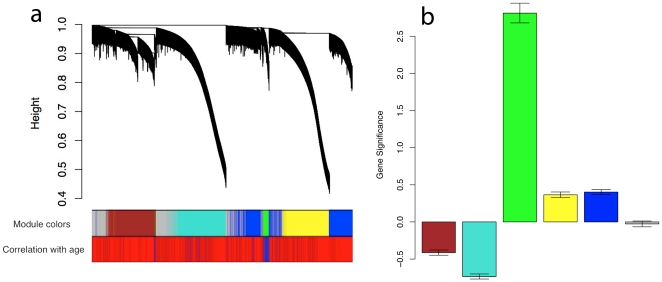
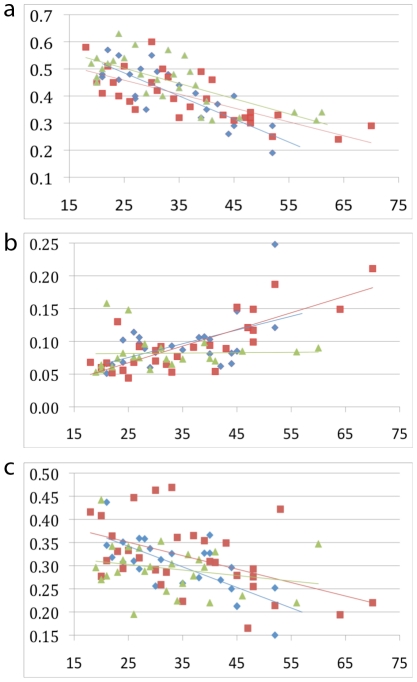
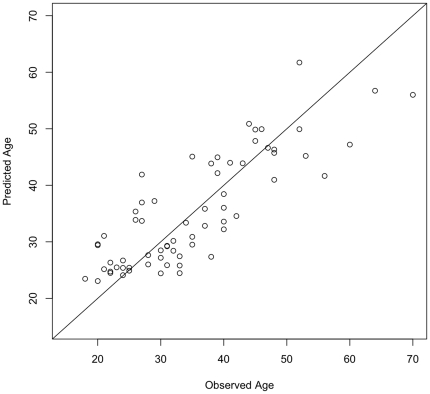
From the moment of conception, we begin to age. A decay of cellular structures, gene regulation, and DNA sequence ages cells and organisms. DNA methylation patterns change with increasing age and contribute to age related disease. Here we identify 88 sites in or near 80 genes for which the degree of cytosine methylation is significantly correlated with age in saliva of 34 male identical twin pairs between 21 and 55 years of age. Furthermore, we validated sites in the promoters of three genes and replicated our results in a general population sample of 31 males and 29 females between 18 and 70 years of age. The methylation of three sites--in the promoters of the EDARADD, TOM1L1, and NPTX2 genes--is linear with age over a range of five decades. Using just two cytosines from these loci, we built a regression model that explained 73% of the variance in age, and is able to predict the age of an individual with an average accuracy of 5.2 years. In forensic science, such a model could estimate the age of a person, based on a biological sample alone. Furthermore, a measurement of relevant sites in the genome could be a tool in routine medical screening to predict the risk of age-related diseases and to tailor interventions based on the epigenetic bio-age instead of the chronological age.
Overview
The claims and statistics of this paper haven’t been checked yet.
Run the check — free, no account needed. It reads the open-access text and checks the sources it cites.
Integrity signals
Registry
Cites
Statistics
Figures
Verification
Claims the paper makes
The claims and statistics of this paper haven’t been checked yet.
Run the check — free, no account needed. It reads the open-access text and checks the sources it cites.
Claims other papers make about this one
Each is checked against this paper’s own text: does it say what the citing paper says it does?
The source backs part of the claim, not all of it — or backs it for a different population, condition or comparison.
In the citing paper
“The first DNA methylation clock was an elastic net model (BOX 1) built in 2011 by Bocklandt et al.53, who demonstrated highly accurate chronological age prediction (within ~5 years) using only about 100 saliva samples.”
From Measuring biological age using omics data (2022) · cites this paper as [53]
Experimental — accuracy not yet measured
Self-check
Percentages, sums and reported differences re-computed from the paper’s own numbers.
The self-check needs the paper’s full text.
Citations
Cites
WGCNA: an R package for weighted correlation network analysis
Langfelder, P., & Horvath, S. (2008) · BMC Bioinformatics · doi:10.1186/1471-2105-9-559 · Cited by 27,252
Self-citationStatistical significance for genomewide studies
Storey, J. D., & Tibshirani, R. (2003) · Proceedings of the National Academy of Sciences · doi:10.1073/pnas.1530509100 · Cited by 9,692
Adjusting batch effects in microarray expression data using empirical Bayes methods
Johnson, W. E., Li, C., & Rabinovic, A. (2007) · Biostatistics · doi:10.1093/biostatistics/kxj037 · Cited by 8,658
A General Framework for Weighted Gene Co-Expression Network Analysis
Zhang, B., & Horvath, S. (2005) · Statistical Applications in Genetics and Molecular Biology · doi:10.2202/1544-6115.1128 · Cited by 5,684
Self-citationEpigenetic differences arise during the lifetime of monozygotic twins
Fraga, M. F., Ballestar, E., Paz, M. F., Ropero, S., Setien, F., Ballestar, M. L., Heine-Suñer, D., Cigudosa, J. C., Urioste, M., Benitez, J., et al. (2005) · Proceedings of the National Academy of Sciences · doi:10.1073/pnas.0500398102 · Cited by 3,602
Marks, P. A., & Breslow, R. (2007) · Nature Biotechnology · doi:10.1038/nbt1272 · Cited by 1,198
Geometric Interpretation of Gene Coexpression Network Analysis
Horvath, S., & Dong, J. (2008) · PLoS Computational Biology · doi:10.1371/journal.pcbi.1000117 · Cited by 867
Self-citationAge-dependent DNA methylation of genes that are suppressed in stem cells is a hallmark of cancer
Teschendorff, A. E., Menon, U., Gentry-Maharaj, A., Ramus, S. J., Weisenberger, D. J., Shen, H., Campan, M., Noushmehr, H., Bell, C. G., Maxwell, A. P., et al. (2010) · Genome Research · doi:10.1101/gr.103606.109 · Cited by 855
Genome-wide association analysis by lasso penalized logistic regression
Wu, T. T., Chen, Y. F., Hastie, T., Sobel, E., & Lange, K. (2009) · Bioinformatics · doi:10.1093/bioinformatics/btp041 · Cited by 785
Human aging-associated DNA hypermethylation occurs preferentially at bivalent chromatin domainsPreprint
Rakyan, V. K., Down, T. A., Maslau, S., Andrew, T., Yang, T.-P., Beyan, H., Whittaker, P., McCann, O. T., Finer, S., Valdes, A. M., et al. (2010) · Genome Research · doi:10.1101/gr.103101.109 · Cited by 746
Cited by
Sorted by citations
DNA methylation age of human tissues and cell types
Horvath, S. (2013) · Genome Biology · doi:10.1186/gb-2013-14-10-r115 · Cited by 7,075
Self-citationGenome-wide methylation profiles reveal quantitative views of human aging rates
Hannum, G., Guinney, J., Zhao, L., Zhang, L., Hughes, G., Sadda, S., Klotzle, B., Bibikova, M., Fan, J.-B., Gao, Y., et al. (2013) · Molecular Cell · doi:10.1016/j.molcel.2012.10.016 · Cited by 4,270
An epigenetic biomarker of aging for lifespan and healthspan
Levine, M. E., Lu, A. T., Quach, A., Chen, B. H., Assimes, T. L., Bandinelli, S., Hou, L., Baccarelli, A. A., Stewart, J. D., Li, Y., et al. (2018) · Aging · doi:10.18632/aging.101414 · Cited by 3,675
Self-citationInflammaging: a new immune–metabolic viewpoint for age-related diseases
Franceschi, C., Garagnani, P., Parini, P., Giuliani, C., & Santoro, A. (2018) · Nature Reviews Endocrinology · doi:10.1038/s41574-018-0059-4 · Cited by 3,586
DNA methylation arrays as surrogate measures of cell mixture distribution
Houseman, E. A., Accomando, W. P., Koestler, D. C., Christensen, B. C., Marsit, C. J., Nelson, H. H., Wiencke, J. K., & Kelsey, K. T. (2012) · BMC Bioinformatics · doi:10.1186/1471-2105-13-86 · Cited by 3,175
Metadata
- Authors
- Bocklandt, S., Lin, W., Sehl, M. E., Sánchez, F. J., Sinsheimer, J. S., Horvath, S., & Vilain, E.
- Affiliations
- University of California, Los Angeles (US)
- Corresponding author
- Vilain, Eric
- Venue
- PLoS ONE
- Publisher
- Public Library of Science (PLoS)
- Published
- 2011-06-22
- Volume
- 6
- Issue
- 6
- Pages
- e14821
- ISSN
- 1932-6203 (ISSN-L)
- PMC
- PMC3120753
- OpenAlex
- W2080644309
- Cited by
- 1,012
- References
- 22
- Citations by year
- 2026: 56 · 2025: 71 · 2024: 83 · 2023: 92 · 2022: 95 · 2021: 108 · 2020: 87 · 2019: 64 · 2018: 52 · 2017: 65 · 2016: 58 · 2015: 63 · 2014: 43 · 2013: 40 · 2012: 30
- FWCI
- 14.97
- Type
- journal article
- Language
- en
- Open access
- gold
- doi.org
- Locations
- PLoS ONE (publishedVersion, cc-by)
- PubMed Central (publishedVersion, cc-by)
- PubMed (publishedVersion)
- DOAJ (DOAJ: Directory of Open Access Journals) (submittedVersion, cc-by-sa)
- eScholarship (California Digital Library) (submittedVersion)
- Figshare (submittedVersion, cc-by)
- Topics
- Life Sciences › Biochemistry, Genetics and Molecular Biology › Molecular Biology › Epigenetics and DNA Methylation
- Life Sciences › Biochemistry, Genetics and Molecular Biology › Cell Biology › Telomeres, Telomerase, and Senescence
- Life Sciences › Biochemistry, Genetics and Molecular Biology › Genetics › Genetic Syndromes and Imprinting
- Keywords
- DNA methylation, age prediction, epigenetic clocks, saliva, EDARADD, NPTX2, promoter methylation, forensic age estimation, age-related disease risk
- MeSH terms
- Adolescent, Adult, Aged, Aging, Female, Humans, Male, Middle Aged, Models, Genetic, Saliva, Twins, Reproducibility of Results, DNA Probes, DNA Methylation, Oligonucleotide Array Sequence Analysis, Epigenesis, Genetic, Young Adult, Genetic Loci
About these checks
Registry, retraction, Cites and statistics results are computed, not judged, with one exception: a printed reference that no index lists is read once by a model before it counts as a citation error. Claims are extracted by a model and kept only when their quote appears verbatim in the text; each cited source is then checked, with a model’s help, for whether it says what the claim relies on. Those verdicts can be wrong — read the claim’s quote and the cited source before relying on one.
Statistics and arithmetic are recomputed, not judged.
Confidence bands are shown only for fields calibrated on our annotated test set. None is calibrated yet, so no band is shown.
What counts as a claim ›How we measure confidence ›How we check this ›
Are you an author, or do you see a problem with this page? Request a review
