

Natural Plant Sugar Sources of Anopheles Mosquitoes Strongly Impact Malaria Transmission Potential
Open accessThe DOI matches its Crossref record; 31 of the 33 references it cites were found in a registry or an index.
Abstract
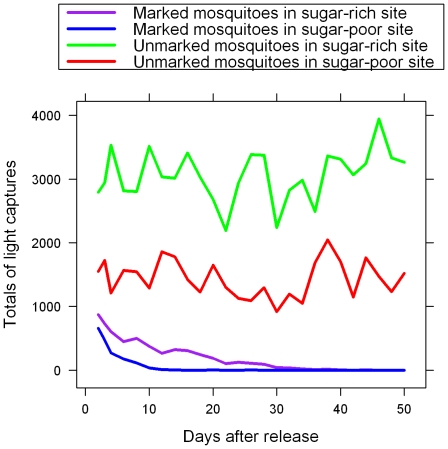
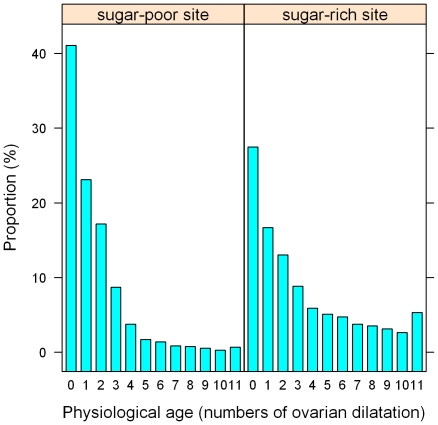
An improved knowledge of mosquito life history could strengthen malaria vector control efforts that primarily focus on killing mosquitoes indoors using insecticide treated nets and indoor residual spraying. Natural sugar sources, usually floral nectars of plants, are a primary energy resource for adult mosquitoes but their role in regulating the dynamics of mosquito populations is unclear. To determine how the sugar availability impacts Anopheles sergentii populations, mark-release-recapture studies were conducted in two oases in Israel with either absence or presence of the local primary sugar source, flowering Acacia raddiana trees. Compared with population estimates from the sugar-rich oasis, An. sergentii in the sugar-poor oasis showed smaller population size (37,494 vs. 85,595), lower survival rates (0.72 vs. 0.93), and prolonged gonotrophic cycles (3.33 vs. 2.36 days). The estimated number of females older than the extrinsic incubation period of malaria (10 days) in the sugar rich site was 4 times greater than in the sugar poor site. Sugar feeding detected in mosquito guts in the sugar-rich site was significantly higher (73%) than in the sugar-poor site (48%). In contrast, plant tissue feeding (poor quality sugar source) in the sugar-rich habitat was much less (0.3%) than in the sugar-poor site (30%). More important, the estimated vectorial capacity, a standard measure of malaria transmission potential, was more than 250-fold higher in the sugar-rich oasis than that in the sugar-poor site. Our results convincingly show that the availability of sugar sources in the local environment is a major determinant regulating the dynamics of mosquito populations and their vector potential, suggesting that control interventions targeting sugar-feeding mosquitoes pose a promising tactic for combating transmission of malaria parasites and other pathogens.
Overview
The claims and statistics of this paper haven’t been checked yet.
Free: it reads the open-access text and checks the first 5 claims that cite a source we can check. Create a free account to check every claim.
Integrity signals
Registry
Cites
Statistics
Figures
Verification
Claims the paper makes
The claims and statistics of this paper haven’t been checked yet.
Free: it reads the open-access text and checks the first 5 claims that cite a source we can check. Create a free account to check every claim.
Claims other papers make about this one
Each is checked against this paper’s own text: does it say what the citing paper says it does?
The cited source says what the claim attributes to it.
In the citing paper
“As recently described [23], the environments of the two oases are very similar except for the availability of sugar sources.”
The cited source says what the claim attributes to it.
In the citing paper
“As demonstrated in a recent comparative study of An. sergentii in sugar-rich and sugar-poor oases in Israel, the availability of natural plant sugar sources affects mosquito fitness, population dynamics, and malaria vector capacity [23].”
Self-check
Percentages, sums and reported differences re-computed from the paper’s own numbers.
The self-check needs the paper’s full text.
Citations
Cites
R: A Language and Environment for Statistical Computing
R Core Team (2025) · doi:10.32614/r.manuals · Cited by 352,181
Direct microdetermination of sucrose
van Handel, E. (1968) · Analytical Biochemistry · doi:10.1016/0003-2697(68)90317-5 · Cited by 729
Auclair, J. L. (1963) · Annual Review of Entomology · doi:10.1146/annurev.en.08.010163.002255 · Cited by 506 · cited 1×
“Sugar content in these alternative plant tissue sources is frugal, as compared to high concentrations (20– 60%) in nectar and honeydew [32,33,34].”
BackgroundStatics and dynamics of malaria infection in Anopheles mosquitoes.
(2004) · Malaria Journal · doi:10.1186/1475-2875-3-13 · Cited by 473 · cited 1×
“It is well documented that the effects of interventions on the mosquito survival rates are extremely important [30].”
BackgroundKilleen, G. F., Smith, T. A., Ferguson, H. M., Mshinda, H., Abdulla, S., Lengeler, C., & Kachur, S. P. (2007) · PLoS Medicine · doi:10.1371/journal.pmed.0040229 · Cited by 408 · cited 1×
“, bednets and source reduction of aquatic habitats, can significantly affect population dynamics and the vectorial capacity of pathogen transmitting mosquitoes [8,9,10].”
BackgroundEcology: A Prerequisite for Malaria Elimination and Eradication
Ferguson, H. M., Dornhaus, A., Beeche, A., Borgemeister, C., Gottlieb, M., Mulla, M. S., Gimnig, J. E., Fish, D., & Killeen, G. F. (2010) · PLoS Medicine · doi:10.1371/journal.pmed.1000303 · Cited by 374 · cited 3×
“Vector ecology has been reiterated as the key for the development of much-needed new approaches beyond LLINs and IRS for controlling malaria vector species and locally eliminating malaria parasite transmission [6].”
BackgroundInfluentialHow to make evolution-proof insecticides for malaria control
Read, A. F., Lynch, P. A., & Thomas, M. B. (2009) · PLoS Biology · doi:10.1371/journal.pbio.1000058 · Cited by 288 · cited 1×
“Nevertheless, scale-up applications of LLINs and IRS inevitably lead to development of insecticide resistance and do not suffice to sustain long-term control effects [3,4].”
BackgroundMüller, G. C., Beier, J. C., Traore, S. F., Toure, M. B., Traore, M. M., Bah, S., Doumbia, S., & Schlein, Y. (2010) · Malaria Journal · doi:10.1186/1475-2875-9-210 · Cited by 239
Self-citationKilleen, G. F., McKenzie, F. E., Foy, B. D., Schieffelin, C., Billingsley, P. F., & Beier, J. C. (2000) · The American journal of tropical medicine and hygiene · doi:10.4269/ajtmh.2000.62.535 · Cited by 220 · cited 2×
“2 - 4 days [23], our estimation was weighted average to take into account the variation of individual mosquitoes.”
BackgroundSelf-citationPost‐secretory determinants of sugar concentration in nectar
CORBET, S. A., WILLMER, P. G., BEAMENT, J. W. L., UNWIN, D. M., & PRŶS‐JONES, O. E. (1979) · Plant, Cell & Environment · doi:10.1111/j.1365-3040.1979.tb00084.x · Cited by 209 · cited 1×
“Sugar content in these alternative plant tissue sources is frugal, as compared to high concentrations (20– 60%) in nectar and honeydew [32,33,34].”
Background
Research works printed but not linked: 3
- WHO 2004 Global strategic framework for integrated vector management. WHO/CDS/CPE/PVC/2004 10 1 12
- Zohary M Orshansky G 1949 Structure and ecology of the vegetation in the Dead Sea region of Palestine. Palest J Bot 4 177 206
- Van Handel E 1972 The detection of nectar in mosquitoes. Mosq News 32 458
Cited by
Items 101–134 of 134
Mya, M. M., Thaung, S., Kyi, N. T. T., Oo, K. A. H., & Oo, N. N. (2024) · Middle East Journal of Applied Science & Technology · doi:10.46431/mejast.2024.7108 · Cited by 4
The olfactory neurobiology and chemical ecology of mosquito attraction to plant nutrient sources
Leon-Noreña, M., Jandu, S., Boyi, J., Bouzada, L. M. E. I., Rouyar, A., Coutinho-Abreu, I. V., Chen, F., Akbari, O. S., Pitts, R. J., & Riffell, J. A. (2025) · Proceedings of the Royal Society B Biological Sciences · doi:10.1098/rspb.2025.1806 · Cited by 2
“In contrast, in plant nutrient-rich environments, the estimated vectorial capacity was 250-fold higher than in nutrient-poor environments for Anopheles mosquitoes [12,13].”
Sugar diet affects Culex pipiens early‐life mortality, biochemical parameters, and immunocompetence
García‐Ruiz, O., Pascual‐Gil, J., Megías, C., la Puente, J. M., Figuerola, J., & Ruiz‐López, M. J. (2025) · Ecosphere · doi:10.1002/ecs2.70158 · Cited by 2
Effects of nectar and sugar on the longevity of the mosquito Anopheles gambiae s.l.Preprint
Cissé-Niambélé, K., Koella, J. C., & Guibéhi, B. K. (2025) · bioRxiv (Cold Spring Harbor Laboratory) · doi:10.1101/2025.03.02.641044 · Cited by 3
Impacts of Crop Protection Practices on Human Infectious Diseases
Ratnadass, A., Deberdt, P., Martin, T., Sester, M., & Deguine, J. (2023) · Wiley eBooks · doi:10.1002/9781119867333.ch21 · Cited by 8
Atriplex halimus L. Amaranthaceae
Elachouri, M., Benaicha, S., Ilyesse, R., & Bussmann, R. W. (2023) · Ethnobotany of mountain regions · doi:10.1007/978-3-031-13933-8_47-1 · Cited by 1
Making scents of mosquito lures: semiochemical attractants for adult mosquitoes
Thomas, N. K., Berry, C., & Sobhy, I. S. (2026) · Parasites & Vectors · doi:10.1186/s13071-026-07488-w · Cited by 1
“They forage for plant sugars from nectars, fruits and honeydews, with sugar-source selection influencing mosquito lifespan, fecundity and pollination behaviours [100, 150–154].”
Stica, C. J., Lobo, N. F., & Moore, S. (2021) · Ecology and control of vector-borne diseases · doi:10.3920/978-90-8686-895-7_6 · Cited by 1
State-dependent domicile leaving rates in Anopheles gambiae
Zappia, S. P. W., Chubaty, A. M., & Roitberg, B. D. (2018) · Malaria Journal · doi:10.1186/s12936-017-2166-4 · Cited by 1
“, toxic baits [5]) makes such tactics much more evolution proof than other tactics (e.”
BackgroundDesign and validation of a low-cost sugar-feeder for resource-poor insectaries
Stavrou–Dowd, Z. T., Rose, C., Acosta-Serrano, Á., & Haines, L. R. (2025) · Gates Open Research · doi:10.12688/gatesopenres.16314.1 · Cited by 1
Stalled malaria control – root causes and possible remediesPreprint
Hargrove, J. W., & Vale, G. A. (2022) · medRxiv · doi:10.1101/2022.07.09.22277454 · Cited by 1
“The use of attractive toxic sugar baits (ATSB) has, likewise, been suggested as a complement to the use of bed nets (Gu et al., 2011; Beier et al., 2012).”
BackgroundFloral and honeydew foraging ecology of select mosquito species
Peach, D. A. H. (2019) · Summit (Simon Fraser University)
Chemosensation in Aedes aegypti: from molecular response profiles to host-seeking behaviour
Tallon, A. K. (2020) · Epsilon Open Archive (Sveriges lantbruksuniversitet biblioteket (Swedish University of Agricultural Sciences)) · Cited by 1
Plant Cuttings: news in Botany
(2017) · Annals of Botany · doi:10.1093/aob/mcx105
Atriplex halimus L. Amaranthaceae
Elachouri, M., Benaicha, S., Ilyesse, R., & Bussmann, R. W. (2024) · Ethnobotany of mountain regions · doi:10.1007/978-3-031-43105-0_47
Muhoro, A. M., Kosgei, J. J., Njangiru, I. K., Rasaki, L. A., & Farkas, E. (2024) · Acta Botanica Hungarica · doi:10.1556/034.66.2024.3-4.7 · Cited by 1
Attractive Toxic Sugar Bait (ATSB ® )
Galili, A., & Morag, M. (2024) · CABI eBooks · doi:10.1079/9781789248845.0010
Cissé-Niambélé, K., Koella, J. C., & Guibéhi, B. K. (2025) · Research Square · doi:10.21203/rs.3.rs-7508796/v1
Effects of nectar and sugar on the longevity of the mosquito Anopheles gambiae s.lPreprint
Cissé-Niambélé, K., Koella, J. C., & Guibéhi, B. K. (2025) · Research Square · doi:10.21203/rs.3.rs-7367548/v1
Energy-state dependent responses of Anopheles gambiae to an unobtainable host
Zappia, S. P. W. (2011) · Summit (Simon Fraser University)
Sugar host preferences in adult Anopheles coluzzii
Malmgren, L. (2015)
Wong, Z. (2021) · The Knowledge Bank (The Ohio State University)
Floral traits predict nectar rewards across diverse plant communitiesPreprint
Herreros-Moya, E., Sinka, M. E., Portwood, H., MacKay, G., Storer, K. E., Kühn, N., & Willis, K. J. (2026) · bioRxiv (Cold Spring Harbor Laboratory) · doi:10.64898/2026.01.14.699445
“Variation in sugar availability can influence mosquito survival, flight activity, population dynamics, and vectorial capacity, potentially affecting the risk of vector-borne diseases such as malaria (Gu et al. 2011; Manda et al. 2007; Schlein & Müller 2008; Yu et al. 2018).”
Effects of phytochemicals in nectar on the insecticide resistance of the mosquito Anopheles gambiaePreprint
Cissé-Niambélé, K., Koella, J. C., & Guibéhi, B. K. (2026) · Research Square · doi:10.21203/rs.3.rs-8465886/v1
Zembere, K., Coleman, S., Chirombo, J., Mbewe, R. B., & Tangena, J.-A. A. (2026) · PLoS ONE · doi:10.1371/journal.pone.0344351
Benoit, J. B., & Lahondère, C. (2026) · Advances in insect physiology · doi:10.1016/bs.aiip.2026.05.006
Field video recording paired with trapping reveals mosquito diel sugar-feeding patterns
Méndez-Cardona, S., Rockwell, M. N., Futo, M., Colee, J., Thongsripong, P., Reeves, L. E., Caragata, E. P., Kim, D., Alto, B. W., & Burkett-Cadena, N. D. (2026) · Journal of Medical Entomology · doi:10.1093/jme/tjag118
Tchouassi, D. P., Rotich, G., Mustapha, A. M., Otieno, F. G., Kamau, L., Oruni, A., Torto, B., & Wondji, C. S. (2026) · Parasites & Vectors · doi:10.1186/s13071-026-07601-z
Effects of nectar and sugar on the longevity of the mosquito Anopheles gambiae s.l.
Cissé-Niambélé, K., Koella, J. C., & Koudou, G. B. (2026) · Scientific Reports · doi:10.1038/s41598-026-77578-3
Metadata
- Authors
- Gu, W., Müller, G., Schlein, Y., Novak, R. J., & Beier, J. C.
- Affiliations
- University of Alabama (US)
- Hebrew University of Jerusalem (IL)
- University of Alabama at Birmingham (US)
- University of Miami (US)
- Corresponding author
- Gu, Weidong
- Venue
- PLoS ONE
- Publisher
- Public Library of Science (PLoS)
- Published
- 2011-01-20
- Volume
- 6
- Issue
- 1
- Pages
- e15996
- ISSN
- 1932-6203 (ISSN-L)
- PMC
- PMC3024498
- OpenAlex
- W1982736581
- Semantic Scholar
- 0e1cf6dc9c43781be5efa453540d3c4c8776d9b4
- Cited by
- 128
- References
- 33
- Citations by year
- 2026: 5 · 2025: 13 · 2024: 8 · 2023: 4 · 2022: 6 · 2021: 7 · 2020: 9 · 2019: 6 · 2018: 9 · 2017: 11 · 2016: 4 · 2015: 13 · 2014: 7 · 2013: 10 · 2012: 10
- FWCI
- 10.07
- Type
- journal article
- Language
- en
- Open access
- gold
- doi.org
- Locations
- PLoS ONE (publishedVersion, cc-by)
- PubMed Central (publishedVersion, cc-by)
- PubMed (publishedVersion)
- DOAJ (DOAJ: Directory of Open Access Journals) (submittedVersion, cc-by-sa)
- Funders
- Bill and Melinda Gates Foundation (47302)
- Topics
- Health Sciences › Medicine › Public Health, Environmental and Occupational Health › Malaria Research and Control
- Health Sciences › Medicine › Public Health, Environmental and Occupational Health › Mosquito-borne diseases and control
- Life Sciences › Agricultural and Biological Sciences › Insect Science › Insect behavior and control techniques
- Keywords
- Anopheles sergentii, malaria vectors, floral nectar, Acacia raddiana, mosquito population dynamics, vectorial capacity, gonotrophic cycle, mosquito survival
- MeSH terms
- Acacia, Animals, Anopheles, Feeding Behavior, Malaria, Mosquito Control, Plants, Population Dynamics, Carbohydrate Metabolism
About these checks
Registry, retraction, Cites and statistics results are computed, not judged, with one exception: a printed reference that no index lists is read once by a model before it counts as a citation error. Claims are extracted by a model and kept only when their quote appears verbatim in the text; each cited source is then checked, with a model’s help, for whether it says what the claim relies on. Those verdicts can be wrong — read the claim’s quote and the cited source before relying on one.
Statistics and arithmetic are recomputed, not judged.
Confidence bands are shown only for fields calibrated on our annotated test set. None is calibrated yet, so no band is shown.
What counts as a claim ›How we measure confidence ›How we check this ›
Are you an author, or do you see a problem with this page? Request a review
Data sources
Bibliographic data: Semantic Scholar, OpenAlex, Crossref.
Contains information from the Semantic Scholar Academic Graph Datasets, made available under the ODC Attribution License (ODC-BY 1.0).
Semantic Scholar’s data is described in: Kinney, R., et al. (2023). The Semantic Scholar Open Data Platform. arXiv:2301.10140.
