

The DOI matches its Crossref record; 48 of the 48 references it cites were found in a registry or an index.
Contribution of CgPDR1-Regulated Genes in Enhanced Virulence of Azole-Resistant Candida glabrata
Open accessAbstract
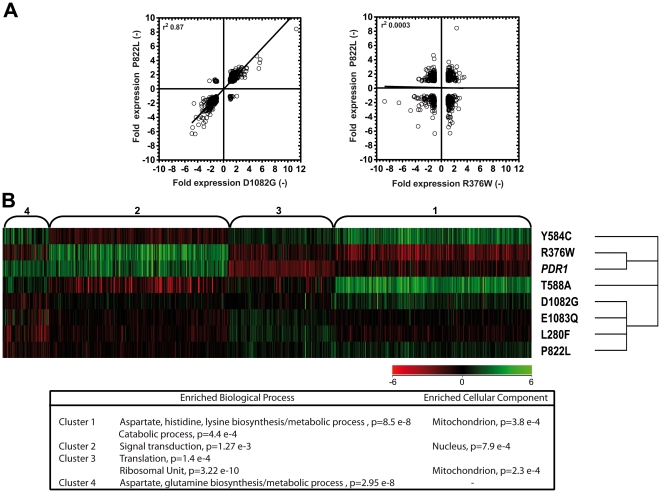
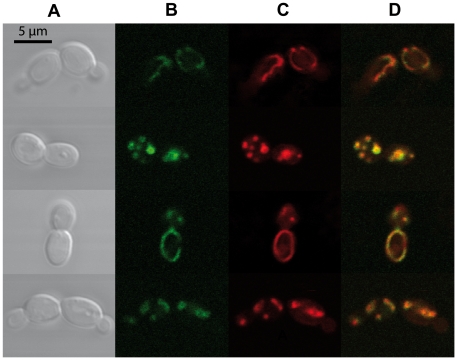
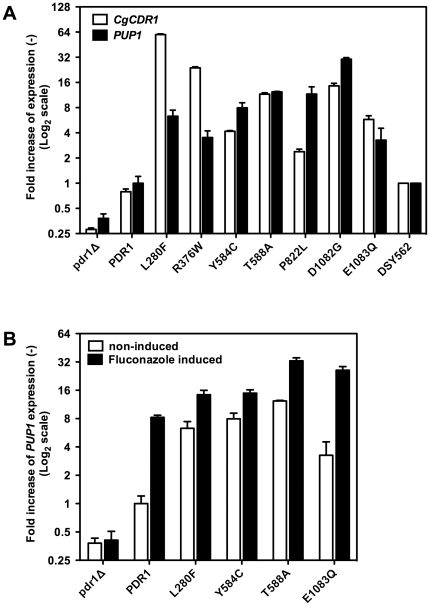
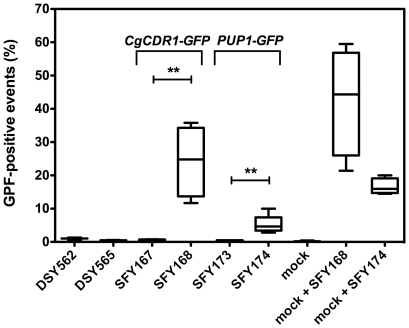
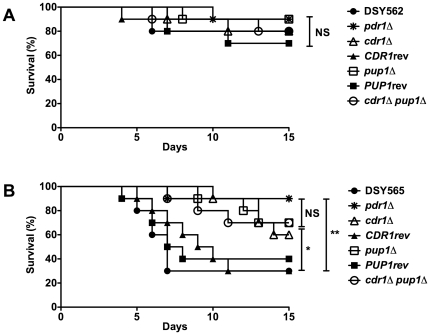
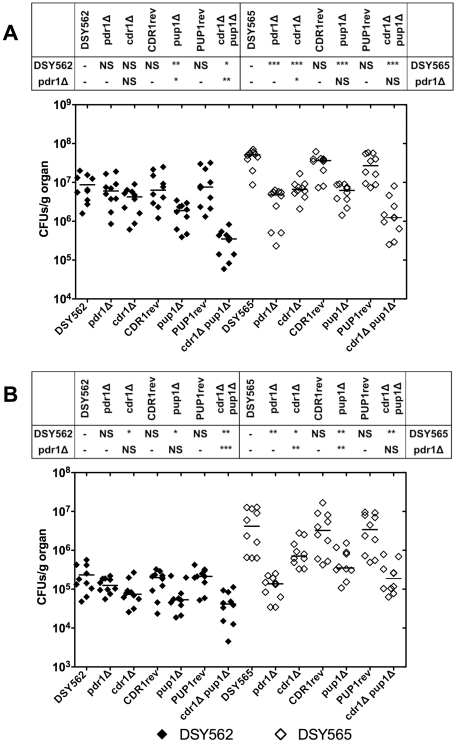
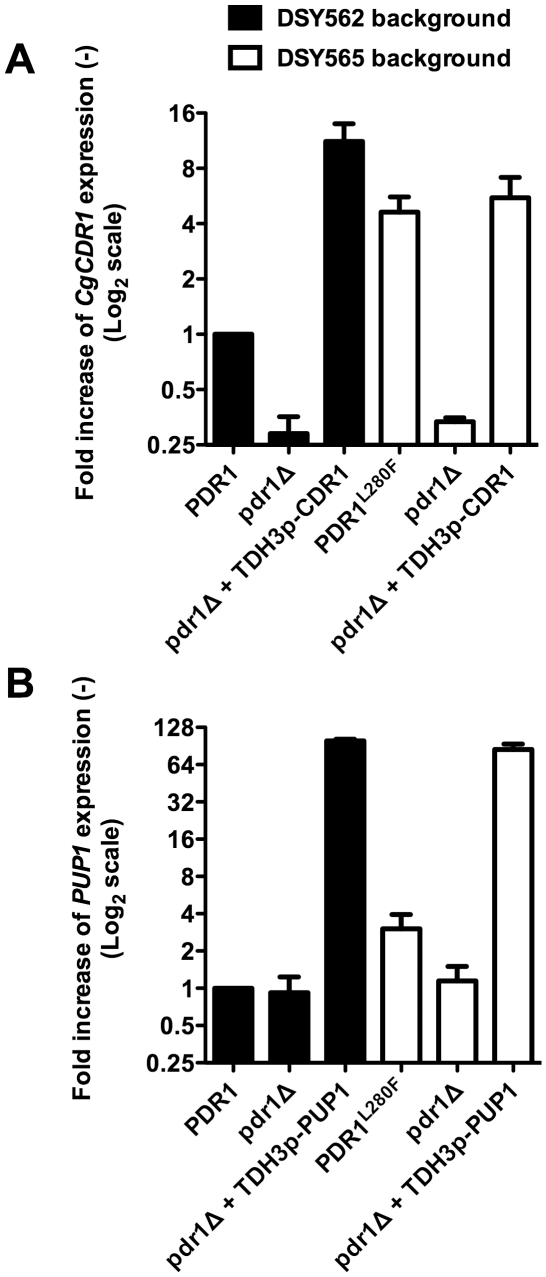
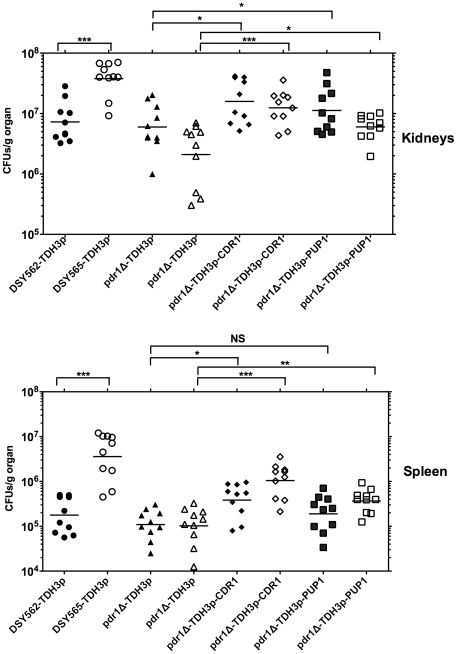
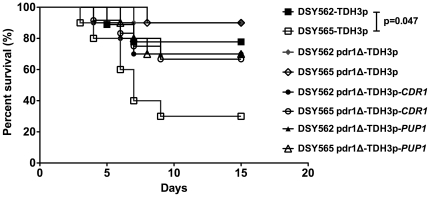
In Candida glabrata, the transcription factor CgPdr1 is involved in resistance to azole antifungals via upregulation of ATP binding cassette (ABC)-transporter genes including at least CgCDR1, CgCDR2 and CgSNQ2. A high diversity of GOF (gain-of-function) mutations in CgPDR1 exists for the upregulation of ABC-transporters. These mutations enhance C. glabrata virulence in animal models, thus indicating that CgPDR1 might regulate the expression of yet unidentified virulence factors. We hypothesized that CgPdr1-dependent virulence factor(s) should be commonly regulated by all GOF mutations in CgPDR1. As deduced from transcript profiling with microarrays, a high number of genes (up to 385) were differentially regulated by a selected number (7) of GOF mutations expressed in the same genetic background. Surprisingly, the transcriptional profiles resulting from expression of GOF mutations showed minimal overlap in co-regulated genes. Only two genes, CgCDR1 and PUP1 (for PDR1 upregulated and encoding a mitochondrial protein), were commonly upregulated by all tested GOFs. While both genes mediated azole resistance, although to different extents, their deletions in an azole-resistant isolate led to a reduction of virulence and decreased tissue burden as compared to clinical parents. As expected from their role in C. glabrata virulence, the two genes were expressed as well in vitro and in vivo. The individual overexpression of these two genes in a CgPDR1-independent manner could partially restore phenotypes obtained in clinical isolates. These data therefore demonstrate that at least these two CgPDR1-dependent and -upregulated genes contribute to the enhanced virulence of C. glabrata that acquired azole resistance.
Overview
The claims and statistics of this paper haven’t been checked yet.
Run the check — free, no account needed. It reads the open-access text and checks the sources it cites.
Integrity signals
Registry
Cites
Statistics
Figures
Verification
Claims the paper makes
The claims and statistics of this paper haven’t been checked yet.
Run the check — free, no account needed. It reads the open-access text and checks the sources it cites.
Claims other papers make about this one
Each is checked against this paper’s own text: does it say what the citing paper says it does?
In the citing paper
“Specific pdr1 mutations in C. glabrata can also lead to a gain of fitness through enhanced adhesion and virulence”
From Genetic Drivers of Multidrug Resistance in Candida glabrata (2016) · cites this paper as Ferrari et al., 2011
In the citing paper
“In C. glabrata, the transcription factor Pdr1 is involved in resistance to azoles through upregulation of CDR1, CDR2, and SNQ2 [91].”
From Candida glabrata Biofilms: How Far Have We Come? (2017) · cites this paper as [91]
Self-check
Percentages, sums and reported differences re-computed from the paper’s own numbers.
The self-check needs the paper’s full text.
Citations
Cites
Epidemiology of Invasive Candidiasis: a Persistent Public Health Problem
Pfaller, M. A., & Diekema, D. J. (2007) · Clinical Microbiology Reviews · doi:10.1128/cmr.00029-06 · Cited by 4,174 · cited 1×
“glabrata is often reported as the second most prevalent species after Candida albicans [2,3].”
BackgroundResistance of Candida species to antifungal agents: molecular mechanisms and clinical consequences
Sanglard, D., & Odds, F. C. (2002) · The Lancet Infectious Diseases · doi:10.1016/s1473-3099(02)00181-0 · Cited by 784
Self-citationThe SAT1 flipper, an optimized tool for gene disruption in Candida albicans
Reuß, O., Vik, Å., Kolter, R., & Morschhäuser, J. (2004) · Gene · doi:10.1016/j.gene.2004.06.021 · Cited by 744
Sionov, E., Lee, H., Chang, Y. C., & Kwon-Chung, K. J. (2010) · PLoS Pathogens · doi:10.1371/journal.ppat.1000848 · Cited by 479
The biological cost of mutational antibiotic resistance: any practical conclusions?
Andersson, D. I. (2006) · Current Opinion in Microbiology · doi:10.1016/j.mib.2006.07.002 · Cited by 475
Kretschmer, M., Leroch, M., Mosbach, A., Walker, A. S., Fillinger, S., Mernke, D., Schoonbeek, H., Pradier, J., Leroux, P., Waard, M. A. D., et al. (2009) · PLoS Pathogens · doi:10.1371/journal.ppat.1000696 · Cited by 420
Coste, A. T., Karababa, M., Ischer, F., Bille, J., & Sanglard, D. (2004) · Eukaryotic Cell · doi:10.1128/ec.3.6.1639-1652.2004 · Cited by 407
Self-citationEvolution of antifungal-drug resistance: mechanisms and pathogen fitness
Anderson, J. B. (2005) · Nature Reviews Microbiology · doi:10.1038/nrmicro1179 · Cited by 375
The changing face of epidemiology of invasive fungal disease in Europe
Lass‐Flörl, C. (2009) · Mycoses · doi:10.1111/j.1439-0507.2009.01691.x · Cited by 371
Morschhäuser, J., Barker, K. S., Liu, T. T., Blaß-Warmuth, J., Homayouni, R., & Rogers, P. D. (2007) · PLoS Pathogens · doi:10.1371/journal.ppat.0030164 · Cited by 355
Cited by
Sorted by citations
Antifungal Drug Resistance: Molecular Mechanisms in Candida albicans and Beyond
Lee, Y., Puumala, E., Robbins, N., & Cowen, L. E. (2021) · Chemical Reviews · doi:10.1021/acs.chemrev.0c00199 · Cited by 801
Alexander, B. D., Johnson, M. D., Pfeiffer, C. D., Jiménez-Ortigosa, C., Catania, J., Booker, R., Castanheira, M., Messer, S. A., Perlin, D. S., & Pfaller, M. A. (2013) · Clinical Infectious Diseases · doi:10.1093/cid/cit136 · Cited by 778
Mechanisms of Antifungal Drug Resistance
Cowen, L. E., Sanglard, D., Howard, S. J., Rogers, P. D., & Perlin, D. S. (2015) · Cold Spring Harbor Perspectives in Medicine · doi:10.1101/cshperspect.a019752 · Cited by 647
Self-citationAntifungal Resistance and New Strategies to Control Fungal Infections
Vandeputte, P., Ferrari, S., & Coste, A. T. (2011) · International Journal of Microbiology · doi:10.1155/2012/713687 · Cited by 531
Self-citationThe Antifungal Pipeline: Fosmanogepix, Ibrexafungerp, Olorofim, Opelconazole, and Rezafungin
Hoenigl, M., Sprute, R., Egger, M., Arastehfar, A., Cornely, O. A., Krause, R., Lass-Flörl, C., Prattes, J., Spec, A., Thompson, G. R., et al. (2021) · Drugs · doi:10.1007/s40265-021-01611-0 · Cited by 467
Metadata
- Authors
- Ferrari, S., Sanguinetti, M., Torelli, R., Posteraro, B., & Sanglard, D.
- Affiliations
- University of Lausanne (CH)
- Università Cattolica del Sacro Cuore (IT)
- Centre Hospitalier Universitaire Vaudois (CH)
- Corresponding author
- Sanglard, Dominique
- Venue
- PLoS ONE
- Publisher
- Public Library of Science (PLoS)
- Published
- 2011-03-09
- Volume
- 6
- Issue
- 3
- Pages
- e17589
- ISSN
- 1932-6203 (ISSN-L)
- PMC
- PMC3052359
- OpenAlex
- W2091654454
- Cited by
- 110
- References
- 48
- Citations by year
- 2026: 1 · 2025: 3 · 2024: 2 · 2023: 8 · 2022: 7 · 2021: 7 · 2020: 9 · 2019: 7 · 2018: 10 · 2017: 7 · 2016: 9 · 2015: 7 · 2014: 10 · 2013: 11 · 2012: 9
- FWCI
- 7.13
- Type
- journal article
- Language
- en
- Open access
- gold
- doi.org
- Licence
- cc-by
- Locations
- PLoS ONE (publishedVersion, cc-by)
- PubMed Central (publishedVersion, cc-by)
- PubMed (publishedVersion)
- IRIS (submittedVersion)
- PubliCatt (Università Cattolica del Sacro Cuore) (submittedVersion, cc-by)
- DOAJ (DOAJ: Directory of Open Access Journals) (submittedVersion)
- Figshare (submittedVersion, cc-by)
- SERVAL (Université de Lausanne) (submittedVersion, other-oa)
- Topics
- Health Sciences › Medicine › Infectious Diseases › Antifungal resistance and susceptibility
- Life Sciences › Biochemistry, Genetics and Molecular Biology › Molecular Biology › Fungal and yeast genetics research
- Health Sciences › Medicine › Infectious Diseases › Fungal Infections and Studies
- Keywords
- Candida glabrata, azole resistance, virulence, gain-of-function mutations, ABC transporters, transcriptional regulation, gene co-regulation, tissue burden, antifungal resistance
- MeSH terms
- Animals, Antifungal Agents, Azoles, Candidiasis, Disease Models, Animal, Female, Fungal Proteins, Genes, Fungal, Mice, Inbred BALB C, Microbial Sensitivity Tests, Mitochondria, Mutation, Transcription, Genetic, Virulence, Colony Count, Microbial, Fluconazole, Gene Expression Regulation, Fungal, Gene Expression Profiling, Drug Resistance, Fungal, Candida glabrata, Mice
About these checks
Registry, retraction, Cites and statistics results are computed, not judged, with one exception: a printed reference that no index lists is read once by a model before it counts as a citation error. Claims are extracted by a model and kept only when their quote appears verbatim in the text; each cited source is then checked, with a model’s help, for whether it says what the claim relies on. Those verdicts can be wrong — read the claim’s quote and the cited source before relying on one.
Statistics and arithmetic are recomputed, not judged.
Confidence bands are shown only for fields calibrated on our annotated test set. None is calibrated yet, so no band is shown.
What counts as a claim ›How we measure confidence ›How we check this ›
Are you an author, or do you see a problem with this page? Request a review
