

The DOI matches its Crossref record; 40 of the 41 references it cites were found in a registry or an index.
Regulation of AKT Phosphorylation at Ser473 and Thr308 by Endoplasmic Reticulum Stress Modulates Substrate Specificity in a Severity Dependent Manner
Open accessAbstract
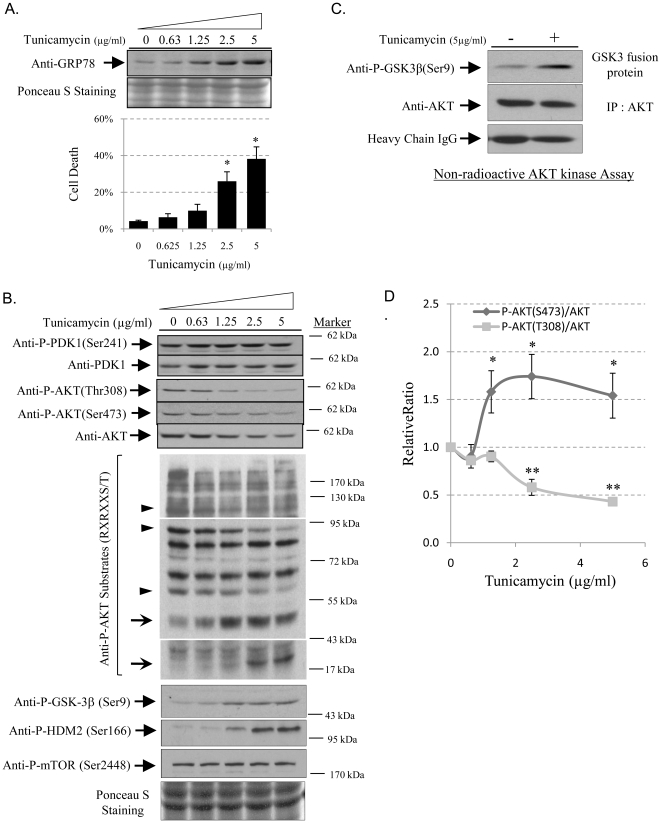
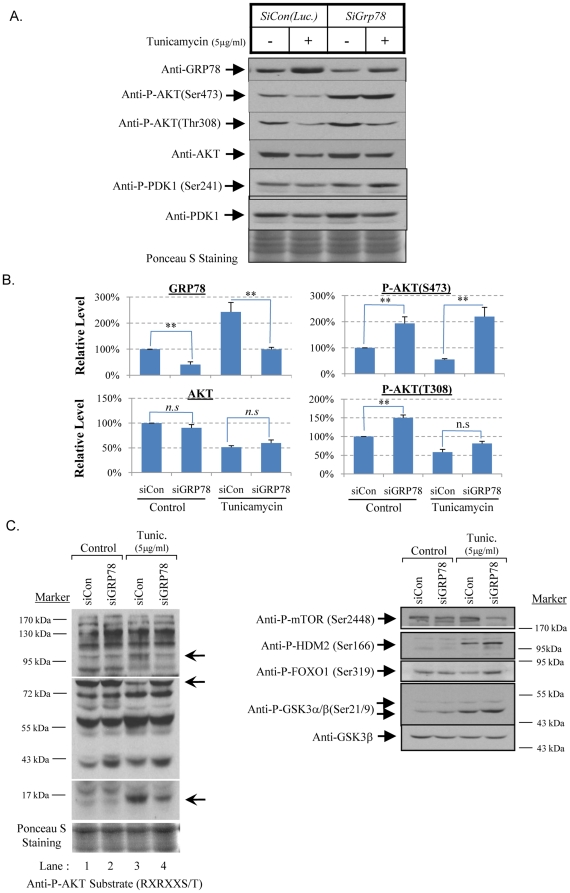
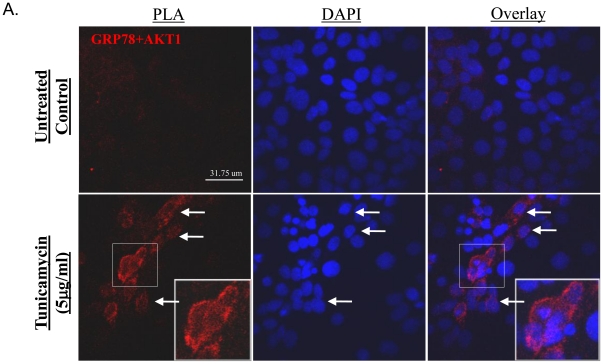
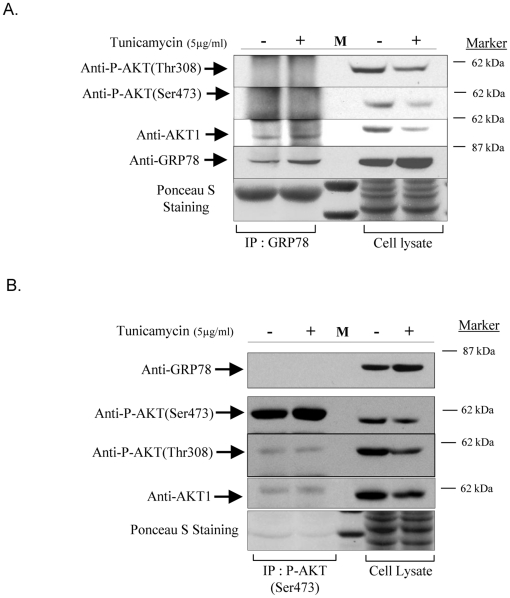
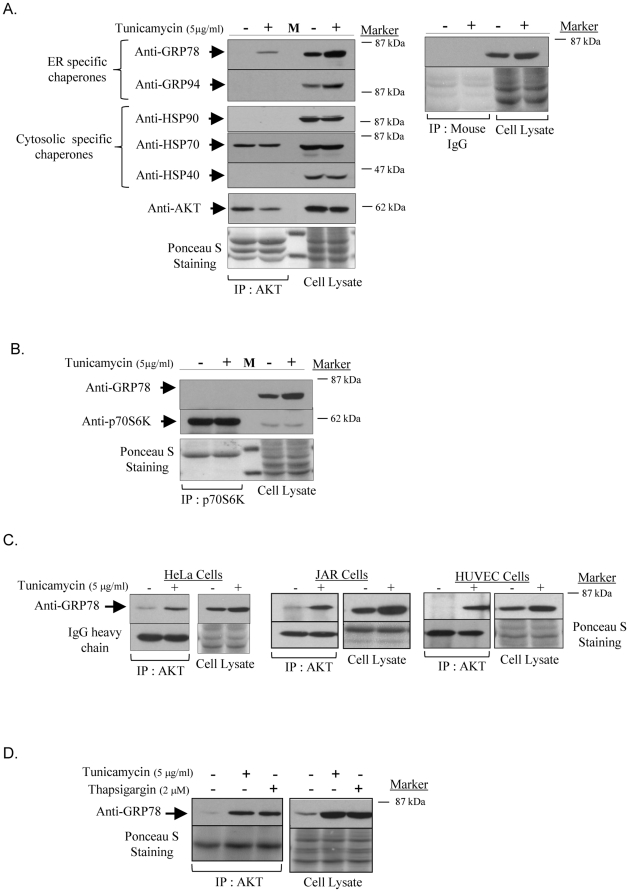
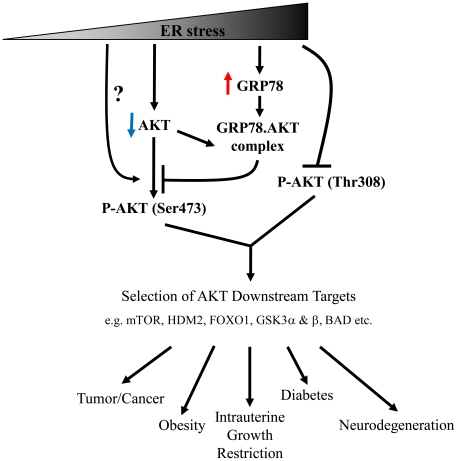
Endoplasmic reticulum (ER) stress is a common factor in the pathophysiology of diverse human diseases that are characterised by contrasting cellular behaviours, from proliferation in cancer to apoptosis in neurodegenerative disorders. Coincidently, dysregulation of AKT/PKB activity, which is the central regulator of cell growth, proliferation and survival, is often associated with the same diseases. Here, we demonstrate that ER stress modulates AKT substrate specificity in a severity-dependent manner, as shown by phospho-specific antibodies against known AKT targets. ER stress also reduces both total and phosphorylated AKT in a severity-dependent manner, without affecting activity of the upstream kinase PDK1. Normalisation to total AKT revealed that under ER stress phosphorylation of Thr308 is suppressed while that of Ser473 is increased. ER stress induces GRP78, and siRNA-mediated knock-down of GRP78 enhances phosphorylation at Ser473 by 3.6 fold, but not at Thr308. Substrate specificity is again altered. An in-situ proximity ligation assay revealed a physical interaction between GRP78 and AKT at the plasma membrane of cells following induction of ER stress. Staining was weak in cells with normal nuclear morphology but stronger in those displaying rounded, condensed nuclei. Co-immunoprecipitation of GRP78 and P-AKT(Ser473) confirmed the immuno-complex consists of non-phosphorylated AKT (Ser473 and Thr308). The interaction is likely specific as AKT did not bind to all molecular chaperones, and GRP78 did not bind to p70 S6 kinase. These findings provide one mechanistic explanation for how ER stress contributes to human pathologies demonstrating contrasting cell fates via modulation of AKT signalling.
Overview
The claims and statistics of this paper haven’t been checked yet.
Run the check — free, no account needed. It reads the open-access text and checks the sources it cites.
Integrity signals
Registry
Cites
Statistics
Figures
Verification
Claims the paper makes
The claims and statistics of this paper haven’t been checked yet.
Run the check — free, no account needed. It reads the open-access text and checks the sources it cites.
Claims other papers make about this one
Each is checked against this paper’s own text: does it say what the citing paper says it does?
In the citing paper
“TSC1/2 also acts on mTORC2, which in turn regulates the activity and substrate specificity of AKT through phosphorylation (597).”
From Placental Origins of Chronic Disease (2016) · cites this paper as [597]
Self-check
Percentages, sums and reported differences re-computed from the paper’s own numbers.
The self-check needs the paper’s full text.
Citations
Cites
Phosphorylation and regulation of Akt/PKB by the rictor-mTOR complex
Sarbassov, D. D., Guertin, D. A., Ali, S. M., & Sabatini, D. M. (2005) · Science · doi:10.1126/science.1106148 · Cited by 6,216
AKT/PKB signaling: navigating downstream
Manning, B. D., & Cantley, L. C. (2007) · Cell · doi:10.1016/j.cell.2007.06.009 · Cited by 6,115
Inhibition of glycogen synthase kinase-3 by insulin mediated by protein kinase B
Cross, D. A. E., Alessi, D. R., Cohen, P., Andjelkovich, M., & Hemmings, B. A. (1995) · Nature · doi:10.1038/378785a0 · Cited by 5,244
Mechanism of activation of protein kinase B by insulin and IGF‐1.
Alessi, D. R., Andjelković, M., Caudwell, B., Cron, P. D., MORRICE, N. A., Cohen, P., & Hemmings, B. A. (1996) · The EMBO Journal · doi:10.1002/j.1460-2075.1996.tb01045.x · Cited by 3,014
Alessi, D. R., James, S. R., Downes, C. P., Holmes, A. B., Gaffney, P. R. J., Reese, C. B., & Cohen, P. (1997) · Current Biology · doi:10.1016/s0960-9822(06)00122-9 · Cited by 2,874
Guertin, D. A., Stevens, D. M., Thoreen, C. C., Burds, A. A., Kalaany, N. Y., Moffat, J., Brown, M., Fitzgerald, K. J., & Sabatini, D. M. (2006) · Developmental Cell · doi:10.1016/j.devcel.2006.10.007 · Cited by 1,467
Direct Regulation of the Akt Proto-Oncogene Product by Phosphatidylinositol-3,4-bisphosphate
Franke, T. F., Kaplan, D. R., Cantley, L. C., & Toker, A. (1997) · Science · doi:10.1126/science.275.5300.665 · Cited by 1,462
Jacinto, E., Facchinetti, V., Liu, D., Soto, N., Wei, S., Jung, S. Y., Huang, Q., Qin, J., & Su, B. (2006) · Cell · doi:10.1016/j.cell.2006.08.033 · Cited by 1,407
A trip to the ER: coping with stress
Rutkowski, D. T., & Kaufman, R. J. (2003) · Trends in Cell Biology · doi:10.1016/j.tcb.2003.11.001 · Cited by 1,375
The nuts and bolts of AGC protein kinases
Pearce, L. R., Komander, D., & Alessi, D. R. (2010) · Nature Reviews Molecular Cell Biology · doi:10.1038/nrm2822 · Cited by 1,294
Cited by
Sorted by citations
ER stress: Autophagy induction, inhibition and selection
Rashid, H.-O., Yadav, R. K., Kim, H., & Chae, H. (2015) · Autophagy · doi:10.1080/15548627.2015.1091141 · Cited by 818
Placental Origins of Chronic Disease
Burton, G. J., Fowden, A. L., & Thornburg, K. L. (2016) · Physiological Reviews · doi:10.1152/physrev.00029.2015 · Cited by 717
Self-citationWhere is mTOR and what is it doing there?
Betz, C., & Hall, M. N. (2013) · The Journal of Cell Biology · doi:10.1083/jcb.201306041 · Cited by 531
An overview of technical considerations for Western blotting applications to physiological research
Bass, J. J., Wilkinson, D. J., Rankin, D., Phillips, B. E., Szewczyk, N. J., Smith, K., & Atherton, P. J. (2016) · Scandinavian Journal of Medicine and Science in Sports · doi:10.1111/sms.12702 · Cited by 432
Stress-induced self-cannibalism: on the regulation of autophagy by endoplasmic reticulum stress
Deegan, S., Saveljeva, S., Gorman, A. M., & Samali, A. (2012) · Cellular and Molecular Life Sciences · doi:10.1007/s00018-012-1173-4 · Cited by 279
Metadata
- Authors
- Yung, H. W., Charnock-Jones, D. S., & Burton, G. J.
- Affiliations
- University of Cambridge (GB)
- Corresponding author
- Burton, Graham J.
- Venue
- PLoS ONE
- Publisher
- Public Library of Science (PLoS)
- Published
- 2011-03-21
- Volume
- 6
- Issue
- 3
- Pages
- e17894
- ISSN
- 1932-6203 (ISSN-L)
- PMC
- PMC3061875
- OpenAlex
- W2058236541
- Cited by
- 158
- References
- 41
- Citations by year
- 2026: 6 · 2025: 5 · 2024: 9 · 2023: 7 · 2022: 12 · 2021: 10 · 2020: 15 · 2019: 14 · 2018: 8 · 2017: 16 · 2016: 12 · 2015: 10 · 2014: 15 · 2013: 7 · 2012: 9
- FWCI
- 5.21
- Type
- journal article
- Language
- en
- Open access
- gold
- doi.org
- Locations
- PLoS ONE (publishedVersion, cc-by)
- PubMed Central (publishedVersion, cc-by)
- PubMed (publishedVersion)
- Apollo (University of Cambridge) (submittedVersion, cc-by)
- DOAJ (DOAJ: Directory of Open Access Journals) (submittedVersion, cc-by-sa)
- Figshare (submittedVersion, cc-by)
- Apollo (cc-by)
- Funders
- Wellcome Trust (084804, 084804/2/08/Z, 084804/Z/08/Z)
- Topics
- Life Sciences › Biochemistry, Genetics and Molecular Biology › Cell Biology › Endoplasmic Reticulum Stress and Disease
- Life Sciences › Biochemistry, Genetics and Molecular Biology › Molecular Biology › PI3K/AKT/mTOR signaling in cancer
- Life Sciences › Biochemistry, Genetics and Molecular Biology › Cell Biology › Cellular transport and secretion
- Keywords
- endoplasmic reticulum stress, Akt phosphorylation, GRP78, PDK1, plasma membrane, apoptosis, cell proliferation, p70 S6 kinase, molecular chaperones, proximity ligation assay
- MeSH terms
- Endoplasmic Reticulum Chaperone BiP, Endoplasmic Reticulum, Heat-Shock Proteins, Humans, Phosphorylation, Serine, Substrate Specificity, Threonine, Down-Regulation, Proto-Oncogene Proteins c-akt
About these checks
Registry, retraction, Cites and statistics results are computed, not judged, with one exception: a printed reference that no index lists is read once by a model before it counts as a citation error. Claims are extracted by a model and kept only when their quote appears verbatim in the text; each cited source is then checked, with a model’s help, for whether it says what the claim relies on. Those verdicts can be wrong — read the claim’s quote and the cited source before relying on one.
Statistics and arithmetic are recomputed, not judged.
Confidence bands are shown only for fields calibrated on our annotated test set. None is calibrated yet, so no band is shown.
What counts as a claim ›How we measure confidence ›How we check this ›
Are you an author, or do you see a problem with this page? Request a review
