

A Collaborative Brain-Computer Interface for Improving Human Performance
Open accessThe DOI matches its Crossref record; 41 of the 44 references it cites were found in a registry or an index.
Abstract
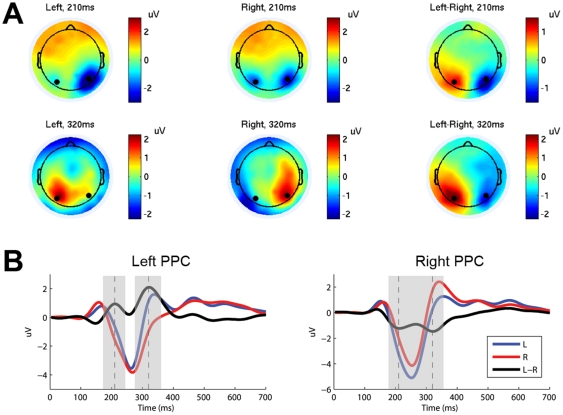
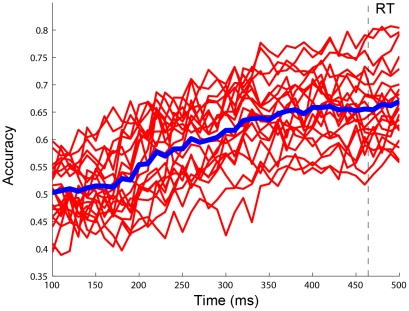
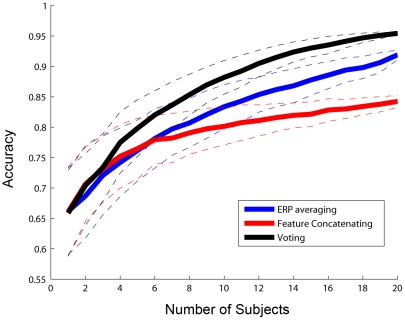
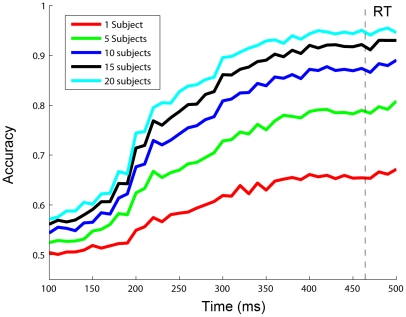
Electroencephalogram (EEG) based brain-computer interfaces (BCI) have been studied since the 1970s. Currently, the main focus of BCI research lies on the clinical use, which aims to provide a new communication channel to patients with motor disabilities to improve their quality of life. However, the BCI technology can also be used to improve human performance for normal healthy users. Although this application has been proposed for a long time, little progress has been made in real-world practices due to technical limits of EEG. To overcome the bottleneck of low single-user BCI performance, this study proposes a collaborative paradigm to improve overall BCI performance by integrating information from multiple users. To test the feasibility of a collaborative BCI, this study quantitatively compares the classification accuracies of collaborative and single-user BCI applied to the EEG data collected from 20 subjects in a movement-planning experiment. This study also explores three different methods for fusing and analyzing EEG data from multiple subjects: (1) Event-related potentials (ERP) averaging, (2) Feature concatenating, and (3) Voting. In a demonstration system using the Voting method, the classification accuracy of predicting movement directions (reaching left vs. reaching right) was enhanced substantially from 66% to 80%, 88%, 93%, and 95% as the numbers of subjects increased from 1 to 5, 10, 15, and 20, respectively. Furthermore, the decision of reaching direction could be made around 100-250 ms earlier than the subject's actual motor response by decoding the ERP activities arising mainly from the posterior parietal cortex (PPC), which are related to the processing of visuomotor transmission. Taken together, these results suggest that a collaborative BCI can effectively fuse brain activities of a group of people to improve the overall performance of natural human behavior.
Overview
The claims and statistics of this paper haven’t been checked yet.
Free: it reads the open-access text and checks the first 5 claims that cite a source we can check. Create a free account to check every claim.
Integrity signals
Registry
Cites
Statistics
Figures
Verification
Claims the paper makes
The claims and statistics of this paper haven’t been checked yet.
Free: it reads the open-access text and checks the first 5 claims that cite a source we can check. Create a free account to check every claim.
Claims other papers make about this one
Each is checked against this paper’s own text: does it say what the citing paper says it does?
The cited source says what the claim attributes to it.
In the citing paper
“however, subjects performed the task on different days and no brain stimulation was used to convey information directly to subjects’ brains.”
From BrainNet: A Multi-Person Brain-to-Brain Interface for Direct Collaboration Between Brains (2019) · cites this paper as [23]
Experimental — accuracy not yet measuredThe cited source says what the claim attributes to it.
In the citing paper
“In humans, researchers have studied “collaborative BCIs” (rather than BBIs) that pool information from multiple human brains to improve performance in a delayed saccade-or-reach task23”
From BrainNet: A Multi-Person Brain-to-Brain Interface for Direct Collaboration Between Brains (2019) · cites this paper as [23]
Self-check
Percentages, sums and reported differences re-computed from the paper’s own numbers.
The self-check needs the paper’s full text.
Citations
Cites
Delorme, A., & Makeig, S. (2004) · Journal of Neuroscience Methods · doi:10.1016/j.jneumeth.2003.10.009 · Cited by 24,371 · cited 1×
“We used independent component analysis (ICA) as an unsupervised spatial filtering technique to remove artifacts arising from eye and muscle movements. For each subject, all trials were band-pass filtered (1–30 Hz), concatenated, and then decomposed using the EEGLAB toolbox”
Brain–computer interfaces for communication and control
Wolpaw, J. R., Birbaumer, N., McFarland, D. J., Pfurtscheller, G., & Vaughan, T. M. (2002) · Clinical Neurophysiology · doi:10.1016/s1388-2457(02)00057-3 · Cited by 7,927
(2005) · Cited by 5,977
A review of classification algorithms for EEG-based brain–computer interfaces
Lotte, F., Congedo, M., Lécuyer, A., Lamarche, F., & Arnaldi, B. (2007) · Journal of Neural Engineering · doi:10.1088/1741-2560/4/2/r01 · Cited by 2,665 · cited 2×
“Recently, following the wide employment of machine learning techniques in BCI studies, feature combination methods have been introduced in EEG classification [5,27].”
Optimal spatial filtering of single trial EEG during imagined hand movement
Ramoser, H., Muller-Gerking, J., & Pfurtscheller, G. (2000) · IEEE Transactions on Rehabilitation Engineering · doi:10.1109/86.895946 · Cited by 2,457 · cited 1×
“Firstly, for more electrodes over the PPC area, spatial filtering techniques can be applied to improve the SNR through removing task irrelevant activities [35,36].”
Brain-computer interface technology: a review of the first international meeting
Wolpaw, J. R., Birbaumer, N., Heetderks, W. J., McFarland, D. J., Peckham, P. H., Schalk, G., Donchin, E., Quatrano, L. A., Robinson, C. J., & Vaughan, T. M. (2000) · IEEE Transactions on Rehabilitation Engineering · doi:10.1109/tre.2000.847807 · Cited by 2,324 · cited 2×
“On one hand, some researchers sought to develop biofeedback techniques that would improve performance of military personnel engaged in tasks involving high mental loads [7].”
Pattern Classification (2nd Edition)
Duda, R. O., Hart, P. E., & Stork, D. G. (2000) · Wiley-Interscience eBooks · Cited by 2,070
Brain–machine interfaces: past, present and future
Lebedev, M. A., & Nicolelis, M. A. L. (2006) · Trends in Neurosciences · doi:10.1016/j.tins.2006.07.004 · Cited by 1,875
Thut, G., Nietzel, A., Brandt, S. A., & Pascual-Leone, A. (2006) · The Journal of Neuroscience · doi:10.1523/jneurosci.0875-06.2006 · Cited by 1,494
The Wisdom of Teams: Creating the High-Performance Organization
(1997) · Quality Management Journal · doi:10.1080/10686967.1997.11918781 · Cited by 1,493
Cited by
Items 101–147 of 147
Online Control of a Virtual Object with Collaborative SSVEP
Touyama, H., & Sakuda, M. (2017) · Journal of Advanced Computational Intelligence and Intelligent Informatics · doi:10.20965/jaciii.2017.p1291 · Cited by 4
Optimization of a wearable speed monitoring device for welding applications
Afroz, A. S., Digiacomo, F., Pelliccia, R., Inglese, F., Stefanini, C., & Milazzo, M. (2020) · The International Journal of Advanced Manufacturing Technology · doi:10.1007/s00170-020-05945-z · Cited by 4
User Experience Evaluation Towards Cooperative Brain-Robot Interaction
Crawford, C. S., Andujar, M., Jackson, F., Remy, S. L., & Gilbert, J. E. (2015) · Lecture notes in computer science · doi:10.1007/978-3-319-20901-2_17 · Cited by 4
A Cross-Brain Interaction Platform Based on Neurofeedback Using Electroencephalogram
Zhang, R., & Zhao, X. (2018) · Lecture notes in computer science · doi:10.1007/978-3-319-91470-1_19 · Cited by 3
Cognitive Augmentation Via a Brain/Cloud Interface
Angelica, A., Opriș, I. C., Lebedev, M., & Boehm, F. (2021) · Contemporary clinical neuroscience · doi:10.1007/978-3-030-54564-2_17 · Cited by 3
An empirical suggestion for collaborative learning in motor imagery-based BCIs
Kang, E., Kim, B.-C., & Suk, H. (2016) · International Winter Conference on Brain-Computer Interface (BCI) · doi:10.1109/iww-bci.2016.7457450 · Cited by 3
“Recently, collaborative methods [4,5,6], which integrate information from samples of multiple subjects, have validated their efficacy.”
BackgroundAugmenting Collaboration with Invisible Data: Brain-Computer Interface for Emotional Awareness
Makhkamova, A., Ziegler, P., & Werth, D. (2019) · Mensch und Computer (MuC) · doi:10.1145/3340764.3344908 · Cited by 3
“Researchers are in general interested in the transition of devices of such type from laboratories and assistance to people with disabilities to daily-life applications for healthy people [26].”
BackgroundWalking improves the performance of a brain-computer interface for group decision making
Bhattacharyya, S., Cinel, C., Citi, L., Valeriani, D., & Poli, R. (2021) · Elsevier eBooks · doi:10.1016/b978-0-12-821413-8.00017-8 · Cited by 4
“INTRODUCTION Collaborative brain-computer interfaces (cBCIs) have been used to improve group decision making thanks to their ability to estimate the decision confidence of individuals from their brain signals and response time (RT) [1-3].”
BackgroundZhang, L., Chen, X., Chen, L., Gu, B., Wang, Z., & Ming, D. (2021) · PubMed Central · doi:10.7507/1001-5515.202007059 · Cited by 3
Hairston, W. D., Chen, J., Barnes, M., Martinez, I., LaFiandra, M. E., Binseel, M. S., Scharine, A. A., Ericson, M. A., Vaughan, B., Lance, B. J., et al. (2012) · Defense Technical Information Center (DTIC) · doi:10.21236/ada562494 · Cited by 3
Yin, Z., Wang, Y., Dong, M., Ren, S., Hu, H., Yin, K., & Liang, J. (2021) · Frontiers in Neuroscience · doi:10.3389/fnins.2021.652920 · Cited by 4
Self-citationBrain Imaging Methods in Social and Affective Neuroscience: A Machine Learning Perspective
Trambaiolli, L. R., Biazoli, C. E., & Sato, J. R. (2022) · Springer eBooks · doi:10.1007/978-3-031-08651-9_13 · Cited by 3
Responses in posterior parietal cortex to movement intention task with visual and tactile cues
Kamikawa, Y., & Tanaka, T. (2015) · Annual International Conference of the IEEE Engineering in Medicine and Biology Society (EMBC) · doi:10.1109/embc.2015.7319919 · Cited by 2
“Based on the above findings, movement intention based BCI have been reported [5], [6], [7], [8].”
InfluentialIndependent components for EEG signal classification
Olivier, T. E., Du, S., van Wyk, B. J., & Hamam, Y. (2016) · doi:10.1145/3028842.3028875 · Cited by 2
Valeriani, D., Cinel, C., & Poli, R. (2017) · Open Access at Essex (University of Essex) · Cited by 2
Cecotti, H., & Rivet, B. (2014) · Brain Sciences · doi:10.3390/brainsci4030488 · Cited by 2
“In a cooperative BCI, the decision is based on the combination of brain signals from multiple users [27,28].”
BackgroundBrain–Computer Interfaces for Affective Neurofeedback Applications
Trambaiolli, L. R., & Falk, T. H. (2023) · Wiley eBooks · doi:10.1002/9781119863663.ch3 · Cited by 4
Brain computer interface: a survey
Boyapati, Y. M., Noshin, A., Wahid, S. R., & Khan, A. A. (2025) · Elsevier eBooks · doi:10.1016/b978-0-443-41624-8.00021-8 · Cited by 1
Decision by majority by thinking
Touyama, H., & Fan, J. (2017) · 日本バーチャルリアリティ学会論文誌 · doi:10.18974/tvrsj.22.1_27 · Cited by 1
Approach to collaborative BCI for enhancing human-to-human interaction in shared visual task
Grubov, V., & Александрович, М. В. (2021) · Saratov Fall Meeting: Computations and Data Analysis: from Nanoscale Tools to Brain Functions (SFM) · doi:10.1117/12.2591327 · Cited by 1
“The natural evolution in this direction is the concept of collaborative BCIs, 10,11 which aimed to use multi-brain computing to further enhance human performance.”
BackgroundAugmentation Through Interconnection: Brain-Nets and Telemedicine
Lebedev, M., Shaderkin, I. A., Ryabkov, I. V., & Lebedev, G. S. (2021) · Contemporary clinical neuroscience · doi:10.1007/978-3-030-54564-2_16 · Cited by 1
Smart Healthcare System: Interface to COVID-19 Prevention Using Dual-Layer Security
Faujdar, N., Agrawal, R., Varshney, N., & Khan, M. Z. (2021) · Springer eBooks · doi:10.1007/978-981-16-6542-4_8 · Cited by 1
Emotional Face Retrieval with P300 Signals of Multiple Subjects
Fan, J., & Touyama, H. (2016) · Joint International Conference on Soft Computing and Intelligent Systems and International Symposium on Advanced Intelligent Systems (SCIS&ISIS) · doi:10.1109/scis-isis.2016.0109 · Cited by 1
Smart Human und der Schutz der Gedanken
Ziebell, M. M. O. (2020) · Datenschutz und Datensicherheit - DuD · doi:10.1007/s11623-020-1289-x · Cited by 1
Gant, K. L. (2016) · Cited by 1
Evaluate effects of multiple users in collaborative Brain-Computer Interfaces: A SSVEP studyPreprint
Do, T., & Huynh, T. T. (2021) · bioRxiv (Cold Spring Harbor Laboratory) · doi:10.1101/2021.03.05.434173 · Cited by 1
集団同時脳波計測 : P300の単試行検出精度の向上に向けて( VR心理学5~脳機能計測とVR~)
吉竹, 一., 増田, 侑., & 唐山, 英. (2013) · 日本バーチャルリアリティ学会論文誌 · doi:10.18974/tvrsj.18.1_13
Improved targeting through collaborative decision-making and brain computer interfaces
Stoica, A., Barrero, D. F., & McDonald-Maier, K. D. (2013) · International Conference on Collaboration Technologies and Systems (CTS) · doi:10.1109/cts.2013.6567266
“Brain computer interfaces (BCI) [1], [2] provide an alternative to classical interfaces, such as the ones based on mechanical interactions.”
BackgroundInfluentialTowards Analyzing Cooperative Brain-Robot Interfaces Through Affective and Subjective Data
Crawford, C. S., & Gilbert, J. E. (2015) · ACM/IEEE International Conference on Human-Robot Interaction (HRI) · doi:10.1145/2701973.2702716
“Previous research suggests that combining cognitive information from multiple users could provide advantage over single-user BCI implementations [3].”
BackgroundREFLEXIONES SOBRE LOS CYBORGS Y LOS ROBOTS
Mestres, F., & Vives-Rego, J. (2012)
[A TrAdaBoost-based method for detecting multiple subjects' P300 potentials].
Xu, G., Lin, F., Gong, M., Li, M., & Yu, H. (2019) · PubMed Central · doi:10.7507/1001-5515.201811025
Personalised Signal Processing for Cortical and Cardiac Applications
Saha, S. (2020) · Adelaide Research & Scholarship (AR&S) (University of Adelaide)
Development of the approach to collaborative BCI
Grubov, V., Александрович, М. В., & Nedaivozov, V. O. (2020) · Scientific School Dynamics of Complex Networks and their Applications (DCNA) · doi:10.1109/dcnair50402.2020.9216796
“The natural evolution in this direction is the concept of collaborative BCIs [17], [18], which aimed to use multi-brain computing to further enhance human performance.”
Background(2017) · Wiley eBooks · doi:10.1002/9781119183839.refs
Haba, T., Cui, G., & Touyama, H. (2022) · International Conference on Machine Learning and Cybernetics · doi:10.1109/icmlc56445.2022.9941311
A BCI System for Physically Challenged Based on Alpha Dynamics of EEG SignalsPreprint
Khare, V. (2023) · Research Square · doi:10.21203/rs.3.rs-1798411/v1
Aplicación de las neurotecnologías a la cognición y el comportamiento social
Botero, C. G. D. P., & Perdomo, J. A. D. (2023) · Revista Mexicana de Ciencias Penales · doi:10.57042/rmcp.v7i21.676 · Cited by 1
Kim, H. (2022) · MechEcology · doi:10.23104/me.2022.4.1.1.1
Improving decision capabilities through brain–computer interfaces
Poli, R., & Cinel, C. (2025) · Elsevier eBooks · doi:10.1016/b978-0-443-24824-5.00008-9
Ye, Z., Yu, Y., Zhang, Y., Zhou, Z., Hu, D., & Zeng, L. (2025) · IEEE Transactions on Cognitive and Developmental Systems · doi:10.1109/tcds.2025.3603145 · Cited by 1
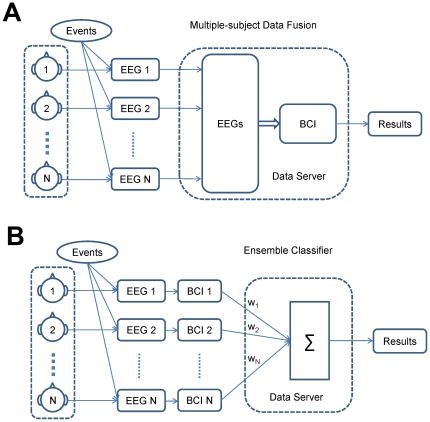
“Moreover, through averaging, feature combination, and voting across 20 brains, Wang et al. [44] improved the accuracy from 0.66 to a maximum of 0.95.”
InfluentialSub-Group Partition Strategy for RSVP-based Collaborative Brain-Computer Interfaces
Si, Y., Wang, Z., Zhao, X., Xu, T., Zhou, T., & Hu, H. (2025) · Annual International Conference of the IEEE Engineering in Medicine and Biology Society (EMBC) · doi:10.1109/embc58623.2025.11252828
“Wang and Jung established a fundamental framework by categorizing cBCIs into centralized and distributed architectures, introducing two signal-level fusion approaches for centralized cBCIs and a decision-level method for distributed cBCIs [9].”
InfluentialRedefining Talent Management in the Era of Transhumanism: Opportunities and Strategies
Lavanya, R. S., & Sowmya, G. (2025) · Emerald Group Publishing Limited eBooks · doi:10.1108/978-1-83708-166-020251009 · Cited by 1
EEG Foundation Model Improves Online Directional Motor Imagery Brain-computer Interface ControlPreprint
Karrenbach, M., Wang, H., Johnson, Z., Ding, Y., & He, B. (2026) · bioRxiv (Cold Spring Harbor Laboratory) · doi:10.64898/2026.03.24.714020
“Studies have found that some kinematic characteristics from motor execution of the upper limb [23], [24], [25], [26], [27] can be decoded, even continuously [28].”
Méthodes pour l'électroencéphalographie multi-sujet et application aux interfaces cerveau-ordinateur
Korczowski, L. (2018) · theses.fr (ABES) · doi:10.70675/38d2a12fz024fz4d84z8a8az0dc16b2cff6a · Cited by 2
Rimbert, S. (2020) · theses.fr (ABES) · doi:10.70675/f150ac36z890fz4d60z83ddz912e4bc36c96 · Cited by 1
Capturing Team Cognition: A Multimodal Dataset for Adaptive Collaborative Interfaces
Micek, C., Warnke, L., Rodrigues, L., Putze, F., & Solovey, E. (2026) · CHI Conference on Human Factors in Computing Systems · doi:10.1145/3772318.3791607 · Cited by 1
Metadata
- Authors
- Wang, Y., & Jung, T.-P.
- Affiliations
- University of California San Diego (US)
- Corresponding author
- Wang, Yijun
- Jung, Tzyy-Ping
- Venue
- PLoS ONE
- Publisher
- Public Library of Science (PLoS)
- Published
- 2011-05-31
- Volume
- 6
- Issue
- 5
- Pages
- e20422
- ISSN
- 1932-6203 (ISSN-L)
- PMC
- PMC3105048
- OpenAlex
- W2137916148
- Cited by
- 147
- References
- 41
- Citations by year
- 2026: 2 · 2025: 9 · 2024: 3 · 2023: 10 · 2022: 11 · 2021: 13 · 2020: 9 · 2019: 8 · 2018: 8 · 2017: 12 · 2016: 11 · 2015: 14 · 2014: 13 · 2013: 14 · 2012: 9
- FWCI
- 6.00
- Type
- journal article
- Language
- en
- Open access
- gold
- doi.org
- Locations
- PLoS ONE (publishedVersion, cc-by)
- PubMed Central (publishedVersion, cc-by)
- PubMed (publishedVersion)
- DOAJ (DOAJ: Directory of Open Access Journals) (submittedVersion, cc-by-sa)
- eScholarship (California Digital Library) (submittedVersion)
- eScholarship (California Digital Library) (submittedVersion, cc-by)
- Funders
- Army Research Laboratory (W911-NF-10-2-0022, Cooperative Agreement Number W911NF-10-2-0022, W911NF, W911NF-10)
- Topics
- Life Sciences › Neuroscience › Cognitive Neuroscience › EEG and Brain-Computer Interfaces
- Physical Sciences › Computer Science › Human-Computer Interaction › Gaze Tracking and Assistive Technology
- Physical Sciences › Engineering › Biomedical Engineering › Muscle activation and electromyography studies
- Keywords
- EEG, event-related potentials, voting classifier, feature concatenation, posterior parietal cortex, visuomotor processing, motor planning
- MeSH terms
- Adult, Brain, Electroencephalography, Evoked Potentials, Female, Humans, Male, Motor Activity, Signal Processing, Computer-Assisted, User-Computer Interface, Young Adult
About these checks
Registry, retraction, Cites and statistics results are computed, not judged, with one exception: a printed reference that no index lists is read once by a model before it counts as a citation error. Claims are extracted by a model and kept only when their quote appears verbatim in the text; each cited source is then checked, with a model’s help, for whether it says what the claim relies on. Those verdicts can be wrong — read the claim’s quote and the cited source before relying on one.
Statistics and arithmetic are recomputed, not judged.
Confidence bands are shown only for fields calibrated on our annotated test set. None is calibrated yet, so no band is shown.
What counts as a claim ›How we measure confidence ›How we check this ›
Are you an author, or do you see a problem with this page? Request a review
Data sources
Bibliographic data: Semantic Scholar, OpenAlex, Crossref.
Contains information from the Semantic Scholar Academic Graph Datasets, made available under the ODC Attribution License (ODC-BY 1.0).
Semantic Scholar’s data is described in: Kinney, R., et al. (2023). The Semantic Scholar Open Data Platform. arXiv:2301.10140.
