

The DOI matches its Crossref record; 9 of the 10 references it cites were found in a registry or an index.
Assessing Google Flu Trends Performance in the United States during the 2009 Influenza Virus A (H1N1) Pandemic
Open accessAbstract
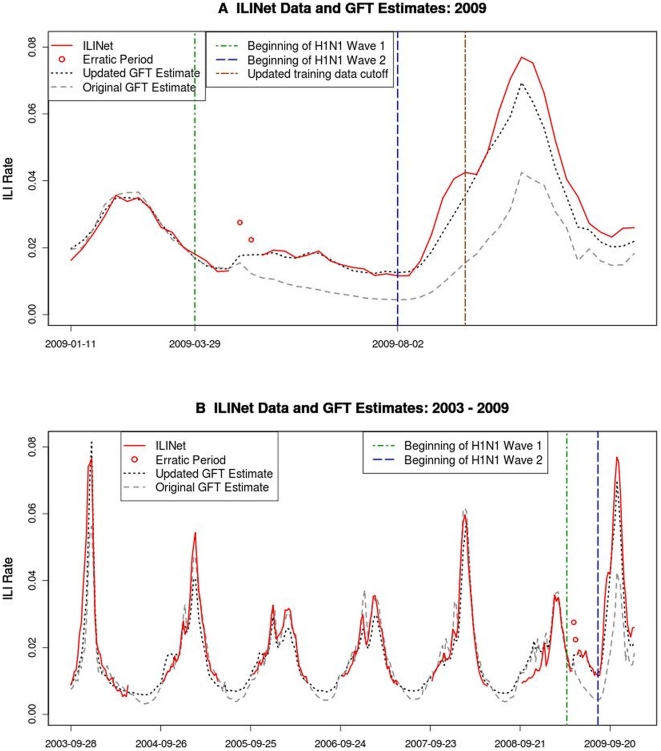
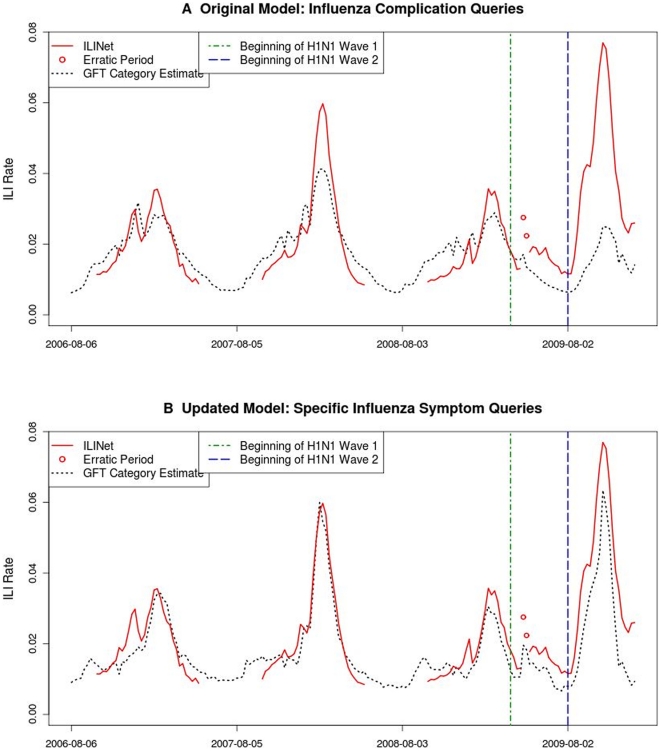
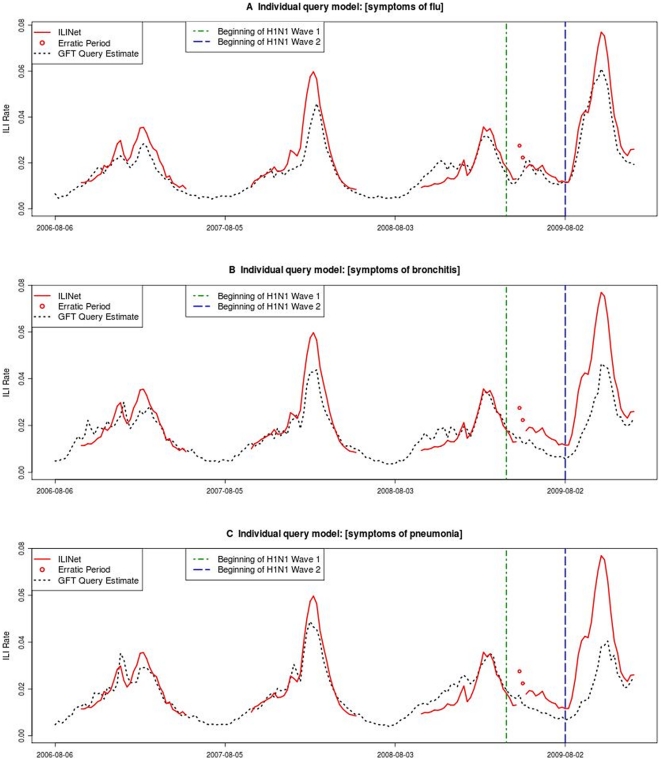
BACKGROUND: Google Flu Trends (GFT) uses anonymized, aggregated internet search activity to provide near-real time estimates of influenza activity. GFT estimates have shown a strong correlation with official influenza surveillance data. The 2009 influenza virus A (H1N1) pandemic [pH1N1] provided the first opportunity to evaluate GFT during a non-seasonal influenza outbreak. In September 2009, an updated United States GFT model was developed using data from the beginning of pH1N1. METHODOLOGY/PRINCIPAL FINDINGS: We evaluated the accuracy of each U.S. GFT model by comparing weekly estimates of ILI (influenza-like illness) activity with the U.S. Outpatient Influenza-like Illness Surveillance Network (ILINet). For each GFT model we calculated the correlation and RMSE (root mean square error) between model estimates and ILINet for four time periods: pre-H1N1, Summer H1N1, Winter H1N1, and H1N1 overall (Mar 2009-Dec 2009). We also compared the number of queries, query volume, and types of queries (e.g., influenza symptoms, influenza complications) in each model. Both models' estimates were highly correlated with ILINet pre-H1N1 and over the entire surveillance period, although the original model underestimated the magnitude of ILI activity during pH1N1. The updated model was more correlated with ILINet than the original model during Summer H1N1 (r = 0.95 and 0.29, respectively). The updated model included more search query terms than the original model, with more queries directly related to influenza infection, whereas the original model contained more queries related to influenza complications. CONCLUSIONS: Internet search behavior changed during pH1N1, particularly in the categories "influenza complications" and "term for influenza." The complications associated with pH1N1, the fact that pH1N1 began in the summer rather than winter, and changes in health-seeking behavior each may have played a part. Both GFT models performed well prior to and during pH1N1, although the updated model performed better during pH1N1, especially during the summer months.
Overview
The claims and statistics of this paper haven’t been checked yet.
Run the check — free, no account needed. It reads the open-access text and checks the sources it cites.
Integrity signals
Registry
Cites
Statistics
Figures
Verification
Claims the paper makes
The claims and statistics of this paper haven’t been checked yet.
Run the check — free, no account needed. It reads the open-access text and checks the sources it cites.
Claims other papers make about this one
Each is checked against this paper’s own text: does it say what the citing paper says it does?
The cited source doesn’t support the claim as written.
In the citing paper
“This ad hoc method of throwing out peculiar search terms failed when GFT completely missed the nonseasonal 2009 infl uenza A–H1N1 pandemic ( 2, 14).”
From The Parable of Google Flu: Traps in Big Data Analysis (2014) · cites this paper as [14]
Checked by a reasoning model — may be wrong.
Experimental — accuracy not yet measuredThe cited source doesn’t support the claim as written.
In the citing paper
“Oddly, the few search terms offered in the papers ( 14) do not seem to be strongly related with either GFT or the CDC data (SM)—we surmise that the authors felt an unarticulated need to cloak the actual search terms identifi ed.”
From The Parable of Google Flu: Traps in Big Data Analysis (2014) · cites this paper as [14]
Checked by a reasoning model — may be wrong.
Experimental — accuracy not yet measuredThe source backs part of the claim, not all of it — or backs it for a different population, condition or comparison.
In the citing paper
“GFT has never documented the 45 search terms used, and the examples that have been released appear misleading ( 14) (SM).”
From The Parable of Google Flu: Traps in Big Data Analysis (2014) · cites this paper as [14]
Experimental — accuracy not yet measured
Self-check
Percentages, sums and reported differences re-computed from the paper’s own numbers.
The self-check needs the paper’s full text.
Citations
Cites
MapReduce: simplified data processing on large clusters
Dean, J., & Ghemawat, S. (2008) · Communications of the ACM · doi:10.1145/1327452.1327492 · Cited by 18,476
Detecting influenza epidemics using search engine query data
Ginsberg, J., Mohebbi, M. H., Patel, R. S., Brammer, L., Smolinski, M. S., & Brilliant, L. (2009) · Nature · doi:10.1038/nature07634 · Cited by 4,295
Self-citationEmergence of a Novel Swine-Origin Influenza A (H1N1) Virus in Humans
Novel Swine-Origin Influenza A (H1N1) Virus Investigation Team (2009) · New England Journal of Medicine · doi:10.1056/nejmoa0903810 · Cited by 3,063
Infodemiology: tracking flu-related searches on the web for syndromic surveillance.
Eysenbach, G. (2006) · PubMed · Cited by 414
Kelly, H., & Grant, K. A. (2009) · Eurosurveillance · doi:10.2807/ese.14.31.19288-en · Cited by 193
Interpreting “Google Flu Trends” data for pandemic H1N1 influenza: The New Zealand experience
Wilson, N., Mason, K., Tobias, M., Peacey, M., Huang, Q. S., & Baker, M. G. (2009) · Eurosurveillance · doi:10.2807/ese.14.44.19386-en · Cited by 78
Brammer, L., Blanton, L., Epperson, S., Mustaquim, D., Bishop, A., Kniss, K. L., Dhara, R., Nowell, M., Kamimoto, L., & Finelli, L. (2010) · Clinical Infectious Diseases · doi:10.1093/cid/ciq009 · Cited by 67
Influenza activity--United States and worldwide, 2007-08 season.
(2008) · PubMed · Cited by 63
Reed, C., Angulo, F. J., Biggerstaff, M., Swerdlow, D. L., & Finelli, L. (2010) · Clinical Infectious Diseases · doi:10.1093/cid/ciq024 · Cited by 16
Cited by
Sorted by citations
The Parable of Google Flu: Traps in Big Data Analysis
Lazer, D., Kennedy, R., King, G., & Vespignani, A. (2014) · Science · doi:10.1126/science.1248506 · Cited by 2,523
Towards a genomics-informed, real-time, global pathogen surveillance system
Gardy, J. L., & Loman, N. J. (2018) · Nature Reviews Genetics · doi:10.1038/nrg.2017.88 · Cited by 771
Jusup, M., Holme, P., Kanazawa, K., Takayasu, M., Romić, I., Wang, Z., Geček, S., Lipić, T., Boris Podobnik, A., Wang, L., et al. (2022) · Physics Reports · doi:10.1016/j.physrep.2021.10.005 · Cited by 688
Reviewing the History of Pandemic Influenza: Understanding Patterns of Emergence and Transmission
Saunders‐Hastings, P., & Krewski, D. R. (2016) · Pathogens · doi:10.3390/pathogens5040066 · Cited by 600
Broniatowski, D. A., Paul, M., & Dredze, M. (2013) · PLoS ONE · doi:10.1371/journal.pone.0083672 · Cited by 474
Metadata
- Authors
- Cook, S., Conrad, C., Fowlkes, A. L., & Mohebbi, M. H.
- Affiliations
- Google (United States) (US)
- Google (United Kingdom) (GB)
- Centers for Disease Control and Prevention (US)
- Corresponding author
- Conrad, Corrie
- ORCID
- Fowlkes, Ashley L.
- Venue
- PLoS ONE
- Publisher
- Public Library of Science (PLoS)
- Published
- 2011-08-19
- Volume
- 6
- Issue
- 8
- Pages
- e23610
- ISSN
- 1932-6203 (ISSN-L)
- PMC
- PMC3158788
- OpenAlex
- W1998956117
- Cited by
- 381
- References
- 10
- Citations by year
- 2026: 5 · 2025: 4 · 2024: 7 · 2023: 8 · 2022: 25 · 2021: 33 · 2020: 50 · 2019: 25 · 2018: 26 · 2017: 34 · 2016: 41 · 2015: 48 · 2014: 38 · 2013: 27 · 2012: 9
- FWCI
- 18.08
- Type
- journal article
- Language
- en
- Open access
- gold
- doi.org
- Licence
- Locations
- PLoS ONE (publishedVersion, public-domain)
- Europe PMC (PubMed Central) (publishedVersion, public-domain)
- PubMed Central (publishedVersion, public-domain)
- PubMed (publishedVersion)
- DOAJ (DOAJ: Directory of Open Access Journals) (submittedVersion, cc-by-sa)
- Funders
- Topics
- Health Sciences › Medicine › Epidemiology › Data-Driven Disease Surveillance
- Health Sciences › Medicine › Epidemiology › Influenza Virus Research Studies
- Health Sciences › Medicine › Epidemiology › Respiratory viral infections research
- Keywords
- Google Flu Trends, influenza surveillance, 2009 H1N1 pandemic, influenza-like illness, online search behavior, health-seeking behavior, model accuracy assessment
- MeSH terms
- Humans, Influenza, Human, Models, Biological, Population Surveillance, Time Factors, United States, Influenza A Virus, H1N1 Subtype, Search Engine, Pandemics
About these checks
Registry, retraction, Cites and statistics results are computed, not judged, with one exception: a printed reference that no index lists is read once by a model before it counts as a citation error. Claims are extracted by a model and kept only when their quote appears verbatim in the text; each cited source is then checked, with a model’s help, for whether it says what the claim relies on. Those verdicts can be wrong — read the claim’s quote and the cited source before relying on one.
Statistics and arithmetic are recomputed, not judged.
Confidence bands are shown only for fields calibrated on our annotated test set. None is calibrated yet, so no band is shown.
What counts as a claim ›How we measure confidence ›How we check this ›
Are you an author, or do you see a problem with this page? Request a review
