

The DOI matches its Crossref record; 9 of the 10 references it cites were found in a registry or an index.
Assessing Google Flu Trends Performance in the United States during the 2009 Influenza Virus A (H1N1) Pandemic
Open accessAbstract
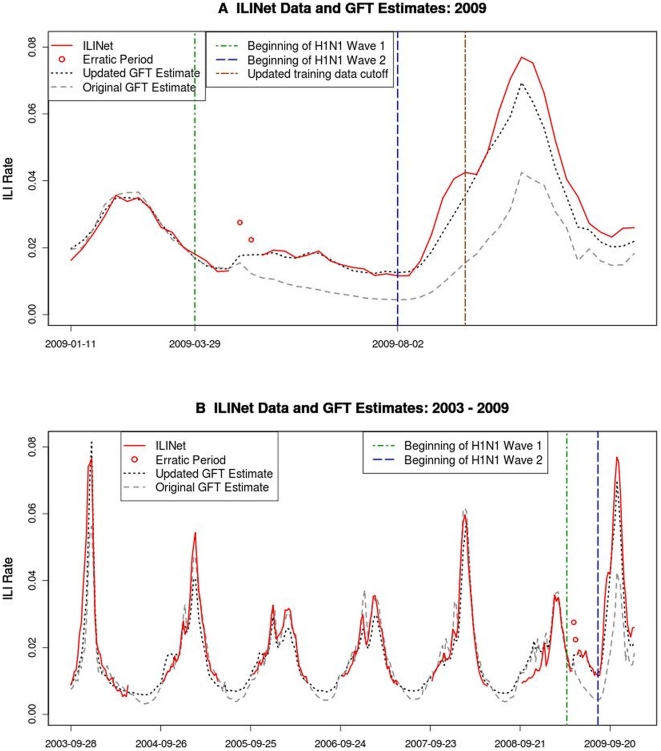
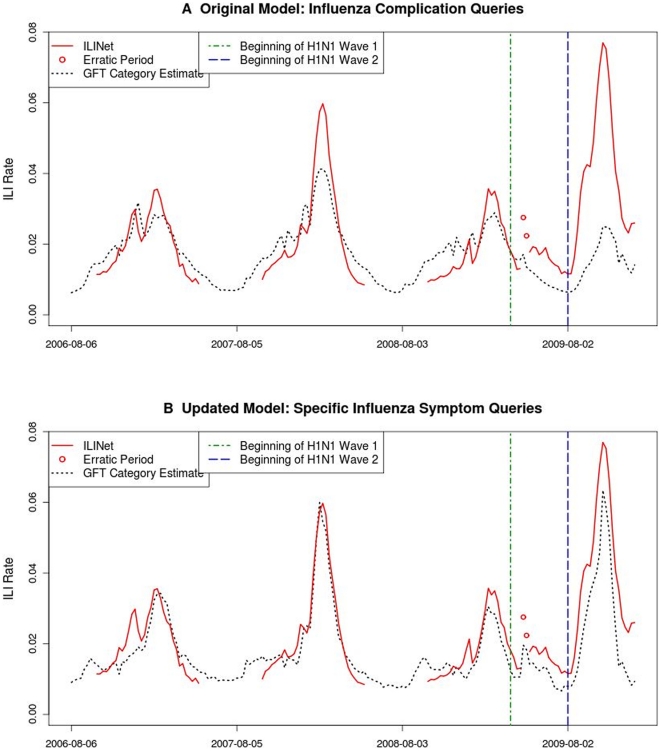
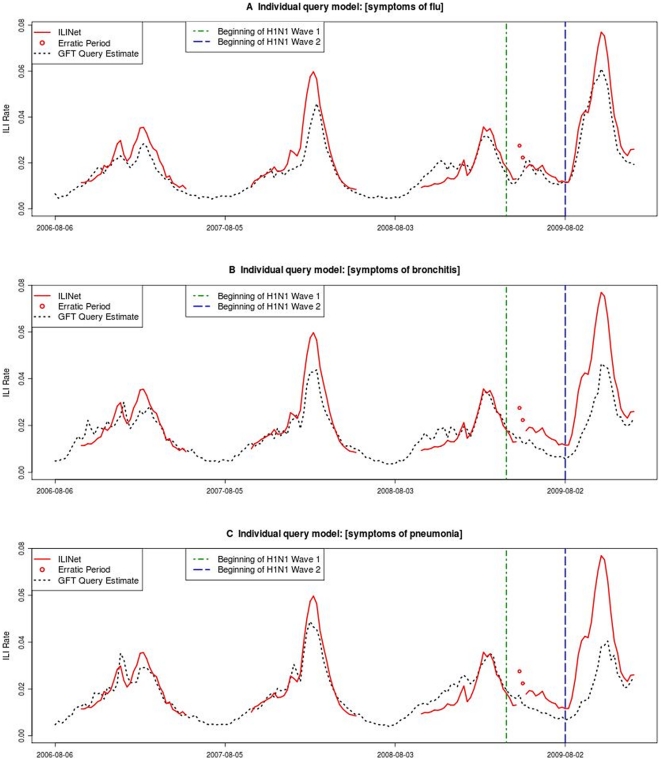
BACKGROUND: Google Flu Trends (GFT) uses anonymized, aggregated internet search activity to provide near-real time estimates of influenza activity. GFT estimates have shown a strong correlation with official influenza surveillance data. The 2009 influenza virus A (H1N1) pandemic [pH1N1] provided the first opportunity to evaluate GFT during a non-seasonal influenza outbreak. In September 2009, an updated United States GFT model was developed using data from the beginning of pH1N1. METHODOLOGY/PRINCIPAL FINDINGS: We evaluated the accuracy of each U.S. GFT model by comparing weekly estimates of ILI (influenza-like illness) activity with the U.S. Outpatient Influenza-like Illness Surveillance Network (ILINet). For each GFT model we calculated the correlation and RMSE (root mean square error) between model estimates and ILINet for four time periods: pre-H1N1, Summer H1N1, Winter H1N1, and H1N1 overall (Mar 2009-Dec 2009). We also compared the number of queries, query volume, and types of queries (e.g., influenza symptoms, influenza complications) in each model. Both models' estimates were highly correlated with ILINet pre-H1N1 and over the entire surveillance period, although the original model underestimated the magnitude of ILI activity during pH1N1. The updated model was more correlated with ILINet than the original model during Summer H1N1 (r = 0.95 and 0.29, respectively). The updated model included more search query terms than the original model, with more queries directly related to influenza infection, whereas the original model contained more queries related to influenza complications. CONCLUSIONS: Internet search behavior changed during pH1N1, particularly in the categories "influenza complications" and "term for influenza." The complications associated with pH1N1, the fact that pH1N1 began in the summer rather than winter, and changes in health-seeking behavior each may have played a part. Both GFT models performed well prior to and during pH1N1, although the updated model performed better during pH1N1, especially during the summer months.
Overview
The claims and statistics of this paper haven’t been checked yet.
Run the check — free, no account needed. It reads the open-access text and checks the sources it cites.
Integrity signals
Registry
Cites
Statistics
Figures
Verification
Claims the paper makes
The claims and statistics of this paper haven’t been checked yet.
Run the check — free, no account needed. It reads the open-access text and checks the sources it cites.
Claims other papers make about this one
Each is checked against this paper’s own text: does it say what the citing paper says it does?
The cited source doesn’t support the claim as written.
In the citing paper
“This ad hoc method of throwing out peculiar search terms failed when GFT completely missed the nonseasonal 2009 infl uenza A–H1N1 pandemic ( 2, 14).”
From The Parable of Google Flu: Traps in Big Data Analysis (2014) · cites this paper as [14]
Checked by a reasoning model — may be wrong.
Experimental — accuracy not yet measuredThe cited source doesn’t support the claim as written.
In the citing paper
“Oddly, the few search terms offered in the papers ( 14) do not seem to be strongly related with either GFT or the CDC data (SM)—we surmise that the authors felt an unarticulated need to cloak the actual search terms identifi ed.”
From The Parable of Google Flu: Traps in Big Data Analysis (2014) · cites this paper as [14]
Checked by a reasoning model — may be wrong.
Experimental — accuracy not yet measuredThe source backs part of the claim, not all of it — or backs it for a different population, condition or comparison.
In the citing paper
“GFT has never documented the 45 search terms used, and the examples that have been released appear misleading ( 14) (SM).”
From The Parable of Google Flu: Traps in Big Data Analysis (2014) · cites this paper as [14]
Experimental — accuracy not yet measured
Self-check
Percentages, sums and reported differences re-computed from the paper’s own numbers.
The self-check needs the paper’s full text.
Citations
Cites
MapReduce: simplified data processing on large clusters
Dean, J., & Ghemawat, S. (2008) · Communications of the ACM · doi:10.1145/1327452.1327492 · Cited by 18,476
Detecting influenza epidemics using search engine query data
Ginsberg, J., Mohebbi, M. H., Patel, R. S., Brammer, L., Smolinski, M. S., & Brilliant, L. (2009) · Nature · doi:10.1038/nature07634 · Cited by 4,295
Self-citationEmergence of a Novel Swine-Origin Influenza A (H1N1) Virus in Humans
Novel Swine-Origin Influenza A (H1N1) Virus Investigation Team (2009) · New England Journal of Medicine · doi:10.1056/nejmoa0903810 · Cited by 3,063
Infodemiology: tracking flu-related searches on the web for syndromic surveillance.
Eysenbach, G. (2006) · PubMed · Cited by 414
Kelly, H., & Grant, K. A. (2009) · Eurosurveillance · doi:10.2807/ese.14.31.19288-en · Cited by 193
Interpreting “Google Flu Trends” data for pandemic H1N1 influenza: The New Zealand experience
Wilson, N., Mason, K., Tobias, M., Peacey, M., Huang, Q. S., & Baker, M. G. (2009) · Eurosurveillance · doi:10.2807/ese.14.44.19386-en · Cited by 78
Brammer, L., Blanton, L., Epperson, S., Mustaquim, D., Bishop, A., Kniss, K. L., Dhara, R., Nowell, M., Kamimoto, L., & Finelli, L. (2010) · Clinical Infectious Diseases · doi:10.1093/cid/ciq009 · Cited by 67
Influenza activity--United States and worldwide, 2007-08 season.
(2008) · PubMed · Cited by 63
Reed, C., Angulo, F. J., Biggerstaff, M., Swerdlow, D. L., & Finelli, L. (2010) · Clinical Infectious Diseases · doi:10.1093/cid/ciq024 · Cited by 16
Cited by
Sorted by citations
The Parable of Google Flu: Traps in Big Data Analysis
Lazer, D., Kennedy, R., King, G., & Vespignani, A. (2014) · Science · doi:10.1126/science.1248506 · Cited by 2,523
Towards a genomics-informed, real-time, global pathogen surveillance system
Gardy, J. L., & Loman, N. J. (2018) · Nature Reviews Genetics · doi:10.1038/nrg.2017.88 · Cited by 771
Jusup, M., Holme, P., Kanazawa, K., Takayasu, M., Romić, I., Wang, Z., Geček, S., Lipić, T., Boris Podobnik, A., Wang, L., et al. (2022) · Physics Reports · doi:10.1016/j.physrep.2021.10.005 · Cited by 688
Reviewing the History of Pandemic Influenza: Understanding Patterns of Emergence and Transmission
Saunders‐Hastings, P., & Krewski, D. R. (2016) · Pathogens · doi:10.3390/pathogens5040066 · Cited by 600
Broniatowski, D. A., Paul, M., & Dredze, M. (2013) · PLoS ONE · doi:10.1371/journal.pone.0083672 · Cited by 474
Combining Search, Social Media, and Traditional Data Sources to Improve Influenza Surveillance
Santillana, M., Nguyen, A., Dredze, M., Paul, M., Nsoesie, E., & Brownstein, J. (2015) · PLoS Comput. Biol. · doi:10.1371/journal.pcbi.1004513 · Cited by 441
Accurate estimation of influenza epidemics using Google search data via ARGO
Yang, S., Santillana, M., & Kou, S. (2015) · Proceedings of the National Academy of Sciences of the United States of America · doi:10.1073/pnas.1515373112 · Cited by 372
Social Media– and Internet-Based Disease Surveillance for Public Health
Aiello, A. E., Renson, A., & Zivich, P. N. (2020) · Annual Review of Public Health · doi:10.1146/annurev-publhealth-040119-094402 · Cited by 363
Influenza Forecasting with Google Flu Trends
Dugas, A. F., Jalalpour, M., Gel, Y. R., Levin, S., Torcaso, F., Igusa, T., & Rothman, R. E. (2013) · PLoS ONE · doi:10.1371/journal.pone.0056176 · Cited by 349
Olson, D. R., Konty, K. J., Paladini, M., Viboud, C., & Simonsen, L. (2013) · PLoS Computational Biology · doi:10.1371/journal.pcbi.1003256 · Cited by 320
Internet-based surveillance systems for monitoring emerging infectious diseases
Milinovich, G. J., Williams, G. M., Clements, A., & Hu, W. (2013) · The Lancet Infectious Diseases · doi:10.1016/s1473-3099(13)70244-5 · Cited by 309
Association of the COVID-19 pandemic with internet search volumes: a Google Trends™ analysis
Effenberger, M., Kronbichler, A., Shin, J. I., Mayer, G., Tilg, H., & Perco, P. (2020) · International Journal of Infectious Diseases · doi:10.1016/j.ijid.2020.04.033 · Cited by 270
Ethical challenges of big data in public health
Vayena, E., Salathé, M., Madoff, L. C., & Brownstein, J. S. (2015) · PLOS Computational Biology · doi:10.1371/journal.pcbi.1003904 · Cited by 268
Separating Fact from Fear: Tracking Flu Infections on Twitter
Lamb, A., Paul, M. J., & Dredze, M. H. (2013) · Cited by 247
Mass Media and the Contagion of Fear: The Case of Ebola in America
Towers, S., Afzal, S., Bernal, G., Bliss, N. T., Brown, S., Espinoza, B., Jackson, J., Judson-Garcia, J., Khan, M., Lin, M. R., et al. (2015) · PLoS ONE · doi:10.1371/journal.pone.0129179 · Cited by 224
Digital epidemiology: what is it, and where is it going?
Salathé, M. (2018) · Life Sciences Society and Policy · doi:10.1186/s40504-017-0065-7 · Cited by 230
Yang, W., Karspeck, A. R., & Shaman, J. L. (2014) · PLoS Computational Biology · doi:10.1371/journal.pcbi.1003583 · Cited by 201
McIver, D. J., & Brownstein, J. S. (2014) · PLoS Computational Biology · doi:10.1371/journal.pcbi.1003581 · Cited by 195
Using data-driven agent-based models for forecasting emerging infectious diseases
Venkatramanan, S., Lewis, B. L., Chen, J., Higdon, D., Vullikanti, A. K. S., & MARATHE, M. V. (2017) · Epidemics · doi:10.1016/j.epidem.2017.02.010 · Cited by 189
Social Media Analyses for Social Measurement
Schober, M. F., Josh Pasek, B., Guggenheim, L., Lampe, C. A. C., & Conrad, F. G. (2016) · Public Opinion Quarterly · doi:10.1093/poq/nfv048 · Cited by 201
What Can Digital Disease Detection Learn from (an External Revision to) Google Flu Trends?
Santillana, M., Wendong, D., Althouse, B. M., & Ayers, J. W. (2014) · American Journal of Preventive Medicine · doi:10.1016/j.amepre.2014.05.020 · Cited by 183
Predicting Asthma-Related Emergency Department Visits Using Big Data
Ram, S., Zhang, W., Williams, M., & Pengetnze, Y. (2015) · IEEE Journal of Biomedical and Health Informatics · doi:10.1109/jbhi.2015.2404829 · Cited by 180
McGough, S. F., Brownstein, J. S., Hawkins, J. B., & Santillana, M. (2017) · PLoS neglected tropical diseases · doi:10.1371/journal.pntd.0005295 · Cited by 176
Using Google Trends for Influenza Surveillance in South China
Kang, M., Zhong, H., He, J., Rutherford, S., & Yang, F. (2013) · PLoS ONE · doi:10.1371/journal.pone.0055205 · Cited by 171
for the Influenza Forecasting Contest Working Group, Biggerstaff, M., Alper, D., Dredze, M. H., Fox, S. J., Fung, I. C., Hickmann, K. S., Lewis, B. L., Rosenfeld, R., Shaman, J. L., et al. (2016) · BMC Infectious Diseases · doi:10.1186/s12879-016-1669-x · Cited by 165
Social Listening: A Content Analysis of E-Cigarette Discussions on Twitter
Cole-Lewis, H. J., Pugatch, J., Sanders, A. E., Varghese, A., Posada, S., Yun, C., Schwarz, M., & Augustson, E. M. (2015) · Journal of Medical Internet Research · doi:10.2196/jmir.4969 · Cited by 161
New Data Sources in Social Science Research: Things to Know Before Working With Reddit Data
Amaya, A., Bach, R. L., Keusch, F., & Kreuter, F. (2019) · Social Science Computer Review · doi:10.1177/0894439319893305 · Cited by 158
The Measles Vaccination Narrative in Twitter: A Quantitative Analysis
Radzikowski, J., Stefanidis, A., Jacobsen, K. H., Croitoru, A., Crooks, A. T., & Delamater, P. L. (2016) · JMIR Public Health and Surveillance · doi:10.2196/publichealth.5059 · Cited by 153
Infectious Disease Surveillance in the Big Data Era: Towards Faster and Locally Relevant Systems
Simonsen, L., Gog, J. R., Olson, D., & Viboud, C. G. (2016) · The Journal of Infectious Diseases · doi:10.1093/infdis/jiw376 · Cited by 146
Is the Sky Falling? New Technology, Changing Media, and the Future of Surveys
Couper, M. P. (2013) · Survey research methods · doi:10.18148/srm/2013.v7i3.5751 · Cited by 144
Advances in nowcasting influenza-like illness rates using search query logs
Lampos, V., Miller, A. C., Crossan, S., & Stefansen, C. (2015) · Scientific Reports · doi:10.1038/srep12760 · Cited by 143
Choi, J., Cho, Y., Shim, E., & Woo, H. (2016) · BMC Public Health · doi:10.1186/s12889-016-3893-0 · Cited by 140
Surveillance for emerging respiratory viruses
Al‐Tawfiq, J. A., Zumla, A. I., Gautret, P., Gray, G. C., Hui, D. S. C., Al-Rabeeah, A. A., & Memish, Z. A. (2014) · The Lancet Infectious Diseases · doi:10.1016/s1473-3099(14)70840-0 · Cited by 143
Machine-learned epidemiology: real-time detection of foodborne illness at scale
Sadilek, A., Caty, S. N., DiPrete, L., Mansour, R., Schenk, T. L., Bergtholdt, M., Jha, A., Ramaswami, P., & Gabrilovich, E. (2018) · npj Digital Medicine · doi:10.1038/s41746-018-0045-1 · Cited by 136
Correlation between National Influenza Surveillance Data and Google Trends in South Korea
Cho, S. J., Sohn, C. H., Jo, M. W., Shin, S.-Y., Lee, J.-H., Ryoo, S. M., Kim, W. Y., & Seo, D. (2013) · PLoS ONE · doi:10.1371/journal.pone.0081422 · Cited by 127
A review of influenza detection and prediction through social networking sites
Alessa, A., & Faezipour, M. (2018) · Theoretical Biology and Medical Modelling · doi:10.1186/s12976-017-0074-5 · Cited by 126
Flexible Modeling of Epidemics with an Empirical Bayes Framework
Brooks, L., Farrow, D., Hyun, S., Tibshirani, R. J., & Rosenfeld, R. (2015) · PLoS Computational Biology · doi:10.1371/journal.pcbi.1004382 · Cited by 119
Skip the Trip: Air Travelers' Behavioral Responses to Pandemic Influenza
Fenichel, E. P., Kuminoff, N. V., & Chowell, G. (2013) · PLoS ONE · doi:10.1371/journal.pone.0058249 · Cited by 119
Gao, J. G., Zhang, Y., & Zhou, T. (2019) · Physics Reports · doi:10.1016/j.physrep.2019.05.002 · Cited by 122
Can Big Data Protect a Firm from CompetitionPreprint
Lambrecht, A., & Tucker, C. E. (2015) · SSRN Electronic Journal · doi:10.2139/ssrn.2705530 · Cited by 108
Ng, K. Y., & Gui, M. M. (2020) · Physica D Nonlinear Phenomena · doi:10.1016/j.physd.2020.132599 · Cited by 108
Low validity of Google Trends for behavioral forecasting of national suicide rates
Tran, U. S., Andel, R., Niederkrotenthaler, T., Till, B., Ajdacic‐Gross, V., & Voracek, M. (2017) · PLoS ONE · doi:10.1371/journal.pone.0183149 · Cited by 105
Smartphone apps in the COVID-19 pandemic
Pandit, J. A., Radin, J. M., Quer, G., & Topol, E. J. (2022) · Nature Biotechnology · doi:10.1038/s41587-022-01350-x · Cited by 101
Advances in using Internet searches to track dengue
Yang, S., Kou, S. C., Lu, F., Brownstein, J., Brooke, N., & Santillana, M. (2016) · PLoS Comput. Biol. · doi:10.1371/journal.pcbi.1005607 · Cited by 94
Adaptive nowcasting of influenza outbreaks using Google searches
Preis, T., & Moat, H. S. (2014) · Royal Society Open Science · doi:10.1098/rsos.140095 · Cited by 97
Using electronic health records and Internet search information for accurate influenza forecasting
Yang, S., Santillana, M., Brownstein, J. S., Gray, J., Richardson, S., & Kou, S. C. (2017) · BMC Infectious Diseases · doi:10.1186/s12879-017-2424-7 · Cited by 91
Precision global health in the digital age
Flahault, A., Geissbühler, A., Guessous, I., Guerin, P. J., Bolon, I., Salathé, M., & Escher, G. (2017) · Swiss Medical Weekly · doi:10.4414/smw.2017.14423 · Cited by 92
Bayesian Nonparametric Covariance RegressionPreprint
Fox, E. B., & Dunson, D. B. (2011) · arXiv (Cornell University) · doi:10.5555/2789272.2912079 · Cited by 88
Yesterday, Today and Tomorrow of Big Data
Özköse, H., Arı, E. S., & Gencer, C. (2015) · Procedia - Social and Behavioral Sciences · doi:10.1016/j.sbspro.2015.06.147 · Cited by 87
Kostkova, P., Szomszor, M., & Louis, C. S. (2014) · ACM Transactions on Management Information Systems · doi:10.1145/2597892 · Cited by 92
Phillips, C., Leahy, A. B., Li, Y., Schapira, M. M., Bailey, L. C., & Merchant, R. M. (2018) · Journal of Medical Internet Research · doi:10.2196/jmir.8870 · Cited by 82
Woo, H., Cho, Y., Shim, E., Lee, J., Lee, C.-G., & Kim, S. H. (2016) · Journal of Medical Internet Research · doi:10.2196/jmir.4955 · Cited by 81
Salathé, M. (2016) · The Journal of Infectious Diseases · doi:10.1093/infdis/jiw281 · Cited by 81
Total Error in a Big Data World: Adapting the TSE Framework to Big Data
Amaya, A., Biemer, P. P., & Kinyon, D. L. (2019) · Journal of Survey Statistics and Methodology · doi:10.1093/jssam/smz056 · Cited by 77
Milinovich, G. J., Avril, S. M. R., Clements, A., Brownstein, J. S., Tong, S., & Hu, W. (2014) · BMC Infectious Diseases · doi:10.1186/s12879-014-0690-1 · Cited by 77
Cloud-based Electronic Health Records for Real-time, Region-specific Influenza Surveillance
Santillana, M., Nguyen, A. T., Louie, T., Zink, A., Gray, J., Sung, I., & Brownstein, J. (2015) · Scientific Reports · doi:10.1038/srep25732 · Cited by 84
Sharpe, J. D., Hopkins, R. S., Cook, R. L., & Striley, C. W. (2016) · JMIR Public Health and Surveillance · doi:10.2196/publichealth.5901 · Cited by 74
Using Clinicians’ Search Query Data to Monitor Influenza Epidemics
Santillana, M., Nsoesie, E., Mekaru, S. R., Scales, D., & Brownstein, J. (2014) · Clinical Infectious Diseases · doi:10.1093/cid/ciu647 · Cited by 81
Influenza-Like Illness Surveillance on Twitter through Automated Learning of Naïve Language
Gesualdo, F., Stilo, G., Agricola, E., Gonfiantini, M. V., Pandolfi, E., Velardi, P., & Tozzi, A. E. (2013) · PLoS ONE · doi:10.1371/journal.pone.0082489 · Cited by 68
How to Exploit Twitter for Public Health Monitoring?
Krieck, M., Otrusina, L., Smrž, P., Dolog, P., Nejdl, W., Velasco, E., & Denecke, K. (2013) · Methods of Information in Medicine · doi:10.3414/me12-02-0010 · Cited by 70
Can we trust Big Data? Applying philosophy of science to software
Symons, J., & Alvarado, R. (2016) · Big Data & Society · doi:10.1177/2053951716664747 · Cited by 77
Cole-Lewis, H. J., Varghese, A., Sanders, A. E., Schwarz, M., Pugatch, J., & Augustson, E. M. (2015) · Journal of Medical Internet Research · doi:10.2196/jmir.4392 · Cited by 68
Using Networks to Combine “Big Data” and Traditional Surveillance to Improve Influenza Predictions
Davidson, M. W., Haim, D. A., & Radin, J. M. (2015) · Scientific Reports · doi:10.1038/srep08154 · Cited by 68
Data-driven methods for present and future pandemics: Monitoring, modelling and managing
Álamo, T., Reina, D. G., Millán, P., Preciado, V. M., & Giordano, G. (2021) · Annual Reviews in Control · doi:10.1016/j.arcontrol.2021.05.003 · Cited by 69
Paguio, J. A., Yao, J. S., & Dee, E. C. (2020) · Vaccine · doi:10.1016/j.vaccine.2020.06.069 · Cited by 64
Using search queries for malaria surveillance, Thailand
Ocampo, A., Chunara, R., & Brownstein, J. S. (2013) · Malaria Journal · doi:10.1186/1475-2875-12-390 · Cited by 65
A “big data” approach to HIV epidemiology and prevention
Young, S. D. (2014) · Preventive Medicine · doi:10.1016/j.ypmed.2014.11.002 · Cited by 63
Viboud, C. G., Charu, V., Olson, D. R., Ballesteros, S. P., Gog, J. R., Khan, F. L., Grenfell, B. T., & Simonsen, L. (2014) · PLoS ONE · doi:10.1371/journal.pone.0102429 · Cited by 63
Social Monitoring for Public Health
Paul, M. J., & Dredze, M. H. (2017) · Synthesis lectures on information concepts, retrieval, and services · doi:10.1007/978-3-031-02311-8 · Cited by 66
Awaiting the Second Big Data Revolution: From Digital Noise to Value Creation
Huberty, M. (2015) · Journal of Industry Competition and Trade · doi:10.1007/s10842-014-0190-4 · Cited by 59
Early Stage Influenza Detection from TwitterPreprint
Li, J., & Cardie, C. (2013) · arXiv (Cornell University) · doi:10.48550/arxiv.1309.7340 · Cited by 59
Kundu, S., Ganganaik, P. B., Louis, J., Chalamalasetty, H., & Rao, B. P. (2022) · IEEE Transactions on Very Large Scale Integration (VLSI) Systems · doi:10.1109/tvlsi.2022.3161847 · Cited by 57
Early identification of adverse drug reactions from search log data
White, R. W., Wang, S., Pant, A., Harpaz, R., Shukla, P., Sun, W., DuMouchel, W., & Horvitz, E. (2015) · Journal of Biomedical Informatics · doi:10.1016/j.jbi.2015.11.005 · Cited by 57
Disease surveillance data sharing for public health: the next ethical frontiers
Kostkova, P. (2018) · Life Sciences Society and Policy · doi:10.1186/s40504-018-0078-x · Cited by 57
Jun, S., Yoo, H. S., & Lee, J. (2021) · Technological Forecasting and Social Change · doi:10.1016/j.techfore.2021.120592 · Cited by 68
Implications of non-stationarity on predictive modeling using EHRs
Jung, K., & Shah, N. H. (2015) · Journal of Biomedical Informatics · doi:10.1016/j.jbi.2015.10.006 · Cited by 55
Big Data in Organizations and the Role of Human Resource Management
Scholz, T. M. (2017) · Peter Lang D eBooks · doi:10.3726/b10907 · Cited by 72
Williams, S. (2020) · The MIT Press eBooks · doi:10.7551/mitpress/12261.001.0001 · Cited by 65
Google Flu Trends Still Appears Sick: An Evaluation of the 2013-2014 Flu SeasonPreprint
Lazer, D., Kennedy, R., King, G., & Vespignani, A. (2014) · SSRN Electronic Journal · doi:10.2139/ssrn.2408560 · Cited by 53
Big data in safety management: An overview
Wang, B., & Wang, Y. (2021) · Safety Science · doi:10.1016/j.ssci.2021.105414 · Cited by 51
Predicting New Diagnoses of HIV Infection Using Internet Search Engine Data
Jena, A. B., Karaca‐Mandic, P., Weaver, L., & Seabury, S. A. (2013) · Clinical Infectious Diseases · doi:10.1093/cid/cit022 · Cited by 50
Ethical Issues in Health Research With Novel Online Sources
Vayena, E., Mastroianni, A. C., & Kahn, J. P. (2012) · American Journal of Public Health · doi:10.2105/ajph.2012.300813 · Cited by 48
Wang, H.-W., Chen, D., Yu, H.-W., & Chen, Y. (2015) · Journal of Medical Internet Research · doi:10.2196/jmir.4516 · Cited by 51
Using Social Media to Predict the Future: A Systematic Literature Review
Phillips, L., Dowling, C., Shaffer, K., Hodas, N. O., & Volkova, S. (2017) · arXiv (Cornell University) · doi:10.48550/arxiv.1706.06134 · Cited by 76
Toward the use of neural networks for influenza prediction at multiple spatial resolutions
Aiken, E., Nguyen, A. T., Viboud, C. G., & Santillana, M. (2021) · Science Advances · doi:10.1126/sciadv.abb1237 · Cited by 50
Can Google Trends data improve forecasting of Lyme disease incidence?
Kapitány‐Fövény, M., Ferenci, T., Sulyok, Z., Kegele, J., Richter, H., Valyi-Nagy, I. T., & Sulyok, M. (2018) · Zoonoses and Public Health · doi:10.1111/zph.12539 · Cited by 49
Turn to the Internet First? Using Online Medical Behavioral Data to Forecast COVID-19 Epidemic Trend
Huang, W., Cao, B., Yang, G., Luo, N., & Chao, N. (2020) · Information Processing & Management · doi:10.1016/j.ipm.2020.102486 · Cited by 48
Baltrusaitis, K., Brownstein, J. S., Scarpino, S. V., Bakota, E. V., Crawley, A. W., Conidi, G., Gunn, J. E., Gray, J., Zink, A., & Santillana, M. (2018) · BMC Infectious Diseases · doi:10.1186/s12879-018-3322-3 · Cited by 48
Katsikopoulos, K. V., Şimşek, Ö., Buckmann, M., & Gigerenzer, G. (2021) · International Journal of Forecasting · doi:10.1016/j.ijforecast.2020.12.006 · Cited by 51
Social Monitoring for Public Health
Paul, M. J., & Dredze, M. H. (2017) · Synthesis lectures on information concepts, retrieval, and services · doi:10.2200/s00791ed1v01y201707icr060 · Cited by 54
Psychological AI: Designing Algorithms Informed by Human Psychology
Gigerenzer, G. (2023) · Perspectives on Psychological Science · doi:10.1177/17456916231180597 · Cited by 57
Crisis Standards of Care: A Toolkit for Indicators and Triggers
Hanfling, D., Hick, J. L., Stroud, C., & Triggers (2013) · Cited by 43
Classification in the Wild: The Science and Art of Transparent Decision Making
Katsikopoulos, K. V., Şimşek, Ö., Buckmann, M., & Gigerenzer, G. (2021) · doi:10.7551/mitpress/11790.001.0001 · Cited by 42
Infodemiology and Infoveillance of Multiple Sclerosis in Italy
Bragazzi, N. L. (2013) · Multiple Sclerosis International · doi:10.1155/2013/924029 · Cited by 41
Influenza Virus: Tracking, Predicting, and Forecasting
Ali, S. T., & Cowling, B. J. (2020) · Annual Review of Public Health · doi:10.1146/annurev-publhealth-010720-021049 · Cited by 42
Introduction to supervised machine learning in clinical epidemiology
Ono, S., & Goto, T. (2022) · Annals of Clinical Epidemiology · doi:10.37737/ace.22009 · Cited by 48
Ayers, J. W., Althouse, B. M., Johnson, M. L., Dredze, M. H., & Cohen, J. E. (2014) · American Journal of Preventive Medicine · doi:10.1016/j.amepre.2014.02.003 · Cited by 40
Cumulative Query Method for Influenza Surveillance Using Search Engine Data
Seo, D., Jo, M., Sohn, C. H., Shin, S.-Y., Lee, J., Yu, M., Kim, W., Lim, K. S., & Lee, S. (2014) · Journal of Medical Internet Research · doi:10.2196/jmir.3680 · Cited by 39
Predicting Attributes of Nodes Using Network Structure
Ali, S., Shakeel, M. H., Khan, I., Faizullah, S., & Khan, M. A. (2021) · ACM Transactions on Intelligent Systems and Technology · doi:10.1145/3442390 · Cited by 39
Doan, S., Lucila Ohno-machado, A., & Collier, N. (2012) · Cited by 39
Metadata
- Authors
- Cook, S., Conrad, C., Fowlkes, A. L., & Mohebbi, M. H.
- Affiliations
- Google (United States) (US)
- Google (United Kingdom) (GB)
- Centers for Disease Control and Prevention (US)
- Corresponding author
- Conrad, Corrie
- ORCID
- Fowlkes, Ashley L.
- Venue
- PLoS ONE
- Publisher
- Public Library of Science (PLoS)
- Published
- 2011-08-19
- Volume
- 6
- Issue
- 8
- Pages
- e23610
- ISSN
- 1932-6203 (ISSN-L)
- PMC
- PMC3158788
- OpenAlex
- W1998956117
- Cited by
- 381
- References
- 10
- Citations by year
- 2026: 5 · 2025: 4 · 2024: 7 · 2023: 8 · 2022: 25 · 2021: 33 · 2020: 50 · 2019: 25 · 2018: 26 · 2017: 34 · 2016: 41 · 2015: 48 · 2014: 38 · 2013: 27 · 2012: 9
- FWCI
- 18.08
- Type
- journal article
- Language
- en
- Open access
- gold
- doi.org
- Licence
- Locations
- PLoS ONE (publishedVersion, public-domain)
- Europe PMC (PubMed Central) (publishedVersion, public-domain)
- PubMed Central (publishedVersion, public-domain)
- PubMed (publishedVersion)
- DOAJ (DOAJ: Directory of Open Access Journals) (submittedVersion, cc-by-sa)
- Funders
- Topics
- Health Sciences › Medicine › Epidemiology › Data-Driven Disease Surveillance
- Health Sciences › Medicine › Epidemiology › Influenza Virus Research Studies
- Health Sciences › Medicine › Epidemiology › Respiratory viral infections research
- Keywords
- Google Flu Trends, influenza surveillance, 2009 H1N1 pandemic, influenza-like illness, online search behavior, health-seeking behavior, model accuracy assessment
- MeSH terms
- Humans, Influenza, Human, Models, Biological, Population Surveillance, Time Factors, United States, Influenza A Virus, H1N1 Subtype, Search Engine, Pandemics
About these checks
Registry, retraction, Cites and statistics results are computed, not judged, with one exception: a printed reference that no index lists is read once by a model before it counts as a citation error. Claims are extracted by a model and kept only when their quote appears verbatim in the text; each cited source is then checked, with a model’s help, for whether it says what the claim relies on. Those verdicts can be wrong — read the claim’s quote and the cited source before relying on one.
Statistics and arithmetic are recomputed, not judged.
Confidence bands are shown only for fields calibrated on our annotated test set. None is calibrated yet, so no band is shown.
What counts as a claim ›How we measure confidence ›How we check this ›
Are you an author, or do you see a problem with this page? Request a review
