

The DOI matches its Crossref record; 83 of the 83 references it cites were found in a registry or an index.
Sleep-Dependent Facilitation of Episodic Memory Details
Open accessAbstract
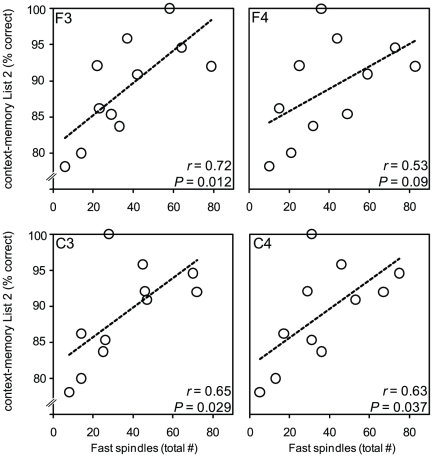
While a role for sleep in declarative memory processing is established, the qualitative nature of this consolidation benefit, and the physiological mechanisms mediating it, remain debated. Here, we investigate the impact of sleep physiology on characteristics of episodic memory using an item- (memory elements) and context- (contextual details associated with those elements) learning paradigm; the latter being especially dependent on the hippocampus. Following back-to-back encoding of two word lists, each associated with a different context, participants were assigned to either a Nap-group, who obtained a 120-min nap, or a No Nap-group. Six hours post-encoding, participants performed a recognition test involving item-memory and context-memory judgments. In contrast to item-memory, which demonstrated no between-group differences, a significant benefit in context-memory developed in the Nap-group, the extent of which correlated both with the amount of stage-2 NREM sleep and frontal fast sleep-spindles. Furthermore, a difference was observed on the basis of word-list order, with the sleep benefit and associated physiological correlations being selective for the second word-list, learned last (most proximal to sleep). These findings suggest that sleep may preferentially benefit contextual (hippocampal-dependent) aspects of memory, supported by sleep-spindle oscillations, and that the temporal order of initial learning differentially determines subsequent offline consolidation.
Overview
The claims and statistics of this paper haven’t been checked yet.
Run the check — free, no account needed. It reads the open-access text and checks the sources it cites.
Integrity signals
Registry
Cites
Statistics
Figures
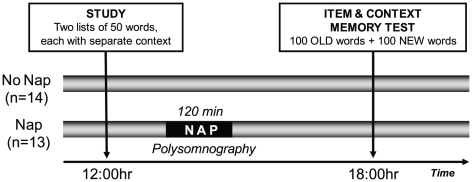
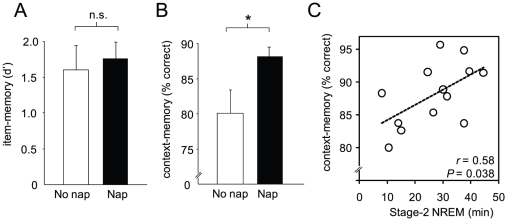
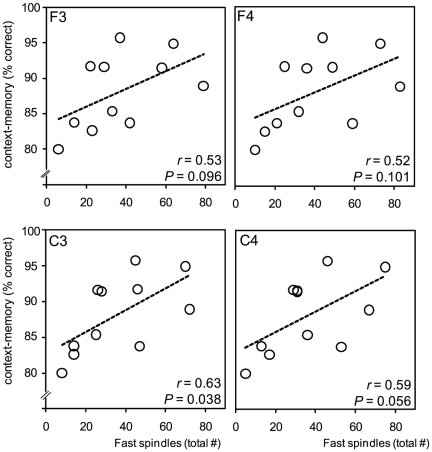
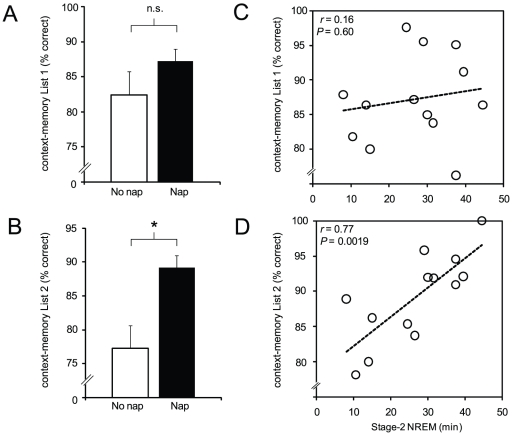
Verification
Claims the paper makes
The claims and statistics of this paper haven’t been checked yet.
Run the check — free, no account needed. It reads the open-access text and checks the sources it cites.
Claims other papers make about this one
Each is checked against this paper’s own text: does it say what the citing paper says it does?
The source backs part of the claim, not all of it — or backs it for a different population, condition or comparison.
In the citing paper
“In children and adults, spindle number and density strongly correlate with IQ scores (106, 395, 439, 847, 1038, 1039) as well as overnight retention of memories (213, 1057, 1230).”
From About Sleep's Role in Memory (2013) · cites this paper as [1230]
Experimental — accuracy not yet measuredThe cited source says what the claim attributes to it.
In the citing paper
“In addition, some human studies revealed that, compared with item memory, context memory, a core function of the hippocampus, is particularly sensitive to the beneficial effects of sleep (602,732,1128,1230).”
From About Sleep's Role in Memory (2013) · cites this paper as [1230]
The cited source says what the claim attributes to it.
In the citing paper
“Moreover, spindles (13-15 Hz) during a postlearning nap predicted sleepdependent memory improvement for contextual aspects of episodic memories known to most closely depend on the hippocampal function (1230).”
From About Sleep's Role in Memory (2013) · cites this paper as [1230]
Self-check
Percentages, sums and reported differences re-computed from the paper’s own numbers.
The self-check needs the paper’s full text.
Citations
Cites
Detection Theory: A User's Guide
Macmillan, N. A., & Creelman, C. D. (1991) · Cited by 5,415
Memory and the hippocampus: A synthesis from findings with rats, monkeys, and humans.
Squire, L. R. (1992) · Psychological Review · doi:10.1037/0033-295x.99.2.195 · Cited by 5,376
Diekelmann, S., & Born, J. (2010) · Nature Reviews Neuroscience · doi:10.1038/nrn2762 · Cited by 3,760
Van Dongen, H. P. A., Maislin, G., Mullington, J. M., & Dinges, D. F. (2003) · Sleep · doi:10.1093/sleep/26.2.117 · Cited by 3,173
Quantification of Sleepiness: A New Approach
Hoddes, E., Zarcone, V., Smythe, H., Phillips, R., & Dement, W. C. (1973) · Psychophysiology · doi:10.1111/j.1469-8986.1973.tb00801.x · Cited by 2,538
Neurocognitive consequences of sleep deprivation
Goel, N., Rao, H., Durmer, J., & Dinges, D. (2009) · Seminars in Neurology · doi:10.1055/s-0029-1237117 · Cited by 2,154
Dinges, D. F., Pack, F. M., Williams, K., Gillen, K. A., Powell, J. W., Ott, G. E., Trasande, C. A., & Pack, A. I. (1997) · SLEEP · doi:10.1093/sleep/20.4.267 · Cited by 2,018
Boosting slow oscillations during sleep potentiates memory
Marshall, L., Helgadóttir, H., Mölle, M., & Born, J. (2006) · Nature · doi:10.1038/nature05278 · Cited by 1,792
Recognition memory: What are the roles of the perirhinal cortex and hippocampus?
Brown, M. W., & Aggleton, J. P. (2001) · Nature reviews. Neuroscience · doi:10.1038/35049064 · Cited by 1,624
Selective suppression of hippocampal ripples impairs spatial memory
Girardeau, G., Benchenane, K., Wiener, S. I., Buzsáki, G., & Zugaro, M. B. (2009) · Nature Neuroscience · doi:10.1038/nn.2384 · Cited by 1,560
Research works printed but not linked: 3
- [6]Walker MP Stickgold R 2010 Overnight alchemy: sleep-dependent memory evolution. Nat Rev Neurosci 11 218; author reply 218 20168316 PMC2891532
- [64]Nishida M Walker M 2007 Daytime naps, motor memory consolidation and regionally specific sleep spindles. PLoS ONE 2 e341 17406665 PMC1828623
- [72]Clemens Z Fabo D Halasz P 2006 Twenty-four hours retention of visuospatial memory correlates with the number of parietal sleep spindles. Neurosci Lett 403 52 56 16714084
Cited by
Sorted by citations
Rasch, B., & Born, J. (2013) · Physiological Reviews · doi:10.1152/physrev.00032.2012 · Cited by 2,783
Hippocampal sharp wave-ripple: A cognitive biomarker for episodic memory and planning
Buzsáki, G. (2015) · Hippocampus · doi:10.1002/hipo.22488 · Cited by 1,759
Sleep spindles: mechanisms and functions
Fernandez, L. M. J., & Lüthi, A. (2020) · Physiological Reviews · doi:10.1152/physrev.00042.2018 · Cited by 716
Sleep, Plasticity and Memory from Molecules to Whole-Brain Networks
Abel, T. G., Havekes, R., Saletin, J., & Walker, M. P. (2013) · Current Biology · doi:10.1016/j.cub.2013.07.025 · Cited by 585
Self-citationA contextual binding theory of episodic memory: systems consolidation reconsidered
Yonelinas, A. P., Ranganath, C., Ekstrom, A. D., & Wiltgen, B. J. (2019) · Nature reviews. Neuroscience · doi:10.1038/s41583-019-0150-4 · Cited by 492
Metadata
- Authors
- van der Helm, E., Gujar, N., Nishida, M., & Walker, M. P.
- Affiliations
- University of California, Berkeley (US)
- Tokyo Medical and Dental University (JP)
- Corresponding author
- Walker, Matthew P.
- Venue
- PLoS ONE
- Publisher
- Public Library of Science (PLoS)
- Published
- 2011-11-17
- Volume
- 6
- Issue
- 11
- Pages
- e27421
- ISSN
- 1932-6203 (ISSN-L)
- PMC
- PMC3219667
- OpenAlex
- W2150174546
- Cited by
- 138
- References
- 83
- Citations by year
- 2025: 5 · 2024: 7 · 2023: 5 · 2022: 8 · 2021: 12 · 2020: 9 · 2019: 11 · 2018: 8 · 2017: 12 · 2016: 7 · 2015: 11 · 2014: 15 · 2013: 18 · 2012: 8
- FWCI
- 6.65
- Type
- journal article
- Language
- en
- Open access
- gold
- doi.org
- Locations
- PLoS ONE (publishedVersion, cc-by)
- Europe PMC (PubMed Central) (publishedVersion, cc-by)
- PubMed Central (publishedVersion, cc-by)
- PubMed (publishedVersion)
- DOAJ (DOAJ: Directory of Open Access Journals) (submittedVersion)
- Figshare (submittedVersion, cc-by)
- Funders
- National Institutes of Health
- National Institute on Aging (R01AG031164)
- Topics
- Life Sciences › Neuroscience › Cognitive Neuroscience › Sleep and Wakefulness Research
- Life Sciences › Neuroscience › Cognitive Neuroscience › Memory and Neural Mechanisms
- Life Sciences › Neuroscience › Cognitive Neuroscience › Memory Processes and Influences
- Keywords
- sleep-dependent memory consolidation, episodic memory, contextual memory, item memory, hippocampus, NREM sleep, sleep spindles, frontal lobe, recognition memory, declarative memory
- MeSH terms
- Adolescent, Adult, Female, Hippocampus, Humans, Learning, Male, Sleep, Wakefulness, Young Adult, Memory, Episodic
About these checks
Registry, retraction, Cites and statistics results are computed, not judged, with one exception: a printed reference that no index lists is read once by a model before it counts as a citation error. Claims are extracted by a model and kept only when their quote appears verbatim in the text; each cited source is then checked, with a model’s help, for whether it says what the claim relies on. Those verdicts can be wrong — read the claim’s quote and the cited source before relying on one.
Statistics and arithmetic are recomputed, not judged.
Confidence bands are shown only for fields calibrated on our annotated test set. None is calibrated yet, so no band is shown.
What counts as a claim ›How we measure confidence ›How we check this ›
Are you an author, or do you see a problem with this page? Request a review
