

The DOI matches its Crossref record; 50 of the 50 references it cites were found in a registry or an index.
Niclosamide Suppresses Cancer Cell Growth By Inducing Wnt Co-Receptor LRP6 Degradation and Inhibiting the Wnt/β-Catenin Pathway
Open accessAbstract
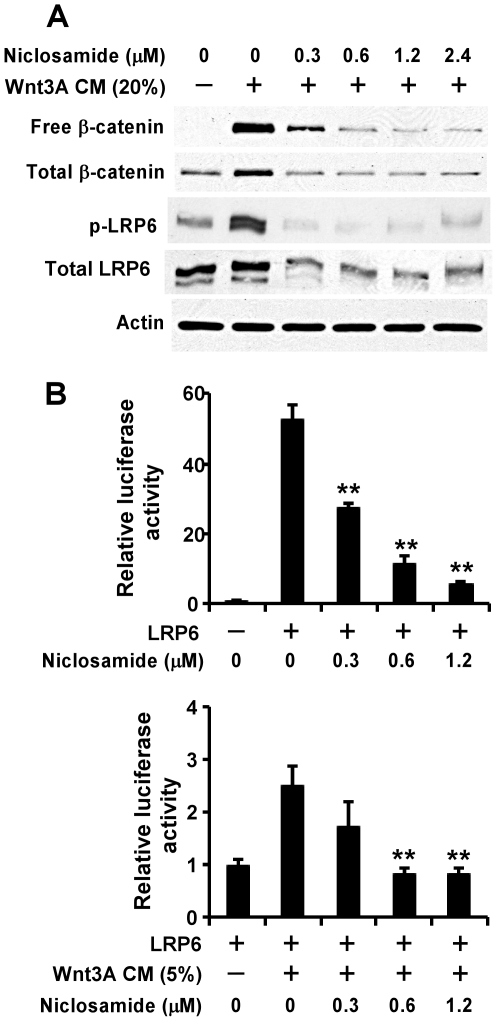
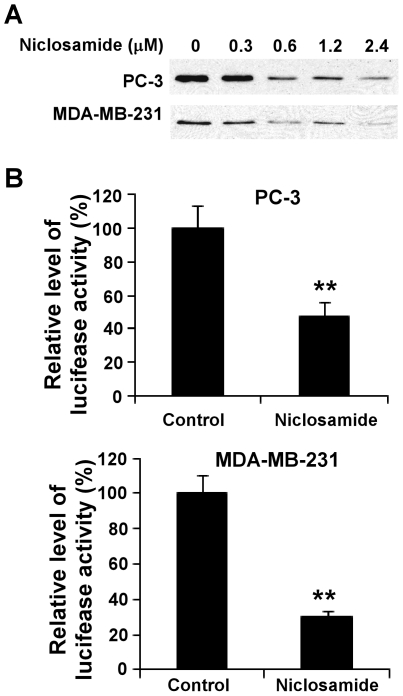
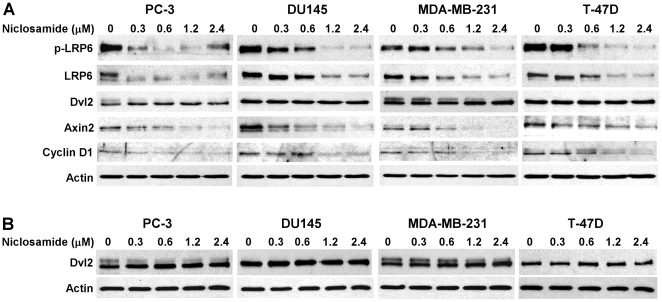
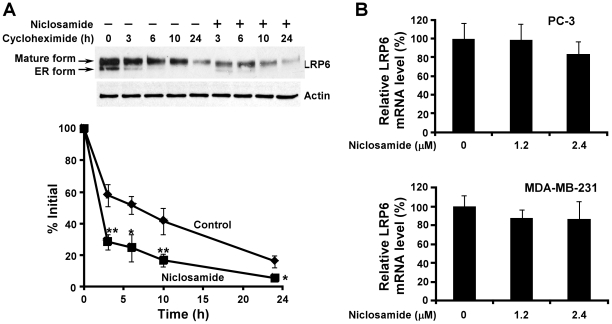
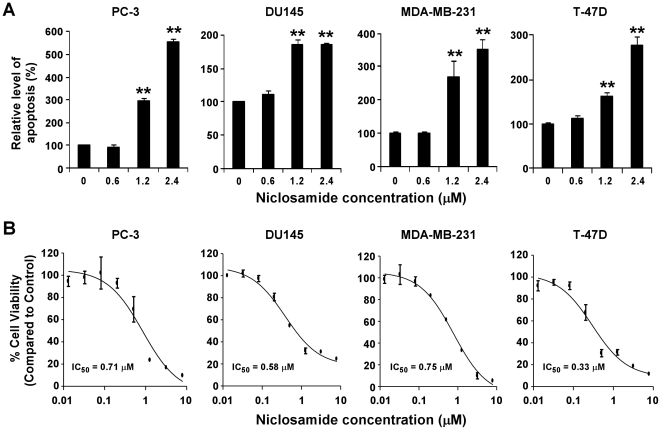
The Wnt/β-catenin signaling pathway is important for tumor initiation and progression. The low density lipoprotein receptor-related protein-6 (LRP6) is an essential Wnt co-receptor for Wnt/β-catenin signaling and represents a promising anticancer target. Recently, the antihelminthic drug, niclosamide was found to inhibit Wnt/β-catenin signaling, although the mechanism was not well defined. We found that niclosamide was able to suppress LRP6 expression and phosphorylation, block Wnt3A-induced β-catenin accumulation, and inhibit Wnt/β-catenin signaling in HEK293 cells. Furthermore, the inhibitory effects of niclosamide on LRP6 expression/phosphorylation and Wnt/β-catenin signaling were conformed in human prostate PC-3 and DU145 and breast MDA-MB-231 and T-47D cancer cells. Moreover, we showed that the mechanism by which niclosamide suppressed LRP6 resulted from increased degradation as evident by a shorter half-life. Finally, we demonstrated that niclosamide was able to induce cancer cell apoptosis, and displayed excellent anticancer activity with IC(50) values less than 1 µM for prostate PC-3 and DU145 and breast MDA-MB-231 and T-47D cancer cells. The IC(50) values are comparable to those shown to suppress the activities of Wnt/β-catenin signaling in prostate and breast cancer cells. Our data indicate that niclosamide is a unique small molecule Wnt/β-catenin signaling inhibitor targeting the Wnt co-receptor LRP6 on the cell surface, and that niclosamide has a potential to be developed a novel chemopreventive or therapeutic agent for human prostate and breast cancer.
Overview
The claims and statistics of this paper haven’t been checked yet.
Run the check — free, no account needed. It reads the open-access text and checks the sources it cites.
Integrity signals
Registry
Cites
Statistics
Figures
Verification
Claims the paper makes
The claims and statistics of this paper haven’t been checked yet.
Run the check — free, no account needed. It reads the open-access text and checks the sources it cites.
Claims other papers make about this one
Each is checked against this paper’s own text: does it say what the citing paper says it does?
The cited source says what the claim attributes to it.
In the citing paper
“In our previous studies, we have demonstrated that niclosamide (5-chloro-N-[2-chloro-4-nitrophenyl]−2-hydroxy benzamide), an FDA approved antihelminthic drug, suppresses Wnt/β-catenin signaling by promoting Wnt co-receptor LRP6 degradation in cancer cells [27, 37, 38].”
From CI-994 is a dual modulator of class I HDACs and Wnt/β-catenin signaling for the treatment of Alzheimer's disease (2026) · cites this paper as [27]
The cited source says what the claim attributes to it.
In the citing paper
“On the other hand, niclosamide can induce Wnt co-receptor LRP6 degradation and suppress Wnt/β-catenin signaling in cancer cells [27, 37, 38], while CI-994 displays the opposite effect on LRP6 regulation by reducing LRP6 turnover.”
From CI-994 is a dual modulator of class I HDACs and Wnt/β-catenin signaling for the treatment of Alzheimer's disease (2026) · cites this paper as [27]
Self-check
Percentages, sums and reported differences re-computed from the paper’s own numbers.
The self-check needs the paper’s full text.
Citations
Cites
Wnt/β-Catenin Signaling: Components, Mechanisms, and Diseases
MacDonald, B. T., Tamai, K., & He, X. (2009) · Developmental Cell · doi:10.1016/j.devcel.2009.06.016 · Cited by 5,583
β-Catenin regulates expression of cyclin D1 in colon carcinoma cells
Tetsu, O., & McCormick, F. (1999) · Nature · doi:10.1038/18884 · Cited by 3,601
Identification of Selective Inhibitors of Cancer Stem Cells by High-Throughput Screening
Gupta, P. B., Önder, T. T., Jiang, G., Tao, K. X., Kuperwasser, C., Weinberg, R. A., & Lander, E. S. (2009) · Cell · doi:10.1016/j.cell.2009.06.034 · Cited by 2,429
The cyclin D1 gene is a target of the β-catenin/LEF-1 pathway
Shtutman, M., Zhurinsky, J., Simcha, I., Albanese, C., D’Amico, M., Pestell, R., & Ben-Ze’ev, A. (1999) · Proceedings of the National Academy of Sciences · doi:10.1073/pnas.96.10.5522 · Cited by 2,230
Jho, E., Zhang, T., Domon–Dell, C., Joo, C., Freund, J., & Costantini, F. D. (2002) · Molecular and Cellular Biology · doi:10.1128/mcb.22.4.1172-1183.2002 · Cited by 1,683
Lustig, B., Jerchow, B., Sachs, M., Weiler, S., Pietsch, T., Karsten, U., van de Wetering, M., Clevers, H., Schlag, P., Birchmeier, W., et al. (2002) · Molecular and Cellular Biology · doi:10.1128/mcb.22.4.1184-1193.2002 · Cited by 1,198
LDL-receptor-related proteins in Wnt signal transduction
Tamai, K., Semenov, M., Kato, Y., Spokony, R., Liu, C., Katsuyama, Y., Hess, F., Saint-Jeannet, J.-P., & He, X. (2000) · Nature · doi:10.1038/35035117 · Cited by 1,128
An LDL-receptor-related protein mediates Wnt signalling in mice
Pinson, K. I., Brennan, J., Monkley, S. J., Avery, B. J., & Skarnes, W. C. (2000) · Nature · doi:10.1038/35035124 · Cited by 1,086
Epigenetic inactivation of SFRP genes allows constitutive WNT signaling in colorectal cancer
Suzuki, H., Watkins, D. N., Jair, K.-W., Schuebel, K. E., Markowitz, S. D., Chen, W. D., Pretlow, T. P., Yang, B., Akiyama, Y., van Engeland, M., et al. (2004) · Nature Genetics · doi:10.1038/ng1330 · Cited by 1,074
Targeting cancer stem cells by inhibiting Wnt, Notch, and Hedgehog pathways
Takebe, N., Harris, P. J., Warren, R. Q., & Ivy, S. P. (2010) · Nature Reviews Clinical Oncology · doi:10.1038/nrclinonc.2010.196 · Cited by 1,025
Cited by
Sorted by citations
Wnt/β-catenin signalling: function, biological mechanisms, and therapeutic opportunities
Liu, J., Xiao, Q., Xiao, J., Niu, C., Li, Y., Zhang, X., Zhou, Z., Shu, G., & Yin, G. (2022) · Signal Transduction and Targeted Therapy · doi:10.1038/s41392-021-00762-6 · Cited by 2,519
Self-citationWnt/β-catenin signaling in cancers and targeted therapies
Yu, F., Yu, C., Li, F., Zuo, Y., Wang, Y., Yao, L., Wu, C., Wang, C., & Ye, L. (2021) · Signal Transduction and Targeted Therapy · doi:10.1038/s41392-021-00701-5 · Cited by 734
The Wnt/β-catenin pathway in ovarian cancer: A review
Arend, R. C., Londoño-Joshi, A. I., Straughn, J. M., & Buchsbaum, D. J. (2013) · Gynecologic Oncology · doi:10.1016/j.ygyno.2013.09.034 · Cited by 458
“Our laboratory has seen an increase expression of LRP6 in ovarian cancer patients.”
BackgroundInfluentialNiclosamide: Beyond an antihelminthic drug
Chen, W., Mook, R. A., Premont, R. T., & Wang, J. (2017) · Cellular Signalling · doi:10.1016/j.cellsig.2017.04.001 · Cited by 446
WNT signalling in prostate cancer
Murillo-Garzón, V., & Kypta, R. M. (2017) · Nature Reviews Urology · doi:10.1038/nrurol.2017.144 · Cited by 370
Metadata
- Authors
- Lu, W., Lin, C., Roberts, M. J., Waud, W. R., Piazza, G. A., & Li, Y.
- Affiliations
- Southern Research Institute (US)
- University of South Alabama (US)
- Corresponding author
- Li, Yonghe
- Venue
- PLoS ONE
- Publisher
- Public Library of Science (PLoS)
- Published
- 2011-12-16
- Volume
- 6
- Issue
- 12
- Pages
- e29290
- ISSN
- 1932-6203 (ISSN-L)
- PMC
- PMC3241710
- OpenAlex
- W2007145040
- Cited by
- 230
- References
- 50
- Citations by year
- 2026: 14 · 2025: 13 · 2024: 16 · 2023: 10 · 2022: 12 · 2021: 18 · 2020: 22 · 2019: 19 · 2018: 17 · 2017: 20 · 2016: 21 · 2015: 21 · 2014: 14 · 2013: 8 · 2012: 5
- FWCI
- 3.51
- Type
- journal article
- Language
- en
- Open access
- gold
- doi.org
- Locations
- PLoS ONE (publishedVersion, cc-by)
- PubMed Central (publishedVersion, cc-by)
- PubMed (publishedVersion)
- DOAJ (DOAJ: Directory of Open Access Journals) (submittedVersion, cc-by-sa)
- Funders
- University of Rochester
- National Institutes of Health (RO1CA124531)
- National Cancer Institute (R01CA124531)
- Topics
- Life Sciences › Biochemistry, Genetics and Molecular Biology › Molecular Biology › Wnt/β-catenin signaling in development and cancer
- Life Sciences › Biochemistry, Genetics and Molecular Biology › Molecular Biology › Hedgehog Signaling Pathway Studies
- Health Sciences › Medicine › Oncology › Drug Transport and Resistance Mechanisms
- Keywords
- niclosamide, LRP6, Wnt/β-catenin signaling, Wnt co-receptor, protein degradation, prostate cancer, breast cancer, apoptosis, anticancer drug repurposing, antihelminthic drugs, chemoprevention
- MeSH terms
- Dishevelled Proteins, Breast Neoplasms, Drug Screening Assays, Antitumor, Female, Humans, Male, Neoplasm Proteins, Neoplasms, Niclosamide, Phosphoproteins, Phosphorylation, Prostatic Neoplasms, Apoptosis, Cell Line, Tumor, Adaptor Proteins, Signal Transducing, Cell Proliferation, Wnt Proteins, beta Catenin, HEK293 Cells, Proteolysis, Wnt Signaling Pathway, Low Density Lipoprotein Receptor-Related Protein-6, Wnt3A Protein
About these checks
Registry, retraction, Cites and statistics results are computed, not judged, with one exception: a printed reference that no index lists is read once by a model before it counts as a citation error. Claims are extracted by a model and kept only when their quote appears verbatim in the text; each cited source is then checked, with a model’s help, for whether it says what the claim relies on. Those verdicts can be wrong — read the claim’s quote and the cited source before relying on one.
Statistics and arithmetic are recomputed, not judged.
Confidence bands are shown only for fields calibrated on our annotated test set. None is calibrated yet, so no band is shown.
What counts as a claim ›How we measure confidence ›How we check this ›
Are you an author, or do you see a problem with this page? Request a review
