

The DOI matches its Crossref record; 67 of the 69 references it cites were found in a registry or an index, and 1 are not checked yet.
“Mind the Trap”: Mindfulness Practice Reduces Cognitive Rigidity
Open accessAbstract
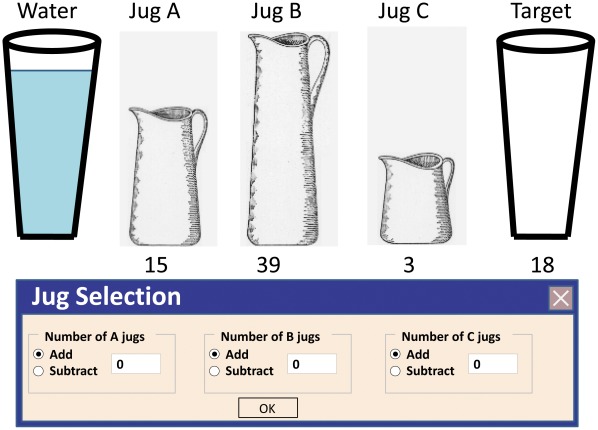
Two experiments examined the relation between mindfulness practice and cognitive rigidity by using a variation of the Einstellung water jar task. Participants were required to use three hypothetical jars to obtain a specific amount of water. Initial problems were solvable by the same complex formula, but in later problems ("critical" or "trap" problems) solving was possible by an additional much simpler formula. A rigidity score was compiled through perseverance of the complex formula. In Experiment 1, experienced mindfulness meditators received significantly lower rigidity scores than non-meditators who had registered for their first meditation retreat. Similar results were obtained in randomized controlled Experiment 2 comparing non-meditators who underwent an eight meeting mindfulness program with a waiting list group. The authors conclude that mindfulness meditation reduces cognitive rigidity via the tendency to be "blinded" by experience. Results are discussed in light of the benefits of mindfulness practice regarding a reduced tendency to overlook novel and adaptive ways of responding due to past experience, both in and out of the clinical setting.
Overview
The claims and statistics of this paper haven’t been checked yet.
Run the check — free, no account needed. It reads the open-access text and checks the sources it cites.
Integrity signals
Registry
Cites
Statistics
Figures
Verification
Claims the paper makes
The claims and statistics of this paper haven’t been checked yet.
Run the check — free, no account needed. It reads the open-access text and checks the sources it cites.
Claims other papers make about this one
Each is checked against this paper’s own text: does it say what the citing paper says it does?
The source backs part of the claim, not all of it — or backs it for a different population, condition or comparison.
In the citing paper
“These anti-depressive and anxiolytic effects are thought to in turn be mediated by enhancements in decentring and cognitive flexibility, in the case of mindfulness intervention (16, 19), vs. mystical experiences and disrupted cortical connectivity in the case of psychedelic-assisted therapy (49, 50).”
From Examining the Potential Synergistic Effects Between Mindfulness Training and Psychedelic-Assisted Therapy (2021) · cites this paper as [16]
Experimental — accuracy not yet measuredIn the citing paper
“Studies examining other MBIs with healthy participants similarly indicated improvements in cognitive abilities such as working memory (76–77), cognitive flexibility (78–79) and inhibition (80), with very limited evidence regarding attentional improvements (see (73) for a review).”
From Mindfulness-Based Interventions in Psychiatry (2018) · cites this paper as [77]
Self-check
Percentages, sums and reported differences re-computed from the paper’s own numbers.
The self-check needs the paper’s full text.
Citations
Cites
Faul, F., Erdfelder, E., Lang, A.-G., & Buchner, A. (2007) · Behavior Research Methods · doi:10.3758/bf03193146 · Cited by 65,971
(2008) · Medical Entomology and Zoology · Cited by 7,477
Mindfulness: A proposed operational definition.
Bishop, S. R., Lau, M., Shapiro, S., Carlson, L., Anderson, N. D., Carmody, J., Segal, Z. V., Abbey, S., Speca, M., Velting, D., et al. (2004) · Clinical Psychology: Science and Practice · doi:10.1093/clipsy.bph077 · Cited by 7,234
(1993) · Cited by 7,136
(1999) · Cited by 5,934
Responses to depression and their effects on the duration of depressive episodes
Nolen-Hoeksema, S. (1991) · Journal of Abnormal Psychology · doi:10.1037/0021-843x.100.4.569 · Cited by 4,529
(2001) · Cited by 3,666
(2005) · Medical Entomology and Zoology · Cited by 3,197
Psychological flexibility as a fundamental aspect of health
Kashdan, T. B., & Rottenberg, J. (2010) · Clinical Psychology Review · doi:10.1016/j.cpr.2010.03.001 · Cited by 3,054 · cited 1×
“Such cognitive rigidity may play a key role in psychopathlogy (for reviews see [6,7], see also [8]).”
BackgroundWherever you go, there you are: Mindfulness meditation in everyday life
Kwee, M. G. T. (1995) · Behaviour Research and Therapy · doi:10.1016/0005-7967(95)90133-7 · Cited by 2,912
Cited by
Sorted by citations
Mindfulness in organizations: a cross-level review
Sutcliffe, K. M., Vogus, T. J., & Dane, E. (2016) · Annual Review of Organizational Psychology and Organizational Behavior · doi:10.1146/annurev-orgpsych-041015-062531 · Cited by 428
Galante, J., Friedrich, C., Dawson, A. F., Modrego-Alarcón, M., Gebbing, P., Delgado-Suárez, I., Gupta, R., Dean, L., Dalgleish, T., White, I. R., et al. (2021) · PLOS Medicine · doi:10.1371/journal.pmed.1003481 · Cited by 319
“Year, Country N Participants (category) Mean Age (SD) Women Outcomes Intervention (category) Control/s (category) Outcome Time Points Xu 2015 [277], China 90 Adults (1) 31 (8) 56% Dis, Mindf Mindfulness training (2) Waitlist (1) Post–int Yazdanimehr 2016 [278,279], Iran 80 Pregnant women (2) 26 (5.2) 100% Anx, Dep, Di…”
InfluentialDiamond, A. D., & Ling, D. S. (2019) · Oxford University Press eBooks · doi:10.1093/oso/9780199974467.003.0008 · Cited by 343
Garland, E. L., Froeliger, B., Zeidan, F., Partin, K., & Howard, M. O. (2013) · Neuroscience & Biobehavioral Reviews · doi:10.1016/j.neubiorev.2013.08.006 · Cited by 277
Garland, E. L., Froeliger, B., & Howard, M. O. (2014) · Frontiers in Psychiatry · doi:10.3389/fpsyt.2013.00173 · Cited by 268
Metadata
- Authors
- Greenberg, J., Reiner, K., & Meiran, N.
- Affiliations
- Ben-Gurion University of the Negev (IL)
- Corresponding author
- Greenberg, Jonathan
- Venue
- PLoS ONE
- Publisher
- Public Library of Science (PLoS)
- Published
- 2012-05-15
- Volume
- 7
- Issue
- 5
- Pages
- e36206
- ISSN
- 1932-6203 (ISSN-L)
- PMC
- PMC3352909
- OpenAlex
- W2026631848
- Cited by
- 214
- References
- 69
- Citations by year
- 2026: 7 · 2025: 7 · 2024: 9 · 2023: 36 · 2022: 16 · 2021: 24 · 2020: 14 · 2019: 14 · 2018: 18 · 2017: 8 · 2016: 22 · 2015: 11 · 2014: 13 · 2013: 14 · 2012: 1
- FWCI
- 14.84
- Type
- journal article
- Language
- en
- Open access
- gold
- doi.org
- Locations
- PLoS ONE (publishedVersion, cc-by)
- Europe PMC (PubMed Central) (publishedVersion, cc-by)
- PubMed Central (publishedVersion, cc-by)
- PubMed (publishedVersion)
- DOAJ (DOAJ: Directory of Open Access Journals) (submittedVersion, cc-by-sa)
- Funders
- Israel Science Foundation
- Topics
- Social Sciences › Psychology › Clinical Psychology › Mindfulness and Compassion Interventions
- Social Sciences › Psychology › Experimental and Cognitive Psychology › Cognitive Functions and Memory
- Social Sciences › Psychology › Experimental and Cognitive Psychology › Cognitive Abilities and Testing
- Keywords
- mindfulness meditation, cognitive rigidity, Einstellung effect, problem solving, meditation retreats, cognitive flexibility
- MeSH terms
- Adult, Aged, Cognition, Female, Humans, Male
About these checks
Registry, retraction, Cites and statistics results are computed, not judged, with one exception: a printed reference that no index lists is read once by a model before it counts as a citation error. Claims are extracted by a model and kept only when their quote appears verbatim in the text; each cited source is then checked, with a model’s help, for whether it says what the claim relies on. Those verdicts can be wrong — read the claim’s quote and the cited source before relying on one.
Statistics and arithmetic are recomputed, not judged.
Confidence bands are shown only for fields calibrated on our annotated test set. None is calibrated yet, so no band is shown.
What counts as a claim ›How we measure confidence ›How we check this ›
Are you an author, or do you see a problem with this page? Request a review
