

The DOI matches its Crossref record; 67 of the 69 references it cites were found in a registry or an index, and 1 are not checked yet.
“Mind the Trap”: Mindfulness Practice Reduces Cognitive Rigidity
Open accessAbstract
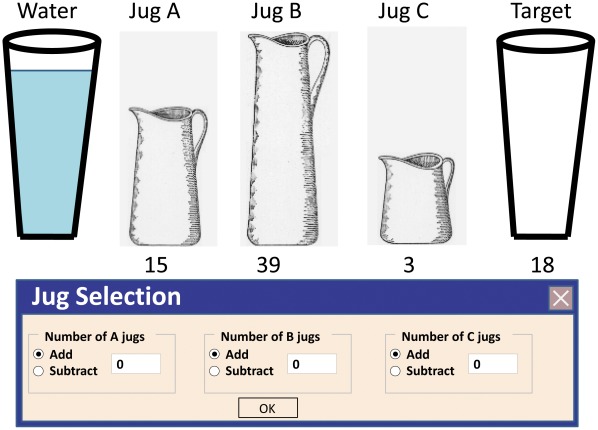
Two experiments examined the relation between mindfulness practice and cognitive rigidity by using a variation of the Einstellung water jar task. Participants were required to use three hypothetical jars to obtain a specific amount of water. Initial problems were solvable by the same complex formula, but in later problems ("critical" or "trap" problems) solving was possible by an additional much simpler formula. A rigidity score was compiled through perseverance of the complex formula. In Experiment 1, experienced mindfulness meditators received significantly lower rigidity scores than non-meditators who had registered for their first meditation retreat. Similar results were obtained in randomized controlled Experiment 2 comparing non-meditators who underwent an eight meeting mindfulness program with a waiting list group. The authors conclude that mindfulness meditation reduces cognitive rigidity via the tendency to be "blinded" by experience. Results are discussed in light of the benefits of mindfulness practice regarding a reduced tendency to overlook novel and adaptive ways of responding due to past experience, both in and out of the clinical setting.
Overview
The claims and statistics of this paper haven’t been checked yet.
Run the check — free, no account needed. It reads the open-access text and checks the sources it cites.
Integrity signals
Registry
Cites
Statistics
Figures
Verification
Claims the paper makes
The claims and statistics of this paper haven’t been checked yet.
Run the check — free, no account needed. It reads the open-access text and checks the sources it cites.
Claims other papers make about this one
Each is checked against this paper’s own text: does it say what the citing paper says it does?
The source backs part of the claim, not all of it — or backs it for a different population, condition or comparison.
In the citing paper
“These anti-depressive and anxiolytic effects are thought to in turn be mediated by enhancements in decentring and cognitive flexibility, in the case of mindfulness intervention (16, 19), vs. mystical experiences and disrupted cortical connectivity in the case of psychedelic-assisted therapy (49, 50).”
From Examining the Potential Synergistic Effects Between Mindfulness Training and Psychedelic-Assisted Therapy (2021) · cites this paper as [16]
Experimental — accuracy not yet measuredIn the citing paper
“Studies examining other MBIs with healthy participants similarly indicated improvements in cognitive abilities such as working memory (76–77), cognitive flexibility (78–79) and inhibition (80), with very limited evidence regarding attentional improvements (see (73) for a review).”
From Mindfulness-Based Interventions in Psychiatry (2018) · cites this paper as [77]
Self-check
Percentages, sums and reported differences re-computed from the paper’s own numbers.
The self-check needs the paper’s full text.
Citations
Cites
Faul, F., Erdfelder, E., Lang, A.-G., & Buchner, A. (2007) · Behavior Research Methods · doi:10.3758/bf03193146 · Cited by 65,971
(2008) · Medical Entomology and Zoology · Cited by 7,477
Mindfulness: A proposed operational definition.
Bishop, S. R., Lau, M., Shapiro, S., Carlson, L., Anderson, N. D., Carmody, J., Segal, Z. V., Abbey, S., Speca, M., Velting, D., et al. (2004) · Clinical Psychology: Science and Practice · doi:10.1093/clipsy.bph077 · Cited by 7,234
(1993) · Cited by 7,136
(1999) · Cited by 5,934
Responses to depression and their effects on the duration of depressive episodes
Nolen-Hoeksema, S. (1991) · Journal of Abnormal Psychology · doi:10.1037/0021-843x.100.4.569 · Cited by 4,529
(2001) · Cited by 3,666
(2005) · Medical Entomology and Zoology · Cited by 3,197
Psychological flexibility as a fundamental aspect of health
Kashdan, T. B., & Rottenberg, J. (2010) · Clinical Psychology Review · doi:10.1016/j.cpr.2010.03.001 · Cited by 3,054 · cited 1×
“Such cognitive rigidity may play a key role in psychopathlogy (for reviews see [6,7], see also [8]).”
BackgroundWherever you go, there you are: Mindfulness meditation in everyday life
Kwee, M. G. T. (1995) · Behaviour Research and Therapy · doi:10.1016/0005-7967(95)90133-7 · Cited by 2,912
Cited by
Sorted by citations
Mindfulness in organizations: a cross-level review
Sutcliffe, K. M., Vogus, T. J., & Dane, E. (2016) · Annual Review of Organizational Psychology and Organizational Behavior · doi:10.1146/annurev-orgpsych-041015-062531 · Cited by 428
Galante, J., Friedrich, C., Dawson, A. F., Modrego-Alarcón, M., Gebbing, P., Delgado-Suárez, I., Gupta, R., Dean, L., Dalgleish, T., White, I. R., et al. (2021) · PLOS Medicine · doi:10.1371/journal.pmed.1003481 · Cited by 319
“Year, Country N Participants (category) Mean Age (SD) Women Outcomes Intervention (category) Control/s (category) Outcome Time Points Xu 2015 [277], China 90 Adults (1) 31 (8) 56% Dis, Mindf Mindfulness training (2) Waitlist (1) Post–int Yazdanimehr 2016 [278,279], Iran 80 Pregnant women (2) 26 (5.2) 100% Anx, Dep, Di…”
InfluentialDiamond, A. D., & Ling, D. S. (2019) · Oxford University Press eBooks · doi:10.1093/oso/9780199974467.003.0008 · Cited by 343
Garland, E. L., Froeliger, B., Zeidan, F., Partin, K., & Howard, M. O. (2013) · Neuroscience & Biobehavioral Reviews · doi:10.1016/j.neubiorev.2013.08.006 · Cited by 277
Garland, E. L., Froeliger, B., & Howard, M. O. (2014) · Frontiers in Psychiatry · doi:10.3389/fpsyt.2013.00173 · Cited by 268
Mind full of ideas: A meta-analysis of the mindfulness–creativity link
Lebuda, I., Zabelina, D. L., & Karwowski, M. (2015) · Personality and Individual Differences · doi:10.1016/j.paid.2015.09.040 · Cited by 268
Cachia, R. L., Anderson, A., & Moore, D. W. (2016) · Journal of Child and Family Studies · doi:10.1007/s10826-015-0193-8 · Cited by 213
Mindfulness As Metacognitive Practice
Kudesia, R. S. (2017) · Academy of Management Review · doi:10.5465/amr.2015.0333 · Cited by 222
Whitfield, T. J., Barnhofer, T., Acabchuk, R. L., Cohen, A., Lee, M., Schlosser, M., Arenaza‐Urquijo, E. M., Böttcher, A., Britton, W. B., Coll‐Padrós, N., et al. (2021) · Neuropsychology Review · doi:10.1007/s11065-021-09519-y · Cited by 247
Mindfulness and creativity: Implications for thinking and learning
Henriksen, D., Richardson, C., & Shack, K. (2020) · Thinking Skills and Creativity · doi:10.1016/j.tsc.2020.100689 · Cited by 194
Specific Mindfulness Skills Differentially Predict Creative Performance
Baas, M., Nevicka, B., & Ten Velden, F. S. (2014) · Personality and Social Psychology Bulletin · doi:10.1177/0146167214535813 · Cited by 191
Mindfulness-Based Interventions in Psychiatry
Shapero, B. G., Greenberg, J., Pedrelli, P., de Jong, M., & Desbordes, G. (2018) · Focus · doi:10.1176/appi.focus.20170039 · Cited by 172
Self-citationStress on health-related quality of life in older adults: the protective nature of mindfulness
de Frias, C. M., & Whyne, E. (2015) · Aging & Mental Health · doi:10.1080/13607863.2014.924090 · Cited by 165
Cognitive effects of MBSR/MBCT: A systematic review of neuropsychological outcomes
Lao, S.-A., Kissane, D. W., & Meadows, G. N. (2016) · Consciousness and Cognition · doi:10.1016/j.concog.2016.08.017 · Cited by 187
Noone, C., & Hogan, M. (2018) · BMC Psychology · doi:10.1186/s40359-018-0226-3 · Cited by 144
Froeliger, B., Garland, E. L., & McClernon, F. J. (2012) · Evidence-based Complementary and Alternative Medicine · doi:10.1155/2012/821307 · Cited by 144
Mindfulness and eating disorder psychopathology: A meta‐analysis
Sala, M., Shankar Ram, S., Vanzhula, I. A., & Levinson, C. A. (2020) · International Journal of Eating Disorders · doi:10.1002/eat.23247 · Cited by 119
Heintzelman, S. J., & King, L. A. (2018) · Personality and Social Psychology Bulletin · doi:10.1177/0146167218795133 · Cited by 145
Mindful creativity: the influence of mindfulness meditation on creative thinking
Capurso, V., Fabbro, F., & Crescentini, C. (2014) · Frontiers in Psychology · doi:10.3389/fpsyg.2013.01020 · Cited by 115
The Effectiveness of Daily Mindful Breathing Practices on Test Anxiety of Students
Cho, H., Ryu, S., Noh, J., & Lee, J. (2016) · PLOS ONE · doi:10.1371/journal.pone.0164822 · Cited by 115
Priddy, S. E., Howard, M. O., Hanley, A. W., Riquino, M. R., Friberg-Felsted, K., & Garland, E. L. (2018) · Substance Abuse and Rehabilitation · doi:10.2147/sar.s145201 · Cited by 101
Schwind, J., McCay, E. A., Beanlands, H. J., Martin, L. S., Martin, J. M., & Binder, M. (2016) · Nurse Education Today · doi:10.1016/j.nedt.2016.12.017 · Cited by 107
Noone, C., Bunting, B. P., & Hogan, M. (2016) · Frontiers in Psychology · doi:10.3389/fpsyg.2015.02043 · Cited by 107
Heuschkel, K., & Kuypers, K. P. C. (2020) · Frontiers in Psychiatry · doi:10.3389/fpsyt.2020.00224 · Cited by 86
Noone, C., & Hogan, M. (2016) · BMC Psychology · doi:10.1186/s40359-016-0122-7 · Cited by 86
Ozsivadjian, A., Hollocks, M. J., Magiati, I., Happé, F., Baird, G., & Absoud, M. (2021) · Journal of Child Psychology and Psychiatry · doi:10.1111/jcpp.13295 · Cited by 81
Sustainability-oriented innovations: Can mindfulness make a difference?
Siqueira, R. P., & Pitassi, C. (2016) · Journal of Cleaner Production · doi:10.1016/j.jclepro.2016.08.056 · Cited by 90
Exploring age‐related brain degeneration in meditation practitioners
Luders, E. (2014) · Annals of the New York Academy of Sciences · doi:10.1111/nyas.12217 · Cited by 79
Berkovich‐Ohana, A., Glicksohn, J., Ben‐Soussan, T. D., & Goldstein, A. (2016) · Mindfulness · doi:10.1007/s12671-016-0649-y · Cited by 86
A Moment of Mindfulness: Computer-Mediated Mindfulness Practice Increases State Mindfulness
Mahmood, L., Hopthrow, T., & Randsley de Moura, G. (2016) · PLOS ONE · doi:10.1371/journal.pone.0153923 · Cited by 75
Psychological Effects of Meditation for Healthy Practitioners: An Update
Sedlmeier, P., Loße, C., & Quasten, L. C. (2018) · Mindfulness · doi:10.1007/s12671-017-0780-4 · Cited by 74
Tulver, K., Kaup, K., Laukkonen, R., & Aru, J. (2023) · Consciousness and Cognition · doi:10.1016/j.concog.2023.103494 · Cited by 86
Whitehead, R., Bates, G., Elphinstone, B., Yang, Y., & Murray, G. (2019) · Journal of Happiness Studies · doi:10.1007/s10902-018-0041-9 · Cited by 69
“2014), cognitive rigidity (Greenberg et al. 2010) and emotional regulation (Teper et al.”
BackgroundMontero‐Marín, J., Puebla‐Guedea, M., Herrera‐Mercadal, P., Cebolla, A., Soler, J., Demarzo, M., Vázquez, C., Rodríguez-Bornaetxea, F., & García‐Campayo, J. (2016) · Frontiers in Psychology · doi:10.3389/fpsyg.2016.01935 · Cited by 78
Sevinc, G., Hölzel, B. K., Hashmi, J., Greenberg, J., McCallister, A., Treadway, M., Schneider, M. L., Dusek, J. A., Carmody, J., & Lazar, S. W. (2018) · Psychosomatic Medicine · doi:10.1097/psy.0000000000000590 · Cited by 67
Self-citationEffects of Long-Term Mindfulness Meditation on Brain's White Matter Microstructure and its Aging
Laneri, D., Schuster, V., Dietsche, B., Jansen, A., Ott, U., & Sommer, J. B. (2016) · Frontiers in Aging Neuroscience · doi:10.3389/fnagi.2015.00254 · Cited by 72
Greenberg, J., Romero, V. L., Elkin-Frankston, S., Bezdek, M. A., Schumacher, E. H., & Lazar, S. W. (2018) · Brain Imaging and Behavior · doi:10.1007/s11682-018-9858-4 · Cited by 83
Self-citationMindfulness and cognitive functions: Toward a unifying neurocognitive framework
Raffone, A., & Srinivasan, N. (2017) · Mindfulness · doi:10.1007/s12671-016-0654-1 · Cited by 64
Farmer, N. M., & Cotter, E. W. (2021) · Frontiers in Psychology · doi:10.3389/fpsyg.2021.560578 · Cited by 92
Lysova, E. I., Fletcher, L., & Baroudi, S. E. (2022) · Human Relations · doi:10.1177/00187267221094243 · Cited by 83
Kudesia, R. S., & Nyima, V. T. (2014) · Mindfulness · doi:10.1007/s12671-014-0337-8 · Cited by 68
Ching, H.-H., Koo, M., Tsai, T.-H., & Chen, C.-Y. (2015) · Evidence-based Complementary and Alternative Medicine · doi:10.1155/2015/254358 · Cited by 58
(2014) · Europe PMC (PubMed Central) · Cited by 56
Mindful learning: Why attention matters in education
Hassed, C. S. (2016) · International Journal of School & Educational Psychology · doi:10.1080/21683603.2016.1130564 · Cited by 60
Mindfulness and Job Performance: Does Creativity Matter?
Ngo, L. V., Nguyen, N. P., Lee, J., & Andonopoulos, V. (2020) · Australasian Marketing Journal (AMJ) · doi:10.1016/j.ausmj.2019.12.003 · Cited by 62
Rumination as a Transdiagnostic Phenomenon in the 21st Century: The Flow Model of Rumination
Wong, S. M. Y., Chen, E. Y. H., Lee, M. C. Y., Suen, Y. N., & Hui, C. L. M. (2023) · Brain Sciences · doi:10.3390/brainsci13071041 · Cited by 48
The Effect of Mindfulness Training on Proactive and Reactive Cognitive Control
Li, Y., Liu, F., Zhang, Q., Liu, X., & Wei, P. (2018) · Frontiers in Psychology · doi:10.3389/fpsyg.2018.01002 · Cited by 57
Workplace Mindfulness: Multidimensional Model, Scale Development and Validation
Zheng, X., Ni, D., Liu, X., & Liang, L. H. (2022) · Journal of Business and Psychology · doi:10.1007/s10869-022-09814-2 · Cited by 53
Embodied cognitive flexibility and neuroplasticity following Quadrato Motor Training
Ben‐Soussan, T. D., Berkovich‐Ohana, A., Piervincenzi, C., Glicksohn, J., & Carducci, F. (2015) · Frontiers in Psychology · doi:10.3389/fpsyg.2015.01021 · Cited by 47
In the heat of the game: Analogical abduction in a pragmatist account of entrepreneurial reasoning
Sergeeva, A., Bhardwaj, A., & Dimov, D. P. (2021) · Journal of Business Venturing · doi:10.1016/j.jbusvent.2021.106158 · Cited by 46
Task switching training effects are mediated by working-memory management
Pereg, M., Shahar, N., & Meiran, N. (2013) · Intelligence · doi:10.1016/j.intell.2013.06.009 · Cited by 51
Self-citationEleftheriou, M. E., & Thomas, E. (2021) · Frontiers in Psychiatry · doi:10.3389/fpsyt.2021.707057 · Cited by 39
“These anti-depressive and anxiolytic effects are thought to in turn be mediated by enhancements in decentring and cognitive flexibility, in the case of mindfulness intervention (16, 19), vs.”
BackgroundElphinstone, B., Whitehead, R., Tinker, S. P., & Bates, G. (2019) · Educational Psychology · doi:10.1080/01443410.2019.1588228 · Cited by 42
Mindfulness Training and Attentional Control in Older Adults: a Randomized Controlled Trial
Whitmoyer, P., Fountain‐Zaragoza, S., Andridge, R., Bredemeier, K., Londerée, A. M., Kaye, L., & Prakash, R. S. (2019) · Mindfulness · doi:10.1007/s12671-019-01218-3 · Cited by 45
Weder, B. (2022) · Frontiers in Behavioral Neuroscience · doi:10.3389/fnbeh.2022.928522 · Cited by 52
Mindfulness and creativity in the workplace
Kudesia, R. S. (2015) · Cambridge University Press eBooks · doi:10.1017/cbo9781107587793.010 · Cited by 43
Cultivating creative workplaces through mindfulness
Byrne, E., & Thatchenkery, T. (2019) · Journal of Organizational Change Management · doi:10.1108/jocm-10-2017-0387 · Cited by 36
Whitmarsh, S., Uddén, J., Barendregt, H. P., & Petersson, K. M. (2013) · Consciousness and Cognition · doi:10.1016/j.concog.2013.05.007 · Cited by 43
The embodied transcendental: a Kantian perspective on neurophenomenology
Khachouf, O. T., Poletti, S., & Pagnoni, G. (2013) · Frontiers in Human Neuroscience · doi:10.3389/fnhum.2013.00611 · Cited by 41
Mindfulness-Based Coping With University Life: A Randomized Wait-List Controlled Study
Lynch, S., Gander, M., Nahar, A., Kohls, N., & Walach, H. (2018) · SAGE Open · doi:10.1177/2158244018758379 · Cited by 48
Charoensukmongkol, P. (2019) · Organization Management Journal · doi:10.1080/15416518.2019.1661820 · Cited by 37
“Off with the Old”: Mindfulness Practice Improves Backward Inhibition
Greenberg, J., Reiner, K., & Meiran, N. (2013) · Frontiers in Psychology · doi:10.3389/fpsyg.2012.00618 · Cited by 33
“The program, based on Mindfulness Based Cognitive Therapy (MBCT) program (Segal et al., 2002) with adaptations to include handling everyday stress rather than only depression, is described in detail by Greenberg et al. (2012).”
BackgroundMethodInfluentialSelf-citationCh, N. A. N., Ansah, A. A., Katrahmani, A., Burmeister, J., Kun, A. L., Mills, C., Shaer, O., & Lee, J. D. (2022) · International Journal of Human-Computer Studies · doi:10.1016/j.ijhcs.2022.102982 · Cited by 40
Noone, C., & Hogan, M. (2017) · Mindfulness · doi:10.1007/s12671-017-0789-8 · Cited by 34
Meditation, Cognitive Flexibility and Well-Being
Hartkamp, M., & Thornton, I. M. (2017) · Journal of Cognitive Enhancement · doi:10.1007/s41465-017-0026-3 · Cited by 37
Facing epistemic and complex uncertainty in serious illness: The role of mindfulness and shared mind
Epstein, R. M. (2021) · Patient Education and Counseling · doi:10.1016/j.pec.2021.07.030 · Cited by 31
Shapero, B. G., Greenberg, J., Mischoulon, D., Pedrelli, P., Meade, K., & Lazar, S. W. (2018) · Mindfulness · doi:10.1007/s12671-018-0889-0 · Cited by 37
Self-citationSheridan, H., & Reingold, E. M. (2013) · PLoS ONE · doi:10.1371/journal.pone.0075796 · Cited by 33
Lodha, S., & Gupta, R. (2022) · Journal of Cognitive Enhancement · doi:10.1007/s41465-022-00254-7 · Cited by 34
Heeren, A., Deplus, S., Peschard, V., Nef, F., Kotsou, I., Dierickx, C., Mondillon, L., Robinaugh, D. J., & Philippot, P. (2014) · Mindfulness · doi:10.1007/s12671-014-0287-1 · Cited by 35
The Flexible Effect of Mindfulness on Cognitive Control
Chang, J.-H., Kuo, C., Huang, C.-L., & Lin, Y.-C. (2017) · Mindfulness · doi:10.1007/s12671-017-0816-9 · Cited by 34
Effects of Mindfulness on Conceptual Modeling Performance: A Series of Experiments
Bernárdez, B., Durán, A., Parejo, J. A., Juristo, N., & Ruiz–Cortés, A. (2020) · IEEE Transactions on Software Engineering · doi:10.1109/tse.2020.2991699 · Cited by 27
Lu, F., & Sinha, J. (2019) · Journal of Advertising · doi:10.1080/00913367.2019.1597788 · Cited by 27
Psychedelics as potential catalysts of scientific creativity and insight
Gandy, S., Bonnelle, V., Jacobs, E., & Luke, D. P. (2022) · Drug Science Policy and Law · doi:10.1177/20503245221097649 · Cited by 31
Kline, A., Chesin, M. S., Latorre, M., Miller, R. B., Hill, L. S., Shcherbakov, A., King, A. R., Stanley, B., Weiner, M. D., & Interian, A. (2016) · Contemporary Clinical Trials · doi:10.1016/j.cct.2016.08.015 · Cited by 25
Shankland, R., Favre, P., Kotsou, I., & Mermillod, M. (2020) · Mindfulness · doi:10.1007/s12671-020-01515-2 · Cited by 24
Miller, S., Boxmeyer, C. L., Romero, D. E., Powell, N. P., Jones, S., & Lochman, J. E. (2020) · Clinical Child and Family Psychology Review · doi:10.1007/s10567-020-00312-6 · Cited by 24
Baas, M., Nevicka, B., & Velden, F. S. T. (2020) · European Journal of Work and Organizational Psychology · doi:10.1080/1359432x.2020.1727889 · Cited by 29
Rashkova, Y., Moi, L., & Cabiddu, F. (2023) · Journal of Business Ethics · doi:10.1007/s10551-023-05357-5 · Cited by 29
Taming the Wild Elephant: Mindfulness and Its Role in Overcoming Automatic Mental Processes
Ostafin, B. D. (2015) · Springer eBooks · doi:10.1007/978-1-4939-2263-5_5 · Cited by 22
My Healthy Brain: a multimodal lifestyle program to promote brain health
Mace, R. A., Greenberg, J., Stauder, M. J., Reynolds, G., & Vranceanu, A. (2021) · Aging & Mental Health · doi:10.1080/13607863.2021.1904828 · Cited by 21
Self-citationNowell, B. L., & Stutler, J. (2019) · Perspectives on Public Management and Governance · doi:10.1093/ppmgov/gvz028 · Cited by 23
Caycho‐Rodríguez, T., Cadena, C. H. G., Reyes-Bossio, M. A., Cabrera-Orosco, I., Guadalupe, L. A. O., & Gallegos, W. L. A. (2019) · Revista Argentina de Ciencias del Comportamiento ( RACC ) · doi:10.32348/1852.4206.v11.n3.24870 · Cited by 28
Salivary measurement and mindfulness-based modulation of prescription opioid cue-reactivity
Hanley, A. W., & Garland, E. L. (2020) · Drug and Alcohol Dependence · doi:10.1016/j.drugalcdep.2020.108351 · Cited by 19
Teng, S.-C., & Lien, Y.-W. (2022) · PLoS ONE · doi:10.1371/journal.pone.0267187 · Cited by 19
Ezer, T. S., Giron, J., Erel, H., & Zuckerman, O. (2024) · CHI Conference on Human Factors in Computing Systems · doi:10.1145/3613904.3642557 · Cited by 19
Using a False Memory Paradigm to Understand the Cognitive Effects of Meditation
Wendt, B. A., Bell, H. B., Buroker, O. G., & Hall, A. C. G. (2021) · Mindfulness · doi:10.1007/s12671-020-01574-5 · Cited by 19
Cognitive fusion and personality traits in the context of mindfulness: A cross-sectional study
Pux, S., Hahn, E. W., Bergmann, N., Hahne, I., Pauly, L., Ta, T. M. T., Pijenborg, G. H. M., & Böge, K. (2022) · PLoS ONE · doi:10.1371/journal.pone.0273331 · Cited by 18
Food Choices of Contemporary Cuisine and Traditional Foods: Effects on Family Ties
Yasmeen, B., & Fischer, F. (2024) · Nutrients · doi:10.3390/nu16234126 · Cited by 18
Creating an Environment for Innovation: The Risk-Taking Leadership Competency
Crenshaw, J. T., & Yoder‐Wise, P. S. (2013) · Nurse Leader · doi:10.1016/j.mnl.2012.11.001 · Cited by 17
Armstrong, M., Castellanos, J. P., & Christie, D. (2024) · Frontiers in Pain Research · doi:10.3389/fpain.2024.1346053 · Cited by 19
The Impact of Mindful Learning on Subjective and Psychological Well-Being in Postgraduate Students
Wang, Q., Zhang, Y., Zhang, Y., & Chen, T.-W. (2023) · Behavioral Sciences · doi:10.3390/bs13121009 · Cited by 41
The Uncertainty of Creativity: Opening Possibilities and Reducing Restrictions Through Mindfulness
Henriksen, D., Richardson, C., Gruber, N., & Mishra, P. (2022) · Creativity theory and action in education · doi:10.1007/978-3-030-98729-9_7 · Cited by 18
Lyon, A. (2023) · doi:10.1093/oso/9780198843757.001.0001 · Cited by 20
The Role of Mindfulness in Viewing and Making Art in Children and Adults
Zabelina, D. L., White, R. A., Tobin, A., & Thompson, L. D. (2020) · Mindfulness · doi:10.1007/s12671-020-01474-8 · Cited by 16
Marson, F., Fano, A. D., PELLEGRINO, M. A., Pesce, C., Glicksohn, J., & Ben‐Soussan, T. D. (2021) · Children · doi:10.3390/children8070583 · Cited by 15
Cultivating ambiguity tolerance through mindfulness: An induction randomized controlled trial
Spinelli, C., Ibrahim, M., & Khoury, B. (2022) · Current Psychology · doi:10.1007/s12144-021-02597-4 · Cited by 22
Pagis, M., & Summers‐Effler, E. (2021) · Sociological Forum · doi:10.1111/socf.12768 · Cited by 15
CREATIVITY TRILATERAL DYNAMICS: PLAYFULNESS, MINDFULNESS, AND IMPROVISATION
Hassan, D. K. (2019) · Creativity Studies · doi:10.3846/cs.2019.4313 · Cited by 17
Mindfulness Training & Assessment and Intelligence
Drigas, A. S., & Karyotaki, M. (2018) · International Journal of Recent Contributions from Engineering Science & IT (iJES) · doi:10.3991/ijes.v6i3.9248 · Cited by 19
Metadata
- Authors
- Greenberg, J., Reiner, K., & Meiran, N.
- Affiliations
- Ben-Gurion University of the Negev (IL)
- Corresponding author
- Greenberg, Jonathan
- Venue
- PLoS ONE
- Publisher
- Public Library of Science (PLoS)
- Published
- 2012-05-15
- Volume
- 7
- Issue
- 5
- Pages
- e36206
- ISSN
- 1932-6203 (ISSN-L)
- PMC
- PMC3352909
- OpenAlex
- W2026631848
- Cited by
- 214
- References
- 69
- Citations by year
- 2026: 7 · 2025: 7 · 2024: 9 · 2023: 36 · 2022: 16 · 2021: 24 · 2020: 14 · 2019: 14 · 2018: 18 · 2017: 8 · 2016: 22 · 2015: 11 · 2014: 13 · 2013: 14 · 2012: 1
- FWCI
- 14.84
- Type
- journal article
- Language
- en
- Open access
- gold
- doi.org
- Locations
- PLoS ONE (publishedVersion, cc-by)
- Europe PMC (PubMed Central) (publishedVersion, cc-by)
- PubMed Central (publishedVersion, cc-by)
- PubMed (publishedVersion)
- DOAJ (DOAJ: Directory of Open Access Journals) (submittedVersion, cc-by-sa)
- Funders
- Israel Science Foundation
- Topics
- Social Sciences › Psychology › Clinical Psychology › Mindfulness and Compassion Interventions
- Social Sciences › Psychology › Experimental and Cognitive Psychology › Cognitive Functions and Memory
- Social Sciences › Psychology › Experimental and Cognitive Psychology › Cognitive Abilities and Testing
- Keywords
- mindfulness meditation, cognitive rigidity, Einstellung effect, problem solving, meditation retreats, cognitive flexibility
- MeSH terms
- Adult, Aged, Cognition, Female, Humans, Male
About these checks
Registry, retraction, Cites and statistics results are computed, not judged, with one exception: a printed reference that no index lists is read once by a model before it counts as a citation error. Claims are extracted by a model and kept only when their quote appears verbatim in the text; each cited source is then checked, with a model’s help, for whether it says what the claim relies on. Those verdicts can be wrong — read the claim’s quote and the cited source before relying on one.
Statistics and arithmetic are recomputed, not judged.
Confidence bands are shown only for fields calibrated on our annotated test set. None is calibrated yet, so no band is shown.
What counts as a claim ›How we measure confidence ›How we check this ›
Are you an author, or do you see a problem with this page? Request a review
