

The DOI matches its Crossref record; 42 of the 42 references it cites were found in a registry or an index.
Fundamentals of FGF19 & FGF21 Action In Vitro and In Vivo
Open accessAbstract
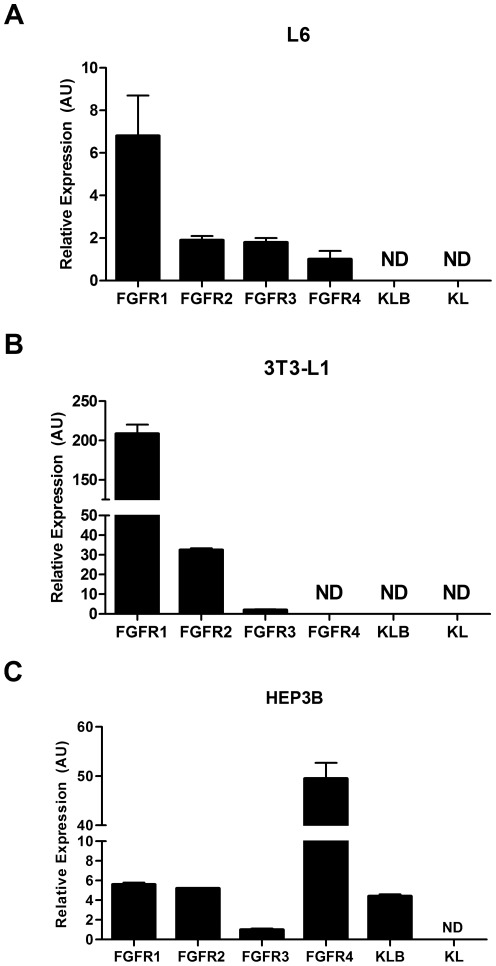
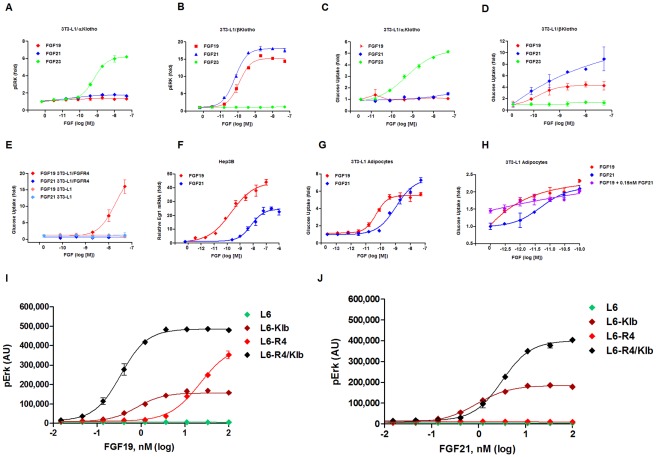
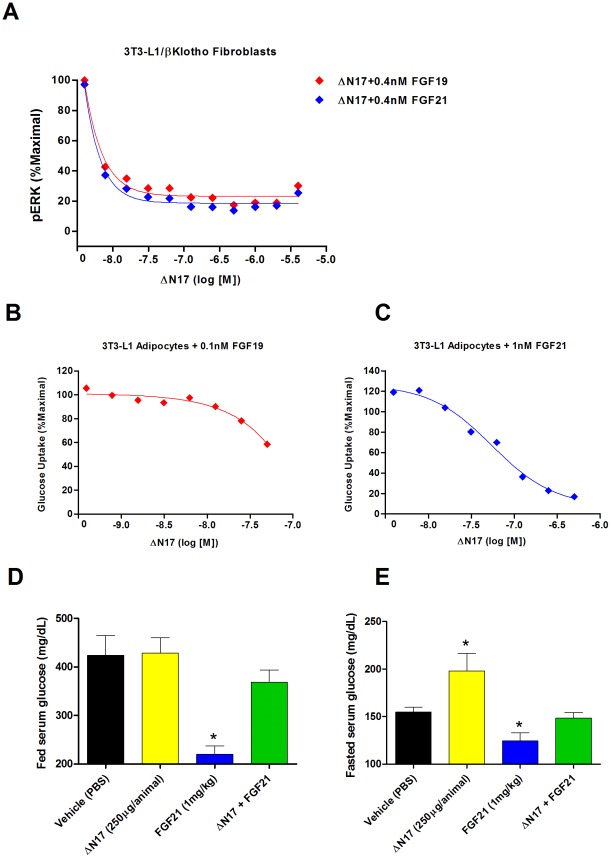
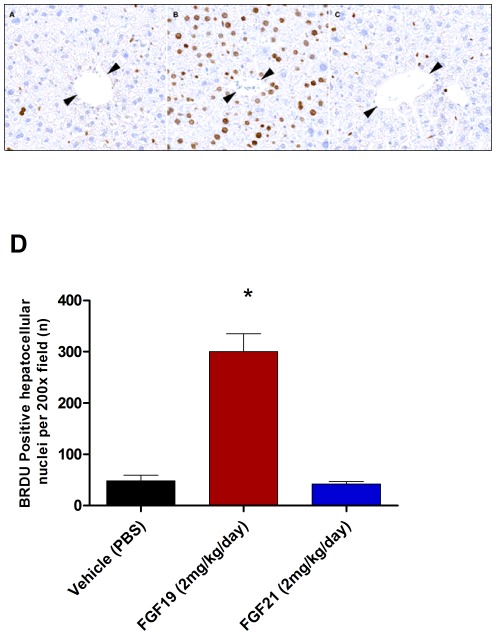
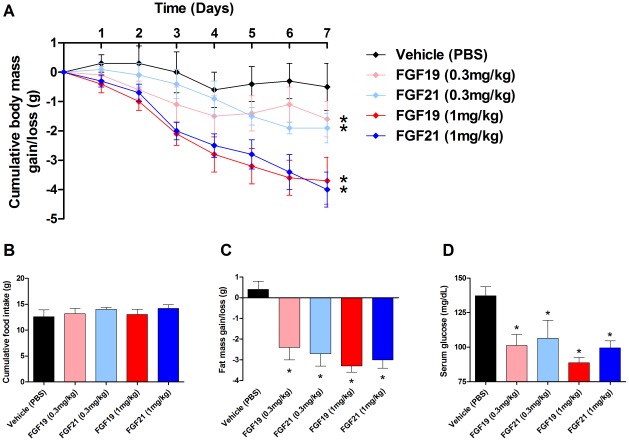
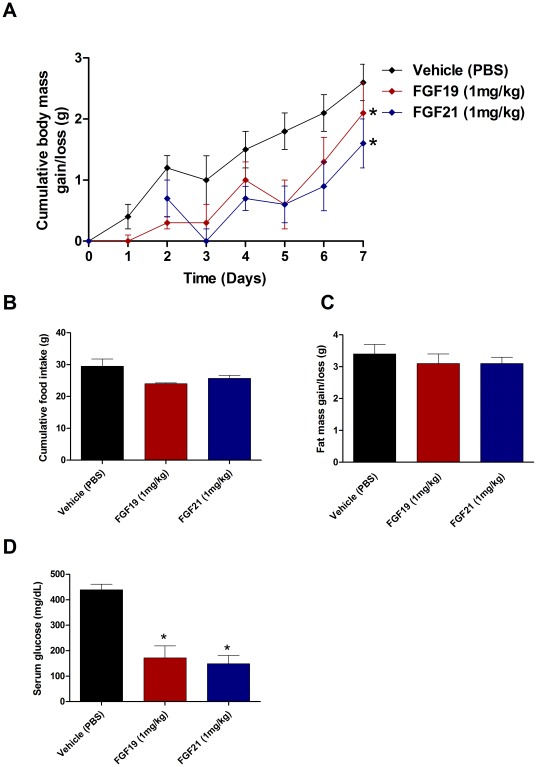
Fibroblast growth factors 19 (FGF19) and 21 (FGF21) have emerged as key regulators of energy metabolism. Several studies have been conducted to understand the mechanism of FGF19 and FGF21 action, however, the data presented has often been inconsistent and at times contradictory. Here in a single study we compare the mechanisms mediating FGF19/FGF21 actions, and how similarities/differences in actions at the cellular level between these two factors translate to common/divergent physiological outputs. Firstly, we show that in cell culture FGF19/FGF21 are very similar, however, key differences are still observed differentiating the two. In vitro we found that both FGF's activate FGFRs in the context of βKlotho (KLB) expression. Furthermore, both factors alter ERK phosphorylation and glucose uptake with comparable potency. Combination treatment of cells with both factors did not have additive effects and treatment with a competitive inhibitor, the FGF21 delta N17 mutant, also blocked FGF19's effects, suggestive of a shared receptor activation mechanism. The key differences between FGF21/FGF19 were noted at the receptor interaction level, specifically the unique ability of FGF19 to bind/signal directly via FGFR4. To determine if differential effects on energy homeostasis and hepatic mitogenicity exist we treated DIO and ob/ob mice with FGF19/FGF21. We find comparable efficacy of the two proteins to correct body weight and serum glucose in both DIO and ob/ob mice. Nevertheless, FGF21 and FGF19 had distinctly different effects on proliferation in the liver. Interestingly, in vivo blockade of FGF21 signaling in mice using ΔN17 caused profound changes in glycemia indicative of the critical role KLB and FGF21 play in the regulation of glucose homeostasis. Overall, our data demonstrate that while subtle differences exist in vitro the metabolic effects in vivo of FGF19/FGF21 are indistinguishable, supporting a shared mechanism of action for these two hormones in the regulation of energy balance.
Overview
The claims and statistics of this paper haven’t been checked yet.
Run the check — free, no account needed. It reads the open-access text and checks the sources it cites.
Integrity signals
Registry
Cites
Statistics
Figures
Verification
Claims the paper makes
The claims and statistics of this paper haven’t been checked yet.
Run the check — free, no account needed. It reads the open-access text and checks the sources it cites.
Claims other papers make about this one
Each is checked against this paper’s own text: does it say what the citing paper says it does?
In the citing paper
“In addition, disrupting leptin signaling using ob/ob or db/db mice abrogates the beneficial effects of FGF21 in lowering body weight in response to extended FGF21 administration (3, 45, 51, 67, 139).”
From Fibroblast Growth Factor 21: A Versatile Regulator of Metabolic Homeostasis (2018) · cites this paper as [3]
Self-check
Percentages, sums and reported differences re-computed from the paper’s own numbers.
The self-check needs the paper’s full text.
Citations
Cites
FGF-21 as a novel metabolic regulator
Kharitonenkov, A., Shiyanova, T. L., Koester, A., Ford, A. M., Micanovic, R., Galbreath, E. J., Sandusky, G. E., Hammond, L. J., Moyers, J. S., Owens, R. A., et al. (2005) · Journal of Clinical Investigation · doi:10.1172/jci23606 · Cited by 2,125
Self-citationKlotho converts canonical FGF receptor into a specific receptor for FGF23
Urakawa, I., Yamazaki, Y., Shimada, T., Iijima, K., Hasegawa, H., Okawa, K., Fujita, T., Fukumoto, S., & Yamashita, T. (2006) · Nature · doi:10.1038/nature05315 · Cited by 1,865
Inagaki, T., Dutchak, P., Zhao, G., Ding, X., Gautron, L., Parameswara, V., Li, Y., Goetz, R., Mohammadi, M., Esser, V., et al. (2007) · Cell Metabolism · doi:10.1016/j.cmet.2007.05.003 · Cited by 1,504
Badman, M. K., Pissios, P., Kennedy, A. R., Koukos, G., Flier, J. S., & Maratos-Flier, E. (2007) · Cell Metabolism · doi:10.1016/j.cmet.2007.05.002 · Cited by 1,495
Regulation of Fibroblast Growth Factor-23 Signaling by Klotho
Kurosu, H., Ogawa, Y., Miyoshi, M., Yamamoto, M., Nandi, A., Rosenblatt, K. P., Baum, M. G., Schiavi, S. C., Hu, M. C., Moe, O. W., et al. (2006) · Journal of Biological Chemistry · doi:10.1074/jbc.c500457200 · Cited by 1,381
Fibroblast Growth Factor 21 Corrects Obesity in Mice
Coskun, T., Bina, H. A., Schneider, M. A., Dunbar, J. D., Hu, C. C., Chen, Y., Moller, D. E., & Kharitonenkov, A. (2008) · Endocrinology · doi:10.1210/en.2008-0816 · Cited by 1,031
Self-citationObesity Is a Fibroblast Growth Factor 21 (FGF21)-Resistant State
Fisher, F. M., Chui, P. C., Antonellis, P. J., Bina, H. A., Kharitonenkov, A., Flier, J. S., & Maratos-Flier, E. (2010) · Diabetes · doi:10.2337/db10-0193 · Cited by 830
Self-citationKurosu, H., Choi, M., Ogawa, Y., Dickson, A. S., Goetz, R., Eliseenkova, A. V., Mohammadi, M., Rosenblatt, K. P., Kliewer, S. A., & Kuro-o, M. (2007) · Journal of Biological Chemistry · doi:10.1074/jbc.m704165200 · Cited by 748
Potthoff, M. J., Inagaki, T., Satapati, S., Ding, X., He, T., Goetz, R., Mohammadi, M., Finck, B. N., Mangelsdorf, D. J., Kliewer, S. A., et al. (2009) · Proceedings of the National Academy of Sciences · doi:10.1073/pnas.0904187106 · Cited by 704
βKlotho is required for metabolic activity of fibroblast growth factor 21
Ogawa, Y., Kurosu, H., Yamamoto, M., Nandi, A., Rosenblatt, K. P., Goetz, R., Eliseenkova, A. V., Mohammadi, M., & Kuro-o, M. (2007) · Proceedings of the National Academy of Sciences · doi:10.1073/pnas.0701600104 · Cited by 617
Cited by
Sorted by citations
Items 101–109 of 109
Qureshi, H. A. (2014) · Journal of Liver · doi:10.4172/2167-0889.1000158 · Cited by 4
The role of β-Klotho in FGF signaling: from molecular insights to therapeutic innovations
Yan, F., Yang, C., Huang, S., Yuan, L., Qiu, Y., Liu, T., Peng, X., & Yang, Y. (2026) · American Journal of Physiology-Endocrinology and Metabolism · doi:10.1152/ajpendo.00042.2026 · Cited by 4
Gastric bypass surgery mimetic approaches
Boettcher, B. R. (2017) · Drug Discovery Today · doi:10.1016/j.drudis.2017.04.009 · Cited by 3
Brunel, F. M., Parlee, S. D., Li, P., Lu, W., Chabenne, J. R., Pérez–Tilve, D., Finan, B., Kharitonenkov, A., & DiMarchi, R. D. (2026) · Biochemistry · doi:10.1021/acs.biochem.5c00820 · Cited by 2
Self-citationPlacing a Hex on Glucose Uptake
Bowman, F. M., Summers, S. A., & Holland, W. L. (2023) · Diabetes · doi:10.2337/dbi22-0040 · Cited by 2
A novel GLP-1and FGF21 fusion protein for the treatment of non-alcoholic steatohepatitis (NASH)
Zhang, Z., Ma, Y., Xie, C., He, Y., Wang, D., Song, H., Yuan, M., & Zhang, X. (2024) · Advanced Pharmaceutical Bulletin · doi:10.34172/apb.43672 · Cited by 1
Wäse, K., Bartels, T., Schwahn, U., & Kabiri, M. (2023) · Toxicologic Pathology · doi:10.1177/01926233231164097 · Cited by 1
Analyses of fibroblast growth factor signaling in lung fibrosis
MacKenzie, B., & Justus Liebig University Giessen (2013) · University writing server of the Justus Liebig University Giessen (Justus-Liebig-Universität Gießen) · doi:10.22029/jlupub-13923
Wean, J. (2021) · UKnowledge (University of Kentucky) · doi:10.13023/etd.2021.383
Metadata
- Authors
- Adams, A. C., Coskun, T., Irizarry Rovira, A. R., Schneider, M. A., Raches, D. W., Micanovic, R., Bina, H. A., Dunbar, J. D., & Kharitonenkov, A.
- Affiliations
- Eli Lilly (United States) (US)
- Corresponding author
- Kharitonenkov, Alexei
- Venue
- PLoS ONE
- Publisher
- Public Library of Science (PLoS)
- Published
- 2012-05-31
- Volume
- 7
- Issue
- 5
- Pages
- e38438
- ISSN
- 1932-6203 (ISSN-L)
- PMC
- PMC3365001
- OpenAlex
- W2050866090
- Cited by
- 109
- References
- 42
- Citations by year
- 2026: 2 · 2025: 2 · 2024: 5 · 2023: 6 · 2022: 7 · 2021: 9 · 2020: 6 · 2019: 7 · 2018: 9 · 2017: 8 · 2016: 9 · 2015: 10 · 2014: 10 · 2013: 14 · 2012: 5
- FWCI
- 5.02
- Type
- journal article
- Language
- en
- Open access
- gold
- doi.org
- Locations
- PLoS ONE (publishedVersion, cc-by)
- Europe PMC (PubMed Central) (publishedVersion, cc-by)
- PubMed Central (publishedVersion, cc-by)
- PubMed (publishedVersion)
- DOAJ (DOAJ: Directory of Open Access Journals) (submittedVersion)
- Topics
- Life Sciences › Biochemistry, Genetics and Molecular Biology › Molecular Biology › Fibroblast Growth Factor Research
- Health Sciences › Medicine › Nephrology › Parathyroid Disorders and Treatments
- Health Sciences › Medicine › Hepatology › Liver physiology and pathology
- Keywords
- FGF19, FGF21, fibroblast growth factor, FGFR4, β-Klotho, energy metabolism, glucose homeostasis, ERK1/2 phosphorylation, glucose uptake, obesity, ob/ob mice, high-fat diet
- MeSH terms
- Klotho Proteins, Animals, Body Weight, Cell Line, Eating, Fibroblast Growth Factors, Glucuronidase, Male, Mice, Inbred C57BL, Signal Transduction, Receptors, Fibroblast Growth Factor, Hepatocytes, Cell Proliferation, Mice
About these checks
Registry, retraction, Cites and statistics results are computed, not judged, with one exception: a printed reference that no index lists is read once by a model before it counts as a citation error. Claims are extracted by a model and kept only when their quote appears verbatim in the text; each cited source is then checked, with a model’s help, for whether it says what the claim relies on. Those verdicts can be wrong — read the claim’s quote and the cited source before relying on one.
Statistics and arithmetic are recomputed, not judged.
Confidence bands are shown only for fields calibrated on our annotated test set. None is calibrated yet, so no band is shown.
What counts as a claim ›How we measure confidence ›How we check this ›
Are you an author, or do you see a problem with this page? Request a review
