

PKC-Dependent Human Monocyte Adhesion Requires AMPK and Syk Activation
Open accessThe DOI matches its Crossref record; 45 of the 45 references it cites were found in a registry or an index.
Abstract
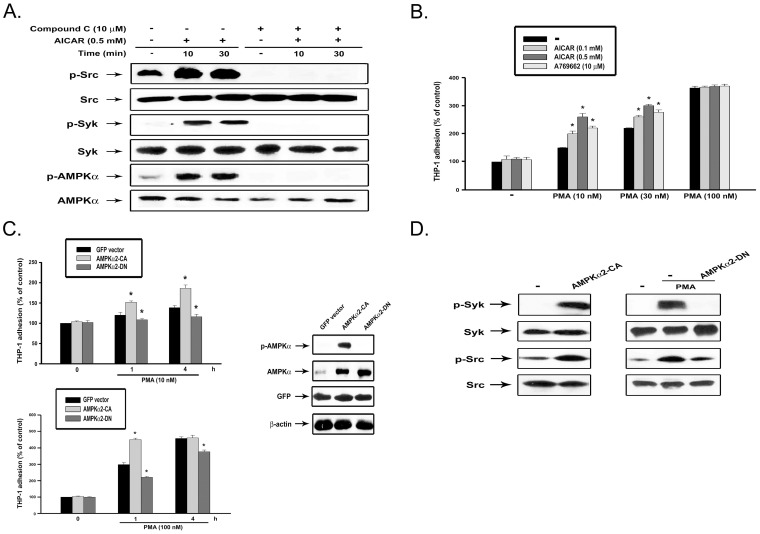
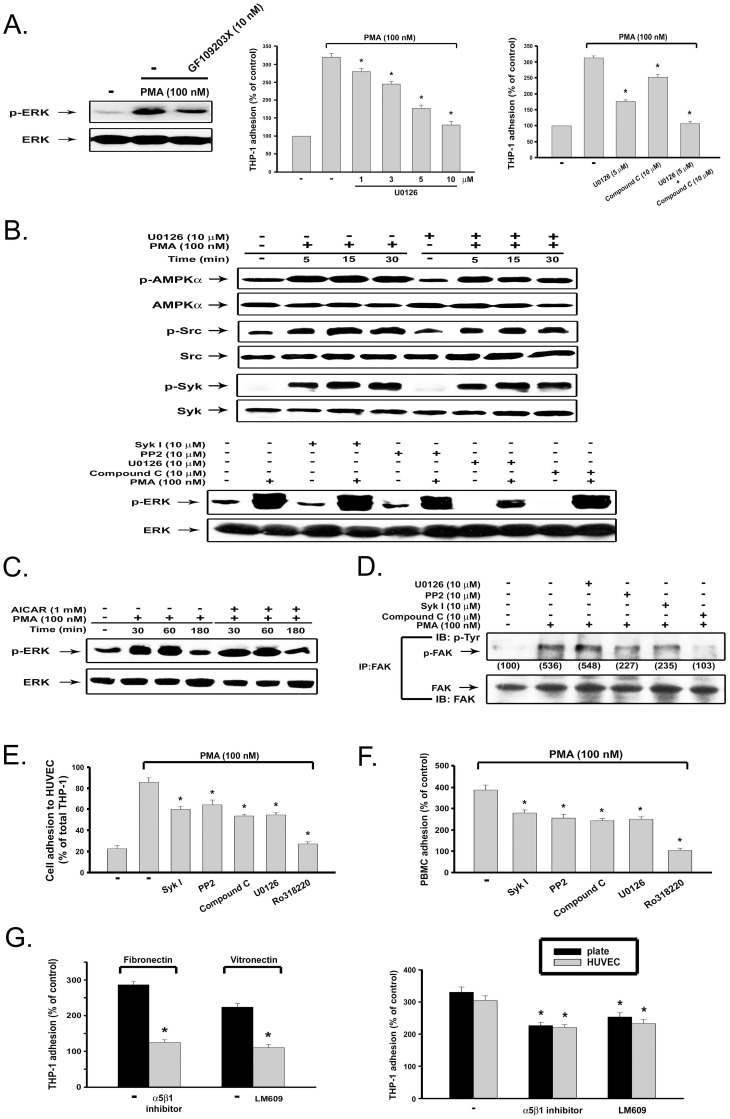
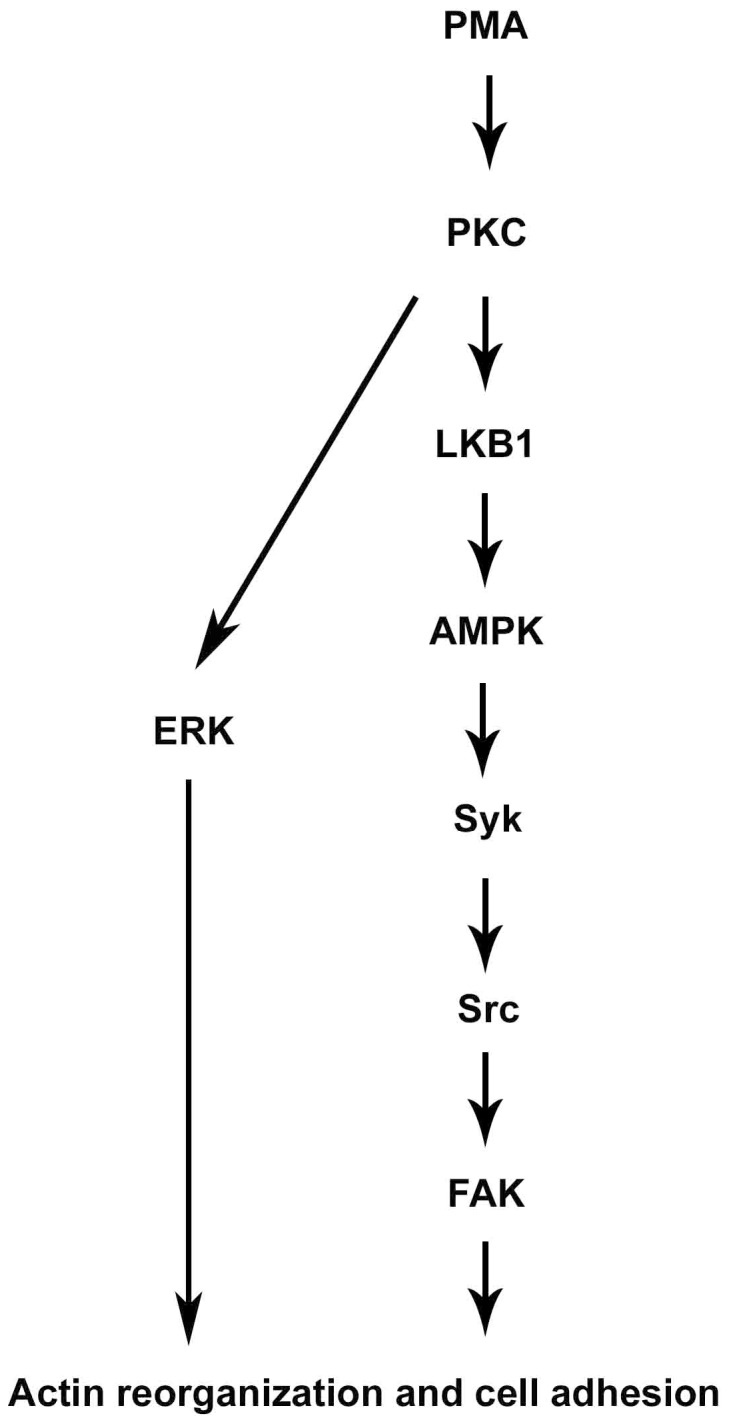
PKC plays a pivotal role in mediating monocyte adhesion; however, the underlying mechanisms of PKC-mediated cell adhesion are still unclear. In this study, we elucidated the signaling network of phorbol ester PMA-stimulated human monocyte adhesion. Our results with pharmacological inhibitors suggested the involvement of AMPK, Syk, Src and ERK in PKC-dependent adhesion of THP-1 monocytes to culture plates. Biochemical analysis further confirmed the ability of PMA to activate these kinases, as well as the involvement of AMPK-Syk-Src signaling in this event. Direct protein interaction between AMPK and Syk, which requires the kinase domain of AMPK and linker region of Syk, was observed following PMA stimulation. Notably, we identified Syk as a novel downstream target of AMPK; AICAR can induce Syk phosphorylation at Ser178 and activation of this kinase. However, activation of AMPK alone, either by stimulation with AICAR or by overexpression, is not sufficient to induce monocyte adhesion. Studies further demonstrated that PKC-mediated ERK signaling independent of AMPK activation is also involved in cell adhesion. Moreover, AMPK, Syk, Src and ERK signaling were also required for PMA to induce THP-1 cell adhesion to endothelial cells as well as to induce adhesion response of human primary monocytes. Taken together, we propose a bifurcated kinase signaling pathway involved in PMA-mediated adhesion of monocytes. PKC can activate LKB1/AMPK, leading to phosphorylation and activation of Syk, and subsequent activation of Src and FAK. In addition, PKC-dependent ERK activation induces a coordinated signal for cytoskeleton rearrangement and cell adhesion. For the first time we demonstrate Syk as a novel substrate target of AMPK, and shed new light on the role of AMPK in monocyte adhesion, in addition to its well identified functions in energy homeostasis.
Overview
The claims and statistics of this paper haven’t been checked yet.
Free: it reads the open-access text and checks the first 5 claims that cite a source we can check. Create a free account to check every claim.
Integrity signals
Registry
Cites
Statistics
Figures
Verification
Claims the paper makes
The claims and statistics of this paper haven’t been checked yet.
Free: it reads the open-access text and checks the first 5 claims that cite a source we can check. Create a free account to check every claim.
Claims other papers make about this one
Each is checked against this paper’s own text: does it say what the citing paper says it does?
The source backs part of the claim, not all of it — or backs it for a different population, condition or comparison.
In the citing paper
“Both these pathways have been implicated in the manipulation of cellular functions, such as adhesion, and in the control of herpesvirus infection and replication in target cells (15, 27, 28).”
From Equine Herpesvirus Type 1 Enhances Viral Replication in CD172a + Monocytic Cells upon Adhesion to Endothelial Cells (2015) · cites this paper as [27]
Experimental — accuracy not yet measuredThe check wasn’t confident either way, so it gives no verdict — never disputed.
In the citing paper
“Binding of herpesviruses to integrins is known to activate cellular pathways, including PI3K/Akt (PI3K stands for phosphatidylinositol 3-kinase and Akt for protein kinase B), one of the early events of integrinligand interaction, and the downstream ERK/MAPK (MAPK stands for mitogen-activated protein kinase and ERK for extracellular signal-regulated kinases).”
From Equine Herpesvirus Type 1 Enhances Viral Replication in CD172a + Monocytic Cells upon Adhesion to Endothelial Cells (2015) · cites this paper as [27]
Experimental — accuracy not yet measured
Self-check
Percentages, sums and reported differences re-computed from the paper’s own numbers.
The self-check needs the paper’s full text.
Citations
Cites
Steinberg, G. R., & Kemp, B. E. (2009) · Physiological Reviews · doi:10.1152/physrev.00011.2008 · Cited by 1,637 · cited 1×
“It has been demonstrated that AMPK functions as an intracellular energy sensor that is activated when cells experience energydepleting stresses [11,12].”
BackgroundThe SYK tyrosine kinase: A crucial player in diverse biological functions
Mócsai, A., Ruland, J., & Tybulewicz, V. L. J. (2010) · Nature Reviews Immunology · doi:10.1038/nri2765 · Cited by 1,368 · cited 2×
“Most findings propose that Syk is the upstream signal to induce PKC activation either indirectly via PLC activation or directly via physical interaction [2,7,24].”
BackgroundAMP-Activated Protein Kinase in Metabolic Control and Insulin Signaling
Towler, M. C., & Hardie, D. G. (2007) · Circulation Research · doi:10.1161/01.res.0000256090.42690.05 · Cited by 1,253 · cited 1×
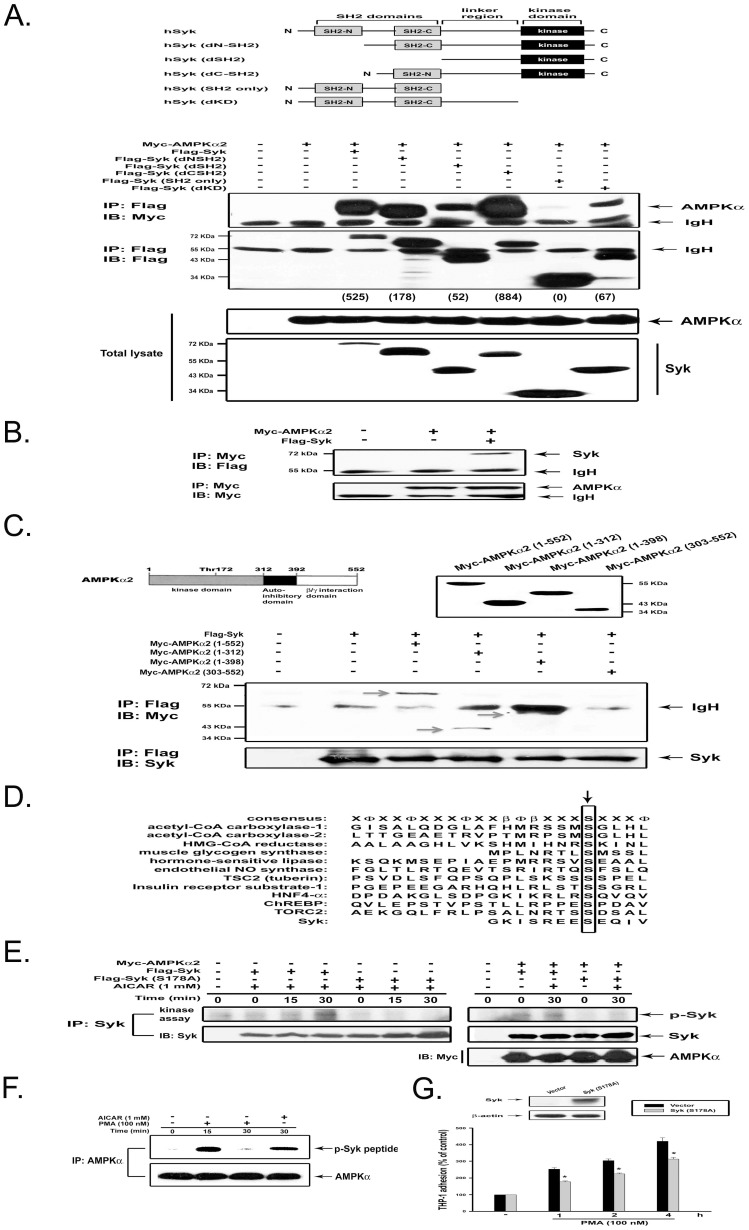
“After alignment of the consensus phosphorylation motif for AMPK and confirmation using variant synthetic peptides substrates [18,19], we predicted Syk might be phosphorylated by AMPK at Ser178 (Fig.”
MethodThe AMP-activated protein kinase pathway – new players upstream and downstream
Hardie, D. G. (2004) · Journal of Cell Science · doi:10.1242/jcs.01540 · Cited by 1,143 · cited 1×
“AMP-activated protein kinase (AMPK) is a heterotrimeric serine/threonine kinase composed of a catalytic alpha subunit and regulatory beta and gamma subunits [10].”
BackgroundAMPK: An Emerging Drug Target for Diabetes and the Metabolic Syndrome
Zhang, B. B., Zhou, G., & Li, C. (2009) · Cell Metabolism · doi:10.1016/j.cmet.2009.03.012 · Cited by 1,026 · cited 1×
“It has been demonstrated that AMPK functions as an intracellular energy sensor that is activated when cells experience energydepleting stresses [11,12].”
BackgroundThe Ca2+/Calmodulin-dependent Protein Kinase Kinases Are AMP-activated Protein Kinase Kinases
Hurley, R. L., Anderson, K. A., Franzone, J. M., Kemp, B. E., Means, A. R., & Witters, L. A. (2005) · Journal of Biological Chemistry · doi:10.1074/jbc.m503824200 · Cited by 1,018
Salminen, A., Hyttinen, J. M. T., & Kaarniranta, K. (2011) · Journal of Molecular Medicine · doi:10.1007/s00109-011-0748-0 · Cited by 866 · cited 1×
“In addition to its role in metabolic processes, AMPK is also implicated as an anti-inflammatory target [13,14].”
BackgroundSchwende, H., Fitzke, E., Ambs, P., & Dieter, P. (1996) · Journal of Leukocyte Biology · doi:10.1002/jlb.59.4.555 · Cited by 581 · cited 5×
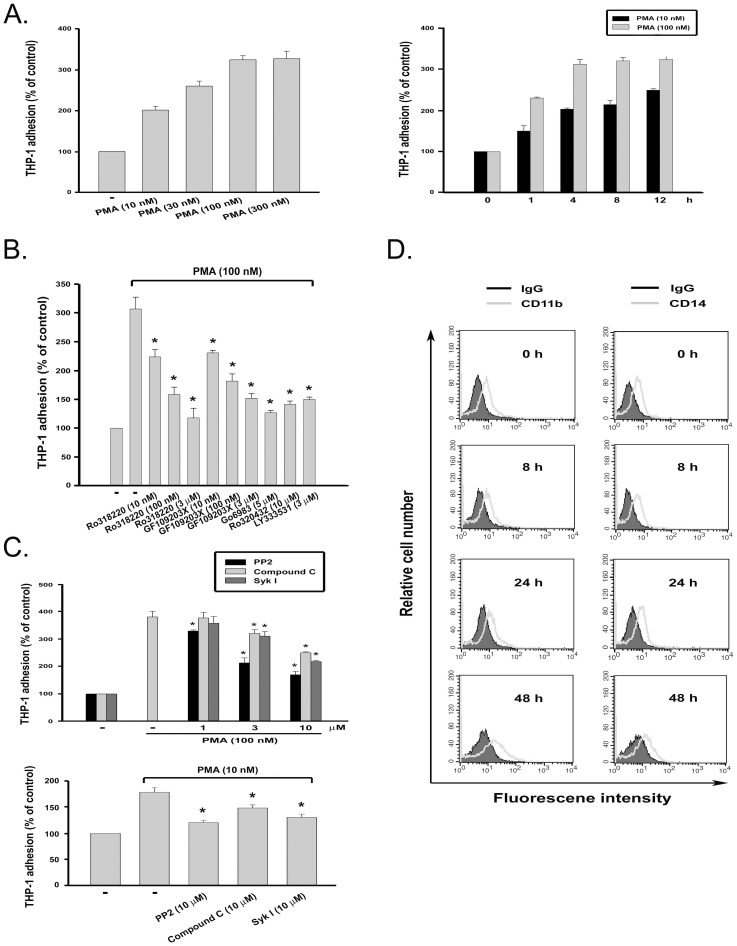
“(D) After PMA (100 nM) treatment for different periods, THP-1 cells were stained with control IgG conjugated with fluorochrome, FITC-conjugated CD11b, or PE-conjugated CD14 antibody for flow cytometry. doi:10.1371/journal.pone.0040999.g001 PLoS ONE | www.plosone.org 4 July 2012 | Volume 7 | Issue 7 | e40999 PLoS ONE |…”
BackgroundInfluentialTaniguchi, T., Kobayashi, T., Kondo, J., Takahashi, K., Nakamura, H., Suzuki, J., Nagai, K., Yamada, T., Nakamura, S., & Yamamura, H. (1991) · Journal of Biological Chemistry · doi:10.1016/s0021-9258(18)98478-4 · Cited by 436 · cited 1×
“comprising two N-terminal Src homology 2 (SH2) domains, a linker region, and one kinase domain in its C-terminal region [1].”
BackgroundExpression of Tie-2 by Human Monocytes and Their Responses to Angiopoietin-2
Murdoch, C., Tazzyman, S., Webster, S., & Lewis, C. E. (2007) · The Journal of Immunology · doi:10.4049/jimmunol.178.11.7405 · Cited by 318 · cited 1×
“Primary monocytes were prepared from the blood of healthy human donors and cultured in DMEM as described previously [45].”
Method
Cited by
Brozovich, F. V., Nicholson, C. J., Degen, C. V., Gao, Y. Z., Aggarwal, M., & Morgan, K. G. (2016) · Pharmacological Reviews · doi:10.1124/pr.115.010652 · Cited by 542
“…et al., 2005) and a PKC-mediated pathway will lead to the phosphorylation, or activation, of PYK2 and Src tyrosine kinases (Hodges et al., 2007; Chang et al., 2012), there is also evidence that receptor tyrosine kinases participate in the regulation of vascular tone. ephrin (EPH) kinases are…”
BackgroundBian, Z., Shi, L., Guo, Y.-L., Lv, Z., Tang, C., Niu, S., Tremblay, A., Venkataramani, M., Culpepper, C., Li, L., et al. (2016) · Proceedings of the National Academy of Sciences · doi:10.1073/pnas.1521069113 · Cited by 138
The Crosstalk Between Cell Adhesion and Cancer Metabolism
Sousa, B., Pereira, J., & Paredes, J. (2019) · International Journal of Molecular Sciences · doi:10.3390/ijms20081933 · Cited by 128
Cao, J., Han, Z., Tian, L., Chen, K., Fan, Y., Ye, B., Huang, W., Wang, C., & Huang, Z. (2014) · Journal of Translational Medicine · doi:10.1186/s12967-014-0266-2 · Cited by 85
Protein kinase C phosphorylates AMP-activated protein kinase α1 Ser487
Heathcote, H. R., Mancini, S. J., Strembitska, A., Jamal, K., Reihill, J. A., Palmer, T. M., Gould, G. W., & Salt, I. P. (2016) · Biochemical Journal · doi:10.1042/bcj20160211 · Cited by 73
Mechanisms linking mechanotransduction and cell metabolism
Salvi, A. M., & DeMali, K. A. (2018) · Current Opinion in Cell Biology · doi:10.1016/j.ceb.2018.05.004 · Cited by 79
“Indeed, AMPK is required for the reorganization of the actin cytoskeleton that supports monocyte adhesion to adhere to endothelial cells (Figure 3) [44].”
BackgroundSaisorn, W., Saithong, S., Phuengmaung, P., Udompornpitak, K., Bhunyakarnjanarat, T., Visitchanakun, P., Charoensappakit, A., Pisitkun, P., Chiewchengchol, D., & Leelahavanichkul, A. (2021) · Frontiers in Immunology · doi:10.3389/fimmu.2021.669162 · Cited by 59
“Because spleen tyrosine kinase (Syk) and nuclear factor kappa B (NFkB), a downstream signaling of Syk (68), are the possible shared Frontiers in Immunology | www.frontiersin.org 6 downstream signaling of PMA and LPS (20, 21, 69, 70), these molecules are explored.”
BackgroundResultInfluentialLinhares‐Lacerda, L., Temerozo, J. R., Alves, M. R., Azevedo, E. P., Mojoli, A., Nascimento, M. T. C., Silva-Oliveira, G., Savino, W., Foguel, D., Bou‐Habib, D. C., et al. (2020) · Scientific Reports · doi:10.1038/s41598-020-59486-2 · Cited by 53
EL‐Yazbi, A. F., Abd‐Elrahman, K. S., & Moreno‐Domínguez, A. (2015) · Biochemical Pharmacology · doi:10.1016/j.bcp.2015.04.011 · Cited by 50
de Llera, A. H., Martín‐Hidalgo, D., Gil, M. C., García, L. J., & Bragado, M. J. (2014) · Biology of Reproduction · doi:10.1095/biolreprod.113.112797 · Cited by 52
“The observation that PMA stimulates AMPK phosphorylation had been previously reported in somatic cells [51], where it has also been demonstrated that AMPK is not a substrate for PKC.”
BackgroundNidogen-2 is a Novel Endogenous Ligand of LGR4 to Inhibit Vascular Calcification
Chen, Y., Mao, C., Gu, R., Zhao, R., Li, W., Ma, Z., Jia, Y., Yu, F., Luo, J., Fu, Y., et al. (2022) · Circulation Research · doi:10.1161/circresaha.122.321614 · Cited by 48
Laval, K., Favoreel, H. W., Poelaert, K. C. K., Van Cleemput, J., & Nauwynck, H. J. (2015) · Journal of Virology · doi:10.1128/jvi.01589-15 · Cited by 44
Zawrotniak, M., Bartnicka, D., & Rapala-Kozik, M. (2019) · Journal of Photochemistry and Photobiology B Biology · doi:10.1016/j.jphotobiol.2019.111511 · Cited by 41
Shen, J., Zhan, Y.-C., Li, H.-Y., & Wang, Z. (2019) · Acta Pharmacologica Sinica · doi:10.1038/s41401-019-0290-0 · Cited by 46
“Another study also showed that AMPK contributes to Src activation in endothelial cells or THP-1 monocytes [9, 33].”
BackgroundHudson, G., Flannigan, K. L., Venu, V. K. P., Alston, L. A., Sandall, C. F., MacDonald, J. A., Muruve, D. A., Chang, T. K. H., Mani, S., & Hirota, S. A. (2019) · Journal of Pharmacology and Experimental Therapeutics · doi:10.1124/jpet.118.255679 · Cited by 39
“To assess the role of Src-family kinases (SFKs) in the induction of ATP release, we used 4-Amino-5-(4-chlorophenyl)-7-(t-butyl)pyrazolo[3,4-d]pyrimidine (PP2) (10 mM) (Chang et al., 2012) (Sigma-Aldrich Canada).”
MethodInfluentialChen, K., Hsu, H., Yang, H., Tian, Y., Ko, Y.-C., Yang, C.-W., & Hung, C. (2016) · The International Journal of Biochemistry & Cell Biology · doi:10.1016/j.biocel.2016.03.001 · Cited by 35
The KSHV K1 Protein Modulates AMPK Function to Enhance Cell Survival
Anders, P., Zhang, Z., Bhende, P. M., Giffin, L., & Damania, B. (2016) · PLoS Pathogens · doi:10.1371/journal.ppat.1005985 · Cited by 35
Wen, H.-C., Huo, Y., Chou, C., & Lee, W. (2018) · Scientific Reports · doi:10.1038/s41598-018-34548-8 · Cited by 37
Paradoxical activation of AMPK by glucose drives selective EP300 activity in colorectal cancer
Gutiérrez-Salmerón, M., García-Martínez, J. M., Martínez‐Useros, J., Fernández‐Aceñero, M. J., Viollet, B., Olivier, S., Chauhan, J. S., Lucena, S. R., la Vieja, A. D., Goding, C. R., et al. (2020) · PLoS Biology · doi:10.1371/journal.pbio.3000732 · Cited by 30
“Nevertheless, in some cell types, PKC may induce pEP300 (S89) indirectly through AMPK activation as shown in monocytes [49].”
BackgroundSun, H., Zhang, L., Fan, Z. ‐., Chen, D., Zhang, L., Gao, X., Kang, Y., & Zhu, G. (2013) · Acta Physiologica · doi:10.1111/apha.12188 · Cited by 31
“The intensity of the colour was measured in a microplate reader (ELX800, BioTek, Vermont, USA) at 450 nm (Triantafyllou et al. 2011, Chang et al. 2012, Ji et al. 2012).”
MethodWu, S.-E., & Miller, W. E. (2016) · Virology · doi:10.1016/j.virol.2016.07.025 · Cited by 34
“We chose to include the PKC inhibitor in our investigations because PKC is a downstream mediator of PLC-β signaling/IP3 accumulation and because PKC activity has been previously shown to promote monocyte adhesion (Chang et al., 2012).”
BackgroundYang, K., Wang, X., Liu, Z., Lu, L., Mao, J., Meng, H., Wang, Y., Hu, Y. H., Zeng, Y. Z., Zhang, X., et al. (2015) · Circulation Journal · doi:10.1253/circj.cj-15-0345 · Cited by 30
Comparison of anti-inflammatory mechanisms between doxofylline and theophylline in human monocytes
Talmon, M., Massara, E., Brunini, C., & Fresu, L. G. (2019) · Pulmonary Pharmacology & Therapeutics · doi:10.1016/j.pupt.2019.101851 · Cited by 25
Blanco, A., Coronado, R. A., Arun, N., Ma, K., Dar, R. D., & Kieffer, C. (2024) · Proceedings of the National Academy of Sciences · doi:10.1073/pnas.2313823121 · Cited by 27
Tvedt, T. H. A., Nepstad, I., & Bruserud, Ø. (2016) · Expert Opinion on Investigational Drugs · doi:10.1080/13543784.2017.1275564 · Cited by 26
“VEGF increases GM-CSF release from endothelial cells [32] Src family of kinases Experimental studies suggest that Src activation is important in angiogenesis/tube formation [99] SRC family kinases are important for CXCL12induced migration of endothelial progenitor cells [54] Syk is important for β2-integrin signaling;…”
BackgroundLPS Induces mTORC1 and mTORC2 Activation During Monocyte Adhesion
Ribeiro, M. C., Peruchetti, D. B., Silva, L. S., Silva‐Filho, J. L., de Souza, M. C., Henriques, M. D. G., Caruso‐Neves, C., & Pinheiro, A. A. S. (2018) · Frontiers in Molecular Biosciences · doi:10.3389/fmolb.2018.00067 · Cited by 24
“Accordingly, it was shown that phorbol esters, such as PMA (extensively used as a PKC activator), induces monocyte adhesion and differentiation into macrophages (Tsuchiya et al., 1982; Chang et al., 2012).”
BackgroundMukherjee, S., Graber, J. H., & Moore, C. L. (2023) · Frontiers in Immunology · doi:10.3389/fimmu.2023.1091403 · Cited by 21
“As 103 observed previously (37, 38), these cells also displayed increased attachment and no longer 104 proliferated after PMA treatment (Fig.”
Lodge, R., Gilmore, J. C., Barbosa, J. F., Lombard‐Vadnais, F., & Cohen, É. A. (2017) · Viruses · doi:10.3390/v10010013 · Cited by 22
“PMA used to induce THP-1 differentiation has been reported to enhance NF-κB-driven genes [51], such as the one encoding miR-221/miR-222.”
BackgroundMethodA role for spleen tyrosine kinase in renal fibrosis in the mouse obstructed kidney
Ma, F. Y., Blease, K., & Nikolic‐Paterson, D. J. (2016) · Life Sciences · doi:10.1016/j.lfs.2016.01.023 · Cited by 19
Marino, M., Bo’, C. D., Tucci, M., Venturi, S., Mantegazza, G., Taverniti, V., Möller, P., Riso, P., & Porrini, M. (2021) · European Journal of Nutrition · doi:10.1007/s00394-021-02714-w · Cited by 16
Jayaprakash, K., Demirel, I., Günaltay, S., Khalaf, H., & Bengtsson, T. (2017) · Apmis · doi:10.1111/apm.12701 · Cited by 14
Wu, Y., Shen, K., & Johnson, S. W. (2017) · European Journal of Neuroscience · doi:10.1111/ejn.13756 · Cited by 14
“Furthermore, PKC has been shown to activate AMPK in monocytes (Chang et al., 2012).”
BackgroundPavulraj, S., Kamel, M., Stephanowitz, H., Liu, F., Plendl, J., Osterrieder, N., & Azab, W. (2020) · Viruses · doi:10.3390/v12090999 · Cited by 13
“MAPK pathway is involved in the manipulation of cellular functions such as signal transduction, cell adhesion, virus replication in target cells, and cell survival [90,91].”
BackgroundEroles, M., Alonso, J. L., Ortega, A., Boudier, T., Gharzeddine, K., Lafont, F., Franz, C. M., Millet, A., Valotteau, C., & Rico, F. (2023) · Nanoscale · doi:10.1039/d3nr00757j · Cited by 17
Chiou, E., & Zennadi, R. (2015) · The International Journal of Biochemistry & Cell Biology · doi:10.1016/j.biocel.2015.05.013 · Cited by 12
Bhattacharya, A., Ghosh, P., Singh, A., Ghosh, A., Bhowmick, A., Sinha, D. K., Ghosh, A., & Sen, P. (2021) · Cellular Signalling · doi:10.1016/j.cellsig.2021.110150 · Cited by 9
Biological activities of interleukin (IL)-21 in human monocytes and macrophages
Vallières, F., Durocher, I., & Girard, D. (2019) · Cellular Immunology · doi:10.1016/j.cellimm.2019.02.002 · Cited by 9
El-Sisi, M. G., Radwan, S. M., Saeed, A. M., & EL-Mesallamy, H. O. (2021) · Molecular and Cellular Biochemistry · doi:10.1007/s11010-020-04030-z · Cited by 8
The role of biogenic amines in the modulation of monocytes in autoimmune neuroinflammation
Belousova, O., Lopatina, A., Kuzmina, U. S., & Melnikov, M. (2023) · Multiple Sclerosis and Related Disorders · doi:10.1016/j.msard.2023.104920 · Cited by 10
Song, S., Li, X., Geng, C., Guo, Y., Yang, Y., & Wang, C. (2023) · Frontiers in Pharmacology · doi:10.3389/fphar.2023.1171512 · Cited by 6
Tsai, J., Chuang, L., Chen, C., Liang, C., Chen, Y., & Chen, C. (2014) · Mediators of Inflammation · doi:10.1155/2014/726068 · Cited by 8
“Consistent with the previous study, AMPK phosphorylation was involved in the inhibition of monocyte adhesion [38].”
ResultOxidative modifications control aberrant tyrosine kinase activity
Schulan, P., Wende, K., von Woedtke, T., Weltmann, K., Bekeschus, S., & Clemen, R. (2024) · Biointerphases · doi:10.1116/6.0003970 · Cited by 6
Wong, T. Y., Tan, Y. Q., Lin, S., & Leung, L. K. (2016) · The International Journal of Biochemistry & Cell Biology · doi:10.1016/j.biocel.2016.03.010 · Cited by 6
“PMA is capable of activating AMPK in monocyte differntiation (Cao et al., 2014) and adhesion (Chang et al., 2012).”
BackgroundLee, H., Huang, D.-Y., Chang, H., Lin, C.-Y., Ren, W.-Y., Dai, Y., & Lin, W. (2022) · Frontiers in Pharmacology · doi:10.3389/fphar.2022.763678 · Cited by 7
Self-citationModelling the Sorafenib-resistant Liver Cancer Microenvironment by Using 3-D Spheroids
Sarıyar, E., & Karagonlar, Z. F. (2023) · Alternatives to Laboratory Animals · doi:10.1177/02611929231193421 · Cited by 8
“It is known that phorbol 12myristate 13-acetate (PMA) treatment activates protein kinase C (PKC), induces adhesion and stimulates macrophage differentiation in THP-1 cells.(31,32) CD68 is a cell surface glycoprotein that is highly expressed in macrophages and other mononuclear phagocytes.”
BackgroundMetabolic Pathways of Eukaryotes and Connection to Cell Mechanics
Mierke, C. T. (2020) · Biological and medical physics, biomedical engineering · doi:10.1007/978-3-030-58532-7_17 · Cited by 2
Tm, S., Васильевич, П. В., Николаевич, Ш. А., & Fi, E. (2017) · Medical Immunology (Russia) · doi:10.15789/1563-0625-2017-1-27-34 · Cited by 3
Lteif, M., Abratanska, S., Turbica, I., & Pallardy, M. J. (2026) · European Journal of Pharmaceutics and Biopharmaceutics · doi:10.1016/j.ejpb.2026.114990 · Cited by 2
Li, P., Yin, X. H., Wen, X., Li, X., Wang, Y., Zhan, H., Che, H., Yao, C., Hou, Q., Zhang, Z., et al. (2025) · Frontiers in Immunology · doi:10.3389/fimmu.2025.1524491 · Cited by 4
Srivastava, K., & Bayraktutan, U. (2017) · Research Portal (Queen's University Belfast) · Cited by 2
The Intersection of Anoikis Resistance and Fatty Acid Metabolism in Cancer
Bapat, J., & Bitler, B. G. (2021) · Springer eBooks · doi:10.1007/978-3-030-73856-3_3 · Cited by 1
Tm, S., Васильевич, П. В., Николаевич, Ш. А., Rudneva, I. A., Тимофеева, Т. А., Рафаиловна, К. Р., Masalova, O. V., & Aa, K. (2018) · Russian Journal of Infection and Immunity · doi:10.15789/2220-7619-2018-1-25-32
Saisorn, W. (2020) · Chula Digiverse · doi:10.58837/chula.the.2020.312
“In addition, ROS activity was correlated with apoptotic assay because ROS are generated via the NADPH oxidase, which is necessary for phosphatidylserine exposure during PMA and LPS-induced cell death (149, 150).”
Method
Metadata
- Authors
- Chang, M.-Y., Huang, D.-Y., Ho, F.-M., Huang, K.-C., & Lin, W.-W.
- Affiliations
- National Taiwan University (TW)
- China Medical University (TW)
- National Taiwan University Hospital (TW)
- Corresponding author
- Lin, Wan-Wan
- Venue
- PLoS ONE
- Publisher
- Public Library of Science (PLoS)
- Published
- 2012-07-25
- Volume
- 7
- Issue
- 7
- Pages
- e40999
- ISSN
- 1932-6203 (ISSN-L)
- PMC
- PMC3405105
- OpenAlex
- W2049709955
- Cited by
- 54
- References
- 45
- Citations by year
- 2026: 1 · 2025: 1 · 2024: 2 · 2023: 6 · 2022: 2 · 2021: 5 · 2020: 5 · 2019: 6 · 2018: 4 · 2017: 5 · 2016: 9 · 2015: 4 · 2014: 3 · 2013: 1
- FWCI
- 1.03
- Type
- journal article
- Language
- en
- Open access
- gold
- doi.org
- Locations
- PLoS ONE (publishedVersion, cc-by)
- Europe PMC (PubMed Central) (publishedVersion, cc-by)
- PubMed Central (publishedVersion, cc-by)
- PubMed (publishedVersion)
- DOAJ (DOAJ: Directory of Open Access Journals) (submittedVersion, cc-by-sa)
- Funders
- National Science Council (NSC 100-2314-B-002-075)
- National Health Research Institutes (NHRI-EX100-10052SI)
- Topics
- Life Sciences › Biochemistry, Genetics and Molecular Biology › Molecular Biology › Protein Kinase Regulation and GTPase Signaling
- Health Sciences › Medicine › Immunology and Allergy › Cell Adhesion Molecules Research
- Life Sciences › Biochemistry, Genetics and Molecular Biology › Molecular Biology › Metabolism, Diabetes, and Cancer
- Keywords
- monocyte adhesion, protein kinase C, AMPK, Syk, Src kinase, ERK signaling, LKB1, AICAR, THP-1 cells, endothelial cells, focal adhesion kinase, cytoskeleton rearrangement, kinase signaling pathways
- MeSH terms
- Syk Kinase, AMP-Activated Protein Kinase Kinases, Carcinogens, Cell Adhesion, Cell Line, Cytoskeleton, Energy Metabolism, Enzyme Activation, Humans, Monocytes, Protein Kinase C, Protein-Tyrosine Kinases, Tetradecanoylphorbol Acetate, Protein Serine-Threonine Kinases, src-Family Kinases, MAP Kinase Signaling System, Intracellular Signaling Peptides and Proteins, AMP-Activated Protein Kinases
About these checks
Registry, retraction, Cites and statistics results are computed, not judged, with one exception: a printed reference that no index lists is read once by a model before it counts as a citation error. Claims are extracted by a model and kept only when their quote appears verbatim in the text; each cited source is then checked, with a model’s help, for whether it says what the claim relies on. Those verdicts can be wrong — read the claim’s quote and the cited source before relying on one.
Statistics and arithmetic are recomputed, not judged.
Confidence bands are shown only for fields calibrated on our annotated test set. None is calibrated yet, so no band is shown.
What counts as a claim ›How we measure confidence ›How we check this ›
Are you an author, or do you see a problem with this page? Request a review
Data sources
Bibliographic data: Semantic Scholar, OpenAlex, Crossref.
Contains information from the Semantic Scholar Academic Graph Datasets, made available under the ODC Attribution License (ODC-BY 1.0).
Semantic Scholar’s data is described in: Kinney, R., et al. (2023). The Semantic Scholar Open Data Platform. arXiv:2301.10140.
