

Innate Immune Dysfunctions in Aged Mice Facilitate the Systemic Dissemination of Methicillin-Resistant S. aureus
Open accessThe DOI matches its Crossref record; 39 of the 39 references it cites were found in a registry or an index.
Abstract
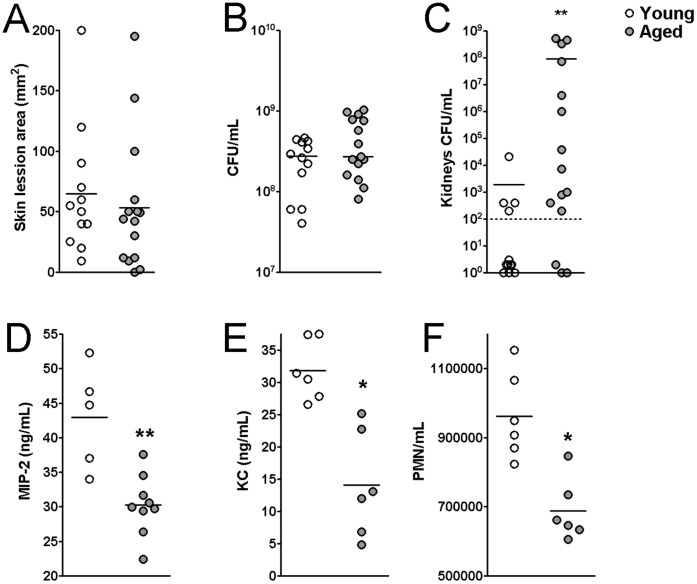
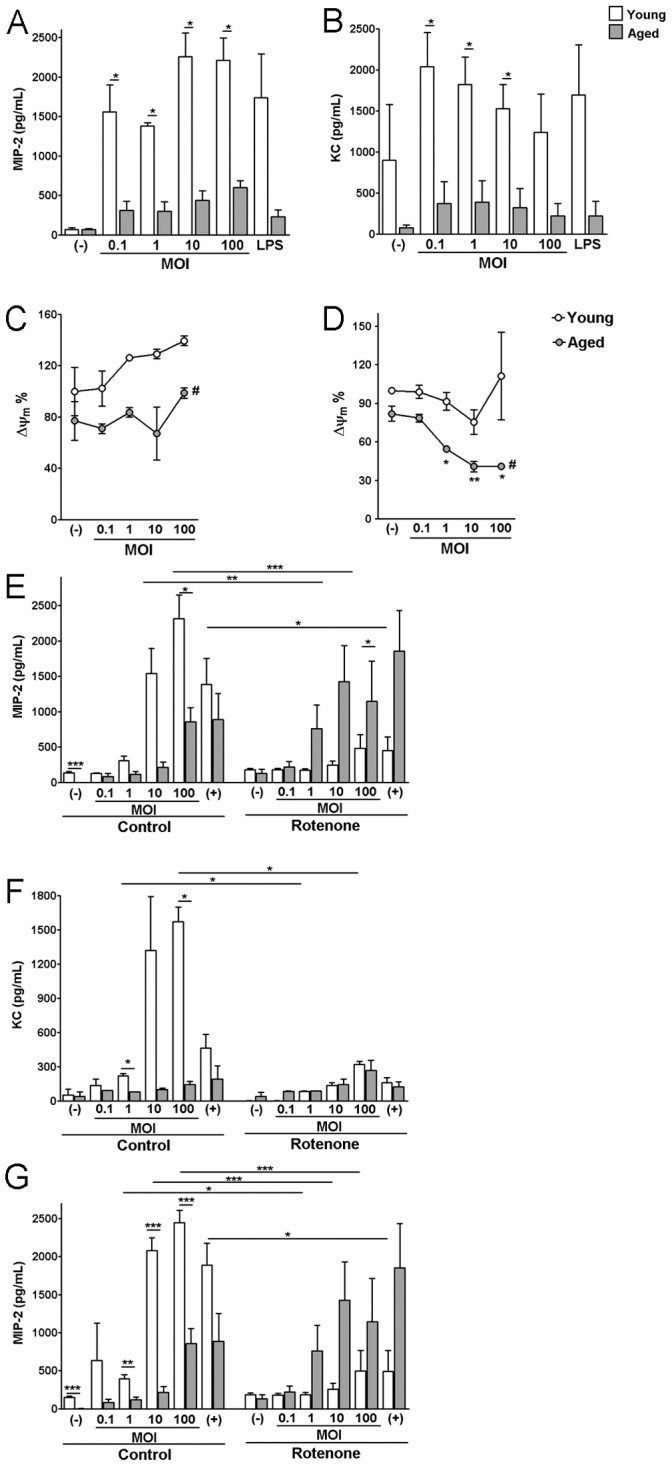
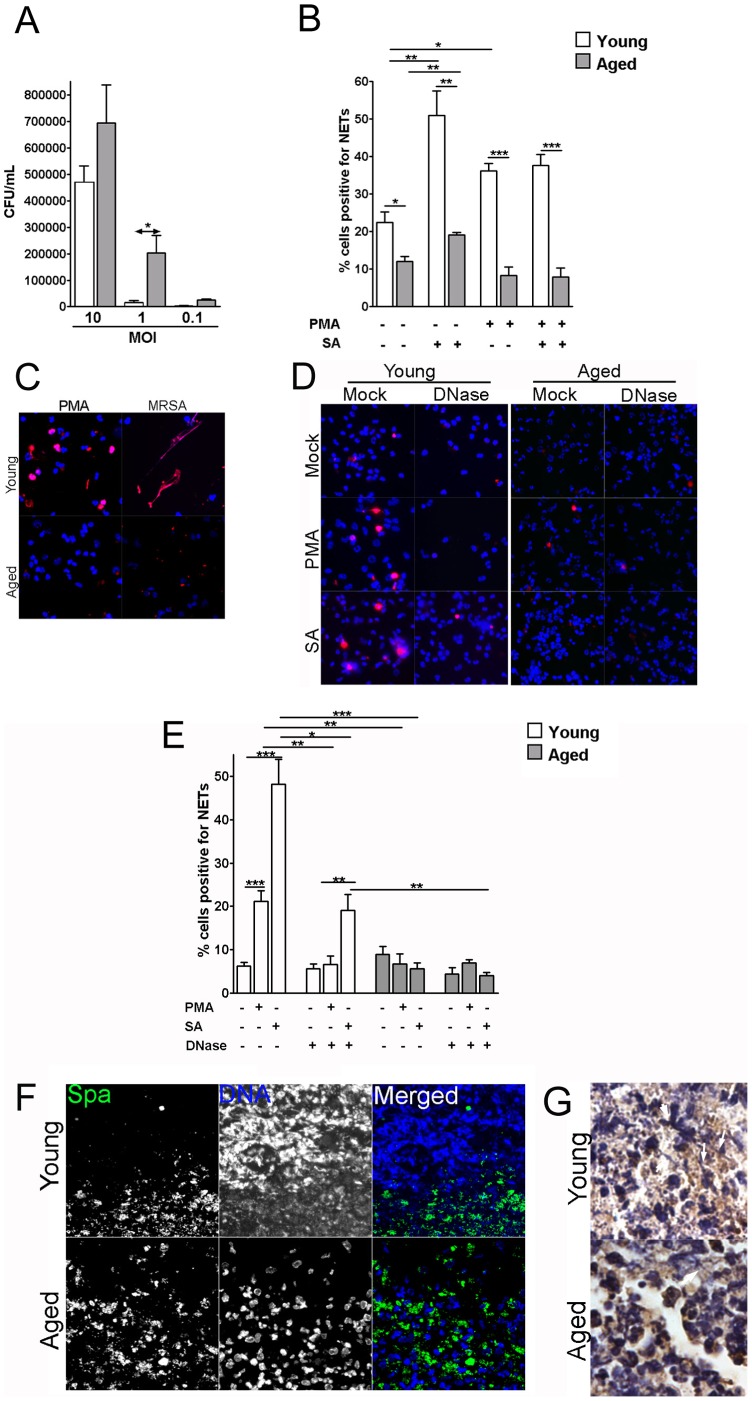
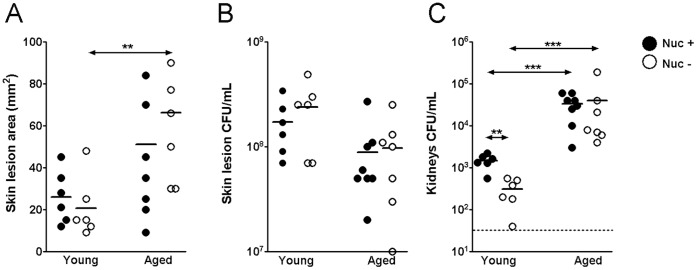
Elderly humans show increased susceptibility to invasive staphylococcal disease after skin and soft tissue infection. However, it is not understood how host immunity changes with aging, and how that predisposes to invasive disease. In a model of severe skin infection, we showed that aged mice (16- to 20-month-old) exhibit dramatic bacterial dissemination compared with young adult mice (2-month-old). Bacterial dissemination was associated with significant reductions of CXCL1 (KC), polymorphonuclear cells (PMNs), and extracellular DNA traps (NETs) at the infection site. PMNs and primary skin fibroblasts isolated from aged mice showed decreased secretion of CXCL2 (MIP-2) and KC in response to MRSA, and in vitro analyses of mitochondrial functions revealed that the mitochondrial electron transport chain complex I plays a significant role in induction of chemokines in the cells isolated from young but not old mice. Additionally, PMNs isolated from aged mice have reduced ability to form NETs and to kill MRSA. Expression of nuclease by S. aureus led to increased bacterial systemic dissemination in young but not old mice, suggesting that defective NETs formation in elderly mice permitted nuclease and non-nuclease expressing S. aureus to disseminate equally well. Overall, these findings suggest that gross impairment of both skin barrier function and innate immunity contributes to the propensity for MRSA to disseminate in aged mice. Furthermore, the study indicates that contribution of bacterial factors to pathogenicity may vary with host age.
Overview
The claims and statistics of this paper haven’t been checked yet.
Free: it reads the open-access text and checks the first 5 claims that cite a source we can check. Create a free account to check every claim.
Integrity signals
Registry
Cites
Statistics
Figures
Verification
Claims the paper makes
The claims and statistics of this paper haven’t been checked yet.
Free: it reads the open-access text and checks the first 5 claims that cite a source we can check. Create a free account to check every claim.
Claims other papers make about this one
Each is checked against this paper’s own text: does it say what the citing paper says it does?
In the citing paper
“in mice, neutrophils from aged animals also display a reduced capability to form neutrophil extracellular traps (NETs) in a model of severe skin infection by Staphylococcus aureus [43].”
From Aging of the immune system: Focus on inflammation and vaccination (2016) · cites this paper as [43]
Self-check
Percentages, sums and reported differences re-computed from the paper’s own numbers.
The self-check needs the paper’s full text.
Citations
Cites
Neutrophil Extracellular Traps Kill Bacteria
Brinkmann, V., Reichard, U., Goosmann, C., Fauler, B., Uhlemann, Y., Weiss, D. S., Weinrauch, Y., & Zychlinsky, A. (2004) · Science · doi:10.1126/science.1092385 · Cited by 10,268 · cited 3×
“invading organisms and prevents them from systemic dissemination [10].”
BackgroundDefective LPS Signaling in C3H/HeJ and C57BL/10ScCr Mice: Mutations in Tlr4 Gene
Poltorak, A., He, X., Smirnova, I., Liu, M.-Y., Huffel, C. V., Du, X., Birdwell, D., Alejos, E., Silva, M., Galanos, C., et al. (1998) · Science · doi:10.1126/science.282.5396.2085 · Cited by 7,631
Klevens, R. M. (2007) · JAMA · doi:10.1001/jama.298.15.1763 · Cited by 3,726 · cited 2×
“Age-dependent immune changes are likely to contribute to the increased incidence of severe infections [2], and based on epidemiologic studies, the elderly population is more prone to invasive MRSA disease [3].”
BackgroundExtracellular DNA traps promote thrombosis
Fuchs, T. A., Brill, A., Duerschmied, D., Schatzberg, D., Monestier, M., Myers, D. D., Wrobleski, S. K., Wakefield, T. W., Hartwig, J. H., & Wagner, D. D. (2010) · Proceedings of the National Academy of Sciences · doi:10.1073/pnas.1005743107 · Cited by 2,492 · cited 1×
“NETs were visualized using a modified established protocol [38].”
MethodPlatelet TLR4 activates neutrophil extracellular traps to ensnare bacteria in septic blood
Clark, S. R., Ma, A. C., Tavener, S. A., McDonald, B., Goodarzi, Z., Kelly, M. M., Patel, K. D., Chakrabarti, S., McAvoy, E., Sinclair, G. D., et al. (2007) · Nature Medicine · doi:10.1038/nm1565 · Cited by 2,309 · cited 2×
“clear cells (PMNs) form neutrophil extracellular DNA traps (NETs) containing DNA, histone, granule enzymes, and antimicrobial components [10,11,12].”
BackgroundCutting edge: impaired toll-like receptor expression and function in aging
Renshaw, M., Rockwell, J., Engleman, C., Gewirtz, A., Katz, J., & Sambhara, S. (2002) · The Journal of Immunology · doi:10.4049/jimmunol.169.9.4697 · Cited by 626 · cited 3×
“An in vitro study of murine peritoneal macrophages attributes the decreased level of inflammation in elderly to lower levels of Toll-like receptors (TLR) expression on cell surfaces [8], suggesting that innate immune activation decreases with aging.”
BackgroundResultInfluentialNuclease Expression by Staphylococcus aureus Facilitates Escape from Neutrophil Extracellular Traps
Berends, E. T. M., Horswill, A. R., Haste, N. M., Monestier, M., Nizet, V., & von Köckritz-Blickwede, M. (2010) · Journal of Innate Immunity · doi:10.1159/000319909 · Cited by 487 · cited 2×
“Prior studies have shown that nuclease expression by pathogens leads to destruction of NETs and facilitates systemic dissemination of the bacteria [13,24,25,26].”
BackgroundEffect of age on human neutrophil function
Wenisch, C., Patruta, S., Daxböck, F., Krause, R., & Hörl, W. (2000) · Journal of Leukocyte Biology · doi:10.1002/jlb.67.1.40 · Cited by 450 · cited 1×
“Prior studies have demonstrated that immune cells from elderly subjects, compared to cells isolated from young subjects, exhibit reduced chemotaxis, phagocytosis, and respiratory burst activity in response to bacterial infection [5,6,7].”
BackgroundInflammation and endothelial dysfunction during aging: role of NF-κB
Csiszar, A., Wang, M., Lakatta, E. G., & Ungvari, Z. (2008) · Journal of Applied Physiology · doi:10.1152/japplphysiol.90470.2008 · Cited by 441 · cited 1×
“Furthermore, decline in cellular and inflammatory responses has been shown to be associated with dysfunction of mitochondria in cells isolated from aged hosts [9].”
BackgroundDNase Sda1 provides selection pressure for a switch to invasive group A streptococcal infection
Walker, M. J., Hollands, A., Sanderson-Smith, M. L., Cole, J. N., Kirk, J. K., Henningham, A., McArthur, J. D., Dinkla, K., Aziz, R. K., Kansal, R. G., et al. (2007) · Nature Medicine · doi:10.1038/nm1612 · Cited by 426 · cited 3×
“Prior studies have shown that nuclease expression by pathogens leads to destruction of NETs and facilitates systemic dissemination of the bacteria [13,24,25,26].”
Background
Cited by
Items 101–113 of 113
Heterochronic Parabiosis Studies of the Aging Immune System
Davies, J. (2016) · UA Campus Repository (The University of Arizona)
The Effects of Mechanical Ventilation on Neutrophil Extracellular Trap Formation
Yildiz, C. (2013) · TSpace (University of Toronto)
Age-Related Dysfunction in the Innate Immune Response to Lung Infections
Boe, D. M., Chen, M. M., & Kovacs, E. J. (2018) · Springer eBooks · doi:10.1007/978-3-319-64597-1_91-1
Age-Related Changes in the Murine Immune System
Nikolich‐Žugich, J., Contreras, N. A., Coplen, C. P., & Jeftic, I. D. (2019) · Springer eBooks · doi:10.1007/978-3-319-69892-2_67-1
Age-Related Changes in the Murine Immune System
Nikolich‐Žugich, J., Contreras, N. A., Coplen, C. P., & Jeftic, I. D. (2021) · Springer eBooks · doi:10.1007/978-3-030-22009-9_67
Bashir, S., Wilson, M., Ashiru-Oredope, D. A. I., & Murdan, S. (2023) · AAPS advances in the pharmaceutical sciences series · doi:10.1007/978-3-031-35811-1_9
Reduced efficacy of an anti-toxin vaccine from senescence-driven attenuation of toxin virulence
Du, X., Tseng, C.-W., Bjånes, E., Gage, H. L., Swan, J., Tsai, C., Hajam, I. A., Gonzalez, C., Lin, B. J., Nizet, V., et al. (2026) · JCI Insight · doi:10.1172/jci.insight.199834 · Cited by 1
“Similarly, our prior work demonstrated that S . aureus nuclease lost immune evasion function in aged mice because of reduced neutrophil extracellular trap (NET) formation (26).”
Self-citationSommer, C., Reamon-Buettner, S. M., Niehof, M., Hildebrand, C. B., Braun, A., Sewald, K., Dehmel, S., & Brandenberger, C. (2024) · Figshare · doi:10.6084/m9.figshare.26660729
Sommer, C., Reamon-Buettner, S. M., Niehof, M., Hildebrand, C. B., Braun, A., Sewald, K., Dehmel, S., & Brandenberger, C. (2024) · Figshare · doi:10.6084/m9.figshare.26660726
Abdullah, G. A., Walsh, J., Sellin, A., McLean, C., Akpan, A., Phelan, M. M., & Wright, H. L. (2025) · medRxiv · doi:10.64898/2025.12.16.25342352
Mazzoleni, V. (2020) · theses.fr (ABES) · doi:10.70675/e88b84afzf8b6z49cczb855z7c96c25470a2 · Cited by 2
Infection and sensitization reveal stimulus-specific immune remodeling in aged skinPreprint
Severn, M. M., Voigt, A. Y., Dhinakaran, A. K., Yang, R., Aiken, E. S., Kang, S., Jalili‐Firoozinezhad, S., & Oh, J. (2026) · bioRxiv (Cold Spring Harbor Laboratory) · doi:10.64898/2026.09.03.749212
Hieber, C., Grabbe, S., & Bros, M. (2026) · Cells · doi:10.3390/cells15201852
“The ability to form these NETs in response to pathogen challenge, termed NETosis, has been shown to be impaired in aged mice [22].”
Metadata
- Authors
- Tseng, C. W., Kyme, P. A., Arruda, A., Ramanujan, V. K., Tawackoli, W., & Liu, G. Y.
- Affiliations
- Cedars-Sinai Medical Center (US)
- Corresponding author
- Tseng, Ching Wen
- Liu, George Y.
- Venue
- PLoS ONE
- Publisher
- Public Library of Science (PLoS)
- Published
- 2012-07-26
- Volume
- 7
- Issue
- 7
- Pages
- e41454
- ISSN
- 1932-6203 (ISSN-L)
- PMC
- PMC3406035
- OpenAlex
- W2019107501
- Cited by
- 112
- References
- 39
- Citations by year
- 2026: 5 · 2025: 6 · 2024: 8 · 2023: 5 · 2022: 11 · 2021: 16 · 2020: 6 · 2019: 9 · 2018: 7 · 2017: 9 · 2016: 10 · 2015: 10 · 2014: 6 · 2013: 4
- FWCI
- 2.78
- Type
- journal article
- Language
- en
- Open access
- gold
- doi.org
- Locations
- PLoS ONE (publishedVersion, cc-by)
- Europe PMC (PubMed Central) (publishedVersion, cc-by)
- PubMed Central (publishedVersion, cc-by)
- PubMed (publishedVersion)
- DOAJ (DOAJ: Directory of Open Access Journals) (submittedVersion)
- Figshare (submittedVersion, cc-by)
- Funders
- Cedars-Sinai Medical Center
- Medical Research and Materiel Command
- Telemedicine and Advanced Technology Research Center
- Topics
- Life Sciences › Immunology and Microbiology › Immunology › Neutrophil, Myeloperoxidase and Oxidative Mechanisms
- Health Sciences › Medicine › Infectious Diseases › Antimicrobial Resistance in Staphylococcus
- Life Sciences › Immunology and Microbiology › Immunology › Immune Response and Inflammation
- Keywords
- methicillin-resistant Staphylococcus aureus, aging, innate immunity, systemic dissemination, skin and soft tissue infections, neutrophils, extracellular DNA traps, CXCL1, CXCL2, chemokine secretion, mitochondrial complex I, skin barrier function, host-pathogen interaction
- MeSH terms
- Aging, Animals, Deoxyribonucleases, Extracellular Space, Female, Immunity, Innate, Male, Neutrophils, Chemokines, Virulence Factors, Electron Transport Complex I, Mice, Methicillin-Resistant Staphylococcus aureus
About these checks
Registry, retraction, Cites and statistics results are computed, not judged, with one exception: a printed reference that no index lists is read once by a model before it counts as a citation error. Claims are extracted by a model and kept only when their quote appears verbatim in the text; each cited source is then checked, with a model’s help, for whether it says what the claim relies on. Those verdicts can be wrong — read the claim’s quote and the cited source before relying on one.
Statistics and arithmetic are recomputed, not judged.
Confidence bands are shown only for fields calibrated on our annotated test set. None is calibrated yet, so no band is shown.
What counts as a claim ›How we measure confidence ›How we check this ›
Are you an author, or do you see a problem with this page? Request a review
Data sources
Bibliographic data: Semantic Scholar, OpenAlex, Crossref.
Contains information from the Semantic Scholar Academic Graph Datasets, made available under the ODC Attribution License (ODC-BY 1.0).
Semantic Scholar’s data is described in: Kinney, R., et al. (2023). The Semantic Scholar Open Data Platform. arXiv:2301.10140.
