

Associations between Pathogens in the Upper Respiratory Tract of Young Children: Interplay between Viruses and Bacteria
Open accessThe DOI matches its Crossref record; 43 of the 43 references it cites were found in a registry or an index.
Abstract
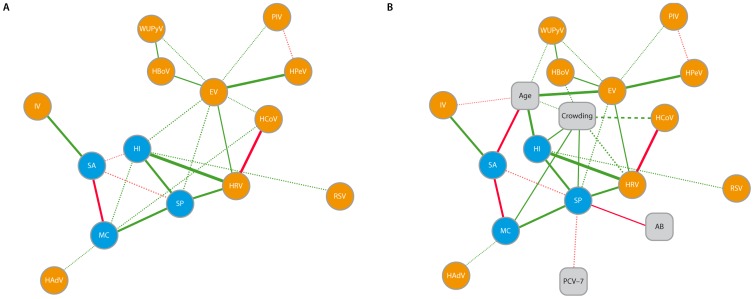
BACKGROUND: High rates of potentially pathogenic bacteria and respiratory viruses can be detected in the upper respiratory tract of healthy children. Investigating presence of and associations between these pathogens in healthy individuals is still a rather unexplored field of research, but may have implications for interpreting findings during disease. METHODOLOGY/PRINCIPAL FINDINGS: We selected 986 nasopharyngeal samples from 433 6- to 24-month-old healthy children that had participated in a randomized controlled trial. We determined the presence of 20 common respiratory viruses using real-time PCR. Streptococcus pneumoniae, Haemophilus influenzae, Moraxella catarrhalis and Staphylococcus aureus were identified by conventional culture methods. Information on risk factors was obtained by questionnaires. We performed multivariate logistic regression analyses followed by partial correlation analysis to identify the overall pattern of associations. S. pneumoniae colonization was positively associated with the presence of H. influenzae (adjusted odds ratio 1.60, 95% confidence interval 1.18-2.16), M. catarrhalis (1.78, 1.29-2.47), human rhinoviruses (1.63, 1.19-2.22) and enteroviruses (1.97, 1.26-3.10), and negatively associated with S. aureus presence (0.59, 0.35-0.98). H. influenzae was positively associated with human rhinoviruses (1.63, 1.22-2.18) and respiratory syncytial viruses (2.78, 1.06-7.28). M. catarrhalis colonization was positively associated with coronaviruses (1.99, 1.01-3.93) and adenoviruses (3.69, 1.29-10.56), and negatively with S. aureus carriage (0.42, 0.25-0.69). We observed a strong positive association between S. aureus and influenza viruses (4.87, 1.59-14.89). In addition, human rhinoviruses and enteroviruses were positively correlated (2.40, 1.66-3.47), as were enteroviruses and human bocavirus, WU polyomavirus, parainfluenza viruses, and human parechovirus. A negative association was observed between human rhinoviruses and coronaviruses. CONCLUSIONS/SIGNIFICANCE: Our data revealed high viral and bacterial prevalence rates and distinct bacterial-bacterial, viral-bacterial and viral-viral associations in healthy children, hinting towards the complexity and potential dynamics of microbial communities in the upper respiratory tract. This warrants careful consideration when associating microbial presence with specific respiratory diseases.
Overview
The claims and statistics of this paper haven’t been checked yet.
Free: it reads the open-access text and checks the first 5 claims that cite a source we can check. Create a free account to check every claim.
Integrity signals
Registry
Cites
Statistics
Figures
Verification
Claims the paper makes
The claims and statistics of this paper haven’t been checked yet.
Free: it reads the open-access text and checks the first 5 claims that cite a source we can check. Create a free account to check every claim.
Claims other papers make about this one
Each is checked against this paper’s own text: does it say what the citing paper says it does?
The source backs part of the claim, not all of it — or backs it for a different population, condition or comparison.
In the citing paper
“These studies have reported an overall detection rate of 67% for respiratory viruses in healthy asymptomatic children, including human rhinovirus (HRV), human bocavirus, polyomaviruses, human adenovirus and human coronavirus31,53.”
From The microbiota of the respiratory tract: gatekeeper to respiratory health (2017) · cites this paper as [53]
Experimental — accuracy not yet measuredThe cited source says what the claim attributes to it.
In the citing paper
“In addition to bacterial inhabitants, PCR-based studies suggest the extensive presence of viral pathogens in the URT.”
From The microbiota of the respiratory tract: gatekeeper to respiratory health (2017) · cites this paper as [53]
The cited source says what the claim attributes to it.
In the citing paper
“H. influenzae was positively associated with hRV and RSV;”
From Respiratory viral infection-induced microbiome alterations and secondary bacterial pneumonia. (2018) · cites this paper as [112]
In the citing paper
“Another study examining the presence of 20 respiratory viruses by PCR panel and prevalence of bacterial carriage in the nasopharynx of children found a strong positive association between S. aureus colonization and influenza virus (112).”
From Respiratory viral infection-induced microbiome alterations and secondary bacterial pneumonia. (2018) · cites this paper as [112]
In the citing paper
“Moreover, S. pneumoniae colonization was positively associated with the presence of hRV and enteroviruses;”
From Respiratory viral infection-induced microbiome alterations and secondary bacterial pneumonia. (2018) · cites this paper as [112]
1 more claim about this paper
Create a free account to see every claim other papers make about this one.
Self-check
Percentages, sums and reported differences re-computed from the paper’s own numbers.
The self-check needs the paper’s full text.
Citations
Cites
Models for Longitudinal Data: A Generalized Estimating Equation Approach
Zeger, S. L., Liang, K.-Y., & Albert, P. S. (1988) · Biometrics · doi:10.2307/2531734 · Cited by 4,505 · cited 1×
“We verified our primary analyses using a repeated measurements model taking more than one measurement per child into account using generalized linear models with an autoregressive correlation structure [19].”
MethodReview: a gentle introduction to imputation of missing values.
Donders, A. R. T., van der Heijden, G. J. M. G., Stijnen, T., & Moons, K. G. M. (2006) · Journal of Clinical Epidemiology · doi:10.1016/j.jclinepi.2006.01.014 · Cited by 2,582
Integration of biological networks and gene expression data using Cytoscape
Cline, M. S., Smoot, M., Cerami, E., Kuchinsky, A., Landys, N., Workman, C., Christmas, R., Avila-Campilo, I., Creech, M., Gross, B., et al. (2007) · Nature Protocols · doi:10.1038/nprot.2007.324 · Cited by 2,507 · cited 1×
“This analysis was performed in software package R 2.7 (function cor2por [package for R; available at: http://cran.r-project.org/ web/packages/corpcor/index.html]) and visualized using the complex network analysis in Cytoscape (version 2.7) [20] .”
MethodInfluentialStreptococcus pneumoniae colonisation: the key to pneumococcal disease
Bogaert, D., de Groot, R., & Hermans, P. (2004) · The Lancet Infectious Diseases · doi:10.1016/s1473-3099(04)00938-7 · Cited by 1,929 · cited 4×
“A balance in its polymicrobial composition and diversity is assumed to be important for maintenance of a healthy state [4],[6].”
BackgroundInfluentialSelf-citationMicrobial community structure and its functional implications
Fuhrman, J. A. (2009) · Nature · doi:10.1038/nature08058 · Cited by 1,382 · cited 1×
“The latter enables a helicopter-view of possible interrelations between microbes in a complex community, simultaneously correcting for the influence of important epidemiologic and environmental determinants [21].”
BackgroundSequence-based identification of microbial pathogens: a reconsideration of Koch's postulates
Fredericks, D. N., & Relman, D. A. (1996) · Clinical Microbiology Reviews · doi:10.1128/cmr.9.1.18 · Cited by 944 · cited 1×
“Koch's original postulates, designed to link one causative microbe to one specific disease, have been subject to reconsideration since they were formulated in 1884 [1] [2] [3] .”
BackgroundWhat are the consequences of the disappearing human microbiota?
Blaser, M. J., & Falkow, S. (2009) · Nature Reviews Microbiology · doi:10.1038/nrmicro2245 · Cited by 855 · cited 1×
“In a balanced state, this bacterial ecosystem is assumed to be beneficial for health, for example by stimulating the immune system and functioning as a protective barrier against invading pathogens [7].”
BackgroundShifting the balance: antibiotic effects on host–microbiota mutualism
Willing, B. P., Russell, S. L., & Finlay, B. B. (2011) · Nature Reviews Microbiology · doi:10.1038/nrmicro2536 · Cited by 747 · cited 1×
“Research on microbiota of the intestinal tract has made clear that symbiotic bacteria are co-dependent because of shared metabolic pathways [33].”
BackgroundIntestinal Microbiota Promote Enteric Virus Replication and Systemic Pathogenesis
Kuss, S. K., Best, G. T., Etheredge, C. A., Pruijssers, A. J., Frierson, J. M., Hooper, L. V., Dermody, T. S., & Pfeiffer, J. K. (2011) · Science · doi:10.1126/science.1211057 · Cited by 629 · cited 1×
“For example, interdependence between viruses and bacteria occurring in the gut was recently described: some viruses cover themselves with molecules from bacterial residents to make a viral infection possible [37],[38].”
BackgroundColonisation by Streptococcus pneumoniae and Staphylococcus aureus in healthy children
Bogaert, D., van Belkum, A., Sluijter, M., Luijendijk, A., de Groot, R., Rümke, H., Verbrugh, H., & Hermans, P. (2004) · The Lancet · doi:10.1016/s0140-6736(04)16357-5 · Cited by 592 · cited 1×
“aureus during nasopharyngeal carriage was confirmed in the present study [12],[25],[26].”
ResultSelf-citation
Cited by
Items 201–208 of 208
Hoong, A. T. C., Ramzi, N. H., Johari, N. A., Lai, P. K., Simone, W., Chang, X. Q., Lin, E., Lum, X. R., Roslan, A. A., Nathan, A. M., et al. (2026) · BMC Infectious Diseases · doi:10.1186/s12879-026-12800-1
“Our findings support prior studies showing that SPN and HI frequently co-exist together in children [14, 15], especially among those with severe pneumonia [10].”
Host-pathogens interactions during RSV / S. pneumoniae infection immune response and p53 pathway
Machado, D. B. B. (2017) · theses.fr (ABES) · doi:10.70675/3b4a9038z62abz41fcz8fa8zd0dbd4dcbfe4
“Perturbation of this equilibrium, by the emergence of a pathogen and/or imbalance of the host immunity, can constitute the starting point of respiratory diseases [2, 26, 138].”
BackgroundMorgene, M. F. (2018) · theses.fr (ABES) · doi:10.70675/b0196800za02fz441eza108z5f55bfa12952 · Cited by 2
Chen, J., Wang, H., Li, Y., Xiao, Y., Yan, Y., Zhang, Y., & Lu, X. (2026) · Pathogens · doi:10.3390/pathogens15060628
“Multiple-positive results may reflect mixed infection, sequential infection, colonization or residual shedding, and may require clinical interpretation rather than automatic treatment escalation [74].”
Artificial Intelligence–Driven Graph Methods for Microbiome Research: A Systematic Review
Shum-Tim, C., Islam, P., Boyajian, J. L., Abosalha, A. K., Kassab, A., Santos, M., Khan, K. A., Stern, K., Emad, A., & Prakash, S. (2026) · WIREs Mechanisms of Disease · doi:10.1002/wsbm.70016
“…2023; Labus et al. 2019; Ma, Wang, et al. 2020; Vandeputte et al. 2017; Galli and Fasanelli 2020; Larsen and Claassen 2018; Richards et al. 2014; van den Bergh et al. 2012; Mac Aogain et al. 2021; Kuntal et al. 2019; Champion et al. 2024; Ciucci et al. 2017; Bernstein et al. 2019; Ban et al.…”
Neue und seltene pneumotrope Viren
Ringshausen, F. C., & Rohde, G. G. U. (2013) · Der Pneumologe · doi:10.1007/s10405-013-0675-6
“Pneu mokokken) eine bedeutende Rolle spielen [8, 40, 42] .”
Background
Metadata
- Authors
- van den Bergh, M. R., Biesbroek, G., Rossen, J. W. A., de Steenhuijsen Piters, W. A. A., Bosch, A. A. T. M., van Gils, E. J. M., Wang, X., Boonacker, C. W. B., Veenhoven, R. H., Bruin, J. P., Bogaert, D., & Sanders, E. A. M.
- Affiliations
- University Medical Center Utrecht (NL)
- Elisabeth-TweeSteden Ziekenhuis (NL)
- Spaarne Ziekenhuis (NL)
- Corresponding author
- Bogaert, Debby
- Venue
- PLoS ONE
- Publisher
- Public Library of Science (PLoS)
- Published
- 2012-10-17
- Volume
- 7
- Issue
- 10
- Pages
- e47711
- ISSN
- 1932-6203 (ISSN-L)
- PMC
- PMC3474735
- OpenAlex
- W1985164700
- Cited by
- 208
- References
- 43
- Citations by year
- 2026: 7 · 2025: 9 · 2024: 4 · 2023: 11 · 2022: 10 · 2021: 21 · 2020: 10 · 2019: 14 · 2018: 18 · 2017: 22 · 2016: 21 · 2015: 23 · 2014: 25 · 2013: 11 · 2012: 1
- FWCI
- 14.55
- Type
- journal article
- Language
- en
- Open access
- gold
- doi.org
- Locations
- PLoS ONE (publishedVersion, cc-by)
- Europe PMC (PubMed Central) (publishedVersion, cc-by)
- PubMed Central (publishedVersion, cc-by)
- PubMed (publishedVersion)
- University of Groningen research database (University of Groningen / Centre for Information Technology) (publishedVersion, cc-by)
- Figshare (submittedVersion, cc-by)
- DOAJ (DOAJ: Directory of Open Access Journals) (submittedVersion, cc-by-sa)
- University of Groningen research database (University of Groningen / Centre for Information Technology) (submittedVersion, cc-by)
- Funders
- Pfizer
- GlaxoSmithKline
- ZonMw (91610121, 91209010)
- Nederlandse Organisatie voor Wetenschappelijk Onderzoek
- Topics
- Health Sciences › Medicine › Epidemiology › Respiratory viral infections research
- Health Sciences › Medicine › Epidemiology › Pneumonia and Respiratory Infections
- Health Sciences › Medicine › Pediatrics, Perinatology and Child Health › Pediatric health and respiratory diseases
- Keywords
- upper respiratory tract colonization, young children, respiratory viruses, respiratory tract bacteria, Streptococcus pneumoniae, Haemophilus influenzae, Moraxella catarrhalis, Staphylococcus aureus, human rhinovirus, enterovirus, respiratory syncytial virus, influenza virus, adenovirus, coronavirus, co-infection, healthy children, nasopharynx
- MeSH terms
- Bacteria, Child, Preschool, Female, Humans, Infant, Male, Nasopharynx, Respiratory System, Respiratory Tract Infections, Risk Factors, Viruses, Colony Count, Microbial, Odds Ratio, Microbial Interactions
About these checks
Registry, retraction, Cites and statistics results are computed, not judged, with one exception: a printed reference that no index lists is read once by a model before it counts as a citation error. Claims are extracted by a model and kept only when their quote appears verbatim in the text; each cited source is then checked, with a model’s help, for whether it says what the claim relies on. Those verdicts can be wrong — read the claim’s quote and the cited source before relying on one.
Statistics and arithmetic are recomputed, not judged.
Confidence bands are shown only for fields calibrated on our annotated test set. None is calibrated yet, so no band is shown.
What counts as a claim ›How we measure confidence ›How we check this ›
Are you an author, or do you see a problem with this page? Request a review
Data sources
Bibliographic data: Semantic Scholar, OpenAlex, Crossref.
Contains information from the Semantic Scholar Academic Graph Datasets, made available under the ODC Attribution License (ODC-BY 1.0).
Semantic Scholar’s data is described in: Kinney, R., et al. (2023). The Semantic Scholar Open Data Platform. arXiv:2301.10140.
