

Cognitive Biases toward Internet Game-Related Pictures and Executive Deficits in Individuals with an Internet Game Addiction
Open accessThe DOI matches its Crossref record; 21 of the 21 references it cites were found in a registry or an index.
Abstract
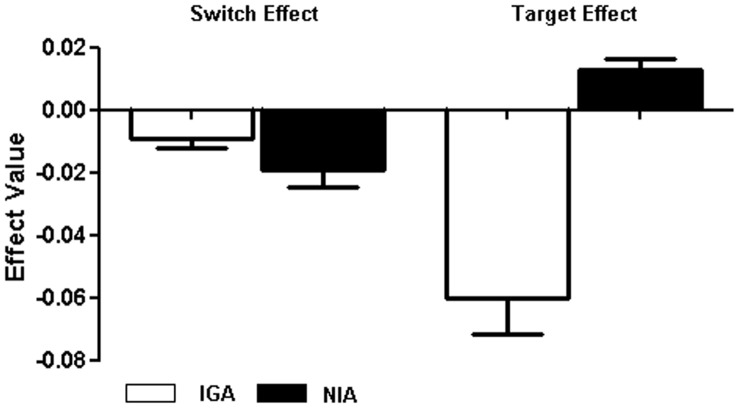
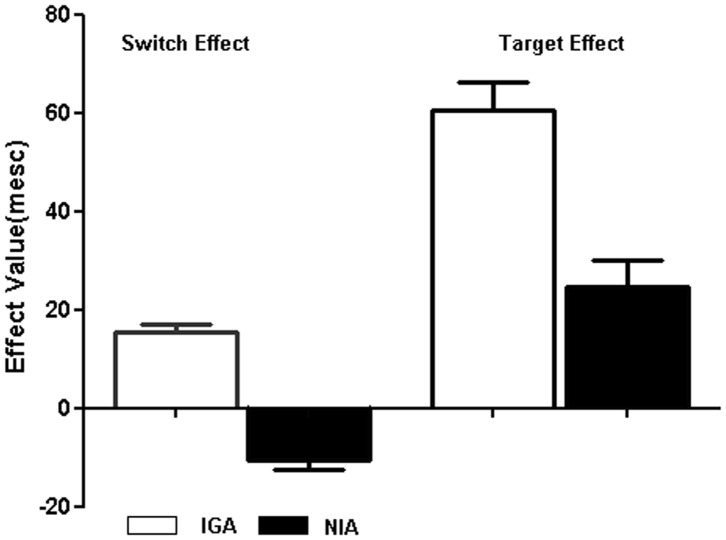
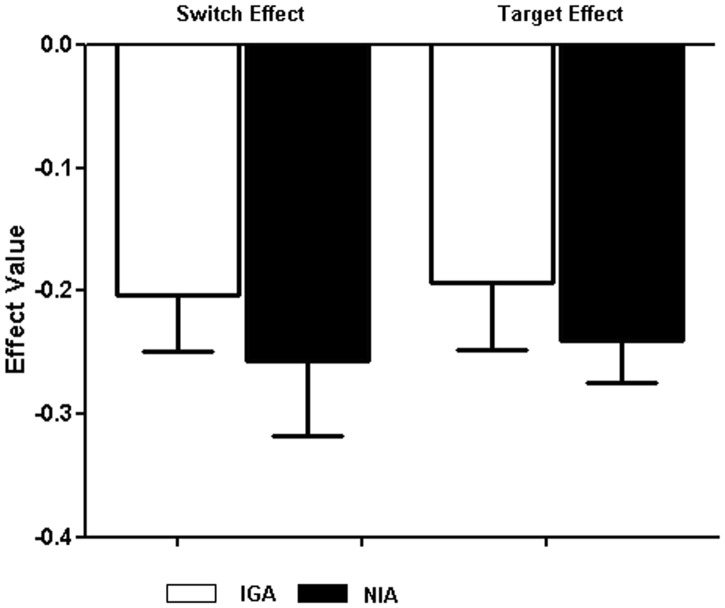
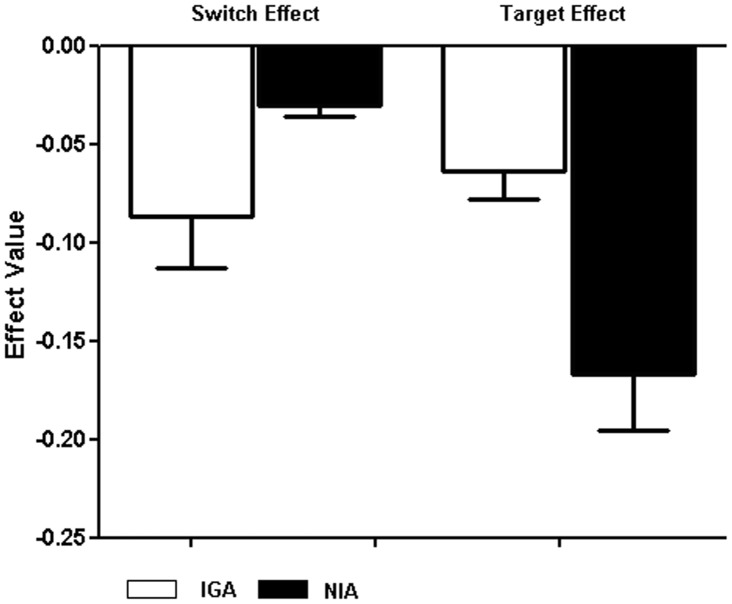
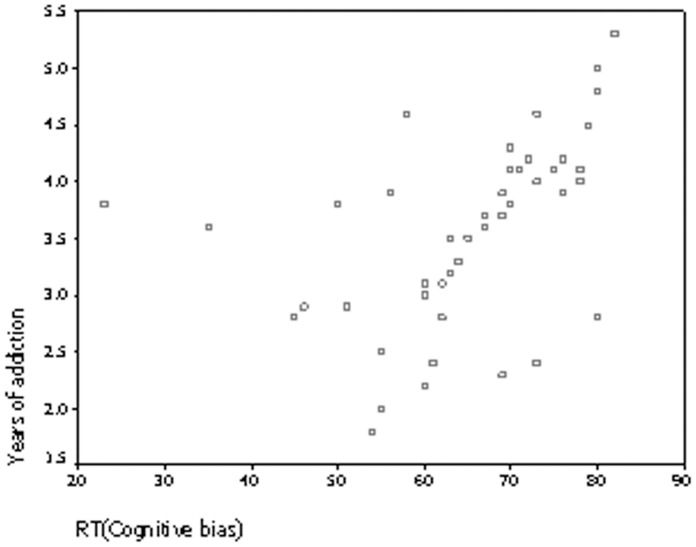
BACKGROUND: The cue-related go/no-go switching task provides an experimental approach to study individual's flexibility in changing situations. Because Internet addiction disorder (IAD) belongs to the compulsive-impulsive spectrum of disorders, it should present cognitive bias and executive functioning deficit characteristics of some of these types of disorders. Until now, no studies have been reported on cognitive bias and executive function involving mental flexibility and response inhibition in IAD. METHODOLOGY/PRINCIPAL FINDINGS: A total of 46 subjects who met the criteria of the modified Young's Diagnostic Questionnaire for Internet addiction (YDQ) were recruited as an Internet game addiction (IGA) group, along with 46 healthy control individuals. All participants performed the Internet game-shifting task. Using hit rate, RT, d' and C as the dependent measures, a three-way ANOVA (group × target × condition) was performed. For hit rate, a significant effect of group, type of target and condition were found. The group-target interaction effect was significant. For RT, significant effects were revealed for group and type of target. The group-target interaction effect was significant. Comparisons of the means revealed that the slowing down of IGA relative to NIA was more pronounced when the target stimuli were neutral as opposed to Internet game-related pictures. In addition, the group-condition interaction effect was significant. For d', significant effects of group, type of target and condition were found. The group-target interaction effect was significant. For C, the type of target produced a significant effect. There was a positive correlation between the length of the addiction (number of years) and the severity of the cognitive bias. CONCLUSIONS: IGA present cognitive biases towards information related to Internet gaming. These biases, as well as poor executive functioning skills (lower mental flexibility and response inhibition), might be responsible for Internet game addiction. The assessment of cognitive biases in IGA might provide a methodology for evaluation of therapeutic effects.
Overview
The claims and statistics of this paper haven’t been checked yet.
Free: it reads the open-access text and checks the first 5 claims that cite a source we can check. Create a free account to check every claim.
Integrity signals
Registry
Cites
Statistics
Figures
Verification
Claims the paper makes
The claims and statistics of this paper haven’t been checked yet.
Free: it reads the open-access text and checks the first 5 claims that cite a source we can check. Create a free account to check every claim.
Claims other papers make about this one
Each is checked against this paper’s own text: does it say what the citing paper says it does?
The cited source says what the claim attributes to it.
In the citing paper
“In this context, Zhou et al. (2012) used a shifting task with cues representative for Internet games and found reductions in response inhibition and mental flexibility.”
From Integrating psychological and neurobiological considerations regarding the development and maintenance of specific Internet-use disorders: An Interaction of Person-Affect-Cognition-Execution (I-PACE) model (2016) · cites this paper as Zhou et al., 2012
Self-check
Percentages, sums and reported differences re-computed from the paper’s own numbers.
The self-check needs the paper’s full text.
Citations
Cites
Internet Addiction: The Emergence of a New Clinical Disorder
YOUNG, K. S. (1998) · CyberPsychology & Behavior · doi:10.1089/cpb.1998.1.237 · Cited by 5,513
Pragmatics of measuring recognition memory: Applications to dementia and amnesia.
Snodgrass, J. G., & Corwin, J. (1988) · Journal of Experimental Psychology General · doi:10.1037//0096-3445.117.1.34 · Cited by 3,089
A cognitive-behavioral model of pathological Internet use
Davis, R. A. (2001) · Computers in Human Behavior · doi:10.1016/s0747-5632(00)00041-8 · Cited by 3,010
Monsell, S. (2003) · Trends in Cognitive Sciences · doi:10.1016/s1364-6613(03)00028-7 · Cited by 2,984
A CLASSIFICATION OF HAND PREFERENCE BY ASSOCIATION ANALYSIS
ANNETT, M. (1970) · British Journal of Psychology · doi:10.1111/j.2044-8295.1970.tb01248.x · Cited by 2,283
Issues for DSM-V: Internet Addiction
Block, J. J. (2008) · American Journal of Psychiatry · doi:10.1176/appi.ajp.2007.07101556 · Cited by 1,385 · cited 1×
“, preoccupation, mood modification, excessive use, withdrawal, tolerance and functional impairment [7].”
BackgroundThe Relationship Between Depression and Internet Addiction
YOUNG, K. S., & ROGERS, R. C. (1998) · CyberPsychology & Behavior · doi:10.1089/cpb.1998.1.25 · Cited by 1,196
Modification in the Proposed Diagnostic Criteria for Internet Addiction
Beard, K. W., & Wolf, E. M. (2001) · CyberPsychology & Behavior · doi:10.1089/109493101300210286 · Cited by 1,008
Internet Addiction: Definition, Assessment, Epidemiology and??Clinical Management
Shaw, M., & Black, D. W. (2008) · CNS Drugs · doi:10.2165/00023210-200822050-00001 · Cited by 807
Drug craving and addiction: integrating psychological and neuropsychopharmacological approaches
Franken, I. H. A. (2003) · Progress in Neuro-Psychopharmacology and Biological Psychiatry · doi:10.1016/s0278-5846(03)00081-2 · Cited by 763
Research works printed but not linked: 1
- 15. Beard KW, Wolf EM (2001) Modification in the proposed diagnostic criteria for Internet addiction. CyberPsychology and Behavior 4: 377-383. · DOI · Paper page
Cited by
Items 101–180 of 180
„Nie taki diabeł straszny...” – czyli poznawcze konsekwencje gniewu i ich motywacyjne podłoże
Szymaniak, K. (2021) · Wydawnictwo Liberi Libri eBooks · doi:10.47943/lib.9788363487515.rozdzial06 · Cited by 9
Inteligentny sport: o związkach inteligencji z aktywnością fizyczną i poziomem wykonania sportowego
Waleriańczyk, W., & Stolarski, M. (2021) · Wydawnictwo Liberi Libri eBooks · doi:10.47943/lib.9788363487515.rozdzial09 · Cited by 8
Inteligencja a funkcjonowanie w bliskich związkach
Leniarska, M., & Zajenkowski, M. (2021) · Wydawnictwo Liberi Libri eBooks · doi:10.47943/lib.9788363487515.rozdzial11 · Cited by 8
Inteligencja a agresja. Czy wysokie IQ może uchronić przed wkroczeniem na ścieżkę przestępczą?
Bodecka-Zych, M. (2021) · Wydawnictwo Liberi Libri eBooks · doi:10.47943/lib.9788363487515.rozdzial03 · Cited by 8
Yifei, P., & Motevalli, S. (2023) · International Journal of Academic Research in Progressive Education and Development · doi:10.6007/ijarped/v12-i3/17869 · Cited by 8
Fu, J., Xu, X., Dong, Y.-S., Wang, M., Zhou, Z., Hu, Y., Li, Q., Liu, S., He, W., & Dong, G. (2025) · Journal of Affective Disorders · doi:10.1016/j.jad.2025.02.026 · Cited by 8
Self-citationLee, T. H., Kim, M., Kwak, Y. B., Hwang, W. J., Kim, T., Choi, J., & Kwon, J. S. (2018) · Frontiers in Behavioral Neuroscience · doi:10.3389/fnbeh.2018.00248 · Cited by 8
Digital game addiction and psychological needs for teeanergers
Dursun, A., & Çapan, B. E. (2018) · Cited by 8
(2021) · European Journal of Contemporary Education · doi:10.13187/ejced.2021.2.338 · Cited by 8
Alavinikoo, S., Pirmoradi, M., Tajrishi, K. Z., & Arezoomandan, R. (2025) · Journal of Clinical and Experimental Neuropsychology · doi:10.1080/13803395.2025.2480139 · Cited by 7
Erdem, A. (2022) · Ahmet Keleşoğlu Eğitim Fakültesi Dergisi · doi:10.38151/akef.2022.20 · Cited by 7
Mao, Z., Huang, J., Zhang, M., Zhang, M. L., Zhao, C., Liu, Z., & Xing, X. (2025) · Behavioural Brain Research · doi:10.1016/j.bbr.2025.115558 · Cited by 6
Maleki, F., Shakiba, S., Dolatshahi, B., Yoosefi, A., & Jamialahmadi, S. (2024) · Current Psychology · doi:10.1007/s12144-024-07140-9 · Cited by 5
Coșa, I. M., Dobrean, A., Balázsi, R., & Poetar, C.-R. (2025) · Personality and Individual Differences · doi:10.1016/j.paid.2025.113193 · Cited by 5
Nie, Y., Pan, T., Zheng, Y., Fan, L., & He, J. (2021) · Current Psychology · doi:10.1007/s12144-021-01395-2 · Cited by 5
Effects of Game-Related Tasks for the Diagnosis and Classification of Gaming Disorder
Choi, J., Choi, Y. T., Jung, Y., Lee, J., Lee, J., Park, E., & Kim, I. Y. (2024) · Biosensors · doi:10.3390/bios14010042 · Cited by 5
Influence of reinforcement learning on the inhibitory control of Internet gaming disorder
Zhang, M., Zhao, C., Zhang, M. L., Mao, S., Yang, M., Mao, Z., & Xing, X. (2024) · PsyCh Journal · doi:10.1002/pchj.772 · Cited by 5
Cudo, A., Starzak, P., & Szubielska, M. (2024) · Advances in Cognitive Psychology · doi:10.5709/acp-0438-7 · Cited by 5
Neuropsychological Features of Gaming Disorder and Psychiatric Comorbidities
Tei, S., & Fujino, J. (2023) · Advances in information quality and management · doi:10.4018/978-1-6684-7366-5.ch058 · Cited by 4
Sebre, S. B., Miltuze, A., & Limonovs, L. (2019) · Human, Technologies and Quality of Education · doi:10.22364/htqe.2018.09 · Cited by 4
Zhou, H., Hui, B. P. H., Wang, T. Y., & Wu, A. M. S. (2025) · Addictive Behaviors · doi:10.1016/j.addbeh.2024.108245 · Cited by 4
Online Attentional Bias Modification Training for Adolescents With Internet Gaming Disorder
Nasiry, S., & Noori, M. (2022) · Practice in Clinical Psychology · doi:10.32598/jpcp.10.2.739.3 · Cited by 4
Asheri, M., Ghodsi, P., & Ghasemi, M. (2024) · doi:10.61838/kman.jayps.5.4.16 · Cited by 4
Similarities and Differences in Psychology
Chen, Y., Sun, Y., Ai, S., Li, J. J., Lü, L., & Shi, J. (2017) · Advances in experimental medicine and biology · doi:10.1007/978-981-10-5562-1_6 · Cited by 4
Death in the Cybernetic Era: AI, Virtual Agents, and Selfless Selves
Tei, S. (2025) · Studies in applied philosophy, epistemology and rational ethics · doi:10.1007/978-3-031-98808-0_16 · Cited by 3
The relationship between problematic internet use and the need for cognitive closure
Cudo, A., Kopiś-Posiej, N., Jarząbek-Cudo, A., Szewczyk, R. Ł., & Demczuk, M. (2019) · Postępy Psychiatrii i Neurologii · doi:10.5114/ppn.2019.89136 · Cited by 3
Human, Technologies and Quality of Education
University of Latvia. 76th conference (2019) · doi:10.22364/htqe.2018 · Cited by 6
Binge Gaming and COVID-19: A Looming Crisis
Mahapatra, S., Sharma, M. K., Amudhan, S., & Anand, N. (2021) · Journal of Mental Health and Human Behaviour · doi:10.4103/jmhhb.jmhhb_26_21 · Cited by 3
Li, S., Du, M., Yi, X., Yang, H., Yang, L., Shao, H., Wu, A. M. S., Mo, P. K. H., Xu, D., Zheng, P., et al. (2025) · Addictive Behaviors · doi:10.1016/j.addbeh.2025.108449 · Cited by 3
Qi, X., Du, X., Yang, Y., Du, G., Gao, P., Zhang, Y., Qin, W., Li, X., & Zhang, Q. (2019) · Frontiers in Behavioral Neuroscience · doi:10.3389/fnbeh.2019.00074 · Cited by 3
Karaer, Y. (2018) · Hacettepe University Institutional Repository (hacettepe.edu.tr) · Cited by 3
Rabiei, N., Sadeghi, S., Ranaei, N., & Ghanbari, N. (2025) · BMC Psychology · doi:10.1186/s40359-025-02792-z · Cited by 2
Proactive control for conflict resolution is intact in subclinical obsessive-compulsive individuals
Fornaro, S., Visalli, A., Viviani, G., Ambrosini, E., & Vallesi, A. (2024) · Frontiers in Psychology · doi:10.3389/fpsyg.2024.1490147 · Cited by 2
Approach-avoidance tendencies in problematic usage of the internet: Evidence from a multisite study
Diers, M., Müller, S. M., Kessling, A., Schmid, A. M., Thomas, T. A., Antons, S., Joshi, M., Krikova, K., Kampa, M., Mallon, L., et al. (2026) · Journal of Behavioral Addictions · doi:10.1556/2006.2026.00057 · Cited by 2
Attentional Bias in Gaming Addiction: A Systematic Review of Behavioral Studies
Refahi, Z., Namazi, S. A., King, D. L., & Sadeghi, S. (2025) · Current Addiction Reports · doi:10.1007/s40429-025-00691-2 · Cited by 2
Qi, Y., Yan, Z., Liu, Y., Turel, O., Zhang, X., Zhao, H., Liu, J., Zhang, Y., & He, Q. (2026) · Dialogues in Clinical Neuroscience · doi:10.1080/19585969.2026.2637718 · Cited by 2
Exposure to Video Games and Decision Making
Curcio, G., & Peracchia, S. (2018) · Advances in multimedia and interactive technologies book series · doi:10.4018/978-1-5225-7601-3.ch010 · Cited by 2
Internet Use Influences Self-Related Process: Evidence From Behavior and ERPs
Zhao, G., Zhang, Y., Kong, F., Liu, Z., Wang, Y., Zhou, B., Zhang, X., Tang, F., & Zhou, Z. (2018) · Frontiers in Psychology · doi:10.3389/fpsyg.2018.02597 · Cited by 2
Self-citationLiao, H.-Y., Ko, L., He, C.-R., Lin, C. C., Chang, C., Lin, P., Lu, S.-W., Yen, J., & Ko, C. (2025) · Neuropsychobiology · doi:10.1159/000547700 · Cited by 2
박성준, Kwak, H.-W., Lee, S. I., & Chang, M.-S. (2017) · 한국심리학회지: 인지 및 생물 · doi:10.22172/cogbio.2017.29.1.001 · Cited by 2
Sosyal medya bağımlılığının fizyo-psikolojik etkileri
Sevginer, P. (2022) · Dspace Repository (Marmara Üniversitesi) · Cited by 2
Funkcjonowanie poznawcze w uzależnieniach behawioralnych
Nowakowska, I., Lewandowska, K., & Lewczuk, K. (2021) · Wydawnictwo Liberi Libri eBooks · doi:10.47943/lib.9788363487515.rozdzial04 · Cited by 1
The Capacity of Cognitive Control in Action Video Game Players: The Role of Gaming Device
Zhou, Y., Li, J., Zhan, D., & Gao, X. (2026) · International Journal of Human-Computer Interaction · doi:10.1080/10447318.2025.2606214 · Cited by 1
Alshaibany, F. F., Aljabri, M. M., Alharbi, A. M., Alharbi, B. S., Alghamdi, A., Almutairy, B. M., Alshehri, W. M., Alyahya, N. M., & Alodhialah, A. M. (2026) · Healthcare · doi:10.3390/healthcare14131955 · Cited by 1
Exposure to Video Games and Decision Making
Curcio, G., & Peracchia, S. (2017) · IGI Global eBooks · doi:10.4018/978-1-5225-2255-3.ch287 · Cited by 1
Saba, N., Batool, I., & Batool, H. (2024) · Journal of Professional & Applied Psychology · doi:10.52053/jpap.v5i3.292 · Cited by 1
Зависимость от компьютерных онлайн-игр как подтип интернет-аддикции (литературный обзор)
Петров, А. A., & Черняк, Н. Б. (2017) · Сибирский вестник психиатрии и наркологии · doi:10.26617/1810-3111-2017-4(97)-82-88 · Cited by 1
DİJİTAL OYUN BAĞIMLILININ NARSİSİZM KÜLTÜRÜNE ETKİLERİ
Arğın, E. (2019) · Turkish Studies - Information Technologies and Applied Sciences · doi:10.29228/turkishstudies.30271 · Cited by 1
Brandtner, A. (2023) · DuEPublico (University of Duisburg-Essen) · doi:10.17185/duepublico/78298 · Cited by 1
The Influence of Smartphones on Children's Brain Development
Sany, D. G. G. (2025) · Fuel Cells Bulletin · doi:10.52710/fcb.20 · Cited by 1
Łowicki, P. (2021) · Wydawnictwo Liberi Libri eBooks · doi:10.47943/lib.9788363487515.rozdzial07
(2021) · Wydawnictwo Liberi Libri eBooks · doi:10.47943/lib.9788363487515.rozdzial00a
Jak inteligentnie kontrolować swoje zachowania? Siła woli w życiu codziennym
Jędrzejczyk, J. (2021) · Wydawnictwo Liberi Libri eBooks · doi:10.47943/lib.9788363487515.rozdzial02
Tian, J., Zhang, H., Wang, X., Zhang, H., Ma, L., Mei, B., Zhang, M., Lang, Y., Wei, Y., Han, S., et al. (2026) · Addictive Behaviors Reports · doi:10.1016/j.abrep.2026.100703
Scoping Review: Gaming Decision in Problematic Gamers
Diantina, F. P., & Takwin, B. (2023) · Schema Journal of Psychological Research · doi:10.29313/schema.v0i0.12784
Petrescu, T.-C., Błachnio, A., & Enea, V. (2026) · Journal of Rational-Emotive & Cognitive-Behavior Therapy · doi:10.1007/s10942-026-00649-x
Tian, J., Zhang, H., Wang, X., Zhang, H., Ma, L., Mei, B., Zhang, M., Yan, L., Wei, Y., Han, S., et al. (2026) · Frontiers in Psychiatry · doi:10.3389/fpsyt.2026.1883842
Comprehensive Evaluation of Internet Gaming Disorder : Clinical and Neurobiological Assessments
Paik, S.-H., Cho, H., Choi, J., Choi, S., & Kim, D. (2016) · 신경정신의학 · doi:10.4306/jknpa.2016.55.4.334
Harjanti, A. P. (2025) · The International Journal of Medical Science and Health Research · doi:10.70070/59k1b162
Similarities and Differences in Psychology
Di, T.-Q., Ilgen, M. A., Meng, S., Sun, Y., & Shi, J. (2025) · Advances in experimental medicine and biology · doi:10.1007/978-981-95-2411-2_5
Neurobiology of technological addiction : Impulsive compulsive spectrum
Ghosal, M. K. (2016) · Bengal Journal of Psychiatry · doi:10.51332/bjp.2016.v21.i2.22
Xiong, S., & Duff, B. R. L. (2020) · Wiley eBooks · doi:10.1002/9781119011071.iemp0193
Exploration of Self-regulation and Impulsiveness Between Problematic Online Gamers and Non-gamers
Cheung, V. H. M., & Kan, W. S. (2021) · The Asian Conference on the Arts, Humanities and Social Sciences Conference proceedings/Asian Conference on the Social Sciences official conference proceedings/Asian Conference on Arts & Humanities official conference proceedings · doi:10.22492/issn.2186-2303.2021.1
Zajenkowski, M. (2021) · Wydawnictwo Liberi Libri eBooks · doi:10.47943/lib.9788363487515.rozdzial00b
Przekonania na temat inteligencji, czyli kto i dlaczego chce być (postrzegany jako) mądry
Zajenkowski, M., & Maciantowicz, O. (2021) · Wydawnictwo Liberi Libri eBooks · doi:10.47943/lib.9788363487515.rozdzial05
Inteligencja: ogólna zdolność o praktycznym znaczeniu dla szkoły, pracy, zdrowia i długości życia
Zajenkowski, M. (2021) · Wydawnictwo Liberi Libri eBooks · doi:10.47943/lib.9788363487515.rozdzial01
Craving and decision making in individuals with pathological buying
Trotzke, P. (2016) · DuEPublico (University of Duisburg-Essen)
Wegmann, E. (2017) · DuEPublico (University of Duisburg-Essen)
Fornaro, S. (n.d.) · Padua Research Archive (University of Padova)
\nNegative attentional bias as a transdiagnostic psychiatric marker
Bergman, M. A. (2021) · Radboud Repository (Radboud University)
Rumboirusi, R. L., & Samay, I. Y. (2026) · Indonesian Journal of Advanced Research · doi:10.55927/ijar.v5i1.16140
Jitoku, D., Kobayashi, N., Fujimoto, Y., Qian, C., Okuzumi, S., Tei, S., Matsuyoshi, D., Tamura, T., Takahashi, H., Ueno, T., et al. (2024) · doi:10.3389/fpsyg.2024.1332462.s001
لاکانی, ن., & اکبری, ب. (2021) · Salāmat-i ijtimā̒ī · doi:10.22037/ch.v8i3.31233
Exploring EEG Changes in Video Game Players A Study on Behavioral Addiction
Sabauri, K., Zurabashvili, D., & Chichiveishvili, N. (2026) · Translational and Clinical Medicine - Georgian Medical Journal
Designing Stimulus as Cognitive Task Stimulus for Measurement of Cognitive Bias in Online Gamers
Diantina, F. P., Nawangsih, E., Permana, R. H., Khasanah, A. N., Hanifa, F. A., Putri, G. I. L., & Shafana, Y. C. (2025) · Global Medical & Health Communication (GMHC) · doi:10.29313/gmhc.v13i1.14135
Predicting Social Well-Being Based on Parenting Styles and Internet Addiction in Students
Movahed, L. A. B., & Zeinalizadeh, B. (2024) · doi:10.61838/kman.ijes.7.4.8
Metadata
- Authors
- Zhou, Z., Yuan, G., & Yao, J.
- Affiliations
- Nanjing Medical University (CN)
- Corresponding author
- Zhou, Zhenhe
- Venue
- PLoS ONE
- Publisher
- Public Library of Science (PLoS)
- Published
- 2012-11-14
- Volume
- 7
- Issue
- 11
- Pages
- e48961
- ISSN
- 1932-6203 (ISSN-L)
- PMC
- PMC3498351
- OpenAlex
- W2019465558
- Cited by
- 153
- References
- 21
- Citations by year
- 2026: 8 · 2025: 13 · 2024: 8 · 2023: 6 · 2022: 10 · 2021: 23 · 2020: 8 · 2019: 11 · 2018: 11 · 2017: 14 · 2016: 12 · 2015: 17 · 2014: 9 · 2013: 3
- FWCI
- 30.47
- Type
- journal article
- Language
- en
- Open access
- gold
- doi.org
- Locations
- PLoS ONE (publishedVersion, cc-by)
- PubMed Central (publishedVersion, cc-by)
- PubMed (publishedVersion)
- DOAJ (DOAJ: Directory of Open Access Journals) (submittedVersion, cc-by-sa)
- Funders
- Government of Jiangsu Province
- Topics
- Social Sciences › Sociology and Political Science › Impact of Technology on Adolescents
- Social Sciences › Psychology › Clinical Psychology › Gambling Behavior and Treatments
- Social Sciences › Psychology › Clinical Psychology › Sexuality, Behavior, and Technology
- Keywords
- online game addiction, cognitive biases, executive function, response inhibition, cognitive flexibility
- MeSH terms
- Adolescent, Adult, Attention, Cognition, Female, Humans, Male, Neuropsychological Tests, Surveys and Questionnaires, Reaction Time, Behavior, Addictive, Video Games, Internet, Executive Function
About these checks
Registry, retraction, Cites and statistics results are computed, not judged, with one exception: a printed reference that no index lists is read once by a model before it counts as a citation error. Claims are extracted by a model and kept only when their quote appears verbatim in the text; each cited source is then checked, with a model’s help, for whether it says what the claim relies on. Those verdicts can be wrong — read the claim’s quote and the cited source before relying on one.
Statistics and arithmetic are recomputed, not judged.
Confidence bands are shown only for fields calibrated on our annotated test set. None is calibrated yet, so no band is shown.
What counts as a claim ›How we measure confidence ›How we check this ›
Are you an author, or do you see a problem with this page? Request a review
Data sources
Bibliographic data: Semantic Scholar, OpenAlex, Crossref.
Contains information from the Semantic Scholar Academic Graph Datasets, made available under the ODC Attribution License (ODC-BY 1.0).
Semantic Scholar’s data is described in: Kinney, R., et al. (2023). The Semantic Scholar Open Data Platform. arXiv:2301.10140.
