

The DOI matches its Crossref record; 29 of the 29 references it cites were found in a registry or an index.
The Impact of Article Length on the Number of Future Citations: A Bibliometric Analysis of General Medicine Journals
Open accessAbstract
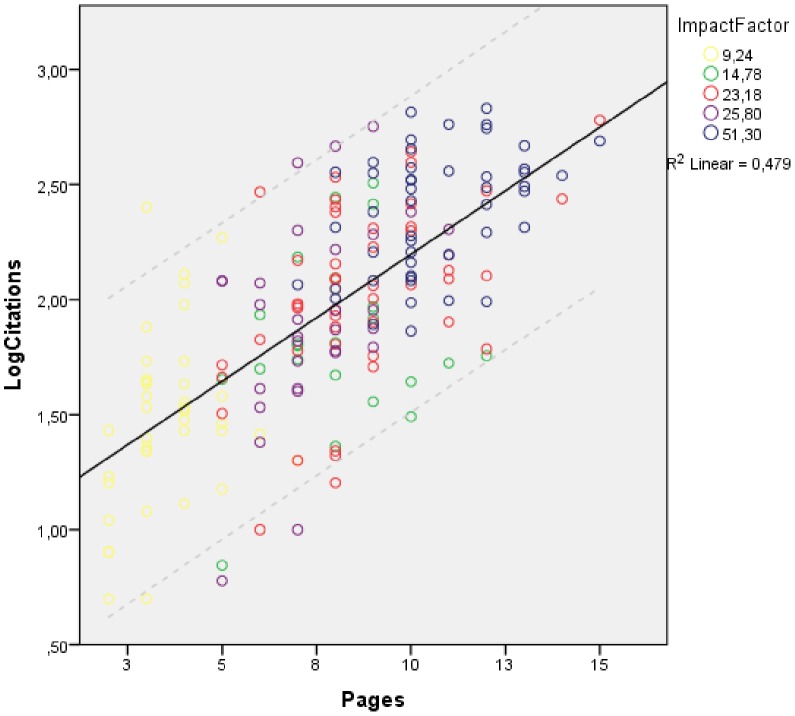
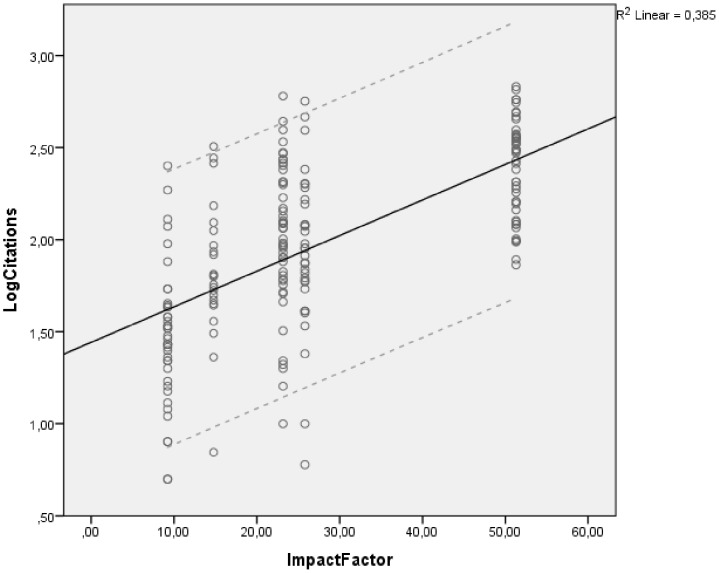
BACKGROUND: The number of citations received is considered an index of study quality and impact. We aimed to examine the factors associated with the number of citations of published articles, focusing on the article length. METHODS: Original human studies published in the first trimester of 2006 in 5 major General Medicine journals were analyzed with regard to the number of authors and of author-affiliated institutions, title and abstract word count, article length (number of print pages), number of bibliographic references, study design, and 2006 journal impact factor (JIF). A multiple linear regression model was employed to identify the variables independently associated with the number of article citations received through January 2012. RESULTS: On univariate analysis the JIF, number of authors, article length, study design (interventional/observational and prospective/retrospective), title and abstract word count, number of author-affiliated institutions, and number of references were all associated with the number of citations received. On multivariate analysis with the logarithm of citations as the dependent variable, only article length [regression coefficient: 14.64 (95% confidence intervals: (5.76-23.50)] and JIF [3.37 (1.80-4.948)] independently predicted the number of citations. The variance of citations explained by these parameters was 51.2%. CONCLUSION: In a sample of articles published in major General Medicine journals, in addition to journal impact factors, article length and number of authors independently predicted the number of citations. This may reflect a higher complexity level and quality of longer and multi-authored studies.
Overview
The claims and statistics of this paper haven’t been checked yet.
Run the check — free, no account needed. It reads the open-access text and checks the sources it cites.
Integrity signals
Registry
Cites
Statistics
Figures
Verification
Claims the paper makes
The claims and statistics of this paper haven’t been checked yet.
Run the check — free, no account needed. It reads the open-access text and checks the sources it cites.
Claims other papers make about this one
Each is checked against this paper’s own text: does it say what the citing paper says it does?
In the citing paper
“Several studies have indicated that some characteristics of a document's title and abstract might be less or more attractive for different readers.”
From Core Elements in the Process of Citing Publications: Conceptual Overview of the Literature (2018) · cites this paper as Falagas et al., 2013
In the citing paper
“For instance, it has been revealed that a positive correlation exists between citation counts and the number of cited references (Falagas et al., 2013) that is documents with more cited references would achieve more citations (Vieira and Gomes, 2010).”
From Core Elements in the Process of Citing Publications: Conceptual Overview of the Literature (2018) · cites this paper as Falagas et al., 2013
Self-check
Percentages, sums and reported differences re-computed from the paper’s own numbers.
The self-check needs the paper’s full text.
Citations
Cites
Molecular Structure of Nucleic Acids: A Structure for Deoxyribose Nucleic Acid
WATSON, J. D., & CRICK, F. H. C. (1953) · Nature · doi:10.1038/171737a0 · Cited by 13,584
Citation Advantage of Open Access Articles
Eysenbach, G. (2006) · PLoS Biology · doi:10.1371/journal.pbio.0040157 · Cited by 829
Molecular structure of nucleic acids
Watson, J. D., & Crick, F. H. C. (2004) · Resonance · doi:10.1007/bf02834980 · Cited by 660
Callaham, M. (2002) · JAMA · doi:10.1001/jama.287.21.2847 · Cited by 644
Comparison of SCImago journal rank indicator with journal impact factor
Falagas, M. E., Kouranos, V., Jorge, R. A., & Karageorgopoulos, D. E. (2008) · The FASEB Journal · doi:10.1096/fj.08-107938 · Cited by 559
Self-citationRelative Citation Impact of Various Study Designs in the Health Sciences
Patsopoulos, N. A. (2005) · JAMA · doi:10.1001/jama.293.19.2362 · Cited by 498
Fortnightly Review: How can impact factors be improved?
Garfield, E. (1996) · BMJ · doi:10.1136/bmj.313.7054.411 · Cited by 491
Open access publishing, article downloads, and citations: randomised controlled trial
Davis, P. M., Lewenstein, B. V., Simon, D. H., Booth, J. G., & Connolly, M. J. L. (2008) · BMJ · doi:10.1136/bmj.a568 · Cited by 419
The top-ten in journal impact factor manipulation
Falagas, M. E., & Alexiou, V. G. (2008) · Archivum Immunologiae et Therapiae Experimentalis · doi:10.1007/s00005-008-0024-5 · Cited by 262
Self-citationScientific Collaboration Results in Higher Citation Rates of Published Articles
Figg, W. D., Dunn, L. A., Liewehr, D. J., Steinberg, S. M., Thurman, P. W., Barrett, J. C., & Birkinshaw, J. (2006) · Pharmacotherapy The Journal of Human Pharmacology and Drug Therapy · doi:10.1592/phco.26.6.759 · Cited by 242
Cited by
Sorted by citations
Factors Affecting Number of Citations: A Comprehensive Review of the Literature
Tahamtan, I., Safipour Afshar, A., & Ahamdzadeh, K. (2016) · Scientometrics · doi:10.1007/s11192-016-1889-2 · Cited by 912
Swedberg, R. (2020) · Cambridge University Press eBooks · doi:10.1017/9781108762519.002 · Cited by 471
Haustein, S., Costas, R., & Larivière, V. (2015) · PLoS ONE · doi:10.1371/journal.pone.0120495 · Cited by 371
van Eck, N. J., Waltman, L., van Raan, A. F. J., Klautz, R. J. M., & Peul, W. C. (2013) · PLoS ONE · doi:10.1371/journal.pone.0062395 · Cited by 253
Major trends in knowledge management research: a bibliometric study
Akhavan, P., Ebrahim, N. A., Fetrati, M. A., & Pezeshkan, A. (2016) · Scientometrics · doi:10.1007/s11192-016-1938-x · Cited by 209
Releasing a preprint is associated with more attention and citations for the peer-reviewed article
Fu, D., & Hughey, J. (2019) · eLife · doi:10.7554/elife.52646 · Cited by 205
Frazão, T. D. C., Camilo, D. G. G., Cabral, E. L. D. S., & de Souza, R. P. (2018) · BMC Medical Informatics and Decision Making · doi:10.1186/s12911-018-0663-1 · Cited by 172
The “Efficacy-Effectiveness Gap”: Historical Background and Current Conceptualization
Nordon, C., Karcher, H., Groenwold, R. H. H., Ankarfeldt, M. Z., Pichler, F., Chevrou-Severac, H., Rossignol, M., Abbe, A., & Abenhaim, L. (2016) · Value in Health · doi:10.1016/j.jval.2015.09.2938 · Cited by 177
Citations increase with manuscript length, author number, and references cited in ecology journals
Fox, C. W., Paine, C. E. T., & Sauterey, B. (2016) · Ecology and Evolution · doi:10.1002/ece3.2505 · Cited by 166
Core Elements in the Process of Citing Publications: Conceptual Overview of the Literature
Tahamtan, I., & Bornmann, L. (2018) · Journal of Informetrics · doi:10.1016/j.joi.2018.01.002 · Cited by 149
(2020) · Cambridge University Press eBooks · doi:10.1017/9781108762519 · Cited by 154
Bibliometrics of systematic reviews: analysis of citation rates and journal impact factors
Royle, P., Kandala, N., Barnard, K. D., & Waugh, N. R. (2013) · Systematic Reviews · doi:10.1186/2046-4053-2-74 · Cited by 132
Fox, C. W., & Burns, C. S. (2015) · Ecology and Evolution · doi:10.1002/ece3.1480 · Cited by 88
Breugelmans, J. G., Roberge, G., Tippett, C., Durning, M., Struck, D. B., & Makanga, M. M. (2018) · PLoS ONE · doi:10.1371/journal.pone.0203156 · Cited by 87
Antoniou, G. A., Antoniou, S. A., Georgakarakos, E. I., Sfyroeras, G. S., & Georgiadis, G. S. (2015) · Annals of Vascular Surgery · doi:10.1016/j.avsg.2014.09.017 · Cited by 77
Multinational teams and diseconomies of scale in collaborative research
Hsiehchen, D., Espinoza, M., & Hsieh, A. (2015) · Science Advances · doi:10.1126/sciadv.1500211 · Cited by 79
How much is too much? The effects of information quantity on crowdfunding performance
Moy, N., Chan, H. F., & Torgler, B. (2018) · PLoS ONE · doi:10.1371/journal.pone.0192012 · Cited by 70
Zhou, J., Zuo, M., & Ye, C. (2019) · International Journal of Medical Informatics · doi:10.1016/j.ijmedinf.2019.07.018 · Cited by 64
Kousha, K., & Thelwall, M. A. (2023) · Journal of the Association for Information Science and Technology · doi:10.1002/asi.24810 · Cited by 74
Serrano‐Pozo, A., Aldridge, G. M., & Zhang, Q. (2017) · Journal of Alzheimer s Disease · doi:10.3233/jad-170184 · Cited by 59
The impact factor of an open access journal does not contribute to an article’s citations
Chua, S., Qureshi, A. M., Krishnan, V., Pai, D., Kamal, L. B., Gunasegaran, S., Afzal, M., Ambawatta, L., Gan, J. Y. S., Kew, P., et al. (2017) · F1000Research · doi:10.12688/f1000research.10892.1 · Cited by 59
Do successful PhD outcomes reflect the research environment rather than academic ability?
Belavý, D. L., Owen, P. J., & Livingston, P. M. (2020) · PLoS ONE · doi:10.1371/journal.pone.0236327 · Cited by 57
van der Pol, C. B., McInnes, M. D. F., Petrcich, W., Tunis, A. S., & Hanna, R. R. (2015) · PLoS ONE · doi:10.1371/journal.pone.0119892 · Cited by 55
A review of the top 100 most cited papers on food safety
Onyeaka, H. N., Anumudu, C. K., Okolo, C. A., Anyogu, A., Odeyemi, O. A., & Bassey, A. P. (2022) · Quality Assurance and Safety of Crops & Foods · doi:10.15586/qas.v14i4.1124 · Cited by 55
Sooryamoorthy, R. (2017) · Scientometrics · doi:10.1007/s11192-017-2265-6 · Cited by 52
Pottier, P., Lagisz, M., Burke, S., Drobniak, S. M., Downing, P. A., Macartney, E. L., Martinig, A. R., Mizuno, A., Morrison, K., Pollo, P., et al. (2024) · Proceedings of the Royal Society B Biological Sciences · doi:10.1098/rspb.2024.1222 · Cited by 69
Shekhani, H. N., Shariff, S., Bhulani, N., Khosa, F., & Hanna, T. N. (2017) · American Journal of Roentgenology · doi:10.2214/ajr.17.18077 · Cited by 50
The advantage of simple paper abstracts
Letchford, A., Preis, T., & Moat, H. S. (2015) · Journal of Informetrics · doi:10.1016/j.joi.2015.11.001 · Cited by 51
A scientometric analysis of selected GIScience journals
Biljecki, F. (2016) · International Journal of Geographical Information Systems · doi:10.1080/13658816.2015.1130831 · Cited by 49
Hafeez, D. M., Jalal, S., & Khosa, F. (2018) · Journal of Psychiatric Research · doi:10.1016/j.jpsychires.2018.07.010 · Cited by 48
Which can better predict the future success of articles? Bibliometric indices or alternative metrics
Wang, M., Wang, Z., & Chen, G. (2019) · Scientometrics · doi:10.1007/s11192-019-03052-9 · Cited by 44
The correlation between paper length and citations: a meta-analysis
Xie, J., Gong, K., Cheng, Y., & Ke, Q. (2019) · Scientometrics · doi:10.1007/s11192-019-03015-0 · Cited by 40
Bornmann, L., & Tekles, A. (2021) · Journal of Informetrics · doi:10.1016/j.joi.2021.101159 · Cited by 45
Füting, P., Barthel, L., Cairns, T., Briesen, H., & Schmideder, S. (2021) · Fungal Biology and Biotechnology · doi:10.1186/s40694-021-00131-6 · Cited by 26
Ronda‐Pupo, G. A. (2017) · Scientometrics · doi:10.1007/s11192-016-2231-8 · Cited by 38
Clinical Simulation in Nursing: A Bibliometric Analysis after Its Tenth Anniversary
Kokol, P., Vošner, H. B., & Železnik, D. (2017) · Clinical Simulation in Nursing · doi:10.1016/j.ecns.2016.11.007 · Cited by 37
Bramoullé, Y., & Ductor, L. (2018) · Journal of Economic Behavior & Organization · doi:10.1016/j.jebo.2018.01.014 · Cited by 36
Ellingson, M. K., Shi, X., Skydel, J. J., Nyhan, K., Lehman, R., Ross, J. S., & Wallach, J. D. (2021) · BMJ Open · doi:10.1136/bmjopen-2020-047107 · Cited by 41
Identifying potentially excellent publications using a citation-based machine learning approach
Hu, Z., Cui, J., & Lin, A. (2023) · Information Processing & Management · doi:10.1016/j.ipm.2023.103323 · Cited by 34
Factors affecting the citations of papers in tribology journals
Liskiewicz, T. W., Liśkiewicz, G., & Paczesny, J. (2021) · Scientometrics · doi:10.1007/s11192-021-03870-w · Cited by 35
Fahimifar, S., Mousavi, K., Mozaffari, F., & Ausloos, M. (2022) · Quality & Quantity · doi:10.1007/s11135-022-01480-z · Cited by 37
Ahmed, A., Adam, M., Ghafar, N. A., Muhammad, M., & Ebrahim, N. A. (2016) · PubMed Central · Cited by 31
Pre-registration and Results-Free Review in Observational and Qualitative Research
Jacobs, A. M. (2020) · Cambridge University Press eBooks · doi:10.1017/9781108762519.009 · Cited by 30
Pottegård, A., Haastrup, M. B., Stage, T. B., Hansen, M., Larsen, K. S., Meegaard, P. M., Meegaard, L., Horneberg, H., Gils, C., Dideriksen, D., et al. (2014) · BMJ · doi:10.1136/bmj.g7092 · Cited by 26
The citation advantage of foreign language references for Chinese social science papers
Gong, K., Xie, J., Cheng, Y., Larivière, V., & Sugimoto, C. R. (2019) · Scientometrics · doi:10.1007/s11192-019-03146-4 · Cited by 26
(2015) · Cited by 25
Transformers Go for the LOLs: Generating (Humourous) Titles from Scientific Abstracts End-to-End
Chen, Y., & Eger, S. (2023) · Workshop on Evaluation and Comparison of NLP Systems (Eval4NLP) · doi:10.18653/v1/2023.eval4nlp-1.6 · Cited by 29
Bornmann, L., Haunschild, R., & Mutz, R. (2020) · Journal of Informetrics · doi:10.1016/j.joi.2020.101098 · Cited by 26
Păduraru, O., Moroșanu, A., Paduraru, C. Ș., & Cărăușu, E. M. (2022) · Healthcare · doi:10.3390/healthcare10030555 · Cited by 23
Categorization and correlational analysis of quality factors influencing citation
Khatoon, A., Daud, A. Y., & Amjad, T. (2024) · Artificial Intelligence Review · doi:10.1007/s10462-023-10657-3 · Cited by 29
Why Do Some Articles in Planning Journals Get Cited More than Others?
Stevens, M. R., Park, K., Tian, G., Kim, K., & Ewing, R. (2019) · Journal of Planning Education and Research · doi:10.1177/0739456x19827083 · Cited by 21
Zhou, W. H., Xu, Z., & Zavadskas, E. K. (2019) · International Journal of Strategic Property Management · doi:10.3846/ijspm.2019.10535 · Cited by 21
Koç, T., Kadir, K. U. R. T., & Akbıyık, A. (2019) · Procedia Computer Science · doi:10.1016/j.procs.2019.09.128 · Cited by 21
Article length and citation outcomes
Hasan, S. A., & Breunig, R. V. (2021) · Scientometrics · doi:10.1007/s11192-021-04083-x · Cited by 21
Releasing a preprint is associated with more attention and citations for the peer-reviewed articlePreprint
Fu, D., & Hughey, J. (2019) · bioRxiv (Cold Spring Harbor Laboratory) · doi:10.1101/699652 · Cited by 23
Empirical analysis of the text structure of original research articles in medical journals
Heßler, N., Rottmann, M., & Ziegler, A. (2020) · PLoS ONE · doi:10.1371/journal.pone.0240288 · Cited by 21
Quality and Impact of Survey Research Among Anesthesiologists: A Systematic Review
Geyer, E. D., Miller, R., Kim, S. S., Tobias, J. D., Nafiu, O. O., & Tumin, D. (2020) · Advances in Medical Education and Practice · doi:10.2147/amep.s259908 · Cited by 17
Jiang, G. K., & Yajun, J. (2023) · Scientometrics · doi:10.1007/s11192-023-04738-x · Cited by 17
Zhou, Y. (2021) · Scientometrics · doi:10.1007/s11192-021-03995-y · Cited by 16
The deliverance of open access books : Examining usage and dissemination
Snijder, R. C. (2019) · Amsterdam University Press eBooks · doi:10.26530/oapen_1004809 · Cited by 15
The evolution of conceptual diversity in economics titles from 1890 to 2012
Guo, S., Zhang, G., Ju, Q., Chen, Y., Chen, Q., & Li, L. (2014) · Scientometrics · doi:10.1007/s11192-014-1501-6 · Cited by 15
Zhang, Z., & Poucke, S. V. (2017) · PLoS ONE · doi:10.1371/journal.pone.0169398 · Cited by 15
Huang, M., Naser-Tavakolian, K., Clifton, M. A., Franceschi, A. M., Kim, D., Zhang, J. Z., & Schweitzer, M. (2019) · Cureus · doi:10.7759/cureus.5313 · Cited by 16
Making Your Research Paper Discoverable: Title Plays the Winning Trick
Kumar, M. J. (2013) · IETE Technical Review · doi:10.4103/0256-4602.123113 · Cited by 15
Bornmann, L. (2018) · Journal of Informetrics · doi:10.1016/j.joi.2018.12.007 · Cited by 15
Making Research Data Accessible
Kapiszewski, D., & Karcher, S. (2020) · Cambridge University Press eBooks · doi:10.1017/9781108762519.008 · Cited by 15
Eve, M. P., Neylon, C., O’Donnell, D. P., Moore, S., Gadie, R., Odeniyi, V., & Parvin, S. (2020) · Cambridge University Press eBooks · doi:10.1017/9781108783521 · Cited by 16
Antoniou, S. A., Andreou, A., Antoniou, G. A., Koch, O. O., Köhler, G., Luketina, R. R., Bertsias, A., Pointner, R., & Granderath, F.-A. (2015) · The American Journal of Surgery · doi:10.1016/j.amjsurg.2015.04.022 · Cited by 14
Hizqiyah, I. Y. N., Nugraha, I., Cartono, C., Yusuf, I., Nurlaelah, I., Yanti, M., & Nuraeni, S. (2023) · JPBI (Jurnal Pendidikan Biologi Indonesia) · doi:10.22219/jpbi.v9i1.22089 · Cited by 24
Geographic Citation Gaps in NLP Research
Rungta, M., Singh, J., Mohammad, S. M., & Yang, D. (2022) · Conference on Empirical Methods in Natural Language Processing (EMNLP) · doi:10.18653/v1/2022.emnlp-main.89 · Cited by 13
Characteristics of scientific impact of Resources Conservation and Recycling in the past 30 years
Fu, H., Fang, K., & Fang, C. (2018) · Resources Conservation and Recycling · doi:10.1016/j.resconrec.2018.06.021 · Cited by 13
Increasing author counts in neurosurgical journals from 1980 to 2020
Cole, T. S., Pacult, M. A., & Lawton, M. T. (2021) · Journal of neurosurgery · doi:10.3171/2021.1.jns204257 · Cited by 12
Articles with impact: insights into 10 years of research with machine learning
van der Zwaard, S., de Leeuw, A., Meerhoff, L. A., Bodine, S. C., & Knobbe, A. (2020) · Journal of Applied Physiology · doi:10.1152/japplphysiol.00489.2020 · Cited by 12
Öner, B. S., & Orbay, M. (2022) · Forensic Sciences Research · doi:10.1080/20961790.2021.2002525 · Cited by 13
Bian, J., Abdelrahman, S., Shi, J., & Fiol, G. D. (2018) · Journal of Biomedical Informatics · doi:10.1016/j.jbi.2018.11.010 · Cited by 11
Ten tips for promoting your research
Hardman, T. C., Krentz, A. J., & Wierzbicki, A. S. (2020) · Cardiovascular Endocrinology & Metabolism · doi:10.1097/xce.0000000000000191 · Cited by 11
Rethinking Entrepreneurial Human Capital
Giulio, B., Minola, T., Benigni, S., & Tomelleri, S. (2018) · Studies on entrepreneurship, structural change and industrial dynamics · doi:10.1007/978-3-319-90548-8 · Cited by 13
Zang, D., & Liu, C. (2023) · Scientometrics · doi:10.1007/s11192-023-04634-4 · Cited by 10
Andrade, A., Dominski, F. H., & Vilarino, G. T. (2021) · Applied Sciences · doi:10.3390/app11104540 · Cited by 10
How to accomplish a highly cited paper in the tourism, leisure and hospitality field
Cunill, O. M., González, L. A. O., Santomil, P. D., & Forteza, C. M. (2022) · Journal of Business Research · doi:10.1016/j.jbusres.2022.113619 · Cited by 12
Lyu, P., & Wolfram, D. (2018) · Proceedings of the Association for Information Science and Technology · doi:10.1002/pra2.2018.14505501035 · Cited by 10
Süleyman Demirel Üniversitesi Tıp Fakültesi Dergisi’nin Son 10 Yılının Bibliyometrik Analizi
Ercan, S., Yazkan, R., Kolcu, G., Kolcu, M. İ. B., Gülle, K., & Koşar, A. (2019) · SDÜ Tıp Fakültesi Dergisi · doi:10.17343/sdutfd.560909 · Cited by 9
Identification High Influential Articles by Considering the Topic Characteristics of Articles
Wang, M., Jiao, S., Zhang, J., Zhang, X., & Zhu, N. (2020) · IEEE Access · doi:10.1109/access.2020.3001190 · Cited by 10
Prediction of future citation count with machine learning and neural network
Su, Z. (2020) · Asia-Pacific Conference on Image Processing, Electronics and Computers (IPEC) · doi:10.1109/ipec49694.2020.9114959 · Cited by 9
Are Papers Asking Questions Cited More Frequently in Computer Science?
Fiala, D., Král, P., & Dostál, M. (2021) · Computers · doi:10.3390/computers10080096 · Cited by 11
Ariza-Guerrero, A. M., & Blázquez, J. S. (2023) · Scientometrics · doi:10.1007/s11192-023-04863-7 · Cited by 8
Population vulnerability to COVID-19 in Europe: a burden of disease analysisPreprint
Wyper, G. M. A., Assunção, R., Cuschieri, S., Devleesschauwer, B., Fletcher, E., Haagsma, J. A., Hilderink, H. B. M., Idavain, J., Lesnik, T., von der Lippe, E., et al. (2020) · medRxiv · doi:10.1101/2020.04.29.20064279 · Cited by 8
Lutter, M., Rudolf, H., Lenz, R., Hotfiel, T., & Tischer, T. (2023) · Journal of Experimental Orthopaedics · doi:10.1186/s40634-023-00631-x · Cited by 7
Forgotten Knowledge: Examining the Citational Amnesia in NLP
Singh, J., Rungta, M., Yang, D., & Mohammad, S. M. (2023) · Proceedings of the conference - Association for Computational Linguistics. Meeting · doi:10.18653/v1/2023.acl-long.341 · Cited by 7
Danelakis, A., Helge Langseth, A., Nachev, P., Nelson, A., Bjørk, M., Matharu, M. S., Tronvik, E., May, A., & Stubberud, A. (2024) · Cephalalgia · doi:10.1177/03331024241251488 · Cited by 7
Assessing number and quality of urology open access journals: 2011 to 2018
AlRyalat, S. A., Alessa, Z., Mansour, M., Hamidi, M., Obeidat, M., & Odtallah, O. (2021) · Current Urology · doi:10.1097/cu9.0000000000000007 · Cited by 7
Schwarzer, M., Alscher, L., & Doenst, T. (2018) · The Thoracic and Cardiovascular Surgeon · doi:10.1055/s-0038-1661004 · Cited by 7
Apologies for Past Mistakes and Promises for A New Start for the APJCP in 2014
Moore, M. A., Lim, M.-K., & Huang, X. (2014) · Asian Pacific Journal of Cancer Prevention · doi:10.7314/apjcp.2014.15.1.1 · Cited by 7
Clustering citation distributions for semantic categorization and citation prediction
Osborne, F., Peroni, S., & Motta, E. (2014) · Open Research Online (The Open University) · Cited by 6
Variations in Instructed vs. Published Word Counts in Top Five Medical Journals
Silverberg, O. M., & Ray, J. G. (2017) · Journal of General Internal Medicine · doi:10.1007/s11606-017-4196-6 · Cited by 6
Knowledge substitutability and complementarity in scientific collaboration
Lin, K., Hu, B., Li, Z., Bu, Y., & Dong, X. (2024) · Journal of Informetrics · doi:10.1016/j.joi.2024.101601 · Cited by 5
Çevik, O., Yakar, M., & Paylı, M. (2025) · International Journal of Engineering and Geosciences · doi:10.26833/ijeg.1680503 · Cited by 5
Addressing Impact of Counseling Research: A Comparative Study of Counseling and Psychology Journals
Hunter, Q., Balkin, R. S., & Reiner, S. M. (2018) · Counseling Outcome Research and Evaluation · doi:10.1080/21501378.2017.1403848 · Cited by 5
Reliability of Inference: Analogs of Replication in Qualitative Research
Fairfield, T., & Charman, A. E. (2020) · Cambridge University Press eBooks · doi:10.1017/9781108762519.012 · Cited by 6
Gerring, J., Mahoney, J., & Elman, C. (2020) · Cambridge University Press eBooks · doi:10.1017/9781108762519.001 · Cited by 6
Metadata
- Authors
- Falagas, M. E., Zarkali, A., Karageorgopoulos, D. E., Bardakas, V., & Mavros, M. N.
- Affiliations
- Tufts University (US)
- Alfa Institute of Biomedical Sciences (GR)
- Hygeia Hospital (GR)
- National Technical University of Athens (GR)
- Corresponding author
- Falagas, Matthew E.
- Venue
- PLoS ONE
- Publisher
- Public Library of Science (PLoS)
- Published
- 2013-02-06
- Volume
- 8
- Issue
- 2
- Pages
- e49476
- ISSN
- 1932-6203 (ISSN-L)
- PMC
- PMC3566179
- OpenAlex
- W2059156680
- Cited by
- 168
- References
- 29
- Citations by year
- 2026: 6 · 2025: 12 · 2024: 10 · 2023: 11 · 2022: 14 · 2021: 13 · 2020: 35 · 2019: 14 · 2018: 14 · 2017: 10 · 2016: 8 · 2015: 11 · 2014: 6 · 2013: 4
- FWCI
- 10.65
- Type
- journal article
- Language
- en
- Open access
- gold
- doi.org
- Locations
- PLoS ONE (publishedVersion, cc-by)
- Europe PMC (PubMed Central) (publishedVersion, other-oa)
- PubMed Central (publishedVersion, cc-by)
- PubMed (publishedVersion)
- RePEc: Research Papers in Economics (submittedVersion)
- DOAJ (DOAJ: Directory of Open Access Journals) (submittedVersion, cc-by-sa)
- Topics
- Social Sciences › Library and Information Sciences › scientometrics and bibliometrics research
- Social Sciences › Library and Information Sciences › Academic Writing and Publishing
- Social Sciences › Library and Information Sciences › Academic Publishing and Open Access
- Keywords
- article length, citation impact, journal impact factor, number of authors, bibliographic references, research design, general medicine journals, research quality indicators
- MeSH terms
- Equipment Design, Humans, Publishing, Research, Bibliometrics, Journal Impact Factor
About these checks
Registry, retraction, Cites and statistics results are computed, not judged, with one exception: a printed reference that no index lists is read once by a model before it counts as a citation error. Claims are extracted by a model and kept only when their quote appears verbatim in the text; each cited source is then checked, with a model’s help, for whether it says what the claim relies on. Those verdicts can be wrong — read the claim’s quote and the cited source before relying on one.
Statistics and arithmetic are recomputed, not judged.
Confidence bands are shown only for fields calibrated on our annotated test set. None is calibrated yet, so no band is shown.
What counts as a claim ›How we measure confidence ›How we check this ›
Are you an author, or do you see a problem with this page? Request a review
