

The DOI matches its Crossref record; 29 of the 29 references it cites were found in a registry or an index.
The Impact of Article Length on the Number of Future Citations: A Bibliometric Analysis of General Medicine Journals
Open accessAbstract
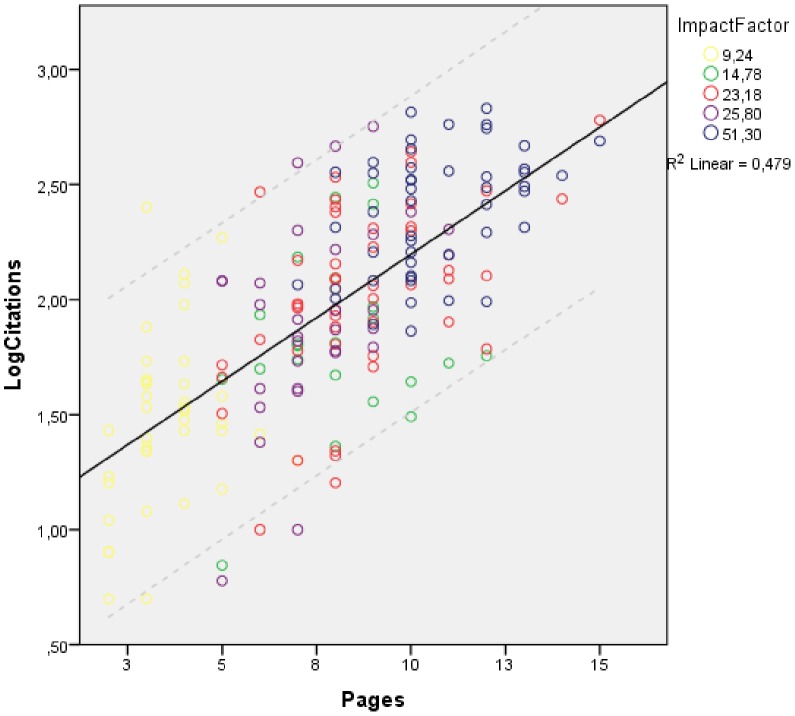
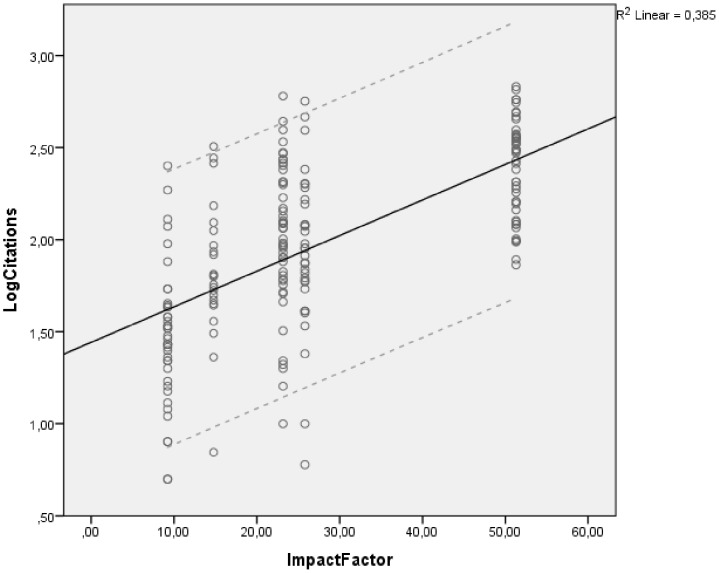
BACKGROUND: The number of citations received is considered an index of study quality and impact. We aimed to examine the factors associated with the number of citations of published articles, focusing on the article length. METHODS: Original human studies published in the first trimester of 2006 in 5 major General Medicine journals were analyzed with regard to the number of authors and of author-affiliated institutions, title and abstract word count, article length (number of print pages), number of bibliographic references, study design, and 2006 journal impact factor (JIF). A multiple linear regression model was employed to identify the variables independently associated with the number of article citations received through January 2012. RESULTS: On univariate analysis the JIF, number of authors, article length, study design (interventional/observational and prospective/retrospective), title and abstract word count, number of author-affiliated institutions, and number of references were all associated with the number of citations received. On multivariate analysis with the logarithm of citations as the dependent variable, only article length [regression coefficient: 14.64 (95% confidence intervals: (5.76-23.50)] and JIF [3.37 (1.80-4.948)] independently predicted the number of citations. The variance of citations explained by these parameters was 51.2%. CONCLUSION: In a sample of articles published in major General Medicine journals, in addition to journal impact factors, article length and number of authors independently predicted the number of citations. This may reflect a higher complexity level and quality of longer and multi-authored studies.
Overview
The claims and statistics of this paper haven’t been checked yet.
Run the check — free, no account needed. It reads the open-access text and checks the sources it cites.
Integrity signals
Registry
Cites
Statistics
Figures
Verification
Claims the paper makes
The claims and statistics of this paper haven’t been checked yet.
Run the check — free, no account needed. It reads the open-access text and checks the sources it cites.
Claims other papers make about this one
Each is checked against this paper’s own text: does it say what the citing paper says it does?
In the citing paper
“Several studies have indicated that some characteristics of a document's title and abstract might be less or more attractive for different readers.”
From Core Elements in the Process of Citing Publications: Conceptual Overview of the Literature (2018) · cites this paper as Falagas et al., 2013
In the citing paper
“For instance, it has been revealed that a positive correlation exists between citation counts and the number of cited references (Falagas et al., 2013) that is documents with more cited references would achieve more citations (Vieira and Gomes, 2010).”
From Core Elements in the Process of Citing Publications: Conceptual Overview of the Literature (2018) · cites this paper as Falagas et al., 2013
Self-check
Percentages, sums and reported differences re-computed from the paper’s own numbers.
The self-check needs the paper’s full text.
Citations
Cites
Molecular Structure of Nucleic Acids: A Structure for Deoxyribose Nucleic Acid
WATSON, J. D., & CRICK, F. H. C. (1953) · Nature · doi:10.1038/171737a0 · Cited by 13,584
Citation Advantage of Open Access Articles
Eysenbach, G. (2006) · PLoS Biology · doi:10.1371/journal.pbio.0040157 · Cited by 829
Molecular structure of nucleic acids
Watson, J. D., & Crick, F. H. C. (2004) · Resonance · doi:10.1007/bf02834980 · Cited by 660
Callaham, M. (2002) · JAMA · doi:10.1001/jama.287.21.2847 · Cited by 644
Comparison of SCImago journal rank indicator with journal impact factor
Falagas, M. E., Kouranos, V., Jorge, R. A., & Karageorgopoulos, D. E. (2008) · The FASEB Journal · doi:10.1096/fj.08-107938 · Cited by 559
Self-citationRelative Citation Impact of Various Study Designs in the Health Sciences
Patsopoulos, N. A. (2005) · JAMA · doi:10.1001/jama.293.19.2362 · Cited by 498
Fortnightly Review: How can impact factors be improved?
Garfield, E. (1996) · BMJ · doi:10.1136/bmj.313.7054.411 · Cited by 491
Open access publishing, article downloads, and citations: randomised controlled trial
Davis, P. M., Lewenstein, B. V., Simon, D. H., Booth, J. G., & Connolly, M. J. L. (2008) · BMJ · doi:10.1136/bmj.a568 · Cited by 419
The top-ten in journal impact factor manipulation
Falagas, M. E., & Alexiou, V. G. (2008) · Archivum Immunologiae et Therapiae Experimentalis · doi:10.1007/s00005-008-0024-5 · Cited by 262
Self-citationScientific Collaboration Results in Higher Citation Rates of Published Articles
Figg, W. D., Dunn, L. A., Liewehr, D. J., Steinberg, S. M., Thurman, P. W., Barrett, J. C., & Birkinshaw, J. (2006) · Pharmacotherapy The Journal of Human Pharmacology and Drug Therapy · doi:10.1592/phco.26.6.759 · Cited by 242
Cited by
Sorted by citations
Factors Affecting Number of Citations: A Comprehensive Review of the Literature
Tahamtan, I., Safipour Afshar, A., & Ahamdzadeh, K. (2016) · Scientometrics · doi:10.1007/s11192-016-1889-2 · Cited by 912
Swedberg, R. (2020) · Cambridge University Press eBooks · doi:10.1017/9781108762519.002 · Cited by 471
Haustein, S., Costas, R., & Larivière, V. (2015) · PLoS ONE · doi:10.1371/journal.pone.0120495 · Cited by 371
van Eck, N. J., Waltman, L., van Raan, A. F. J., Klautz, R. J. M., & Peul, W. C. (2013) · PLoS ONE · doi:10.1371/journal.pone.0062395 · Cited by 253
Major trends in knowledge management research: a bibliometric study
Akhavan, P., Ebrahim, N. A., Fetrati, M. A., & Pezeshkan, A. (2016) · Scientometrics · doi:10.1007/s11192-016-1938-x · Cited by 209
Metadata
- Authors
- Falagas, M. E., Zarkali, A., Karageorgopoulos, D. E., Bardakas, V., & Mavros, M. N.
- Affiliations
- Tufts University (US)
- Alfa Institute of Biomedical Sciences (GR)
- Hygeia Hospital (GR)
- National Technical University of Athens (GR)
- Corresponding author
- Falagas, Matthew E.
- Venue
- PLoS ONE
- Publisher
- Public Library of Science (PLoS)
- Published
- 2013-02-06
- Volume
- 8
- Issue
- 2
- Pages
- e49476
- ISSN
- 1932-6203 (ISSN-L)
- PMC
- PMC3566179
- OpenAlex
- W2059156680
- Cited by
- 168
- References
- 29
- Citations by year
- 2026: 6 · 2025: 12 · 2024: 10 · 2023: 11 · 2022: 14 · 2021: 13 · 2020: 35 · 2019: 14 · 2018: 14 · 2017: 10 · 2016: 8 · 2015: 11 · 2014: 6 · 2013: 4
- FWCI
- 10.65
- Type
- journal article
- Language
- en
- Open access
- gold
- doi.org
- Locations
- PLoS ONE (publishedVersion, cc-by)
- Europe PMC (PubMed Central) (publishedVersion, other-oa)
- PubMed Central (publishedVersion, cc-by)
- PubMed (publishedVersion)
- RePEc: Research Papers in Economics (submittedVersion)
- DOAJ (DOAJ: Directory of Open Access Journals) (submittedVersion, cc-by-sa)
- Topics
- Social Sciences › Library and Information Sciences › scientometrics and bibliometrics research
- Social Sciences › Library and Information Sciences › Academic Writing and Publishing
- Social Sciences › Library and Information Sciences › Academic Publishing and Open Access
- Keywords
- article length, citation impact, journal impact factor, number of authors, bibliographic references, research design, general medicine journals, research quality indicators
- MeSH terms
- Equipment Design, Humans, Publishing, Research, Bibliometrics, Journal Impact Factor
About these checks
Registry, retraction, Cites and statistics results are computed, not judged, with one exception: a printed reference that no index lists is read once by a model before it counts as a citation error. Claims are extracted by a model and kept only when their quote appears verbatim in the text; each cited source is then checked, with a model’s help, for whether it says what the claim relies on. Those verdicts can be wrong — read the claim’s quote and the cited source before relying on one.
Statistics and arithmetic are recomputed, not judged.
Confidence bands are shown only for fields calibrated on our annotated test set. None is calibrated yet, so no band is shown.
What counts as a claim ›How we measure confidence ›How we check this ›
Are you an author, or do you see a problem with this page? Request a review
