

The DOI matches its Crossref record; 39 of the 39 references it cites were found in a registry or an index.
How Expert Advice Influences Decision Making
Open accessAbstract
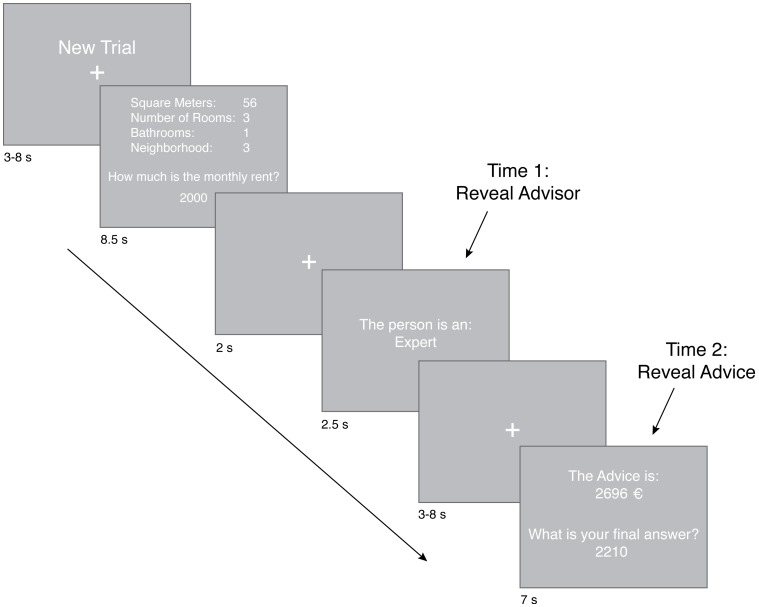
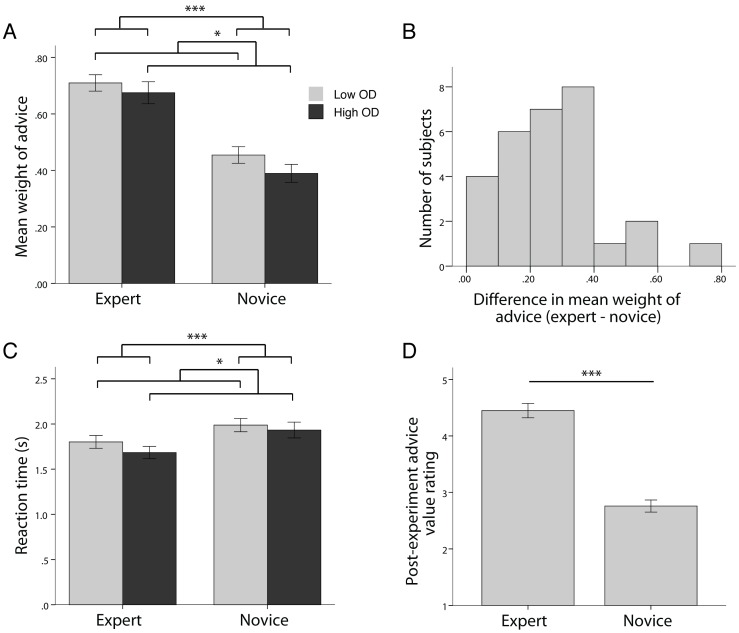
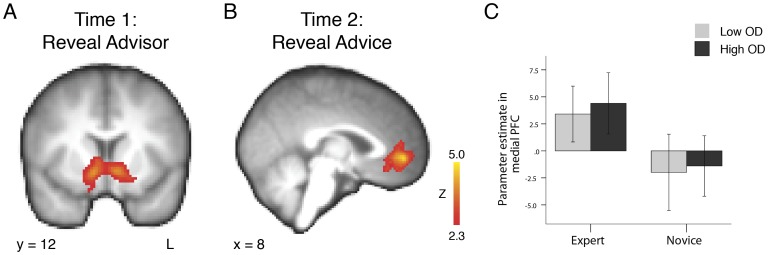
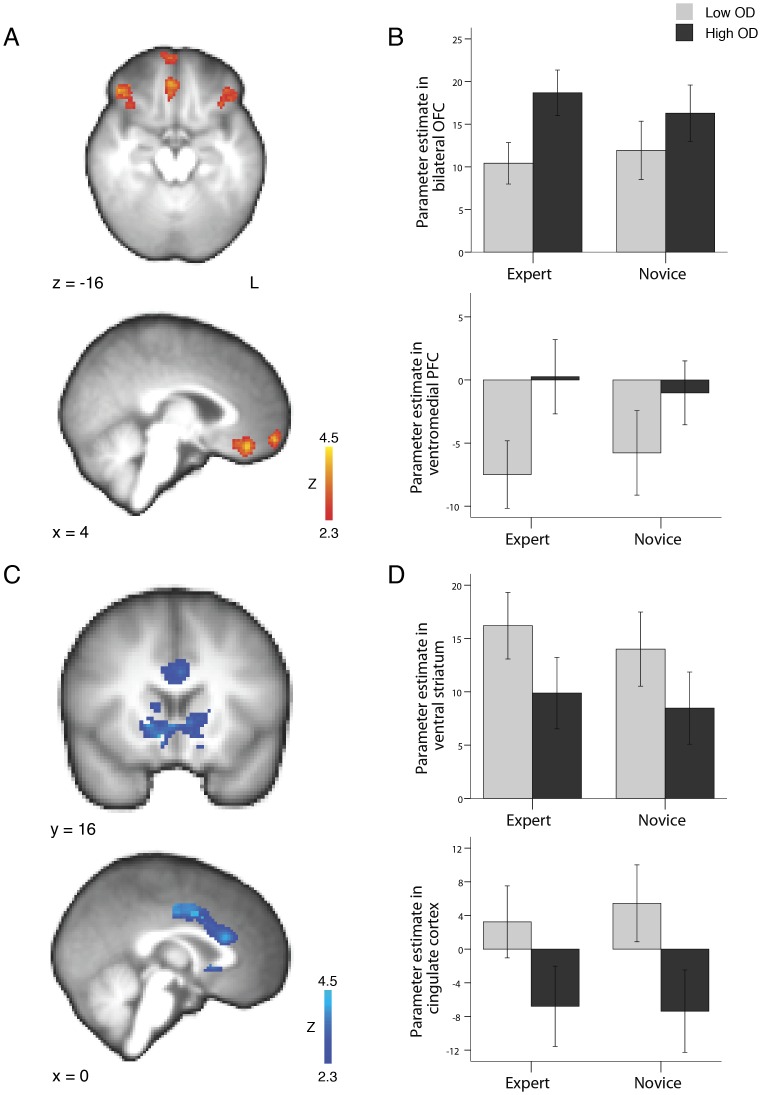
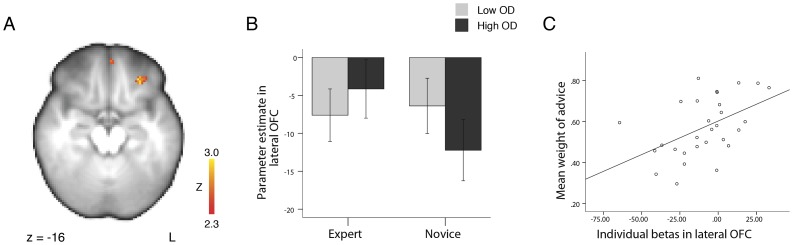
People often use expert advice when making decisions in our society, but how we are influenced by this advice has yet to be understood. To address this, using functional magnetic resonance imaging, we provided expert and novice advice to participants during an estimation task. Participants reported that they valued expert advice more than novice advice, and activity in the ventral striatum correlated with this valuation, even before decisions with the advice were made. When using advice, participants compared their initial opinion to their advisor's opinion. This comparison, termed the "opinion difference", influenced advice utilization and was represented in reward-sensitive brain regions. Finally, the left lateral orbitofrontal cortex integrated both the size of the opinion difference and the advisor's level of expertise, and average activity in this area correlated with mean advice utilization across participants. Taken together, these findings provide neural evidence for how advice engenders behavioral change during the decision-making process.
Overview
The claims and statistics of this paper haven’t been checked yet.
Run the check — free, no account needed. It reads the open-access text and checks the sources it cites.
Integrity signals
Registry
Cites
Statistics
Figures
Verification
Claims the paper makes
The claims and statistics of this paper haven’t been checked yet.
Run the check — free, no account needed. It reads the open-access text and checks the sources it cites.
Claims other papers make about this one
Each is checked against this paper’s own text: does it say what the citing paper says it does?
In the citing paper
“Specifically, knowing that advice is coming from an expert rather than a novice increases ventral striatum activity prior to actually receiving advice 52.”
From The social brain and reward: Social information processing in the human striatum (2014) · cites this paper as [52]
In the citing paper
“Value signals in the striatum appear to reflect a) how we evaluate the advice itself (e.g., valuing an expert's opinion) 52”
From The social brain and reward: Social information processing in the human striatum (2014) · cites this paper as [52]
In the citing paper
“Finally, ventromedial prefrontal cortex appears to integrate information concerning advice from others, the validity of the advice, and the value of decision options 3, 52.”
From The social brain and reward: Social information processing in the human striatum (2014) · cites this paper as [52]
Self-check
Percentages, sums and reported differences re-computed from the paper’s own numbers.
The self-check needs the paper’s full text.
Citations
Cites
Advances in functional and structural MR image analysis and implementation as FSL
Smith, S. M., Jenkinson, M., Woolrich, M. W., Beckmann, C. F., Behrens, T. E. J., Johansen-Berg, H., Bannister, P. R., De Luca, M., Drobnjak, I., Flitney, D. E., et al. (2004) · NeuroImage · doi:10.1016/j.neuroimage.2004.07.051 · Cited by 13,630
Jenkinson, M., Bannister, P., Brady, M., & Smith, S. (2002) · NeuroImage · doi:10.1006/nimg.2002.1132 · Cited by 11,888
Fast robust automated brain extraction
Smith, S. M. (2002) · Human Brain Mapping · doi:10.1002/hbm.10062 · Cited by 10,496
Conflict monitoring and anterior cingulate cortex: an update
Botvinick, M. M., Cohen, J. D., & Carter, C. S. (2004) · Trends in Cognitive Sciences · doi:10.1016/j.tics.2004.10.003 · Cited by 3,623
The role of the medial frontal cortex in cognitive control
Ridderinkhof, K. R., Ullsperger, M., Crone, E. A., & Nieuwenhuis, S. (2004) · Science · doi:10.1126/science.1100301 · Cited by 2,974
Dissociation of reward anticipation and outcome with event-related fMRI
Knutson, B., Fong, G. W., Adams, C. M., Varner, J. L., & Hommer, D. (2001) · Neuroreport · doi:10.1097/00001756-200112040-00016 · Cited by 1,300
Neuromarketing: the hope and hype of neuroimaging in business
Dan Ariely, C., & Berns, G. S. (2010) · Nature reviews. Neuroscience · doi:10.1038/nrn2795 · Cited by 1,192
Encoding Predictive Reward Value in Human Amygdala and Orbitofrontal Cortex
Gottfried, J. A., O'Doherty, J., & Dolan, R. J. (2003) · Science · doi:10.1126/science.1087919 · Cited by 1,165
Frontal cortex and reward-guided learning and decision-making
Rushworth, M. F. S., Noonan, M. P., Boorman, E. D., Walton, M. E., & Behrens, T. E. (2011) · Neuron · doi:10.1016/j.neuron.2011.05.014 · Cited by 1,111
Neural responses during anticipation of a primary taste reward
O'Doherty, J. P., Deichmann, R., Critchley, H. D., & Dolan, R. J. (2002) · Neuron · doi:10.1016/s0896-6273(02)00603-7 · Cited by 1,076
Cited by
Sorted by citations
The Emerging Neuroscience of Social Media
Meshi, D., Tamir, D. I., & Heekeren, H. R. (2015) · Trends in Cognitive Sciences · doi:10.1016/j.tics.2015.09.004 · Cited by 322
Self-citationThe social brain and reward: Social information processing in the human striatum
Bhanji, J. P., & Delgado, M. R. (2014) · WIREs Cognitive Science · doi:10.1002/wcs.1266 · Cited by 256
A brain network supporting social influences in human decision-making
Zhang, L., & Gläscher, J. P. (2020) · Science Advances · doi:10.1126/sciadv.abb4159 · Cited by 158
Rzymski, P., Borkowski, L., Drąg, M., Flisiak, R., Jemielity, J., Krajewski, J., Mastalerz–Migas, A., Matyja, A., Pyrć, K., Simon, K. A., et al. (2021) · Vaccines · doi:10.3390/vaccines9020109 · Cited by 157
Wu, H., Luo, Y., & Feng, C. (2016) · Neuroscience & Biobehavioral Reviews · doi:10.1016/j.neubiorev.2016.08.038 · Cited by 117
Metadata
- Authors
- Meshi, D., Biele, G., Korn, C. W., & Heekeren, H. R.
- Affiliations
- Humboldt-Universität zu Berlin (DE)
- University of Oslo (NO)
- Corresponding author
- Meshi, Dar
- Heekeren, Hauke R.
- Venue
- PLoS ONE
- Publisher
- Public Library of Science (PLoS)
- Published
- 2012-11-21
- Volume
- 7
- Issue
- 11
- Pages
- e49748
- ISSN
- 1932-6203 (ISSN-L)
- PMC
- PMC3504100
- OpenAlex
- W2052744504
- Cited by
- 107
- References
- 39
- Citations by year
- 2026: 10 · 2025: 15 · 2024: 20 · 2023: 3 · 2022: 5 · 2021: 17 · 2020: 4 · 2019: 1 · 2018: 5 · 2017: 5 · 2016: 12 · 2015: 5 · 2014: 3 · 2013: 1
- FWCI
- 2.23
- Type
- journal article
- Language
- en
- Open access
- gold
- doi.org
- Locations
- PLoS ONE (publishedVersion, cc-by)
- Europe PMC (PubMed Central) (publishedVersion, cc-by)
- PubMed Central (publishedVersion, cc-by)
- PubMed (publishedVersion)
- DOAJ (DOAJ: Directory of Open Access Journals) (submittedVersion, cc-by-sa)
- Figshare (submittedVersion, cc-by)
- Refubium (Universitätsbibliothek der Freien Universität Berlin) (submittedVersion, cc-by)
- Funders
- Bundesministerium für Bildung und Forschung
- Topics
- Social Sciences › Decision Sciences › General Decision Sciences › Decision-Making and Behavioral Economics
- Life Sciences › Neuroscience › Cognitive Neuroscience › Neural and Behavioral Psychology Studies
- Social Sciences › Economics, Econometrics and Finance › Economics and Econometrics › Experimental Behavioral Economics Studies
- Keywords
- expert advice, decision-making, ventral striatum, orbitofrontal cortex, behavior change, reward processing
- MeSH terms
- Adult, Behavior, Brain, Brain Mapping, Choice Behavior, Decision Making, Female, Humans, Magnetic Resonance Imaging, Male, Professional Competence, Reward, Neuroimaging
About these checks
Registry, retraction, Cites and statistics results are computed, not judged, with one exception: a printed reference that no index lists is read once by a model before it counts as a citation error. Claims are extracted by a model and kept only when their quote appears verbatim in the text; each cited source is then checked, with a model’s help, for whether it says what the claim relies on. Those verdicts can be wrong — read the claim’s quote and the cited source before relying on one.
Statistics and arithmetic are recomputed, not judged.
Confidence bands are shown only for fields calibrated on our annotated test set. None is calibrated yet, so no band is shown.
What counts as a claim ›How we measure confidence ›How we check this ›
Are you an author, or do you see a problem with this page? Request a review
