

The DOI matches its Crossref record; 58 of the 59 references it cites were found in a registry or an index.
Effect of Antioxidant Vitamin Supplementation on Cardiovascular Outcomes: A Meta-Analysis of Randomized Controlled Trials
Open accessAbstract
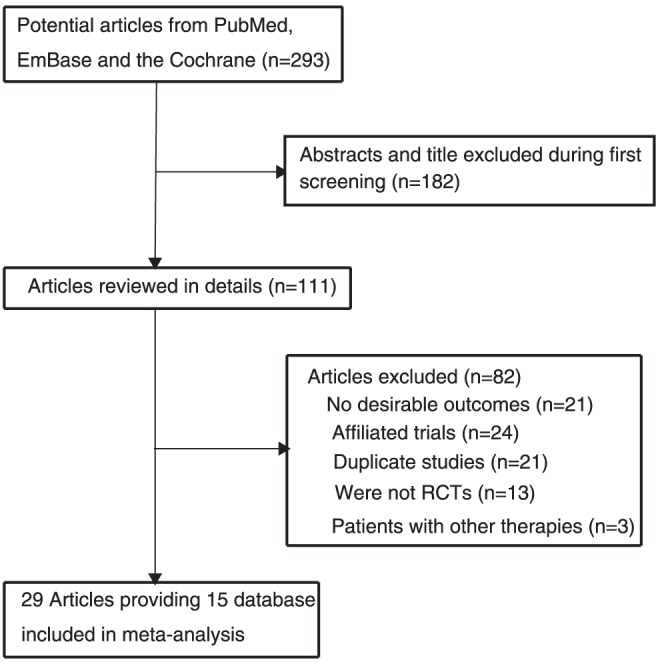
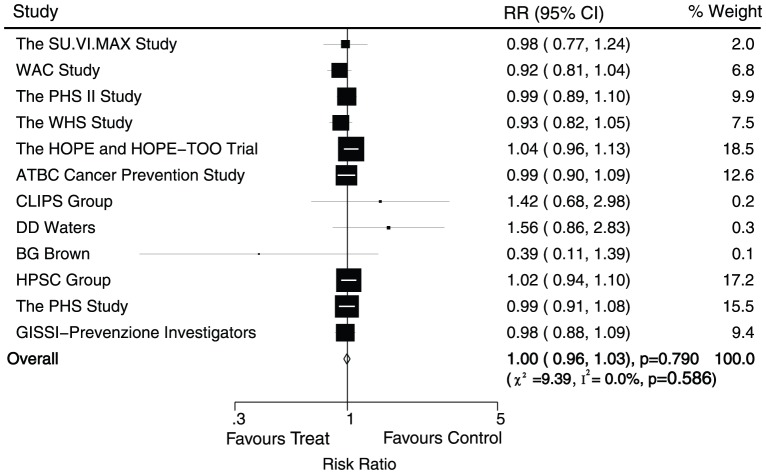
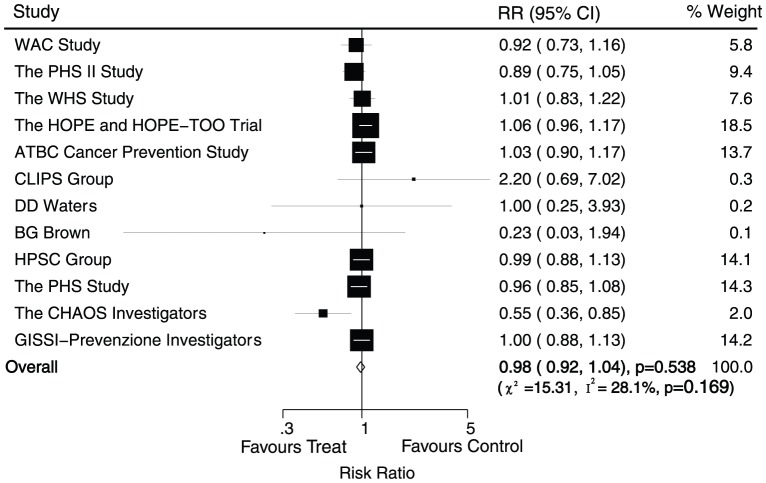
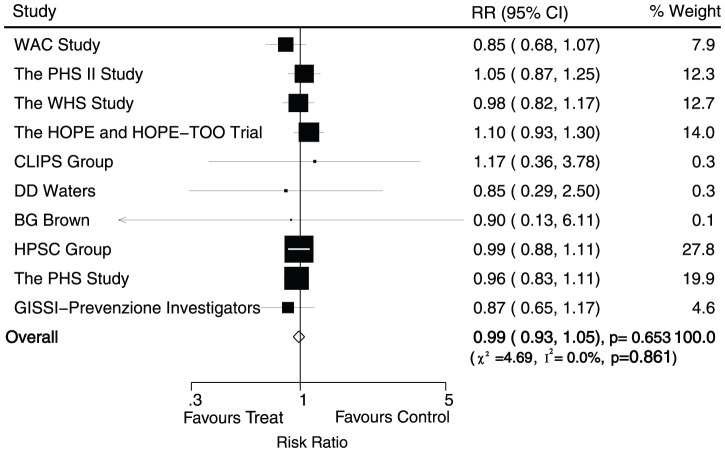
BACKGROUND: Antioxidant vitamin (vitamin E, beta-carotene, and vitamin C) are widely used for preventing major cardiovascular outcomes. However, the effect of antioxidant vitamin on cardiovascular events remains unclear. METHODOLOGY AND PRINCIPAL FINDINGS: We searched PubMed, EmBase, the Cochrane Central Register of Controlled Trials, and the proceedings of major conferences for relevant literature. Eligible studies were randomized controlled trials that reported on the effects of antioxidant vitamin on cardiovascular outcomes as compared to placebo. Outcomes analyzed were major cardiovascular events, myocardial infarction, stroke, cardiac death, total death, and any possible adverse events. We used the I(2) statistic to measure heterogeneity between trials and calculated risk estimates for cardiovascular outcomes with random-effect meta-analysis. Independent extraction was performed by two reviewers and consensus was reached. Of 293 identified studies, we included 15 trials reporting data on 188209 participants. These studies reported 12749 major cardiovascular events, 6699 myocardial infarction, 3749 strokes, 14122 total death, and 5980 cardiac deaths. Overall, antioxidant vitamin supplementation as compared to placebo had no effect on major cardiovascular events (RR, 1.00; 95%CI, 0.96-1.03), myocardial infarction (RR, 0.98; 95%CI, 0.92-1.04), stroke (RR, 0.99; 95%CI, 0.93-1.05), total death (RR, 1.03; 95%CI, 0.98-1.07), cardiac death (RR, 1.02; 95%CI, 0.97-1.07), revascularization (RR, 1.00; 95%CI, 0.95-1.05), total CHD (RR, 0.96; 95%CI, 0.87-1.05), angina (RR, 0.98; 95%CI, 0.90-1.07), and congestive heart failure (RR, 1.07; 95%CI, 0.96 to 1.19). CONCLUSION/SIGNIFICANCE: Antioxidant vitamin supplementation has no effect on the incidence of major cardiovascular events, myocardial infarction, stroke, total death, and cardiac death.
Overview
The claims and statistics of this paper haven’t been checked yet.
Run the check — free, no account needed. It reads the open-access text and checks the sources it cites.
Integrity signals
Registry
Cites
Statistics
Figures
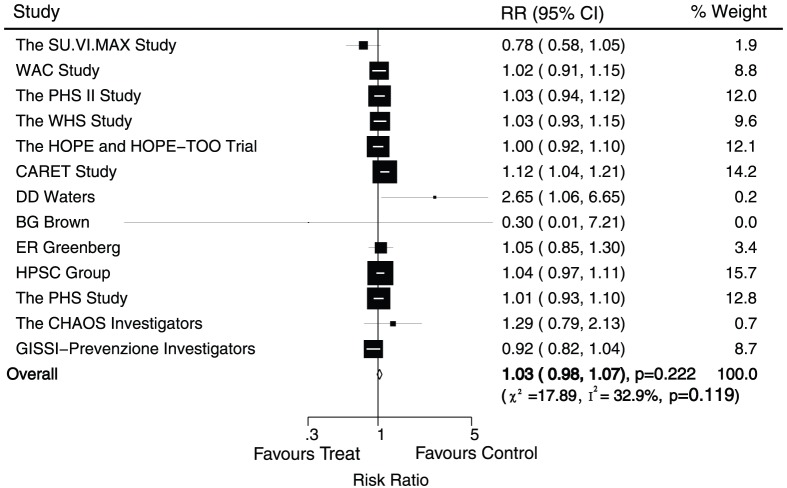
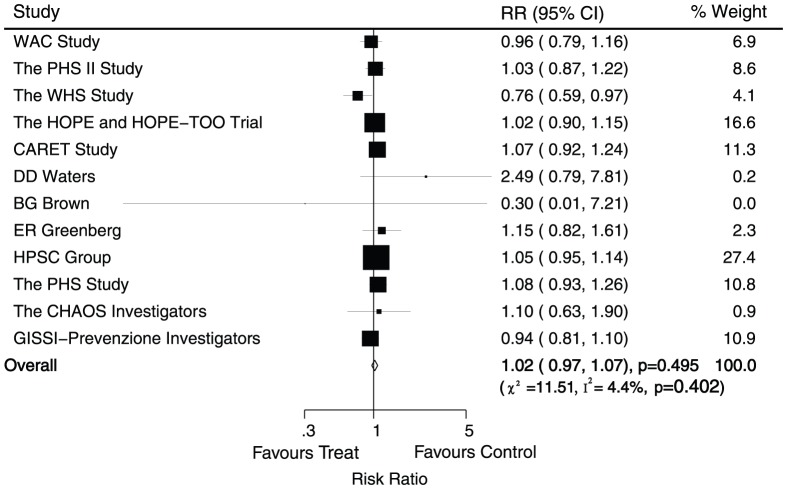
Verification
Claims the paper makes
The claims and statistics of this paper haven’t been checked yet.
Run the check — free, no account needed. It reads the open-access text and checks the sources it cites.
Claims other papers make about this one
Each is checked against this paper’s own text: does it say what the citing paper says it does?
In the citing paper
“Several vitamins and nutrients associate with lower CVD risk in observational studies, but trials of supplements, including folate, B-vitamins, beta-carotene, vitamin C, vitamin E, and selenium, have shown no significant effects on atherosclerosis progression or CVD events.19, 331, 332”
From Dietary and Policy Priorities for Cardiovascular Disease, Diabetes, and Obesity: A Comprehensive Review (2016) · cites this paper as [332]
Self-check
Percentages, sums and reported differences re-computed from the paper’s own numbers.
The self-check needs the paper’s full text.
Citations
Cites
Preferred Reporting Items for Systematic Reviews and Meta-Analyses: the PRISMA statement
Moher, D., Liberati, A., Tetzlaff, J., Altman, D. G., & for the PRISMA Group (2009) · BMJ · doi:10.1136/bmj.b2535 · Cited by 83,823
Measuring inconsistency in meta-analyses
Higgins, J. P. T., Thompson, S. G., Deeks, J. J., & Altman, D. G. (2003) · BMJ · doi:10.1136/bmj.327.7414.557 · Cited by 63,139
Bias in meta-analysis detected by a simple, graphical test
Egger, M., Smith, G. D., Schneider, M., & Minder, C. (1997) · BMJ · doi:10.1136/bmj.315.7109.629 · Cited by 56,722
Preferred reporting items for systematic reviews and meta-analyses: the PRISMA Statement.
(2009) · PubMed Central · Cited by 44,859
Meta-analysis in clinical trials
DerSimonian, R., & Laird, N. (1986) · Controlled Clinical Trials · doi:10.1016/0197-2456(86)90046-2 · Cited by 39,552
Assessing the quality of reports of randomized clinical trials: Is blinding necessary?
Jadad, A. R., Moore, R. A., Carroll, D., Jenkinson, C., Reynolds, D. J. M., Gavaghan, D. J., & McQuay, H. J. (1996) · Controlled Clinical Trials · doi:10.1016/0197-2456(95)00134-4 · Cited by 17,582
Operating characteristics of a rank correlation test for publication bias
Begg, C. B., & Mazumdar, M. (1994) · Biometrics · doi:10.2307/2533446 · Cited by 16,955
Zhang, Q., Wang, C., Zheng, M., Li, Y., Li, J., Zhang, L., Shang, X., & Yan, C. (2014) · Cerebrovascular Diseases · doi:10.1159/000369778 · Cited by 11,609
Self-citation(1994) · New England Journal of Medicine · doi:10.1056/nejm199404143301501 · Cited by 4,737
Dong, Y., Hao, L., Shi, Z., Wang, G., Zhang, Z., & Han, C. (2013) · Urologia Internationalis · doi:10.1159/000351405 · Cited by 4,557
Research works printed but not linked: 2
- MJ Stampfer, 1993, A review of the epidemiology of dietary antioxidants and risk of coronary heart disease, Can J Cardiol, l9, 14B
- D Steinberg, 1992, Antioxidants in the prevention of human atherosclerosis, Circulation, 85, 2337
Cited by
Sorted by citations
Items 201–202 of 202
Xu, S.-Y., Liu, H.-Y., Chen, L.-H., Lu, X.-X., Hang, F.-J., & Zhao, L.-Y. (2026) · Frontiers in Nutrition · doi:10.3389/fnut.2026.1739431
Baek, S., Kang, M. S., Raffa, G. M., Pisano, C., Nuzzi, V., Kowalewski, M., Suwalski, P., & Urbanowicz, T. K. (2026) · Antioxidants · doi:10.3390/antiox15101222
Metadata
- Authors
- Ye, Y., Li, J., & Yuan, Z.
- Affiliations
- Shanghai Jiao Tong University (CN)
- Children's Hospital of Fudan University (CN)
- Corresponding author
- Yuan, Zhongxiang
- ORCID
- Venue
- PLoS ONE
- Publisher
- Public Library of Science (PLoS)
- Published
- 2013-02-20
- Volume
- 8
- Issue
- 2
- Pages
- e56803
- ISSN
- 1932-6203 (ISSN-L)
- PMC
- PMC3577664
- OpenAlex
- W1975083648
- Cited by
- 204
- References
- 59
- Citations by year
- 2026: 6 · 2025: 9 · 2024: 9 · 2023: 13 · 2022: 15 · 2021: 22 · 2020: 11 · 2019: 28 · 2018: 19 · 2017: 11 · 2016: 20 · 2015: 17 · 2014: 14 · 2013: 9
- FWCI
- 1.96
- Type
- journal article
- Language
- en
- Open access
- gold
- doi.org
- Locations
- PLoS ONE (publishedVersion, cc-by)
- Europe PMC (PubMed Central) (publishedVersion, cc-by)
- PubMed Central (publishedVersion, cc-by)
- PubMed (publishedVersion)
- RePEc: Research Papers in Economics (submittedVersion)
- DOAJ (DOAJ: Directory of Open Access Journals) (submittedVersion, cc-by-sa)
- Figshare (submittedVersion, cc-by)
- Topics
- Health Sciences › Medicine › Biochemistry (medical) › Antioxidant Activity and Oxidative Stress
- Health Sciences › Medicine › Public Health, Environmental and Occupational Health › Nutritional Studies and Diet
- Health Sciences › Medicine › Biochemistry (medical) › Phytochemicals and Antioxidant Activities
- Keywords
- antioxidant vitamins, vitamin E, beta-carotene, vitamin C, cardiovascular outcomes, myocardial infarction, stroke, cardiovascular mortality, all-cause mortality, coronary artery disease, congestive heart failure, angina pectoris, revascularization, adverse events, vitamin supplementation, cardiovascular disease prevention, selenium, nicotinic acid, omega-3 fatty acids, statins, blood pressure
- MeSH terms
- Antioxidants, Ascorbic Acid, Cardiovascular Diseases, Humans, Risk, Vitamin E, Vitamins, Odds Ratio, Randomized Controlled Trials as Topic, Publication Bias, beta Carotene, Dietary Supplements
About these checks
Registry, retraction, Cites and statistics results are computed, not judged, with one exception: a printed reference that no index lists is read once by a model before it counts as a citation error. Claims are extracted by a model and kept only when their quote appears verbatim in the text; each cited source is then checked, with a model’s help, for whether it says what the claim relies on. Those verdicts can be wrong — read the claim’s quote and the cited source before relying on one.
Statistics and arithmetic are recomputed, not judged.
Confidence bands are shown only for fields calibrated on our annotated test set. None is calibrated yet, so no band is shown.
What counts as a claim ›How we measure confidence ›How we check this ›
Are you an author, or do you see a problem with this page? Request a review
