

The DOI matches its Crossref record; 56 of the 57 references it cites were found in a registry or an index.
Noninvasive and Targeted Gene Delivery into the Brain Using Microbubble-Facilitated Focused Ultrasound
Open accessAbstract
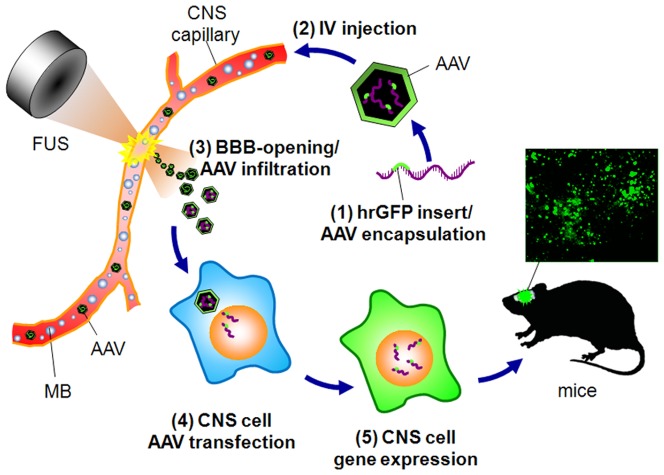
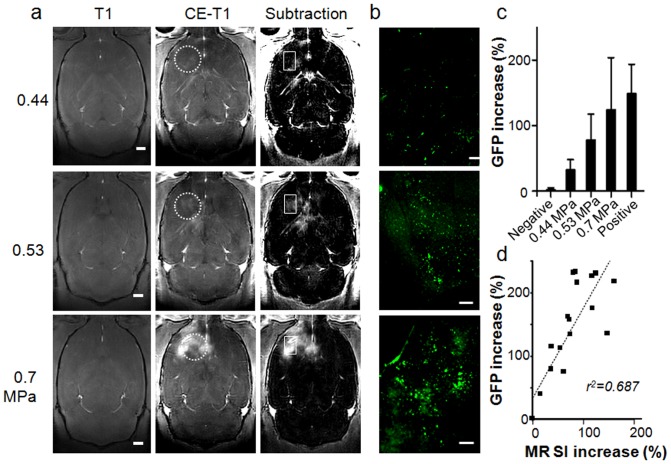
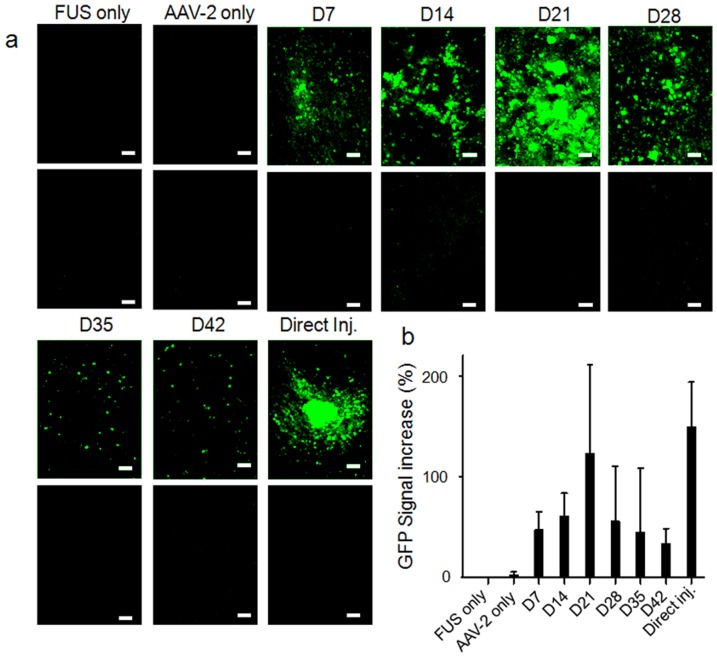
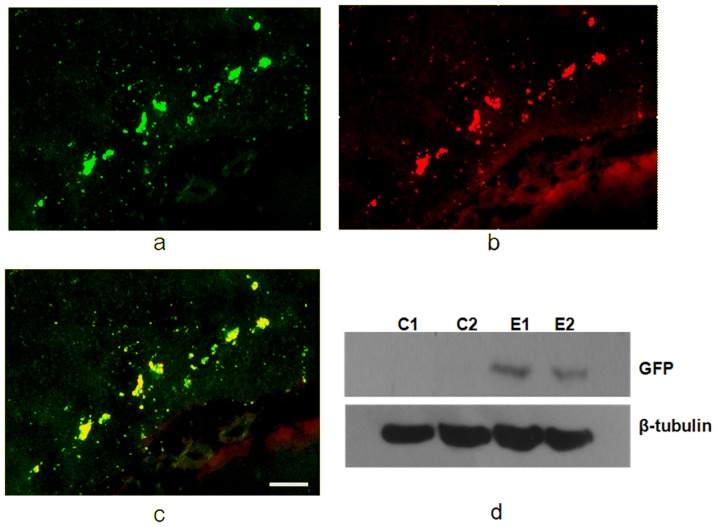
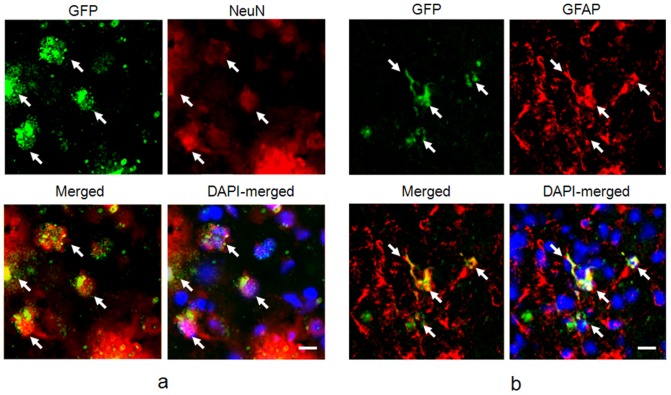
Recombinant adeno-associated viral (rAAV) vectors are potentially powerful tools for gene therapy of CNS diseases, but their penetration into brain parenchyma is severely limited by the blood-brain barrier (BBB) and current delivery relies on invasive stereotactic injection. Here we evaluate the local, targeted delivery of rAAV vectors into the brains of mice by noninvasive, reversible, microbubble-facilitated focused ultrasound (FUS), resulting in BBB opening that can be monitored and controlled by magnetic resonance imaging (MRI). Using this method, we found that IV-administered AAV2-GFP (green fluorescence protein) with a low viral vector titer (1×10(9) vg/g) can successfully penetrate the BBB-opened brain regions to express GFP. We show that MRI monitoring of BBB-opening could serve as an indicator of the scale and distribution of AAV transduction. Transduction peaked at 3 weeks and neurons and astrocytes were affected. This novel, noninvasive delivery approach could significantly broaden the application of AAV-viral-vector-based genes for treatment of CNS diseases.
Overview
The claims and statistics of this paper haven’t been checked yet.
Run the check — free, no account needed. It reads the open-access text and checks the sources it cites.
Integrity signals
Registry
Cites
Statistics
Figures
Verification
Claims the paper makes
The claims and statistics of this paper haven’t been checked yet.
Run the check — free, no account needed. It reads the open-access text and checks the sources it cites.
Claims other papers make about this one
Each is checked against this paper’s own text: does it say what the citing paper says it does?
The source backs part of the claim, not all of it — or backs it for a different population, condition or comparison.
In the citing paper
“It was reported that IV infusion of AAV1, AAV2 or chimeric AAV1/2 vector, which showed low BBB-crossing per se, successfully penetrated into directed brain regions after FUS-MB treatment [140–142].”
From Designing and optimizing AAV-mediated gene therapy for neurodegenerative diseases: from bench to bedside (2024) · cites this paper as [140]
Experimental — accuracy not yet measured
Self-check
Percentages, sums and reported differences re-computed from the paper’s own numbers.
The self-check needs the paper’s full text.
Citations
Cites
Amyloid oligomers exacerbate tau pathology in a mouse model of tauopathy
Selenica, M.-L. B., Brownlow, M., Jimenez, J. P., Lee, D. C., Pena, G., Dickey, C. A., Gordon, M. N., & Morgan, D. (2013) · Neurodegenerative Diseases · doi:10.1159/000337230 · Cited by 10,359
Noninvasive MR Imaging–guided Focal Opening of the Blood-Brain Barrier in Rabbits
Hynynen, K., McDannold, N. J., Vykhodtseva, N. I., & Jolesz, F. A. (2001) · Radiology · doi:10.1148/radiol.2202001804 · Cited by 1,463
Intravascular AAV9 preferentially targets neonatal neurons and adult astrocytes
Foust, K. D., Nurre, E., Montgomery, C. L., Hernandez, A., Chan, C. M., & Kaspar, B. K. (2009) · Nature Biotechnology · doi:10.1038/nbt.1515 · Cited by 1,456 · cited 1×
“This finding suggests that systemic administration of viral vector for CNS transduction could be achieved without viral toxicity, as opposed to other reports of viral IV administration that required much higher concentrations (10-10 vg/ml [20,21,22]).”
ResultSummerford, C., & Samulski, R. J. (1998) · Journal of Virology · doi:10.1128/jvi.72.2.1438-1445.1998 · Cited by 1,409
Kaplitt, M. G., Feigin, A., Tang, C., Fitzsimons, H. L., Mattis, P., Lawlor, P. A., Bland, R. J., Young, D., Strybing, K., Eidelberg, D., et al. (2007) · The Lancet · doi:10.1016/s0140-6736(07)60982-9 · Cited by 1,067
Kaplitt, M. G., Leone, P., Samulski, R. J., Xiao, X., Pfaff, D. W., O’Malley, K. L., & During, M. J. (1994) · Nature Genetics · doi:10.1038/ng1094-148 · Cited by 1,031
Adeno-associated Virus Serotypes: Vector Toolkit for Human Gene Therapy
Wu, Z., Asokan, A., & Samulski, R. J. (2006) · Molecular Therapy · doi:10.1016/j.ymthe.2006.05.009 · Cited by 957
Therapeutic in vivo gene transfer for genetic disease using AAV: Progress and challenges
Mingozzi, F., & High, K. A. (2011) · Nature Reviews Genetics · doi:10.1038/nrg2988 · Cited by 893
Blood-Brain Barrier in Physiology and Medicine
Rapoport, S. I. (1976) · Medical Entomology and Zoology · Cited by 889
Burger, C., Gorbatyuk, O. S., Velardo, M. J., Peden, C. S., Williams, P., Zolotukhin, S., Reier, P. J., Mandel, R. J., & Muzyczka, N. (2004) · Molecular Therapy · doi:10.1016/j.ymthe.2004.05.024 · Cited by 741
Research works printed but not linked: 1
- N Carty, 2010, Convection-enhanced delivery and systemic mannitol increase gene product distribution of AAV vectors 5, 8, and 9 and increase gene product in the adult mouse brain, J Neurosci Methods, 194, 144, 10.1016/j.jneumeth.2010.10.010 · DOI
Cited by
Sorted by citations
Aryal, M., Arvanitis, C., Alexander, P. M., & McDannold, N. J. (2014) · Advanced Drug Delivery Reviews · doi:10.1016/j.addr.2014.01.008 · Cited by 461
Crossing the Blood–Brain Barrier: Recent Advances in Drug Delivery to the Brain
Patel, M. M., & Patel, B. M. (2017) · CNS Drugs · doi:10.1007/s40263-016-0405-9 · Cited by 430
Evolving Drug Delivery Strategies to Overcome the Blood Brain Barrier
S. Hersh, D., S. Wadajkar, A., B. Roberts, N., G. Perez, J., P. Connolly, N., Frenkel, V., A. Winkles, J., F. Woodworth, G., & J. Kim, A. (2016) · Current Pharmaceutical Design · doi:10.2174/1381612822666151221150733 · Cited by 387
Stereotactic modulation of blood-brain barrier permeability to enhance drug delivery
Appelboom, G., Detappe, A., LoPresti, M. A., Kunjachan, S., Mitrasinovic, S., Goldman, S., Chang, S. D., & Tillement, O. (2016) · Neuro-Oncology · doi:10.1093/neuonc/now137 · Cited by 340
Focused ultrasound-mediated drug delivery through the blood–brain barrier
Burgess, A., Shah, K., Hough, O., & Hynynen, K. (2015) · Expert Review of Neurotherapeutics · doi:10.1586/14737175.2015.1028369 · Cited by 332
Metadata
- Authors
- Hsu, P.-H., Wei, K.-C., Huang, C.-Y., Wen, C.-J., Yen, T.-C., Liu, C.-L., Lin, Y.-T., Chen, J.-C., Shen, C.-R., & Liu, H.-L.
- Affiliations
- Chang Gung University (TW)
- Ming Chi University of Technology (TW)
- Corresponding author
- Shen, Chia-Rui
- Liu, Hao-Li
- ORCID
- Venue
- PLoS ONE
- Publisher
- Public Library of Science (PLoS)
- Published
- 2013-02-27
- Volume
- 8
- Issue
- 2
- Pages
- e57682
- ISSN
- 1932-6203 (ISSN-L)
- PMC
- PMC3584045
- OpenAlex
- W1969401867
- Cited by
- 136
- References
- 57
- Citations by year
- 2026: 5 · 2025: 8 · 2024: 9 · 2023: 4 · 2022: 12 · 2021: 20 · 2020: 12 · 2019: 12 · 2018: 12 · 2017: 3 · 2016: 9 · 2015: 14 · 2014: 13 · 2013: 2
- FWCI
- 6.99
- Type
- journal article
- Language
- en
- Open access
- gold
- doi.org
- Locations
- PLoS ONE (publishedVersion, cc-by)
- Europe PMC (PubMed Central) (publishedVersion, cc-by)
- PubMed Central (publishedVersion, cc-by)
- PubMed (publishedVersion)
- DOAJ (DOAJ: Directory of Open Access Journals) (submittedVersion, cc-by-sa)
- Figshare (submittedVersion, cc-by)
- Funders
- National Science Council (100-2321-B-182-010)
- Chang Gung Medical Foundation
- Topics
- Physical Sciences › Engineering › Biomedical Engineering › Ultrasound and Hyperthermia Applications
- Life Sciences › Biochemistry, Genetics and Molecular Biology › Genetics › Virus-based gene therapy research
- Life Sciences › Neuroscience › Neurology › Barrier Structure and Function Studies
- Keywords
- gene therapy, adeno-associated virus vectors, focused ultrasound, microbubbles, blood-brain barrier disruption, central nervous system disorders
- MeSH terms
- Dependovirus, Animals, Astrocytes, Blood-Brain Barrier, Brain, Contrast Media, Fluorescent Antibody Technique, Genetic Vectors, Magnetic Resonance Imaging, Male, Mice, Inbred ICR, Transduction, Genetic, Ultrasonics, Blotting, Western, Reproducibility of Results, Gene Transfer Techniques, Microbubbles, Green Fluorescent Proteins, Mice
About these checks
Registry, retraction, Cites and statistics results are computed, not judged, with one exception: a printed reference that no index lists is read once by a model before it counts as a citation error. Claims are extracted by a model and kept only when their quote appears verbatim in the text; each cited source is then checked, with a model’s help, for whether it says what the claim relies on. Those verdicts can be wrong — read the claim’s quote and the cited source before relying on one.
Statistics and arithmetic are recomputed, not judged.
Confidence bands are shown only for fields calibrated on our annotated test set. None is calibrated yet, so no band is shown.
What counts as a claim ›How we measure confidence ›How we check this ›
Are you an author, or do you see a problem with this page? Request a review
