

Remarkable Growth of Open Access in the Biomedical Field: Analysis of PubMed Articles from 2006 to 2010
Open accessThe DOI matches its Crossref record; 13 of the 13 references it cites were found in a registry or an index.
Abstract
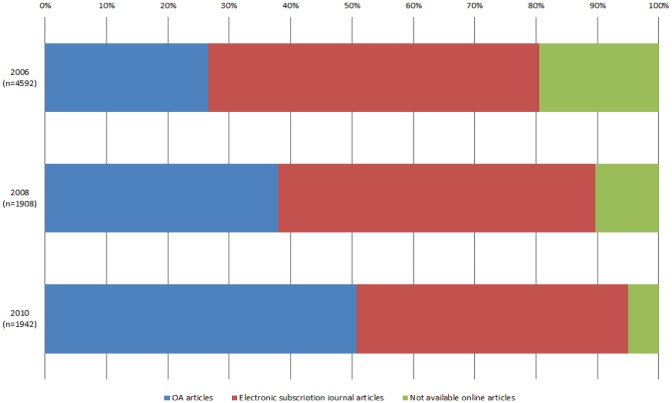
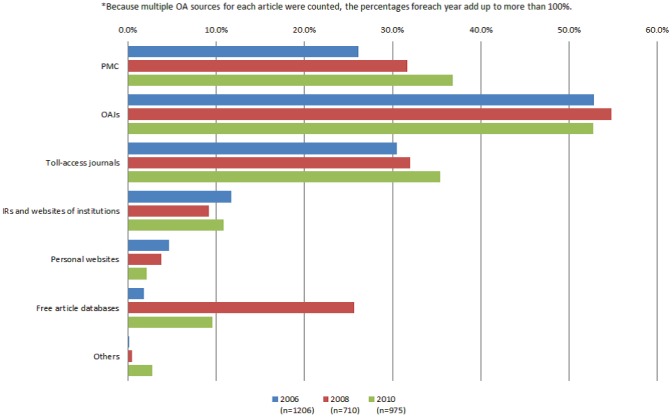
INTRODUCTION: This study clarifies the trends observed in open access (OA) in the biomedical field between 2006 and 2010, and explores the possible explanations for the differences in OA rates revealed in recent surveys. METHODS: The study consists of a main survey and two supplementary surveys. In the main survey, a manual Google search was performed to investigate whether full-text versions of articles from PubMed were freely available. Target samples were articles published in 2005, 2007, and 2009; the searches were performed a year after publication in 2006, 2008, and 2010, respectively. Using the search results, we classified the OA provision methods into seven categories. The supplementary surveys calculated the OA rate using two search functions on PubMed: "LinkOut" and "Limits." RESULTS: The main survey concluded that the OA rate increased significantly between 2006 and 2010: the OA rate in 2010 (50.2%) was twice that in 2006 (26.3%). Furthermore, majority of OA articles were available from OA journal (OAJ) websites, indicating that OAJs have consistently been a significant contributor to OA throughout the period. OA availability through the PubMed Central (PMC) repository also increased significantly. OA rates obtained from two supplementary surveys were lower than those found in the main survey. "LinkOut" could find only 40% of OA articles in the main survey. DISCUSSION: OA articles in the biomedical field have more than a 50% share. OA has been achieved through OAJs. The reason why the OA rates in our surveys are different from those in recent surveys seems to be the difference in sampling methods and verification procedures.
Overview
The claims and statistics of this paper haven’t been checked yet.
Free: it reads the open-access text and checks the first 5 claims that cite a source we can check. Create a free account to check every claim.
Integrity signals
Registry
Cites
Statistics
Figures
Verification
Claims the paper makes
The claims and statistics of this paper haven’t been checked yet.
Free: it reads the open-access text and checks the first 5 claims that cite a source we can check. Create a free account to check every claim.
Claims other papers make about this one
Each is checked against this paper’s own text: does it say what the citing paper says it does?
The source backs part of the claim, not all of it — or backs it for a different population, condition or comparison.
In the citing paper
“In the biomedical field, almost half of all research is available in full text only by subscription”
From Evaluation of reporting quality of abstracts of randomized controlled trials regarding patients with COVID-19 using the CONSORT statement for abstracts (2022) · cites this paper as Kurata et al., 2013
Experimental — accuracy not yet measuredThe source backs part of the claim, not all of it — or backs it for a different population, condition or comparison.
In the citing paper
“the abstract is also an important tool for clinical decision-making, as there may be financial, technical, temporal, and language barriers that impede or reduce access to the full text of the article.”
From Evaluation of reporting quality of abstracts of randomized controlled trials regarding patients with COVID-19 using the CONSORT statement for abstracts (2022) · cites this paper as Kurata et al., 2013
Experimental — accuracy not yet measuredIn the citing paper
“In fact, they are the primary source of information for many readers because of their accessibility and conciseness [1, 2].”
From Overstatements in abstract conclusions claiming effectiveness of interventions in psychiatry: A meta-epidemiological investigation (2017) · cites this paper as [2]
Self-check
Percentages, sums and reported differences re-computed from the paper’s own numbers.
The self-check needs the paper’s full text.
Citations
Cites
The Development of Open Access Journal Publishing from 1993 to 2009
Laakso, M., Welling, P., Bukvova, H., Nyman, L., Björk, B.-C., & Hedlund, T. (2011) · PLoS ONE · doi:10.1371/journal.pone.0020961 · Cited by 755
Open Access to the Scientific Journal Literature: Situation 2009
Björk, B.-C., Welling, P., Laakso, M., Majlender, P., Hedlund, T., & Guðnason, G. (2010) · PLoS ONE · doi:10.1371/journal.pone.0011273 · Cited by 526
Anatomy of open access publishing: a study of longitudinal development and internal structure
Laakso, M., & Björk, B.-C. (2012) · BMC Medicine · doi:10.1186/1741-7015-10-124 · Cited by 364
Hajjem, C., Harnad, S. R., & Gingras, Y. (2006) · arXiv (Cornell University) · doi:10.48550/arxiv.cs/0606079 · Cited by 352
Open access to the scientific journal literature.
Suber, P. (2002) · Journal of Biology · doi:10.1186/1475-4924-1-3 · Cited by 117
A Review of Open Access Self-Archiving Mandate Policies
Xia, J., Gilchrist, S. B., Smith, N. X. P., Kingery, J. A., Radecki, J. R., Wilhelm, M. L., Harrison, K. C., Ashby, M. L., & Mahn, A. J. (2012) · portal: Libraries and the Academy · doi:10.1353/pla.2012.0000 · Cited by 105
Status of open access in the biomedical field in 2005
Matsubayashi, M., Kurata, K., Sakai, Y., Morioka, T., Kato, S., Mine, S., & Ueda, S. (2009) · Journal of the Medical Library Association JMLA · doi:10.3163/1536-5050.97.1.002 · Cited by 54
Self-citationThe Open Access Availability of Library and Information Science Literature
Way, D. (2010) · College & Research Libraries · doi:10.5860/crl-38r1 · Cited by 51
Characteristics of Open Access Journals in Six Subject Areas
Walters, W. H., & Linvill, A. C. (2011) · College & Research Libraries · doi:10.5860/crl-132 · Cited by 48
Britain aims for broad open access
Noorden, R. V. (2012) · Nature · doi:10.1038/486302a · Cited by 23
Cited by
Boutron, I., Altman, D. G., Hopewell, S., Vera-Badillo, F., Tannock, I., & Ravaud, P. (2014) · Journal of Clinical Oncology · doi:10.1200/jco.2014.56.7503 · Cited by 368
Pinfield, S., Salter, J., & Bath, P. A. (2016) · Journal of the Association for Information Science and Technology · doi:10.1002/asi.23446 · Cited by 196
Making Open Access work: The “state-of-the-art” in providing Open Access to scholarly literature
Pinfield, S. (2015) · Online Information Review · doi:10.1108/oir-05-2015-0167 · Cited by 113
“A large number of discipline- specific studies have contributed to a greater understanding of the landscape and generally reinforce this overall picture, including Biomedicine (Kurata et al., 2013), Business and management (Lyons and Booth, 2011), Conservation Science (Fuller et al., 2014), Construction Management (Bj…”
BackgroundPinfield, S., Salter, J., & Bath, P. A. (2017) · Journal of the Association for Information Science and Technology · doi:10.1002/asi.23742 · Cited by 78
Make Data Sharing Routine to Prepare for Public Health Emergencies
Chrétien, J.-P., Rivers, C., & Johansson, M. A. (2016) · PLoS Medicine · doi:10.1371/journal.pmed.1002109 · Cited by 65
Metadata
- Authors
- Kurata, K., Morioka, T., Yokoi, K., & Matsubayashi, M.
- Affiliations
- Keio University (JP)
- Kunitachi College of Music (JP)
- Tokyo Institute of Technology (JP)
- University of Tsukuba (JP)
- Corresponding author
- Matsubayashi, Mamiko
- Venue
- PLoS ONE
- Publisher
- Public Library of Science (PLoS)
- Published
- 2013-05-01
- Volume
- 8
- Issue
- 5
- Pages
- e60925
- ISSN
- 1932-6203 (ISSN-L)
- PMC
- PMC3641021
- OpenAlex
- W2134327724
- Cited by
- 66
- References
- 13
- Citations by year
- 2026: 1 · 2025: 1 · 2024: 5 · 2023: 4 · 2022: 3 · 2021: 4 · 2020: 2 · 2019: 4 · 2018: 4 · 2017: 8 · 2016: 10 · 2015: 8 · 2014: 5 · 2013: 7
- FWCI
- 21.96
- Type
- journal article
- Language
- en
- Open access
- gold
- doi.org
- Locations
- PLoS ONE (publishedVersion, cc-by)
- Europe PMC (PubMed Central) (publishedVersion, cc-by)
- PubMed Central (publishedVersion, cc-by)
- PubMed (publishedVersion)
- RePEc: Research Papers in Economics (publishedVersion)
- DOAJ (DOAJ: Directory of Open Access Journals) (publishedVersion)
- Institutional Repositories DataBase (IRDB) (submittedVersion, cc-by-nc-nd)
- Terrestrial Environment Research Center (University of Tsukuba) (submittedVersion, other-oa)
- Funders
- Japan Society for the Promotion of Science (23300089, 17500160)
- Topics
- Social Sciences › Library and Information Sciences › Academic Publishing and Open Access
- Social Sciences › Library and Information Sciences › scientometrics and bibliometrics research
- Social Sciences › Library and Information Sciences › Publishing and Scholarly Communication
- Keywords
- open access, biomedical literature, PubMed, open access journals, PubMed Central, full-text availability
- MeSH terms
- Data Collection, Humans, Publishing, Bibliometrics, Internet, Access to Information, Biomedical Research, PubMed
About these checks
Registry, retraction, Cites and statistics results are computed, not judged, with one exception: a printed reference that no index lists is read once by a model before it counts as a citation error. Claims are extracted by a model and kept only when their quote appears verbatim in the text; each cited source is then checked, with a model’s help, for whether it says what the claim relies on. Those verdicts can be wrong — read the claim’s quote and the cited source before relying on one.
Statistics and arithmetic are recomputed, not judged.
Confidence bands are shown only for fields calibrated on our annotated test set. None is calibrated yet, so no band is shown.
What counts as a claim ›How we measure confidence ›How we check this ›
Are you an author, or do you see a problem with this page? Request a review
Data sources
Bibliographic data: Semantic Scholar, OpenAlex, Crossref.
Contains information from the Semantic Scholar Academic Graph Datasets, made available under the ODC Attribution License (ODC-BY 1.0).
Semantic Scholar’s data is described in: Kinney, R., et al. (2023). The Semantic Scholar Open Data Platform. arXiv:2301.10140.
