

Can Taichi Reshape the Brain? A Brain Morphometry Study
Open accessThe DOI matches its Crossref record; 76 of the 78 references it cites were found in a registry or an index.
Abstract
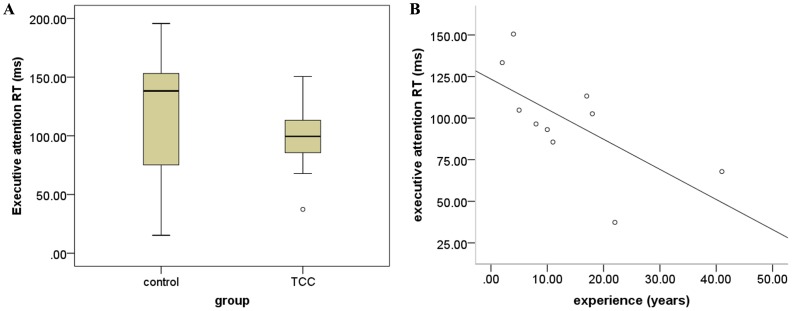
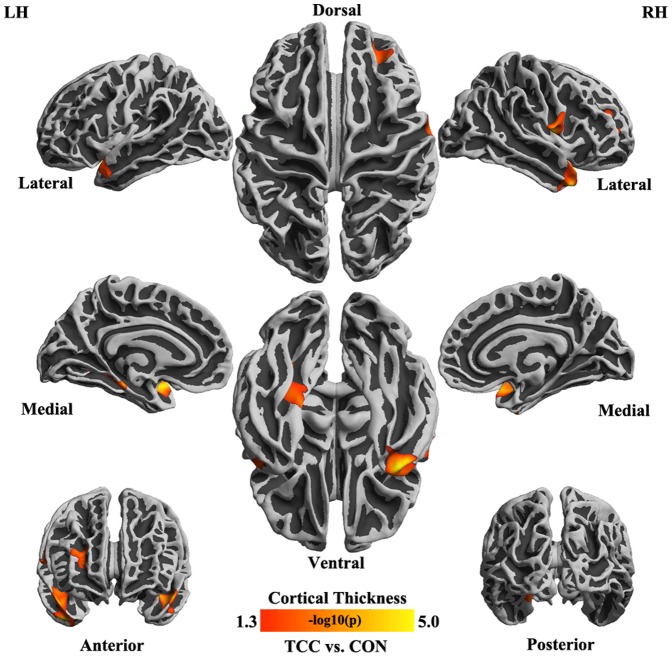
Although research has provided abundant evidence for Taichi-induced improvements in psychological and physiological well-being, little is known about possible links to brain structure of Taichi practice. Using high-resolution MRI of 22 Tai Chi Chuan (TCC) practitioners and 18 controls matched for age, sex and education, we set out to examine the underlying anatomical correlates of long-term Taichi practice at two different levels of regional specificity. For this purpose, parcel-wise and vertex-wise analyses were employed to quantify the difference between TCC practitioners and the controls based on cortical surface reconstruction. We also adopted the Attention Network Test (ANT) to explore the effect of TCC on executive control. TCC practitioners, compared with controls, showed significantly thicker cortex in precentral gyrus, insula sulcus and middle frontal sulcus in the right hemisphere and superior temporal gyrus and medial occipito-temporal sulcus and lingual sulcus in the left hemisphere. Moreover, we found that thicker cortex in left medial occipito-temporal sulcus and lingual sulcus was associated with greater intensity of TCC practice. These findings indicate that long-term TCC practice could induce regional structural change and also suggest TCC might share similar patterns of neural correlates with meditation and aerobic exercise.
Overview
The claims and statistics of this paper haven’t been checked yet.
Free: it reads the open-access text and checks the first 5 claims that cite a source we can check. Create a free account to check every claim.
Integrity signals
Registry
Cites
Statistics
Figures


Verification
Claims the paper makes
The claims and statistics of this paper haven’t been checked yet.
Free: it reads the open-access text and checks the first 5 claims that cite a source we can check. Create a free account to check every claim.
Claims other papers make about this one
Each is checked against this paper’s own text: does it say what the citing paper says it does?
The source backs part of the claim, not all of it — or backs it for a different population, condition or comparison.
In the citing paper
“Several studies reported that different meditation techniques require different cognitive processes and thus produce different neural effects [55, 56].”
From The meditative mind: a comprehensive meta-analysis of MRI studies. (2015) · cites this paper as [56]
Experimental — accuracy not yet measured
Self-check
Percentages, sums and reported differences re-computed from the paper’s own numbers.
The self-check needs the paper’s full text.
Citations
Cites
Desikan, R. S., Ségonne, F., Fischl, B., Quinn, B. T., Dickerson, B. C., Blacker, D., Buckner, R. L., Dale, A. M., Maguire, R. P., Hyman, B. T., et al. (2006) · NeuroImage · doi:10.1016/j.neuroimage.2006.01.021 · Cited by 13,324 · cited 1×
“Parcel-wise analysis The cortical surface was parcellated into 74 and 34 parcellation elements (parcels) for each hemisphere defined by the DesikanKilliany atlas [40,41] and Destrieux atlas [42] to explore the largescale structural changes, respectively.”
MethodCortical Surface-Based Analysis
Dale, A. M., Fischl, B., & Sereno, M. I. (1999) · NeuroImage · doi:10.1006/nimg.1998.0395 · Cited by 10,910
Measuring the thickness of the human cerebral cortex from magnetic resonance images
Fischl, B., & Dale, A. M. (2000) · Proceedings of the National Academy of Sciences · doi:10.1073/pnas.200033797 · Cited by 5,818 · cited 2×
“Finally, the cortical thickness at that location of the vertex is the mean of these two values [34].”
BackgroundMethodAutomatically Parcellating the Human Cerebral Cortex
Fischl, B. (2004) · Cerebral Cortex · doi:10.1093/cercor/bhg087 · Cited by 4,253 · cited 1×
“Parcel-wise analysis The cortical surface was parcellated into 74 and 34 parcellation elements (parcels) for each hemisphere defined by the DesikanKilliany atlas [40,41] and Destrieux atlas [42] to explore the largescale structural changes, respectively.”
MethodTesting the efficiency and independence of attentional networks
Fan, J., McCandliss, B. D., Sommer, T., Raz, A., & Posner, M. I. (2002) · Journal of Cognitive Neuroscience · doi:10.1162/089892902317361886 · Cited by 3,717 · cited 1×
“Before MRI sessions, the participants completed an Attention Network Test (ANT), which is considered as the flanker test to measure different behavioral aspects of attention including alerting, orienting and executive attention based on the Attention Network theory [25].”
MethodBe smart, exercise your heart: Exercise effects on brain and cognition
Hillman, C. H., Erickson, K. I., & Kramer, A. F. (2008) · Nature Reviews Neuroscience · doi:10.1038/nrn2298 · Cited by 3,563 · cited 3×
“Moreover, a large number of studies demonstrate an important role of BA9 in for exercise-related improvement of executive function in adolescents and the elderly [1].”
BackgroundNeural systems supporting interoceptive awareness
Critchley, H. D., Wiens, S., Rotshtein, P., Öhman, A., & Dolan, R. J. (2004) · Nature Neuroscience · doi:10.1038/nn1176 · Cited by 3,406 · cited 1×
“Greater right insula grey matter correlates with increased accuracy in the subjective sense of the inner body, and with negative emotional experience [61].”
BackgroundSpecification of Cerebral Cortical Areas
Rakic, P. (1988) · Science · doi:10.1126/science.3291116 · Cited by 3,127 · cited 1×
“It is suggested that cortical thickness is related to the number or density of cells in a column [72–74], which might help to explain the detailed change of thickness in cellular level.”
BackgroundAutomatic parcellation of human cortical gyri and sulci using standard anatomical nomenclature
Destrieux, C., Fischl, B., Dale, A., & Halgren, E. (2010) · NeuroImage · doi:10.1016/j.neuroimage.2010.06.010 · Cited by 2,956 · cited 1×
“Parcel-wise analysis The cortical surface was parcellated into 74 and 34 parcellation elements (parcels) for each hemisphere defined by the DesikanKilliany atlas [40,41] and Destrieux atlas [42] to explore the largescale structural changes, respectively.”
MethodA hybrid approach to the skull stripping problem in MRI
Ségonne, F., Dale, A. M., Busa, E., Glessner, M., Salat, D., Hahn, H. K., & Fischl, B. (2004) · NeuroImage · doi:10.1016/j.neuroimage.2004.03.032 · Cited by 2,212 · cited 1×
“Brain tissues were then extracted using a hybrid watershed/surface deformation procedure [30] and automatically segmented into the cerebrospinal fluid (CSF), white matter (WM) and deep gray matter (GM) volumetric structures [29].”
Method
Research works printed but not linked: 1
- ES Sandlund, 2000, The effects of Tai Chi Chuan relaxation and exercise on stress responses and well being: An overview of research, Int J Stress Manage, 7, 139, 10.1023/a:1009536319034 · doi:10.1023/a:1009536319034
Cited by
Fox, K. C. R., Nijeboer, S., Dixon, M. L., Floman, J. L., Ellamil, M., Rumak, S. P., Sedlmeier, P., & Christoff, K. (2014) · Neuroscience & Biobehavioral Reviews · doi:10.1016/j.neubiorev.2014.03.016 · Cited by 804
A research agenda for aging in China in the 21st century
Fang, E. F., Scheibye-Knudsen, M., Jahn, H. J., Li, J., Ling, L., Guo, H., Zhu, X., Preedy, V., Lu, H., Bohr, V. A., et al. (2015) · Ageing Research Reviews · doi:10.1016/j.arr.2015.08.003 · Cited by 721
Zuo, X.-N., & Xing, X.-X. (2014) · Neuroscience & Biobehavioral Reviews · doi:10.1016/j.neubiorev.2014.05.009 · Cited by 660
Self-citationThe Effect of Diaphragmatic Breathing on Attention, Negative Affect and Stress in Healthy Adults
Ma, X., Yue, Z.-Q., Gong, Z.-Q., Zhang, H., Duan, N.-Y., Shi, Y.-T., Wei, G.-X., & Li, Y.-F. (2017) · Frontiers in Psychology · doi:10.3389/fpsyg.2017.00874 · Cited by 509
“Moreover, specific changes, such as an increased cortical thickness (Wei et al., 2013), prefrontalhippocampus functional connectivity (Tao et al.”
BackgroundSelf-citationBreath of Life: The Respiratory Vagal Stimulation Model of Contemplative Activity
Gerritsen, R. J. S., & Band, G. P. H. (2018) · Frontiers in Human Neuroscience · doi:10.3389/fnhum.2018.00397 · Cited by 342
“The frontal end stations of CAN also show predicted structural changes: PFC gray matter density is increased by diverse meditation styles and mind-body exercises (Lazar et al., 2005; Luders et al., 2009, 2012a; Lutz et al., 2015; Hölzel et al., 2011a; Froeliger et al., 2012; Tang et al., 2015; Wei et al., 2013; Yin et…”
Background
Metadata
- Authors
- Wei, G.-X., Xu, T., Fan, F.-M., Dong, H.-M., Jiang, L.-L., Li, H.-J., Yang, Z., Luo, J., & Zuo, X.-N.
- Affiliations
- Chinese Academy of Sciences (CN)
- Corresponding author
- Luo, Jing
- Zuo, Xi-Nian
- Venue
- PLoS ONE
- Publisher
- Public Library of Science (PLoS)
- Published
- 2013-04-09
- Volume
- 8
- Issue
- 4
- Pages
- e61038
- ISSN
- 1932-6203 (ISSN-L)
- PMC
- PMC3621760
- OpenAlex
- W2086825712
- Cited by
- 152
- References
- 78
- Citations by year
- 2026: 13 · 2025: 9 · 2024: 10 · 2023: 8 · 2022: 22 · 2021: 11 · 2020: 12 · 2019: 5 · 2018: 15 · 2017: 14 · 2016: 6 · 2015: 15 · 2014: 8 · 2013: 4
- FWCI
- 29.01
- Type
- journal article
- Language
- en
- Open access
- gold
- doi.org
- Locations
- PLoS ONE (publishedVersion, cc-by)
- Europe PMC (PubMed Central) (publishedVersion, other-oa)
- PubMed Central (publishedVersion, cc-by)
- PubMed (publishedVersion)
- Institutional Repository of Institute of Psychology, Chinese Academy of Sciences (Institute of Psychology, Chinese Academy of Sciences) (submittedVersion)
- DOAJ (DOAJ: Directory of Open Access Journals) (submittedVersion, cc-by-sa)
- Funders
- National Natural Science Foundation of China (81171409, 91132728, 81220108014, KSCX2-EW-J-8, 31200794, KSZD-EW-TZ-002, 81030028)
- Chinese Academy of Sciences (KSZD-EW-TZ-002, KSCX2-EWJ-8, 81220108014, 81171409, Y2CX112006)
- Institute of Psychology, Chinese Academy of Sciences
- National Institute of Mental Health (R01MH139349)
- Topics
- Social Sciences › Safety Research › Martial Arts: Techniques, Psychology, and Education
- Life Sciences › Neuroscience › Neurology › Transcranial Magnetic Stimulation Studies
- Social Sciences › Psychology › Clinical Psychology › Mindfulness and Compassion Interventions
- Keywords
- Tai Chi, brain morphometry, cortical thickness, long-term practice, executive function, Attention Network Test, meditation, aerobic exercise, precentral gyrus, superior temporal gyrus
- MeSH terms
- Brain Mapping, Cerebral Cortex, Female, Humans, Image Processing, Computer-Assisted, Magnetic Resonance Imaging, Male, Middle Aged, Psychological Tests, Exercise, Case-Control Studies, Meditation, Tai Ji
About these checks
Registry, retraction, Cites and statistics results are computed, not judged, with one exception: a printed reference that no index lists is read once by a model before it counts as a citation error. Claims are extracted by a model and kept only when their quote appears verbatim in the text; each cited source is then checked, with a model’s help, for whether it says what the claim relies on. Those verdicts can be wrong — read the claim’s quote and the cited source before relying on one.
Statistics and arithmetic are recomputed, not judged.
Confidence bands are shown only for fields calibrated on our annotated test set. None is calibrated yet, so no band is shown.
What counts as a claim ›How we measure confidence ›How we check this ›
Are you an author, or do you see a problem with this page? Request a review
How to cite
Cite CoChat for the checks on this page, and the paper for its own findings.
- This page
- CoChat. (2026). Citation check: Can Taichi Reshape the Brain? A Brain Morphometry Study. https://app.cochat.ai/papers/10.1371/journal.pone.0061038
- The paper
- Wei, G.-X., Xu, T., Fan, F.-M., Dong, H.-M., Jiang, L.-L., Li, H.-J., Yang, Z., Luo, J., & Zuo, X.-N. (2013). Can Taichi Reshape the Brain? A Brain Morphometry Study. PLoS ONE. https://doi.org/10.1371/journal.pone.0061038
Data sources
Bibliographic data: Semantic Scholar, OpenAlex, Crossref.
Contains information from the Semantic Scholar Academic Graph Datasets, made available under the ODC Attribution License (ODC-BY 1.0).
Semantic Scholar’s data is described in: Kinney, R., et al. (2023). The Semantic Scholar Open Data Platform. arXiv:2301.10140.
