

The DOI matches its Crossref record; 64 of the 64 references it cites were found in a registry or an index.
Passing Messages between Biological Networks to Refine Predicted Interactions
Open accessAbstract
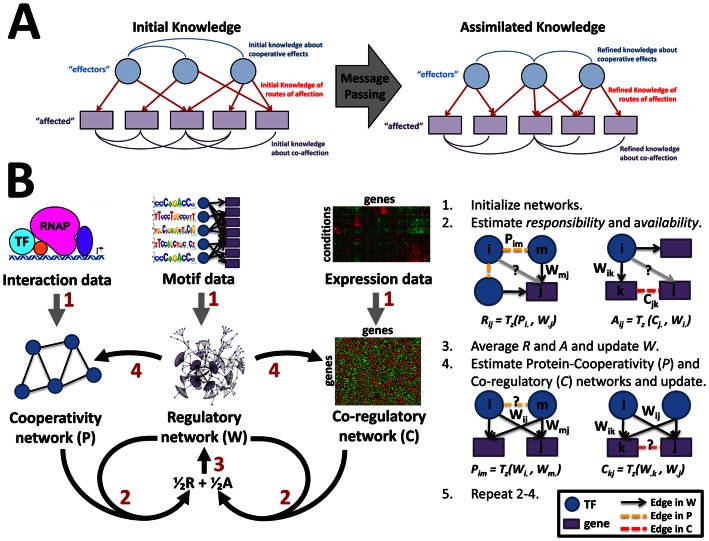
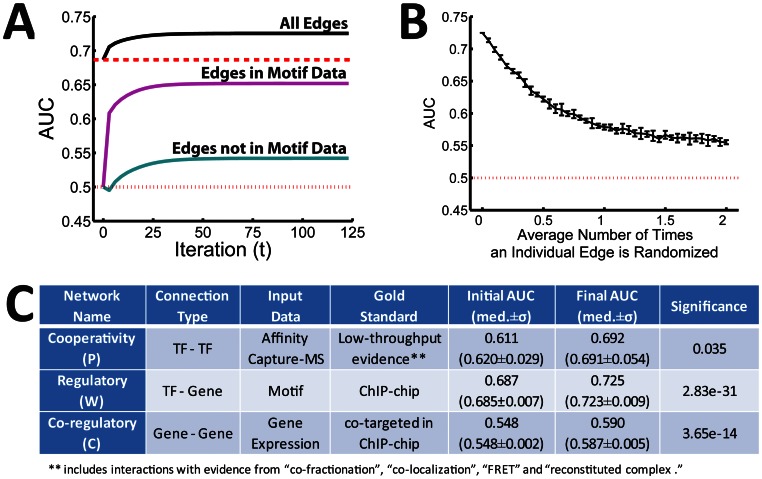
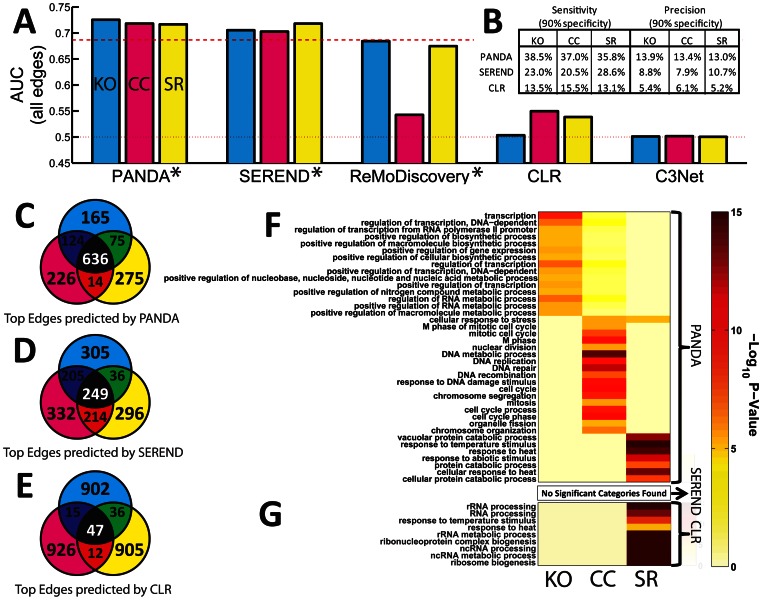
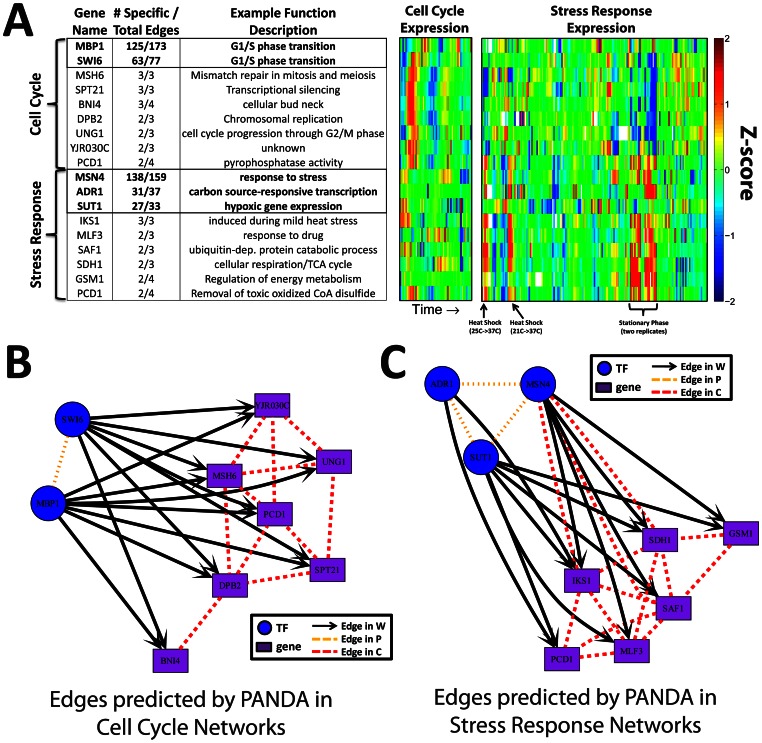
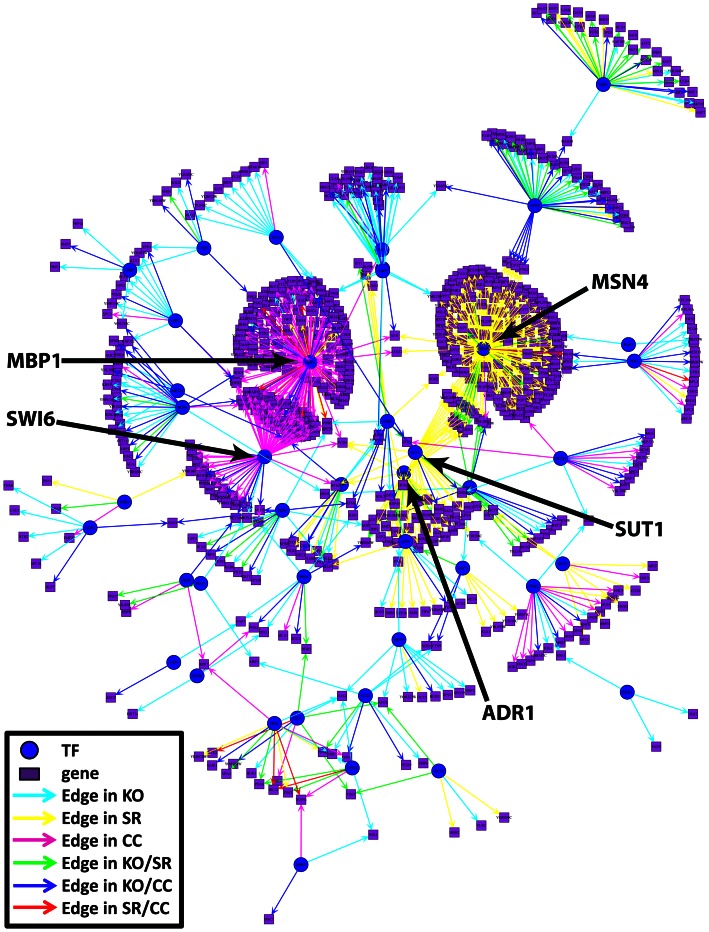
Regulatory network reconstruction is a fundamental problem in computational biology. There are significant limitations to such reconstruction using individual datasets, and increasingly people attempt to construct networks using multiple, independent datasets obtained from complementary sources, but methods for this integration are lacking. We developed PANDA (Passing Attributes between Networks for Data Assimilation), a message-passing model using multiple sources of information to predict regulatory relationships, and used it to integrate protein-protein interaction, gene expression, and sequence motif data to reconstruct genome-wide, condition-specific regulatory networks in yeast as a model. The resulting networks were not only more accurate than those produced using individual data sets and other existing methods, but they also captured information regarding specific biological mechanisms and pathways that were missed using other methodologies. PANDA is scalable to higher eukaryotes, applicable to specific tissue or cell type data and conceptually generalizable to include a variety of regulatory, interaction, expression, and other genome-scale data. An implementation of the PANDA algorithm is available at www.sourceforge.net/projects/panda-net.
Overview
The claims and statistics of this paper haven’t been checked yet.
Run the check — free, no account needed. It reads the open-access text and checks the sources it cites.
Integrity signals
Registry
Cites
Statistics
Figures
Verification
Claims the paper makes
The claims and statistics of this paper haven’t been checked yet.
Run the check — free, no account needed. It reads the open-access text and checks the sources it cites.
Claims other papers make about this one
Each is checked against this paper’s own text: does it say what the citing paper says it does?
The cited source says what the claim attributes to it.
In the citing paper
“However, a focus on TFs is rarely sufficient, and integration of multiple data types is often required to increase the accuracy and usefulness of the resulting networks [13, 147].”
From Gene co-expression analysis for functional classification and gene–disease predictions (2017) · cites this paper as [13]
The cited source says what the claim attributes to it.
In the citing paper
“Overall, integration of multiple data types increases the accuracy of the resulting predictions [13, 147].”
From Gene co-expression analysis for functional classification and gene–disease predictions (2017) · cites this paper as [13]
Self-check
Percentages, sums and reported differences re-computed from the paper’s own numbers.
The self-check needs the paper’s full text.
Citations
Cites
Systematic and integrative analysis of large gene lists using DAVID bioinformatics resources
Huang, D. W., Sherman, B. T., & Lempicki, R. A. (2009) · Nature Protocols · doi:10.1038/nprot.2008.211 · Cited by 35,890
Clustering by Passing Messages Between Data Points
Frey, B. J., & Dueck, D. (2007) · Science · doi:10.1126/science.1136800 · Cited by 6,855
Genomic Expression Programs in the Response of Yeast Cells to Environmental Changes
Gasch, A. P., Spellman, P. T., Kao, C. M., Carmel-Harel, O., Eisen, M. B., Storz, G., Botstein, D., & Brown, P. O. (2000) · Molecular Biology of the Cell · doi:10.1091/mbc.11.12.4241 · Cited by 4,815
BioGRID: a general repository for interaction datasets
Stark, C. (2006) · Nucleic Acids Research · doi:10.1093/nar/gkj109 · Cited by 3,960
Margolin, A. A., Nemenman, I., Basso, K., Wiggins, C., Stolovitzky, G., Favera, R. D., & Califano, A. (2006) · BMC Bioinformatics · doi:10.1186/1471-2105-7-s1-s7 · Cited by 2,420
Margolin, A. A., Nemenman, I. M., Basso, K., Wiggins, C. H., Stolovitzky, G. A., Favera, R. D., & Califano, A. (2006) · BMC Bioinformatics · doi:10.7916/d8g15zbp · Cited by 2,260
Transcriptional regulatory code of a eukaryotic genome
Harbison, C. T., Gordon, D. B., Lee, T. I., Rinaldi, N. J., MacIsaac, K. D., Danford, T., Hannett, N. M., Tagne, J., Reynolds, D. B., Yoo, J. Y., et al. (2004) · Nature · doi:10.1038/nature02800 · Cited by 2,135
Segal, E., Shapira, M., Regev, A., Pe’er, D., Botstein, D., Koller, D., & Friedman, N. (2003) · Nature Genetics · doi:10.1038/ng1165 · Cited by 1,678
Wisdom of crowds for robust gene network inference
The DREAM5 Consortium, Marbach, D., Costello, J. C., Küffner, R., Vega, N. M., Prill, R. J., Camacho, D. M., Allison, K. R., Kellis, M., Collins, J. J., et al. (2012) · Nature Methods · doi:10.1038/nmeth.2016 · Cited by 1,667
Faith, J. J., Hayete, B., Thaden, J. T., Mogno, I., Wierzbowski, J., Cottarel, G., Kasif, S., Collins, J. J., & Gardner, T. S. (2007) · PLoS Biology · doi:10.1371/journal.pbio.0050008 · Cited by 1,563
Cited by
Sorted by citations
Gene co-expression analysis for functional classification and gene–disease predictions
van Dam, S., Võsa, U., van der Graaf, A., Franke, L., & de Magalhães, J. P. (2017) · Briefings in Bioinformatics · doi:10.1093/bib/bbw139 · Cited by 995
DIABLO: an integrative approach for identifying key molecular drivers from multi-omics assays
Singh, A., Shannon, C. P., Gautier, B., Rohart, F., Vacher, M. A., Tebbutt, S. J., & Cao, K. L. (2019) · Bioinformatics · doi:10.1093/bioinformatics/bty1054 · Cited by 1,124
Biomarker development in the precision medicine era: lung cancer as a case study
Vargas, A. J., & Harris, C. C. (2016) · Nature reviews. Cancer · doi:10.1038/nrc.2016.56 · Cited by 562
Sex Differences in Gene Expression and Regulatory Networks across 29 Human Tissues
Lopes‐Ramos, C. M., Chen, C.-Y., Kuijjer, M. L., Paulson, J. N., Sonawane, A. R., Fagny, M., Platig, J., Glass, K., Quackenbush, J. F., & DeMeo, D. L. (2020) · Cell Reports · doi:10.1016/j.celrep.2020.107795 · Cited by 462
Self-citationUnderstanding Tissue-Specific Gene Regulation
Sonawane, A. R., Platig, J., Fagny, M., Chen, C.-Y., Paulson, J. N., Lopes‐Ramos, C. M., DeMeo, D. L., Quackenbush, J. F., Glass, K., & Kuijjer, M. L. (2017) · Cell Reports · doi:10.1016/j.celrep.2017.10.001 · Cited by 425
Self-citation
Metadata
- Authors
- Glass, K., Huttenhower, C., Quackenbush, J., & Yuan, G.-C.
- Affiliations
- Harvard University (US)
- Corresponding author
- Yuan, Guo-Cheng
- Venue
- PLoS ONE
- Publisher
- Public Library of Science (PLoS)
- Published
- 2013-05-31
- Volume
- 8
- Issue
- 5
- Pages
- e64832
- ISSN
- 1932-6203 (ISSN-L)
- PMC
- PMC3669401
- OpenAlex
- W2020672230
- Cited by
- 266
- References
- 64
- Citations by year
- 2026: 24 · 2025: 26 · 2024: 56 · 2023: 22 · 2022: 24 · 2021: 29 · 2020: 24 · 2019: 15 · 2018: 11 · 2017: 12 · 2016: 12 · 2015: 7 · 2014: 4
- FWCI
- 3.44
- Type
- journal article
- Language
- en
- Open access
- gold
- doi.org
- Locations
- PLoS ONE (publishedVersion, cc-by)
- Europe PMC (PubMed Central) (publishedVersion, other-oa)
- PubMed Central (publishedVersion, cc-by)
- PubMed (publishedVersion)
- Digital Access to Scholarship at Harvard (DASH) (Harvard University) (submittedVersion, cc-by)
- DOAJ (DOAJ: Directory of Open Access Journals) (submittedVersion, cc-by-sa)
- Figshare (submittedVersion, cc-by)
- Funders
- National Science Foundation (1053486)
- National Institutes of Health (5r01hl111759-04)
- National Heart, Lung, and Blood Institute (R01-HL111759, P01HL105339)
- Division of Biological Infrastructure (DBI-1053486)
- Topics
- Life Sciences › Biochemistry, Genetics and Molecular Biology › Molecular Biology › Gene Regulatory Network Analysis
- Life Sciences › Biochemistry, Genetics and Molecular Biology › Molecular Biology › Bioinformatics and Genomic Networks
- Life Sciences › Biochemistry, Genetics and Molecular Biology › Molecular Biology › Fungal and yeast genetics research
- Keywords
- regulatory network reconstruction, data integration, message passing, protein-protein interaction, gene expression, sequence motifs, yeast, genome-scale data, network prediction
- MeSH terms
- Algorithms, Computer Simulation, Models, Biological, Saccharomyces cerevisiae, Reproducibility of Results, Signal Transduction, Gene Regulatory Networks, Protein Interaction Maps
About these checks
Registry, retraction, Cites and statistics results are computed, not judged, with one exception: a printed reference that no index lists is read once by a model before it counts as a citation error. Claims are extracted by a model and kept only when their quote appears verbatim in the text; each cited source is then checked, with a model’s help, for whether it says what the claim relies on. Those verdicts can be wrong — read the claim’s quote and the cited source before relying on one.
Statistics and arithmetic are recomputed, not judged.
Confidence bands are shown only for fields calibrated on our annotated test set. None is calibrated yet, so no band is shown.
What counts as a claim ›How we measure confidence ›How we check this ›
Are you an author, or do you see a problem with this page? Request a review
