

The Incidence and Relative Risk of Stroke among Patients with Bipolar Disorder: A Seven-Year Follow-Up Study
Open accessThe DOI matches its Crossref record; 40 of the 40 references it cites were found in a registry or an index.
Abstract
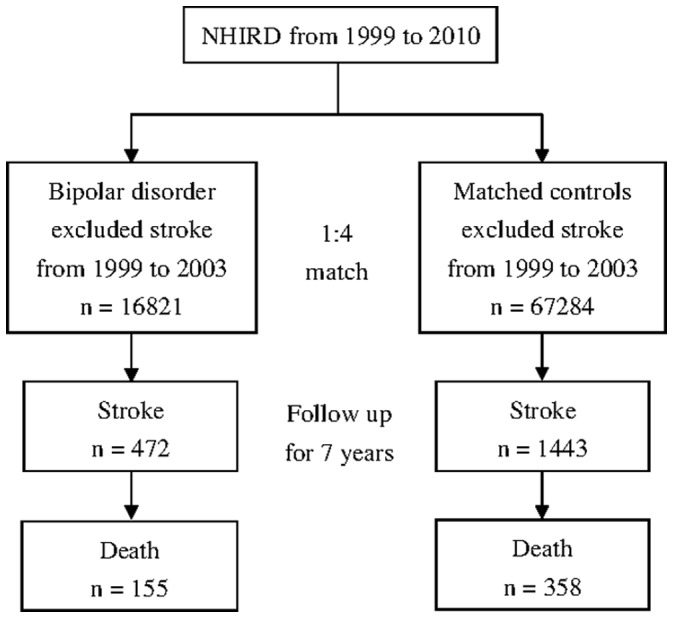
OBJECTIVE: This study aimed to estimate the incidence and relative risk of stroke and post-stroke all-cause mortality among patients with bipolar disorder. METHODS: This study identified a study population from the National Health Insurance Research Database (NHIRD) between 1999 and 2003 that included 16,821 patients with bipolar disorder and 67,284 age- and sex-matched control participants without bipolar disorder. The participants who had experienced a stroke between 1999 and 2003 were excluded and were randomly selected from the NHIRD. The incidence of stroke (ICD-9-CM code 430-438) and patient survival after stroke were calculated for both groups using data from the NIHRD between 2004 and 2010. A Cox proportional-hazards model was used to compare the seven-year stroke-free survival rate and all-cause mortality rate across the two cohorts after adjusting for confounding risk factors. RESULTS: A total of 472 (2.81%) patients with bipolar disorder and 1,443 (2.14%) controls had strokes over seven years. Patients with bipolar disorder were 1.24 times more likely to have a stroke (95% CI = 1.12-1.38; p<0.0001) after adjusting for demographic characteristics and comorbid medical conditions. In addition, 513 (26.8%) patients who had a stroke died during the follow-up period. The all-cause mortality hazard ratio for patients with bipolar disorder was 1.28 (95% CI = 1.06-1.55; p = 0.012) after adjusting for patient, physician and hospital variables. CONCLUSIONS: The likelihood of developing a stroke was greater among patients with bipolar disorder than controls, and the all-cause mortality rate was higher among patients with bipolar disorder than controls during a seven-year follow-up period.
Overview
The claims and statistics of this paper haven’t been checked yet.
Free: it reads the open-access text and checks the first 5 claims that cite a source we can check. Create a free account to check every claim.
Integrity signals
Registry
Cites
Statistics
Figures
Verification
Claims the paper makes
The claims and statistics of this paper haven’t been checked yet.
Free: it reads the open-access text and checks the first 5 claims that cite a source we can check. Create a free account to check every claim.
Claims other papers make about this one
Each is checked against this paper’s own text: does it say what the citing paper says it does?
The cited source says what the claim attributes to it.
In the citing paper
“While there is consistent evidence showing the high prevalence of comorbid medical conditions in BD768, 769, 770, 771, 772, 773, 774 and the negative impact these diagnoses have on longevity,775, 776 these conditions frequently go undiagnosed or undertreated.”
Self-check
Percentages, sums and reported differences re-computed from the paper’s own numbers.
The self-check needs the paper’s full text.
Citations
Cites
Adapting a clinical comorbidity index for use with ICD-9-CM administrative databases
DEYO, R. (1992) · Journal of Clinical Epidemiology · doi:10.1016/0895-4356(92)90133-8 · Cited by 10,452 · cited 1×
“The authors modified the CCIS to calculate the sum of weighted scores based on the relative mortality risk for 19 conditions [12,17].”
MethodSex differences in stroke: epidemiology, clinical presentation, medical care, and outcomes
Reeves, M. J., Bushnell, C. D., Howard, G., Gargano, J. W., Duncan, P. W., Lynch, G., Khatiwoda, A., & Lisabeth, L. (2008) · The Lancet Neurology · doi:10.1016/s1474-4422(08)70193-5 · Cited by 1,362 · cited 1×
“The other American study indicated that the mortality rate was higher for women who were younger than 35 years of age and older than 85 years of age, whereas the rate was lower for women between 35 and 85 years of age compared to that of men in the same age category [29].”
BackgroundWada, K., Tanaka, K., & Nakashima, K. (2011) · PubMed · Cited by 1,132
McElroy, S. L., Altshuler, L. L., Suppes, T., Keck, P. E., Frye, M. A., Denicoff, K. D., Nolen, W. A., Kupka, R. W., Leverich, G. S., Rochussen, J. R., et al. (2001) · American Journal of Psychiatry · doi:10.1176/appi.ajp.158.3.420 · Cited by 693 · cited 1×
“Patients with bipolar disorder often have comorbid anxiety, substance or alcohol use disorder, personality disorder and eating disorders [23,24,25].”
BackgroundMental Disorders and Use of Cardiovascular Procedures After Myocardial Infarction
Druss, B. G. (2000) · JAMA · doi:10.1001/jama.283.4.506 · Cited by 534 · cited 2×
“Previous studies indicated that patients with bipolar disorder experience disparities in specialized medical care and have higher mortality rates [19]; therefore, the model accounted for this finding as well as other factors that are associated with the risk of patient mortality, such as patient age and sex, type of s…”
MethodAbnormalities in Glucose Regulation During Antipsychotic Treatment of Schizophrenia
Newcomer, J. W., Haupt, D. W., Fucetola, R., Melson, A. K., Schweiger, J. A., Cooper, B. P., & Selke, G. (2002) · Archives of General Psychiatry · doi:10.1001/archpsyc.59.4.337 · Cited by 520 · cited 1×
“The severity of bipolar disorder might be related to the use of antipsychotic drugs, which has previously been linked to increased risk of insulin resistance, lipid abnormalities and hypertension [22], all of which can result in vascular events such as stroke.”
BackgroundPsychiatric and Medical Comorbidities of Bipolar Disorder
Krishnan, K. R. R. (2005) · Psychosomatic Medicine · doi:10.1097/01.psy.0000151489.36347.18 · Cited by 502 · cited 1×
“Several studies have demonstrated common medical illnesses comorbid with bipolar disorder, including obesity, hyperlipidemia, hypertension and diabetes mellitus, all of which are recognized as risk factors for stroke [3].”
BackgroundKapral, M. K., Fang, J., Hill, M. D., Silver, F., Richards, J., Jaigobin, C., & Cheung, A. M. (2005) · Stroke · doi:10.1161/01.str.0000157662.09551.e5 · Cited by 394 · cited 1×
“However, there was one study that did not show a difference in mortality for sex [28].”
BackgroundDepressive Symptoms and Increased Risk of Stroke Mortality Over a 29-Year Period
Everson, S. A., Roberts, R. E., Goldberg, D. E., & Kaplan, G. A. (1998) · Archives of Internal Medicine · doi:10.1001/archinte.158.10.1133 · Cited by 355 · cited 1×
“Other studies have shown that depressive symptoms predicted stroke and that a significant relationship exists between depressive symptoms and stroke mortality [6,7].”
Thrift, A. G., Dewey, H. M., Macdonell, R. A. L., McNeil, J. J., & Donnan, G. A. (2001) · Stroke · doi:10.1161/01.str.32.8.1732 · Cited by 300 · cited 1×
“Previous studies showed that death was less commonly caused by ischemic strokes compared to intracranial hemorrhage (ICH) and undetermined strokes [30].”
Background
Cited by
Yatham, L. N., Kennedy, S. H., Parikh, S. V., Schaffer, A., Bond, D. J., Frey, B. N., Sharma, V., Goldstein, B. I., Rej, S., Beaulieu, S., et al. (2018) · Bipolar Disorders · doi:10.1111/bdi.12609 · Cited by 1,852
Correll, C. U., Solmi, M., Veronese, N., Bortolato, B., Rosson, S., Santonastaso, P., Thapa‐Chhetri, N., Fornaro, M., Gallicchio, D., Collantoni, E., et al. (2017) · World Psychiatry · doi:10.1002/wps.20420 · Cited by 1,729
Cardiovascular disease in patients with severe mental illness
Nielsen, R. E., Banner, J., & Jensen, S. E. (2021) · Nature Reviews Cardiology · doi:10.1038/s41569-020-00463-7 · Cited by 389
Lambert, A. M., Parretti, H. M., Pearce, E., Price, M. J., Riley, M., Ryan, R., Tyldesley-Marshall, N., Avşar, T. S., Matthewman, G., Lee, A., et al. (2022) · PLOS Medicine · doi:10.1371/journal.pmed.1003960 · Cited by 127
Biazus, T. B., Beraldi, G. H., Tokeshi, L., Rotenberg, L. D. S., Dragioti, E., Carvalho, A. F., Solmi, M., & Lafer, B. (2023) · Molecular Psychiatry · doi:10.1038/s41380-023-02109-9 · Cited by 140
“Supplementary Figure S1 shows a visual distribution of risk of bias of individual studies and Supplementary Figure S2 summarizes the distribution of biases regarding all included studies.”
Background
Metadata
- Authors
- Wu, H.-C., Chou, F. H.-C., Tsai, K.-Y., Su, C.-Y., Shen, S.-P., & Chung, T.-C.
- Affiliations
- Kaohsiung Municipal Kai-Syuan Psychiatric Hospital (TW)
- I-Shou University (TW)
- Meiho University (TW)
- Corresponding author
- Chung, Tieh-Chi
- Venue
- PLoS ONE
- Publisher
- Public Library of Science (PLoS)
- Published
- 2013-08-30
- Volume
- 8
- Issue
- 8
- Pages
- e73037
- ISSN
- 1932-6203 (ISSN-L)
- PMC
- PMC3758282
- OpenAlex
- W1973472796
- Cited by
- 27
- References
- 40
- Citations by year
- 2026: 1 · 2024: 2 · 2023: 5 · 2022: 2 · 2021: 5 · 2020: 2 · 2019: 3 · 2018: 1 · 2017: 1 · 2015: 5
- FWCI
- 1.18
- Type
- journal article
- Language
- en
- Open access
- gold
- doi.org
- Locations
- PLoS ONE (publishedVersion, cc-by)
- Europe PMC (PubMed Central) (publishedVersion, cc-by)
- PubMed Central (publishedVersion, cc-by)
- PubMed (publishedVersion)
- DOAJ (DOAJ: Directory of Open Access Journals) (submittedVersion, cc-by-sa)
- Funders
- National Health Research Institutes
- Topics
- Health Sciences › Medicine › Psychiatry and Mental health › Bipolar Disorder and Treatment
- Health Sciences › Medicine › Psychiatry and Mental health › Schizophrenia research and treatment
- Social Sciences › Psychology › Clinical Psychology › Psychopathy, Forensic Psychiatry, Sexual Offending
- Keywords
- bipolar disorder, stroke, stroke incidence, relative risk, post-stroke mortality, all-cause mortality, stroke-free survival, comorbidities, psychiatric comorbidity
- MeSH terms
- Adult, Bipolar Disorder, Demography, Female, Follow-Up Studies, Humans, Male, Physicians, Risk Factors, Taiwan, Comorbidity, Incidence, Proportional Hazards Models, Case-Control Studies, Stroke
About these checks
Registry, retraction, Cites and statistics results are computed, not judged, with one exception: a printed reference that no index lists is read once by a model before it counts as a citation error. Claims are extracted by a model and kept only when their quote appears verbatim in the text; each cited source is then checked, with a model’s help, for whether it says what the claim relies on. Those verdicts can be wrong — read the claim’s quote and the cited source before relying on one.
Statistics and arithmetic are recomputed, not judged.
Confidence bands are shown only for fields calibrated on our annotated test set. None is calibrated yet, so no band is shown.
What counts as a claim ›How we measure confidence ›How we check this ›
Are you an author, or do you see a problem with this page? Request a review
Data sources
Bibliographic data: Semantic Scholar, OpenAlex, Crossref.
Contains information from the Semantic Scholar Academic Graph Datasets, made available under the ODC Attribution License (ODC-BY 1.0).
Semantic Scholar’s data is described in: Kinney, R., et al. (2023). The Semantic Scholar Open Data Platform. arXiv:2301.10140.
