

Characterization of Specific Immune Responses to Different Aspergillus Antigens during the Course of Invasive Aspergillosis in Hematologic Patients
Open accessThe DOI matches its Crossref record; 25 of the 25 references it cites were found in a registry or an index.
Abstract
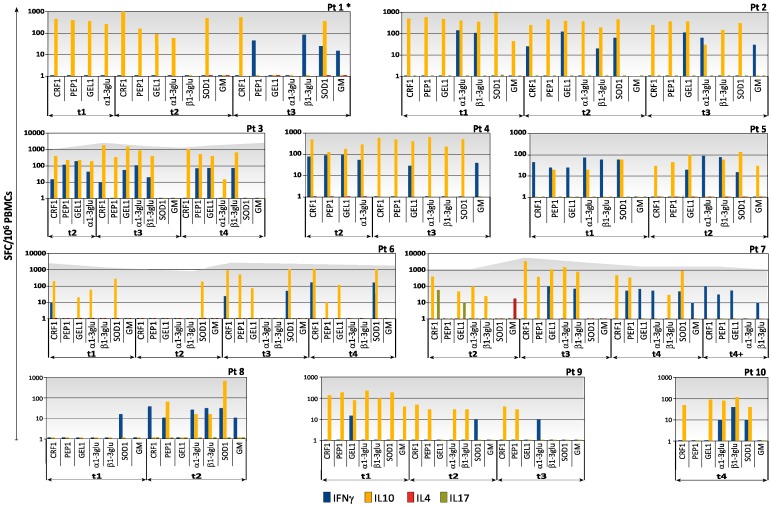
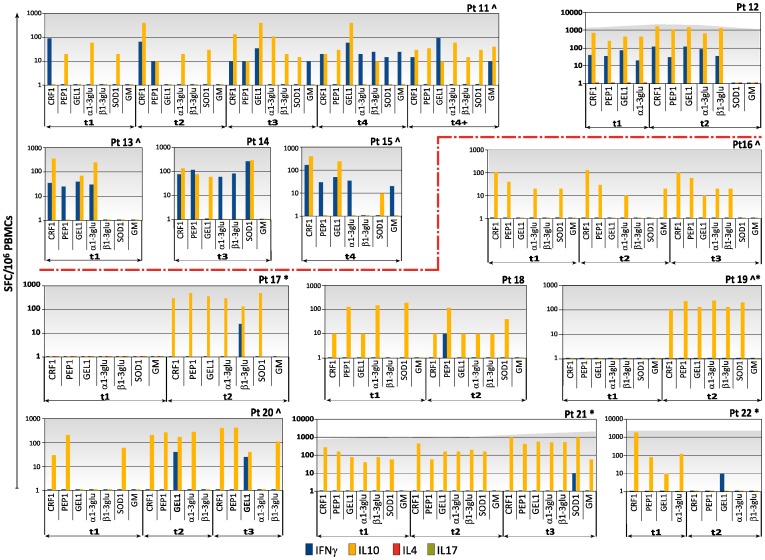
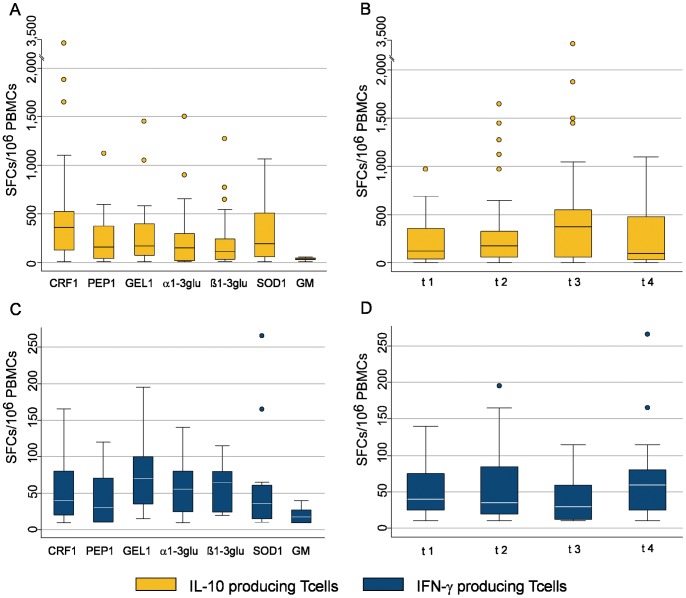
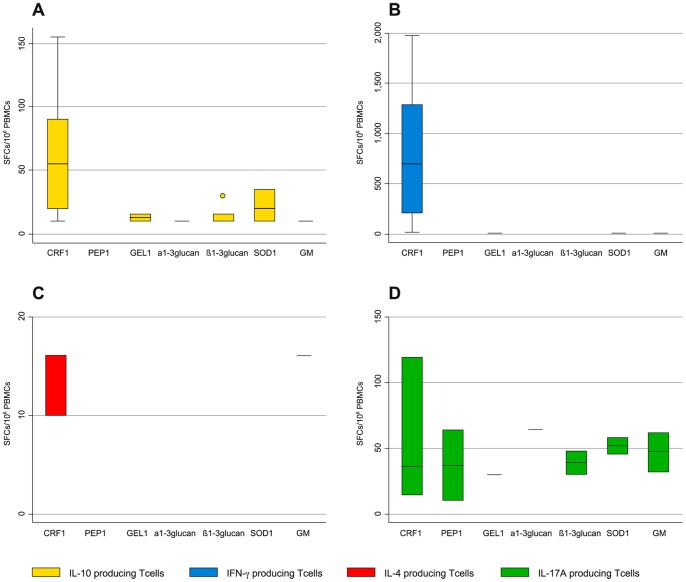
Several studies in mouse model of invasive aspergillosis (IA) and in healthy donors have shown that different Aspergillus antigens may stimulate different adaptive immune responses. However, the occurrence of Aspergillus-specific T cells have not yet been reported in patients with the disease. In patients with IA, we have investigated during the infection: a) whether and how specific T-cell responses to different Aspergillus antigens occur and develop; b) which antigens elicit the highest frequencies of protective immune responses and, c) whether such protective T cells could be expanded ex-vivo. Forty hematologic patients have been studied, including 22 patients with IA and 18 controls. Specific T cells producing IL-10, IFN-γ, IL-4 and IL-17A have been characterized through enzyme linked immunospot and cytokine secretion assays on 88 peripheral blood (PB) samples, by using the following recombinant antigens: GEL1p, CRF1p, PEP1p, SOD1p, α1-3glucan, β1-3glucan, galactomannan. Specific T cells were expanded through short term culture. Aspergillus-specific T cells producing non-protective interleukin-10 (IL-10) and protective interferon-gamma (IFN-γ) have been detected to all the antigens only in IA patients. Lower numbers of specific T cells producing IL-4 and IL-17A have also been shown. Protective T cells targeted predominantly Aspergillus cell wall antigens, tended to increase during the IA course and to be associated with a better clinical outcome. Aspergillus-specific T cells could be successfully generated from the PB of 8 out of 8 patients with IA and included cytotoxic subsets able to lyse Aspergillus hyphae. Aspergillus specific T-cell responses contribute to the clearance of the pathogen in immunosuppressed patients with IA and Aspergillus cell wall antigens are those mainly targeted by protective immune responses. Cytotoxic specific T cells can be expanded from immunosuppressed patients even during the infection by using the above mentioned antigens. These findings may be exploited for immunotherapeutic purposes in patients with IA.
Overview
The claims and statistics of this paper haven’t been checked yet.
Free: it reads the open-access text and checks the first 5 claims that cite a source we can check. Create a free account to check every claim.
Integrity signals
Registry
Cites
Statistics
Figures
Verification
Claims the paper makes
The claims and statistics of this paper haven’t been checked yet.
Free: it reads the open-access text and checks the first 5 claims that cite a source we can check. Create a free account to check every claim.
Claims other papers make about this one
Each is checked against this paper’s own text: does it say what the citing paper says it does?
The cited source says what the claim attributes to it.
In the citing paper
“and IFN-γ-producing T cells correlated with protection and favorable outcomes (308, 313)”
From Aspergillus fumigatus and Aspergillosis in 2019 (2019) · cites this paper as [313]
In the citing paper
“Likewise, Aspergillus-specific T cells are generated in patients with IPA in response to specific antigens, and IFN-γ-producing T cells correlated with protection and favorable outcomes (308, 313)”
From Aspergillus fumigatus and Aspergillosis in 2019 (2019) · cites this paper as [313]
Self-check
Percentages, sums and reported differences re-computed from the paper’s own numbers.
The self-check needs the paper’s full text.
Citations
Cites
De Pauw, B., Walsh, T. J., Donnelly, J. P., Stevens, D. A., Edwards, J. E., Calandra, T., Pappas, P. G., Maertens, J., Lortholary, O., Kauffman, C. A., et al. (2008) · Clinical Infectious Diseases · doi:10.1086/588660 · Cited by 4,917
Self-citationRomani, L. (2011) · Nature Reviews Immunology · doi:10.1038/nri2939 · Cited by 1,793
Self-citationRomani, L. (2004) · Nature Reviews Immunology · doi:10.1038/nri1255 · Cited by 758 · cited 1×
“In mouse model of invasive aspergillosis (IA), previous studies have reported that adaptive immunity contribute to the defence of the host against fungi of the genus Aspergillus and that Aspergillusspecific T cells producing interferon-gamma (IFN-c) may result protective, while those producing interleukin-10 (IL-10) m…”
BackgroundSelf-citationCaillot, D., Couaillier, J.-F., Bernard, A., Casasnovas, O., Denning, D. W., Mannone, L., Lopez, J., Couillault, G., Piard, F., Vagner, O., et al. (2001) · Journal of Clinical Oncology · doi:10.1200/jco.2001.19.1.253 · Cited by 587 · cited 1×
“Phases of Invasive Aspergillosis Based on the kinetics of radiologic signs of pulmonary IA on HRCT [12,13], the infection course has been divided into four phases, defined from t1 to t4, and corresponding to the number of days elapsed from the radiological diagnosis of IA (t1, from the radiologic disclosure of the inf…”
BackgroundPerruccio, K., Tosti, A., Burchielli, E., Topini, F., Ruggeri, L., Carotti, A., Capanni, M., Urbani, E., Mancusi, A., Aversa, F., et al. (2005) · Blood · doi:10.1182/blood-2005-05-1775 · Cited by 391 · cited 1×
“In mouse model of invasive aspergillosis (IA), previous studies have reported that adaptive immunity contribute to the defence of the host against fungi of the genus Aspergillus and that Aspergillusspecific T cells producing interferon-gamma (IFN-c) may result protective, while those producing interleukin-10 (IL-10) m…”
BackgroundSelf-citationExtrathymic T-cell differentiation in vitro
Pawelec, G. (2004) · Nature Reviews Immunology · doi:10.1038/nri1257-c1 · Cited by 362
Polysaccharide processing and presentation by the MHCII pathway
Cobb, B. A., Wang, Q., Tzianabos, A. O., & Kasper, D. L. (2004) · Cell · doi:10.1016/j.cell.2004.05.001 · Cited by 340 · cited 1×
“The recognition of polysaccharides is probably mediated by specific T cells through the class II major histocompatibility complex (MHC) on APCs, as previously reported for other infectious agents showing glycoantigens, such as Staphylococcus aureus, Streptococcus pneumoniae and Bacteroides fragilis [14,15].”
BackgroundHebart, H., Bollinger, C., Fisch, P., Sarfati, J., Meisner, C., Baur, M., Loeffler, J., Monod, M., Latgé, J.-P., & Einsele, H. (2002) · Blood · doi:10.1182/blood-2002-01-0265 · Cited by 257
Self-citationKarlsson, A. C., Martin, J. N., Younger, S. R., Bredt, B. M., Epling, L., Ronquillo, R., Varma, A., Deeks, S. G., McCune, J. M., Nixon, D. F., et al. (2003) · Journal of Immunological Methods · doi:10.1016/j.jim.2003.09.001 · Cited by 223 · cited 1×
“By expanding previous findings, so far obtained only in healthy donors [19–21], we have expanded Aspergillus-specific T cells from PB of patients with IA using a mixture of recombinant antigens different from CRF1p, and found that such cells may induce direct lysis of Aspergillus hyphae, comparable to those obtained b…”
ResultBozza, S., Clavaud, C., Giovannini, G., Fontaine, T., Beauvais, A., Sarfati, J., D'Angelo, C., Perruccio, K., Bonifazi, P., Zagarella, S., et al. (2009) · The Journal of Immunology · doi:10.4049/jimmunol.0900961 · Cited by 176 · cited 4×
“These findings confirm that CD8+ T cells contribute to the immune response to filamentous fungi [7,16], and are in line with those reports showing that Aspergillus fumigatus is a weak inducer of IL-4 and IL-17A responses [5,17].”
BackgroundMethodResultSelf-citationPotenza, L., Vallerini, D., Barozzi, P., Riva, G., Forghieri, F., Zanetti, E., Quadrelli, C., Candoni, A., Maertens, J., Rossi, G., et al. (2011) · Blood · doi:10.1182/blood-2011-07-366526 · Cited by 131
Self-citationCross-protective TH1 immunity against Aspergillus fumigatus and Candida albicans
Stuehler, C., Khanna, N., Bozza, S., Zelante, T., Moretti, S., Kruhm, M., Lurati, S., Conrad, B., Worschech, E., Stevanović, S., et al. (2011) · Blood · doi:10.1182/blood-2010-12-325084 · Cited by 131
Self-citationCarvalho, A., De Luca, A., Bozza, S., Cunha, C., D'Angelo, C., Moretti, S., Perruccio, K., Iannitti, R. G., Fallarino, F., Pierini, A., et al. (2012) · Blood · doi:10.1182/blood-2011-06-362582 · Cited by 131 · cited 1×
“These findings confirm that CD8+ T cells contribute to the immune response to filamentous fungi [7,16], and are in line with those reports showing that Aspergillus fumigatus is a weak inducer of IL-4 and IL-17A responses [5,17].”
ResultSelf-citationRezvani, K., Yong, A. S. M., Tawab, A., Jafarpour, B., Eniafe, R. B., Mielke, S., Savani, B. N., Keyvanfar, K., Li, Y., Kurlander, R. J., et al. (2008) · Blood · doi:10.1182/blood-2008-03-144071 · Cited by 127
Chai, L. Y. A., Van De Veerdonk, F., Marijnissen, R. J., Cheng, S., Khoo, A. L., Hectors, M., Lagrou, K., Vonk, A. G., Maertens, J., Joosten, L. A. B., et al. (2010) · Immunology · doi:10.1111/j.1365-2567.2009.03211.x · Cited by 127 · cited 1×
“These findings confirm that CD8+ T cells contribute to the immune response to filamentous fungi [7,16], and are in line with those reports showing that Aspergillus fumigatus is a weak inducer of IL-4 and IL-17A responses [5,17].”
ResultSelf-citationGeneration of highly purified and functionally active human TH1 cells against Aspergillus fumigatus
Beck, O., Topp, M. S., Koehl, U., Roilides, E., Simitsopoulou, M., Hanisch, M., Sarfati, J., Latgé, J. P., Klingebiel, T., Einsele, H., et al. (2006) · Blood · doi:10.1182/blood-2005-04-1660 · Cited by 127 · cited 1×
“By expanding previous findings, so far obtained only in healthy donors [19–21], we have expanded Aspergillus-specific T cells from PB of patients with IA using a mixture of recombinant antigens different from CRF1p, and found that such cells may induce direct lysis of Aspergillus hyphae, comparable to those obtained b…”
ResultSelf-citationBrodoefel, H., Vogel, M., Hebart, H., Einsele, H., Vonthein, R., Claussen, C., & Horger, M. (2006) · American Journal of Roentgenology · doi:10.2214/ajr.05.0513 · Cited by 106
Recombinant antigens as diagnostic markers for aspergillosis
Sarfati, J., Monod, M., Recco, P., Sulahian, A., Pinel, C., Candolfi, E., Fontaine, T., Debeaupuis, J.-P., Tabouret, M., & Latgé, J.-P. (2006) · Diagnostic Microbiology and Infectious Disease · doi:10.1016/j.diagmicrobio.2006.02.002 · Cited by 95 · cited 1×
“All the antigens have been produced, purified and harnessed as previously reported [5,10,11].”
MethodSelf-citationHealthy Human T-Cell Responses to Aspergillus fumigatus Antigens
Chaudhary, N., Staab, J. F., & Marr, K. A. (2010) · PLoS ONE · doi:10.1371/journal.pone.0009036 · Cited by 89 · cited 2×
“, b) unrelated to the administered treatments, c) and not in antithesis with previous reports and our data showing Aspergillus specific T cells in healthy subjects [4].”
BackgroundResultMHCII glycosylation modulates Bacteroides fragilis carbohydrate antigen presentation
Ryan, S. O., Bonomo, J. A., Zhao, F., & Cobb, B. A. (2011) · Journal of Experimental Medicine · doi:10.1084/jem.20100508 · Cited by 50 · cited 1×
“The recognition of polysaccharides is probably mediated by specific T cells through the class II major histocompatibility complex (MHC) on APCs, as previously reported for other infectious agents showing glycoantigens, such as Staphylococcus aureus, Streptococcus pneumoniae and Bacteroides fragilis [14,15].”
BackgroundRamadan, G., Davies, B. M., Kurup, V. P., & Keever-Taylor, C. A. (2005) · Clinical & Experimental Immunology · doi:10.1111/j.1365-2249.2005.02738.x · Cited by 48 · cited 1×
“and that the production of Granzyme B and IFN-c was higher in stimulated samples, our data suggest that the activity against Aspergillus is mediated directly by T cells, either by secreting cytokines or by cell-cell contact, and are consistent with previous reports [22,23].”
ResultRiva, G., Luppi, M., Barozzi, P., Quadrelli, C., Basso, S., Vallerini, D., Zanetti, E., Morselli, M., Forghieri, F., Maccaferri, M., et al. (2010) · Blood · doi:10.1182/blood-2009-06-230391 · Cited by 47 · cited 1×
“Based on our previous studies, a sample was considered positive if all the followings were fulfilled: 1) the presence of at least 10 spot forming cells (SFCs); 2) the presence of more than 10 SFCs in the sample compared with the negative control; 3) the presence of a stimulation index of $20 (defined as the ratio of t…”
MethodSelf-citationRamadan, G., Davies, B. M., Kurup, V. P., & Keever-Taylor, C. A. (2004) · Clinical & Experimental Immunology · doi:10.1111/j.1365-2249.2005.02699.x · Cited by 37
The GPI‐anchored Gas and Crh families are fungal antigens
Arroyo, J., Sarfati, J., Baixench, M. T., Ragni, E., Guillén, M., Rodriguez‐Peña, J. M., Popolo, L., & Latgé, J. P. (2007) · Yeast · doi:10.1002/yea.1480 · Cited by 35
Self-citationPotenza, L., Barozzi, P., Vallerini, D., Bosco, R., Quadrelli, C., Mediani, L., Morselli, M., Forghieri, F., Volzone, F., Codeluppi, M., et al. (2007) · Leukemia · doi:10.1038/sj.leu.2404504 · Cited by 33 · cited 3×
“Peripheral blood mononuclear cells (PBMCs) were obtained by Ficoll-Hypaque gradient centrifugation and co-cultured for 18–40 hours on a 96well bottom plates coated with anti-cytokine antibodies, namely anti-IL10, anti-IFN-c, anti-IL4 and anti-IL17A, as previously reported [7,8].”
MethodSelf-citation
Cited by
Aspergillus fumigatus and Aspergillosis in 2019
Latgé, J.-P., & Chamilos, G. (2019) · Clinical Microbiology Reviews · doi:10.1128/cmr.00140-18 · Cited by 1,400
Self-citationHeldt, S., Prattes, J., Eigl, S., Spiess, B., Flick, H., Rabensteiner, J., Johnson, G., Prüller, F., Wölfler, A., Niedrist, T., et al. (2018) · Journal of Infection · doi:10.1016/j.jinf.2018.05.001 · Cited by 110
Adel, M., Conti, G. O., Dadar, M., Mahjoub, M., Copat, C., & Ferrante, M. (2016) · Food and Chemical Toxicology · doi:10.1016/j.fct.2016.09.002 · Cited by 100
Immune Correlates of Protection in Human Invasive Aspergillosis
Camargo, J. F., & Husain, S. (2014) · Clinical Infectious Diseases · doi:10.1093/cid/ciu337 · Cited by 99
Improving outcome of fungal diseases – Guiding experts and patients towards excellence
Cornely, O. A., Lass‐Flörl, C., Lagrou, K., Arsic‐Arsenijevic, V., & Hoenigl, M. (2017) · Mycoses · doi:10.1111/myc.12628 · Cited by 74
Metadata
- Authors
- Potenza, L., Vallerini, D., Barozzi, P., Riva, G., Forghieri, F., Beauvais, A., Beau, R., Candoni, A., Maertens, J., Rossi, G., Morselli, M., Zanetti, E., Quadrelli, C., Codeluppi, M., Guaraldi, G., Pagano, L., Caira, M., Giovane, C. D., Maccaferri, M., Stefani, A., Morandi, U., Tazzioli, G., Girardis, M., Delia, M., Specchia, G., Longo, G., Marasca, R., Narni, F., Merli, F., Imovilli, A., Apolone, G., Carvalho, A., Comoli, P., Romani, L., Latgè, J. P., & Luppi, M.
- Affiliations
- University of Modena and Reggio Emilia (IT)
- Institut Pasteur (FR)
- Universitair Ziekenhuis Leuven (BE)
- Università Cattolica del Sacro Cuore (IT)
- University of Bari Aldo Moro (IT)
- University of Perugia (IT)
- Corresponding author
- Luppi, Mario
- ORCID
- Potenza, Leonardo
- Barozzi, Patrizia
- Riva, Giovanni
- Forghieri, Fabio
- Beauvais, Anne
- Candoni, Anna
- Maertens, Johan
- Rossi, Giulio
- Zanetti, Eleonora
- Codeluppi, Mauro
- Guaraldi, Giovanni
- Pagano, Livio
- Giovane, Cinzia Del
- Maccaferri, Monica
- Stefani, Alessandro
- Morandi, Uliano
- Tazzioli, Giovanni
- Girardis, Massimo
- Delia, Mario
- Specchia, Giorgina
- Longo, Giuseppe
- Marasca, Roberto
- Narni, Franco
- Merli, Francesco
- Imovilli, Annalisa
- Apolone, Giovanni
- Carvalho, Agostinho
- Comoli, Patrizia
- Romani, Luigina
- Luppi, Mario
- Venue
- PLoS ONE
- Publisher
- Public Library of Science (PLoS)
- Published
- 2013-09-04
- Volume
- 8
- Issue
- 9
- Pages
- e74326
- ISSN
- 1932-6203 (ISSN-L)
- PMC
- PMC3762751
- OpenAlex
- W2070507509
- Cited by
- 81
- References
- 25
- Citations by year
- 2026: 3 · 2025: 4 · 2024: 4 · 2022: 2 · 2021: 4 · 2020: 6 · 2019: 7 · 2018: 11 · 2017: 11 · 2016: 15 · 2015: 9 · 2014: 5
- FWCI
- 7.02
- Type
- journal article
- Language
- en
- Open access
- gold
- doi.org
- Locations
- PLoS ONE (publishedVersion, cc-by)
- Europe PMC (PubMed Central) (publishedVersion, cc-by)
- PubMed Central (publishedVersion, cc-by)
- PubMed (publishedVersion)
- IRIS UNIMORE (University of Modena and Reggio Emilia) (submittedVersion, cc-by)
- DOAJ (DOAJ: Directory of Open Access Journals) (submittedVersion, cc-by-sa)
- PubliCatt (Università Cattolica del Sacro Cuore) (submittedVersion, other-oa)
- Funders
- Pfizer
- Gilead Sciences
- European Commission (2005-018704, LSHC-CT-2005-018704)
- Associazione Italiana per la Ricerca sul Cancro
- Institut National Du Cancer
- Topics
- Health Sciences › Medicine › Infectious Diseases › Antifungal resistance and susceptibility
- Life Sciences › Biochemistry, Genetics and Molecular Biology › Molecular Biology › Fungal and yeast genetics research
- Life Sciences › Immunology and Microbiology › Immunology › Immunodeficiency and Autoimmune Disorders
- Keywords
- invasive aspergillosis, Aspergillus antigen, cell wall antigens, interferon-gamma, IL-10, IL-17A, IL-4, cytotoxic T lymphocytes, ex vivo T cell expansion, immunocompromised patients, hematologic patients, immunotherapy, clinical outcomes
- MeSH terms
- Adolescent, Adult, Aged, Antigens, Fungal, Aspergillosis, Aspergillus, Female, Hematology, Humans, Male, Middle Aged, Phenotype, Species Specificity, T-Lymphocytes, Young Adult
About these checks
Registry, retraction, Cites and statistics results are computed, not judged, with one exception: a printed reference that no index lists is read once by a model before it counts as a citation error. Claims are extracted by a model and kept only when their quote appears verbatim in the text; each cited source is then checked, with a model’s help, for whether it says what the claim relies on. Those verdicts can be wrong — read the claim’s quote and the cited source before relying on one.
Statistics and arithmetic are recomputed, not judged.
Confidence bands are shown only for fields calibrated on our annotated test set. None is calibrated yet, so no band is shown.
What counts as a claim ›How we measure confidence ›How we check this ›
Are you an author, or do you see a problem with this page? Request a review
Data sources
Bibliographic data: Semantic Scholar, OpenAlex, Crossref.
Contains information from the Semantic Scholar Academic Graph Datasets, made available under the ODC Attribution License (ODC-BY 1.0).
Semantic Scholar’s data is described in: Kinney, R., et al. (2023). The Semantic Scholar Open Data Platform. arXiv:2301.10140.
