

Developmental Differences in the Structure of Executive Function in Middle Childhood and Adolescence
Open accessThe DOI matches its Crossref record; 48 of the 48 references it cites were found in a registry or an index.
Abstract
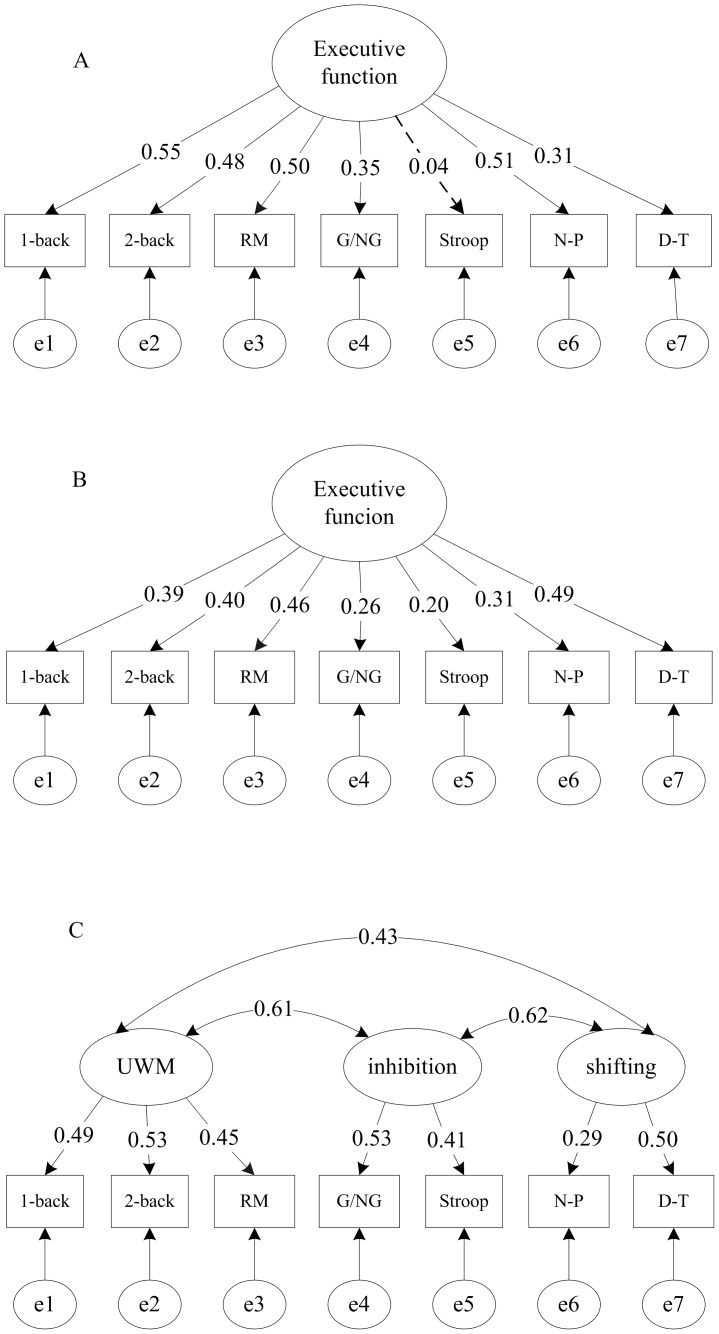
Although it has been argued that the structure of executive function (EF) may change developmentally, there is little empirical research to examine this view in middle childhood and adolescence. The main objective of this study was to examine developmental changes in the component structure of EF in a large sample (N = 457) of 7-15 year olds. Participants completed batteries of tasks that measured three components of EF: updating working memory (UWM), inhibition, and shifting. Confirmatory factor analysis (CFA) was used to test five alternative models in 7-9 year olds, 10-12 year olds, and 13-15 year olds. The results of CFA showed that a single-factor EF model best explained EF performance in 7-9-year-old and 10-12-year-old groups, namely unitary EF, though this single factor explained different amounts of variance at these two ages. In contrast, a three-factor model that included UWM, inhibition, and shifting best accounted for the data from 13-15 year olds, namely diverse EF. In sum, during middle childhood, putative measures of UWM, inhibition, and shifting may rely on similar underlying cognitive processes. Importantly, our findings suggest that developmental dissociations in these three EF components do not emerge until children transition into adolescence. These findings provided empirical evidence for the development of EF structure which progressed from unity to diversity during middle childhood and adolescence.
Overview
The claims and statistics of this paper haven’t been checked yet.
Free: it reads the open-access text and checks the first 5 claims that cite a source we can check. Create a free account to check every claim.
Integrity signals
Registry
Cites
Statistics
Figures
Verification
Claims the paper makes
The claims and statistics of this paper haven’t been checked yet.
Free: it reads the open-access text and checks the first 5 claims that cite a source we can check. Create a free account to check every claim.
Claims other papers make about this one
Each is checked against this paper’s own text: does it say what the citing paper says it does?
The source backs part of the claim, not all of it — or backs it for a different population, condition or comparison.
In the citing paper
“Since that initial study, this psychometric latent variable approach has been used in a large number of studies to show that unity and diversity of CC is evident across samples and ages (e.g., [34–41]), although there are some studies that suggest more unity (higher correlations between factors) in early childhood [35, 42–44].”
From The role of prefrontal cortex in cognitive control and executive function (2022) · cites this paper as [35]
Experimental — accuracy not yet measured
Self-check
Percentages, sums and reported differences re-computed from the paper’s own numbers.
The self-check needs the paper’s full text.
Citations
Cites
Significance tests and goodness of fit in the analysis of covariance structures.
Bentler, P. M., & Bonett, D. G. (1980) · Psychological Bulletin · doi:10.1037//0033-2909.88.3.588 · Cited by 19,023 · cited 7×
“Models were considered to be good fits with non-significant x2 values at the 0.05 level, x2/df of less than 2, CFI of more than 0.90, RMSEA of less than 0.08, and smaller AIC values [38].”
MethodInfluentialMiyake, A., Friedman, N. P., Emerson, M. J., Witzki, A. H., Howerter, A., & Wager, T. D. (2000) · Cognitive Psychology · doi:10.1006/cogp.1999.0734 · Cited by 15,798 · cited 7×
“Following the approach of Miyake and his colleagues [2,12], we used tasks that were designed to tap a single EF component while placing minimal demands on other EF components.”
BackgroundMethodResultInfluentialAn Integrative Theory of Prefrontal Cortex Function
Miller, E. K., & Cohen, J. D. (2001) · Annual Review of Neuroscience · doi:10.1146/annurev.neuro.24.1.167 · Cited by 12,803 · cited 1×
“Executive function (EF) is the ability to monitor and regulate different types of cognition and behavior to achieve specific internal goals [1–2].”
BackgroundSchermelleh-Engel, K., Moosbrugger, H., & Müller, H. (2003) · Department of Psychology - University of Koblenz-Landau · doi:10.23668/psycharchives.12784 · Cited by 8,975
Brain development during childhood and adolescence: a longitudinal MRI study
Giedd, J. N., Blumenthal, J., Jeffries, N. O., Castellanos, F. X., Liu, H., Zijdenbos, A., Paus, T., Evans, A. C., & Rapoport, J. L. (1999) · Nature Neuroscience · doi:10.1038/13158 · Cited by 5,552 · cited 1×
“From the structural perspective, longitudinal neuroimaging studies have demonstrated that gray matter in the PFC increased throughout childhood with a maximum size occurring at approximately 12 years, followed by a sharp loss after 12 years of age [44].”
BackgroundCurran, P. J., West, S. G., & Finch, J. F. (1996) · Psychological Methods · doi:10.1037/1082-989x.1.1.16 · Cited by 5,512 · cited 1×
“, absolute value of skewness ,2 and kurtosis ,7) [39].”
BackgroundCosts of a predictible switch between simple cognitive tasks.
Rogers, R. D., & Monsell, S. (1995) · Journal of Experimental Psychology: General · doi:10.1037/0096-3445.124.2.207 · Cited by 3,170 · cited 3×
“Second, we followed the same procedures used in previous studies [28,35].”
MethodResultMonsell, S. (2003) · Trends in Cognitive Sciences · doi:10.1016/s1364-6613(03)00028-7 · Cited by 2,984
Storage and Executive Processes in the Frontal Lobes
Smith, E. E., & Jonides, J. (1999) · Science · doi:10.1126/science.283.5408.1657 · Cited by 2,834
Executive function in preschoolers: A review using an integrative framework.
Garon, N., Bryson, S. E., & Smith, I. M. (2008) · Psychological Bulletin · doi:10.1037/0033-2909.134.1.31 · Cited by 2,695 · cited 2×
“EF is often linked to the functioning of the prefrontal cortex (PFC) [8–9], and the development of EF appears to be closely linked to the development of PFC [29].”
Background
Research works printed but not linked: 2
- Smith EE, Jonides J (1999) Storage and executive processes in the frontal lobes. Science 283(5408): 1657– 1661. 10073923 · DOI · Paper page
- Zhang HC, Wang XP (1898) standardization research on Raven’s standard progressice matrices in China. Acta Psychology Sinica 21(2): 113– 121.
Cited by
Items 101–166 of 166
Fombouchet, Y. (2022) · theses.fr (ABES) · doi:10.70675/d2a95d53ze728z40cbza605zde9a40929df5 · Cited by 4
Social motives in children: Greed and fear in a social bargaining game
Zhen, S., & Yu, R. (2022) · Journal of Behavioral Decision Making · doi:10.1002/bdm.2305 · Cited by 3
Krakowski, C.-S. (2015) · theses.fr (ABES) · doi:10.70675/4500a900z3068z4d12zb572zc4135b6cdb3f · Cited by 3
“La capacité à résister à la lecture du mot de couleur dans le Stroop continue ainsi à se développer jusqu’à 15 ans (Xu et al., 2013), de même que la capacité à résister aux distracteurs conflictuels dans une tâche de flankers (Waszak et al.”
Executive Functioning in Children
Messer, D. J., Moran, A., & Henry, L. A. (2020) · Wiley eBooks · doi:10.1002/9781119171492.wecad117 · Cited by 3
Gerván, P., Oláh, G., Utczás, K., Tróznai, Z., Berencsi, A., Gombos, F., & Kovács, I. (2023) · PsyArXiv (OSF Preprints) · doi:10.31234/osf.io/hauxc · Cited by 3
Alta capacidad intelectual, funciones ejecutivas y gestión de recursos en la vida diaria
Laguardia, B. B. (2019) · RIUR (Universidad de La Rioja) · Cited by 3
Modrek, A., & Wolf, S. (2024) · Social Development · doi:10.1111/sode.12764 · Cited by 2
The unity/diversity framework of executive functions: behavioral and neural evidence in older adults
Guo, S.-J., Wang, P., Cao, L., & Li, H. (2025) · GeroScience · doi:10.1007/s11357-025-01542-8 · Cited by 2
“This finding is consistent with studies conducted on young adults [4, 5, 8, 9], suggesting that older adults reserved similar construct of EFs as young adults.”
Cheng, C., & Wang, B. (2025) · Behavioral Sciences · doi:10.3390/bs15070956 · Cited by 2
“Fourth, as mentioned above, with increasing age, executive functions become more specialized and independent, leading to a reduction in the shared neural mechanisms underlying updating, inhibition, and switching (Hartung et al., 2020; F. Xu et al., 2013).”
Executive function in adolescents with obesity: A systematic review and meta-analysis
Asgeirsdottir, U. A., Janssen, L., Villringer, A., & Witte, A. V. (2026) · Neuroscience & Biobehavioral Reviews · doi:10.1016/j.neubiorev.2026.106828 · Cited by 3
Vrantsidis, D. M., Wuest, V., & Wiebe, S. A. (2025) · Developmental Review · doi:10.1016/j.dr.2025.101201 · Cited by 2
Figueroa, M., Silvestre, N., & Darbra, S. (2018) · EDULEARN proceedings · doi:10.21125/edulearn.2018.0959 · Cited by 2
Development of proactive control in school-age children and its relationship with working memory
Zhou, H., Li, Z., & Wang, C. (2022) · Current Psychology · doi:10.1007/s12144-022-03260-2 · Cited by 3
Everaert, E. (2023) · Utrecht University Repository (Utrecht University) · doi:10.33540/1715 · Cited by 2
Sántha-Malomsoki, Á. (2021) · REAL-PhD (Hungarian Academy of Sciences) · doi:10.18136/pe.2021.791 · Cited by 2
Liberato, F., & Nunes, E. (2018) · Revista Liberato · doi:10.31514/rliberato.2018v19n31.p07 · Cited by 1
Cognitive Aspects of Pragmatic Disorders
Cummings, L. (2024) · Perspectives in pragmatics, psychology & philosophy · doi:10.1007/978-3-031-50109-8_12 · Cited by 1
Lower level cognitive processes explain most of the unity of executive functions.
Segura, I. A., Cogo‐Moreira, H., Nouri, A., Hartung, J., Marcusson‐Clavertz, D., & Pompéia, S. (2026) · Journal of Experimental Psychology General · doi:10.1037/xge0001910 · Cited by 1
Memory Contributions to the Development of Cognitive Flexibility in Childhood
Fandakova, Y., & Akin, G. (2025) · European Psychologist · doi:10.1027/1016-9040/a000569 · Cited by 1
McClelland, M. M., Kenny, S. A., Didrichsen, S., Herrera, P. N., Halliday, S. E., Ahmadi, A., & Cameron, C. E. (2026) · Frontiers in Psychology · doi:10.3389/fpsyg.2026.1801156 · Cited by 1
“This conceptual understanding is consistent with empirical work indicating that EF in early childhood is best represented as a unitary construct (Brydges et al., 2014; Carlson et al., 2014; Fuhs and Day, 2011; Laureys et al., 2022; Willoughby et al., 2012; Xu et al., 2013).”
Is there a relationship between movement and cognition in childhood and adolescence
Jansen, P. (2014) · Sports Orthopaedics and Traumatology · Cited by 1
Hendrickson, N. K. (2019) · doi:10.11575/prism/36145 · Cited by 1
Zanini, G. D. A. V., Miranda, M. C., Cogo‐Moreira, H., Nouri, A., Fernández, A. L., & Pompéia, S. (2020) · PsyArXiv (OSF Preprints) · doi:10.31234/osf.io/qznpt · Cited by 1
Fonctions exécutives et haut potentiel intellectuel chez l'enfant, l'adolescent et le jeune adulte
Hilscher, E. (2022) · theses.fr (ABES) · doi:10.70675/00ae26fdza2a2z4453z858dze7d3e15f2dd9 · Cited by 1
Développement des fonctions exécutives chez l’enfant du nord-est du Brésil
Guerra, A. B. (2020) · theses.fr (ABES) · doi:10.70675/e35eccdfz49bcz4a78zafafzc1f84553c5eb · Cited by 1
The Effects of Physical Activity on Emotion Regulation and Executive Function: A Narrative ReviewPreprint
Bufton, K., Westrupp, E. M., & OLIVE, L. S. (2024) · OSF Preprints (OSF Preprints) · doi:10.31219/osf.io/8hwzs · Cited by 1
An Examination of Factors Impacting Executive Functioning in Children with Developmental Delays
Barton, H. (2021) · Scholars' Bank (University of Oregon) · Cited by 1
Sonnier, F. (2021) · theses.fr (ABES) · doi:10.70675/d50e0f57z93fbz4c70z8452z0c477ec9dac0 · Cited by 1
Mombo, W. T. (2021) · theses.fr (ABES) · doi:10.70675/1d8b11f1z100bz4072z841dzaab216b5f391 · Cited by 1
Individual Differences in Learning v. Achievement: What Self-Regulation Really Predicts
Modrek, A. (2016) · Columbia Academic Commons (Columbia University) · doi:10.7916/d89c6xhs
Stern, A. (2017) · Loyola eCommons (Loyola University of Chicago)
Correspondence Between Parents’ and Children’s Scientific and Religious Concepts
Saide, A. R. (2018) · eScholarship (California Digital Library)
Modrek, A., & Ramirez, G. (2020) · PsyArXiv (OSF Preprints) · doi:10.31234/osf.io/7t42q
Understanding the Nature and Role of Executive Functions in Children's Academic Development
Waters, N. (2022) · Deep Blue (University of Michigan) · doi:10.7302/4679
إسهام القصور فی بعض الوظائف التنفیذیة فی التنبؤ باضطراب الاكتناز القهری.
المجد, ح. أ. (2023) · مجلة الآداب والعلوم الإنسانية · doi:10.21608/fjhj.2023.188553.1421
Dubé, A. K., Kotsopoulos, D., & Robinson, K. M. (2023) · Springer eBooks · doi:10.1007/978-3-031-29195-1_1
Wulandari, A., & Hendrawan, D. (2024) · Jurnal Kependidikan Jurnal Hasil Penelitian dan Kajian Kepustakaan di Bidang Pendidikan Pengajaran dan Pembelajaran · doi:10.33394/jk.v10i2.11657
McArthur, B. A., Pesigan, K. L., Berg, L., & Mahmi, D. (2025) · Australian Journal of Education · doi:10.1177/00049441251379098
“…such as empathy, self-regulation, and problem-solving develop signi fi cantly across childhood and adolescence (Dorris et al., 2022; Laureys et al., 2022; Xu et al., 2013), it is important to understand how mental health literacy is acquired and expressed at different stages of development.”
Development and Validation of the Executive Dysfunction Inventory for Elementary School Children
Hania, A., Orcullo, D. J. C., & Ali, M. (2025) · Pakistan Journal of Psychological Research · doi:10.33824/pjpr.2025.40.3.28
The Development of Probability Learning and Repeated Choice Behavior in Childhood
Thoma, A. I. (2023) · edoc Publication server (Humboldt University of Berlin) · doi:10.18452/27220
Hindman, E. (2017) · UNSWorks (University of New South Wales, Sydney, Australia) · doi:10.26190/unsworks/19409
Development of Executive Functions: Neurocognitive mechanisms and plasticity in childhood
Ganesan, K. (2023) · UCL Discovery (University College London)
Efeitos do tabagismo e de fatores socioeconômicos em múltiplos domínios de autorregulação
Antonio, R. D. L. (2016) · LA Referencia (Red Federada de Repositorios Institucionales de Publicaciones Científicas)
Clinchard, C. (2023) · VTechWorks (Virginia Tech)
Wanstall, E. A. (2019) · York University Digital Library (York University)
Зубарева, Г. С., & Zubareva, G. S. (2025) · Electronic scientific archive of UrFU (Ural Federal University)
Brandt, A. (2025) · publish.UP (University of Potsdam) · doi:10.25932/publishup-68957
Hofmann, C., Stegmüller, A. M., & Walk, L. M. (2025) · Pedocs (German Institute for International Educational Research) · doi:10.25656/01:34455
EFFECTS OF ANTIBIOTIC USE ON THE HUMAN GUT MICROBIOTA
Kalkir, F., & ŞİMŞEK, Ö. (2025) · Bidge Yayınları eBooks · doi:10.70269/10.70269/8627112653
Impacto da fadiga mental sobre o desempenho tático de jogadores de futebol em diferentes categorias
Silva, G. D. O. S., & Praça, G. M. (2024) · LA Referencia (Red Federada de Repositorios Institucionales de Publicaciones Científicas)
Funções executivas na infância : bateria de avaliação informatizada com escala de percepção parental
Cordeiro, A. S. (2024) · LA Referencia (Red Federada de Repositorios Institucionales de Publicaciones Científicas)
Zhan, X., Weeda, W. D., Huizinga, M., & Baeyens, D. (2026) · Journal of Experimental Child Psychology · doi:10.1016/j.jecp.2026.106470
Terrones, M. C. L. (2022) · Universidad Peruana Cayetano Heredia Institutional Repository
Hardi, F. A., Gunther, K. E., Keding, T. J., Petrie, D. J., Pérez‐Edgar, K. E., Geier, C. F., & Gee, D. G. (2026) · Biological Psychiatry Global Open Science · doi:10.1016/j.bpsgos.2026.100724
Martin-Gomez, F. J. (2023) · theses.fr (ABES) · doi:10.70675/8827e91ezc1e6z41b9zb5cezaad6817446ed
Learning to read : new remediation strategies and underlying cognitive mechanisms
Andreola, C. (2023) · theses.fr (ABES) · doi:10.70675/5c762d33zbc28z4a74zb9daz2e6c21738de6
Pulido, J. H. P. (2026) · Child Neuropsychology · doi:10.1080/09297049.2026.2700210
Megari, K., & Genova, K. D. (2026) · International Journal of Developmental Neuroscience · doi:10.1002/jdn.70171
“Research by Xu et al. (2013) indicates that even at the age of 12, a single model of executive functions is more applicable than a multiple-factor model (Lee et al. 2013).”
Toudert, S. (2025) · Al-Jamie Journal in Psychological Studies and Educational Sciences
Bueno-Galán, M. A. M. (2026) · Institutional Repository University of Extremadura (University of Extremadura)
Normalisation de la batterie H.U.B auprès d'enfants âgés de 8 à 9 ans.
Parent, M. (2024) · Dépôt institutionnel de l'Université libre de Bruxelles (Université Libre de Bruxelles)
Younger, J. W., O’Laughlin, K. D., Anguera, J. A., Bunge, S. A., Ferrer, E. E., Hoeft, F., McCandliss, B. D., Mishra, J., Rosenberg-Lee, M., Gazzaley, A., et al. (2023) · doi:10.3389/fnhum.2023.1195013.s001
Metadata
- Authors
- Xu, F., Han, Y., Sabbagh, M. A., Wang, T., Ren, X., & Li, C.
- Affiliations
- Zhejiang Sci-Tech University (CN)
- Beijing Normal University (CN)
- Queen's University (CA)
- Goethe University Frankfurt (DE)
- Corresponding author
- Xu, Fen
- Han, Yan
- Venue
- PLoS ONE
- Publisher
- Public Library of Science (PLoS)
- Published
- 2013-10-29
- Volume
- 8
- Issue
- 10
- Pages
- e77770
- ISSN
- 1932-6203 (ISSN-L)
- PMC
- PMC3812181
- OpenAlex
- W2100740689
- Cited by
- 128
- References
- 48
- Citations by year
- 2026: 5 · 2025: 13 · 2024: 14 · 2023: 13 · 2022: 18 · 2021: 15 · 2020: 16 · 2019: 3 · 2018: 8 · 2017: 10 · 2016: 7 · 2015: 2 · 2014: 4
- FWCI
- 5.86
- Type
- journal article
- Language
- en
- Open access
- gold
- doi.org
- Locations
- PLoS ONE (publishedVersion, cc-by)
- Europe PMC (PubMed Central) (publishedVersion, cc-by)
- PubMed Central (publishedVersion, cc-by)
- PubMed (publishedVersion)
- RePEc: Research Papers in Economics (submittedVersion)
- DOAJ (DOAJ: Directory of Open Access Journals) (submittedVersion, cc-by-sa)
- Figshare (submittedVersion, cc-by)
- Publication Server of Goethe University Frankfurt am Main (Goethe University Frankfurt) (submittedVersion, cc-by)
- Funders
- National Natural Science Foundation of China (30528027, 31170996, 31028010)
- Natural Science Foundation of Zhejiang Province
- Topics
- Social Sciences › Psychology › Experimental and Cognitive Psychology › Cognitive Abilities and Testing
- Social Sciences › Psychology › Neuropsychology and Physiological Psychology › Developmental and Educational Neuropsychology
- Life Sciences › Neuroscience › Cognitive Neuroscience › Neural and Behavioral Psychology Studies
- Keywords
- executive function, developmental changes, middle childhood, adolescence, inhibition, cognitive flexibility, factor structure, cognitive development
- MeSH terms
- Adolescent, Aging, Attention, Child, Child Development, Female, Humans, Inhibition, Psychological, Male, Memory, Short-Term, Neuropsychological Tests, Reaction Time, Executive Function
About these checks
Registry, retraction, Cites and statistics results are computed, not judged, with one exception: a printed reference that no index lists is read once by a model before it counts as a citation error. Claims are extracted by a model and kept only when their quote appears verbatim in the text; each cited source is then checked, with a model’s help, for whether it says what the claim relies on. Those verdicts can be wrong — read the claim’s quote and the cited source before relying on one.
Statistics and arithmetic are recomputed, not judged.
Confidence bands are shown only for fields calibrated on our annotated test set. None is calibrated yet, so no band is shown.
What counts as a claim ›How we measure confidence ›How we check this ›
Are you an author, or do you see a problem with this page? Request a review
Data sources
Bibliographic data: Semantic Scholar, OpenAlex, Crossref.
Contains information from the Semantic Scholar Academic Graph Datasets, made available under the ODC Attribution License (ODC-BY 1.0).
Semantic Scholar’s data is described in: Kinney, R., et al. (2023). The Semantic Scholar Open Data Platform. arXiv:2301.10140.
