

How Patients Take Malaria Treatment: A Systematic Review of the Literature on Adherence to Antimalarial Drugs
Open accessThe DOI matches its Crossref record; 75 of the 75 references it cites were found in a registry or an index.
Abstract
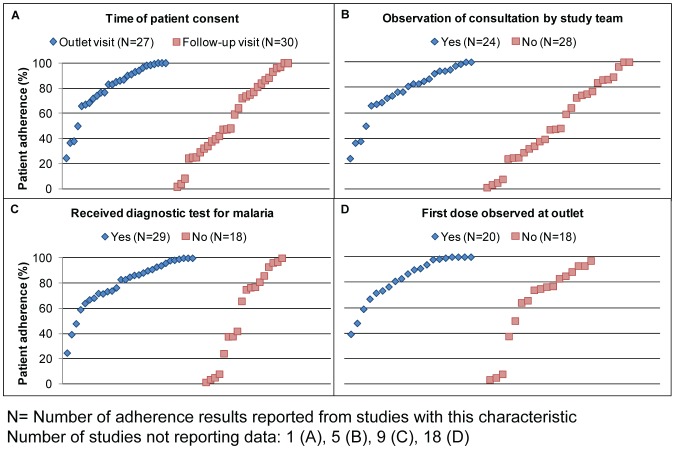
BACKGROUND: High levels of patient adherence to antimalarial treatment are important in ensuring drug effectiveness. To achieve this goal, it is important to understand levels of patient adherence, and the range of study designs and methodological challenges involved in measuring adherence and interpreting results. Since antimalarial adherence was reviewed in 2004, there has been a major expansion in the use of artemisinin-based combination therapies (ACTs) in the public sector, as well as initiatives to make them more widely accessible through community health workers and private retailers. These changes and the large number of recent adherence studies raise the need for an updated review on this topic. OBJECTIVE: We conducted a systematic review of studies reporting quantitative results on patient adherence to antimalarials obtained for treatment. RESULTS: The 55 studies identified reported extensive variation in patient adherence to antimalarials, with many studies reporting very high adherence (90-100%) and others finding adherence of less than 50%. We identified five overarching approaches to assessing adherence based on the definition of adherence and the methods used to measure it. Overall, there was no clear pattern in adherence results by approach. However, adherence tended to be higher among studies where informed consent was collected at the time of obtaining the drug, where patient consultations were directly observed by research staff, and where a diagnostic test was obtained. CONCLUSION: Variations in reported adherence may reflect factors related to patient characteristics and the nature of their consultation with the provider, as well as methodological variations such as interaction between the research team and patients before and during the treatment. Future studies can benefit from an awareness of the impact of study procedures on adherence outcomes, and the identification of improved measurement methods less dependent on self-report.
Overview
The claims and statistics of this paper haven’t been checked yet.
Free: it reads the open-access text and checks the first 5 claims that cite a source we can check. Create a free account to check every claim.
Integrity signals
Registry
Cites
Statistics
Figures
Verification
Claims the paper makes
The claims and statistics of this paper haven’t been checked yet.
Free: it reads the open-access text and checks the first 5 claims that cite a source we can check. Create a free account to check every claim.
Claims other papers make about this one
Each is checked against this paper’s own text: does it say what the citing paper says it does?
The source backs part of the claim, not all of it — or backs it for a different population, condition or comparison.
In the citing paper
“Specifically, variations in the age of participating children, level of caregiver education, household religion and socioeconomic position were found, all of which may influence treatment adherence [3, 29, 67, 68].”
From Adherence to treatment with artemether–lumefantrine or amodiaquine–artesunate for uncomplicated malaria in children in Sierra Leone: a randomized trial (2018) · cites this paper as [29]
Experimental — accuracy not yet measuredThe cited source says what the claim attributes to it.
In the citing paper
“Moreover, although this study did occur under ‘normal conditions’, the fact that providers and caregivers were observed, may have altered their behaviour as a result of participating in the study (participation bias), and influenced adherence outcomes [29, 69].”
From Adherence to treatment with artemether–lumefantrine or amodiaquine–artesunate for uncomplicated malaria in children in Sierra Leone: a randomized trial (2018) · cites this paper as [29]
Self-check
Percentages, sums and reported differences re-computed from the paper’s own numbers.
The self-check needs the paper’s full text.
Citations
Cites
Weltgesundheitsorganisation (2005) · Cited by 3,799
Dondorp, A. M., Fanello, C. I., Hendriksen, I. C., Gomes, E., Seni, A., Chhaganlal, K. D., Bojang, K., Olaosebikan, R., Anunobi, N., Maitland, K., et al. (2010) · The Lancet · doi:10.1016/s0140-6736(10)61924-1 · Cited by 1,022
Nosten, F., van Vugt, M., Price, R., Luxemburger, C., Thway, K., Brockman, A., McGready, R., ter Kuile, F., Looareesuwan, S., & White, N. (2000) · The Lancet · doi:10.1016/s0140-6736(00)02505-8 · Cited by 500 · cited 2×
“1 9 8 9 [3 9 ], (T o g o ),”
BackgroundBarnes, K. I., Durrheim, D. N., Little, F., Jackson, A., Mehta, U., Allen, E., Dlamini, S. S., Tsoka, J., Bredenkamp, B., Mthembu, D. J., et al. (2005) · PLoS Medicine · doi:10.1371/journal.pmed.0020330 · Cited by 285
Piola, P., Fogg, C., Bajunirwe, F., Biraro, S., Grandesso, F., Ruzagira, E., Babigumira, J., Kigozi, I., Kiguli, J., Kyomuhendo, J., et al. (2005) · The Lancet · doi:10.1016/s0140-6736(05)66416-1 · Cited by 211
Changing home treatment of childhood fevers by training shop keepers in rural Kenya
Marsh, V. M., Mutemi, W. M., Muturi, J., Haaland, A., Watkins, W. M., Otieno, G., & Marsh, K. (1999) · Tropical Medicine & International Health · doi:10.1046/j.1365-3156.1999.00403.x · Cited by 204 · cited 7×
“7%–34%) [35,39–40,42,48–49] and adherence to longer primaquine regimens for the treatment of vivax malaria (25%–85%) [21,25,31–32,51,62,66–67].”
BackgroundResultInfluentialHyperparasitaemia and low dosing are an important source of anti-malarial drug resistance
White, N. J., Pongtavornpinyo, W., Maude, R. J., Saralamba, S., Aguas, R., Stepniewska, K., Lee, S. J., Dondorp, A. M., White, L. J., & Day, N. P. (2009) · Malaria Journal · doi:10.1186/1475-2875-8-253 · Cited by 194 · cited 1×
“Sub-therapeutic treatment can result in recrudescence and select for resistant parasites [7].”
Backgroundvon Seidlein, L., Milligan, P., Pinder, M., Bojang, K., Anyalebechi, C., Gosling, R., Coleman, R., Ude, J. I., Sadiq, A., Duraisingh, M., et al. (2000) · The Lancet · doi:10.1016/s0140-6736(99)10237-x · Cited by 190
Sirima, S. B., Konaté, A., Tiono, A. B., Convelbo, N., Cousens, S., & Pagnoni, F. (2003) · Tropical Medicine & International Health · doi:10.1046/j.1365-3156.2003.00997.x · Cited by 182 · cited 1×
“Most household surveys reported adherence to antimalarials obtained from both public and private sectors, except for four that focused on interventions to improve adherence to antimalarials obtained from drug shops [48–49] or community health workers [36,53].”
BackgroundArtesunate/mefloquine treatment of multi-drug resistant falciparum malaria
Price, R. N., Nosten, F., Luxemburger, C., van Vugt, M., Phaipun, L., Chongsuphajaisiddhi, T., & White, N. J. (1997) · Transactions of the Royal Society of Tropical Medicine and Hygiene · doi:10.1016/s0035-9203(97)90032-8 · Cited by 159 · cited 1×
“Since publication of this review, there has been a major expansion of the availability of ACTs, which have been shown to be efficacious and may reduce the spread of resistance in low transmission settings [9–12].”
Background
Cited by
Taylor, W. R. J., Thriemer, K., von Seidlein, L., Yuentrakul, P., Assawariyathipat, T., Assefa, A., Auburn, S., Chand, K., Chau, N. H., Cheah, P. Y., et al. (2019) · The Lancet · doi:10.1016/s0140-6736(19)31285-1 · Cited by 178
Lindner, A. K., Lejon, V., Chappuis, F., Seixas, J., Kazumba, L., Barrett, M. P., Mwamba, E., Erphas, O., Akl, E. A., Villanueva, G., et al. (2020) · The Lancet Infectious Diseases · doi:10.1016/s1473-3099(19)30612-7 · Cited by 161
Douglas, N. M., Poespoprodjo, J. R., Patriani, D., Malloy, M. J., Kenangalem, E., Sugiarto, P., Simpson, J. A., Soenarto, Y., Anstey, N. M., & Price, R. N. (2017) · PLOS Medicine · doi:10.1371/journal.pmed.1002379 · Cited by 107
“It is well recognized that the duration of antimalarial treatment is a critical determinant of adherence [9].”
BackgroundResultInfluentialDrug targets for resistant malaria: Historic to future perspectives
Kumar, S., Bhardwaj, T., Prasad, D. N., & Singh, R. K. (2018) · Biomedicine & Pharmacotherapy · doi:10.1016/j.biopha.2018.05.009 · Cited by 138
Recent advances in use of silver nanoparticles as antimalarial agents
Rai, M. K., Ingle, A. P., Paralikar, P., Gupta, I. R., Medici, S., & dos Santos, C. A. (2017) · International Journal of Pharmaceutics · doi:10.1016/j.ijpharm.2017.04.042 · Cited by 104
Metadata
- Authors
- Bruxvoort, K., Goodman, C., Kachur, S. P., & Schellenberg, D.
- Affiliations
- Ifakara Health Institute (TZ)
- London School of Hygiene & Tropical Medicine (GB)
- Centers for Disease Control and Prevention (US)
- Corresponding author
- Bruxvoort, Katia
- Venue
- PLoS ONE
- Publisher
- Public Library of Science (PLoS)
- Published
- 2014-01-20
- Volume
- 9
- Issue
- 1
- Pages
- e84555
- ISSN
- 1932-6203 (ISSN-L)
- PMC
- PMC3896377
- OpenAlex
- W2050622314
- Semantic Scholar
- 50c7bae19cc16b2a0bcb0d3bc1e76c67e37fad86
- Cited by
- 135
- References
- 74
- Citations by year
- 2026: 4 · 2025: 5 · 2024: 14 · 2023: 12 · 2022: 9 · 2021: 24 · 2020: 16 · 2019: 11 · 2018: 6 · 2017: 9 · 2016: 5 · 2015: 13 · 2014: 7
- FWCI
- 1.47
- Type
- journal article
- Language
- en
- Open access
- gold
- doi.org
- Licence
- Locations
- PLoS ONE (publishedVersion, cc-by)
- Europe PMC (PubMed Central) (publishedVersion, cc-by)
- PubMed Central (publishedVersion, cc-by)
- PubMed (publishedVersion)
- IHI Repository (acceptedVersion)
- LSHTM Research Online (London School of Hygiene and Tropical Medicine) (acceptedVersion)
- RePEc: Research Papers in Economics (submittedVersion)
- DOAJ (DOAJ: Directory of Open Access Journals) (submittedVersion, cc-by-sa)
- Figshare (submittedVersion, cc-by)
- Funders
- Bill and Melinda Gates Foundation
- London School of Hygiene and Tropical Medicine
- Topics
- Health Sciences › Medicine › Family Practice › Medication Adherence and Compliance
- Health Sciences › Medicine › Public Health, Environmental and Occupational Health › Malaria Research and Control
- Health Sciences › Medicine › Infectious Diseases › HIV/AIDS Research and Interventions
- Keywords
- antimalarial drugs, artemisinin-based combination therapy, adherence measurement methods, informed consent, diagnostic testing, self-report bias, community health workers
- MeSH terms
- Antimalarials, Humans, Malaria, Patient Compliance, Artemisinins
About these checks
Registry, retraction, Cites and statistics results are computed, not judged, with one exception: a printed reference that no index lists is read once by a model before it counts as a citation error. Claims are extracted by a model and kept only when their quote appears verbatim in the text; each cited source is then checked, with a model’s help, for whether it says what the claim relies on. Those verdicts can be wrong — read the claim’s quote and the cited source before relying on one.
Statistics and arithmetic are recomputed, not judged.
Confidence bands are shown only for fields calibrated on our annotated test set. None is calibrated yet, so no band is shown.
What counts as a claim ›How we measure confidence ›How we check this ›
Are you an author, or do you see a problem with this page? Request a review
Data sources
Bibliographic data: Semantic Scholar, OpenAlex, Crossref.
Contains information from the Semantic Scholar Academic Graph Datasets, made available under the ODC Attribution License (ODC-BY 1.0).
Semantic Scholar’s data is described in: Kinney, R., et al. (2023). The Semantic Scholar Open Data Platform. arXiv:2301.10140.
