

The DOI matches its Crossref record; 57 of the 58 references it cites were found in a registry or an index.
Controlling Social Stress in Virtual Reality Environments
Open accessAbstract
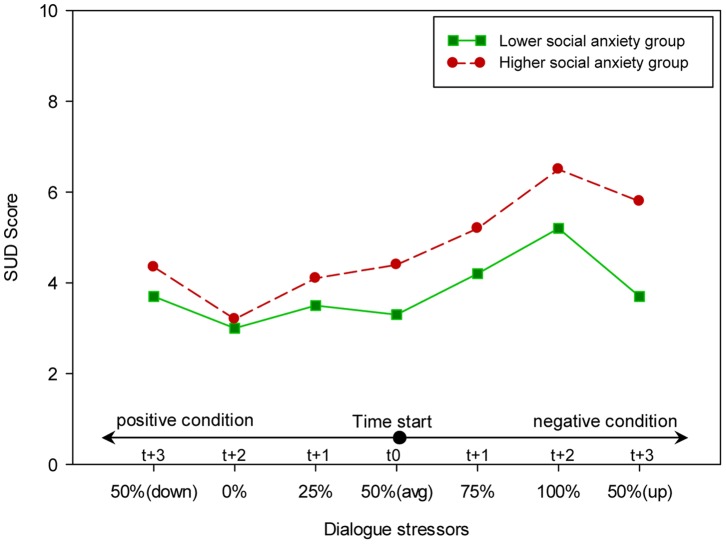
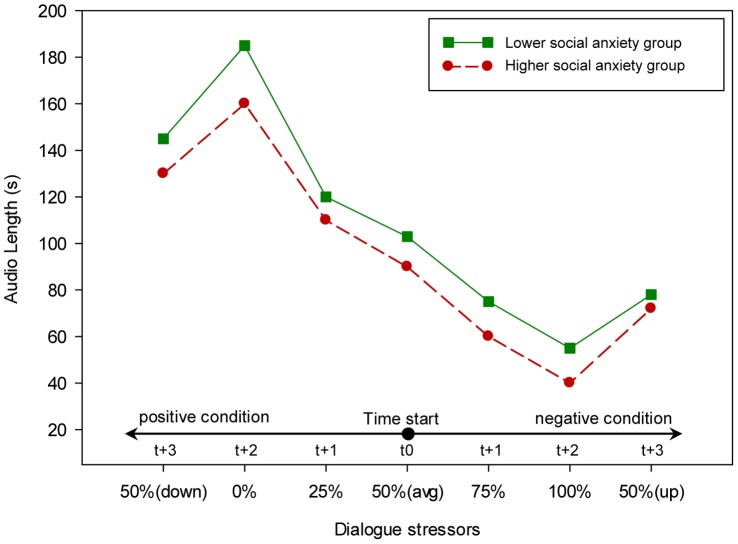
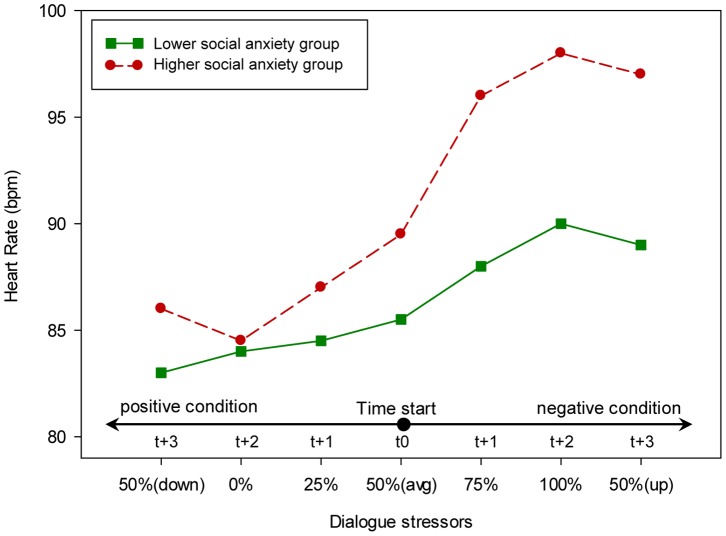
Virtual reality exposure therapy has been proposed as a viable alternative in the treatment of anxiety disorders, including social anxiety disorder. Therapists could benefit from extensive control of anxiety eliciting stimuli during virtual exposure. Two stimuli controls are studied in this study: the social dialogue situation, and the dialogue feedback responses (negative or positive) between a human and a virtual character. In the first study, 16 participants were exposed in three virtual reality scenarios: a neutral virtual world, blind date scenario, and job interview scenario. Results showed a significant difference between the three virtual scenarios in the level of self-reported anxiety and heart rate. In the second study, 24 participants were exposed to a job interview scenario in a virtual environment where the ratio between negative and positive dialogue feedback responses of a virtual character was systematically varied on-the-fly. Results yielded that within a dialogue the more positive dialogue feedback resulted in less self-reported anxiety, lower heart rate, and longer answers, while more negative dialogue feedback of the virtual character resulted in the opposite. The correlations between on the one hand the dialogue stressor ratio and on the other hand the means of SUD score, heart rate and audio length in the eight dialogue conditions showed a strong relationship: r(6) = 0.91, p = 0.002; r(6) = 0.76, p = 0.028 and r(6) = -0.94, p = 0.001 respectively. Furthermore, more anticipatory anxiety reported before exposure was found to coincide with more self-reported anxiety, and shorter answers during the virtual exposure. These results demonstrate that social dialogues in a virtual environment can be effectively manipulated for therapeutic purposes.
Overview
The claims and statistics of this paper haven’t been checked yet.
Run the check — free, no account needed. It reads the open-access text and checks the sources it cites.
Integrity signals
Registry
Cites
Statistics
Figures
Verification
Claims the paper makes
The claims and statistics of this paper haven’t been checked yet.
Run the check — free, no account needed. It reads the open-access text and checks the sources it cites.
Claims other papers make about this one
Each is checked against this paper’s own text: does it say what the citing paper says it does?
The check wasn’t confident either way, so it gives no verdict — never disputed.
In the citing paper
“This significantly reduces the resource investment needed for exposure-based treatments, including time and finances (Hartanto et al., 2014; Carl et al., 2019; Emmelkamp, 2005; Miloff et al., 2016; Reeves et al., 2022; Boeldt et al., 2019; Robillard et al., 2011).”
From Virtual Reality exposure therapy in the treatment of public speaking anxiety and social anxiety disorder (2024) · cites this paper as Hartanto et al., 2014
Experimental — accuracy not yet measured
Self-check
Percentages, sums and reported differences re-computed from the paper’s own numbers.
The self-check needs the paper’s full text.
Citations
Cites
Kessler, R. C., Berglund, P., Demler, O., Jin, R., Merikangas, K. R., & Walters, E. E. (2005) · Archives of General Psychiatry · doi:10.1001/archpsyc.62.6.593 · Cited by 20,391 · cited 1×
“Social anxiety disorder, also commonly referred as social phobia, is one of the most prevalent mental disorders [1].”
BackgroundKirschbaum, C., Pirke, K.-M., & Hellhammer, D. H. (2008) · Neuropsychobiology · doi:10.1159/000119004 · Cited by 6,093
(1997) · Choice Reviews Online · doi:10.5860/choice.34-3702 · Cited by 4,872
Human Nature and the Social Order
Cooley, C. H. (2017) · Routledge eBooks · doi:10.4324/9780203789513 · Cited by 4,847
Bergin and Garfield's Handbook of Psychotherapy and Behavior Change
Lambert, M. J. (2003) · Cited by 3,383
Mattick, R. P., & Clarke, J. C. (1998) · Behaviour Research and Therapy · doi:10.1016/s0005-7967(97)10031-6 · Cited by 3,367
The Experience of Presence: Factor Analytic Insights
Schubert, T., Friedmann, F., & Regenbrecht, H. (2001) · Presence: Teleoperators and Virtual Environments · doi:10.1162/105474601300343603 · Cited by 2,303 · cited 12×
“To get a general understanding of the experienced presence level and to examine whether the virtual world in this experiment established a reasonable level of presence to evoke the anxiety, the overall IPQ score was compared to the online IPQ data set (downloaded on February 9th, 2013.”
MethodInfluentialParsons, T. D., & Rizzo, A. A. (2008) · Journal of Behavior Therapy and Experimental Psychiatry · doi:10.1016/j.jbtep.2007.07.007 · Cited by 994
Technology in mental health care delivery systems
Sidowski, J. B., Johnson, J. H., & Williams, T. A. (1980) · Ablex Pub. Corp. eBooks · Cited by 977
Virtual reality exposure therapy for anxiety disorders: A meta-analysis
Powers, M. B., & Emmelkamp, P. M. G. (2008) · Journal of Anxiety Disorders · doi:10.1016/j.janxdis.2007.04.006 · Cited by 904
Research works printed but not linked: 5
- Herbelin B (2005) Virtual Reality Exposure Therapy for Social Phobia (Doctoral dissertation): Ecole Polytechnique Federale de Lausanne.
- Busscher B, de Vliegher D, Ling Y, Brinkman WP (2010) Analysis of physiological response to neutral virtual reality worlds. Proceedings of the ECCE2010 workshop–Cognitive engineering for technology in mental health care and rehabilitation: 978–994.
- Wolpe J (1958) Psychotherapy by Reciprocal Inhabitation. Stanford, California: Stanford University Press.
- Heimberg RG, Becker RE (2002) Cognitive-Behavioural Group Therapy for Social Phobia (Basic Mechanism and Clinical Strategis). New York: The Guildford Press.
- RP Matticka, 1998, Development and validation of measures of social phobia scrutiny fear and social interaction anxiety, Behaviour Research and Therapy, 36, 455
Cited by
Sorted by citations
Emotion Recognition in Immersive Virtual Reality: From Statistics to Affective Computing
Marín‐Morales, J., Llinares, C., Guixeres, J., & Alcañíz, M. (2020) · Sensors · doi:10.3390/s20185163 · Cited by 298
“(2014) [114] Stress HRV HR MANOVA 24 healthy subjects eMagin Z800 3D stressful social environment No No”
BackgroundKampmann, I. L., Emmelkamp, P. M. G., Hartanto, D., Brinkman, W.-P., Zijlstra, B. J. H., & Morina, N. (2016) · Behaviour Research and Therapy · doi:10.1016/j.brat.2015.12.016 · Cited by 226
“By simulating social situations, VRET allows therapists to control the content, duration, and dif fi culty of social interactions (Hartanto et al., 2014).”
InfluentialSelf-citationD'Cunha, N. M., Nguyen, D. T., Naumovski, N., McKune, A. J., Kellett, J., Georgousopoulou, E. N., Frost, J. S., & Isbel, S. T. (2019) · Gerontology · doi:10.1159/000500040 · Cited by 218
Ling, Y., Nefs, H. T., Morina, N., Heynderickx, I., & Brinkman, W.-P. (2014) · PLoS ONE · doi:10.1371/journal.pone.0096144 · Cited by 215
“The anxiety disorders addressed in these articles (with their references between brackets) were: Acrophobia [23,25,42,46,58– 60], Agoraphobia [48,61], Claustrophobia [62,63], Fear of animals [43,64–70], Fear of flying [24,41], Obsessivecompulsive disorder [26], Social phobia [27,28,71–75], and Exam/test anxiety [76–78…”
Self-citationMeta-analysis of technology-assisted interventions for social anxiety disorder
Kampmann, I. L., Emmelkamp, P. M. G., & Morina, N. (2016) · Journal of Anxiety Disorders · doi:10.1016/j.janxdis.2016.06.007 · Cited by 180
Metadata
- Authors
- Hartanto, D., Kampmann, I. L., Morina, N., Emmelkamp, P. G. M., Neerincx, M. A., & Brinkman, W.-P.
- Affiliations
- Delft University of Technology (NL)
- University of Amsterdam (NL)
- Netherlands Organisation for Applied Scientific Research (NL)
- Corresponding author
- Hartanto, Dwi
- Venue
- PLoS ONE
- Publisher
- Public Library of Science (PLoS)
- Published
- 2014-03-26
- Volume
- 9
- Issue
- 3
- Pages
- e92804
- ISSN
- 1932-6203 (ISSN-L)
- PMC
- PMC3966821
- OpenAlex
- W2148863487
- Cited by
- 115
- References
- 58
- Citations by year
- 2026: 6 · 2025: 9 · 2024: 13 · 2023: 10 · 2022: 12 · 2021: 16 · 2020: 6 · 2019: 12 · 2018: 8 · 2017: 5 · 2016: 7 · 2015: 7 · 2014: 4
- FWCI
- 14.86
- Type
- journal article
- Language
- en
- Update notices
- correction (2019-10-11)
- Open access
- gold
- doi.org
- Locations
- PLoS ONE (publishedVersion, cc-by)
- Europe PMC (PubMed Central) (publishedVersion, other-oa)
- PubMed Central (publishedVersion, cc-by)
- PubMed (publishedVersion)
- UvA-DARE (University of Amsterdam) (acceptedVersion, other-oa)
- TNO Repository (submittedVersion)
- DOAJ (DOAJ: Directory of Open Access Journals) (submittedVersion)
- Repository hosted by TU Delft Library (TU Delft) (submittedVersion)
- Research Repository (Delft University of Technology) (submittedVersion)
- Data Archiving and Networked Services (DANS) (submittedVersion, other-oa)
- Data Archiving and Networked Services (DANS) (submittedVersion, cc-by)
- Funders
- Nederlandse Organisatie voor Wetenschappelijk Onderzoek (655.010.207)
- Topics
- Physical Sciences › Computer Science › Human-Computer Interaction › Virtual Reality Applications and Impacts
- Social Sciences › Psychology › Experimental and Cognitive Psychology › Anxiety, Depression, Psychometrics, Treatment, Cognitive Processes
- Social Sciences › Psychology › Applied Psychology › Digital Mental Health Interventions
- Keywords
- virtual reality exposure therapy, social anxiety disorder, virtual characters, anticipatory anxiety, heart rate, self-reported anxiety, speech length
- MeSH terms
- Adult, Female, Heart Rate, Humans, Interviews as Topic, Male, Stress, Psychological, User-Computer Interface, Young Adult
About these checks
Registry, retraction, Cites and statistics results are computed, not judged, with one exception: a printed reference that no index lists is read once by a model before it counts as a citation error. Claims are extracted by a model and kept only when their quote appears verbatim in the text; each cited source is then checked, with a model’s help, for whether it says what the claim relies on. Those verdicts can be wrong — read the claim’s quote and the cited source before relying on one.
Statistics and arithmetic are recomputed, not judged.
Confidence bands are shown only for fields calibrated on our annotated test set. None is calibrated yet, so no band is shown.
What counts as a claim ›How we measure confidence ›How we check this ›
Are you an author, or do you see a problem with this page? Request a review
