

Psychological and Behavioral Changes during Confinement in a 520-Day Simulated Interplanetary Mission to Mars
Open accessThe DOI matches its Crossref record; 36 of the 36 references it cites were found in a registry or an index.
Abstract
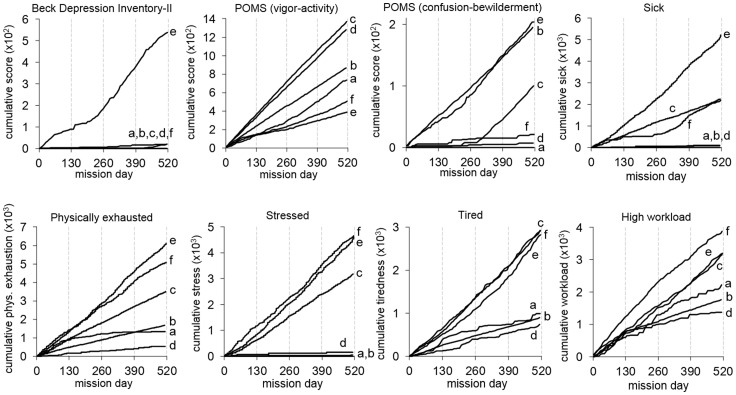
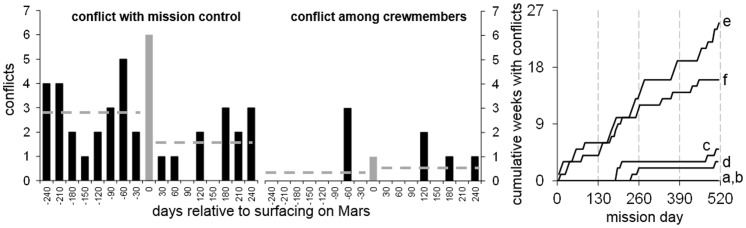
Behavioral health risks are among the most serious and difficult to mitigate risks of confinement in space craft during long-duration space exploration missions. We report on behavioral and psychological reactions of a multinational crew of 6 healthy males confined in a 550 m(3) chamber for 520 days during the first Earth-based, high-fidelity simulated mission to Mars. Rest-activity of crewmembers was objectively measured throughout the mission with wrist-worn actigraphs. Once weekly throughout the mission crewmembers completed the Beck Depression Inventory-II (BDI-II), Profile of Moods State short form (POMS), conflict questionnaire, the Psychomotor Vigilance Test (PVT-B), and series of visual analogue scales on stress and fatigue. We observed substantial inter-individual differences in the behavioral responses of crewmembers to the prolonged mission confinement and isolation. The crewmember with the highest average POMS total mood disturbance score throughout the mission also reported symptoms of depression in 93% of mission weeks, which reached mild-to-moderate levels in >10% of mission weeks. Conflicts with mission control were reported five times more often than conflicts among crewmembers. Two crewmembers who had the highest ratings of stress and physical exhaustion accounted for 85% of the perceived conflicts. One of them developed a persistent sleep onset insomnia with ratings of poor sleep quality, which resulted in chronic partial sleep deprivation, elevated ratings of daytime tiredness, and frequent deficits in behavioral alertness. Sleep-wake timing was altered in two other crewmembers, beginning in the first few months of the mission and persisting throughout. Two crewmembers showed neither behavioral disturbances nor reports of psychological distress during the 17-month period of mission confinement. These results highlight the importance of identifying behavioral, psychological, and biological markers of characteristics that predispose prospective crewmembers to both effective and ineffective behavioral reactions during the confinement of prolonged spaceflight, to inform crew selection, training, and individualized countermeasures.
Overview
The claims and statistics of this paper haven’t been checked yet.
Free: it reads the open-access text and checks the first 5 claims that cite a source we can check. Create a free account to check every claim.
Integrity signals
Registry
Cites
Statistics
Figures
Verification
Claims the paper makes
The claims and statistics of this paper haven’t been checked yet.
Free: it reads the open-access text and checks the first 5 claims that cite a source we can check. Create a free account to check every claim.
Claims other papers make about this one
Each is checked against this paper’s own text: does it say what the citing paper says it does?
The source backs part of the claim, not all of it — or backs it for a different population, condition or comparison.
In the citing paper
“Other in-flight investigations support and expand upon contributors to increased stress on-orbit, including studies documenting reductions in sleep duration62,63 and evaluation of crew responses to habitability and human factors during spaceflight64.”
From Red risks for a journey to the red planet: The highest priority human health risks for a mission to Mars (2020) · cites this paper as [62]
Experimental — accuracy not yet measuredThe source backs part of the claim, not all of it — or backs it for a different population, condition or comparison.
In the citing paper
“One of six (20%) crew reported depressive symptoms based on the Beck Depression Inventory in 93% of mission weeks, which reached mild-to-moderate levels in >10% of mission weeks.”
From Red risks for a journey to the red planet: The highest priority human health risks for a mission to Mars (2020) · cites this paper as [62]
Experimental — accuracy not yet measuredThe source backs part of the claim, not all of it — or backs it for a different population, condition or comparison.
In the citing paper
“In general, few longitudinal studies have been conducted for quantifying how individuals’ biological metabolites, psychological outlook, social drive, and behavioral habits change over a long duration in Mars-like isolation and confinement (Basner et al., 2014; Nicolas and Gushin, 2015).”
From Biobehavioral and psychosocial stress changes during three 8–12 month spaceflight analog missions with Mars-like conditions of isolation and confinement (2022) · cites this paper as Basner et al., 2014
Experimental — accuracy not yet measuredThe cited source says what the claim attributes to it.
In the citing paper
“Two of the six crewmembers reported no adverse behavioral symptoms during the missions62.”
From Red risks for a journey to the red planet: The highest priority human health risks for a mission to Mars (2020) · cites this paper as [62]
The cited source says what the claim attributes to it.
In the citing paper
“Additionally, two crewmembers who had the highest ratings of stress and physical exhaustion accounted for 85% of the perceived conflicts, and other crew demonstrated dysregulation in their circadian entrainment and sleep difficulties.”
From Red risks for a journey to the red planet: The highest priority human health risks for a mission to Mars (2020) · cites this paper as [62]
Self-check
Percentages, sums and reported differences re-computed from the paper’s own numbers.
The self-check needs the paper’s full text.
Citations
Cites
The Measurement of Observer Agreement for Categorical Data
Landis, J. R., & Koch, G. G. (1977) · Biometrics · doi:10.2307/2529310 · Cited by 81,148
Comparison of Beck Depression Inventories -IA and -II in psychiatric outpatients
Beck, A. T., Steer, R. A., Ball, R., & Ranieri, W. F. (1996) · Journal of Personality Assessment · doi:10.1207/s15327752jpa6703_13 · Cited by 5,965
Unraveling the Mystery of Health: How People Manage Stress and Stay Well
Antonovsky, A. (2002) · The Health Psychology Reader · doi:10.4135/9781446221129.n9 · Cited by 5,543
Van Dongen, H. P. A., Maislin, G., Mullington, J. M., & Dinges, D. F. (2003) · Sleep · doi:10.1093/sleep/26.2.117 · Cited by 3,173
Self-citationThe Role of Actigraphy in the Study of Sleep and Circadian Rhythms
Ancoli-Israel, S., Cole, R., Alessi, C., Chambers, M., Moorcroft, W., & Pollak, C. P. (2003) · Sleep · doi:10.1093/sleep/26.3.342 · Cited by 2,751 · cited 1×
“1 Actigraphy: Actigraphy is a reliable, non-invasive method to validly assess rest-activity cycles [13].”
MethodBelenky, G., Wesensten, N. J., Thorne, D. R., Thomas, M. L., Sing, H. C., Redmond, D. P., Russo, M. B., & Balkin, T. J. (2003) · Journal of Sleep Research · doi:10.1046/j.1365-2869.2003.00337.x · Cited by 1,436
A Shortened Version of the Profile of Mood States
Shacham, S. (1983) · Journal of Personality Assessment · doi:10.1207/s15327752jpa4703_14 · Cited by 1,231 · cited 8×
“Data acquisition for psychological measures resulted in 100% completed tests (i.e., N = 6 for SDS-17; N = 444 for BDI-II; POMS-SF;CQ; VAS for workload and sleep quality ratings; and N = 888 for VAS scales for unhappiness, physical exhaustion, mental fatigue, stress, tiredness).”
MethodInfluentialSleep Deprivation and Vigilant Attention
Lim, J., & Dinges, D. F. (2008) · Annals of the New York Academy of Sciences · doi:10.1196/annals.1417.002 · Cited by 1,213 · cited 1×
“The PVT-B measures vigilant attention by recording response time (RT) to visual stimuli that occur at random inter-stimulus intervals (ISI), and it has negligible aptitude and learning effects [15,16].”
BackgroundSelf-citationKushida, C. A., Chang, A., Gadkary, C., Guilleminault, C., Carrillo, O., & Dement, W. C. (2001) · Sleep Medicine · doi:10.1016/s1389-9457(00)00098-8 · Cited by 997
Maximizing sensitivity of the Psychomotor Vigilance Test (PVT) to sleep loss
Basner, M., & Dinges, D. F. (2011) · Sleep · doi:10.1093/sleep/34.5.581 · Cited by 958
Self-citation
Cited by
Items 101–200 of 246
Matsangas, P., Shattuck, N. L., Heinicke, C., & Dunn, J. (2017) · Proceedings of the Human Factors and Ergonomics Society Annual Meeting · doi:10.1177/1541931213601484 · Cited by 8
DNA methylation dynamics associated with long-term isolation of simulated space travel
Hou, F., Zhou, X., Zhou, S., Liu, H., Huang, Y.-E., Yuan, M., Zhu, J., Cao, X., & Jiang, W. (2022) · iScience · doi:10.1016/j.isci.2022.104493 · Cited by 7
Cutsem, J. V., Abeln, V., Schneider, S., Keller, N., Diaz‐Artiles, A., Ramallo, M. A., Dessy, E., Pattyn, N., Ferlazzo, F., & la Torre, G. G. D. (2022) · International Journal of Astrobiology · doi:10.1017/s1473550421000409 · Cited by 10
Liang, R., Wang, L., Sun, S., Zheng, C., Yang, J., & Ming, D. (2022) · Life Sciences in Space Research · doi:10.1016/j.lssr.2022.02.001 · Cited by 8
The third quarter phenomenon revisited: The case of analog space habitat
Skorupa, A., Paliga, M., & Domurat, A. (2024) · Journal of Environmental Psychology · doi:10.1016/j.jenvp.2024.102415 · Cited by 8
Sustaining the Merry Space farmer with pick-and-eat crop production
Landon, L. B., Begerowski, S. R., Roma, P. G., Whiting, S. E., Bell, S. T., & Massa, G. D. (2025) · npj Microgravity · doi:10.1038/s41526-025-00513-9 · Cited by 8
Cognitive Performance and Neuromapping
Thoolen, S. J. J., & Strangman, G. E. (2022) · Springer eBooks · doi:10.1007/978-3-031-18440-6_4 · Cited by 6
Supolkina, N. S., Shved, D. M., Yusupova, A., & Gushin, V. (2023) · Frontiers in Psychology · doi:10.3389/fpsyg.2023.1169606 · Cited by 6
Preparation and medical follow-up for a single-handed transatlantic rowing race
Carron, M., Coulange, M., Dupuy, C., Mastalski, P., Barberon, B., Roullaud, A., Desplantes, A., & Auffray, J. (2017) · International Maritime Health · doi:10.5603/imh.2017.0002 · Cited by 6
Johnson, B. J., Andrews, R. N., Olson, J. D., & Cline, J. M. (2025) · Radiation Research · doi:10.1667/rade-24-00033.1 · Cited by 5
La conquête de la planète Mars : enjeux médico-psychologiques et éthiques
Manier, O., & Colas, M.-D. (2016) · Annales Médico-psychologiques revue psychiatrique · doi:10.1016/j.amp.2016.08.008 · Cited by 5
Critical Mars Mission Elements
Rapp, D. (2023) · Springer eBooks · doi:10.1007/978-3-031-20726-6_5 · Cited by 6
Isolation and confinement due to the COVID-19 pandemic: Lessons for human spaceflight
Arquilla, K. S., Webb, A. K., & Anderson, A. P. (2022) · Acta Astronautica · doi:10.1016/j.actaastro.2022.04.026 · Cited by 7
Psychosocial aspects of spaceflight and aging
Suedfeld, P., Halliwell, J. E., Rank, A. D., & Buckley, N. D. (2016) · REACH · doi:10.1016/j.reach.2016.11.001 · Cited by 9
Smith, N., Peters, D., Jay, C., Sandal, G. M., Barrett, E., & Wuebker, R. J. (2021) · PsyArXiv (OSF Preprints) · doi:10.31234/osf.io/gvhs2 · Cited by 5
Advancements in health monitoring technologies for astronauts in deep space missions: A Review
Gupta, R., & Ghosh, P. S. (2025) · Life Sciences in Space Research · doi:10.1016/j.lssr.2025.06.011 · Cited by 12
30 Sensors to Mars: Toward Distributed Support Systems for Astronauts in Space Habitats
Rüb, I., Matraszek, M., Konorski, P., Perycz, M., Waśniowski, A., Batorski, D., & Iwanicki, K. (2019) · IEEE International Conference on Distributed Computing Systems (ICDCS) · doi:10.1109/icdcs.2019.00169 · Cited by 4
120-day simulation of a Moon mission (SIRIUS-19): context of behavioral occurrences
Tafforin, C. (2022) · Human Ethology · doi:10.22330/he/37/008-015 · Cited by 4
Stankovic, A. S., Pryputniewicz, A., Holder, S., York, S. P., Handley, P. M., Karasinski, J. A., Robinson, S. K., West, J., & Duda, K. R. (2022) · Human Factors The Journal of the Human Factors and Ergonomics Society · doi:10.1177/00187208221113629 · Cited by 4
Swain, R. K., Minz, S., Parganiha, A., Diwan, A., & Pati, A. K. (2020) · Biological Rhythm Research · doi:10.1080/09291016.2020.1812284 · Cited by 4
A hotel room on Mars: quarantine and the psychological view from the virtual front line
Modini, M., & Vrklevski, L. (2020) · Australasian Psychiatry · doi:10.1177/1039856220956465 · Cited by 4
Castellà, J., & Muro, A. (2022) · Quaderns de Psicologia · doi:10.5565/rev/qpsicologia.1752 · Cited by 6
HUMAN SIDE OF SPACE EXPLORATION AND HABITATION
Duda, K. R., Newman, D. J., Zhang, J., Meirhaeghe, N., & Zhou, H. L. (2021) · Wiley eBooks · doi:10.1002/9781119636113.ch56 · Cited by 6
How isolated and confined-environment missions shape human interactions: SIRIUS-21
Migaki, W., Doki, S., Kanai, N., Oi, Y., Vladimirovna, S. D., Takahashi, T., Fujii, A., Hori, D., Matsuzaki, I., & Sasahara, S. (2025) · Acta Astronautica · doi:10.1016/j.actaastro.2025.05.004 · Cited by 3
Sun, J., Shagalov, K., & Liao, T. (2026) · Computers in Human Behavior Reports · doi:10.1016/j.chbr.2026.100945 · Cited by 5
Selected Russian Contributions to Spaceflight
Landon, L. B., Slack, K. J., & Eduardo Salas, A. (2020) · CRC Press eBooks · doi:10.1201/9780429440854-16 · Cited by 3
Geological tasks during HI-SEAS planetary analog mission simulations, Mauna Loa, Hawai'i
Shiro, B. R., Rowland, S. K., Hurtado, J. M., Caldwell, B. J., Bleacher, J. E., Fagents, S. A., Roma, P. G., Bedwell, W. L., & Binsted, K. A. (2022) · Planetary and Space Science · doi:10.1016/j.pss.2021.105409 · Cited by 3
Spaceflight exposome/microgravity effects on the psychoimmunoneuroendocrine system
Capri, M., Montano, N., Piccirillo, S., Narici, M. V., Ferranti, F., & Maccarrone, M. (2025) · npj Microgravity · doi:10.1038/s41526-025-00487-8 · Cited by 5
Integrating bioinformatic strategies in spatial life science research
Hao, Y., Lu, L., Liu, A., Lin, X., Li, X., Kong, X., Li, K., Liang, F., Xiong, J., Qu, L., et al. (2022) · Briefings in Bioinformatics · doi:10.1093/bib/bbac415 · Cited by 4
Pundyavana, A., Gilad, Y., Stahn, A. C., & Basner, M. (2023) · Applied Sciences · doi:10.3390/app13042364 · Cited by 4
Self-citationSelective Serotonin Reuptake Inhibitors and Other Treatment Modalities for Deep Space Missions
El-Khoury, B. B., Ray, K. L., Altchuler, S. I., Reichard, J. F., & Dukes, C. H. (2023) · Aerospace Medicine and Human Performance · doi:10.3357/amhp.6272.2023 · Cited by 3
Structured Review: Psychosocial Stress During Long-Term Stays in Space
Sasahara, S., Oi, Y., Doki, S., Hori, D., Ohtaki, Y., Andrea, C.-S., Takahashi, T., Shiraki, N., Ikeda, Y., Ikeda, T., et al. (2020) · TRANSACTIONS OF THE JAPAN SOCIETY FOR AERONAUTICAL AND SPACE SCIENCES AEROSPACE TECHNOLOGY JAPAN · doi:10.2322/tastj.18.180 · Cited by 3
Newberg, A. B. (2021) · Space and society · doi:10.1007/978-3-030-81388-8_8 · Cited by 3
Behavioral Challenges of Space Exploration
Stuster, J. W. (2021) · Springer eBooks · doi:10.1007/978-3-319-12191-8_34 · Cited by 3
Ngo‐Anh, T. J., Rossiter, A., Suvorov, A. V., Vassilieva, G. Y., & Gushin, V. (2019) · Springer eBooks · doi:10.1007/978-3-030-16996-1_37 · Cited by 6
Feiveson, A. H., Krieger, S., von Scheven, G., Crucian, B. E., Bürkle, A., Stahn, A. C., Wu, H., & Moreno‐Villanueva, M. (2022) · Current Issues in Molecular Biology · doi:10.3390/cimb44020046 · Cited by 2
Wijk, C. H. V. (2023) · African Journal of Psychological Assessment · doi:10.4102/ajopa.v5i0.119 · Cited by 3
Expanding Ketamine Application for Treatment of Acute Suicidality in Long-Duration Spaceflight
Kutz, C. J., Mistry, A. M., & Dukes, C. H. (2025) · Aerospace Medicine and Human Performance · doi:10.3357/amhp.6619.2025 · Cited by 3
Spaceborne and spaceborn: Physiological aspects of pregnancy and birth during interplanetary flight
Holden, A. V. (2025) · Experimental Physiology · doi:10.1113/ep092290 · Cited by 5
Jiang, A., Foing, B. H., Yao, X., Gong, Y., Li, G., Yang, H., & Westland, S. (2025) · Space Science & Technology · doi:10.34133/space.0361 · Cited by 4
Liang, R., Meng, L., Liu, X., Zhu, J., Wang, L., Ren, J., Zhao, M., Liu, J., Zheng, C., Yang, J., et al. (2025) · Molecular Psychiatry · doi:10.1038/s41380-025-03393-3 · Cited by 2
Zhang, J., Tan, L., Xu, X., Xie, C., Xu, X., Li, Z., & Wang, F. (2026) · Tunnelling and Underground Space Technology · doi:10.1016/j.tust.2025.107442 · Cited by 2
Giguère, R., Marois, A., Fortin‐Guichard, D., Charest, J., Rocheleau, J., Thompson, K., Stolberg, M., St‐Martin, P., Bergouignan, A., Niaussat, V., et al. (2026) · Frontiers in Physiology · doi:10.3389/fphys.2025.1729596 · Cited by 3
Gunga, H. (2020) · Elsevier eBooks · doi:10.1016/b978-0-12-815942-2.00007-9 · Cited by 3
Psychological Requirements of a Lunar Base Crew
Picano, J. J., Holland, A. W., Landon, L. B., & Antonsen, E. (2022) · Springer eBooks · doi:10.1007/978-3-030-05323-9_7-1 · Cited by 2
Lim, H. B. T., Malhotra, N., Lou, S. S., & Pillai, J. S. (2023) · International Journal of Sport and Exercise Psychology · doi:10.1080/1612197x.2023.2235593 · Cited by 3
Pasetes, L. N., & Goel, N. (2024) · Journal of Sleep Research · doi:10.1111/jsr.14149 · Cited by 3
Increasing fidelity in lunar and martian analogs for behavioral health and performance research
Rahill, K. M., Mulavara, A. P., George, K. A., Gore, B. F., & Whitmire, A. M. (2025) · Frontiers in Space Technologies · doi:10.3389/frspt.2025.1505823 · Cited by 3
Gunga, H. (2015) · Elsevier eBooks · doi:10.1016/b978-0-12-386947-0.00007-1 · Cited by 3
Häuplik‐Meusburger, S., & Bishop, S. L. (2021) · Space and society · doi:10.1007/978-3-030-69740-2_3 · Cited by 2
Space Medicine: Inspiring a new generation of physicians
Mian, A., & Mian, M. A. (2022) · Postgraduate Medical Journal · doi:10.1136/pmj-2022-141875 · Cited by 4
Foreword: Festschrift in honor of David Dinges, scientist and mentor extraordinaire
Dongen, H. P. A. V., Basner, M., Mullington, J. M., & Carlin, M. M. (2023) · SLEEP Advances · doi:10.1093/sleepadvances/zpad020 · Cited by 2
Self-citationPerrot, L., Martinent, G., Gaudino, M., & Nicolas, M. (2023) · Journal of Environmental Psychology · doi:10.1016/j.jenvp.2023.102099 · Cited by 4
Affective States in a Space-Analog Mission and Insights from Psychometric and Hair Cortisol Measures
Pauly, J., Langlet, C., Hainaut, J.-P., Yusupova, A., & Bolmont, B. (2025) · Aerospace Medicine and Human Performance · doi:10.3357/amhp.6578.2025 · Cited by 1
Britten, R. A., Tamgue, E. N., Arriaga, P. A., Fesshaye, A. S., & Sanford, L. D. (2025) · Life · doi:10.3390/life15111717 · Cited by 1
Tsukakoshi, D., Mutai, H., Yamamoto, S., Sato, M., Furuhashi, K., Nakamura, T., Ichiyama, T., Imamura, H., & Horiuchi, H. (2025) · Nursing in Critical Care · doi:10.1111/nicc.70263 · Cited by 4
Perrot, L., Martinent, G., la Torre, G. G. D., Golemis, A., Wu, R., & Nicolas, M. (2025) · Journal of Environmental Psychology · doi:10.1016/j.jenvp.2025.102787 · Cited by 1
Fly me to the moon: Family conferencing with communication delays on lunar missions
Dev, S. I., Moody, N. D., Arias, D. P., & Bell, S. T. (2026) · Acta Astronautica · doi:10.1016/j.actaastro.2026.01.022 · Cited by 2
Adkins, A. M., Boden, A. F., Singh, N., Luyo, Z. N. M., Britten, R. A., Wellman, L. L., & Sanford, L. D. (2026) · Radiation Research · doi:10.1667/rade-25-00092.1 · Cited by 1
Suedfeld P., Pank D. Halliwell D., Buckley N. Psychosocial aspects of spaceflight and aging
P., P. D. H. D. S., D., P. D. H., & Buckley, N. (2017) · Исследования космоса · doi:10.7256/2453-8817.2017.2.23131
Space Travels and Empathy: A New Area of Educational Intervention
Martínez-Ramón, J. P. (2017) · InTech eBooks · doi:10.5772/intechopen.69288 · Cited by 3
Kanas, N. (2015) · Springer eBooks · doi:10.1007/978-3-319-18869-0_2 · Cited by 1
Reducing Virus Infection Risk in Space Environments through Nutrient Supplementation
Li, H., Xue, Y.-W., Yuan, Q., & Zhang, H. (2022) · Genes · doi:10.3390/genes13091536 · Cited by 1
Shen, Y., Peng, L., Chen, H., Xu, P., Lv, K., Xu, Z., Shen, H., Ji, G., Xiong, J., Hu, D., et al. (2024) · iScience · doi:10.1016/j.isci.2024.109617 · Cited by 2
Roy, B. L., Martin‐Krumm, C., Aufauvre-Poupon, C., Rouquet, C., Trouve, C., Jego, C., Giaume, L., & Trousselard, M. (2024) · European Journal of Trauma & Dissociation · doi:10.1016/j.ejtd.2024.100452 · Cited by 6
Sleep Fragmentation Results in Novel Set-shifting Decrements in GCR-exposed Male and Female Rats
Chang, H. H. V., Fesshaye, A. S., Tidmore, A., Sanford, L. D., & Britten, R. A. (2024) · Radiation Research · doi:10.1667/rade-24-00146.1 · Cited by 3
Behavioral Challenges of Space Exploration
Stuster, J. W. (2020) · Springer eBooks · doi:10.1007/978-3-319-10152-1_34-3 · Cited by 1
Behavioral Health and Performance: An Overview
Dinges, D. F. (2021) · Springer eBooks · doi:10.1007/978-3-319-12191-8_121 · Cited by 1
Self-citationPhysical activity to ameliorate the negative mental health effects of COVID-19-induced confinement
Alomari, M. A., Alzoubi, K. H., Khabour, O. F., & Zraigat, L. A. (2022) · Informatics in Medicine Unlocked · doi:10.1016/j.imu.2022.100976 · Cited by 1
Effects of long-term closed environment on human saliva microbiota and salivary cytokinesPreprint
Zhu, Y., Hao, Z., Fu, Y., Yang, J., Dong, C., & Liu, H. (2020) · bioRxiv (Cold Spring Harbor Laboratory) · doi:10.1101/2020.10.12.336750 · Cited by 1
Pauly, J., Langlet, C., Hainaut, J.-P., & Bolmont, B. (2024) · doi:10.3389/978-2-8325-1247-0 · Cited by 1
Critical Mars Mission Elements
Rapp, D. (2015) · Springer eBooks · doi:10.1007/978-3-319-22249-3_5
The Immune System and Man-Environment Interaction: A General Understanding
Yi, B., & Choukèr, A. (2016) · SpringerBriefs in space life sciences · doi:10.1007/978-3-319-41466-9_2
Identification of a Central Neural Circuit that Regulates Anxiety-induced Bone LossPreprint
Yang, F., Liu, Y., Chen, S., Dai, Z., Yang, D., Gao, D., Shao, J., Wang, Y., Wang, T., Zhang, Z., et al. (2019) · bioRxiv (Cold Spring Harbor Laboratory) · doi:10.1101/812875
La conquête de la planète Mars : enjeux des vols spatiaux de longue durée.
Colas, M.-D., Auxéméry, Y., & Manier, O. (2018) · French Journal of Psychiatry · doi:10.1016/s2590-2415(19)30019-4
Confinement général, sommeil et médecine du sommeil
Taillard, J. (2020) · Médecine du Sommeil · doi:10.1016/j.msom.2020.05.002
Behavioral Health and Performance: An Overview
Dinges, D. F. (2020) · Springer eBooks · doi:10.1007/978-3-319-10152-1_121-2
Self-citationBRAIN IN SPACE. HOW DOES SPACE AFFECT THE HUMAN BRAIN?
Kołodziej, A., & Zdunek, G. (2021) · Issues of Rehabilitation Orthopaedics Neurophysiology and Sport Promotion – IRONS · doi:10.19271/irons-000144-2021-36
Prysyazhnyuk, A. (2020) · e-scholar@UOIT (University of Ontario Institute of Technology)
Jing, A., Hughes, N., Rajkovic, K., Kaur, H., Uraiqat, R., Adamiak, D. A., Jain, A., Lin, H., Najeeb, S., & Mustafa, A. F. (2022) · AIAA SciTech Forum · doi:10.2514/6.2022-0399
Hall, A. (2022) · Advances in psychology, mental health, and behavioral studies (APMHBS) book series · doi:10.4018/978-1-6684-3484-0.ch004
Behavioral Health and Performance: An Overview
Dinges, D. F. (2019) · Springer eBooks · doi:10.1007/978-3-319-10152-1_121-1
Self-citationBehavioral Challenges of Space Exploration
Stuster, J. W. (2017) · Springer eBooks · doi:10.1007/978-3-319-10152-1_34-2
Smith, N., Peters, D., Jay, C., Barrett, E., Sandal, G. M., & Wuebker, R. J. (2022) · SSRN Electronic Journal · doi:10.2139/ssrn.4198483
Optimising Mission Success: A Holistic Approach to Selecting the Best People to Travel to Space
Oxlad, M., Whitburn, S., & Carter, A. J. (2023) · Issues in Space · doi:10.1007/978-981-19-9462-3_2
Barfety-Servignat, V., Béra-Louville, A., Taylor, C., Delêtre, V., Liegeard, T., & Bioy, A. (2023) · Perspectives Psy · doi:10.1051/ppsy/2023621073
Alomari, M. A., Megreya, A. M., Hadi, S., & Haddad, M. (2023) · Health Care For Women International · doi:10.1080/07399332.2023.2181963
(2020) · Odile Jacob eBooks · doi:10.3917/oj.franc.2020.01.0197
Quorum sensing as the microbial expression of a bioethics for mars colonisation
de Araújo, A. F. M. (2023) · Frontiers in Astronomy and Space Sciences · doi:10.3389/fspas.2023.1213400
Human Health Risks Relevant to Deep Space Mars Exploration Missions
Patel, Z. S., Gibson, C. R., Mader, T. H., Whitmire, A. M., Norcross, J. R., Thompson, M. S., Nemec-Bakk, A. S., Boerma, M., & Huff, J. L. (2023) · American Institute of Aeronautics and Astronautics eBooks · doi:10.2514/5.9781624106545.0487.0542
Spinal column and midbrain integration for long duration space missions
Richardson, T. (2023) · F1000Research · doi:10.12688/f1000research.129719.1
It Ain't Gonna Happen: Interplanetary Colonization
Mullen, H., & Lasky, R. C. (2024) · Pan Pacific Symposium · doi:10.23919/panpacific60013.2024.10436445
Hao, Z., Meng, C., Li, L., Feng, S., Zhu, Y., Yang, J., Han, L., Sun, L., Lv, W., Figeys, D., et al. (2023) · Figshare · doi:10.6084/m9.figshare.22688688
Hao, Z., Meng, C., Li, L., Feng, S., Zhu, Y., Yang, J., Han, L., Sun, L., Lv, W., Figeys, D., et al. (2023) · Figshare · doi:10.6084/m9.figshare.22688700
Hao, Z., Meng, C., Li, L., Feng, S., Zhu, Y., Yang, J., Han, L., Sun, L., Lv, W., Figeys, D., et al. (2023) · Figshare · doi:10.6084/m9.figshare.22688697
Hao, Z., Meng, C., Li, L., Feng, S., Zhu, Y., Yang, J., Han, L., Sun, L., Lv, W., Figeys, D., et al. (2023) · Figshare · doi:10.6084/m9.figshare.22688706
Hao, Z., Meng, C., Li, L., Feng, S., Zhu, Y., Yang, J., Han, L., Sun, L., Lv, W., Figeys, D., et al. (2023) · Figshare · doi:10.6084/m9.figshare.22688691
Hao, Z., Meng, C., Li, L., Feng, S., Zhu, Y., Yang, J., Han, L., Sun, L., Lv, W., Figeys, D., et al. (2023) · Figshare · doi:10.6084/m9.figshare.22688685
Hao, Z., Meng, C., Li, L., Feng, S., Zhu, Y., Yang, J., Han, L., Sun, L., Lv, W., Figeys, D., et al. (2023) · Figshare · doi:10.6084/m9.figshare.22688703
Metadata
- Authors
- Basner, M., Dinges, D. F., Mollicone, D. J., Savelev, I., Ecker, A. J., Di Antonio, A., Jones, C. W., Hyder, E. C., Kan, K., Morukov, B. V., & Sutton, J. P.
- Affiliations
- University of Pennsylvania (US)
- Pulsar Informatics (United States) (US)
- National Space Biomedical Research Institute (US)
- Institute of Biomedical Problems (RU)
- Corresponding author
- Basner, Mathias
- Venue
- PLoS ONE
- Publisher
- Public Library of Science (PLoS)
- Published
- 2014-03-27
- Volume
- 9
- Issue
- 3
- Pages
- e93298
- ISSN
- 1932-6203 (ISSN-L)
- PMC
- PMC3968121
- OpenAlex
- W2004322066
- Cited by
- 238
- References
- 36
- Citations by year
- 2026: 30 · 2025: 24 · 2024: 11 · 2023: 35 · 2022: 34 · 2021: 21 · 2020: 20 · 2019: 16 · 2018: 9 · 2017: 15 · 2016: 9 · 2015: 11 · 2014: 3
- FWCI
- 8.42
- Type
- journal article
- Language
- en
- Open access
- gold
- doi.org
- Locations
- PLoS ONE (publishedVersion, cc-by)
- Europe PMC (PubMed Central) (publishedVersion, other-oa)
- PubMed Central (publishedVersion, cc-by)
- PubMed (publishedVersion)
- DOAJ (DOAJ: Directory of Open Access Journals) (submittedVersion)
- Funders
- National Aeronautics and Space Administration (NASA NCC 9‐58, NCC958)
- National Space Biomedical Research Institute (NASA NCC 9‐58, NCC 9‐58)
- Russian Academy of Sciences
- Topics
- Health Sciences › Medicine › Physiology (medical) › Spaceflight effects on biology
- Physical Sciences › Engineering › Aerospace Engineering › Space Exploration and Technology
- Social Sciences › Psychology › Experimental and Cognitive Psychology › Sleep and Work-Related Fatigue
- Keywords
- long-duration spaceflight, psychological distress, depression, mood disturbance, interpersonal conflict, sleep deprivation, insomnia, circadian rhythm disruption, fatigue, stress, crew selection, individual differences
- MeSH terms
- Adult, Affect, Depression, Humans, Male, Motor Activity, Psychological Tests, Psychomotor Performance, Surveys and Questionnaires, Rest, Sleep, Sleep Deprivation, Social Isolation, Space Flight, Stress, Psychological, Astronauts, Mars, Space Simulation
About these checks
Registry, retraction, Cites and statistics results are computed, not judged, with one exception: a printed reference that no index lists is read once by a model before it counts as a citation error. Claims are extracted by a model and kept only when their quote appears verbatim in the text; each cited source is then checked, with a model’s help, for whether it says what the claim relies on. Those verdicts can be wrong — read the claim’s quote and the cited source before relying on one.
Statistics and arithmetic are recomputed, not judged.
Confidence bands are shown only for fields calibrated on our annotated test set. None is calibrated yet, so no band is shown.
What counts as a claim ›How we measure confidence ›How we check this ›
Are you an author, or do you see a problem with this page? Request a review
Data sources
Bibliographic data: Semantic Scholar, OpenAlex, Crossref.
Contains information from the Semantic Scholar Academic Graph Datasets, made available under the ODC Attribution License (ODC-BY 1.0).
Semantic Scholar’s data is described in: Kinney, R., et al. (2023). The Semantic Scholar Open Data Platform. arXiv:2301.10140.
