

Psychological and Behavioral Changes during Confinement in a 520-Day Simulated Interplanetary Mission to Mars
Open accessThe DOI matches its Crossref record; 36 of the 36 references it cites were found in a registry or an index.
Abstract
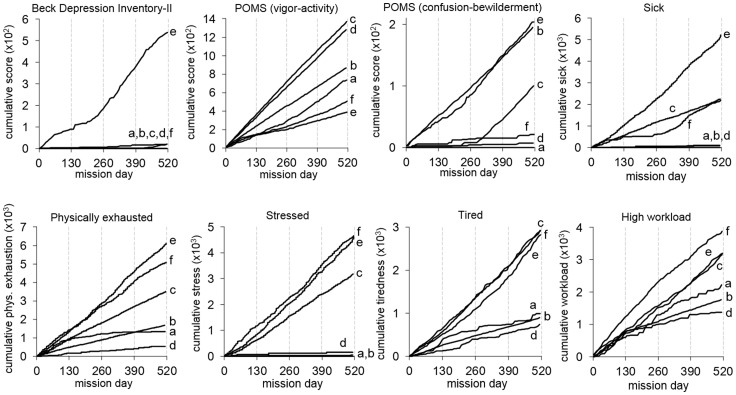
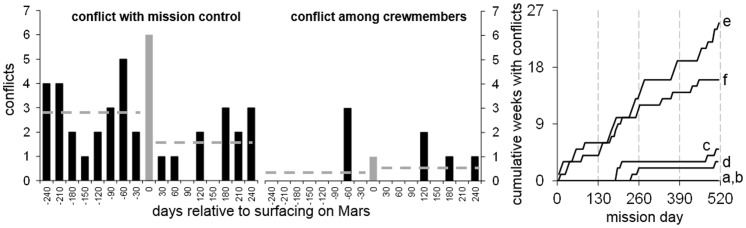
Behavioral health risks are among the most serious and difficult to mitigate risks of confinement in space craft during long-duration space exploration missions. We report on behavioral and psychological reactions of a multinational crew of 6 healthy males confined in a 550 m(3) chamber for 520 days during the first Earth-based, high-fidelity simulated mission to Mars. Rest-activity of crewmembers was objectively measured throughout the mission with wrist-worn actigraphs. Once weekly throughout the mission crewmembers completed the Beck Depression Inventory-II (BDI-II), Profile of Moods State short form (POMS), conflict questionnaire, the Psychomotor Vigilance Test (PVT-B), and series of visual analogue scales on stress and fatigue. We observed substantial inter-individual differences in the behavioral responses of crewmembers to the prolonged mission confinement and isolation. The crewmember with the highest average POMS total mood disturbance score throughout the mission also reported symptoms of depression in 93% of mission weeks, which reached mild-to-moderate levels in >10% of mission weeks. Conflicts with mission control were reported five times more often than conflicts among crewmembers. Two crewmembers who had the highest ratings of stress and physical exhaustion accounted for 85% of the perceived conflicts. One of them developed a persistent sleep onset insomnia with ratings of poor sleep quality, which resulted in chronic partial sleep deprivation, elevated ratings of daytime tiredness, and frequent deficits in behavioral alertness. Sleep-wake timing was altered in two other crewmembers, beginning in the first few months of the mission and persisting throughout. Two crewmembers showed neither behavioral disturbances nor reports of psychological distress during the 17-month period of mission confinement. These results highlight the importance of identifying behavioral, psychological, and biological markers of characteristics that predispose prospective crewmembers to both effective and ineffective behavioral reactions during the confinement of prolonged spaceflight, to inform crew selection, training, and individualized countermeasures.
Overview
The claims and statistics of this paper haven’t been checked yet.
Free: it reads the open-access text and checks the first 5 claims that cite a source we can check. Create a free account to check every claim.
Integrity signals
Registry
Cites
Statistics
Figures
Verification
Claims the paper makes
The claims and statistics of this paper haven’t been checked yet.
Free: it reads the open-access text and checks the first 5 claims that cite a source we can check. Create a free account to check every claim.
Claims other papers make about this one
Each is checked against this paper’s own text: does it say what the citing paper says it does?
The source backs part of the claim, not all of it — or backs it for a different population, condition or comparison.
In the citing paper
“Other in-flight investigations support and expand upon contributors to increased stress on-orbit, including studies documenting reductions in sleep duration62,63 and evaluation of crew responses to habitability and human factors during spaceflight64.”
From Red risks for a journey to the red planet: The highest priority human health risks for a mission to Mars (2020) · cites this paper as [62]
Experimental — accuracy not yet measuredThe source backs part of the claim, not all of it — or backs it for a different population, condition or comparison.
In the citing paper
“One of six (20%) crew reported depressive symptoms based on the Beck Depression Inventory in 93% of mission weeks, which reached mild-to-moderate levels in >10% of mission weeks.”
From Red risks for a journey to the red planet: The highest priority human health risks for a mission to Mars (2020) · cites this paper as [62]
Experimental — accuracy not yet measuredThe source backs part of the claim, not all of it — or backs it for a different population, condition or comparison.
In the citing paper
“In general, few longitudinal studies have been conducted for quantifying how individuals’ biological metabolites, psychological outlook, social drive, and behavioral habits change over a long duration in Mars-like isolation and confinement (Basner et al., 2014; Nicolas and Gushin, 2015).”
From Biobehavioral and psychosocial stress changes during three 8–12 month spaceflight analog missions with Mars-like conditions of isolation and confinement (2022) · cites this paper as Basner et al., 2014
Experimental — accuracy not yet measuredThe cited source says what the claim attributes to it.
In the citing paper
“Two of the six crewmembers reported no adverse behavioral symptoms during the missions62.”
From Red risks for a journey to the red planet: The highest priority human health risks for a mission to Mars (2020) · cites this paper as [62]
The cited source says what the claim attributes to it.
In the citing paper
“Additionally, two crewmembers who had the highest ratings of stress and physical exhaustion accounted for 85% of the perceived conflicts, and other crew demonstrated dysregulation in their circadian entrainment and sleep difficulties.”
From Red risks for a journey to the red planet: The highest priority human health risks for a mission to Mars (2020) · cites this paper as [62]
Self-check
Percentages, sums and reported differences re-computed from the paper’s own numbers.
The self-check needs the paper’s full text.
Citations
Cites
The Measurement of Observer Agreement for Categorical Data
Landis, J. R., & Koch, G. G. (1977) · Biometrics · doi:10.2307/2529310 · Cited by 81,148
Comparison of Beck Depression Inventories -IA and -II in psychiatric outpatients
Beck, A. T., Steer, R. A., Ball, R., & Ranieri, W. F. (1996) · Journal of Personality Assessment · doi:10.1207/s15327752jpa6703_13 · Cited by 5,965
Unraveling the Mystery of Health: How People Manage Stress and Stay Well
Antonovsky, A. (2002) · The Health Psychology Reader · doi:10.4135/9781446221129.n9 · Cited by 5,543
Van Dongen, H. P. A., Maislin, G., Mullington, J. M., & Dinges, D. F. (2003) · Sleep · doi:10.1093/sleep/26.2.117 · Cited by 3,173
Self-citationThe Role of Actigraphy in the Study of Sleep and Circadian Rhythms
Ancoli-Israel, S., Cole, R., Alessi, C., Chambers, M., Moorcroft, W., & Pollak, C. P. (2003) · Sleep · doi:10.1093/sleep/26.3.342 · Cited by 2,751 · cited 1×
“1 Actigraphy: Actigraphy is a reliable, non-invasive method to validly assess rest-activity cycles [13].”
MethodBelenky, G., Wesensten, N. J., Thorne, D. R., Thomas, M. L., Sing, H. C., Redmond, D. P., Russo, M. B., & Balkin, T. J. (2003) · Journal of Sleep Research · doi:10.1046/j.1365-2869.2003.00337.x · Cited by 1,436
A Shortened Version of the Profile of Mood States
Shacham, S. (1983) · Journal of Personality Assessment · doi:10.1207/s15327752jpa4703_14 · Cited by 1,231 · cited 8×
“Data acquisition for psychological measures resulted in 100% completed tests (i.e., N = 6 for SDS-17; N = 444 for BDI-II; POMS-SF;CQ; VAS for workload and sleep quality ratings; and N = 888 for VAS scales for unhappiness, physical exhaustion, mental fatigue, stress, tiredness).”
MethodInfluentialSleep Deprivation and Vigilant Attention
Lim, J., & Dinges, D. F. (2008) · Annals of the New York Academy of Sciences · doi:10.1196/annals.1417.002 · Cited by 1,213 · cited 1×
“The PVT-B measures vigilant attention by recording response time (RT) to visual stimuli that occur at random inter-stimulus intervals (ISI), and it has negligible aptitude and learning effects [15,16].”
BackgroundSelf-citationKushida, C. A., Chang, A., Gadkary, C., Guilleminault, C., Carrillo, O., & Dement, W. C. (2001) · Sleep Medicine · doi:10.1016/s1389-9457(00)00098-8 · Cited by 997
Maximizing sensitivity of the Psychomotor Vigilance Test (PVT) to sleep loss
Basner, M., & Dinges, D. F. (2011) · Sleep · doi:10.1093/sleep/34.5.581 · Cited by 958
Self-citation
Cited by
Items 201–246 of 246
Hao, Z., Meng, C., Li, L., Feng, S., Zhu, Y., Yang, J., Han, L., Sun, L., Lv, W., Figeys, D., et al. (2023) · Figshare · doi:10.6084/m9.figshare.22688694
Tsukakoshi, D., Mutai, H., Yamamoto, S., Sato, M., Furuhashi, K., Nakamura, T., Ichiyama, T., Imamura, H., & Horiuchi, H. (2025) · SSRN Electronic Journal · doi:10.2139/ssrn.5145292
Bewohnbarkeit als (Lebens) RAUM
Häuplik‐Meusburger, S., & Bishop, S. L. (2025) · Springer eBooks · doi:10.1007/978-3-031-25492-5_3
Applications of Microfluidic Chips in Space Life Sciences
Dongping, W. E. I., Lianwen, S. U. N., & Yang, X. B. (2025) · Chinese Journal of Space Science · doi:10.11728/cjss2025.02.2024-0155
Sanford, L. D., Adkins, A. M., Boden, A. F., Luyo, Z. N. M., Singh, N., Britten, R. A., & Wellman, L. L. (2025) · Life Sciences in Space Research · doi:10.1016/j.lssr.2025.10.001 · Cited by 2
Adapt, endure, succeed: profiling extreme teams
Feitosa, J., Davis, A. S., Castillo, G. F., Burke, C. S., Natale, A. N., & Harmata, R. (2025) · Team Performance Management · doi:10.1108/tpm-05-2024-0045
Hao, Z., Meng, C., Li, L., Feng, S., Zhu, Y., Yang, J., Han, L., Sun, L., Lv, W., Figeys, D., et al. (2023) · Figshare · doi:10.6084/m9.figshare.22688664
Hao, Z., Meng, C., Li, L., Feng, S., Zhu, Y., Yang, J., Han, L., Sun, L., Lv, W., Figeys, D., et al. (2023) · Figshare · doi:10.6084/m9.figshare.22688673
Hao, Z., Meng, C., Li, L., Feng, S., Zhu, Y., Yang, J., Han, L., Sun, L., Lv, W., Figeys, D., et al. (2023) · Figshare · doi:10.6084/m9.figshare.22688646
Hao, Z., Meng, C., Li, L., Feng, S., Zhu, Y., Yang, J., Han, L., Sun, L., Lv, W., Figeys, D., et al. (2023) · Figshare · doi:10.6084/m9.figshare.22688649
Hao, Z., Meng, C., Li, L., Feng, S., Zhu, Y., Yang, J., Han, L., Sun, L., Lv, W., Figeys, D., et al. (2023) · Figshare · doi:10.6084/m9.figshare.22688631
Hao, Z., Meng, C., Li, L., Feng, S., Zhu, Y., Yang, J., Han, L., Sun, L., Lv, W., Figeys, D., et al. (2023) · Figshare · doi:10.6084/m9.figshare.22688634
Hao, Z., Meng, C., Li, L., Feng, S., Zhu, Y., Yang, J., Han, L., Sun, L., Lv, W., Figeys, D., et al. (2023) · Figshare · doi:10.6084/m9.figshare.22688679
Hao, Z., Meng, C., Li, L., Feng, S., Zhu, Y., Yang, J., Han, L., Sun, L., Lv, W., Figeys, D., et al. (2023) · Figshare · doi:10.6084/m9.figshare.22688628
Hao, Z., Meng, C., Li, L., Feng, S., Zhu, Y., Yang, J., Han, L., Sun, L., Lv, W., Figeys, D., et al. (2023) · Figshare · doi:10.6084/m9.figshare.22688640
Hao, Z., Meng, C., Li, L., Feng, S., Zhu, Y., Yang, J., Han, L., Sun, L., Lv, W., Figeys, D., et al. (2023) · Figshare · doi:10.6084/m9.figshare.22688643
Hao, Z., Meng, C., Li, L., Feng, S., Zhu, Y., Yang, J., Han, L., Sun, L., Lv, W., Figeys, D., et al. (2023) · Figshare · doi:10.6084/m9.figshare.22688655
Hao, Z., Meng, C., Li, L., Feng, S., Zhu, Y., Yang, J., Han, L., Sun, L., Lv, W., Figeys, D., et al. (2023) · Figshare · doi:10.6084/m9.figshare.22688667
Barros-Delben, P., Skorupa, A., Delben, P. B., Barros-Delben, N., Araujo, L. O., Weeresinghe, R. L., Mendes, T. T., Marques‐Quinteiro, P., González, L. E., & Silvestre, D. (2026) · Life Sciences in Space Research · doi:10.1016/j.lssr.2026.01.011
Minoretti, P. (2026) · Cureus · doi:10.7759/cureus.105103
Osei, I., Carie, A., Kanithi, L. P., & Boadu, D. O. (2026) · Frontiers in Human Dynamics · doi:10.3389/fhumd.2026.1795513
Jeandel, J. (2019) · theses.fr (ABES) · doi:10.70675/ef224fafzdd92z415ezbe2ez1ee2a696f766
Stieber, M. (2026) · The Polar Journal · doi:10.1080/2154896x.2026.2656078
Glos, M., Salanitro, M., Laharnar, N., Demin, A. V., Penzel, T., & Fietze, I. (2026) · Frontiers in Human Neuroscience · doi:10.3389/fnhum.2026.1720237
Rhodes, D., & Harris, E. (2026) · Polar Record · doi:10.1017/s0032247426100333
Automated behavioral segmentation and markerless pose tracking of mice during spaceflightPreprint
Kiffer, F. C., Scott, R. T., Martens, M. T., Mayo, A., Li, Y., Mendoza, M., Gautam, S., Huang, J., Bathwal, M., Jaikumar, S., et al. (2026) · bioRxiv (Cold Spring Harbor Laboratory) · doi:10.64898/2026.04.30.721950 · Cited by 1
Levine, C. S., & Groth, K. M. (2026) · ASCE-ASME Journal of Risk and Uncertainty in Engineering Systems Part B Mechanical Engineering · doi:10.1115/1.4071895
Basner, M., Rennie, K., Moore, T. M., Gur, R. C., Smith, M. A., Nasrini, J., Hermosillo, E., Ecker, A. J., Schneller, V., Jones, C. W., et al. (2026) · Frontiers in Psychology · doi:10.3389/fpsyg.2026.1783846
Self-citationA brief Meaningful Work and Enjoyment Scale (MeWES) for extreme operational environments
Landon, L. B., Baxley, A. D., Bell, S. T., Stahn, A. C., Russell, D. W., & Roma, P. G. (2026) · Military Psychology · doi:10.1080/08995605.2026.2687217
Sandal, G. M., & Smith, N. (2026) · PLoS ONE · doi:10.1371/journal.pone.0351965
Closed-Loop Hospitality as a Sustainability Assessment Framework for Space-Analogue Habitats
Križaj, D., & Antlej, K. (2026) · Sustainability · doi:10.3390/su18147254
Yancheshmeh, F. A., Woods, M., Martin, A., Loghman, S., Bhaskar, P., & Burton, Z. (2026) · Safety Science · doi:10.1016/j.ssci.2026.107370
Wijk, C. H. V., & Muller, C. J. B. (2026) · African Journal of Psychological Assessment · doi:10.4102/ajopa.v8i0.195
Bell, S. T., Landon, L. B., Dev, S. I., Miller, J. C. W., Begerowski, S. R., Whiting, S., Anderson, S. R., Stosic, M. D., Williams, T. J., & Roma, P. G. (2026) · Acta Astronautica · doi:10.1016/j.actaastro.2026.07.031
Harel, B., Pietrzak, R. H., Dave, S., Maruff, P. T., Romero, H., Brimmer, M., & Doll, H. (2026) · Therapeutic Innovation & Regulatory Science · doi:10.1007/s43441-026-01025-8
Freitas, M. C., Costa, A. B. F. Z., Veloso, F. C., & Andrade, L. D. F. P. (2026) · Journal of Biomedical & Space Sciences (JBSS) · doi:10.66234/bpt7jg08
Chen, D., Ma, L., Chen, J., Zhang, X., Hou, X., Yang, M., Wang, Y., Lei, X., Duan, X., Feng, Y., et al. (2026) · Acta Astronautica · doi:10.1016/j.actaastro.2026.08.060
Opportunities for Australia in space medicine: a realistic pathway to international participationPreprint
Wren, G. G. (2026) · Research Square · doi:10.21203/rs.3.rs-10572991/v1
Caso, S. (2026) · International Journal of Sport and Exercise Psychology · doi:10.1080/1612197x.2026.2730159 · Cited by 1
Challenges and potential technologies for cultivation of plants for human sustenance in space
Chauhan, O., Shashikumar, S. H., Xavier, J. R., & Kumar, R. (2026) · Space habitation. · doi:10.1016/j.spaceh.2026.100078
Dickerson, B. L., Gonzalez, D. E., Comfort, P., Hardy, J. G., Hines, K., Anderson, D. N., Macaulay, T. R., Stankovic, A. S., & Twine, C. (2026) · Frontiers in Physiology · doi:10.3389/fphys.2026.1950155
Fedchuk, M. V., Popova, O. V., & Русанов, В. Б. (2026) · Extreme Medicine · doi:10.47183/mes.2026-542
Hekmatikar, A. H. A., & Pletser, V. (2026) · Microgravity Science and Technology · doi:10.1007/s12217-026-10293-w
Li, S., Ding, H., Huang, Y., Xu, C., Wu, W., Wu, G., Zhang, Y., Zhang, Z., Hu, Y., Yang, L., et al. (2026) · Journal of Cellular Biochemistry · doi:10.1002/jcb.70129
Kanas, N. (2015) · Springer eBooks · doi:10.1007/978-3-319-18869-0_10
Metadata
- Authors
- Basner, M., Dinges, D. F., Mollicone, D. J., Savelev, I., Ecker, A. J., Di Antonio, A., Jones, C. W., Hyder, E. C., Kan, K., Morukov, B. V., & Sutton, J. P.
- Affiliations
- University of Pennsylvania (US)
- Pulsar Informatics (United States) (US)
- National Space Biomedical Research Institute (US)
- Institute of Biomedical Problems (RU)
- Corresponding author
- Basner, Mathias
- Venue
- PLoS ONE
- Publisher
- Public Library of Science (PLoS)
- Published
- 2014-03-27
- Volume
- 9
- Issue
- 3
- Pages
- e93298
- ISSN
- 1932-6203 (ISSN-L)
- PMC
- PMC3968121
- OpenAlex
- W2004322066
- Cited by
- 238
- References
- 36
- Citations by year
- 2026: 30 · 2025: 24 · 2024: 11 · 2023: 35 · 2022: 34 · 2021: 21 · 2020: 20 · 2019: 16 · 2018: 9 · 2017: 15 · 2016: 9 · 2015: 11 · 2014: 3
- FWCI
- 8.42
- Type
- journal article
- Language
- en
- Open access
- gold
- doi.org
- Locations
- PLoS ONE (publishedVersion, cc-by)
- Europe PMC (PubMed Central) (publishedVersion, other-oa)
- PubMed Central (publishedVersion, cc-by)
- PubMed (publishedVersion)
- DOAJ (DOAJ: Directory of Open Access Journals) (submittedVersion)
- Funders
- National Aeronautics and Space Administration (NASA NCC 9‐58, NCC958)
- National Space Biomedical Research Institute (NASA NCC 9‐58, NCC 9‐58)
- Russian Academy of Sciences
- Topics
- Health Sciences › Medicine › Physiology (medical) › Spaceflight effects on biology
- Physical Sciences › Engineering › Aerospace Engineering › Space Exploration and Technology
- Social Sciences › Psychology › Experimental and Cognitive Psychology › Sleep and Work-Related Fatigue
- Keywords
- long-duration spaceflight, psychological distress, depression, mood disturbance, interpersonal conflict, sleep deprivation, insomnia, circadian rhythm disruption, fatigue, stress, crew selection, individual differences
- MeSH terms
- Adult, Affect, Depression, Humans, Male, Motor Activity, Psychological Tests, Psychomotor Performance, Surveys and Questionnaires, Rest, Sleep, Sleep Deprivation, Social Isolation, Space Flight, Stress, Psychological, Astronauts, Mars, Space Simulation
About these checks
Registry, retraction, Cites and statistics results are computed, not judged, with one exception: a printed reference that no index lists is read once by a model before it counts as a citation error. Claims are extracted by a model and kept only when their quote appears verbatim in the text; each cited source is then checked, with a model’s help, for whether it says what the claim relies on. Those verdicts can be wrong — read the claim’s quote and the cited source before relying on one.
Statistics and arithmetic are recomputed, not judged.
Confidence bands are shown only for fields calibrated on our annotated test set. None is calibrated yet, so no band is shown.
What counts as a claim ›How we measure confidence ›How we check this ›
Are you an author, or do you see a problem with this page? Request a review
Data sources
Bibliographic data: Semantic Scholar, OpenAlex, Crossref.
Contains information from the Semantic Scholar Academic Graph Datasets, made available under the ODC Attribution License (ODC-BY 1.0).
Semantic Scholar’s data is described in: Kinney, R., et al. (2023). The Semantic Scholar Open Data Platform. arXiv:2301.10140.
