

The DOI matches its Crossref record; 87 of the 88 references it cites were found in a registry or an index; none of the 24 sources its claims cite is checked for support yet.
A Meta-Analysis on the Relationship between Self-Reported Presence and Anxiety in Virtual Reality Exposure Therapy for Anxiety Disorders
Open accessAbstract
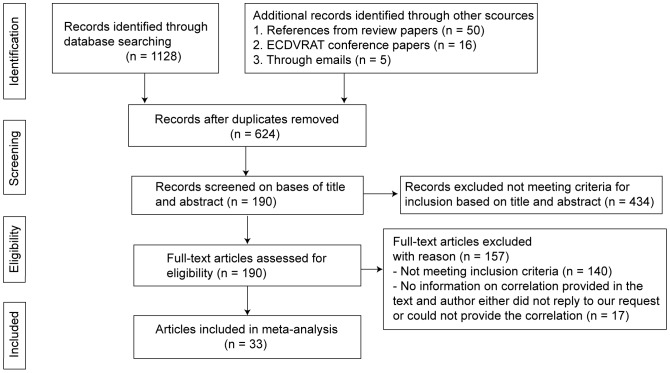
In virtual reality exposure therapy (VRET) for anxiety disorders, sense of presence in the virtual environment is considered the principal mechanism that enables anxiety to be felt. Existing studies on the relation between sense of presence and level of anxiety, however, have yielded mixed results on the correlation between the two. In this meta-analysis, we reviewed publications on VRET for anxiety that included self-reported presence and anxiety. The comprehensive search of the literature identified 33 publications with a total of 1196 participants. The correlation between self-reported sense of presence and anxiety was extracted and meta-analyzed. Potential moderators such as technology characteristics, sample characteristics including age, gender and clinical status, disorder characteristics and study design characteristics such as measurements were also examined. The random effects analysis showed a medium effect size for the correlation between sense of presence and anxiety (r = .28; 95% CI: 0.18-0.38). Moderation analyses revealed that the effect size of the correlation differed across different anxiety disorders, with a large effect size for fear of animals (r = .50; 95% CI: 0.30-0.66) and a no to small effect size for social anxiety disorder (r = .001; 95% CI: -0.19-0.19). Further, the correlation between anxiety and presence was stronger in studies with participants who met criteria for an anxiety disorder than in studies with a non-clinical population. Trackers with six degrees of freedom and displays with a larger field of view resulted in higher effect sizes, compared to trackers with three degrees of freedom and displays with a smaller field of view. In addition, no difference in effect size was found for the type of presence measurement and the type of anxiety measurement. This meta-analysis confirms the positive relation between sense of presence and anxiety and demonstrates that this relation can be affected by various moderating factors.
Overview
AI snapshot
Written from the paper’s full text.
TL;DR
This meta-analysis of 33 publications with 52 correlations and 1,196 participants found a medium positive association between self-reported presence and anxiety in virtual reality exposure therapy (r = .28; 95% CI: 0.18–0.38). The relation varied by anxiety disorder, clinical status, tracker degrees of freedom, and display field of view.
Key findings
- The random-effects weighted mean correlation between self-reported presence and anxiety was r = .28, 95% CI [0.18–0.38], p < .001; excluding the OCD study, it was r = .29, 95% CI [0.19–0.39], p < .001.
- Disorder type significantly moderated the correlation (Q₆ = 17.28, p = .008): fear of animals r = .50 [0.30–0.66], fear of flying r = .52 [0.16–0.75], acrophobia r = .39 [0.22–0.54], and social phobia r = .001 [−0.19–0.19].
- Clinical samples showed a higher correlation than non-clinical samples: r = .42 [0.25–0.57] vs. r = .22 [0.10–0.34], with the moderator approaching significance (Q₁ = 3.47, p = .06); excluding OCD, the difference was significant (clinical r = .47 [0.29–0.61] vs. non-clinical r = .22 [0.10–0.34], Q₁ = 5.15, p = .02).
- Technology moderated the relation: 6 DoF trackers r = .46 [0.30–0.60] vs. 3 DoF trackers r = .23 [0.09–0.36] (Q₁ = 4.81, p = .03), and large FOV displays (>94°) r = .51 [0.28–0.68] vs. small FOV displays (<71°) r = .24 [0.13–0.35] (Q₁ = 4.10, p = .04); presence and anxiety measurement types did not significantly moderate the effect.
Methods
- Systematic literature search in PsycINFO, PubMed, Web of Knowledge, and Scopus through March 19, 2013, plus reference and conference screening; inclusion required human participants in VR/AR for anxiety disorder treatment, self-reported presence and anxiety, and peer-reviewed journal or conference publication.
- The analysis included 33 articles, 52 correlations, and 1,196 participants; the correlation between self-reported presence and anxiety served as the effect size, converted to Fisher’s z, with random-effects meta-analysis, subgroup analyses for categorical moderators, and REML meta-regressions for continuous moderators using Comprehensive Meta-analysis Version 3.
- Moderators examined included anxiety disorder type, age, gender, clinical status, technology characteristics (display, stereoscopy, resolution, FOV, audio, tracker DoF/update frequency), measurement type, sample size, and publication year; publication bias was assessed with Fail-safe N, funnel plot, and Egger’s test.
Limitations
- The paper states that presence and anxiety were self-reported and therefore prone to demand characteristics, and that very few studies covered OCD, claustrophobia, and fear of flying, so caution is needed when generalizing to underrepresented disorders.
- The paper notes that the meta-analysis was based on correlations and could not model the shape of the presence–anxiety relationship, which may not be linear.
- Evident from the text: no PTSD studies were included because authors could not provide correlations; although the search included spatial, social, and co-presence, included publications only reported spatial presence; and the publication-year effect may have been confounded with anxiety disorder type.
Model-written summary. Check it against the paper before relying on it.
Integrity signals
Registry
Cites
Statistics
Figures
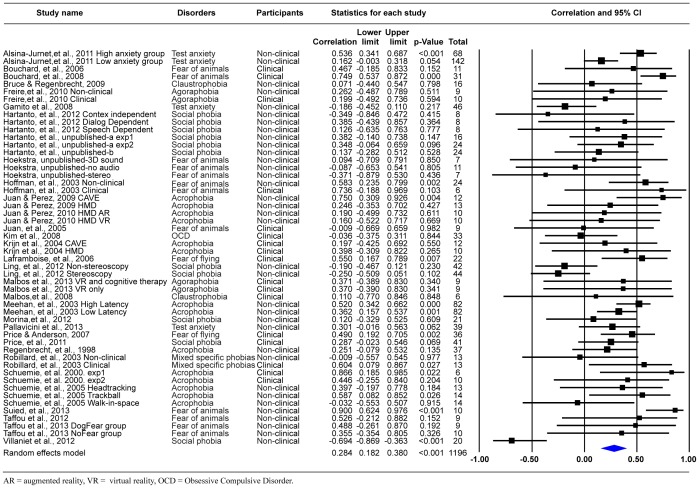
Verification
Claims the paper makes
53 Own result · 18 Not checked yet · 14 Own interpretation · 4 Own method · 2 No basis given
A result the paper reports from its own data — it cites no other source for it, so there is none to check. The quote shows it is in the paper.
In the paper
“As expected, the meta-regression models were all significant in both steps; Q 1 = 4.51, p = .03 and Q 2 = 7.00, p = .03 for step1 and step 2 individually (Table 5).”
§ A Meta-Analysis on the Relationship between Self-Reported Presence and Anxiety in Virtual Reality Exposure Therapy for Anxiety Disorders > Results > 3.4 Effect size across different technology characteristics
plaincorrelational- Asserted: passes — The authors put it forward as true.
- Checkable: passes — It can be checked against evidence.
- Load-bearing: passes — The paper’s conclusions depend on it.
- Based: passes — The paper gives a reason why it holds.
A result the paper reports from its own data — it cites no other source for it, so there is none to check. The quote shows it is in the paper.
In the paper
“The results showed a significant interaction effect between participants' clinical status and display field of view (Q 1 = 4.19, p = .04) and between participants' clinical status and tracker's degree of freedom (Q 1 = 13.66, p<.001).”
§ A Meta-Analysis on the Relationship between Self-Reported Presence and Anxiety in Virtual Reality Exposure Therapy for Anxiety Disorders > Results > 3.4 Effect size across different technology characteristics
plaincorrelational- Asserted: passes — The authors put it forward as true.
- Checkable: passes — It can be checked against evidence.
- Load-bearing: passes — The paper’s conclusions depend on it.
- Based: passes — The paper gives a reason why it holds.
A result the paper reports from its own data — it cites no other source for it, so there is none to check. The quote shows it is in the paper.
In the paper
“Since only tracker's DoF and display field of view significantly moderated the correlation between presence and anxiety, we conducted multiple meta-regression analyses to test whether the combination of these two variables could have a better overall prediction of the weighted mean correlation.”
- Also stated in: § Discussion and Conclusions · hedged
“The meta-analysis also found moderating effects for some technology characteristics such as the degrees of freedom of the tracker and the display's field of view.”
§ A Meta-Analysis on the Relationship between Self-Reported Presence and Anxiety in Virtual Reality Exposure Therapy for Anxiety Disorders > Results > 3.4 Effect size across different technology characteristics
plaincorrelational- Asserted: passes — The authors put it forward as true.
- Checkable: passes — It can be checked against evidence.
- Load-bearing: passes — The paper’s conclusions depend on it.
- Based: passes — The paper gives a reason why it holds.
- Also stated in: § Discussion and Conclusions · hedged
A result the paper reports from its own data — it cites no other source for it, so there is none to check. The quote shows it is in the paper.
In the paper
“However, for social phobia no correlation between self-reported presence and anxiety was found.”
§ A Meta-Analysis on the Relationship between Self-Reported Presence and Anxiety in Virtual Reality Exposure Therapy for Anxiety Disorders > Discussion and Conclusions
plain- Asserted: passes — The authors put it forward as true.
- Checkable: passes — It can be checked against evidence.
- Load-bearing: passes — The paper’s conclusions depend on it.
- Based: passes — The paper gives a reason why it holds.
- Rests on an assumption: The self-reported presence measures used in the included studies validly capture the sense of presence relevant to anxiety in VRET.
A result the paper reports from its own data — it cites no other source for it, so there is none to check. The quote shows it is in the paper.
In the paper
“The subgroup analyses showed no significant moderating effect for the type of anxiety measurement (Q 2 = 1.35, p = .51; see Table 2), and the type of presence measurement (Q 4 = 6.06, p = .20; see Table 2).”
- Also stated in: § Abstract · plain
“In addition, no difference in effect size was found for the type of presence measurement and the type of anxiety measurement.”
§ A Meta-Analysis on the Relationship between Self-Reported Presence and Anxiety in Virtual Reality Exposure Therapy for Anxiety Disorders > Results > 3.1 Effect size across different measurements
plain- Asserted: passes — The authors put it forward as true.
- Checkable: passes — It can be checked against evidence.
- Load-bearing: unclear — It is unclear whether the paper’s conclusions depend on it.
- Based: passes — The paper gives a reason why it holds.
- The authors state this as an assumption: A common among-study variance component across the subgroups.
- Also stated in: § Abstract · plain
A result the paper reports from its own data — it cites no other source for it, so there is none to check. The quote shows it is in the paper.
In the paper
“The results showed a non-significant relation between presence and anxiety with neither spatial resolution (Q 1 = 0.90, p = .34) nor field of view (Q 1 = 2.48, p = .12).”
§ A Meta-Analysis on the Relationship between Self-Reported Presence and Anxiety in Virtual Reality Exposure Therapy for Anxiety Disorders > Results > 3.4 Effect size across different technology characteristics
plain- Asserted: passes — The authors put it forward as true.
- Checkable: passes — It can be checked against evidence.
- Load-bearing: unclear — It is unclear whether the paper’s conclusions depend on it.
- Based: passes — The paper gives a reason why it holds.
A result the paper reports from its own data — it cites no other source for it, so there is none to check. The quote shows it is in the paper.
In the paper
“A subgroup analysis on the correlation between presence and anxiety for the group of large field of view displays (FOV>94°) separated from the group of small field of view displays (FOV<71°) showed a significantly higher correlation (Q 1 = 4.10, p = 04) for studies using a large field of view display r = .51, 95% CI [0.28–0.68], p<.001 compared to studies using a small field of view display r = .”
§ A Meta-Analysis on the Relationship between Self-Reported Presence and Anxiety in Virtual Reality Exposure Therapy for Anxiety Disorders > Results > 3.4 Effect size across different technology characteristics
plaincorrelational- Asserted: passes — The authors put it forward as true.
- Checkable: passes — It can be checked against evidence.
- Load-bearing: passes — The paper’s conclusions depend on it.
- Based: passes — The paper gives a reason why it holds.
A result the paper reports from its own data — it cites no other source for it, so there is none to check. The quote shows it is in the paper.
In the paper
“The summary effect for the group of studies with non-clinical participants was r = .22, 95% CI [0.10–0.34], p<.001, while the summary effect for the group of studies using clinical participants was r = .42, 95% CI [0.25–0.57], p<.001.”
§ A Meta-Analysis on the Relationship between Self-Reported Presence and Anxiety in Virtual Reality Exposure Therapy for Anxiety Disorders > Results > 3.3 Effect size across different participants' characteristics
plaincorrelational- Asserted: passes — The authors put it forward as true.
- Checkable: passes — It can be checked against evidence.
- Load-bearing: passes — The paper’s conclusions depend on it.
- Based: passes — The paper gives a reason why it holds.
- The authors state this as an assumption: A common among-study variance component across the subgroups.
A result the paper reports from its own data — it cites no other source for it, so there is none to check. The quote shows it is in the paper.
In the paper
“No significant differences were found for display type (Q 1 = 1.56, p = .21), stereoscopy (Q 1 = 0.014, p = .91), whether a tracker was used or not (Q 1 = 2.65, p = .10), tracker's update frequency (Q 4 = 3.58, p = .47), audio type (Q 2 = 3.90, p = .14) and audio player (Q 2 = 1.66, p = .44) (see again Table 4).”
§ A Meta-Analysis on the Relationship between Self-Reported Presence and Anxiety in Virtual Reality Exposure Therapy for Anxiety Disorders > Results > 3.4 Effect size across different technology characteristics
plain- Asserted: passes — The authors put it forward as true.
- Checkable: passes — It can be checked against evidence.
- Load-bearing: unclear — It is unclear whether the paper’s conclusions depend on it.
- Based: passes — The paper gives a reason why it holds.
- The authors state this as an assumption: A common among-study variance component across the subgroups.
A result the paper reports from its own data — it cites no other source for it, so there is none to check. The quote shows it is in the paper.
In the paper
“Correlations between presence and anxiety were significantly different among the various disorders, varying from almost zero for social phobia and claustrophobia to a large effect for fear of animals and fear of flying (see Table 3). Subgroup analyses showed significant differences between different anxiety disorders (Q 6 = 17.28, p = .008).”
- Also stated in: § Abstract · plain
“Moderation analyses revealed that the effect size of the correlation differed across different anxiety disorders, with a large effect size for fear of animals (r = .50; 95% CI: 0.30–0.66) and a no to small effect size for social anxiety disorder (r = .001; 95% CI: −0.19–0.19).”
§ A Meta-Analysis on the Relationship between Self-Reported Presence and Anxiety in Virtual Reality Exposure Therapy for Anxiety Disorders > Results > 3.2 Effect size across different anxiety disorders
plaincorrelational- Asserted: passes — The authors put it forward as true.
- Checkable: passes — It can be checked against evidence.
- Load-bearing: passes — The paper’s conclusions depend on it.
- Based: passes — The paper gives a reason why it holds.
- The authors state this as an assumption: A common among-study variance component across the subgroups.
- Also stated in: § Abstract · plain
- It may state two separate claims as one. 16
- The quote only partly states this claim. 1
- Probably not a substantial claim. 16
A result the paper reports from its own data — it cites no other source for it, so there is none to check. The quote shows it is in the paper.
In the paper
“On the basis of the standardized methodology, we included 33 articles with 52 correlations, with a total sample size of 1196 participants.”
- Also stated in: § Abstract · plain
“The comprehensive search of the literature identified 33 publications with a total of 1196 participants.”
§ A Meta-Analysis on the Relationship between Self-Reported Presence and Anxiety in Virtual Reality Exposure Therapy for Anxiety Disorders > Results
plainn = 1,196- Asserted: passes — The authors put it forward as true.
- Checkable: passes — It can be checked against evidence.
- Load-bearing: passes — The paper’s conclusions depend on it.
- Based: passes — The paper gives a reason why it holds.
It may state two separate claims as one.
- Also stated in: § Abstract · plain
A result the paper reports from its own data — it cites no other source for it, so there is none to check. The quote shows it is in the paper.
In the paper
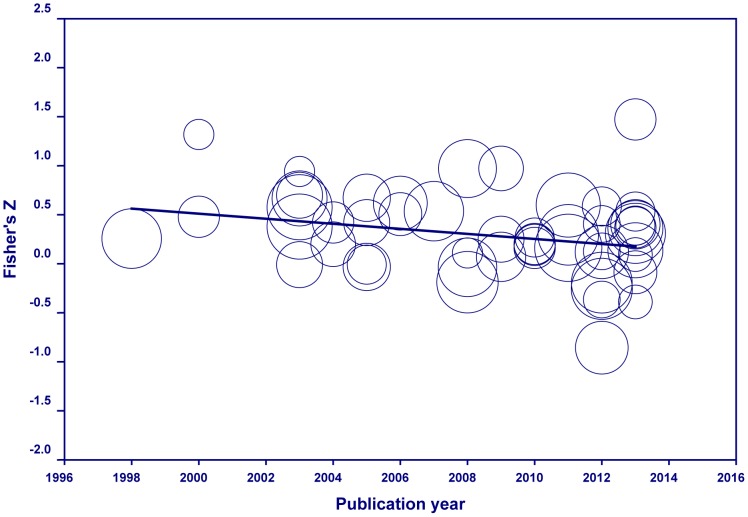
“This model was approaching significant (Q 1 = 3.78, p = .051) with 9.62% of the variability in the correlation coefficients accounted for by the publication year (see Table 7).”
§ A Meta-Analysis on the Relationship between Self-Reported Presence and Anxiety in Virtual Reality Exposure Therapy for Anxiety Disorders > Results > 3.5 Effect size as a function of sample size and publication year
plaincorrelational- Asserted: passes — The authors put it forward as true.
- Checkable: passes — It can be checked against evidence.
- Load-bearing: unclear — It is unclear whether the paper’s conclusions depend on it.
- Based: passes — The paper gives a reason why it holds.
It may state two separate claims as one.
A result the paper reports from its own data — it cites no other source for it, so there is none to check. The quote shows it is in the paper.
In the paper
“Further, the correlation between anxiety and presence was stronger in studies with participants who met criteria for an anxiety disorder than in studies with a non-clinical population.”
- Also stated in: § 3.3 Effect size across different participants' characteristics · plain
“Hence, the correlation between presence and anxiety was higher for the clinical sample of people than for the non-clinical sample, but the effect of this moderator was only approaching significance (Q 1 = 3.47, p = .06).”
§ A Meta-Analysis on the Relationship between Self-Reported Presence and Anxiety in Virtual Reality Exposure Therapy for Anxiety Disorders > Abstract
plaincorrelational- Asserted: passes — The authors put it forward as true.
- Checkable: passes — It can be checked against evidence.
- Load-bearing: unclear — It is unclear whether the paper’s conclusions depend on it.
- Based: passes — The paper gives a reason why it holds.
It may state two separate claims as one.
- The authors state this as an assumption: A common among-study variance component across the subgroups.
- Also stated in: § 3.3 Effect size across different participants' characteristics · plain
A result the paper reports from its own data — it cites no other source for it, so there is none to check. The quote shows it is in the paper.
In the paper
“and a no to small effect size for social anxiety disorder (r = .001; 95% CI: −0.19–0.19).”
- Also stated in: § 3.2 Effect size across different anxiety disorders · plain
“In contrast, 11 correlations were included in the calculation of the summary effect for social phobia, and still the mean correlation did not deviate significantly from zero.”
§ A Meta-Analysis on the Relationship between Self-Reported Presence and Anxiety in Virtual Reality Exposure Therapy for Anxiety Disorders > Abstract
plain- Asserted: passes — The authors put it forward as true.
- Checkable: passes — It can be checked against evidence.
- Load-bearing: passes — The paper’s conclusions depend on it.
- Based: passes — The paper gives a reason why it holds.
It may state two separate claims as one.
- The authors state this as an assumption: A common among-study variance component across the subgroups.
- Also stated in: § 3.2 Effect size across different anxiety disorders · plain
A result the paper reports from its own data — it cites no other source for it, so there is none to check. The quote shows it is in the paper.
In the paper
“For claustrophobia the summary correlation was not found to deviate significantly from zero, but this result was only based on two correlations.”
§ A Meta-Analysis on the Relationship between Self-Reported Presence and Anxiety in Virtual Reality Exposure Therapy for Anxiety Disorders > Results > 3.2 Effect size across different anxiety disorders
plain- Asserted: passes — The authors put it forward as true.
- Checkable: passes — It can be checked against evidence.
- Load-bearing: unclear — It is unclear whether the paper’s conclusions depend on it.
- Based: passes — The paper gives a reason why it holds.
It may state two separate claims as one.
- The authors state this as an assumption: A common among-study variance component across the subgroups.
A result the paper reports from its own data — it cites no other source for it, so there is none to check. The quote shows it is in the paper.
In the paper
“Additionally, preliminary analyses indicated substantial heterogeneity in the data (fixed effects: Q 51 = 126.17, p<.001 for the entire dataset, and Q 50 = 123.04, p<.001 for the dataset without the study on OCD) suggesting that the data are heterogeneous, which supports the choice for a random-effects model.”
§ A Meta-Analysis on the Relationship between Self-Reported Presence and Anxiety in Virtual Reality Exposure Therapy for Anxiety Disorders > Results
hedged- Asserted: passes — The authors put it forward as true.
- Checkable: passes — It can be checked against evidence.
- Load-bearing: passes — The paper’s conclusions depend on it.
- Based: passes — The paper gives a reason why it holds.
It may state two separate claims as one.
A result the paper reports from its own data — it cites no other source for it, so there is none to check. The quote shows it is in the paper.
In the paper
“The resulting model did not show a significant effect of gender on the correlation (Q 1 = 1.82, p = .18).”
§ A Meta-Analysis on the Relationship between Self-Reported Presence and Anxiety in Virtual Reality Exposure Therapy for Anxiety Disorders > Results > 3.3 Effect size across different participants' characteristics
plain- Asserted: passes — The authors put it forward as true.
- Checkable: passes — It can be checked against evidence.
- Load-bearing: unclear — It is unclear whether the paper’s conclusions depend on it.
- Based: passes — The paper gives a reason why it holds.
The quote only partly states this claim.
- The authors state this as an assumption: A common among-study variance component across the subgroups.
A result the paper reports from its own data — it cites no other source for it, so there is none to check. The quote shows it is in the paper.
In the paper
“For fear of flying, the summary correlation was found to be significantly above zero, but still as the confidence interval shows, the exact size of the correlation is not precise.”
§ A Meta-Analysis on the Relationship between Self-Reported Presence and Anxiety in Virtual Reality Exposure Therapy for Anxiety Disorders > Results > 3.2 Effect size across different anxiety disorders
plaincorrelational- Asserted: passes — The authors put it forward as true.
- Checkable: passes — It can be checked against evidence.
- Load-bearing: unclear — It is unclear whether the paper’s conclusions depend on it.
- Based: passes — The paper gives a reason why it holds.
It may state two separate claims as one.
- The authors state this as an assumption: A common among-study variance component across the subgroups.
A result the paper reports from its own data — it cites no other source for it, so there is none to check. The quote shows it is in the paper.
In the paper
“The subgroup analyses showed a significant moderating effect for the degrees of freedom of the tracker (Q 1 = 4.81, p = .03) with a tracker with 6 DoF resulting in higher correlations than a tracker with 3 DoF (see Table 4).”
- Also stated in: § Abstract · plain
“Trackers with six degrees of freedom and displays with a larger field of view resulted in higher effect sizes, compared to trackers with three degrees of freedom and displays with a smaller field of view.”
§ A Meta-Analysis on the Relationship between Self-Reported Presence and Anxiety in Virtual Reality Exposure Therapy for Anxiety Disorders > Results > 3.4 Effect size across different technology characteristics
plaincorrelational- Asserted: passes — The authors put it forward as true.
- Checkable: passes — It can be checked against evidence.
- Load-bearing: passes — The paper’s conclusions depend on it.
- Based: passes — The paper gives a reason why it holds.
It may state two separate claims as one.
- The authors state this as an assumption: A common among-study variance component across the subgroups.
- Also stated in: § Abstract · plain
A result the paper reports from its own data — it cites no other source for it, so there is none to check. The quote shows it is in the paper.
In the paper
“The shape of the funnel plots in Figure S1 did not reveal any indication of funnel plot asymmetry. This visual impression was also confirmed by Egger's test with p = .67, two-tailed.”
§ A Meta-Analysis on the Relationship between Self-Reported Presence and Anxiety in Virtual Reality Exposure Therapy for Anxiety Disorders > Results
plain- Asserted: passes — The authors put it forward as true.
- Checkable: passes — It can be checked against evidence.
- Load-bearing: unclear — It is unclear whether the paper’s conclusions depend on it.
- Based: passes — The paper gives a reason why it holds.
It may state two separate claims as one.
A result the paper reports from its own data — it cites no other source for it, so there is none to check. The quote shows it is in the paper.
In the paper
“The moderating effect was found in the studies with less immersive technology, but not in studies with more immersive technology.”
§ A Meta-Analysis on the Relationship between Self-Reported Presence and Anxiety in Virtual Reality Exposure Therapy for Anxiety Disorders > Discussion and Conclusions
plain- Asserted: passes — The authors put it forward as true.
- Checkable: passes — It can be checked against evidence.
- Load-bearing: passes — The paper’s conclusions depend on it.
- Based: passes — The paper gives a reason why it holds.
It may state two separate claims as one.
In the paper
“In VRET, the sense of presence has been considered the principal mechanism that leads to the experience of anxiety [12].”
§ A Meta-Analysis on the Relationship between Self-Reported Presence and Anxiety in Virtual Reality Exposure Therapy for Anxiety Disorders > Introduction
What the sources say
- Not checked yetcites [12] Wiederhold BK, Wiederhold MD (2005) Virtual reality therapy for anxiety disorders: Advances in evaluation and treatment. Washington, DC: Amrican Psychological Association. 225 p. source
plaindirect- Asserted: passes — The authors put it forward as true.
- Checkable: passes — It can be checked against evidence.
- Load-bearing: passes — The paper’s conclusions depend on it.
- Based: passes — The paper gives a reason why it holds.
Probably not a substantial claim.
A conclusion the paper draws from its own results — it cites no other source for it, so there is none to check. The quote shows it is in the paper.
In the paper
“This meta-analysis confirms the positive relation between sense of presence and anxiety and demonstrates that this relation can be affected by various moderating factors.”
§ A Meta-Analysis on the Relationship between Self-Reported Presence and Anxiety in Virtual Reality Exposure Therapy for Anxiety Disorders > Abstract
boostedcorrelational- Asserted: passes — The authors put it forward as true.
- Checkable: passes — It can be checked against evidence.
- Load-bearing: passes — The paper’s conclusions depend on it.
- Based: passes — The paper gives a reason why it holds.
It may state two separate claims as one.
- Rests on an assumption: There are no published quantitative syntheses on the relationship between presence and anxiety.
In the paper
“Rosenthal [54] suggested that findings could be considered as robust if the required number of studies to reduce the overall effect size to a non-significant level exceeded 5 × number of included studies (effect sizes)+10.”
§ A Meta-Analysis on the Relationship between Self-Reported Presence and Anxiety in Virtual Reality Exposure Therapy for Anxiety Disorders > Methods > 2.4 publication bias
What the sources say
- Not checked yetcites [54] Rosenthal R (1991) Meta-analytic procedures for social research. London, UK: Sage. 168 p. source
hedged- Asserted: passes — The authors put it forward as true.
- Checkable: passes — It can be checked against evidence.
- Load-bearing: passes — The paper’s conclusions depend on it.
- Based: passes — The paper gives a reason why it holds.
Probably not a substantial claim.
In the paper
“Recently, Slater [81] also argued that presence at least has two independent components: place illusion and plausibility.”
§ A Meta-Analysis on the Relationship between Self-Reported Presence and Anxiety in Virtual Reality Exposure Therapy for Anxiety Disorders > Discussion and Conclusions
What the sources say
- Not checked yetcites [81] M Slater, 2009, Place illusion and plausibility can lead to realistic behaviour in immersive virtual environments, Philosophical Transactions of the Royal Society B-Biological Sciences source
plain- Asserted: passes — The authors put it forward as true.
- Checkable: passes — It can be checked against evidence.
- Load-bearing: fails — The paper’s conclusions may not depend on it.
- Based: passes — The paper gives a reason why it holds.
Probably not a substantial claim. The paper’s conclusions may not depend on it.
What the paper did — it cites no source for this, so there is none to check. The quote shows it is in the paper.
In the paper
“For the subgroup analyses, effects had to be demonstrated by at least two different research teams in each subgroup.”
§ A Meta-Analysis on the Relationship between Self-Reported Presence and Anxiety in Virtual Reality Exposure Therapy for Anxiety Disorders > Methods > 2.3 Effect size calculation
plain- Asserted: passes — The authors put it forward as true.
- Checkable: passes — It can be checked against evidence.
- Load-bearing: passes — The paper’s conclusions depend on it.
- Based: passes — The paper gives a reason why it holds.
Probably not a substantial claim.
In the paper
“Both place illusion and plausibility contribute to realistic responses in the virtual environment.”
§ A Meta-Analysis on the Relationship between Self-Reported Presence and Anxiety in Virtual Reality Exposure Therapy for Anxiety Disorders > Discussion and Conclusions
What the sources say
- Not checked yetcites [81] M Slater, 2009, Place illusion and plausibility can lead to realistic behaviour in immersive virtual environments, Philosophical Transactions of the Royal Society B-Biological Sciences source
plaindirect- Asserted: passes — The authors put it forward as true.
- Checkable: passes — It can be checked against evidence.
- Load-bearing: fails — The paper’s conclusions may not depend on it.
- Based: passes — The paper gives a reason why it holds.
Probably not a substantial claim. The paper’s conclusions may not depend on it. It may state two separate claims as one.
A conclusion the paper draws from its own results — it cites no other source for it, so there is none to check. The quote shows it is in the paper.
In the paper
“A potential explanation for this observation is that advancements in immersive technology reduce the moderating effect of other factors, such as personality, clinical status and the surrounding real world.”
§ A Meta-Analysis on the Relationship between Self-Reported Presence and Anxiety in Virtual Reality Exposure Therapy for Anxiety Disorders > Results > 3.4 Effect size across different technology characteristics
hedgedconditional- Asserted: passes — The authors put it forward as true.
- Checkable: passes — It can be checked against evidence.
- Load-bearing: passes — The paper’s conclusions depend on it.
- Based: passes — The paper gives a reason why it holds.
Probably not a substantial claim.
What the paper did — it cites no source for this, so there is none to check. The quote shows it is in the paper.
In the paper
“The summary effect size was calculated using the random effects model due to the heterogeneity of the studies.”
§ A Meta-Analysis on the Relationship between Self-Reported Presence and Anxiety in Virtual Reality Exposure Therapy for Anxiety Disorders > Methods > 2.3 Effect size calculation
plain- Asserted: passes — The authors put it forward as true.
- Checkable: passes — It can be checked against evidence.
- Load-bearing: passes — The paper’s conclusions depend on it.
- Based: passes — The paper gives a reason why it holds.
Probably not a substantial claim.
In the paper
“Since OCD is not listed as an anxiety disorder in DSM-V [2], the new version published in 2013, we conducted all analyses twice, i.e., first with all 33 publications, and then with the same dataset, but without the study on OCD.”
§ A Meta-Analysis on the Relationship between Self-Reported Presence and Anxiety in Virtual Reality Exposure Therapy for Anxiety Disorders > Results
What the sources say
- Not checked yetcites [2] American Psychiatric Association (2013) Diagnostic and statistical manual of mental disorders. Washington, DC: Author. 991 p. source
plain- Asserted: passes — The authors put it forward as true.
- Checkable: passes — It can be checked against evidence.
- Load-bearing: passes — The paper’s conclusions depend on it.
- Based: passes — The paper gives a reason why it holds.
Probably not a substantial claim. It may state two separate claims as one.
None of the sources cited for this claim have been checked yet.
In the paper
“Due to habituation to the virtual stimuli in the virtual environment, participants' anxiety would decrease over time [48], [49].”
§ A Meta-Analysis on the Relationship between Self-Reported Presence and Anxiety in Virtual Reality Exposure Therapy for Anxiety Disorders > Methods > 2.2. Procedure
What the sources say
- Not checked yetcites [48] E Malbos, 2013, A controlled study of agoraphobia and the independent effect of virtual reality exposure therapy, Australian and New Zealand Journal of Psychiatry source
- Not checked yetcites [49] Hofmann SG, Otto MW (2008) Cognitive Behavioral Therapy for Social Anxiety Disorder: Evidence-Based and Disorder-Specific Treatment Techniques. New York: Routledge. 232 p. source
hedgeddirect- Asserted: passes — The authors put it forward as true.
- Checkable: passes — It can be checked against evidence.
- Load-bearing: passes — The paper’s conclusions depend on it.
- Based: passes — The paper gives a reason why it holds.
Probably not a substantial claim.
In the paper
“Social anxiety centers on the perception of negative human evaluation, and thus individuals' perception of the appearance of both verbal and non-verbal behavior of virtual characters [80] seems a relevant cue for activating the fear structure.”
§ A Meta-Analysis on the Relationship between Self-Reported Presence and Anxiety in Virtual Reality Exposure Therapy for Anxiety Disorders > Discussion and Conclusions
What the sources say
- Not checked yetcites [80] C Qu, 2013, Human perception of a conversational virtual human: An empirical study on the effect of emotion and culture, Virtual Reality source
plain- Asserted: passes — The authors put it forward as true.
- Checkable: passes — It can be checked against evidence.
- Load-bearing: passes — The paper’s conclusions depend on it.
- Based: passes — The paper gives a reason why it holds.
Probably not a substantial claim.
In the paper
“Publication bias was also assessed with a funnel plot visually, and qualified with Egger's weighted regression method [55].”
§ A Meta-Analysis on the Relationship between Self-Reported Presence and Anxiety in Virtual Reality Exposure Therapy for Anxiety Disorders > Methods > 2.4 publication bias
What the sources say
- Not checked yetcites [55] M Egger, 1997, Bias in meta-analysis detected by a simple, graphical test, British Medical Journal source
plain- Asserted: passes — The authors put it forward as true.
- Checkable: passes — It can be checked against evidence.
- Load-bearing: fails — The paper’s conclusions may not depend on it.
- Based: passes — The paper gives a reason why it holds.
Probably not a substantial claim. The paper’s conclusions may not depend on it. It may state two separate claims as one.
In the paper
“To test whether the overall effect that we found was robust, the classic Fail-safe N value as proposed by Rosenthal [54] was calculated.”
§ A Meta-Analysis on the Relationship between Self-Reported Presence and Anxiety in Virtual Reality Exposure Therapy for Anxiety Disorders > Methods > 2.4 publication bias
What the sources say
- Not checked yetcites [54] Rosenthal R (1991) Meta-analytic procedures for social research. London, UK: Sage. 168 p. source
plain- Asserted: passes — The authors put it forward as true.
- Checkable: passes — It can be checked against evidence.
- Load-bearing: fails — The paper’s conclusions may not depend on it.
- Based: passes — The paper gives a reason why it holds.
Probably not a substantial claim. The paper’s conclusions may not depend on it.
What the paper did — it cites no source for this, so there is none to check. The quote shows it is in the paper.
In the paper
“Our current meta-analysis study, however, was based on correlations between presence and anxiety, where the shape of the relationship between presence and anxiety could not be modeled.”
§ A Meta-Analysis on the Relationship between Self-Reported Presence and Anxiety in Virtual Reality Exposure Therapy for Anxiety Disorders > Discussion and Conclusions
plain- Asserted: passes — The authors put it forward as true.
- Checkable: passes — It can be checked against evidence.
- Load-bearing: passes — The paper’s conclusions depend on it.
- Based: passes — The paper gives a reason why it holds.
It may state two separate claims as one.
A conclusion the paper draws from its own results — it cites no other source for it, so there is none to check. The quote shows it is in the paper.
In the paper
“These findings put forward the hypothesis that applying more advanced immersive technology leaves less room for other factors to moderate the correlation between presence and anxiety.”
§ A Meta-Analysis on the Relationship between Self-Reported Presence and Anxiety in Virtual Reality Exposure Therapy for Anxiety Disorders > Discussion and Conclusions
hedgeddirect- Asserted: fails — The authors may not put it forward as true.
- Checkable: passes — It can be checked against evidence.
- Load-bearing: passes — The paper’s conclusions depend on it.
- Based: passes — The paper gives a reason why it holds.
Probably not a substantial claim. The authors may not put it forward as true.
A conclusion the paper draws from its own results — it cites no other source for it, so there is none to check. The quote shows it is in the paper.
In the paper
“Nonetheless, for both clinical and non-clinical individuals, the reported presence can be seen as the degree in which real life cues have been imitated.”
§ A Meta-Analysis on the Relationship between Self-Reported Presence and Anxiety in Virtual Reality Exposure Therapy for Anxiety Disorders > Discussion and Conclusions
plaincorrelational- Asserted: passes — The authors put it forward as true.
- Checkable: fails — It may be too vague to check against evidence.
- Load-bearing: fails — The paper’s conclusions may not depend on it.
- Based: fails — The paper may give no reason why it holds.
Probably not a substantial claim. It may be too vague to check against evidence. The paper’s conclusions may not depend on it. The paper may give no reason why it holds.
In the paper
“This finding is also in line with what Ling et al. [86] suggested, namely that the role of participants' absorption may be larger in less immersive virtual environments.”
§ A Meta-Analysis on the Relationship between Self-Reported Presence and Anxiety in Virtual Reality Exposure Therapy for Anxiety Disorders > Discussion and Conclusions
What the sources say
- Not checked yetcites [86] Y Ling, 2013, The relationship between individual characteristics and experienced presence, Computers in Human Behavior source
hedgedconditional- Asserted: passes — The authors put it forward as true.
- Checkable: passes — It can be checked against evidence.
- Load-bearing: fails — The paper’s conclusions may not depend on it.
- Based: passes — The paper gives a reason why it holds.
Probably not a substantial claim. The paper’s conclusions may not depend on it.
A conclusion the paper draws from its own results — it cites no other source for it, so there is none to check. The quote shows it is in the paper.
In the paper
“It seems that advanced immersive technology dominates the relationship and reduces the ‘noise’ from other factors such as individuals' characteristics, personality or previous experiences which may affect experienced presence and anxiety in virtual environments.”
§ A Meta-Analysis on the Relationship between Self-Reported Presence and Anxiety in Virtual Reality Exposure Therapy for Anxiety Disorders > Discussion and Conclusions
hedgeddirect- Asserted: passes — The authors put it forward as true.
- Checkable: passes — It can be checked against evidence.
- Load-bearing: passes — The paper’s conclusions depend on it.
- Based: passes — The paper gives a reason why it holds.
It may state two separate claims as one.
A conclusion the paper draws from its own results — it cites no other source for it, so there is none to check. The quote shows it is in the paper.
In the paper
“As suggested above, place illusion is well covered by most presence questionnaires, but future research should investigate the extent to which presence questionnaires also measure plausibility, i.e., the extent to which one takes what is happening in the virtual environment as real, since the latter might be more relevant than spatial presence for VRET for social phobia.”
§ A Meta-Analysis on the Relationship between Self-Reported Presence and Anxiety in Virtual Reality Exposure Therapy for Anxiety Disorders > Discussion and Conclusions
boostedcorrelational- Asserted: passes — The authors put it forward as true.
- Checkable: passes — It can be checked against evidence.
- Load-bearing: fails — The paper’s conclusions may not depend on it.
- Based: passes — The paper gives a reason why it holds.
Probably not a substantial claim. The paper’s conclusions may not depend on it.
The paper relies on this without support.
There are no published quantitative syntheses on the relationship between presence and anxiety.
“To our knowledge, there are no published quantitative syntheses on the relationship between presence and anxiety.”
The authors state this as an assumption.
Presence was stable during participants' exposure to the virtual environment.
“As earlier studies [27], [47] found no order effect on presence during one session, we assumed that presence was stable during participants' exposure to the virtual environment.”
The authors state this as an assumption.
A common among-study variance component across the subgroups.
“We pooled within-group estimates of tau-squared, assuming a common among-study variance component across the subgroups [51].”
The authors state this as an assumption.
The effect size of all current or future unpublished studies is equal to zero.
“A conservative method of addressing this problem is to assume that the effect size of all current or future unpublished studies is equal to zero and to compute the number of such studies it would require to reduce the overall effect size to a non-significant level (α = .05, two-tailed).”
The paper relies on this without support.
The relationship between presence and anxiety is linear enough that a correlation coefficient is a meaningful summary of their association.
“Our current meta-analysis study, however, was based on correlations between presence and anxiety, where the shape of the relationship between presence and anxiety could not be modeled.”
The paper relies on this without support.
The self-reported presence measures used in the included studies validly capture the sense of presence relevant to anxiety in VRET.
“First, the measurements of presence and anxiety used in this study were self-reported which is prone to well-known demand characteristics.”
Claims other papers make about this one
Each is checked against this paper’s own text: does it say what the citing paper says it does?
The source backs part of the claim, not all of it — or backs it for a different population, condition or comparison.
In the citing paper
“Immersive technology can help to increase the sense of presence, defined as the sense of being in a virtual environment (Steuer, 1992), as well as the emotional response experienced in a virtual scenario (Ling et al., 2014).”
From An internet-based treatment for flying phobia using 360° images: A feasibility pilot study (2022) · cites this paper as Ling et al., 2014
Experimental — accuracy not yet measuredThe source backs part of the claim, not all of it — or backs it for a different population, condition or comparison.
In the citing paper
“Immersive technology can reduce the “noise” of other individual or real-world factors in an exposure scenario, and, therefore, it can increase the presence and anxiety experienced in these virtual environments (Ling et al., 2014).”
From An Internet-based treatment for Flying Phobia using 360° images: Study protocol for a feasibility pilot study (2021) · cites this paper as Ling et al., 2014
Experimental — accuracy not yet measuredThe source backs part of the claim, not all of it — or backs it for a different population, condition or comparison.
In the citing paper
“The immersion level of the technology is not the only variable that explains the subjective sense of presence, but it does play a role in this relationship.”
From An Internet-based treatment for Flying Phobia using 360° images: Study protocol for a feasibility pilot study (2021) · cites this paper as Ling et al., 2014
Experimental — accuracy not yet measuredThe source backs part of the claim, not all of it — or backs it for a different population, condition or comparison.
In the citing paper
“The ITC-SOPI has been established as a reliable and valid tool for assessing the sense of presence and shows a significant relationship with anxiety levels during virtual reality exposure therapy (Ling et al., 2014).”
From Speaking face-to-face with a virtual avatar to reduce anxiety in students who stutter: Tool development and pilot study results. (2026) · cites this paper as Ling et al., 2014
Experimental — accuracy not yet measuredThe cited source says what the claim attributes to it.
In the citing paper
“In the case of VRET, there is a positive correlation between immersive technology and presence and anxiety (Ling et al., 2014)”
From An Internet-based treatment for Flying Phobia using 360° images: Study protocol for a feasibility pilot study (2021) · cites this paper as Ling et al., 2014
In the citing paper
“A 2014 meta-analysis reported an overall significant correlation of r = .28(95% CI: 0.18-0.38)between self-reported distress and presence during exposure”
From Better, Virtually: the Past, Present, and Future of Virtual Reality Cognitive Behavior Therapy (2021) · cites this paper as Ling et al. 2014
In the citing paper
“albeit with significant differences across sample clinical characteristics and type of VR equipment used (Ling et al. 2014).”
From Better, Virtually: the Past, Present, and Future of Virtual Reality Cognitive Behavior Therapy (2021) · cites this paper as Ling et al. 2014
In the citing paper
“Congruently, reported correlation coefficients between presence and pain are typically of stronger magnitude than those reported between presence and distress during VRET [34,38,39].”
From Experiences of gamified and automated virtual reality exposure therapy for spider phobia: qualitative study (2020) · cites this paper as [34]
In the citing paper
“Meta-analytic research has confirmed a robust but relatively weak association between self-rated distress and sense of presence during exposure [34]”
From Experiences of gamified and automated virtual reality exposure therapy for spider phobia: qualitative study (2020) · cites this paper as [34]
Statistics recomputed
Every reported test result, recomputed from its test statistic and degrees of freedom. A result shows as not adding up only once an independent check has confirmed it.
- Consistentt(50) = 3.5reported p = .001 · recomputed p < .001
“t(50) = 3.50, p = .001”
Self-check
Percentages, sums and reported differences re-computed from the paper’s own numbers.
Each contradiction between two passages listed here was confirmed by an independent check.
Rated minor: it would not touch a result — a value no result rests on, a p-value that stays on the same side of the significance level, or a conflict that is clerical, resolved elsewhere in the paper, or outside its own findings.
In the paper
§ A Meta-Analysis on the Relationship between Self-Reported Presence and Anxiety in Virtual Reality Exposure Therapy for Anxiety Disorders > Results > 3.5 Effect size as a function of sample size and publication year
“This model was approaching significant (Q 1 = 3.78, p = .051)”
§ A Meta-Analysis on the Relationship between Self-Reported Presence and Anxiety in Virtual Reality Exposure Therapy for Anxiety Disorders > Results > 3.5 Effect size as a function of sample size and publication year
“| Interval | −0.026 | .0051 |”
Rated minor: it would not touch a result — a value no result rests on, a p-value that stays on the same side of the significance level, or a conflict that is clerical, resolved elsewhere in the paper, or outside its own findings.
In the paper
“| Yes | 42 | .32 | <.001 | .21 | .42 | | Tracker's DoF | | | | | | | 3 DoF | 27 | .23 | .001 | .09 | .36 | | 6 DoF | 16 | .46 | <.001 | .30 | .60 |”
§ A Meta-Analysis on the Relationship between Self-Reported Presence and Anxiety in Virtual Reality Exposure Therapy for Anxiety Disorders > Results > 3.4 Effect size across different technology characteristics
Reported 42 · recomputed 43
Citations
Cites
Diagnostic and Statistical Manual of Mental Disorders
American Psychiatric Association (2013) · doi:10.1176/appi.books.9780890425596 · Cited by 116,369
Diagnostic and Statistical Manual of Mental Disorders
Williams, J. B. W., & First, M. B. (2013) · Oxford University Press eBooks · doi:10.1093/acrefore/9780199975839.013.104 · Cited by 109,845
Preferred Reporting Items for Systematic Reviews and Meta-Analyses: the PRISMA statement
Moher, D., Liberati, A., Tetzlaff, J., Altman, D. G., & for the PRISMA Group (2009) · BMJ · doi:10.1136/bmj.b2535 · Cited by 83,823
Statistical power analysis for the behavioral sciences
Cohen, J. (1990) · Computers Environment and Urban Systems · doi:10.1016/0198-9715(90)90050-4 · Cited by 65,417
Bias in meta-analysis detected by a simple, graphical test
Egger, M., Smith, G. D., Schneider, M., & Minder, C. (1997) · BMJ · doi:10.1136/bmj.315.7109.629 · Cited by 56,722 · cited 1×
“Publication bias was also assessed with a funnel plot visually, and qualified with Egger’s weighted regression method [55].”
Preferred reporting items for systematic reviews and meta-analyses: the PRISMA Statement.
(2009) · PubMed Central · Cited by 44,859
Meta-analysis in clinical trials
DerSimonian, R., & Laird, N. (1986) · Controlled Clinical Trials · doi:10.1016/0197-2456(86)90046-2 · Cited by 39,552 · cited 2×
“Note that in the random-effects model for calculating the overall effect size and the subgroup analyses, this software only provides method of moments (or the DerSimonian and Laird [53]) to estimate the between-studies variance [51].”
Borenstein, M., Hedges, L. V., Higgins, J. P. T., & Rothstein, H. R. (2009) · doi:10.1002/9780470743386 · Cited by 14,225
Kessler, R. C., Chiu, W. T., Demler, O., & Walters, E. E. (2005) · Archives of General Psychiatry · doi:10.1001/archpsyc.62.6.617 · Cited by 12,052 · cited 1×
“Anxiety disorders have an estimated one-year prevalence rate of about 18% among Americans [1].”
Borenstein, M., Hedges, L. V., Higgins, J. P. T., & Rothstein, H. R. (2021) · doi:10.1002/9781119558378 · Cited by 9,799
Research works printed but not linked: 6
- Schuemie MJ, Bruynzeel M, Drost L, Brinckman M, de Haan G, <etal>et al</etal>.. (2000) Treatment of acrophobia in virtual reality: A pilot study. In: Brockx F, Pauwels L, editors; Antwerp, Belgium. pp. 271–275.
- S Côté, 2008, Virtual reality exposure for phobias: A critical review, Journal of Cyber Therapy and Rehabilitation, 1, 75
- H Ewald, 2009, Fear conditioning in immersive virtual reality, Psychophysiology, 46, S128
- M-R Laframboise, 2006, Relation between anxiety and feeling of presence during virtual reality immersion, CyberPsychology & Behavior, 9, 689
- Spielberger CD, Krasner SS (1988) The assessment of trait and state anxiety. In: Burrows G, Noyes R, Roth M, editors. Handbook of anixety. Amsterdam: Elsevier Science. pp. 31–51.
- S Bouchard, 2011, Exploring new dimensions in the assessment of virtual reality induced side effects, Journal of computer and information technology, 1, 20
Cited by
Sorted by citations
Virtual Reality in the Assessment, Understanding, and Treatment of Mental Health Disorders
Freeman, D., Reeve, S., Robinson, A., Ehlers, A., Clark, D., Spanlang, B., & Slater, M. (2017) · Psychological Medicine · doi:10.1017/s003329171700040x · Cited by 1,428
Neuroscience of virtual reality: from virtual exposure to embodied medicine
Riva, G., Wiederhold, B. K., & Mantovani, F. (2019) · Cyberpsychology, Behavior, and Social Networking · doi:10.1089/cyber.2017.29099.gri · Cited by 608
“For example, as demonstrated by a recent meta-analysis, presence and anxiety are associated with each other during VRE therapy for the treatment of anxiety.(91) This allows a level of self-reflectiveness that is both more predictable and controllable than the one offered by reality, but higher than the one provided by…”
MethodRecent Progress in Virtual Reality Exposure Therapy for Phobias: A Systematic Review
Botella, C., Fernández-Álvarez, J., Guillén, V., García-Palacios, A., & Baños, R. (2017) · Current Psychiatry Reports · doi:10.1007/s11920-017-0788-4 · Cited by 460
Morina, N., Ijntema, H., Meyerbröker, K., & Emmelkamp, P. M. G. (2015) · Behaviour Research and Therapy · doi:10.1016/j.brat.2015.08.010 · Cited by 439
Philippe, T. J., Sikder, N., Jackson, A., Koblanski, M. E., Liow, E., Pilarinos, A., & Vasarhelyi, K. (2022) · JMIR Mental Health · doi:10.2196/35159 · Cited by 436
Metadata
- Authors
- Ling, Y., Nefs, H. T., Morina, N., Heynderickx, I., & Brinkman, W.-P.
- Affiliations
- Delft University of Technology (NL)
- Philips (Netherlands) (NL)
- Corresponding author
- Ling, Yun
- Nefs, Harold T.
- Heynderickx, Ingrid
- Brinkman, Willem-Paul
- Venue
- PLoS ONE
- Publisher
- Public Library of Science (PLoS)
- Published
- 2014-05-06
- Volume
- 9
- Issue
- 5
- Pages
- e96144
- ISSN
- 1932-6203 (ISSN-L)
- PMC
- PMC4011738
- OpenAlex
- W2164854045
- Semantic Scholar
- add99bb7a404accb3de776f6554901e83db8cbf3
- Cited by
- 215
- References
- 88
- Citations by year
- 2026: 22 · 2025: 24 · 2024: 15 · 2023: 16 · 2022: 20 · 2021: 24 · 2020: 27 · 2019: 19 · 2018: 14 · 2017: 13 · 2016: 8 · 2015: 10 · 2014: 3
- FWCI
- 2.98
- Type
- journal article
- Language
- en
- Open access
- gold
- doi.org
- Locations
- PLoS ONE (publishedVersion, cc-by)
- Europe PMC (PubMed Central) (publishedVersion, cc-by)
- PubMed Central (publishedVersion, cc-by)
- PubMed (publishedVersion)
- UvA-DARE (University of Amsterdam) (acceptedVersion, other-oa)
- TU/e Research Portal (submittedVersion, other-oa)
- TU/e Research Portal (submittedVersion)
- RePEc: Research Papers in Economics (submittedVersion)
- DOAJ (DOAJ: Directory of Open Access Journals) (submittedVersion, cc-by-sa)
- Figshare (submittedVersion, cc-by)
- Research Repository (Delft University of Technology) (submittedVersion)
- Data Archiving and Networked Services (DANS) (submittedVersion, other-oa)
- Funders
- Nederlandse Organisatie voor Wetenschappelijk Onderzoek (655.010.207)
- Topics
- Physical Sciences › Computer Science › Human-Computer Interaction › Virtual Reality Applications and Impacts
- Social Sciences › Psychology › Experimental and Cognitive Psychology › Anxiety, Depression, Psychometrics, Treatment, Cognitive Processes
- Social Sciences › Psychology › Applied Psychology › Digital Mental Health Interventions
- Keywords
- virtual reality exposure therapy, presence, anxiety, anxiety disorders, social anxiety disorder, animal phobia, field of view
- MeSH terms
- Anxiety Disorders, Humans, Self Report, Virtual Reality Exposure Therapy
About these checks
Registry, retraction, Cites and statistics results are computed, not judged, with one exception: a printed reference that no index lists is read once by a model before it counts as a citation error. Claims are extracted by a model and kept only when their quote appears verbatim in the text; each cited source is then checked, with a model’s help, for whether it says what the claim relies on. Those verdicts can be wrong — read the claim’s quote and the cited source before relying on one.
A language model drew the claims from the paper on 2026-10-10, under version 3 of the claim definition (model deepseek-v4.1-flash, prompt extract-v3).
A second model labelled each claim on 2026-10-10 (model jev-1.13-20260917, definition revision gold-guideline-v0.2).
Statistics and arithmetic are recomputed, not judged.
Confidence bands are shown only for fields calibrated on our annotated test set. None is calibrated yet, so no band is shown.
What counts as a claim ›How we measure confidence ›How we check this ›
Are you an author, or do you see a problem with this page? Request a review
