

The DOI matches its Crossref record; 55 of the 56 references it cites were found in a registry or an index.
Biotic and Abiotic Properties Mediating Plant Diversity Effects on Soil Microbial Communities in an Experimental Grassland
Open accessAbstract
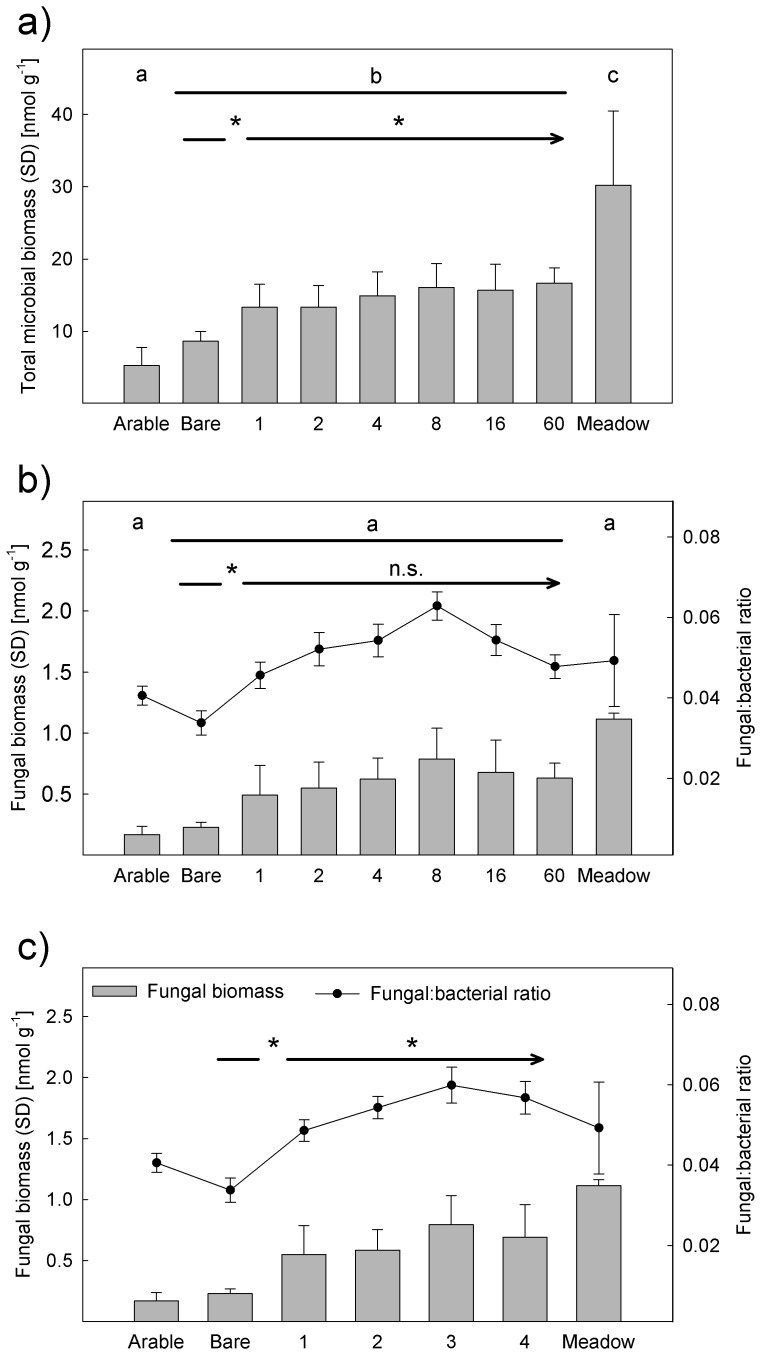
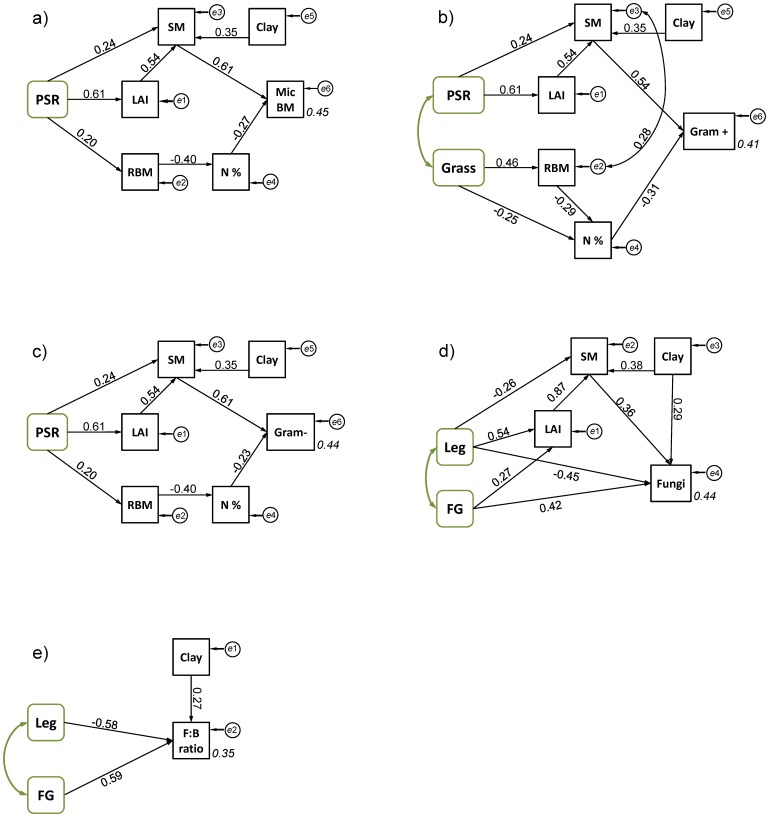
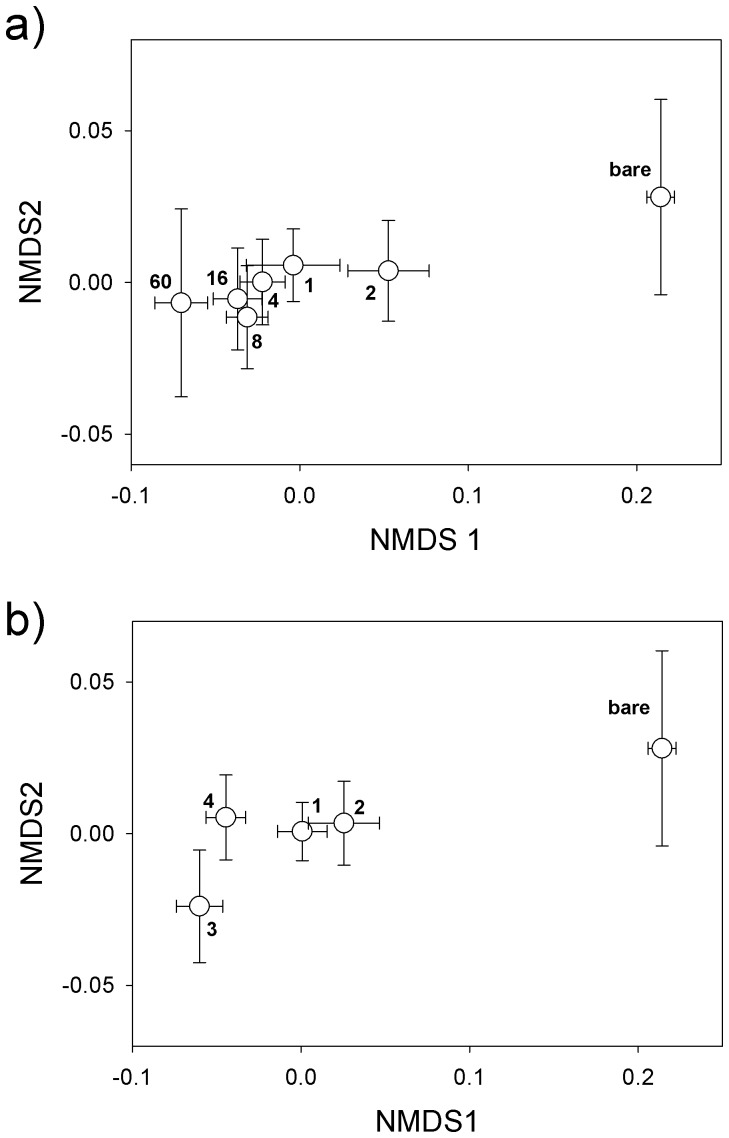
Plant diversity drives changes in the soil microbial community which may result in alterations in ecosystem functions. However, the governing factors between the composition of soil microbial communities and plant diversity are not well understood. We investigated the impact of plant diversity (plant species richness and functional group richness) and plant functional group identity on soil microbial biomass and soil microbial community structure in experimental grassland ecosystems. Total microbial biomass and community structure were determined by phospholipid fatty acid (PLFA) analysis. The diversity gradient covered 1, 2, 4, 8, 16 and 60 plant species and 1, 2, 3 and 4 plant functional groups (grasses, legumes, small herbs and tall herbs). In May 2007, soil samples were taken from experimental plots and from nearby fields and meadows. Beside soil texture, plant species richness was the main driver of soil microbial biomass. Structural equation modeling revealed that the positive plant diversity effect was mainly mediated by higher leaf area index resulting in higher soil moisture in the top soil layer. The fungal-to-bacterial biomass ratio was positively affected by plant functional group richness and negatively by the presence of legumes. Bacteria were more closely related to abiotic differences caused by plant diversity, while fungi were more affected by plant-derived organic matter inputs. We found diverse plant communities promoted faster transition of soil microbial communities typical for arable land towards grassland communities. Although some mechanisms underlying the plant diversity effect on soil microorganisms could be identified, future studies have to determine plant traits shaping soil microbial community structure. We suspect differences in root traits among different plant communities, such as root turnover rates and chemical composition of root exudates, to structure soil microbial communities.
Overview
The claims and statistics of this paper haven’t been checked yet.
Run the check — free, no account needed. It reads the open-access text and checks the sources it cites.
Integrity signals
Registry
Cites
Statistics
Figures
Verification
Claims the paper makes
The claims and statistics of this paper haven’t been checked yet.
Run the check — free, no account needed. It reads the open-access text and checks the sources it cites.
Claims other papers make about this one
Each is checked against this paper’s own text: does it say what the citing paper says it does?
In the citing paper
“First, a denser vegetation in highly diverse plant communities reduces evaporation from the topsoil, which in turn promotes higher soil microbial activity and growth 30 .”
From Plant diversity increases soil microbial activity and soil carbon storage (2015) · cites this paper as [30]
Self-check
Percentages, sums and reported differences re-computed from the paper’s own numbers.
The self-check needs the paper’s full text.
Citations
Cites
R: A Language and Environment for Statistical Computing
R Core Team (2000) · doi:10.32614/r.manuals · Cited by 355,893
A RAPID METHOD OF TOTAL LIPID EXTRACTION AND PURIFICATION
Bligh, E. G., & Dyer, W. J. (1959) · Canadian Journal of Biochemistry and Physiology · doi:10.1139/o59-099 · Cited by 54,751 · cited 1×
“4) to extract soil lipids [29,36].”
Biodiversity loss and its impact on humanity
Cardinale, B. J., Duffy, J. E., Gonzalez, A., Hooper, D. U., Perrings, C., Venail, P., Narwani, A., Mace, G. M., Tilman, D., Wardle, D. A., et al. (2012) · Nature · doi:10.1038/nature11148 · Cited by 7,457 · cited 1×
“but the underlying mechanisms are not well understood [18]; for”
BackgroundVan Der Heijden, M. G. A., Bardgett, R. D., & Van Straalen, N. M. (2008) · Ecology Letters · doi:10.1111/j.1461-0248.2007.01139.x · Cited by 5,053
THE ROLE OF ROOT EXUDATES IN RHIZOSPHERE INTERACTIONS WITH PLANTS AND OTHER ORGANISMS
Bais, H. P., Weir, T. L., Perry, L. G., Gilroy, S., & Vivanco, J. M. (2006) · Annual Review of Plant Biology · doi:10.1146/annurev.arplant.57.032905.105159 · Cited by 4,682 · cited 1×
“Indeed, root exudates were reported to strongly influence soil microbial communities [14,55].”
BackgroundThe use of phospholipid fatty acid analysis to estimate bacterial and fungal biomass in soil
Frosteg�rd, A., & B��th, E. (1996) · Biology and Fertility of Soils · doi:10.1007/bf00384433 · Cited by 2,543 · cited 1×
“The F:B ratio was calculated using the molar weight of the fungal PLFA marker divided by the sum of molar weights of bacterial PLFA biomarker [40].”
MethodStructural Equation Modeling and Natural Systems
Grace, J. B. (2006) · doi:10.1017/cbo9780511617799 · Cited by 2,432 · cited 7×
“The adequacy of the model was tested with Chi-squared tests (x2 tests) and root mean square error of approximation (RMSEA) [44].”
MethodInfluentialZelles, L. (1999) · Biology and Fertility of Soils · doi:10.1007/s003740050533 · Cited by 2,059 · cited 2×
“PLFA 18:2v6 was used as a fungal biomarker [38,39].”
BackgroundMethodFrostegård, Å., Bååth, E., & Tunlio, A. (1993) · Soil Biology and Biochemistry · doi:10.1016/0038-0717(93)90113-p · Cited by 1,442 · cited 1×
“PLFA 18:2v6 was used as a fungal biomarker [38,39].”
MethodVegetation Ecology of Central Europe
Ellenberg, H. (1988) · Medical Entomology and Zoology · Cited by 1,374
Cited by
Sorted by citations
Plant diversity increases soil microbial activity and soil carbon storage
Lange, M., Eisenhauer, N., Sierra, C. A., Bessler, H., Engels, C., Griffiths, R. I., Mellado-Vázquez, P. G., Malik, A. A., Roy, J., Scheu, S., et al. (2015) · Nature Communications · doi:10.1038/ncomms7707 · Cited by 1,742
“…unidentified mechanisms, as suggested by the direct relation in the path model (Fig. of processes influence microbial activity: First, a denser vegetation in highly diverse plant communities reduces evaporation from the topsoil, which in turn promotes higher soil microbial activity and growth 30 .”
Self-citationPrommer, J., Walker, T. W. N., Wanek, W., Braun, J., Zezula, D., Hu, Y., Hofhansl, F., & Richter, A. A. (2019) · Global Change Biology · doi:10.1111/gcb.14777 · Cited by 658
Root biomass and exudates link plant diversity with soil bacterial and fungal biomass
Eisenhauer, N., Lanoue, A., Strecker, T., Scheu, S., Steinauer, K., Thakur, M. P., & Mommer, L. (2017) · Scientific Reports · doi:10.1038/srep44641 · Cited by 539
“Microcosms received the same amount of water because variations in soil water content may co-determine plant diversity effects on soil microorganisms 24 .”
Self-citationWeisser, W. W., Roscher, C., Meyer, S. T., Ebeling, A., Luo, G., Allan, E., Beßler, H., Barnard, R. L., Buchmann, N., Buscot, F., et al. (2017) · Basic and Applied Ecology · doi:10.1016/j.baae.2017.06.002 · Cited by 517
“Structural equation modelling revealed that plant species richness impacts the soil microbial community not only by changes in the availability of organic resources but also via changes in abiotic factors, such as soil water content (Lange et al. 2014).”
BackgroundSelf-citationSoil Fungal:Bacterial Ratios Are Linked to Altered Carbon Cycling
Malik, A. A., Chowdhury, S. P., Schlager, V., Oliver, A., Puissant, J., Mellado-Vázquez, P. G., Jehmlich, N., von Bergen�, M., Griffiths, R. I., & Gleixner, G. (2016) · Frontiers in Microbiology · doi:10.3389/fmicb.2016.01247 · Cited by 483
“It is likely that the higher plant species diversity caused higher F:B ratio of the microbial community due to ecological complementarity effects such as higher and diverse supply of resources for microorganisms (Lange et al., 2014).”
BackgroundMethodInfluentialSelf-citation
Metadata
- Authors
- Lange, M., Habekost, M., Eisenhauer, N., Roscher, C., Bessler, H., Engels, C., Oelmann, Y., Scheu, S., Wilcke, W., Schulze, E.-D., & Gleixner, G.
- Affiliations
- Max Planck Society (DE)
- Friedrich Schiller University Jena (DE)
- Helmholtz Centre for Environmental Research (DE)
- Humboldt-Universität zu Berlin (DE)
- University of Tübingen (DE)
- University of Göttingen (DE)
- University of Bern (CH)
- Corresponding author
- Gleixner, Gerd
- ORCID
- Venue
- PLoS ONE
- Publisher
- Public Library of Science (PLoS)
- Published
- 2014-05-09
- Volume
- 9
- Issue
- 5
- Pages
- e96182
- ISSN
- 1932-6203 (ISSN-L)
- PMC
- PMC4015938
- OpenAlex
- W2045806593
- Cited by
- 233
- References
- 56
- Citations by year
- 2026: 4 · 2025: 8 · 2024: 19 · 2023: 26 · 2022: 21 · 2021: 30 · 2020: 23 · 2019: 30 · 2018: 21 · 2017: 21 · 2016: 10 · 2015: 16 · 2014: 4
- FWCI
- 23.98
- Type
- journal article
- Language
- en
- Open access
- gold
- doi.org
- Locations
- PLoS ONE (publishedVersion, cc-by)
- Europe PMC (PubMed Central) (publishedVersion, other-oa)
- PubMed Central (publishedVersion, cc-by)
- Repository KITopen (Karlsruhe Institute of Technology) (publishedVersion, cc-by)
- PubMed (publishedVersion)
- BORIS (University Library Bern) (submittedVersion, cc-by)
- DOAJ (DOAJ: Directory of Open Access Journals) (submittedVersion, cc-by-sa)
- Max Planck Digital Library (submittedVersion, other-oa)
- Figshare (submittedVersion, cc-by)
- GoeScholar The Publication Server of the Georg-August-Universität Göttingen (Georg-August-Universität Göttingen) (submittedVersion, cc-by)
- GRO (submittedVersion, cc-by)
- MPG.PuRe (Max Planck Society) (submittedVersion, other-oa)
- KITopen (cc-by)
- Funders
- Johns Hopkins University
- Friedrich-Schiller-Universität Jena
- Deutsche Forschungsgemeinschaft (FOR 456)
- Max-Planck-Gesellschaft
- Topics
- Life Sciences › Agricultural and Biological Sciences › Soil Science › Soil Carbon and Nitrogen Dynamics
- Physical Sciences › Environmental Science › Nature and Landscape Conservation › Ecology and Vegetation Dynamics Studies
- Physical Sciences › Environmental Science › Ecology › Microbial Community Ecology and Physiology
- Keywords
- plant diversity, soil microbial communities, plant functional groups, plant species richness, soil microbial biomass, leaf area index, soil moisture, fungal to bacterial ratio, Fabaceae, plant-derived organic matter, root exudates, phospholipid fatty acids, grassland
- MeSH terms
- Bacteria, Chromatography, Gas, Fatty Acids, Fungi, Gas Chromatography-Mass Spectrometry, Models, Theoretical, Phospholipids, Plants, Soil, Soil Microbiology, Water, Plant Roots, Biomass, Biodiversity, Grassland
About these checks
Registry, retraction, Cites and statistics results are computed, not judged, with one exception: a printed reference that no index lists is read once by a model before it counts as a citation error. Claims are extracted by a model and kept only when their quote appears verbatim in the text; each cited source is then checked, with a model’s help, for whether it says what the claim relies on. Those verdicts can be wrong — read the claim’s quote and the cited source before relying on one.
Statistics and arithmetic are recomputed, not judged.
Confidence bands are shown only for fields calibrated on our annotated test set. None is calibrated yet, so no band is shown.
What counts as a claim ›How we measure confidence ›How we check this ›
Are you an author, or do you see a problem with this page? Request a review
